
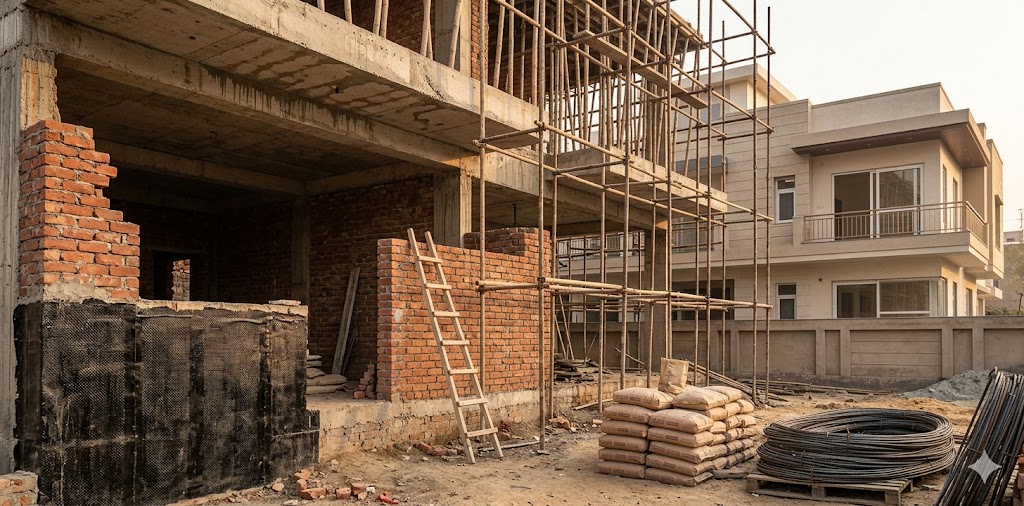
Where Projects Fail — A Causal Map for Indian Architects
Construction Defects, Delays, and Disputes — Root Causes, Mitigation Patterns, and the Architect's Liability Map
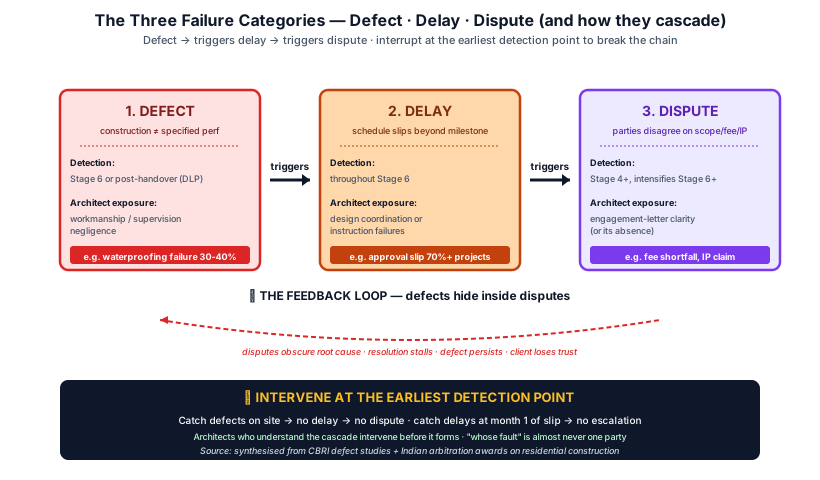
Every Indian residential project that fails, fails in one of three ways: a construction defect that surfaces on site or after handover; a delay that extends the project beyond its budgeted schedule; or a dispute that disrupts the architect-client-contractor relationship. The three are not independent. A defect causes a delay; a delay causes a dispute; a dispute often hides the defect that started it.
This guide is a causal map of those failure modes — the recurring pathologies that an Indian architect encounters across a career, the root causes that produce them, and the design and process mitigations that prevent them. It also covers the architect's liability map when failures reach litigation or insurance: the Architects Act 1972, RERA §14, the Indian Contract Act, and the role of Professional Indemnity (PI) and Contractors All Risks (CAR/EAR) insurance.
The guide is intended for the practising architect at any career stage. The specific failures it documents are not exotic — they are the everyday recurrences that architects who survive their first decade learn to anticipate. Those who do not learn them, repeat them.
"It is impossible to make anything foolproof because fools are so ingenious." — Aphorism widely attributed to engineer Larry Niven and others; the deeper Indian construction reading is that defects often originate in foolproofing rather than malice
1. The Three Categories — Defect, Delay, Dispute
Every project failure can be located in one or more of three categories:
| Category | Definition | Typical Detection Point | Architect's Exposure |
|---|---|---|---|
| Defect | Construction does not meet specified performance | Stage 6 or post-handover (DLP) | Workmanship or supervision negligence |
| Delay | Schedule slips beyond contractual milestone | Throughout Stage 6 | Design coordination or instruction failures |
| Dispute | Parties disagree on scope, fee, IP, or quality | Stage 4 onward, intensifies in Stage 6+ | Engagement-letter clarity |
The categories interact. A waterproofing defect (Category 1) detected at year 2 leads to delayed defect-liability resolution (Category 2), which triggers a dispute about who bears the cost (Category 3). Architects who understand the interaction can intervene at the earliest detection point — usually the defect — and prevent the cascade.
"In construction, the answer to 'whose fault is this?' is almost never one party." — Practitioner observation widely shared in Indian arbitration circles
2. The Defect Atlas — What Goes Wrong On Site
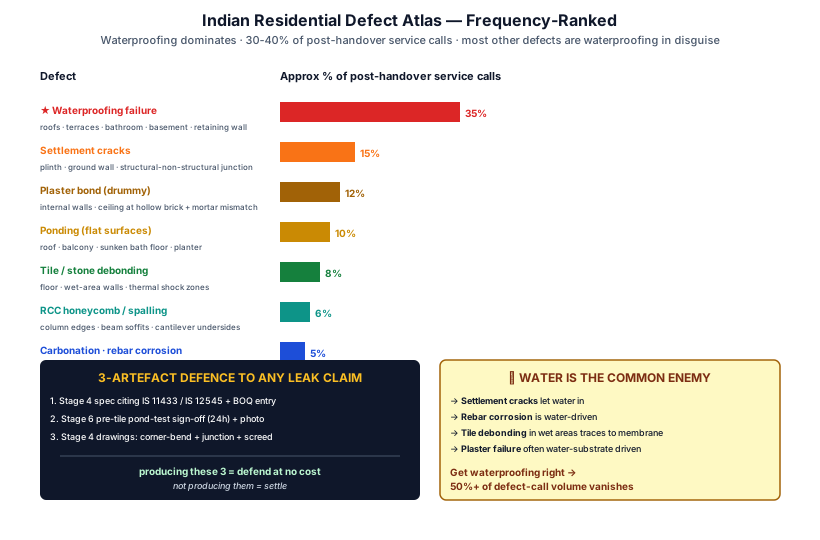
The seven recurring construction defects in Indian residential practice, in approximate order of frequency:
Indian Residential Defect Atlas
| Defect | Where It Appears | Root Cause Map |
|---|---|---|
| Waterproofing failure | Roof, terrace, bathroom floor, basement, retaining wall | Wrong product, missing primer, insufficient curing, no protective screed, design error at junctions, lack of slope, contractor's substitution |
| Settlement crack | Plinth, ground-floor wall, structural-non-structural junction | Differential foundation settlement, inadequate soil-bearing test, swelling soil (black cotton) without designed mitigation, improper backfill compaction |
| Plaster bond failure (drummy plaster) | Internal walls, ceiling | Hollow brick + mortar mix-mismatch, wet substrate, missing chicken-mesh at dissimilar materials, over-thick plaster (>20mm), insufficient curing |
| Ponding on flat surfaces | Roof, balcony, bathroom floor, planter | Insufficient slope (<1.5%), drain blockage from debris, design error, sunken floor design without secondary drain |
| RCC honeycomb / spalling | Column edges, beam soffits, cantilever undersides | Improper compaction, low slump concrete, bad shuttering, cover loss, water ingress to reinforcement |
| Carbonation / rebar corrosion | Older buildings, coastal environments | Insufficient cover (<25mm structural), low-quality concrete, lack of waterproofing on exposed faces |
| Tile / stone debonding | Floor, wall, especially wet areas | Wrong adhesive, insufficient curing of substrate, thermal shock, missing expansion joint, unprimed substrate |
Source: Synthesised from CPWD Specifications (2019), IS 456 (RCC), IS 4326 (earthquake-resistant), IS 875 (loads), CBRI (Central Building Research Institute) defect studies, and IIA chapter-level practice notes.
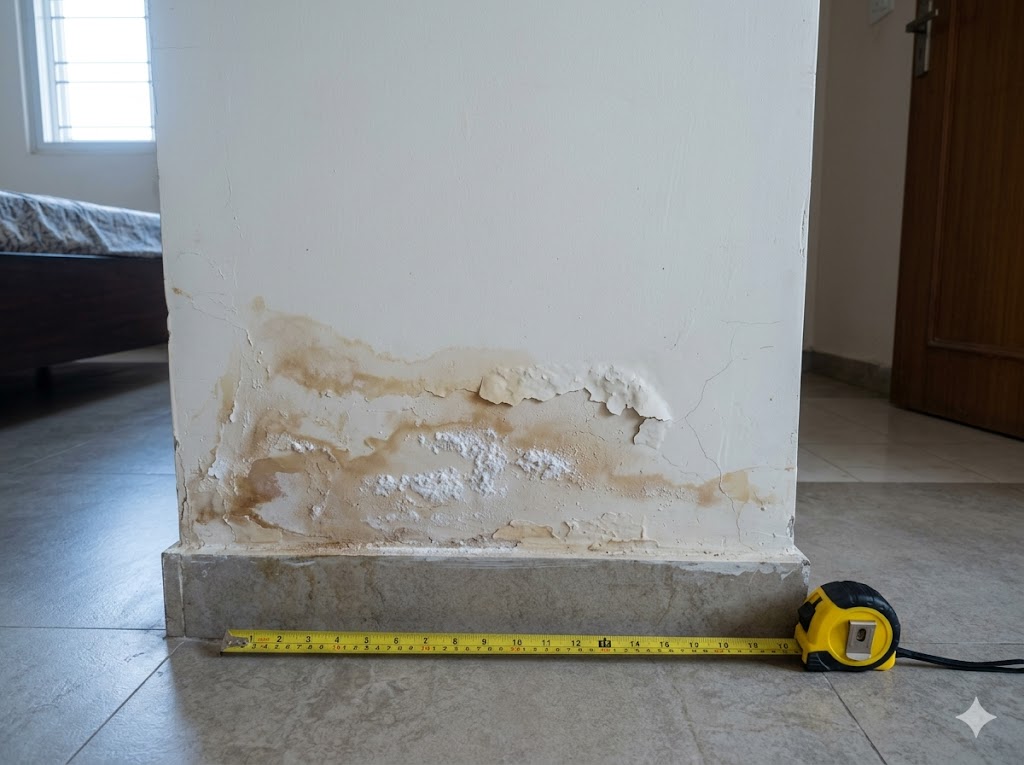
The single most-common Indian residential defect — accounting for an estimated 30–40% of post-handover service calls — is waterproofing failure. Most other defects are pathologies of waterproofing in disguise: settlement cracks let water in; rebar corrosion is water-driven; tile debonding in wet areas traces back to the membrane.
"Show me a 10-year-old residential project with no waterproofing complaint, and I will show you an architect who specified the membrane carefully and a contractor who applied it correctly." — Practitioner aphorism in Indian residential supervision
3. Root-Cause Analysis — The Fishbone for Waterproofing Failure
When a defect occurs, the architect's investigation must identify whether the failure is specification-side, supervision-side, workmanship-side, or design-side. The fishbone (Ishikawa) framework applied to waterproofing:
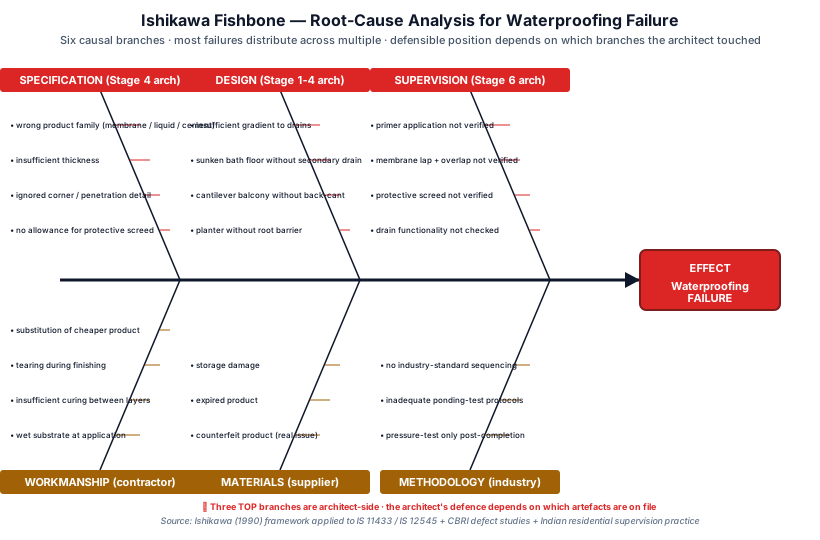
Waterproofing Failure — Causal Branches
| Branch | Specific Causes |
|---|---|
| Specification (Stage 4 architect) | Wrong product family (membrane vs liquid vs cement); wrong thickness; ignoring corner / penetration detailing; no allowance for protective screed |
| Design (Stage 1–4 architect) | Insufficient gradient toward drains; sunken floor without secondary drain; cantilever balcony without back-cant; planter without root barrier |
| Supervision (Stage 6 architect) | Failure to verify primer application; failure to verify membrane lap and overlap; failure to verify protective screed on horizontal; failure to check drain functionality before tile |
| Workmanship (contractor) | Wet substrate at application; insufficient curing between layers; tearing during finishing; substitution of cheaper product |
| Materials (supplier) | Counterfeit product (a real Indian residential issue); expired product; storage damage |
| Methodology (industry) | Pressure-test waterproofing only post-completion; inadequate ponding-test protocols |
When a leak appears at year 2, the forensic process traces the cause through these branches. Most failures distribute across multiple branches — and the architect's defensible position depends on which branches the architect's work touched.
The architect's defence to a year-2 leak claim:
- "My specification (Stage 4) cited IS 11433 / IS 12545 with thickness X and primer Y. The BOQ entry is on file."
- "My supervision (Stage 6) included a pre-tile pond test of 24 hours dated DD-MM-YYYY, signed off by the contractor and verified by photograph."
- "My drawings (Stage 4) showed corner-bend detail, junction with structural slab, and protective screed thickness."
Architects who can produce these three artefacts on demand defend against waterproofing claims at no cost. Architects who cannot, settle.
4. The Delay Atlas — Why Construction Slips
Indian residential construction routinely slips its schedule. The five recurring delay patterns:
Delay Atlas
| Delay Type | Indicative Frequency | Architect's Mitigation |
|---|---|---|
| Approval delay | 70%+ of projects | Front-load: file plinth, fire NOC, AAI early; build buffer into schedule |
| Supply delay | 50%+ of projects | Pre-procure long-lead items (lift, joinery from outside city, custom stone); BOQ with clear lead times |
| Payment delay (client → contractor) | 30–50% | Clear milestone clause in contract; architect's certified-payment recommendations on schedule |
| Weather / monsoon | Annual, predictable | Design Stage 6 schedule around monsoon; treat July–September as ~50% productivity |
| Labour migration / festival | Predictable in Q4 (Onam, Diwali, Pongal) | Plan critical-path work outside festival windows |
The architect's role in delay mitigation is scheduling discipline. Most Indian residential projects operate with no formal Gantt, no critical-path analysis, no float allocation — the schedule is contractor-driven and slips silently. An architect who imposes a Stage 4 schedule (with explicit lead times for approval, supply, weather, labour) and reviews it every month at site meeting transforms the project from reactive to managed.
The classic case: a project's lift order is placed in month 14 of an 18-month project. The lift's lead time is 16 weeks. The project completes structurally at month 17 and stalls 4 months waiting for the lift to arrive, install, and inspect. The architect should have specified the lift in Stage 4, the client should have ordered in month 6, and the lift should have been installed by month 15.
5. Critical Path and Float
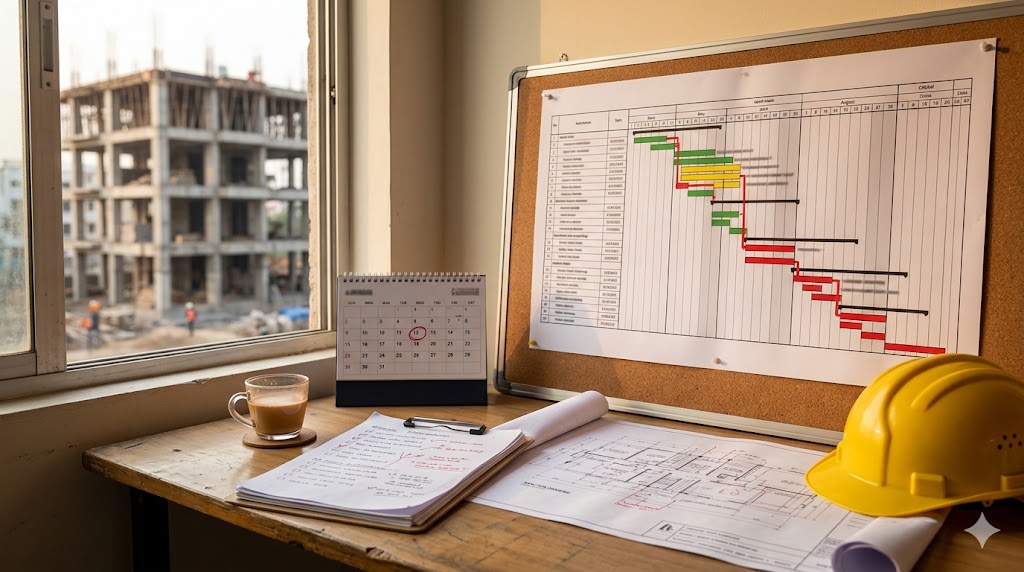
The critical path is the sequence of activities that determines the project's minimum duration. Activities not on the critical path have float — buffer that absorbs minor delays without affecting the end date. Activities on the critical path have zero float — every day of delay extends the project by a day.
Indicative Residential Critical Path
| Sequence | Approximate Duration | Critical Path? |
|---|---|---|
| Sanction → Excavation → Foundation | 4–8 weeks | Yes |
| Foundation → Plinth + plinth verification | 4–6 weeks | Yes |
| Plinth → RCC frame complete | 12–20 weeks | Yes |
| RCC frame → Brick infill + plaster | 8–14 weeks | Yes |
| Plaster → Flooring + electrical 1st-fix | 6–10 weeks | Partial |
| 1st-fix → Plumbing + HVAC | 6–8 weeks | Partial |
| 2nd-fix electrical + finishing | 8–12 weeks | Yes |
| Joinery + furniture procurement | 8–14 weeks | Long-lead — start Stage 5 |
| OC application + NOCs | 4–12 weeks (varies) | Long-lead — start at Stage 6 month 6 |
The architect's discipline: identify the critical path at Stage 4 — typically RCC + finishing + OC — and protect it with explicit weekly reviews. Non-critical activities (interior, soft furnishings, landscape) can absorb their own delays without affecting handover; critical activities cannot.
"In construction, you do not save the schedule by working faster on the critical path. You save it by removing things from the critical path." — Adapted from Goldratt's Theory of Constraints
6. The Dispute Atlas — Where Relationships Break
Disputes in Indian residential projects fall into a small number of recurring patterns:
Dispute Atlas
| Dispute | Root Cause | Mitigation |
|---|---|---|
| Scope creep — design | Engagement letter silent on revisions; client-driven changes not formally tracked | Clear variation clause in contract; written change-orders before execution |
| Fee shortfall | Construction cost over runs; architect's % fee based on baseline; client refuses to escalate fee | Clause: fee on higher of estimate or actual; fee revisits at each stage |
| IP claim (architect → next project) | Architect did not specify license model in engagement | Engagement-letter IP clause: licence for one building at one address |
| Deviation reconciliation (regularisation) | As-built deviates from sanction; architect did not flag in real-time | Site-visit log with deviation flags; written notice to client at first detection |
| Defect attribution | Year-2 leak; client blames architect, contractor blames each other | Photograph protocol; pond-test sign-off; pre-handover snag-list |
| Fee non-payment | Final invoice unpaid because client claims defect | Late-fee + interest clause; mediation-then-arbitration in engagement letter |
| Contractor abandonment | Contractor walks; architect inherits supervision burden | Contract should provide for substitute contractor and architect's fee for transition |
The architect's professional defence against most disputes is the engagement letter drafted at the start of the project. Architects whose engagement letters are detailed and bilateral — with explicit clauses on variations, fees, IP, dispute resolution, and termination — encounter disputes less frequently and resolve them more quickly when they arise. (See the companion guide: The Architect's Scope of Services — COA Conditions of Engagement Decoded.)
7. The Architect's Liability Map
When a project fails, the architect's exposure is governed by several frameworks:
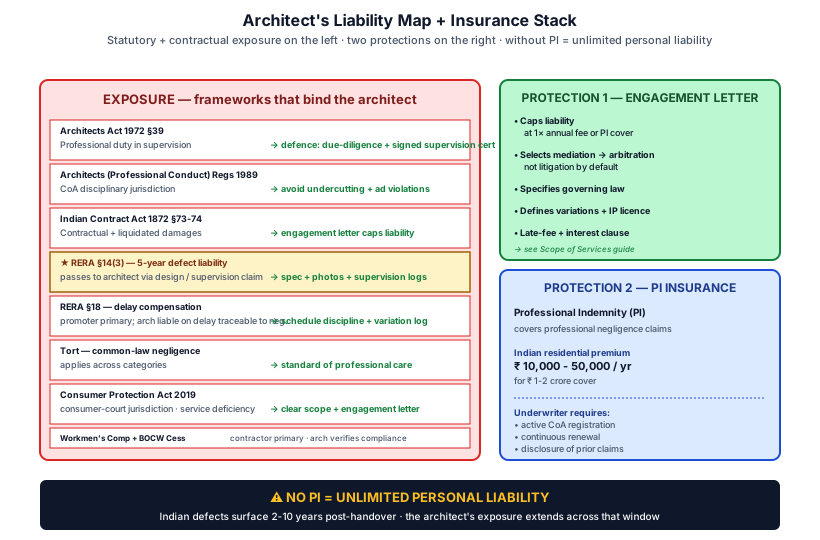
Statutory and Contractual Exposure
| Framework | What It Imposes | Architect's Defence |
|---|---|---|
| Architects Act 1972 §39 | Architect's professional duty in supervision | Demonstrate due diligence; signed supervision certificate |
| Architects (Professional Conduct) Regulations 1989 | Code of professional conduct; CoA disciplinary jurisdiction | Conform to CoA conduct, avoid undercutting, advertising violations |
| Indian Contract Act 1872 §73–74 | Contractual damages and liquidated damages | Engagement letter caps liability; specifies damages |
| RERA §14(3) | 5-year defect liability for promoter; passes to architect via design / supervision claim | Specification on file; photographic record; supervision logs |
| RERA §18 | Delay-compensation to allottees | Promoter's primary; architect liable only if delay traced to design / supervision negligence |
| Tort — negligence claim | Common-law negligence, applicable across categories | Demonstrate standard of professional care |
| Consumer Protection Act 2019 | Consumer-court jurisdiction over service deficiency | Avoidable via clear scope and engagement letter |
| Workmen's Compensation, Building Workers Welfare Cess | Site-worker injury and welfare | Contractor's primary; architect should verify contractor compliance |
The architect's two protections:
1. Engagement letter — caps liability to a stated multiple of fee (typically 1× annual fee); selects mediation-then-arbitration; specifies governing law
2. Professional Indemnity (PI) Insurance — covers professional negligence claims; typical Indian residential premium ₹10,000–₹50,000 per year for ₹1–2 crore cover; underwriters require active CoA registration
Architects practising without PI insurance carry unlimited personal liability for any negligence claim. In the Indian context where defects can surface 2–10 years after handover, this is a substantial risk.
"The architect's first contract is with the client. The architect's most important contract is with the insurer." — Practitioner observation
8. The Mitigation Pattern Library
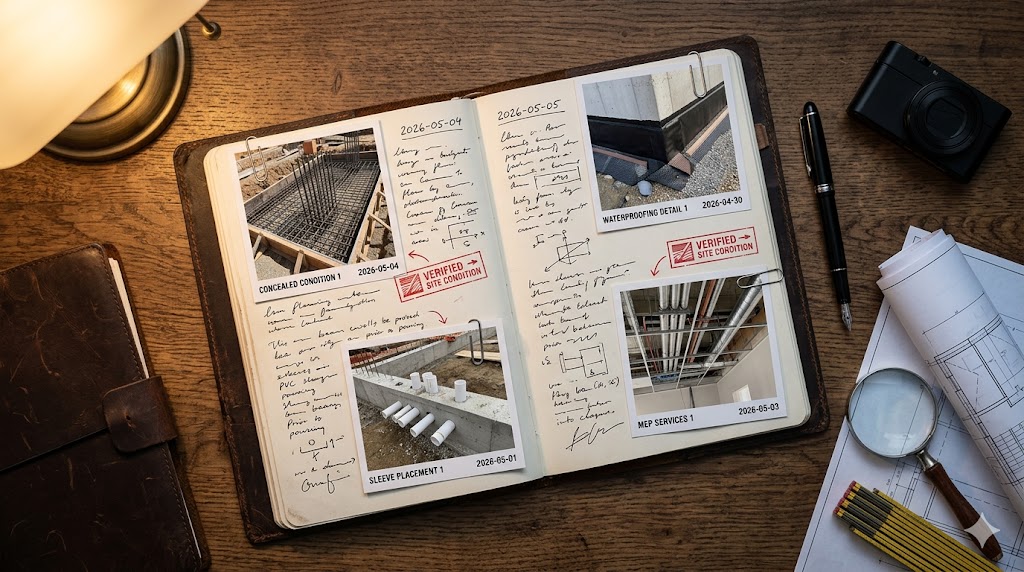
Across categories, a small set of mitigation patterns recur in successful Indian residential practices:
The Mitigation Patterns
| Pattern | What It Does | When to Apply |
|---|---|---|
| Photographic protocol | Date-stamped photographs of every concealed condition (pre-pour, pre-tile, pre-plaster, sleeves) | Stage 6 daily / weekly |
| Pond test for waterproofing | 24-hour water test of bathroom and balcony before tile | After membrane application, before tile |
| Snag list at Stage 6 month 12 | Formal walk-through with client to identify defects before handover | Before handover; binding for both parties |
| Variation register | All changes after Stage 2 sign-off documented in writing | Stage 3 onward |
| Site-visit log with deviation flags | Architect's contemporaneous log of every site visit | Every site visit; signed by client / contractor |
| Pre-handover NOC checklist | Verification that every NOC is in place before OC application | Stage 6 month 12 |
| Insurance review at Stage 1 | Confirm contractor's CAR/EAR cover and architect's PI cover | Project signing |
| Material approval before procurement | Architect approves manufacturer + grade in writing before contractor procures | Stage 4 onward |
| Stage 6 month 9 schedule review | Critical-path review with explicit OC pipeline activation | Stage 6 month 9 |
These nine patterns, applied consistently, prevent or contain most failure modes. They are not exotic; they are the operating habits of mature practices that survive a decade.
9. Insurance — PI, CAR, EAR
Three insurance categories matter in Indian residential construction:
Insurance Categories
| Insurance | What It Covers | Who Buys | Typical Premium |
|---|---|---|---|
| Professional Indemnity (PI) — architect | Professional negligence in design / supervision | Architect | ₹10,000–₹50,000 / yr per ₹1–2 cr cover |
| Contractors All Risks (CAR) | On-site damage to works during construction | Client / contractor | 0.15–0.30% of contract value |
| Erection All Risks (EAR) | Equipment damage during installation (lift, HVAC, etc.) | Client / contractor | Variable per equipment value |
| Workmen's Compensation | Site-worker injury / death | Contractor | Statutory rate per worker |
| Public Liability | Third-party injury / damage | Contractor | 0.05–0.10% of contract value |
| Title Insurance | Property-title risk | Client | One-time premium |
The architect's role in insurance:
- Verify contractor's CAR/EAR cover at Stage 5 (before construction starts)
- Confirm contractor's workmen's compensation registration
- Maintain own PI insurance continuously with renewal margin
- Inform client of scope of architect's PI vs structural / MEP consultants' PI — each consultant has their own cover
Most Indian residential projects under-insure the contractor's CAR/EAR cover. Architects who require evidence at Stage 5 — and decline to issue construction-start instructions until cover is in place — protect the client and themselves.
10. Forensic Investigation — When Something Fails Post-Handover
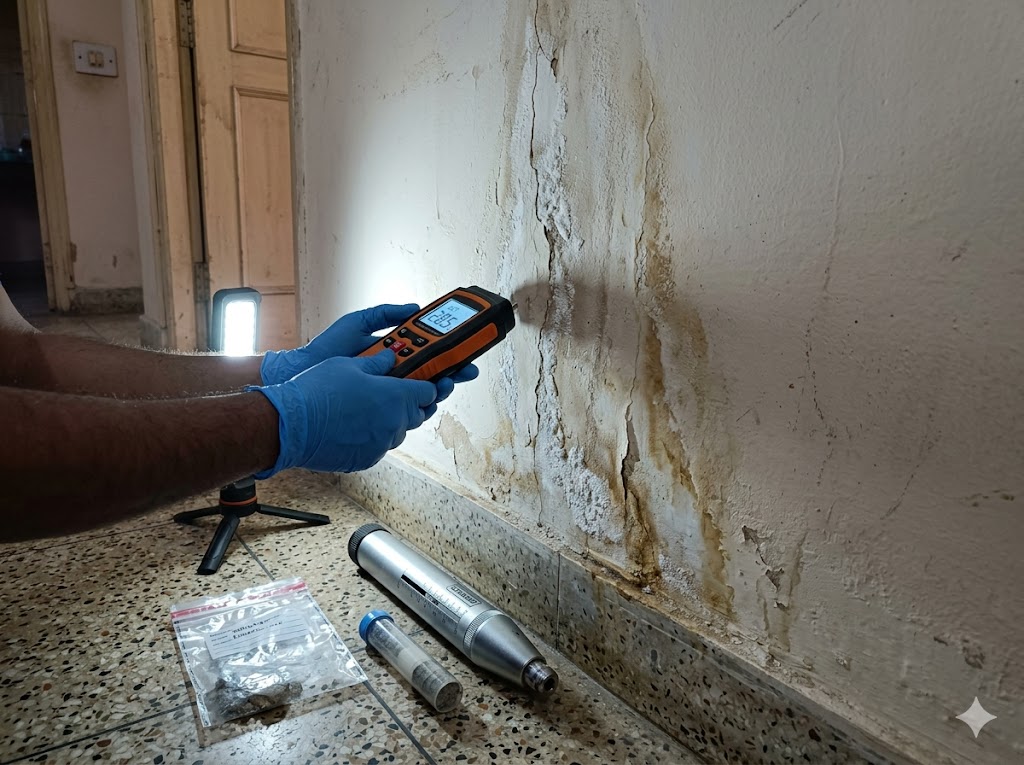
When a defect surfaces at year 1, year 3, or year 7, the architect (or the architect's successor) is often called for a forensic opinion. The professional framework:
Forensic Workflow
| Step | What It Produces |
|---|---|
| 1. Visual inspection | Photographic record, location mapping, severity classification |
| 2. Document review | Sanctioned drawings, working drawings, BOQ, supervision logs, snag list, photographs from construction |
| 3. Hypothesis formation | Likely cause from defect atlas (waterproofing, settlement, etc.) |
| 4. Diagnostic testing | Pond test, moisture meter, schmidt-hammer (concrete), GPR (rebar location), sampling |
| 5. Lab analysis (if required) | Concrete cube test, aggregate quality, waterproofing membrane analysis |
| 6. Causation report | Written opinion locating cause in defect atlas + branch + party responsible |
| 7. Remediation specification | Drawing + specification for repair |
| 8. Cost estimate | Repair cost, including consequential damage |
| 9. Liability allocation | Apportionment among architect, contractor, client based on cause |
Forensic work is increasingly a recognised speciality within Indian architectural practice, often delivered by architects with structural-engineer collaboration. The fee is hourly or assignment-based, typically ₹50,000–₹5,00,000 per investigation depending on scale and depth. Forensic opinions are frequently the basis of arbitration in defect disputes.
For the practising architect, the lesson from forensic work is preventive: every condition that becomes a forensic question after 5 years is a condition the architect could have specified more carefully at Stage 4 or supervised more carefully at Stage 6. The patterns that produce defects are stable across projects; the architect who builds the mitigation patterns into routine practice produces buildings that do not generate forensic work.
11. The Architect's Closing Note
Project failure in Indian residential practice is not exotic. The defects, the delays, the disputes — all distribute across a small number of recurring patterns that an architect encounters through career. The patterns that prevent them — engagement letter clarity, specification rigor, photographic supervision, schedule discipline, insurance discipline, and forensic preparedness — are also small in number.
The mature practice operates these patterns as standard operating procedure, not as project-specific responses. The engagement letter template is reviewed yearly. The Stage 4 specification checklist is enforced. The Stage 6 photographic protocol is built into site visits. The PI insurance is renewed without lapse. The CAR/EAR confirmation is collected at Stage 5 before construction starts.
These are not heroic practices. They are the quiet professional habits that distinguish a 30-year career from a 5-year one. Architects who run their practices on these habits produce buildings that work for decades; architects who treat each project as an improvisation produce buildings that fail in predictable, preventable ways. The difference is not talent or aesthetics — it is the operational discipline that makes architecture a profession rather than a craft of inspiration.
"Excellence is the gradual result of always striving to do better." — Pat Riley, in The Winner Within (1993). The Indian-construction reading: excellence is the result of always producing the same defensible documentation on every project, regardless of inspiration.
Cross-References Within Studio Matrx
- The Architect's Scope of Services in India — engagement letter clauses that limit dispute exposure
- Architect Fee Structures in India — fee structures that prevent fee disputes
- Architect's Site Supervision Checklist — photographic protocol and site-visit log
- Building Construction Quality Assessment — defect detection at Stage 6
- Waterproofing Guide for Indian Homes — the single most-frequent defect category
- OC, CC & Plinth Verification in India — Stage 7 closure that prevents handover-stage disputes
- RERA Guide for Homebuyers & Architects — §14 defect liability and §18 delay compensation
- Use the Risk Index Tool to assess project-specific risk profile
- Use the Site Inspection Checklist to operationalise the photographic protocol
References
1. Bureau of Indian Standards (2000) IS 456 — Code of Practice for Plain and Reinforced Concrete. New Delhi: BIS.
2. Bureau of Indian Standards (1998) IS 11433 — Practice for Application of Bituminous Membranes for Waterproofing. New Delhi: BIS.
3. Bureau of Indian Standards (2007) IS 12545 — Code of Practice for Polymer-Modified Cementitious Waterproofing Materials. New Delhi: BIS.
4. Bureau of Indian Standards (2016) National Building Code of India 2016, Part 6 (Structural Design and Materials). New Delhi: BIS.
5. Government of India (1972) The Architects Act 1972.
6. Government of India (2016) Real Estate (Regulation and Development) Act 2016, particularly §14 (Defect Liability) and §18 (Delay Compensation).
7. Government of India (1872) The Indian Contract Act 1872, §§73–74 (Compensation, Liquidated Damages).
8. Government of India (2019) Consumer Protection Act 2019.
9. Council of Architecture (1989) Architects (Professional Conduct) Regulations 1989.
10. Central Public Works Department (2019) CPWD Specifications — Volumes 1 and 2. New Delhi: CPWD.
11. Central Building Research Institute (Roorkee) (various) Defect Studies and Construction Failure Investigation Reports. Roorkee: CBRI.
12. Goldratt, E.M. (1997) Critical Chain. Great Barrington, MA: North River Press.
13. Royal Institution of Chartered Surveyors (2017) RICS Forensic Building Investigation Standards. London: RICS.
14. American Society of Civil Engineers (2020) Forensic Engineering — Diagnosing Failures and Solving Problems. Reston, VA: ASCE.
15. Goldratt, E.M. (1984, with later editions) The Goal: A Process of Ongoing Improvement. Great Barrington, MA: North River Press — for the Theory of Constraints framework that underpins critical-path discipline.
Author's Note: Project failure is the architectural domain most architects discuss only privately, after the project is over and the dispute is resolved. This guide brings the patterns into the open as a working reference. The specific failures it documents are the everyday recurrences of Indian residential practice — they are the curriculum that experience teaches in 10 years; they can be learned in 25 minutes.
The Studio Matrx Risk Index utility, the Site Inspection Checklist, and the broader practice-management series are designed to operationalise the mitigation patterns. The companion guides on COA Scope of Services, Fee Structures, Site Supervision, and Building Plan Approval provide the upstream engagement and process discipline that prevents most failures from forming in the first place.
This concludes the Studio Matrx Tier 1 architect-guide series. Ten guides — practice management, design intelligence, materials, execution, compliance, and professional risk — aimed at giving the practising Indian architect a working reference for the operational disciplines of the profession.
Disclaimer: This article is for informational and educational purposes only. It does not constitute legal, insurance, or professional advice. Statutory citations, insurance products, and forensic methodologies cited reflect 2026 Indian practice but may shift with statutory amendments and market evolution. Architects must verify against current statutes, consult qualified counsel and insurance brokers, and engage forensic experts where required. Studio Matrx, its authors, and contributors accept no liability for decisions based on this guide.
Export this guide
Related Guides — Deep-dive reading
Scope Boundaries — Architect, Interior Designer & Contractor
The Architects Act 1972, the IIID Code, BOCW 1996 & RERA 2016 — Stage-by-Stage Role Map, Hot Boundary Zones, Liability Matrix, and the Tri-Party Contracting Discipline for Indian Residential Practice
ConstructionSnagging & Punch List Standards for Handover
RERA 2016 §14, the COA Stage-8 Discipline, IS 13311 / IS 1542 / IS 14687 / NBC 2016 Part 6, RICS Snagging Standards — Three-Tier Severity Classification, the Eight Defect Zones, Tolerance Tables, the Punch-List Document Protocol, Retention-Tranche Discipline, and the Architect-Led Handover Workflow for Indian Residential Practice in 2026
ConstructionBathroom Waterproofing Failure in India: Causes, Diagnosis & Fixes (2026)
Why bathroom waterproofing fails in Indian homes — poor surface prep, thin coats, missed junctions, no membrane turn-up, damage during tiling — how to read the symptoms, and whether a surface fix or a full redo is the right remedy.
BathroomsRelated Tools — Try Free
Interior Contract Clause Checklist
16 sections and 98 checkboxes covering scope, BOQ, milestones, penalties, warranty, and disputes.
Contract ChecklistPre-Possession Inspection Checklist
Inspect your flat before registration — 10 categories, 70+ checkpoints across legal, carpet area, structure, finishes, and deviations.
Homebuyer ChecklistContract Studio
AI generates professional architecture service agreements with milestones and scope.
ArchitectAI