
Mall Doors in India: Entrances, Fire Exits and Shop Shutters by Zone (2026)
A footfall-and-fire-led, zone-by-zone guide to specifying doors for a shopping mall or commercial complex in India - automatic glass and revolving main entrances, NBC fire-rated compartment and fire-exit doors with panic bars, anchor-store and tenant shutters, parking entries and service corridors - with indicative per-door costs.
A shopping mall is one of the most door-intensive buildings you will ever specify, and almost none of those doors are about looks. A mid-size Indian mall packs thousands of people, dozens of tenants, a multi-level car park and a basement full of services into one envelope - and on a busy festival weekend the single question that matters is whether every one of those people can get out in minutes if a fire starts in a food court or a clothing store. That is why the mall door brief is not led by aesthetics or even by retail; it is led by footfall flow and the National Building Code's fire-and-egress rules for high-occupancy assembly buildings. Get the glamorous glass entrance wrong and you lose a little kerb appeal. Get the fire-exit doors, panic hardware and compartment doors wrong and you fail occupancy approval, your fire NOC is refused, and in the worst case people die. This guide walks the mall zone by zone - main entrances, tenant shopfronts, the critical fire and life-safety doors, parking, service corridors and washrooms - and tells you which door belongs at each threshold, the driver that decides it, the Indian codes that govern it, and what each costs in 2026. For the wider logic of matching a door to its building type, start with the master overview on choosing a door by space; this is the high-occupancy public-building application of that idea.
The five forces that shape every mall door
Before the zones, the drivers. Every mall door sits somewhere on these five demands, and the weighting flips completely as you move from the dazzling front entrance to the grey concrete fire stair:
- Footfall flow with a sealed envelope. The entrances must move huge crowds in and out hands-free while keeping the conditioned air inside - which is why malls pair automatic or revolving doors with air curtains. The whole building is air-conditioned; an ordinary swing door bleeding cool air all day is a running-cost disaster.
- Fire and egress for massive occupancy - the non-negotiable. A mall is a high-occupancy assembly/mercantile building under NBC 2016. Escape routes, fire-rated compartment doors, smoke doors and fire-exit staircases must be sized for the calculated occupant load, fitted with panic hardware, and open in the direction of escape. This is the legal heart of the brief.
- Per-tenant security. Every shop must close and lock independently overnight while the common mall stays open or the next unit trades. The shutter is the workhorse here.
- Accessibility for the public. Hundreds of elderly, wheelchair and pram users a day. RPwD 2021 and NBC accessibility apply at all customer-facing doors - clear width at least 900 mm, lever or sensor operation, threshold under 12 mm.
- Durability and maintenance at scale. A mall door cycles tens of thousands of times. Cheap hardware that fails in six months, multiplied across a hundred openings, becomes an endless maintenance bill. Specify commercial-grade, serviceable products.
No single door scores high on all five. The skill is reading each zone and specifying for its dominant force - and never, ever letting retail or design instincts override the fire code.
Mall zones and the door each one needs
Read a mall floor as a flow problem wrapped around a life-safety spine. Crowds pour in through the entrance doors, browse the common area lined with tenant shutters, and - the part nobody sees on a normal day - must be able to reach a protected fire-exit staircase through a smoke lobby and a fire-rated door, then escape down to the street, the whole time pushing through doors that open the way they are running. The entrances sell the mall; the fire route keeps it legal and alive.
| Zone | Recommended door | Driver | Indicative ₹ (per door/system, 2026) |
|---|---|---|---|
| Main public entrance | Bank of automatic toughened-glass sliding doors + air curtain (revolving door at flagship lobbies) | Mass footfall hands-free, sealed AC envelope, brand image, accessibility | Auto sliding 1,80,000-4,50,000+ per set; revolving 8,00,000-25,00,000+ |
| Fire-exit staircase | IS 3614 fire-rated steel door + panic / push bar, outward swing, self-closing | NBC egress for high occupancy; the legal core | 14,000-45,000+ |
| Fire / smoke compartment door | IS 3614 fire-rated door, self-closing, on hold-open released by fire alarm | Limits fire and smoke spread between compartments | 12,000-40,000+ |
| Tenant shopfront | Frameless toughened-glass display front + rolling shutter behind | Open display by day, independent lock-up by night | Glass front 18,000-55,000+; shutter 35,000-1,50,000+ |
| Anchor store / department store | Wide automatic glass entry + heavy rolling/sectional shutter | High flow into a large unit, secure independent closure | Auto 1,80,000-4,50,000+; shutter 60,000-2,50,000+ |
| Parking entry (vehicle) | Motorised rolling shutter / high-speed door + boom barrier | Vehicle access control, ventilation, security | Shutter 80,000-3,00,000+; barrier 60,000-2,00,000 |
| Service / loading corridor | Steel or FRP self-closing door; fire-rated where it crosses a compartment | Durable, staff-only, hygiene, fire separation | 10,000-40,000+ |
| Washroom / facilities | WPC or FRP doors (moisture-proof), one accessible cubicle per block | Hygiene, moisture, accessibility | 1,800-12,000 |
The main entrance: move the crowd, keep the cool
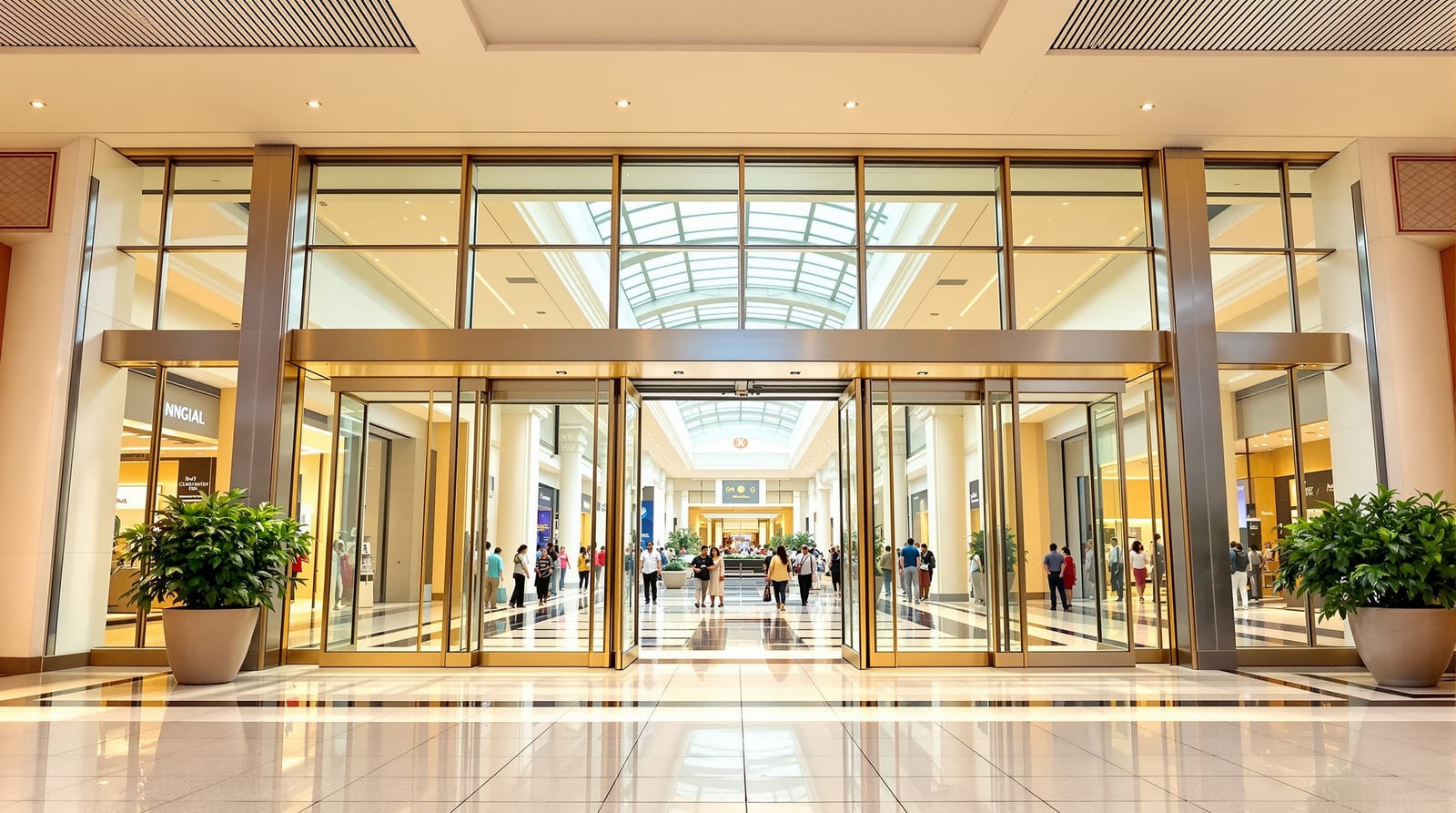
The mall entrance has two jobs that pull against each other - admit a flood of people without a bottleneck, and stop the air-conditioned air from pouring out into a 40 °C street. The standard Indian answer is a bank of automatic toughened-glass sliding doors with an air curtain above the lobby. The automatic doors give a hands-free, sensor-opened path that handles peak crowds, suits wheelchair and pram users, and reads as bright and premium; the air curtain blows a sheet of air across the opening to hold the cool inside and the heat, dust and insects out. Specify the doors to the standards in the automatic sliding doors guide: 10-12 mm toughened glass, redundant safety sensors, and a battery backup that fails to a manually openable state so a power cut never traps the crowd.
At flagship lobbies and hotel-attached malls you will also see revolving doors, which seal the envelope even better because there is never a fully open gap - but a revolving door is never enough on its own for egress, so it is always flanked by automatic or manual swing leaves that serve as the accessible and emergency route. Whatever the entrance type, the accessibility rules are fixed: clear width at least 900 mm (the auto banks easily exceed it), threshold under 12 mm, lever or sensor operation. And the entrance, however grand, is counted toward egress only by its manually operable leaves - an automatic or revolving door, by itself, is not an acceptable means of escape under the code.
Fire and life-safety doors: the part that makes the mall legal
This is the heart of the brief and the reason a mall door package is led by the fire code, not by retail. A shopping mall is a high-occupancy assembly/mercantile building under NBC 2016, which means the building is divided into fire compartments and laced with protected escape routes, and the doors on those routes are life-safety equipment, not joinery.
Three door families do this work:
- Fire-exit staircase doors. Every protected escape stair is closed by an IS 3614 fire-rated steel door fitted with a panic / push bar, swinging outward in the direction of escape, and self-closing. The panic bar is the whole point: a person fleeing in a crowd, possibly in smoke, pushes the bar with their body and the door releases instantly - no knob, no thumb-turn, no thinking. The number and width of these exits is calculated from the occupant load of the floor, not chosen for convenience, and the doors must never be locked or chained against escape. The mechanics and code basis are covered in the fire-exit doors guide and the emergency-exit door standards guide - read both before you finalise the exit schedule.
- Fire / smoke compartment doors. Between fire compartments - across the mall from a high-risk area like the food court or cinema, around service shafts, at the head of a basement stair - sit IS 3614 fire-rated doors that are self-closing, often held open on magnetic hold-opens that release the moment the fire alarm sounds so the compartment seals automatically. Their job is to buy time by stopping fire and smoke crossing the building while people evacuate. The construction and rating logic is in the fire-rated doors guide.
- Smoke doors and lobby doors. Protected lobbies in front of stairs and lifts use smoke-control doors with smoke seals so the escape route itself stays tenable.
The hard rule that overrides every retail and security instinct in the building: a fire-exit and escape door must let people out instantly from the inside even if it is secured against entry from the outside. Tenants who chain a fire exit shut "to stop pilferage", or prop a self-closing compartment door open for airflow, are not saving money - they are breaking the law and voiding the entire fire strategy of the mall. Specify the doors to NBC and IS 3614, then enforce the operating discipline.
Tenant shops, anchors, parking and service zones
Tenant shopfronts. Each unit needs an open, inviting display by day and an independent, secure lock-up by night. The standard pairing is a frameless toughened-glass display front with a rolling shutter behind it - the glass shows the merchandise while the mall trades; the shutter (grille/perforated for window-shopping appeal, or solid for full closure) drops when the shop closes. Choosing and sizing the shutter is covered in the shutter doors guide, and the storefront design logic - glass, frames, locking - in the retail store door guide. Crucially, the tenant's shutter is the tenant's business, but the mall's fire exits are common property; never let a unit's lock-up arrangement block a shared escape route.
Anchor and department stores. A large unit gets a wide automatic glass entry of its own for flow and a heavy rolling or sectional shutter for independent closure, sized to the wide opening and motorised for daily use.
Parking entries. The car-park ramp and basement entries use motorised rolling shutters or high-speed doors plus boom barriers for vehicle access control, ventilation management and overnight security; high-speed doors are worth the premium where the gate cycles constantly. Pedestrian links from the car park into the mall pass through fire-rated self-closing doors, because a basement car park is a high fire-load compartment that must be sealed from the retail floors.
Service corridors, loading and washrooms. Back-of-house corridors take durable steel or FRP self-closing doors, upgraded to fire-rated wherever they cross a compartment line. Washrooms use WPC or FRP doors that shrug off constant moisture, with one accessible cubicle per block carrying a 900 mm clear leaf, lever or pull hardware and a low threshold.
Costs in 2026 (indicative, varies by grade, size and city)
| Door / system | Indicative cost | Notes |
|---|---|---|
| Automatic glass entrance (sensor sliding, per set) | ₹1,80,000-4,50,000+ | Toughened glass, sensors, air curtain extra |
| Air curtain over entrance | ₹25,000-1,50,000+ | Sized to opening width |
| Revolving entrance door | ₹8,00,000-25,00,000+ | Flagship lobbies; always flanked by swing/auto leaves |
| Fire-exit staircase door (panic bar) | ₹14,000-45,000+ | IS 3614, outward swing, push bar, self-closing |
| Fire / smoke compartment door | ₹12,000-40,000+ | IS 3614, self-closing, alarm-released hold-open |
| Tenant glass shopfront | ₹18,000-55,000+ | Frameless toughened, patch fittings, floor spring |
| Rolling shutter (tenant) | ₹35,000-1,50,000+ | Grille/perforated or solid, motorised |
| Anchor / parking shutter | ₹60,000-3,00,000+ | Wide span, heavy-duty, motorised |
| Service / loading steel door | ₹10,000-40,000+ | Steel or FRP, fire-rated where required |
| Washroom door (WPC/FRP) | ₹1,800-12,000 | Moisture-proof; accessible cubicle leaf |
Add 18% GST on supply. In a mall the door spend concentrates in two places - the showpiece entrances and the legally mandatory fire-and-egress doors - and skimping on the second to upgrade the first is the classic, dangerous mistake. Use the door cost calculator for the service, washroom and standard doors, and price the automatic entrances, revolving doors and fire-rated assemblies directly with specialist suppliers against your spec and occupant-load calculation.
Do and don't for mall doors
- Do size and count the fire-exit and compartment doors from the calculated occupant load under NBC 2016, and fit panic hardware on every escape door - this is the first thing a fire NOC inspection checks.
- Do pair automatic or revolving entrances with air curtains to handle footfall while keeping the AC envelope sealed, and keep a manual egress leaf at every entrance.
- Do keep all customer-facing doors accessible - 900 mm clear width, low threshold, lever or sensor operation - and provide an accessible washroom cubicle per block.
- Don't ever let a tenant chain a fire exit shut, or prop a self-closing compartment or smoke door open - it voids the entire fire strategy and is illegal.
- Don't treat the fire doors as a cost to trim so the entrance can be grander; the egress doors are the doors that keep the building legal and people alive.
- Don't specify domestic-grade hardware on high-cycle mall doors - closers, springs and shutters must be commercial-grade and serviceable, or maintenance across a hundred openings will overwhelm you.
For the tenant-side detail behind the shopfronts, the retail store door guide and the shutter doors guide go deeper, the NBC door requirements guide covers the code widths and egress rules that govern the whole building, and the doors-by-space master guide places this mall logic in the wider family of commercial and public buildings.
Frequently asked questions
What kind of doors does a shopping mall use at its main entrance?
Most Indian malls use a bank of automatic toughened-glass sliding doors with an air curtain above to move crowds hands-free while keeping the air-conditioned air inside. Flagship and hotel-attached lobbies may add revolving doors for an even tighter seal, always flanked by automatic or manual swing leaves that serve as the accessible and emergency-escape route.
Why are fire doors so important in a mall?
A mall is a high-occupancy assembly building under NBC 2016, holding thousands of people. Fire-exit staircase doors, fire-rated compartment doors and smoke doors are what let everyone escape quickly and stop fire and smoke spreading. They are life-safety equipment, sized to the occupant load, fitted with panic bars, opening in the direction of escape, and they must never be locked against escape.
What is a panic bar and where is it required in a mall?
A panic or push bar is a horizontal bar across an exit door that releases the latch the instant a fleeing person pushes it with their body - no knob or thumb-turn needed. NBC requires it on the fire-exit and escape doors of high-occupancy buildings, so every protected staircase door and final exit in a mall should carry one and swing outward in the direction of escape.
How do mall shops secure their units at night?
Each tenant typically has a frameless toughened-glass display front backed by a rolling shutter. The glass shows merchandise while the mall trades; the shutter - grille/perforated for window-shopping or solid for full closure - drops and locks when the shop closes, so each unit secures independently without affecting the rest of the mall.
What does a mall door package cost in India in 2026?
Indicatively: automatic glass entrances ₹1,80,000-4,50,000+ per set (revolving doors ₹8,00,000-25,00,000+), fire-exit and compartment doors ₹12,000-45,000+ each, tenant glass fronts ₹18,000-55,000+ with shutters ₹35,000-1,50,000+, and parking and anchor shutters up to ₹3,00,000+. Add 18% GST. Figures are indicative and vary by size, grade, city and vendor.
Export this guide
Related Guides — Deep-dive reading
Emergency Exit Planning in India (2026): Number of Exits, Travel Distance & Two-Way Escape
The building-scale means of egress that a home escape plan sits inside: why you need two independent, remote exits, how travel distance and exit width scale with occupant load, and why exits must open outward, discharge to safety, and never be locked.
SecurityFire Exit Doors in India: NBC 2016 Egress, Panic Bars & Costs (2026)
How fire exit and emergency egress doors must be sized, swung, hardware-fitted and signed to NBC 2016 Part 4 in Indian buildings, and what they cost.
Home Doors & EntrancesEmergency Exit Door Standards in India: NBC 2016 Egress Rules
How exit door width, swing direction, panic hardware, fire rating and signage are governed by NBC 2016 Part 4 — and where homes differ from assembly and commercial buildings.
Home Doors & EntrancesRelated Tools — Try Free
Window Hardware Cost Calculator
Estimate window hardware cost — hinges, handles, locks, rollers and multipoint gears.
Window CalculatorCross-Ventilation Analyzer
Estimate airflow and air changes per hour (ACH) from room size, window areas, layout, and local wind — with NBC 2016 Part 8 compliance check.
Ventilation CalculatorAccess-Control Battery-Backup Calculator
Size the standby battery so an access system keeps running through a power cut, with an egress life-safety note.
Battery Backup