
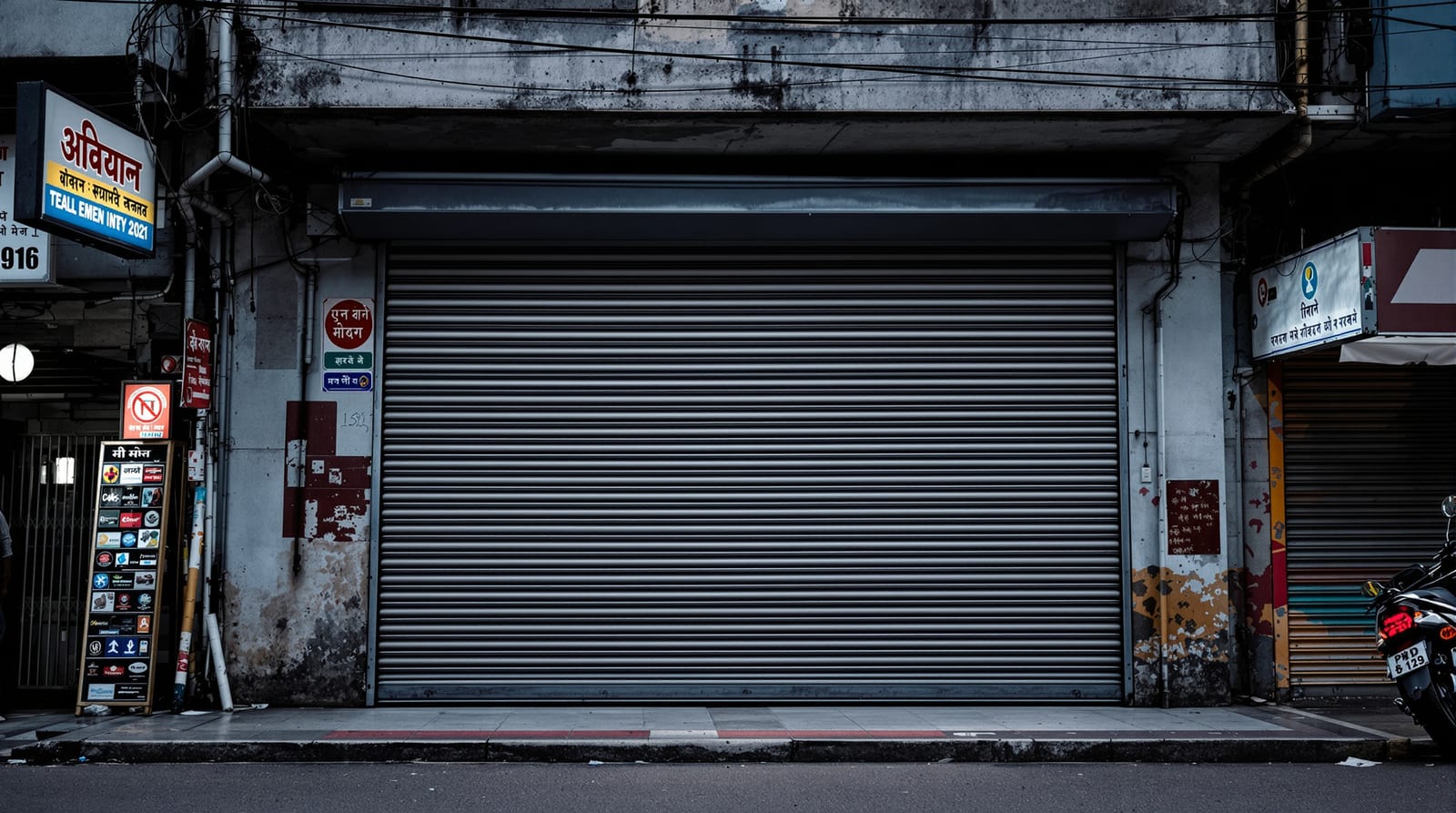
Security Shutter Doors in India 2026: Specifier's Guide
Rolling shutters and grilles for shops, showrooms and godowns — solid, perforated, polycarbonate or grille-lath, manual or motorised, with anti-theft and insurance notes.
For a shop, showroom or godown, the closing line of defence is rarely the door behind the counter — it is the security shutter doors that drop across the frontage every night. A well-specified rolling shutter resists jemmy attacks, vehicle ram, and casual break-in while a grille keeps the storefront visible after hours; a poorly chosen one is a thin curtain of mild steel that a determined thief peels back in minutes. This guide treats the shutter as a security product first and a closure second: lath type, gauge, locking, drive and the insurance fine print that quietly decides whether a claim is paid. It complements the general product overview in shutter doors — here the lens is purely protection. For the wider catalogue see the complete door guide and the specialty doors pillar.
Why security shutter doors are a category of their own
Almost any retail frontage can take a rolling shutter, but security shutter doors are distinguished by lath gauge, end-lock density, bottom-rail strength and the locking system — not by the badge on the box. A 20-gauge decorative shutter and an 18-gauge insurance-grade shutter look identical from the footpath; the difference shows only when someone attacks the bottom rail with a crowbar. In India the relevant manufacturing references are IS 6248 (metal rolling shutters and rolling grilles) for the product itself and the buyer's own insurance policy warranty for what actually counts as 'secure'. There is no single statutory security grade for shop shutters the way there is for fire doors under IS 3614 — so the specification is contractual, written into the bill of quantities and the policy, not the code.
The practical security questions are four: can the curtain be lifted or peeled? can the bottom rail be levered? can the guides be sprung from the wall? and can the lock be defeated? A good specification answers all four; most off-the-shelf shutters answer none of them well.
The four lath types compared
The single biggest decision is the curtain material, because it sets the trade-off between security, visibility, ventilation and cost.
| Lath type | Security | Visibility / ventilation | Typical use | Indicative cost (installed) |
|---|---|---|---|---|
| Solid MS lath (18-20 g) | High vs entry; opaque | None | Godowns, back-of-house, jewellery, banks | ₹260-450/sqft |
| Galvanised / colour-coated solid | High; better corrosion life | None | Coastal, industrial, premium retail | ₹360-600/sqft |
| Perforated / micro-perforated lath | High; lets light + air through | See-through ~40-60% | Showrooms wanting visible window display | ₹360-650/sqft |
| Polycarbonate / clear-link shutter | Medium-high; transparent | Near-full visibility | Malls, brand showrooms, restaurants | ₹650-1,400/sqft |
| Grille / link-lath (open mesh) | Medium; deters smash-grab | Full visibility + airflow | Mall units, arcades, internal grilles | ₹420-900/sqft |
A solid lath shutter is the default for godowns and any premises where there is nothing to display and everything to hide. A perforated shutter is the showroom compromise: a thief sees the goods but cannot reach them, and the perforation cuts the 'tunnel of solid steel' look that planning authorities and mall landlords increasingly dislike. Polycarbonate clear-link shutters keep the window-shopping value of the frontage after hours — important for brand retail — but cost two to three times a solid shutter and scratch over time. Open grille shutters are the lightest deterrent: good against smash-and-grab in a guarded mall, weak as a standalone barrier on a street-facing godown.
For very large openings, godowns and factory bays where the shutter is industrial-scale rather than shopfront-scale, cross-read industrial door types and the broader shutter doors product page.
Manual vs motorised
The drive choice is partly ergonomic and partly security. Below roughly 12-14 sqm of curtain a manual push-up (self-coil) shutter with a centre lock is normal and cheap. Larger or heavier curtains need gear-driven manual (chain hoist) or tubular/side motor operation, because an 18-gauge solid shutter over a 4 m wide showroom is too heavy to lift by hand safely.
Motorisation also changes the threat model. A motorised shutter with the motor inside and no external manual override removes the easy 'lever the bottom rail up' attack, but it introduces a power-failure question — specify a manual override (crank or chain) accessible only from inside, an external override defeats the point. Add anti-drop / anti-fall safety brakes on any motorised curtain over a person's reach; they are a safety requirement, not a luxury.
| Drive | Opening | Typical opening | Security note | Indicative add-on cost |
|---|---|---|---|---|
| Manual push-up (self-coil) | up to ~12-14 sqm | Slow, manual | Centre lock is the weak point | included |
| Gear / chain hoist | up to ~25-30 sqm | Slow, hand-cranked | Good; no power dependency | ₹6,000-18,000 |
| Tubular motor (inside coil) | small-medium | ~0.1-0.15 m/s | Clean; specify internal override | ₹12,000-30,000 |
| Side / centre motor | large | ~0.1-0.2 m/s | Best for heavy curtains; add anti-fall brake | ₹25,000-70,000+ |
Locking and anti-theft features that actually matter
The lock is where most cheap shutters fail an insurer's inspection. A single centre lock leaves both ends of the bottom rail free to be levered. Insurance-grade specification typically calls for:
- Two ground locks (one each side) or multi-point floor bolts, so the bottom rail cannot be sprung at either corner.
- High-security cylinder or anchor locks — boron-steel shackle padlocks through anchor points beat the built-in disc lock.
- End locks (end retainers) on every lath, or every alternate lath, so the curtain cannot be peeled sideways out of the guides.
- Deep guide channels (75-100 mm) fixed with through-bolts or chemical anchors, not short screws — springing the guides off the wall is a common attack.
- A reinforced bottom rail (double-angle or box section) that resists the crowbar.
- For motorised units, an automatic locking gearbox / anti-lift device so the curtain cannot be pushed up when the motor is off.
- Optional vibration/shock alarm sensors and shutter-position contacts wired to the intruder alarm, and CCTV coverage of the frontage.
For an integrated view of frontage protection beyond the shutter itself, see door security and the grading discussion in security door grades.
Gate vs shutter
A frequent client question is whether to fit a rolling shutter or a sliding/collapsible security gate. They solve different problems. A shutter is a continuous barrier — better against weather, dust and a determined break-in, and the only realistic choice for a solid or opaque closure. A collapsible steel gate (channel-and-pintle 'grille gate') is cheaper for very wide openings, gives full ventilation, and is common inside malls or as a secondary barrier — but its diamond mesh is easier to cut and it offers no weather seal. As a rule of thumb: street-facing shop or godown → shutter; internal mall unit or ventilated arcade behind an outer line of defence → gate or grille shutter. Many premium retail jobs fit a clear polycarbonate or grille shutter outside and rely on the building's own security door grades for the inner line.
Cost, GST and what changes the number
Shutter pricing is quoted per square foot of curtain area, installed, but always confirm whether the quote is supply-only or installed and whether guides, locks, motor and a power point are included. GST on rolling shutters is 18%. Drivers of cost are lath gauge (18 g costs more than 20 g), material (galvanised and colour-coated cost 30-60% more than plain MS), drive (motor adds the figures above), and any insurance-mandated locking upgrades.
| Application | Typical spec | Indicative installed range |
|---|---|---|
| Small shop frontage (manual, solid) | 20 g MS, centre + ground locks | ₹260-380/sqft |
| Showroom (perforated, motorised) | 18 g perforated, side motor | ₹450-700/sqft |
| Brand retail (polycarbonate) | Clear-link, motorised, alarm contacts | ₹700-1,400/sqft |
| Godown / warehouse (heavy solid) | 18 g galvanised, gear/motor, multi-lock | ₹400-650/sqft |
Estimate openings with the door cost calculator, and for a fuller specialty bill of quantities the specialty door cost estimator helps frame the budget before you go to a vendor. Treat all figures as bands: the final price comes from a vendor survey against your opening, gauge and locking schedule.
Insurance considerations
This is the part most buyers discover only after a burglary. A 'Burglary & Housebreaking' policy in India usually carries a security warranty describing the minimum protection the premises must maintain — and shutters are explicitly named. Watch for:
- The policy may require a specified lock type or number of locks (e.g. two anchor locks). If only the centre lock was used, a claim can be reduced or repudiated.
- High-value stock (jewellery, electronics) policies often mandate solid (not grille) shutters, an alarm, and CCTV as a condition.
- 'All locks fastened and alarm set' is a continuing warranty — keep evidence (alarm logs, CCTV).
- Galvanised or colour-coated shutters in coastal premises matter because a rusted, jammed shutter that cannot be fully locked breaches the warranty.
The safe approach: get the insurer's security warranty before finalising the shutter spec, and have the vendor confirm in writing that the supplied product meets it. Specialty and insurance-grade shutters are project-specified — get a written vendor spec against your policy and, where stock value is high, a security consultant's sign-off. Names you may encounter for industrial-grade and automated shutters include Gandhi Automations, Shakti Hörmann and Hörmann, alongside local rolling-shutter fabricators for standard shopfronts.
Frequently asked questions
What lath gauge should a security shutter be?
For genuine security use 18-gauge laths as a baseline; 20-gauge is a budget/decorative grade that an insurer may not accept for valuable stock. Pair the gauge with end locks on every (or alternate) lath and a reinforced bottom rail — gauge alone does not make a shutter secure.
Are perforated or polycarbonate shutters secure enough for a showroom?
Yes for most showrooms, with caveats. Perforated steel resists entry like a solid shutter while keeping the display visible; polycarbonate clear-link is transparent and medium-high security but scratches and costs more. For very high-value stock, insurers often still require a solid shutter plus alarm and CCTV.
Should I motorise the shutter or keep it manual?
Manual push-up is fine and cheap up to roughly 12-14 sqm of curtain. Above that, or for heavy 18-gauge curtains, motorise it — but specify an internal-only manual override and an anti-fall brake, and an anti-lift gearbox so the curtain cannot be pushed up when the motor is off.
Shutter or collapsible gate for my shop?
A shutter is the better all-round barrier and the only option for an opaque or weather-sealed closure — choose it for street-facing shops and godowns. A collapsible gate is cheaper and ventilated, suited to internal mall units or as a second line of defence behind another barrier.
Does my insurance dictate the shutter specification?
Often, yes. Burglary policies carry a security warranty that may name the lock type, number of locks and even solid-vs-grille construction. Obtain the warranty wording first and have the vendor confirm the shutter meets it, or a claim can be reduced or refused.
What is the cost of a security shutter per square foot in India in 2026?
As bands, installed: solid MS manual ₹260-450/sqft, perforated or motorised showroom shutters ₹360-700/sqft, and polycarbonate clear-link ₹650-1,400/sqft, all plus 18% GST. Confirm supply-only vs installed and whether motor, guides and locks are included.
Export this guide
Related Guides — Deep-dive reading
Rolling Grille Doors: See-Through Security (India 2026)
Perforated, link and polycarbonate-rod rolling grilles that secure shopfronts and showrooms while keeping visibility and airflow.
Home Doors & EntrancesBurglar-Resistant Doors India 2026: RC1-RC6 Security Guide
How EN 1627 resistance classes RC1 to RC6 work, what each grade actually resists, and how to spec a tested anti-burglary door set for Indian homes and shops.
Home Doors & EntrancesFire-Rated Rolling Shutters & Fire Curtains India 2026
Galvanised steel-lath shutters and fabric fire curtains for large openings — ratings, gravity fail-safe descent, IS standards and motorisation explained for specifiers.
Home Doors & EntrancesRelated Tools — Try Free
Rolling Shutter Cost Calculator
Estimate a rolling shutter door cost by size, material and manual vs motorised operation, with fitting and GST.
Door CalculatorSecurity System Cost Estimator
Estimate the all-in capex with GST, annual running cost and 5-year total cost of ownership of a home or building security system.
Cost EstimatorWindow Grill Design Selector
Pick a window grille style and material by priority — security, looks, budget, view — and estimate cost.
Window Tool