
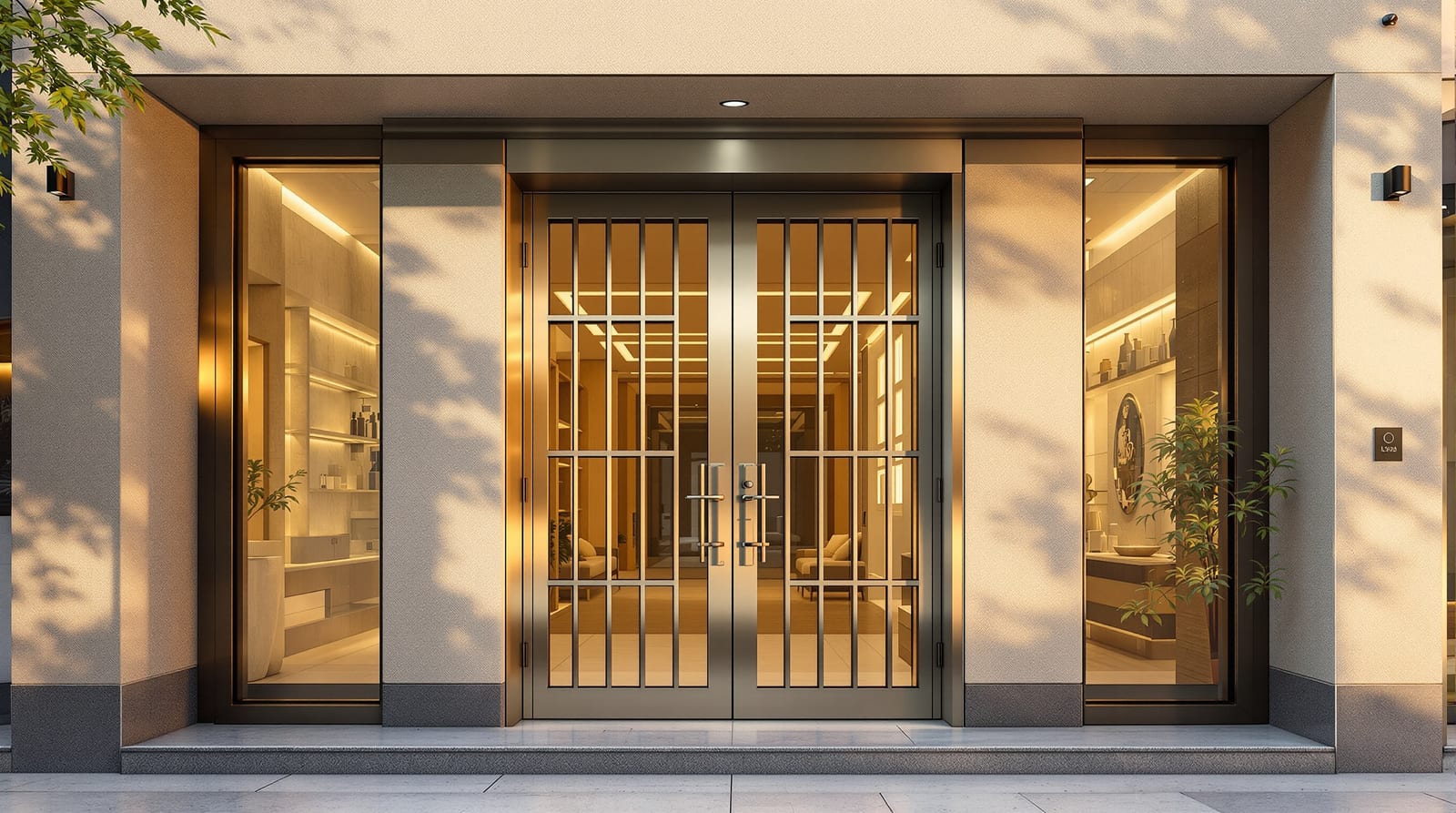
Burglar-Resistant Doors India 2026: RC1-RC6 Security Guide
How EN 1627 resistance classes RC1 to RC6 work, what each grade actually resists, and how to spec a tested anti-burglary door set for Indian homes and shops.
A door is only as secure as its weakest part, and most break-ins happen not because a thief beats the lock but because the leaf splits, the frame levers out, or the hinge side gives way. Burglar-resistant doors answer this by being engineered and tested as a complete set — leaf, frame, lock, hinges and glazing together — against a defined attack. The international yardstick is EN 1627, which sorts doors into resistance classes RC1 to RC6, each tied to a realistic burglar profile and a timed, tooled attack test. This guide explains what each class genuinely resists, how that resistance is built into the door, and what it costs to fit one in an Indian home, shop or godown. It deliberately complements our broader door security guide and the security door grades explainer by focusing on the RC class system and the construction that earns it.
What "burglar-resistant" actually means
There is a critical distinction buyers miss: no door is "burglar-proof". A resistance class states how long a door delays a specific attacker using a specific tool kit before the assembly can be breached. The logic is time — every extra minute raises the burglar's risk of being seen, heard or interrupted, and most opportunist intruders abandon an attempt within a few minutes. So you are buying delay, not invincibility.
The rating belongs to the tested assembly, never to the leaf alone. A certified RC3 leaf hung on an ordinary masonry frame with a single-point lock is not an RC3 door — it is an unrated door with an expensive leaf. This is the same "tested as a set" principle that governs fire-rated doors: mix uncertified components and the rating is void.
How EN 1627 classes are tested
Each class is verified three ways: a static load test (steady force on lock, hinge and panel), a dynamic load test (a heavy impactor simulating a shoulder-charge or kick), and a manual attack test in which a trained tester attacks the door with a defined tool set for a defined "resistance time". Higher classes get more aggressive tools and longer permitted times.
The RC1-RC6 resistance classes
| Class | Burglar profile | Tools used in test | Resistance time | Typical use |
|---|---|---|---|---|
| RC1 (N) | Casual, opportunist; bodily force only | Kicks, shoulder, body weight | No tooled attack test | Low-risk internal / upper-floor |
| RC2 | Opportunist with simple tools | Screwdriver, pliers, wedge | ~3 min | Most homes, flats, shops |
| RC3 | Determined; tries to pry and drill | Above + crowbar, second screwdriver | ~5 min | Front doors in higher-risk areas, jewellers' rear |
| RC4 | Experienced; uses sawing/impact tools | Above + saw, hammer, chisel, cordless drill | ~10 min | Pharmacies, godowns, cash-handling |
| RC5 | Experienced; powerful electric tools | Above + angle grinder, jigsaw, drill | ~15 min | Strongroom anterooms, armoury support |
| RC6 | Highly determined; high-power tools | Above + larger grinder, powerful tools | ~20 min | High-value vaults, critical assets |
For most Indian homes and small shops, RC2 is the practical sweet spot — it stops the casual screwdriver-and-wedge attempt that accounts for the majority of residential break-ins. RC3 is the upgrade for ground-floor front doors in higher-risk localities or where the door is hidden from the street. RC4 and above move into commercial and quasi-vault territory; if you are protecting cash, gold or controlled stock, read this alongside vault and strongroom doors and security shutter doors.
How the resistance is built in
A resistance class is the sum of four hardened sub-systems. Weaken any one and the whole door drops a class.
1. The reinforced leaf
Higher classes use a double-skinned steel leaf (typically 1.0-1.6 mm galvanised sheet) over an internal stiffening matrix or honeycomb core, so it resists kicking, drilling and panel cutting. A budget option is a hardwood or engineered leaf with an internal steel plate. The leaf must resist both bending (so it cannot be levered out of the frame) and local penetration (so a hole cannot be cut to reach the lock). For comparison of base materials see steel doors.
2. The anti-pry frame
Most forced entries are pry attacks: a crowbar between leaf and frame to spring the lock. Resistance comes from a steel frame mechanically anchored into the structural opening (chemical or expansion anchors into RCC/masonry, not just foam) plus an interlocking anti-pry lip — a returned edge on leaf and frame that overlaps so a bar cannot get purchase. The frame anchoring is why retrofitting a security leaf onto an old timber frame defeats the purpose.
3. The multi-point lock
A single deadbolt gives one failure point. RC2-and-above doors use a multi-point lock that throws bolts at three or more positions up and down the lock edge when you turn the key or lift the handle, spreading the load and removing the "pry one corner" weakness. The cylinder should be a drill- and pick-resistant, anti-snap type — anti-snap matters because snapping a protruding euro cylinder is a known quick attack. See our door hardware guide for lock and cylinder selection.
4. Hinge-side protection
A burglar who cannot beat the lock side will try the hinge side. Security doors fit dog bolts (hinge bolts) — fixed studs on the hinge edge of the leaf that engage holes in the frame, so even if the hinges are cut or knocked out the leaf stays locked into the frame on that side.
Glazing and side panels
If the door has a vision panel or sidelight, the glazing must be rated to the same class — laminated P-class security glass (EN 356, P1A to P8B) that holds together under repeated blows. An RC3 leaf beside an unrated glass sidelight is a token gesture; attackers go for the glass. For shopfronts the same logic extends to the security shutter over the glazing line.
Choosing a grade for your premises
| Premises | Suggested class | Reasoning |
|---|---|---|
| Flat above ground floor | RC1-RC2 | Limited approach, opportunist risk only |
| Independent house, front door | RC2-RC3 | Street-facing, may be hidden by porch/wall |
| Retail shop entrance | RC2-RC3 + shutter | Combine door class with rolling shutter |
| Jeweller / pharmacy back door | RC3-RC4 | High-value, tooled attack likely |
| Godown / cash room | RC4-RC5 | Power-tool attack, longer unobserved time |
| Vault anteroom | RC5-RC6 | Pair with a strongroom door |
Use the specialty door selector to narrow a class to your risk, then the specialty door cost estimator to budget the set against an installed price.
Cost bands in India (2026)
Prices are indicative supply-and-install bands for a standard single leaf; custom sizes, finishes, certified glazing and automation push them higher. GST is 18%, and these are project-engineered products, so always get a vendor specification against a tested certificate.
| Class / type | Indicative installed band (₹) | Notes |
|---|---|---|
| Reinforced steel leaf (unrated, basic) | 12,000-30,000 | Sold as "security door"; no test class |
| RC2 certified set | 35,000-75,000 | Practical home/shop grade |
| RC3 certified set | 70,000-1,40,000 | Higher-risk front doors |
| RC4 certified set | 1,30,000-2,50,000 | Commercial, power-tool resistant |
| RC5-RC6 set | 2,50,000-6,00,000+ | Quasi-vault, fully custom |
| Security glazing (P-class) add-on | 6,000-25,000 / panel | Match leaf class |
Beware doors marketed simply as "7-lever" or "anti-theft" with no resistance class — they may be perfectly good leaves but carry no tested delay rating. If the rating matters to you (or to an insurer), ask for the EN 1627 test certificate number and confirm the whole set — not just the leaf — is covered.
For the full picture across every door type, return to the complete door guide; if your project also touches engineered protective products, see specialty doors.
Frequently asked questions
Is there an Indian standard for burglar resistance like the fire-door codes?
India has well-defined standards for fire (IS 3614) but no equivalent mandatory burglary-resistance grading for residential doors. The market therefore uses the European EN 1627 RC1-RC6 system as the de-facto benchmark, and serious suppliers quote it. Always ask which class a door is certified to and request the test certificate; "anti-theft" with no class is a marketing term, not a rating.
Is an RC2 door enough for a normal home?
For most homes and flats, yes. RC2 is tested against an opportunist using simple tools (screwdriver, pliers, wedge) for roughly three minutes — which covers the large majority of residential break-in attempts. Step up to RC3 if your front door is at ground level, hidden from the street, or in a higher-risk locality.
Can I just upgrade the lock on my existing door?
A better lock helps, but it cannot create a resistance class on its own. The rating depends on the leaf, frame anchoring, hinge-side bolts and glazing working as a tested set. Fitting a multi-point lock to a leaf that splits, or to a frame that levers out, simply moves the weak point. For a genuine rating you need a certified door set installed correctly.
What protects the hinge side of the door?
Fixed dog bolts (hinge bolts) on the leaf that engage the frame, so the leaf stays captured even if the hinges are attacked. Combined with a steel frame anchored into the structure and an interlocking anti-pry lip, this removes the hinge side as an easy target.
Do I need rated glass if my door has a vision panel?
Yes. An unrated glass panel or sidelight is the obvious bypass on an otherwise strong door. Specify laminated P-class security glazing (EN 356) matched to the door's resistance class. Otherwise the door's rating is effectively only as strong as the glass beside it.
How do I budget for a certified security door?
Expect roughly ₹35,000-75,000 installed for an RC2 set and ₹70,000-1,40,000 for RC3, plus 18% GST, with custom sizes, finishes and rated glazing adding more. These are project-engineered products, so use the specialty door cost estimator for a first figure and confirm the final price with a vendor quoting against the test certificate.
Export this guide
Related Guides — Deep-dive reading
Reinforced Wooden Doors in India (2026): Making the Timber Main Door Actually Secure
A homeowner's decision guide to choosing or upgrading the wooden main or flat door most Indian homes actually have, so it genuinely resists a break-in, without pretending a hollow flush door is secure.
SecurityDoor Frame Security in India (2026): Anchoring the Chowkhat Break-Ins Actually Exploit
A homeowner's guide to the real weak point behind most forced entries: the frame, not the leaf or the lock, and how to anchor, pack and reinforce a chowkhat so a strong door genuinely stays in the wall.
SecurityBurglar-Proof Doors in India: What Actually Stops a Break-In (2026)
A burglar-resistant main door is a system — solid leaf, anchored frame, multipoint lock, anti-saw bolts and visibility — not just an expensive lock. Here is how each layer works and what it costs to upgrade.
Home Doors & EntrancesRelated Tools — Try Free
Door Security Rating Calculator
Score your main door out of 100 across leaf, frame, lock and hardware — and see the top upgrades.
Security ToolMaterial Comparison Sheet
India's interior material cheatsheet — plywood, finishes, hardware, countertops, paints, waterproofing.
Reference GuideSecurity System Cost Estimator
Estimate the all-in capex with GST, annual running cost and 5-year total cost of ownership of a home or building security system.
Cost Estimator