

Home Lift Planning Questionnaire (India): Answer These Before You Call a Vendor
A fillable eight-part brief that turns a vague lift idea into a spec a vendor can actually quote against.
A home lift sales call goes one of two ways. Either you arrive with a vague "we want a lift, how much?" and spend the next month being quoted four incompatible options that all sound reasonable, or you arrive with a one-page brief that says exactly who the lift is for, where it will go, and what it must do — and the vendor's job collapses into matching a product to a spec you already understand. This guide is built to get you to the second conversation.
What follows is a structured, fillable home lift planning questionnaire: eight grouped question sets, each with a blank "Your answer" column you can print and complete, and a one-line "why we ask" note so you understand what each answer changes. Work through it before you call anyone. By the end you will know — in your own words — the lift type, the rough size, the door type, the backup you need, and the budget band you are shopping in. Then we show you how those answers map to a lift type, and where to go next.
This is the homeowner companion to the residential elevator buyer's guide (the pillar — read it for the full landscape) and the more technical lift specification checklist. Think of this questionnaire as the step that comes before both.
A good brief is not a wish list. It is a set of constraints honest enough that a vendor can say "yes, here is the lift" or "no, that won't fit" on the first visit.
How to use this questionnaire
Print it, or copy it into a document. Answer every row you can; mark the ones you are unsure of, because those are exactly the questions to put to the vendor and a licensed lift contractor. Many answers depend on a quick site measurement (pit depth, headroom, stairwell void) — if you cannot measure confidently, write "to be confirmed on site visit" rather than guessing.
All prices, dimensions and regulatory triggers below are indicative — confirm with your local municipal bye-laws and a licensed lift contractor. Lifts are regulated state by state, and numbers move year to year.
Section A — Who and why
This is the most important section and the one people skip. A lift bought for "convenience" and a lift bought because a parent uses a wheelchair are different machines, with different door, car and budget implications.
| ☐ | Question | Why we ask | Your answer |
|---|---|---|---|
| ☐ | Who uses the lift today (ages, anyone who struggles with stairs)? | The primary user sets the minimum car size and door type. | |
| ☐ | Who will likely use it in 10–20 years — ageing parents, you, grandchildren? | A lift is a 20-year fixture; design for the household you will become. | |
| ☐ | Does anyone use, or may soon need, a wheelchair or walker? | Wheelchair use forces an automatic door and a car of at least ≈1100 × 1400 mm. | |
| ☐ | Will anyone ride alone who cannot self-rescue (child, frail elder)? | Drives the case for an emergency intercom and an Automatic Rescue Device (ARD). | |
| ☐ | Is this primarily for people, or also for carrying loads (luggage, shopping, a stretcher in emergency)? | Load-carrying and stretcher access nudge capacity up. | |
| ☐ | Is accessibility a stated goal, or a "nice if it fits"? | If yes, the accessible-home design and CPWD norms become your spec floor. |
If you ticked wheelchair or ageing-parent use, treat the accessible-home design guide as mandatory reading and apply the CPWD Harmonised Guidelines: ≥900 mm clear door, ≈1100 × 1400 mm car, handrail, Braille/tactile buttons, audio + visual indicators, and a rear mirror to reverse a wheelchair out.
Section B — The building
These answers decide how far the lift travels and how hard the installation will be.
| ☐ | Question | Why we ask | Your answer |
|---|---|---|---|
| ☐ | How many floors will the lift serve (number of stops)? | Stops drive price; G+1 is the cheapest band, each extra floor adds cost. | |
| ☐ | What is the total travel height, floor to top floor (approx. metres)? | Some lift types (pneumatic vacuum) have a limited travel range. | |
| ☐ | Is this a new build (designing now) or a retrofit into a finished home? | New build can shape the shaft; retrofit must work around existing structure. | |
| ☐ | What is the overall building height above ground (metres)? | Above ~13 m a lift may be required; fireman's-lift rules can trigger above 15 m. | |
| ☐ | Is the building residential-only, or mixed-use? | Affects which NBC/bye-law provisions and licences apply. |
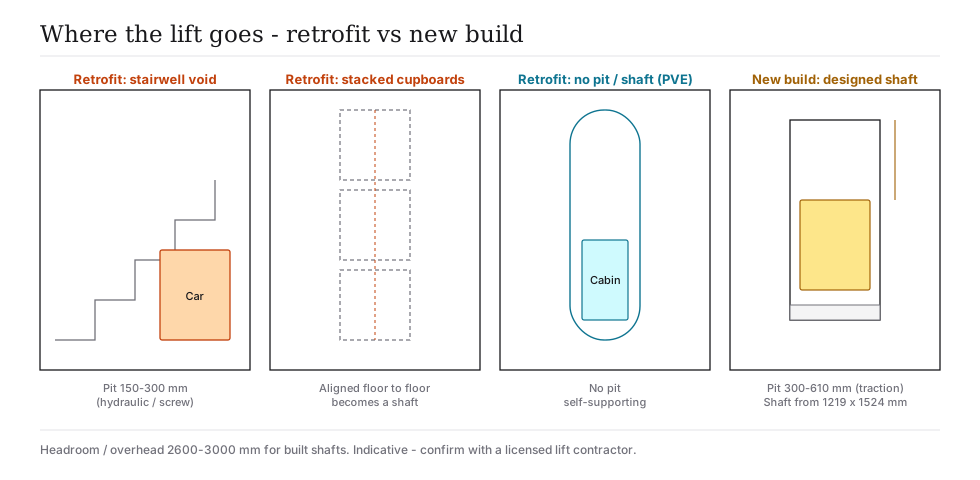
New build vs retrofit is the single biggest fork in the road. In a new build you can design a proper shaft, pit and headroom into the plans. In a finished home, the lift has to fit the space you already have — which is what Section C is for.
Section C — The space you have
This section is where retrofits live or die. Measure honestly; a pneumatic vacuum lift needs no pit or shaft, while a traction lift needs both.
| ☐ | Question | Why we ask | Your answer |
|---|---|---|---|
| ☐ | Is there an existing void you can use — a stairwell well, stacked cupboards, a light well, an unused duct? | A clean vertical void is the cheapest, least disruptive home for a retrofit lift. | |
| ☐ | Can you dig or create a pit, and roughly how deep (mm)? | Hydraulic/screw need ≈150–300 mm; traction ≈300–610 mm; PVE needs none. | |
| ☐ | How much headroom (overhead clearance) is available at the top stop (mm)? | Typical need ≈2600–3000 mm; MRL designs reduce the old machine-room demand. | |
| ☐ | What is the largest clear footprint you can give the shaft (width × depth, mm)? | A small home shaft starts around 1219 × 1524 mm; the car must fit inside it. | |
| ☐ | Is there space for a small adjacent cabinet (for a hydraulic power pack or controller)? | Some types park machinery beside the shaft rather than above it. | |
| ☐ | Will installation disrupt occupied rooms, and can you tolerate that? | Retrofits cut floors and walls; PVE is the least invasive. |
If you have no pit, no shaft and no room for civil work, that answer alone points strongly toward a self-supporting pneumatic vacuum lift. If you are still at the planning stage, the lift-ready future-proof home guide shows how to leave a stacked-cupboard "lift slot" now so you never face a hard retrofit later.
Section D — Type and look
Function first, then finish. Door type is not cosmetic — manual swing doors are the cheapest but are not wheelchair-friendly.
| ☐ | Question | Why we ask | Your answer |
|---|---|---|---|
| ☐ | Enclosed cabin, or panoramic glass (a feature in the stairwell)? | Glass/panoramic reads as a design statement; PVE is inherently panoramic. | |
| ☐ | Manual swing doors or automatic sliding/telescopic doors? | Automatic doors are smoother and the only wheelchair-friendly choice. | |
| ☐ | What finish level — basic, mid, or premium (steel, timber, stone, lighting)? | Finishes can swing the price band significantly within a type. | |
| ☐ | Does the look need to match a specific interior scheme? | Bring material/colour references to the vendor to avoid stock cabins. | |
| ☐ | Any noise or speed preference (bedroom-adjacent, frequent use)? | Hydraulic is quiet; traction/MRL is faster; speeds run ≈0.15–0.5 m/s. |
Section E — Power and backup
India's grid means backup is not optional. Get the supply phase right early — small home lifts can run single-phase, larger traction needs three-phase.
| ☐ | Question | Why we ask | Your answer |
|---|---|---|---|
| ☐ | Is single-phase or three-phase supply available at the lift location? | Single-phase suits small home lifts; three-phase is needed for larger traction. | |
| ☐ | How frequent are power cuts at your address? | Frequent outages make an ARD essential, not a luxury. | |
| ☐ | Do you require an ARD (battery brings the car to the nearest floor and opens doors on a cut)? | In India this should be a non-negotiable — never buy without it. | |
| ☐ | Is the lift on your inverter/generator/solar backup, or standalone? | Affects ARD sizing and running-cost planning. | |
| ☐ | Are you concerned about running cost / energy use? | MRL and screw are modest; PVE draws more power on ascent. |
The answer to "do you need an ARD?" is always yes. Treat any vendor who treats it as an upsell with suspicion.
Section F — Budget and maintenance
Be honest about the all-in number, because GST at 18%, civil work and installation usually sit outside the headline quote.
| ☐ | Question | Why we ask | Your answer |
|---|---|---|---|
| ☐ | What is your all-in budget range, including civil work and GST? | Type bands run ₹8–30 lakh; civil + 18% GST are usually extra. | |
| ☐ | Is the budget a hard ceiling or a target you can stretch? | Tells the vendor whether to value-engineer or upsell finishes. | |
| ☐ | Comprehensive AMC ("bumper-to-bumper") or non-comprehensive? | Comprehensive costs ≈60–70% more but caps surprise spare-part bills. | |
| ☐ | What yearly AMC figure can you carry (indicative ₹20,000–38,500/yr for small residential)? | Maintenance is a lifetime cost, not a one-off; plan for ~5% annual escalation. | |
| ☐ | Is there a local service branch for your shortlisted brands? | A weak local presence means slow breakdown response — a real safety issue. |
Decide your AMC stance now, before you fall for a low sticker price; the AMC evaluation guide explains what comprehensive cover should and should not include.
Section G — Regulatory (which state)
Lifts are state-regulated, and roughly ten states issue lift licences. Your state decides whether you need an installation licence, an operation licence/registration, and periodic government inspection.
| ☐ | Question | Why we ask | Your answer |
|---|---|---|---|
| ☐ | Which state will the lift be installed in? | Licence and registration obligations are set by state Acts, not nationally. | |
| ☐ | Does your state have a Lift Act (e.g. Maharashtra, Karnataka, Delhi, Tamil Nadu, Gujarat, Kerala, others)? | If yes, expect an installation licence before commissioning. | |
| ☐ | Will the vendor handle the licence application and inspection liaison? | Confirm in writing who files paperwork and who pays. | |
| ☐ | Who carries out the safety inspection in your state? | Inspection is by government-appointed inspectors, not the vendor — clarify the schedule. | |
| ☐ | Does your building height trigger NBC lift or fireman's-lift requirements? | Above ~13 m a lift may be required; fireman's-lift rules can trigger above 15 m. |
States with lift legislation include Maharashtra, Gujarat, Karnataka, Kerala, Tamil Nadu, Assam, West Bengal, Delhi, Haryana and Himachal Pradesh. In states without an Act, registration may not be mandated, but IS 14665, IS 15259 and NBC 2016 remain the right best-practice benchmark. All of this is indicative — confirm with your local municipal bye-laws and a licensed lift contractor.
Section H — Timeline
| ☐ | Question | Why we ask | Your answer |
|---|---|---|---|
| ☐ | When do you need the lift operational (date)? | Sets whether a quick-install PVE or a longer civil-led build fits. | |
| ☐ | Is the lift tied to other works (renovation, a parent moving in, a medical event)? | A fixed external deadline changes which options are realistic. | |
| ☐ | How long can the installation disrupt the home? | Retrofits with civil work take longer; PVE is fastest and least invasive. |
How your answers map to a lift type
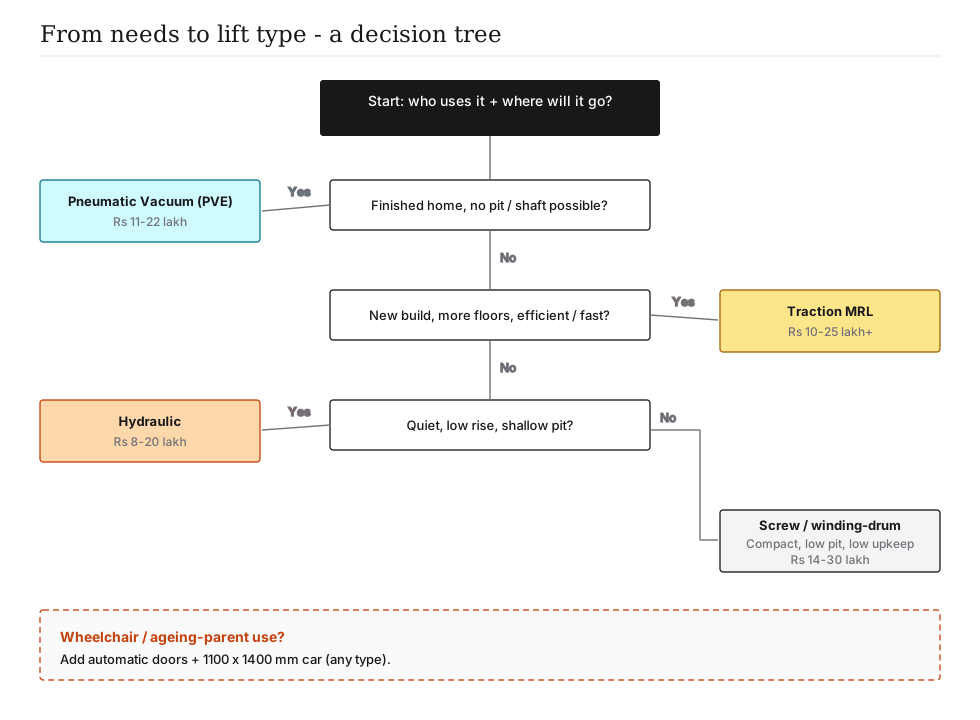
The questionnaire is designed so that a few answers, read together, point to a clear shortlist. The table below is the bridge from your brief to a type — not a final verdict, but the conversation-starter to take to a vendor.
| If your answers say… | The type to look at first | Why |
|---|---|---|
| Finished home, no pit, no shaft, low–mid travel, 2–3 people, panoramic look acceptable | Pneumatic vacuum (PVE) | Self-supporting, no pit/shaft/machine room; easiest retrofit. ₹11–22 lakh. |
| 2–4 floors, quiet running, shallow pit possible, cost-sensitive | Hydraulic | Smooth and quiet for low rise; shallow pit ≈150–300 mm. ₹8–20 lakh. |
| New build, more floors, energy-efficient, faster ride wanted | Traction MRL | 2026 norm; machine in the hoistway, efficient and fast. ₹10–25 lakh+. |
| Compact, low pit, low maintenance, self-supporting | Screw / winding-drum | Low pit, compact, low upkeep. ₹14–30 lakh. |
| Wheelchair / ageing-parent use is confirmed (any type above) | + Automatic doors, ≈1100 × 1400 mm car, CPWD accessibility kit | Accessibility is a spec layer added on top of the type. |
Notice that accessibility is the last row, not its own column — it is a set of requirements you bolt onto whichever type fits the space. If Section A flagged wheelchair use, your car cannot drop below the accessible minimum regardless of which drive type you choose.
What to do with your completed brief
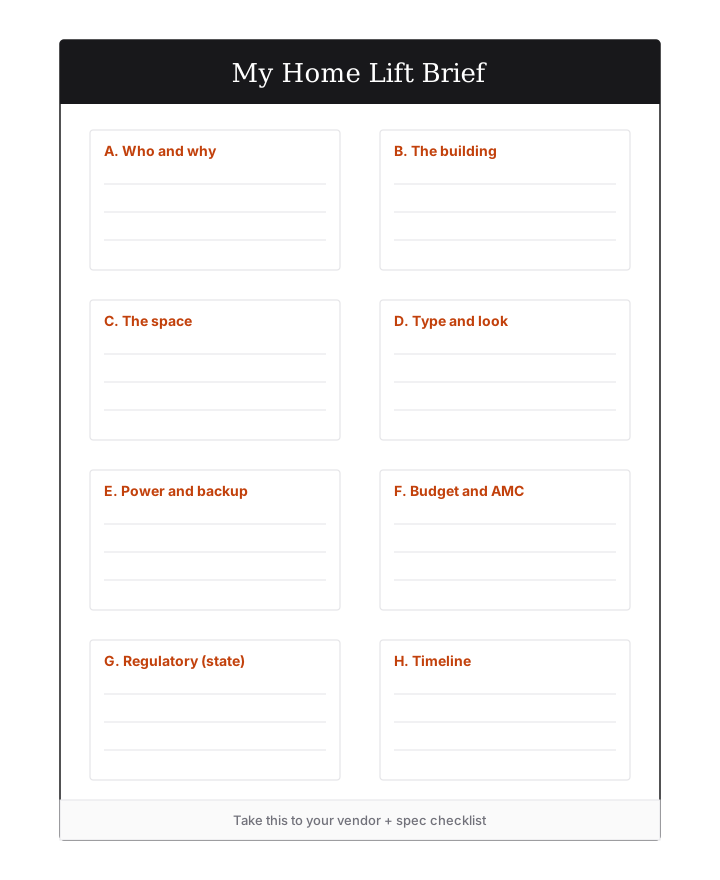
Once the questionnaire is filled, you have a one-page brief. Use it three ways:
- As a filter. Send the brief to two or three vendors and judge them on how well they engage with your constraints versus how fast they quote. Compare them with the vendor comparison guide.
- As a spec seed. Carry your Section C–E answers into the lift specification checklist, which turns "we want automatic doors and an ARD" into a line-item specification a quote can be held against.
- As a project plan. Fold the regulatory and timeline answers into the home lift planning checklist so licences, civil work and inspection are sequenced, not forgotten.
If you are not building yet but want the option later, the lift-ready future-proof home guide and the broader future-proof home design for Indian families show how to leave the structural room now. For the design philosophy behind designing a whole home around changing needs, see universal design and adaptable homes.
The brief is not the whole project — but it is the difference between a vendor selling you a lift and you buying the right one.
References
- IS 14665 (Electric Traction Lifts), Bureau of Indian Standards — Part 1 outline dimensions; Part 2 installation, operation and maintenance.
- IS 15259 (Hydraulic Lifts), Bureau of Indian Standards — companion code for hydraulic installations (referenced by name).
- National Building Code of India 2016, Part 8 (Building Services), Section 5 — Installation of Lifts, Escalators and Moving Walks.
- Rights of Persons with Disabilities (RPwD) Act 2016 — accessibility standards benchmark (legally binds public buildings).
- CPWD / MoHUA Harmonised Guidelines and Space Standards for a Barrier-Free Built Environment (2016) — accessible-lift dimensions and features.
- State lift legislation — e.g. Maharashtra Lifts, Escalators and Moving Walks Act 2017; Karnataka Lifts, Escalators and Passenger Conveyors Act 2015; Delhi Lifts and Escalators Act 2007; Tamil Nadu Lifts Act 1997.
Source URLs:
- IS 14665 Part 1 (BIS): https://law.resource.org/pub/in/bis/S05/is.14665.1.2000.pdf
- IS 14665 Part 2 (BIS): https://law.resource.org/pub/in/bis/S05/is.14665.2.1-2.2000.pdf
- National Building Code 2016 (BIS): https://www.bis.gov.in/standards/technical-department/national-building-code/
- Guide for Using NBC 2016 (BIS): https://www.bis.gov.in/wp-content/uploads/2022/08/Booklet-Guide-for-Using-NBC-2016.pdf
- RPwD Act 2016 (full text): https://ssepd.odisha.gov.in/sites/default/files/2024-01/RPWD%20ACT.pdf
- DEPwD (Dept of Empowerment of Persons with Disabilities): https://depwd.gov.in/en/faqs-4/
- CPWD Harmonised Guidelines: https://www.cpwd.gov.in/Publication/Harmonisedguidelinesdreleasedon23rdMarch2016.pdf
- Lift regulations in India (99acres): https://www.99acres.com/articles/know-all-about-the-lift-regulations-in-india.html
- Maharashtra licence to operate lift (National Govt Services Portal): https://services.india.gov.in/service/detail/maharashtra-license-to-operate-lift
Export this guide
Related Guides — Deep-dive reading
Lift Specification Checklist (India): The Spec Sheet to Hand Every Home-Lift Vendor
One fillable spec sheet that forces every vendor to quote like-for-like on your shaft, your stops, your safety features.
Home Lifts & AccessibilityResidential Elevator Buyer's Guide (India 2026): Types, Cost, Sizing, Regulation & How to Choose
Everything an Indian homeowner needs to choose, size, budget, license and maintain a home lift the right way.
Home Lifts & AccessibilityHome Lift Planning Checklist (India): Everything to Decide Before You Buy
A printable, ten-stage checklist that takes you from the first family conversation to a signed handover.
Home Lifts & AccessibilityRelated Tools — Try Free
Home Lift Comparison Tool
Compare hydraulic, traction, pneumatic vacuum and screw lifts side by side for your home.
Lift ComparisonAccessibility Compliance Calculator
Check a planned lift against the CPWD and RPwD accessible-lift benchmarks for a score.
Lift CheckerHome Lift Budget Planner
Full line-item budget for a home lift — equipment, finishes, civil, GST, AMC and contingency.
Lift Planner