

Lift Vendor Comparison Sheet (India): How to Compare Home-Lift Companies Before You Sign
A blank, printable matrix that turns three glossy brochures into one decision you can defend.
Buying a home lift is not like buying an appliance. You are committing to a piece of machinery that will carry your family for fifteen to twenty years, that is regulated by the state in much of India, and that depends on a service relationship long after the salesperson has moved on. Yet most homeowners compare lift vendors the way they compare flat-screen TVs: by headline price and by whoever called back fastest. That is exactly how people end up with a manual-door cabin that a wheelchair cannot enter, a contract with no ARD on a street that loses power twice a day, or an "all-inclusive" quote that quietly excludes the shaft, the GST and the first year of maintenance.
This guide gives you one tool: a blank, printable vendor comparison matrix you fill in as you talk to each company, plus the questions that populate it and the red flags that should make you walk away. It is the spoke that turns three glossy brochures into a decision you can defend. Read it alongside the residential elevator buyer's guide — the pillar that frames the whole purchase — and pair it with the specification checklist, the AMC evaluation guide and the planning questionnaire.
A lift quote is 30% machine and 70% relationship. The matrix below forces both halves onto the same page.
Why a written comparison beats a memory
Three vendors will each tell you, persuasively, that their product is the safest, the most efficient and the best value. Each will frame the comparison on the axis where they happen to win — Nibav on retrofit ease, a traction major on speed and efficiency, a regional installer on price. The only way to neutralise the spin is to fix the rows in advance and make every vendor answer the same questions in the same units. When the answers sit side by side on paper, the gaps reveal themselves: the cheapest quote turns out to have no automatic doors; the premium one bundles five years of comprehensive AMC; the middle one cannot get you a state operation licence.
Print the matrix. Take it to every site visit and every showroom. Fill a column per vendor in pen. The act of having to write a number in every cell is what exposes the vendor who is vague — and vagueness, as the red-flag section explains, is itself a finding.
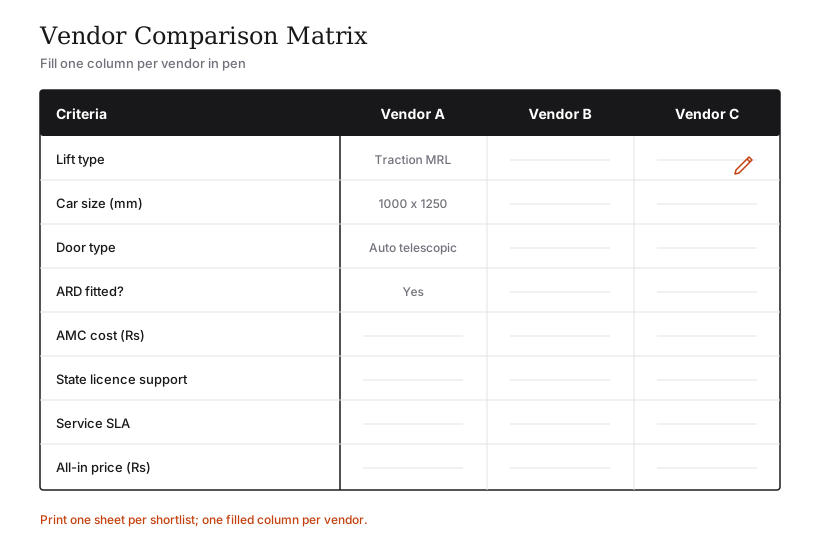
The vendor comparison matrix (print and fill)
This is the heart of the guide. Each row is a decision criterion drawn from the technical and regulatory realities of buying a lift in India; the three blank columns are for the three vendors you shortlist. Write the actual answer, not a tick — "Yes" hides more than it reveals. All prices are indicative — confirm with your local municipal bye-laws and a licensed lift contractor, and remember that GST at 18%, civil work and installation are frequently quoted separately.
| Criterion | What to capture | Vendor A | Vendor B | Vendor C |
|---|---|---|---|---|
| Lift type offered | Hydraulic / traction MRL / screw / pneumatic vacuum | |||
| Capacity (persons / kg) | Home range ≈ 2–8 persons; 2-person ≈ 150–204 kg | |||
| Car size (internal, mm) | Need ≈ 1100 × 1400 mm for wheelchair + attendant | |||
| Door type | Manual swing vs automatic telescopic/sliding | |||
| Door clear width (mm) | ≥ 900 mm for accessibility | |||
| Drive / phase | Single-phase vs three-phase; MRL or pit-mounted | |||
| Pit depth required (mm) | Hydraulic/screw ≈ 150–300; traction ≈ 300–610; pitless/PVE options | |||
| Headroom required (mm) | ≈ 2600–3000 typical | |||
| Speed (m/s) | Home lifts ≈ 0.15–0.5 m/s | |||
| ARD fitted? | Battery rescue to nearest floor on power cut — non-negotiable | |||
| Other safety features | Overspeed governor + safety gear, light curtain, overload sensor, alarm + intercom, manual lowering | |||
| Finishes / cabin options | Glass / steel / wood; mirror on rear wall; lighting | |||
| Standards complied | IS 14665 (traction) / IS 15259 (hydraulic); NBC 2016 Part 8 Sec 5 | |||
| Warranty (years + scope) | Duration; what parts are covered | |||
| AMC type offered | Non-comprehensive vs comprehensive ("bumper-to-bumper") | |||
| AMC annual cost (₹) | Small residential ≈ ₹20,000–38,500/yr; note escalation % | |||
| AMC visits / year | Standard ≈ 12 monthly preventive + emergency calls | |||
| State licence support | Will they file installation + operation licence (if your state has a Lifts Act)? | |||
| Local service branch | City of nearest branch + distance | |||
| Response SLA (breakdown) | Hours to attend a stuck-car call; entrapment protocol | |||
| Lead time (weeks) | Order to commissioning | |||
| Price — machine | Ex civil work, ex GST | |||
| Price — civil + installation | Shaft/pit/electricals + erection | |||
| Price — GST (18%) | On the taxable components | |||
| Price — ALL-IN total (₹) | The only number worth comparing | |||
| References / installs seen | Addresses of working lifts you can visit |
The single most common costing mistake is comparing the machine price of one vendor with the all-in price of another. Drive the conversation to the last row — the all-in total including civil work and GST — or you are not comparing like with like. The cost guide breaks down where each rupee goes.
Reading the lift-type row: what each option means
The first row decides much of the rest, so it deserves a translation. Five drive types reach Indian homes, and they trade off retrofit ease, footprint, speed and price differently.
| Type | Best for | Pit / shaft | Indicative price |
|---|---|---|---|
| Hydraulic | Low rise (2–4 floors); smooth, quiet | Shallow pit ≈ 150–300 mm; power pack in a cabinet | ₹8–20 lakh |
| Traction MRL (gearless) | The 2026 norm; efficient, faster, smooth | Machine in hoistway, no machine room; a little more pit/headroom | ₹10–25 lakh+ |
| Screw / winding-drum | Compact, self-supporting, low maintenance | Low pit ≈ 150–300 mm | ₹14–30 lakh |
| Pneumatic vacuum (PVE) | Easiest retrofit into an existing home | No pit, no shaft, no machine room; self-supporting | ₹11–22 lakh |
A pneumatic vacuum lift is the gentlest retrofit — no pit, no shaft, no machine room — but it is limited to roughly two or three persons and shorter travel, so it rarely suits a wheelchair-and-attendant brief. A traction MRL is the all-round 2026 default. If a vendor only sells one type, that is fine — but make sure the type genuinely fits your house, not just their catalogue. The pillar guide and the planning checklist help you settle the type before you shortlist vendors.
Scoring the matrix into a decision
A filled matrix still needs a verdict. Rather than averaging everything, weight the criteria that are expensive or impossible to fix later. Drive type and shaft fit are locked in at installation. Safety — above all the ARD, essential given Indian power cuts — is not negotiable. Service reach determines whether a stuck car on a Sunday is a two-hour problem or a two-day one. Price matters, but it is the criterion you can negotiate; the others you mostly cannot.
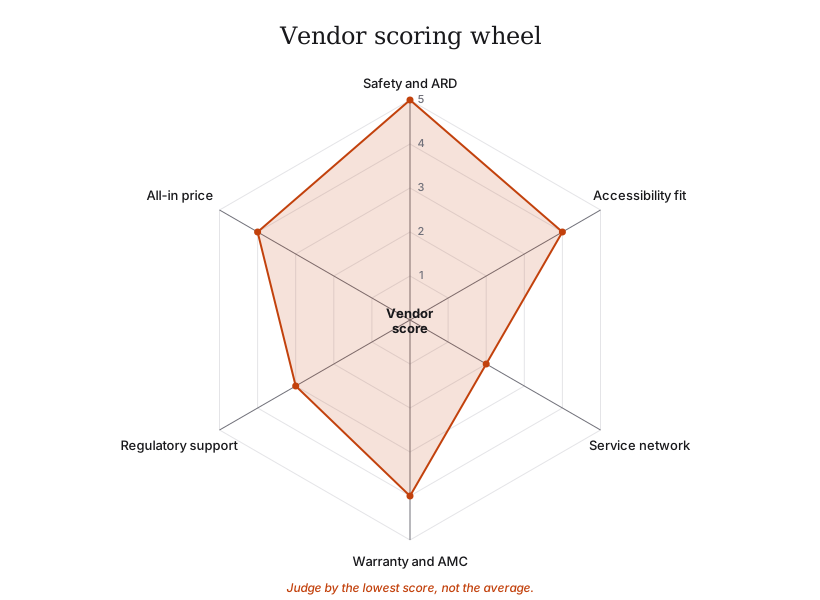
A simple discipline: score each vendor 1–5 on six axes — safety & ARD, accessibility fit, service network, warranty & AMC, regulatory support, and all-in price — then look at the lowest score for each vendor, not the average. A lift that scores 5 on price and 1 on service network is a bad lift. The weakest link is what you live with.
Questions to ask every vendor
Bring these to each conversation verbatim. Identical questions produce comparable answers; open-ended chats produce sales pitches. Use the deeper questionnaire for the full site-and-needs interview — this set is specifically for vetting the company.
| # | Question | Why it matters |
|---|---|---|
| 1 | Which lift type are you proposing for my house, and why that one? | Tests whether they fit the house or push a catalogue |
| 2 | What internal car size and door clear width? Will a wheelchair + attendant fit? | ≈ 1100 × 1400 mm car, ≥ 900 mm door for accessibility |
| 3 | Is an ARD battery backup included as standard? | India's outages make rescue-to-floor essential |
| 4 | Manual or automatic doors — and is the auto-close ≥ 5 seconds? | Manual doors block wheelchairs; CPWD norm is ≥ 5 s |
| 5 | Which IS / NBC standards does the installation comply with? | IS 14665 (traction), IS 15259 (hydraulic), NBC 2016 Part 8 Sec 5 |
| 6 | Does my state require a lift licence, and will you file it? | ~10 states have Lifts Acts; inspection is by govt inspectors |
| 7 | Where is your nearest service branch, and what is your breakdown response time? | Local presence + SLA decide real-world reliability |
| 8 | What does the warranty cover, and for how long? | Separates the machine warranty from the AMC |
| 9 | Comprehensive or non-comprehensive AMC — what is in and what is out? | Comprehensive costs ≈ 60–70% more but caps surprise bills |
| 10 | What is the all-in price including civil work, installation and 18% GST? | The only comparable number |
| 11 | Can you give me three addresses of working installs I can visit? | Real references expose paper promises |
| 12 | What is the lead time from order to commissioning? | Aligns the lift with your build/renovation schedule |
State licence support is a real differentiator
Lifts are state-regulated in roughly ten states — Maharashtra, Gujarat, Karnataka, Kerala, Tamil Nadu, Assam, West Bengal, Delhi, Haryana and Himachal Pradesh — under Acts such as the Maharashtra Lifts, Escalators & Moving Walks Act, 2017; the Karnataka Lifts, Escalators & Passenger Conveyors Act, 2015; the Delhi Lifts & Escalators Act, 2007; and the Tamil Nadu Lifts Act, 1997. In these states a homeowner typically needs an installation licence before commissioning, an operation licence or registration, and periodic safety inspection by the State Electrical or Lift Inspectorate — and that inspection is done by government-appointed inspectors, not private companies. A good vendor handles this paperwork as part of the project; a weak one leaves you to discover the requirement after the lift is installed and unusable. Make "will you file the licence?" a scored row, not an afterthought. (This is indicative and state-varying — confirm with your local bye-laws.)
The India brand landscape
Knowing who is in the market helps you build a sensible shortlist, but resist letting a brand name do your thinking — the matrix decides, not the logo. The home segment is served by global majors, large indigenous makers and category specialists. Describe each only as far as is genuinely known:
- Otis — a global major present in India via its Mumbai subsidiary.
- KONE — KONE Elevator India, headquartered in Chennai, with an eco/efficiency focus.
- Schindler — Swiss/German engineering; ranks among the top brands operating in India.
- TK Elevator (TKE) — a global major active in the Indian market.
- Johnson Lifts — one of India's largest indigenous manufacturers, very common in residential projects.
- Nibav — an India-grown pneumatic vacuum home-lift brand with panoramic glass cabins and strong home-segment marketing.
- Elite Elevators — a home-elevator specialist that has worked with European technology partners.
- Sharp / Aritco — Swedish, premium positioning; alongside many capable regional installers serving the home market.
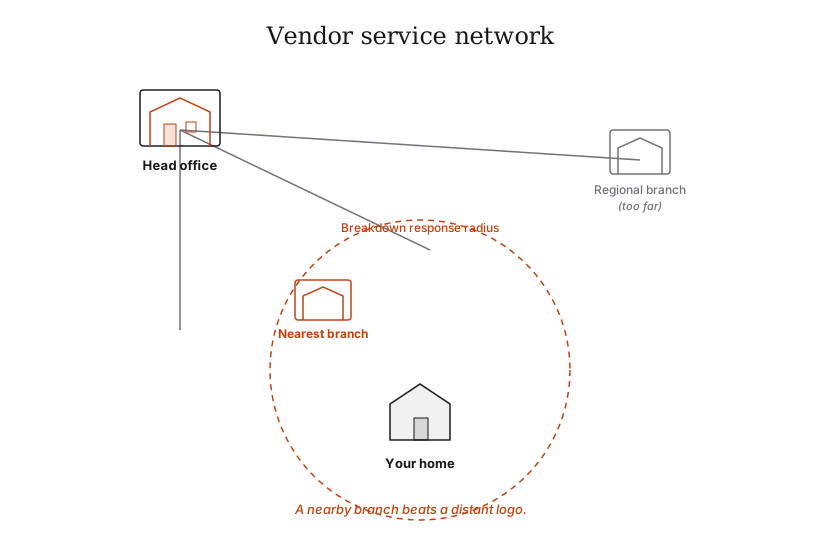
The Indian elevator market is large and growing, with the home segment rising fast. That growth means more choice — and more sales pressure. A familiar brand is a reasonable starting filter, but a global logo with no nearby service branch can serve you worse than a strong regional installer two kilometres away. Let the service-network and response-SLA rows, not the brand, settle ties.
Red flags: when to walk away
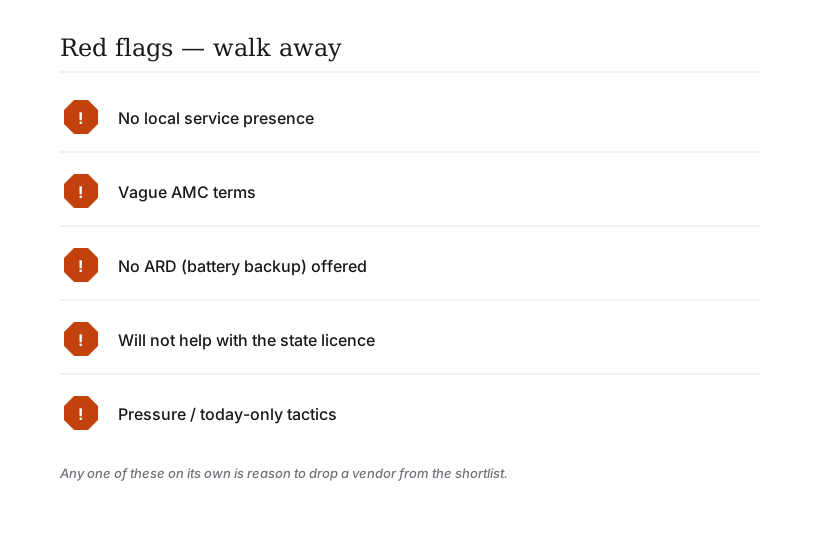
Some answers are not weak points to negotiate — they are reasons to drop a vendor. If you see these, cross the column out.
- No local service presence. A lift that breaks down with no branch in your city is a trapped family waiting on a technician from another state.
- Vague AMC terms. "Don't worry, we'll take care of it" is not a contract. If they will not put visit frequency, response time, inclusions and exclusions in writing, the AMC is worthless. The AMC evaluation guide shows what a real contract looks like.
- No ARD offered. Any vendor who treats battery rescue-to-floor as an optional extra in India does not understand the conditions you live in.
- Won't help with the state licence. In a Lifts-Act state, a vendor who shrugs off the licence is leaving you legally exposed and possibly unable to commission the lift.
- Pressure tactics. "This price is only valid today," "the slot is filling up," refusing to give references, or rushing you past the all-in total — high-pressure selling on a fifteen-year purchase is a tell, not a deal.
If a vendor cannot give you three addresses of working lifts you may visit, you are their reference site. Decline the honour.
After you sign
Choosing the vendor is the start, not the end. The same discipline carries into the specification checklist, so that what you agreed verbally is written into the order, and into the AMC evaluation guide before you renew maintenance each year. If your lift is part of a broader plan to keep the home liveable as the family ages, read it together with universal design for adaptable homes, accessible home design and future-proofing for Indian families. A well-chosen vendor, held to a filled-in matrix, is the difference between a lift you trust and a lift you tolerate.
References
- IS 14665 — Electric Traction Lifts (BIS, committee ETD 25; Parts 1–5: outline dimensions, installation/operation/maintenance, safety rules, components, inspection).
- IS 15259 — Hydraulic Lifts (BIS companion code for hydraulic installations).
- National Building Code of India 2016, Part 8 (Building Services), Section 5 — Installation of Lifts, Escalators & Moving Walks (BIS).
- Rights of Persons with Disabilities (RPwD) Act, 2016 — Sections 40, 44, 45.
- CPWD / MoHUA Harmonised Guidelines & Space Standards for a Barrier-Free Built Environment (2016; Harmonised Guidelines 2021).
- State legislation: Maharashtra Lifts, Escalators & Moving Walks Act, 2017; Karnataka Lifts, Escalators & Passenger Conveyors Act, 2015; Delhi Lifts & Escalators Act, 2007; Tamil Nadu Lifts Act, 1997.
Source links:
- IS 14665 Part 1 (BIS): https://law.resource.org/pub/in/bis/S05/is.14665.1.2000.pdf
- IS 14665 Part 2 (BIS): https://law.resource.org/pub/in/bis/S05/is.14665.2.1-2.2000.pdf
- National Building Code 2016 (BIS): https://www.bis.gov.in/standards/technical-department/national-building-code/
- Guide for Using NBC 2016 (BIS): https://www.bis.gov.in/wp-content/uploads/2022/08/Booklet-Guide-for-Using-NBC-2016.pdf
- RPwD Act 2016 (full text): https://ssepd.odisha.gov.in/sites/default/files/2024-01/RPWD%20ACT.pdf
- DEPwD (Dept of Empowerment of Persons with Disabilities): https://depwd.gov.in/en/faqs-4/
- CPWD Harmonised Guidelines: https://www.cpwd.gov.in/Publication/Harmonisedguidelinesdreleasedon23rdMarch2016.pdf
- Lift regulations in India (overview): https://www.99acres.com/articles/know-all-about-the-lift-regulations-in-india.html
- Maharashtra licence to operate lift (National Govt Services Portal): https://services.india.gov.in/service/detail/maharashtra-license-to-operate-lift
Export this guide
Related Guides — Deep-dive reading
Home Lift Planning Checklist (India): Everything to Decide Before You Buy
A printable, ten-stage checklist that takes you from the first family conversation to a signed handover.
Home Lifts & AccessibilityHome Lift Planning Questionnaire (India): Answer These Before You Call a Vendor
A fillable eight-part brief that turns a vague lift idea into a spec a vendor can actually quote against.
Home Lifts & AccessibilityDesigning Adaptable & Universal-Design Homes
Accessibility, Aging-in-Place, and the Multi-Stage Family — Code, Anthropometrics, and Plan-Stage Discipline for Indian Residential Architects
Room PlanningRelated Tools — Try Free
Home Lift Comparison Tool
Compare hydraulic, traction, pneumatic vacuum and screw lifts side by side for your home.
Lift ComparisonElevator Capacity Calculator
Pick the right home-lift capacity — 2 to 8 person — with car size and wheelchair fit.
Lift CalculatorAccessibility Compliance Calculator
Check a planned lift against the CPWD and RPwD accessible-lift benchmarks for a score.
Lift Checker