
Plot Selection Mistakes to Avoid
The costly, common errors Indian buyers make when choosing a plot — twelve traps from disputed titles to water-logged corners, and exactly how to dodge each one.
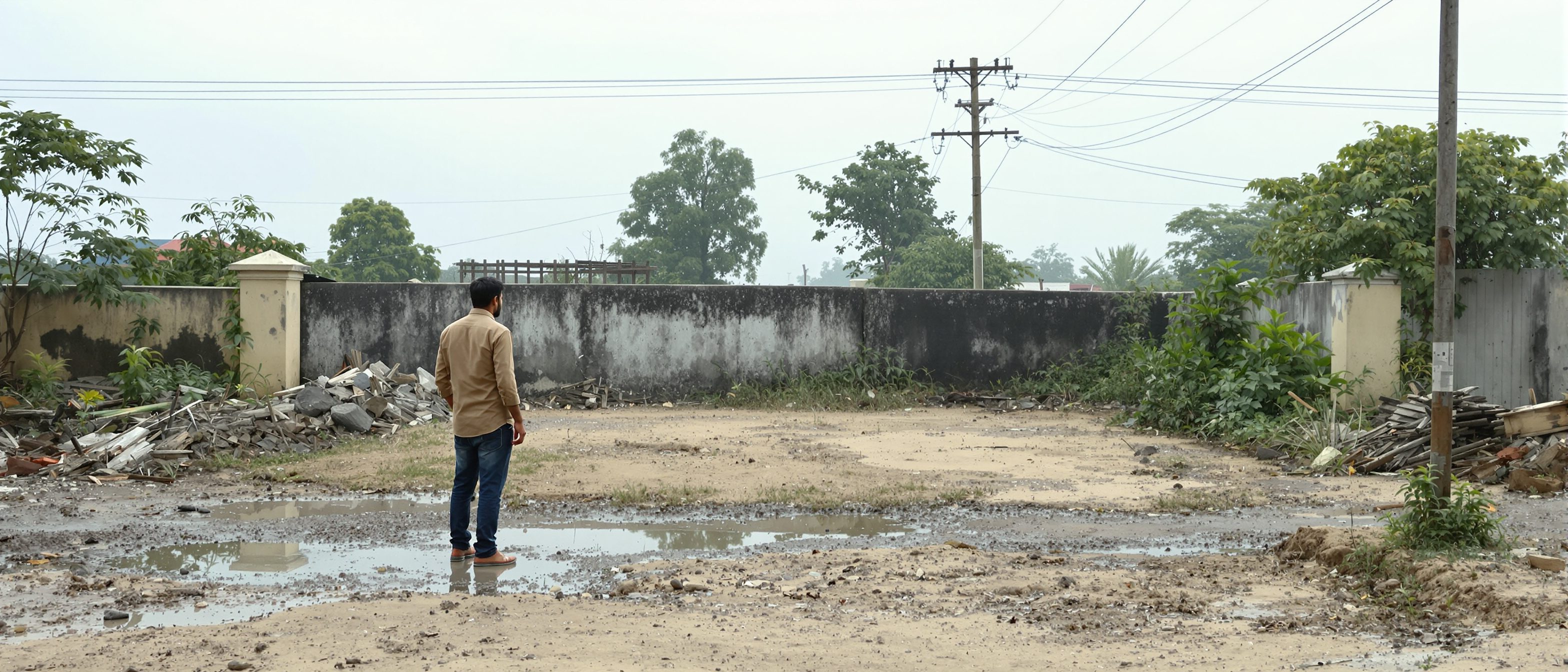
A software couple in Sarjapur, Bengaluru, fell for a plot the moment they saw it: corner site, big neem tree, friendly broker, and a price that felt like a steal. They paid the token the same evening. Six months later they learnt the layout was an unapproved gram-panchayat conversion, the bank refused a construction loan, and the "corner" filled knee-deep every monsoon because it sat at the lowest point of the street. The neem tree was lovely. Everything else was a trap.
This is the painful pattern. A plot is the single most expensive thing most Indian families ever buy, yet it is routinely chosen the way you'd pick a restaurant — on a good feeling and a fast yes. The land doesn't forgive that. A poorly chosen plot quietly taxes you for thirty years through damp walls, wasted floor space, a sunbaked west bedroom, a loan you can't get, or a court case you didn't know existed. The good news: almost every plot disaster comes from a short, repeatable list of mistakes.
Never buy a plot on emotion or price alone — buy it on evidence, because every flaw you ignore at purchase becomes a cost you pay forever.
1. Buying on emotion or a "too-good" price
The mistake: You visit on a pleasant morning, the broker is warm, the price is below market, and you commit before you've checked a single document. The low price is usually the symptom, not the bargain — land is cheap for a reason.
Why it hurts: Emotion blinds you to drainage, title and access problems that a clear head would catch. A 15% "discount" is meaningless if you then spend years and lakhs fixing what the discount was hiding, or if the plot simply won't get loan approval.
How to avoid it: Impose a cooling-off rule on yourself — no token, no advance, no verbal yes on the first visit, ever. Treat a below-market price as a flag to investigate harder, not a reason to rush. Score the plot objectively before you let yourself feel anything: our plot evaluation tool walks you through a systematic, weighted scorecard so the decision rests on points, not mood.
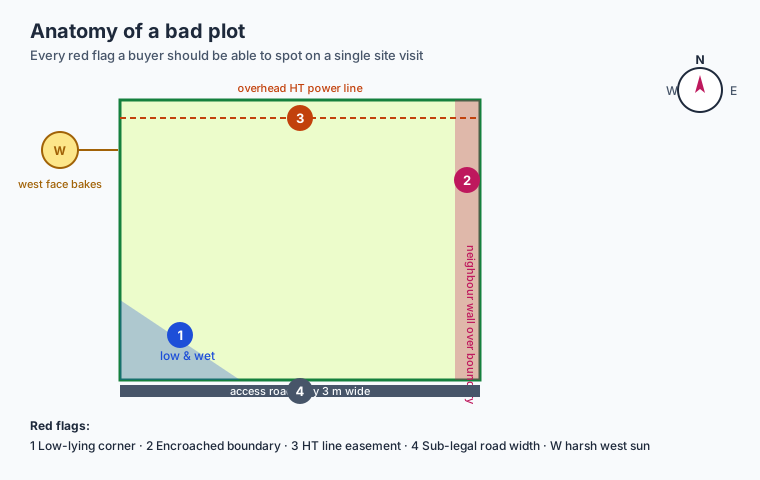
Figure 1: The anatomy of a bad plot. Most red flags are visible on a single careful site visit — if you know what you're looking for.
2. Skipping the legal, title and approval checks
This is the mistake that turns into litigation, and it has several flavours.
Disputed or unclear title
The mistake: Trusting the seller's photocopied papers and a broker's reassurance. Why it hurts: If the title isn't clear — undivided ancestral property, a missing link in the chain, an unsettled inheritance — you can lose the land and your money to a relative who surfaces years later. How to avoid it: Get an advocate to do a 30-year title search, pull the Encumbrance Certificate (EC) from the sub-registrar to confirm there are no existing mortgages or charges, and verify the seller's identity against the records. This is non-negotiable.
Unapproved layouts and gram-panchayat plots
The mistake: Buying a plot in a layout that was never approved by the planning authority (DTCP, BDA, BMRDA, your local development authority) — often a farm-land subdivision sold as "approved" on the strength of a gram-panchayat khata. Why it hurts: Banks will not lend on unapproved plots, resale is hard, regularisation is uncertain and expensive, and in the worst case the layout can be demolished or denied services. How to avoid it: Demand the approved layout plan with the authority's sanction number and verify it directly with that authority — not via the broker. A gram-panchayat receipt is not the same as planning approval.
No RERA registration
The mistake: Buying into a plotted development or layout project that should be RERA-registered but isn't. Why it hurts: You lose the consumer protections RERA provides — registered carpet/plot area, committed timelines, and a grievance forum. How to avoid it: For any promoted plotted layout above the threshold, check the project's registration on your state RERA portal and read the registered details.
"The buyer must satisfy himself about the title of the seller before parting with the purchase money." — the principle of caveat emptor as carried into the Transfer of Property Act, 1882. In Indian land transactions, the burden of due diligence sits squarely on the buyer.
3. Ignoring orientation and the sun
The mistake: Choosing a plot purely on price-per-square-foot without asking which way it faces. A west-facing plot in Nagpur or a south-west bedroom wall in Chennai is a very different life from a north or east aspect. Why it hurts: Orientation is fixed forever. Get it wrong and you fight the afternoon sun with curtains and air-conditioning for decades, or you can't site the rooms where light and privacy want them to be. How to avoid it: Stand on the plot with a compass (or our Vastu compass) and picture the day — morning light in, harsh west sun shaded. Run the site through our sun path analyzer to see exactly where the summer and winter sun will fall before you commit. The deeper design logic of getting this right is covered in our companion guide on site orientation explained and the design-principles view in orientation, light & views.
4. Low-lying land, poor drainage and flood risk
The mistake: Buying the cheap plot at the bottom of the slope, or any site where water has nowhere to go. Why it hurts: Water always runs downhill. A low plot collects the whole street's monsoon runoff — standing water, perpetual damp, mosquitoes, a cracked plinth, and the cost of raising the level with truckloads of fill. Many Indian cities flood predictably each year, and the lowest plots flood first. How to avoid it: Visit after heavy rain, not on a dry day. Compare your plot's level to the road and to neighbours' plinth heights. Ask neighbours about the worst flooding they've seen. Favour the high, free-draining ground even at a premium.
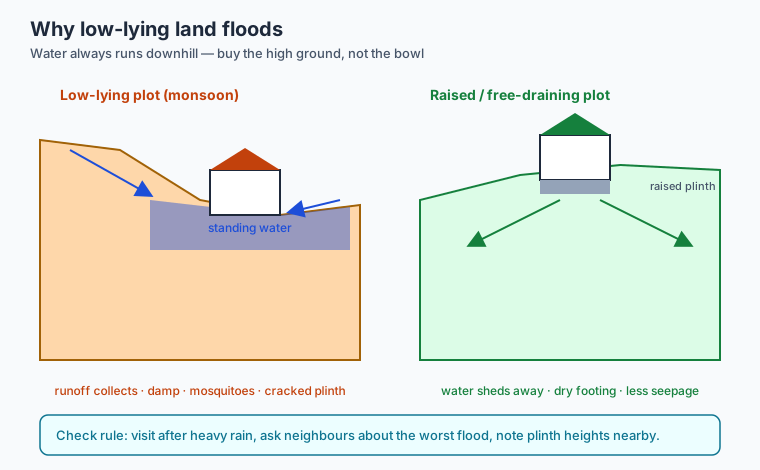
Figure 2: Why low-lying land floods. The plot in the bowl collects everyone's runoff; the raised plot sheds water and keeps its footing dry.
5. Weak, filled or black-cotton soil — untested
The mistake: Assuming all dirt is the same and skipping a soil test. Why it hurts: Black cotton (expansive) soil swells when wet and shrinks when dry, heaving and cracking foundations. Recently filled or made-up ground settles unevenly. Either can push your foundation cost up sharply — deeper footings, under-reamed piles or soil replacement — turning your "cheap" plot into the most expensive one on the street. How to avoid it: Commission a basic geotechnical investigation (a couple of boreholes and a Standard Penetration Test per IS 1892 / IS 6403) before purchase, or at minimum make the sale conditional on a satisfactory soil report. Look for tell-tale wide surface cracks in summer (classic black-cotton) and ask whether the plot was a tank bed, quarry or low area that was filled.
6. Skipping the setback and FSI maths
The mistake: Buying land by its total area without working out how much of it you're actually allowed to build on. Why it hurts: Setbacks (mandatory open margins on each side) and FSI/FAR (the floor-area multiplier on your plot) decide your usable house, not the plot size on the sale deed. On a small plot, generous setbacks can swallow most of the ground; on a large one, a low FSI can leave you unable to build the floor area you imagined. People routinely overpay for land they can't use — or buy too little for the home they want.
How to avoid it: Do the maths before you buy. Check the FSI and setback rules for that exact zone and plot size in the local bylaws, then run the numbers: our FAR/FSI calculator shows your buildable floor area in seconds, and the setback visualizer draws the open margins so you can see the real footprint. The table below shows how setbacks erode a small plot.
| Plot size | Typical small-plot setbacks (illustrative) | Approx. ground footprint left | Lesson |
|---|---|---|---|
| 9 m × 12 m (~30×40 ft) | 1.5 m front, 1 m rear, 0.6 m sides | roughly 6 m × 9.5 m | Tight side margins; plan a compact, vertical home |
| 12 m × 18 m (~40×60 ft) | 3 m front, 3 m rear, 1.5 m sides | roughly 9 m × 12 m | Comfortable; setbacks are a smaller share |
| Corner plot, any size | Extra setback on the second road side | reduced footprint on two faces | Verify both road-facing setbacks before buying |
Setbacks vary by state, authority, plot size and road width — always confirm the exact figures for your zone in the local building bylaws; the values above only show the relationship.
7. Poor access — road width and legal right of way
The mistake: Falling for a quiet interior plot reached by a narrow lane, or one whose only access crosses someone else's land. Why it hurts: Many bylaws tie your permissible FSI and number of floors to the abutting road width — a 3 m lane can cap what you build. Worse, if your legal access is an informal path over a neighbour's land rather than a recorded public road, it can be blocked or disputed, stranding your plot. How to avoid it: Confirm the access road exists in the approved layout, measure its actual width, and check that your plot has a legally recorded frontage onto it. Verify a fire-tender can reach the site if you plan multiple floors. No legal access, no purchase.
8. No privacy and uncomfortable overlooking
The mistake: Ignoring what surrounds the plot — a tall building looming over the only sunny side, windows staring straight into where your bedrooms must go, a busy road or a temple loudspeaker next door. Why it hurts: Privacy and quiet are designed into a home from the site outward; a plot boxed in on its good aspects forces compromises no interior can fully fix. How to avoid it: Visit at different times of day, look up at neighbouring heights, and imagine the windows. Our guide on designing for views and privacy and the interior-zoning view in zones of retreat, rest & privacy show how to weigh this — but the first defence is choosing a plot that isn't overlooked on its best side.
9. T-junction panic and "Vastu dosha" myths
The mistake: Either rejecting a perfectly good plot in a blind panic over a T-junction or a particular direction, or — the opposite — overpaying for a "north-east" plot while ignoring real defects. Why it hurts: Both extremes substitute superstition for analysis. A T-junction plot has a genuine, checkable downside (headlight glare and, in a road accident, the line of travel) that good gate placement and planting can manage — it is not a curse. Meanwhile a "Vastu-perfect" direction means nothing if the plot is in the flood bowl with no clear title. How to avoid it: Separate verifiable facts from fear. If Vastu matters to your family, treat it as one weighted input among many — score it honestly with our Vastu compliance tool — but never let it override drainage, title, soil and orientation. For the design-led reconciliation of Vastu with modern planning, see Vastu for modern homes and the Vastu house plan.
10. Ignoring future development, neighbours and encroachment
The mistake: Judging the plot only as it looks today. Why it hurts: The empty field giving you light and breeze today may become a four-storey wall tomorrow; a planned road widening can eat your setback; a neighbour's compound wall may already sit a foot inside your boundary. Encroachment discovered after purchase is a legal headache. How to avoid it: Check the master plan / development plan for the area to see proposed roads and land-use changes. Walk the boundary with the survey sketch and a measuring tape, confirm the corner stones, and look for any existing structure crossing the line. Ask the authority whether any road widening or reservation affects the plot.
11. No infrastructure — water, sewer, power
The mistake: Assuming services will "come soon." Why it hurts: A plot with no municipal water, no sewer connection and no nearby power line means borewells (that may run dry or saline), septic systems, and an expensive, slow power connection — recurring costs and daily friction that the brochure never mentioned. How to avoid it: Verify on the ground: Is there a municipal water main on the road? A sewer line, or only septic? A power transformer within reach? What is the groundwater situation in that pocket — is the borewell depth in the area increasing year on year? Cheap land far from infrastructure is rarely cheap once you total the connections.
12. Putting it together — a final pre-purchase gate
The antidote to all twelve mistakes is a gate: a fixed sequence of checks that each must pass before you pay a token. Clear the legal stage, then the physical stage, then the buildability stage — and at any red flag, you renegotiate or walk away rather than pay to discover the problem later.
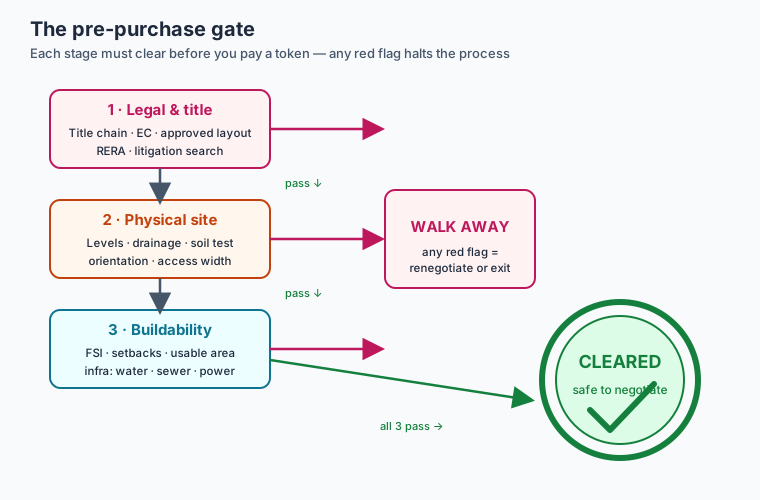
Figure 3: The pre-purchase gate. Each stage must clear before the next; any unresolved red flag halts the purchase.
Top mistakes → red flag → fix
| # | Mistake | Red flag you'll see | The fix |
|---|---|---|---|
| 1 | Buying on emotion/price | Pressure to pay a token today | Cooling-off rule; score it cold |
| 2 | Skipping legal checks | Photocopies only; "panchayat khata" | 30-yr title search + EC + authority approval |
| 3 | Ignoring orientation | Don't know which way it faces | Compass + sun-path before committing |
| 4 | Low-lying / flood land | Plot below road; damp neighbours | Visit after rain; buy the high ground |
| 5 | Untested weak/black-cotton soil | Wide summer cracks; filled ground | Geotechnical test or conditional sale |
| 6 | Skipping setback/FSI maths | Sold on plot area only | Run FSI + setbacks for usable area |
| 7 | Poor access / no legal road | Narrow lane; informal path | Confirm recorded frontage & road width |
| 8 | No privacy / overlooked | Tall neighbour on the sunny side | Visit at different times; check heights |
| 9 | Vastu panic vs facts | Curse claims, or "perfect" but flawed | Weigh Vastu as one input, not a veto |
| 10 | Ignoring future development | Empty adjacent field | Read master plan; walk the boundary |
| 11 | No infrastructure | No mains water/sewer/power nearby | Verify services and groundwater on site |
| 12 | No structured process | Decisions made ad hoc | Run the three-stage gate above |
The final pre-purchase checklist
| Stage | Check | Cleared? |
|---|---|---|
| Legal | 30-year title search by an advocate | |
| Legal | Encumbrance Certificate pulled from sub-registrar | |
| Legal | Approved layout sanction number verified with authority | |
| Legal | RERA registration checked (for promoted layouts) | |
| Legal | No pending litigation / clear inheritance | |
| Physical | Plot level vs road; visited after heavy rain | |
| Physical | Soil test (or conditional sale) — no untested black cotton | |
| Physical | Orientation checked with compass + sun path | |
| Physical | Boundary walked; survey stones & no encroachment | |
| Buildability | FSI + setbacks computed for usable area | |
| Buildability | Legal access & road width confirmed | |
| Buildability | Water, sewer, power and groundwater verified | |
| Buildability | Master-plan check: roads / land-use changes |
Work through it row by row, and let the plot evaluation tool turn the answers into a single weighted score you can compare across plots. A plot that clears every row isn't a gamble — it's an informed decision you'll still be happy with in thirty years.
Sources & further reading
1. National Building Code of India (NBC) 2016, Bureau of Indian Standards — Part 3 Development Control Rules & General Building Requirements (setbacks, access, open spaces).
2. The Transfer of Property Act, 1882 & The Registration Act, 1908 — title transfer, encumbrance and registration framework.
3. The Real Estate (Regulation & Development) Act, 2016 (RERA) and respective State RERA portals — registration of plotted developments.
4. IS 1892 : 1979 — Code of Practice for Subsurface Investigation for Foundations; IS 6403 — bearing capacity of shallow foundations (soil investigation basis).
5. IS 1888 / IS 2131 — Standard Penetration Test method for soil characterisation.
6. Relevant State Town & Country Planning / Development Authority building bylaws (e.g. DTCP, BDA, BMRDA, DDA, MahaRERA & municipal master plans) — FSI, setbacks and zoning specific to your plot.
7. Christopher Alexander, A Pattern Language (1977) — patterns on "Site Repair" and building on the worst part of the land, leaving the best intact.
Use this guide as the warning track and its positive twin, how to evaluate a residential plot, as the framework that scores a good one. Pair both with site analysis for homeowners to read the land itself, and site orientation explained to lock in the one thing you can never change after purchase.
Export this guide
Related Guides — Deep-dive reading
Site Analysis for Homeowners: How to Read a Plot Before You Build
The master guide to reading your land — its legal envelope, sun, wind, slope, soil, access, neighbours, views, services and microclimate — before you buy a plot or draw a plan.
Site PlanningHow to Evaluate a Residential Plot in India
A practical, layered framework for assessing a plot before you buy — from clear title and the buildable-area maths to access, soil, orientation and a weighted scorecard.
Site PlanningPlot Due Diligence in India: The Complete Pre-Purchase Check (2026)
Before you pay a rupee for a plot, run the full pre-purchase check with your lawyer and a licensed surveyor - legal title, revenue records, planning approvals, physical survey and financial dues. This guide walks through each pillar, gives you a checklist and tells you when to walk away.
Buying LandRelated Tools — Try Free
Cross-Ventilation Analyzer
Estimate airflow and air changes per hour (ACH) from room size, window areas, layout, and local wind — with NBC 2016 Part 8 compliance check.
Ventilation CalculatorWindow Orientation Planner
Pick the best window type, glass and shading by wall direction — north, east, south and west.
Window ToolPlot Evaluation Toolkit — 20-Parameter Scoring
Weighted 20-parameter evaluation of residential plots covering legal, infrastructure, and hidden costs.
Land Buying