
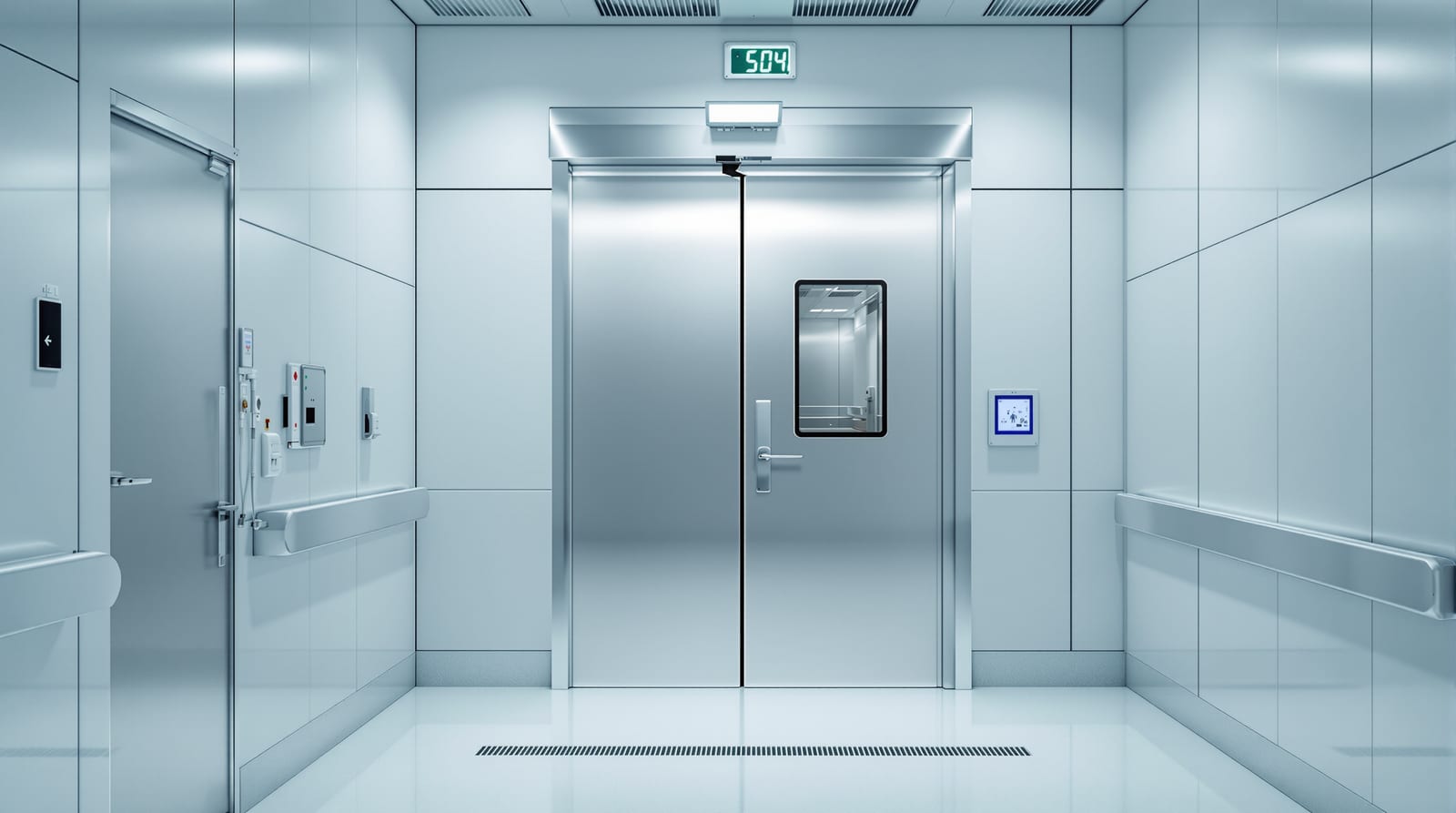
Isolation Room Doors: Negative & Positive Pressure India 2026
Sealed self-closing doors and anteroom pairs for negative-pressure AIIR and positive-pressure protective isolation rooms in Indian hospitals.
Isolation room doors are the single most safety-critical opening in an infection-control suite: they hold the pressure differential that keeps airborne pathogens contained — or keeps them out. Unlike an ordinary ward door, an isolation room door is a sealed, self-closing, leak-controlled assembly, almost always paired across an anteroom, and engineered against a measured pressure regime rather than chosen from a catalogue. This guide explains the two regimes — negative-pressure (airborne infection isolation, or AIIR) and positive-pressure (protective, for immunocompromised patients) — and how the door, gaskets, vision panel, interlock and pressure monitoring work together as one system. As with every project-engineered opening, the final specification and price must come from a vendor working to your HVAC consultant's pressure calculation and your hospital's NABH accreditation requirements.
Two regimes, two opposite goals
The physics of isolation is simple to state and unforgiving in practice: air flows from higher to lower pressure, so the door must seal well enough that the HVAC system can hold a stable differential without the leakage path swamping the supply and exhaust fans.
- Negative-pressure (AIIR): the room sits below corridor/anteroom pressure (typically −2.5 to −8 Pa, often cited as ≥−2.5 Pa minimum). Air is pulled into the room and exhausted, usually HEPA-filtered, to the outside. Used for tuberculosis, measles, COVID-19, and other airborne diseases. The patient is the source; the goal is containment.
- Positive-pressure (protective): the room sits above surrounding pressure (typically +2.5 to +8 Pa). Filtered air flows out of the room, keeping airborne contaminants away from immunocompromised patients — bone-marrow transplant, severe burns, oncology. The patient is the one being protected.
A single airborne-infection isolation patient who is also immunocompromised needs a combination suite — a positive-pressure anteroom buffering a negative-pressure room — which is the most demanding door arrangement of all and must be designed by a specialist.
| Parameter | Negative-pressure (AIIR) | Positive-pressure (protective) |
|---|---|---|
| Pressure vs. surroundings | −2.5 to −8 Pa | +2.5 to +8 Pa |
| Airflow direction at door | Into the room | Out of the room |
| Air changes per hour (ACH) | 12+ (6 minimum for older retrofits) | 12+ |
| Exhaust | HEPA, to outside | Filtered supply, room exhaust may recirculate |
| Door must resist leakage | Yes — both directions critical | Yes — both directions critical |
| Typical patient | TB, COVID-19, measles | BMT, oncology, severe burns |
What makes an isolation door different
The leaf and frame are an airtightness device. A standard hospital door may leak several cubic metres of air per minute around its perimeter; an isolation door must reduce that to a level the fans can overcome while holding the set point. Achieving this needs every element to work together — it is an assembly, not a leaf.
Sealing the perimeter
- Compression gaskets on head and jambs (silicone or EPDM), and crucially a drop seal (automatic bottom seal) that descends as the door closes to seal the threshold gap — the worst leakage path on any door.
- Self-closing action via concealed or surface closer, so the door is never left ajar and the differential is never lost. For high-acuity rooms, automatic hermetic sliding doors (gasket plus drop-seal, see hermetic doors) give the tightest, most repeatable seal and are touch-free.
- Flush, washable leaf — laminate, powder-coated steel, or FRP — with no panel rebates to trap contamination, and a flush-glazed vision panel for staff to observe the patient without opening the door.
The anteroom and door pairs
Most true isolation rooms use an anteroom (a small buffer vestibule) with two doors: corridor-to-anteroom and anteroom-to-room. The anteroom acts as an airlock and a PPE donning/doffing space.
- Interlock (electromagnetic or sequential): prevents both doors being open simultaneously, so the pressure cascade is never short-circuited. An interlock should always include an override for emergencies and patient evacuation — it must fail safe for life-safety, not trap occupants.
- This cascade logic mirrors pharma cleanroom airlocks, but with the medical priority that fire-egress and rapid clinical access always win over pressure integrity.
Pressure monitoring
Every isolation room must have a continuous, visible pressure monitor (digital manometer or magnehelic gauge) mounted at the door, with audible/visual alarm on loss of differential. Staff must verify direction before entry; a daily smoke-tube or tissue test at the door gap is good practice and a common NABH audit point.
Indian standards and accreditation context
There is no single Indian Standard for the isolation door product itself; compliance is driven by the room specification under several frameworks:
| Framework | What it governs |
|---|---|
| NABH (Hospital Accreditation Standards) | Isolation facility provision, infection-control, anteroom & pressure requirements |
| NBC 2016, Part 9 (Health-care) | HVAC, air-change and room-pressure guidance for healthcare |
| ICMR / NCDC & MoHFW guidance | AIIR criteria, pandemic-preparedness norms (TB, COVID-19) |
| ASHRAE 170 (referenced) | International benchmark for pressure, ACH and filtration often cited by HVAC consultants |
| IS 3614 (where fire-rated) | If the door doubles as a fire/smoke barrier on an exit route |
The post-COVID pandemic-preparedness push has made AIIR capacity a board-level priority for Indian hospitals, and NABH assessors now scrutinise pressure monitoring, anteroom logic and door-seal condition during surveys. Where an isolation door also sits on a fire-compartment line, it must satisfy fire-rated door requirements as a tested assembly — fire integrity and air-sealing are not the same thing, and one cannot be assumed from the other.
Anatomy of an isolation door assembly
Cost bands (India 2026)
Isolation doors are custom-engineered, so prices vary widely with leaf material, automation, sealing grade and whether the order is supply-only or installed. Treat these as rule-of-thumb bands, not quotations; GST at 18% applies. A full suite needs two doors plus interlock and monitoring.
| Configuration | Indicative band (supply-only) | Notes |
|---|---|---|
| Manual swing isolation door (gasketed, drop seal, vision panel, self-closer) | ₹25,000 – ₹55,000 / leaf | Laminate or steel leaf |
| Automatic hermetic sliding isolation door | ₹1,50,000 – ₹4,00,000+ / opening | Touch-free, tightest seal |
| Anteroom door interlock system (electro-magnetic, 2-door, override) | ₹35,000 – ₹90,000 / set | Excludes doors |
| Differential pressure monitor + alarm (per room) | ₹15,000 – ₹60,000 | Digital, NABH-grade |
| Complete two-door isolation suite (manual leaves) | ₹1,10,000 – ₹2,50,000 | Doors + interlock + monitor, installed |
Installed cost typically adds 15–30% for fixing, sealing, commissioning and pressure verification. The pressure-test and commissioning step is non-negotiable: a door that seals on paper but leaks in the field defeats the entire room.
Selecting and specifying
1. Confirm the regime first. Negative for source isolation, positive for protective, combination for both — set by the infection-control committee and HVAC consultant, not the door vendor.
2. Get the pressure target and ACH from the HVAC design; the door's allowable leakage follows from the fan capacity.
3. Decide manual vs. automatic. ICUs, high-throughput AIIR and burns units justify hermetic sliding; standard ward isolation often uses manual swing with drop seals.
4. Plan the anteroom and interlock early — retrofitting a buffer vestibule into an existing ward is the hardest and costliest change.
5. Coordinate fire and egress. Where the door is on a compartment line or exit route, reconcile sealing with fire rating and ensure interlocks fail-safe-open. See operation theatre doors and data-centre doors for related sealed-environment logic.
6. Specify monitoring and a maintenance regime. Gaskets and drop seals wear; budget periodic seal replacement and pressure re-verification, much like cleanroom door upkeep.
For first-pass sizing and budgeting across specialty types, the specialty door selector and specialty door cost estimator help frame the brief before you approach a vendor. For the wider product family, see the complete door guide and the phase pillar on specialty doors.
Frequently asked questions
Do all isolation rooms need an anteroom?
Not every retrofit has one, but a true airborne-infection isolation room (AIIR) should have an anteroom with a two-door arrangement. The anteroom buffers the pressure cascade and gives staff a PPE donning/doffing space. NABH and pandemic-preparedness guidance strongly favour anterooms; single-door isolation rooms are a compromise where space or budget prevents a full suite.
What pressure difference should an isolation door hold?
Negative-pressure rooms typically run −2.5 to −8 Pa relative to surroundings (≥−2.5 Pa is a common minimum), and positive-pressure protective rooms +2.5 to +8 Pa. The exact set point comes from your HVAC consultant and the room's clinical use; the door's job is to limit leakage so the fans can hold that differential continuously.
Can one door switch between negative and positive pressure?
The door hardware (gaskets, drop seal, self-closer) is the same; the regime is set by the HVAC system, not the door. A room can in principle be reconfigured, but switching direction is a clinical and engineering decision involving exhaust filtration, air balancing and re-commissioning — never something done casually at the door.
Why is a drop seal so important?
The threshold gap under a door is usually the largest single air-leakage path. An automatic drop seal descends as the door closes to seal that gap, dramatically cutting leakage and helping the room hold its pressure. Without it, perimeter gaskets alone rarely achieve a stable differential.
How do interlocks not trap people in an emergency?
A properly engineered interlock prevents both anteroom doors opening at once during normal use but includes an emergency override and fails safe (releases) on fire alarm or power loss. Life-safety and patient evacuation always take priority over pressure integrity, and assessors check this during audits.
Are isolation doors covered by an Indian Standard?
There is no single IS for the isolation door product. Compliance is driven by the room specification under NABH accreditation, NBC 2016 Part 9, and ICMR/NCDC/MoHFW guidance, with ASHRAE 170 often referenced by HVAC consultants. If the door also serves as a fire or smoke barrier, IS 3614 fire-rating rules apply to it as a tested assembly.
Export this guide
Related Guides — Deep-dive reading
Pharma Cleanroom Doors: GMP Flush Door Guide India 2026
Specifier's guide to flush GI/SS304 cleanroom doors, double vision panels, full gaskets, interlocked airlocks and Schedule M / ISO 14644 compliance.
Home Doors & EntrancesAutomatic Swing Door Operators: Retrofit Guide India 2026
How to retrofit a normal hinged door to open by itself — full-energy vs low-energy operators, activation, safety and cost for Indian buildings.
Home Doors & EntrancesFail-Safe vs Fail-Secure Locks: The Guide (India 2026)
Why fail-safe vs fail-secure is the single most important access-control decision, and how to get it right for every door.
Home Doors & EntrancesRelated Tools — Try Free
Acoustic Privacy (STC) Visualizer
Indian healthcare acoustic visualizer — compare wall assemblies and noise sources, see received SPL after STC attenuation, and check FGI 2018 / IS 1950 / NABH speech-privacy compliance with live dual-canvas waveform.
Acoustic ToolHealing View Impact Calculator
Evidence-Based Design dashboard quantifying the recovery impact of nature view + daylight factor on analgesic use, length of stay, and HCAHPS patient-experience uplift. Calibrated against Ulrich 1984 (Science), Park & Mattson 2008, and the CHD EBD evidence base.
EBD CalculatorHospital Door Selector
Pick the right healthcare door by zone — OT, ICU, ward, radiology and lab — with hygiene, clearance and code checks.
Door Tool