
Parking and Garage Cost in India: What It Really Costs to Build (2026)
An honest, indicative cost-literacy guide to building parking and garages in India — why the same number of bays can cost wildly different amounts, the surface-stilt-podium-basement-mechanical cost order, the full cost stack most people forget, cost per bay vs per square metre, the hidden and lifetime costs, and the levers that actually cut the bill.
Ask "what does a parking space cost to build?" and the honest answer is: it depends more on the type than on almost anything else. The same single car bay might cost a modest amount as an open surface slot, a bit more under a stilt, appreciably more on a podium, and several times more in a basement that needs excavation, shoring, dewatering and forced ventilation. Two owners can both say "I built ten car spaces" and have spent amounts that differ by a factor of five — and neither is lying.
This guide is the cost-literacy chapter of the Parking and Garage Design hub: why parking cost swings so hard, the full cost stack that most budgets miss, the surface-to-basement cost order, cost per bay vs per square metre, the hidden and lifetime costs, and the levers that genuinely cut the bill. It does not quote you a price — rates move with city, soil, depth and year — so every figure here is a relative band and every real number should come from local quotes. Push the actual arithmetic to the Parking Construction Cost Calculator, and where a garage door or a floor finish drives the number, the garage door cost calculator and the parking flooring calculator.
Before you cost anything, decide the type honestly — the parking systems guide lays out surface, stilt, podium, basement and mechanical, and choosing the cheapest type that fits your plot is the single biggest saving you will ever make.
Scope & how to read this. Every figure here is a relative, indicative band to help you plan and compare — never a firm price, rate or quote. Actual costs swing hugely by city, soil, depth, specification and year, so get local quotes from contractors and let a licensed structural engineer, MEP consultant and quantity surveyor price and certify the real design. Costs are not quotes; confirm everything against a professional and your local rates.
Why the same bay costs wildly different amounts
People assume a "car space" is a car space. It is not. The cost of one bay is set by a chain of decisions, and the biggest link by far is what supports and encloses it.
- Type is the dominant driver. An open surface bay is essentially a paved rectangle with drainage and marking. A basement bay carries a share of a deep excavated, waterproofed, mechanically-ventilated concrete box. Everything else — finishes, lighting, EV — is a rounding error next to that difference.
- Ground conditions. Rock, soft clay, a high water table or a tight urban plot needing shoring can swing a basement's cost dramatically before a single bay exists. This is why "get a soil test first" is cost advice, not just engineering advice.
- Depth and levels. Each level of basement below the first adds excavation, shoring, dewatering and ramp length — the second basement usually costs more per bay than the first, not less.
- Specification. A bare-slab surface lot and a granite-finished, fully-lit, EV-ready podium are different animals. Specification is a real lever you control.
- Efficiency of the layout. A scheme that wastes area on clumsy aisles buys more structure per car. Squeezing more bays into the same slab lowers cost per bay — the whole point of the parking capacity and efficiency guide.
The trap is costing only the shell — the columns, slab and paving you can see — and under-budgeting everything bolted to it. The next section is the antidote.
Cost per bay vs cost per square metre
Contractors and consultants quote in two currencies, and you should read both:
- Cost per square metre (or per sq ft) of built parking area is how the structure and MEP are usually priced — it scales with the slab you build.
- Cost per bay (per ECS) is what an owner or society actually feels — it bundles the bay plus its share of the aisles, ramps and services. An efficient layout fits more bays into the same square metres, so a lower cost per bay even at the same cost per square metre.
Neither number is "the" cost. Use per-square-metre thinking to compare structural types and per-bay thinking to compare whole schemes — and let the calculator hold the arithmetic while you vary the inputs.
The cost stack — what most budgets forget
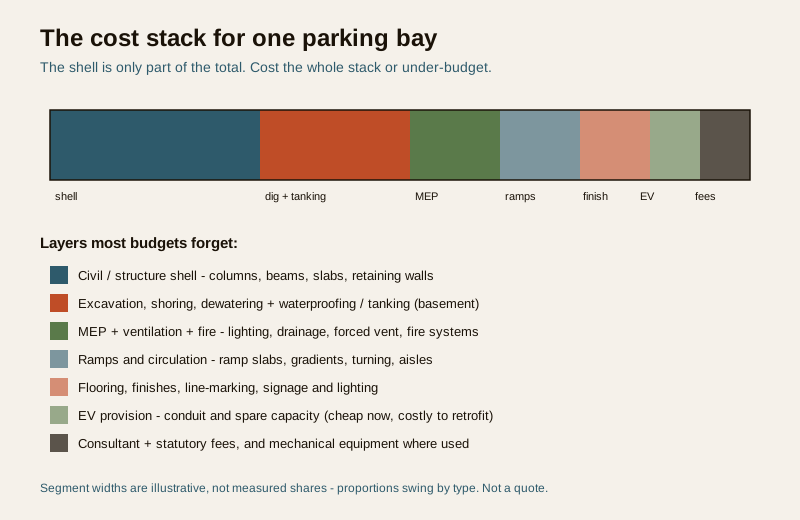
A parking budget is a stack, not a single line. Cost the shell only and you will typically under-budget by a wide margin, because the services, protection and fees below often rival or exceed the visible structure — especially for basements. Here is the whole stack:
| Cost-stack layer | What it covers | Where it bites hardest |
|---|---|---|
| Civil / structure shell | Columns, beams, slabs, retaining walls, paving | Every type; dominant for podium and basement |
| Excavation, shoring, dewatering | Digging, keeping the hole and neighbours safe, pumping water | Basement only — can rival the shell |
| Waterproofing & tanking | Keeping a below-grade or podium box dry for life | Basement and podium; skimping here is the classic regret |
| MEP + ventilation + fire | Lighting, drainage, mechanical ventilation, fire systems | Basement (forced ventilation) and any enclosed parking |
| Ramps & circulation | Ramp slabs, gradients, turning, aisles | Multi-level and basement; eats usable area too |
| Flooring & finishes | Surface/hardener, coatings, kerbs, walls | You control this; surface lots keep it cheap |
| Line-marking, signage & lighting | Bay stripes, arrows, wayfinding, lux levels | Small line, but skipped and then retrofitted |
| EV provision | Conduit, spare capacity, charger points | Cheap now, expensive to retrofit later |
| Equipment (mechanical only) | Puzzle/stack/tower machinery, pits, controls | Mechanical systems — priced per bay of machinery |
| Consultant & statutory fees | Structural, MEP, QS, approvals, sanction | Every scheme; forgotten in DIY budgets |
Two layers deserve a warning. Waterproofing is invisible when it works and catastrophic when it fails — costing it out is not the place to save. And EV provision is trivially cheap as buried conduit and spare panel capacity today, but a painful, disruptive retrofit later — the EV-ready parking guide makes the case for laying it in from the start.
The iceberg — shell-only vs the full cost
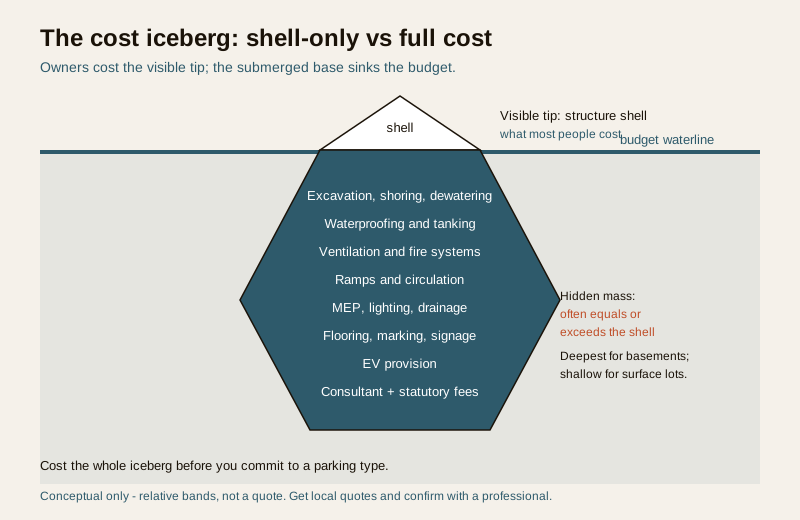
The commonest budgeting mistake is the iceberg: the shell is the visible tip above the waterline, and the excavation, waterproofing, ventilation, fire, ramps, EV and fees are the far larger mass below. Owners see and cost the tip; the project is sunk by the base. For a surface lot the iceberg is shallow — the tip is most of it. For a basement it is deep — the hidden mass can equal or exceed the visible shell. Always cost the whole iceberg before you commit to a type.
The cost order — surface to basement to mechanical
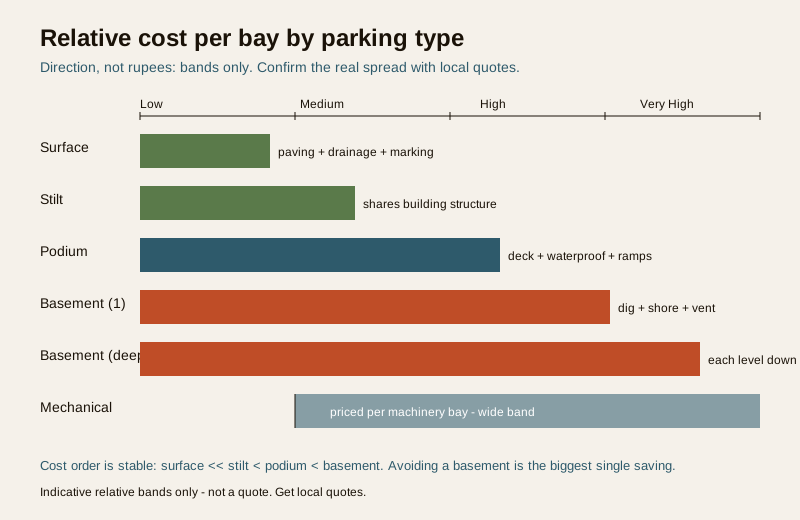
Set aside firm numbers and think in relative bands. Across almost every Indian project the cost-per-bay order is remarkably stable, even as the actual rupees swing by city and year. From cheapest to dearest:
| Parking type | Relative cost band | What drives the band |
|---|---|---|
| Surface (open) | Low | Paving, drainage, marking only — no structure overhead, no enclosure |
| Stilt (under building) | Low to Medium | Shares the building's columns and slab; simple ventilation and lighting |
| Podium (deck over ground) | Medium to High | A dedicated structural deck, waterproofing and ramps; land is freed below |
| Basement (one level) | High | Excavation, shoring, dewatering, tanking and forced ventilation and fire |
| Basement (deeper levels) | High to Very High | Each level down adds excavation, shoring, ramp length and services |
| Mechanical (stack/puzzle/tower) | Medium to Very High | Priced per bay of machinery; saves area but adds equipment and upkeep |
Read this order as direction, not magnitude — confirm the actual spread with local quotes. A few honest implications:
- Avoid a basement if a podium or stilt does the job. The jump from stilt or podium to basement is the single largest cost step in the table, driven by everything below the waterline. The parking systems guide and the podium parking guide help you check whether you can dodge the dig.
- Mechanical is a wide band. A simple two-car mechanical stacker at a villa is modest; an automated tower is a major capital and maintenance commitment priced per machinery bay. It buys area, not necessarily money — justify it where land is the binding constraint.
- The second basement is not cheaper than the first. Depth compounds cost; do not assume economies of scale downward.
The hidden and lifetime costs
The build cost is only the down-payment. Three categories routinely surprise owners because they sit outside the construction quote:
Soft costs and approvals
Consultant fees (structural, MEP, quantity surveyor), statutory approvals and sanction, and the surveys and soil tests a serious scheme needs are real money and almost always left out of back-of-envelope budgets. They also cannot be skipped — a below-grade or multi-level structure is a professional-led, sanctioned exercise, not a DIY one.
Land opportunity cost
Every square metre given to parking is a square metre not sold, rented or lived in. On an expensive plot the opportunity cost of the land under surface parking can dwarf the construction cost — which is precisely the argument for going vertical (podium, basement or mechanical) to free ground area, and for right-sizing your bay count so you build no more parking than you must.
Maintenance over the life of the structure
Parking is not build-and-forget. Over its life it demands drainage clearing, waterproofing upkeep, ventilation-fan and fire-system servicing, ramp and floor recoating, line-marking refresh, and — for mechanical systems — an ongoing service contract for the machinery. Cheaper to build is not always cheaper to own: a poorly-waterproofed basement or an under-specified mechanical system can cost more over a decade than a dearer, more robust choice. The parking maintenance guide sets out the intervals; budget them from day one.
Levers that actually cut the cost
You cannot change the price of concrete, but you can change how much of it you buy. The genuine levers, in rough order of impact:
| Cost lever | How it saves | Guide / tool |
|---|---|---|
| Choose the cheapest type that fits | Avoiding a basement is the biggest single saving | parking systems guide |
| Build fewer, right-sized bays | Do not over-provide; size bays to your fleet | parking space requirements |
| Improve layout efficiency | More bays per slab lowers cost per bay | parking capacity and efficiency |
| Match specification to need | Finish and light appropriately, not lavishly | parking area flooring |
| Lay EV conduit now | Cheap ducting now beats a costly retrofit later | EV-ready parking |
| Cost the whole stack up front | No mid-project surprises or value-engineering panic | construction cost calculator |
The first three do the heavy lifting. A right-sized, efficiently-laid-out stilt or podium scheme will almost always beat an over-provided basement — and it does so before you have argued about the price of a floor coating. Where you do spend, spend on the things that fail expensively: structure, waterproofing, ventilation and fire, all professional-led.
What to pin down before you budget
| Item to fix first | Why it changes the number | Confirm with |
|---|---|---|
| Parking type (surface/stilt/podium/basement/mechanical) | Sets the cost band before anything else | Structural engineer + local quotes |
| Bay count and mix | You pay per bay; do not over-provide | Local parking rules + requirements guide |
| Soil / water table (for basements) | Swings excavation, shoring and dewatering | Soil test + geotechnical advice |
| Specification level | Finishes, lighting and EV are real choices | Your brief + quantity surveyor |
| Consultant and approval fees | Routinely omitted from rough budgets | Consultants + local authority |
| Lifetime maintenance | Cheapest to build is not cheapest to own | maintenance guide |
How it connects
- Sits under the Parking and Garage Design hub; choose the type in the parking systems guide before you cost anything.
- Costs the cheapest realistic type: dodge a dig with the podium parking guide, or size the dig honestly with the basement parking design guide.
- Lower cost per bay by building fewer, better-laid-out bays — see parking space requirements and parking capacity and efficiency.
- Lay EV conduit up front with the EV-ready parking guide, and budget upkeep with the parking maintenance guide; the surface itself is in parking area flooring.
- Security of the finished structure lives in the Parking and Garage Security library.
- Do the arithmetic in the parking construction cost calculator, and price the pieces with the garage door cost calculator and the parking flooring calculator.
Key takeaways
- Type is the biggest cost driver — the cost-per-bay order surface << stilt < podium < basement is remarkably stable; avoiding a basement is the single largest saving.
- Parking cost is a stack, not a shell — excavation, waterproofing, ventilation, fire, ramps, EV and fees often rival or exceed the visible structure, especially below grade.
- Cost the whole iceberg: the shell is the visible tip, and the hidden mass sinks under-budgeted projects.
- Read both cost per bay and cost per square metre — an efficient layout lowers the per-bay number even at the same per-square-metre rate.
- Mechanical parking is a wide band priced per machinery bay; it buys area, not necessarily money — justify it where land is the binding constraint.
- Do not forget the hidden and lifetime costs — approvals and consultants, land opportunity cost, and maintenance over the structure's life.
- The best levers are choosing the right type, building fewer right-sized bays and improving layout efficiency — spend saved money on structure, waterproofing, ventilation and fire, all professional-led.
- Every figure here is a relative band, not a quote — get local quotes and let engineers, MEP consultants and a quantity surveyor price the real design.
References
- Local contractor and quantity-surveyor quotations — the only reliable source of a real price; rates vary by city, soil, depth, specification and year.
- CPWD / state DSR-type schedule-of-rates data — indicative civil, excavation and finish rates for planning comparisons, not firm quotes.
- National Building Code of India, NBC (SP 7:2026), Bureau of Indian Standards — parking, ventilation, fire and circulation provisions that shape scope and cost.
- IS codes and BIS guidance on concrete, waterproofing and structural design — the specification behind the shell, tanking and MEP line items.
- Local development-control regulations / municipal bye-laws — the parking provision and approval requirements that fix bay count and consultant / sanction fees.
- Mechanical parking equipment suppliers — indicative per-bay machinery and service-contract cost ranges (city and system specific).
All cost bands, orders and stack proportions here are indicative planning aids only and are not quotes; actual costs swing widely by city, soil, depth, specification and year, so get local quotes and confirm the design against NBC (SP 7:2026), your local bye-laws and a licensed structural engineer, MEP consultant and quantity surveyor.
Export this guide
Related Guides — Deep-dive reading
Mechanical Parking Systems in India: Stack, Puzzle and Tower (2026)
A planning and procurement guide to mechanical and automated car parking — two/three-level dependent stack parkers, semi-automated puzzle matrices, automated towers and pit stackers — how each works, roughly how much footprint it saves, retrieval convenience, cost bands, and the honest caveats: power, backup, AMC, a power-fail retrieval plan, and vendor + structural + electrical coordination.
ParkingParking Systems in India: Open, Basement, Podium and Mechanical (2026)
The which-system decision guide for Indian homes, societies and developers — how open, covered/stilt, basement, podium, multi-level (MLCP) and mechanical/automated parking compare on space efficiency, indicative cost, plot fit and the engineering and life-safety burden, plus a clear way to choose the right one.
ParkingThe Truth About Cost Per Square Foot
Why a ₹/sqft interior quote is the most misleading number in Indian home costing — and how to convert it into a real BOQ
Cost & MoneyRelated Tools — Try Free
Cross-Ventilation Analyzer
Estimate airflow and air changes per hour (ACH) from room size, window areas, layout, and local wind — with NBC 2016 Part 8 compliance check.
Ventilation CalculatorRainwater Tank Sizer
How big should your rainwater tank be? Computes annual harvest, recommended tank capacity in litres, water-bill savings, and payback — for 10 Indian cities.
RWH CalculatorApartment vs Villa Interior Planning Guide
Compare ceiling height, structural flexibility, lighting, storage, and services between apartments and villas.
Planning Guide