
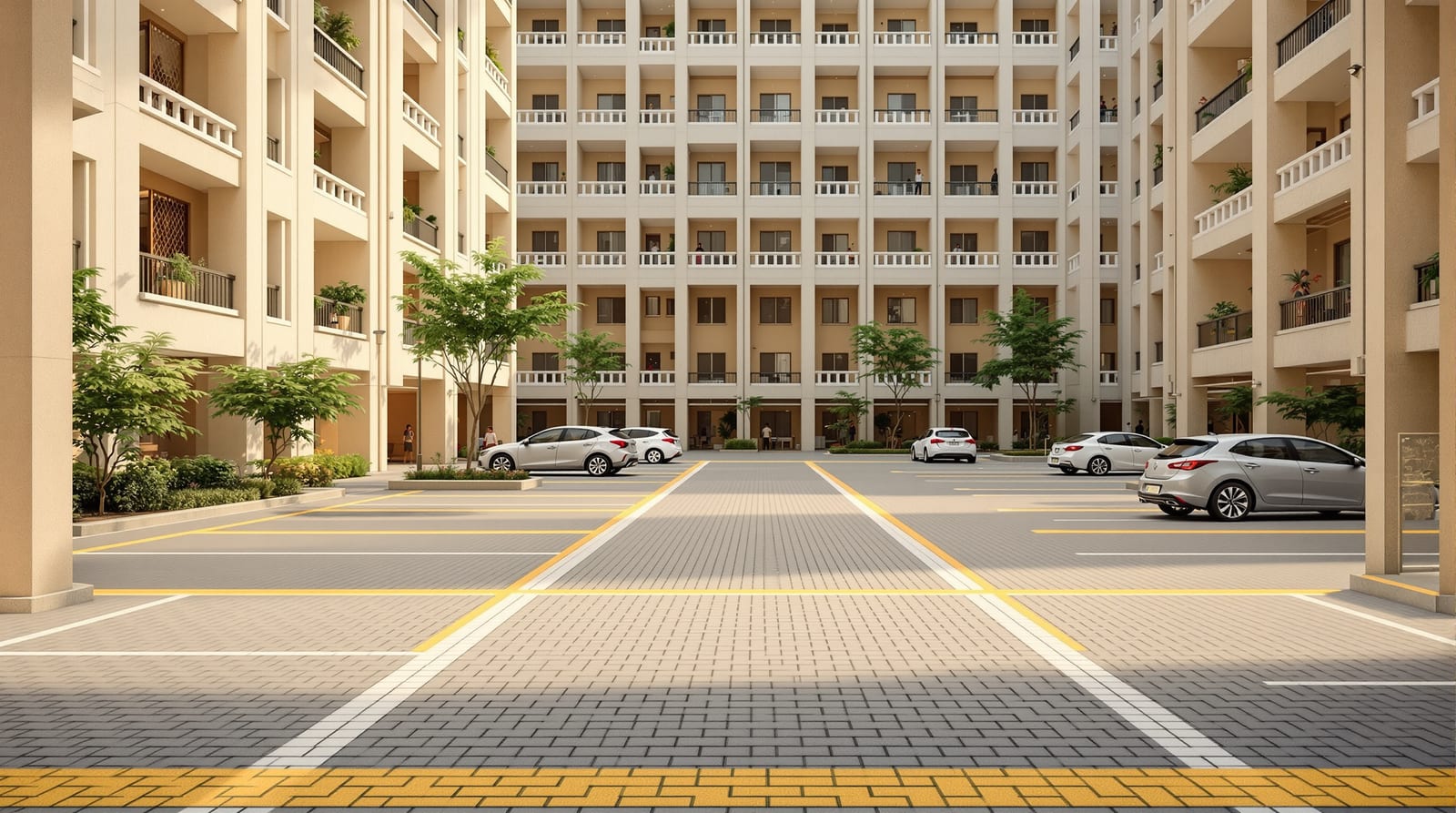
Parking Area Flooring in India: Society, Mall & Basement Surfaces That Take Heavy Load
How to specify parking-area flooring for apartment complexes, malls, offices and basements - heavy vehicle load, oil, tyre wear, ramps, drainage and dust-free sealing, with India cost per sq ft.
A commercial or society parking area is one of the most punishing floors a building has. It is measured in thousands of square metres, not square feet; it carries everything from scooters to loaded SUVs, ambulances, fire tenders and the occasional delivery truck; and it must survive constant tyre-scrub, oil and coolant drips, ramp braking, monsoon water and decades of use with minimal maintenance. The wrong specification here is enormously expensive to undo. This guide tells designers, builders and society committees how to choose the right surface for each parking condition - open society lots, covered podium parking, basements, ramps and permeable overflow - with India costs, codes and detailing.
Read the parking zone before you pick a floor
Parking is not one floor. A single project usually has four or five distinct conditions, each with a different correct answer:
- Open / surface lots (society compounds, mall surface parking, office visitor parking) get full sun, rain and UV. Here drainage, permeability, repairability and demarcation matter most. Bound finishes that trap water fail; jointed and permeable systems win.
- Covered podium / ground-floor parking stays mostly dry but still sees water dragged in. A dust-free, strong, line-markable surface is the goal.
- Basement parking is enclosed, ventilated mechanically, and must be clean and dust-free - airborne concrete dust fouls cars, equipment and lungs. This is sealed-concrete or coating territory, never an open jointed paving.
- Ramps connecting levels are the single highest-risk surface: vehicles brake and accelerate on a slope, often when wet. Ramps demand a deliberately textured, high anti-slip finish (think DIN 51130 R12-R13) and accessibility compliance where pedestrians share them.
- Overflow / green parking (event overflow, eco-rated projects) wants permeable, planted or grass-paver surfaces that count toward site SUDS and reduce runoff.
Get these zones mapped first, then specify each one for its real demands rather than tiling the whole basement the same way as the open lot.
What a parking floor really has to survive
- Vehicle load - point load, not spread. A car puts 1.2-2 tonnes through four palm-sized contact patches; a loaded delivery truck or fire tender multiplies that. The surface and, critically, the base must resist punching, rutting and cracking. Thin tiles or weak screeds over poorly compacted fill are the classic failure.
- Abrasion and tyre marks. Power-steering scrub at parking bays grinds the surface; hot black rubber leaves marks. You want either a hard, dense wearing surface (floor hardener, granolithic, epoxy) or a textured/dark finish that hides marks (charcoal pavers, exposed aggregate).
- Oil, fuel and coolant. Drips stain and, on bare concrete, soak in permanently. Non-absorbent sealed or coated surfaces wipe clean; jointed pavers let you swap a stained block.
- Ramp slip resistance. On a 1:8 to 1:10 vehicle ramp, wet grip is a safety and liability issue. Grooved concrete, grooved stone or R12+ structured tiles are mandatory. See the ramp flooring guide for slope and detailing.
- Drainage versus dust-free sealing. Open lots must shed and ideally soak away water; basements must be sealed against dust and easy to wash down to trapped gullies. These are opposite requirements - never carry an open-lot detail into a basement.
- Line-marking and wayfinding. Commercial parking lives or dies on legible bay lines, arrows, numbers, EV and accessible bays, and colour-coded zones. The floor must hold paint or thermoplastic line-marking, which strongly favours smooth sealed concrete over jointed paving in covered areas.
The top picks, ranked by zone
1. Paver blocks (80-100 mm) - the default for open society and lot parking
Interlocking concrete paver blocks are the standard for open society compounds and surface lots, and rightly so. For commercial parking use 80 mm blocks for cars and light vehicles and 100 mm where buses, trucks or fire tenders run. They are laid dry over a compacted granular base and sand bed - no rigid screed to crack - so the surface flexes with settlement and individual blocks lift out for repairs or for access to services below. The joints drain rainwater, the textured top is naturally anti-skid, and coloured blocks demarcate bays, drive lanes and no-parking zones without paint. Specify IS 15658 compliant pavers of at least M35-M40 grade for commercial loads. Full detail in the paver blocks guide; size the job with the parking flooring calculator.
2. VDF concrete + floor hardener - the workhorse covered and basement deck
For covered podium and basement parking, a vacuum dewatered concrete (VDF) slab finished with a metallic or non-metallic floor hardener is the most cost-effective heavy-duty floor in India. Vacuum dewatering pulls free water out of the fresh slab to give a dense, high-strength, low-dust surface; the dry-shake floor hardener trowelled in at the end gives an abrasion-resistant wearing layer that shrugs off tyre scrub. It is strong, economical over large areas, repairable, takes line-marking paint well, and is the ideal substrate if you later add epoxy. Read vacuum dewatered concrete flooring.
3. Epoxy or PU coating - the clean, dust-free basement
Where the brief calls for a genuinely dust-free, oil-proof, washable and premium basement - mall parking, corporate offices, hospitals - an epoxy (or, for heat and chemical resistance, polyurethane) coating over a sound, cured VDF or RCC slab is the answer. It seals the concrete completely so dust, oil and fuel wipe straight off, holds crisp coloured line-marking and zone graphics, and brightens a basement by reflecting light. Use a vehicle-grade, high-build system (1.5-3 mm) with an anti-slip broadcast on ramps and bend areas; thin decorative coats fail under hot tyres. Keep coatings to covered and basement areas - epoxy is not UV-stable and chalks in sun. See epoxy flooring.
4. Grass pavers - permeable overflow and eco-rated parking
Grass pavers (cellular concrete or HDPE grids filled with soil and grass, or open-cell concrete) give a load-bearing yet permeable, planted surface for overflow parking, occasional-use lots and green-rated projects. They let rainwater soak straight into the ground, cut runoff and the urban heat-island effect, and count toward IGBC/GRIHA permeability and SUDS credits. They suit low-frequency parking; they are not for daily high-turnover bays where the grass cannot recover. See grass pavers and permeable flooring.
5. Heavy-duty epoxy / PU screed - premium basements and ramps
For premium developments or where chemical and thermal load is high, a thicker self-levelling epoxy or PU screed system with a heavy anti-slip aggregate on ramps gives the most durable, seamless, easy-wash basement floor. It is the most expensive option but the longest-lived and the cleanest to maintain. See PU resin flooring.
6. Trowelled / power-floated concrete - the economy baseline
A well-laid power-floated RCC slab with a broom or trowel finish is the minimum acceptable parking surface and a fine choice for budget covered parking. It carries load well; its weaknesses are dusting and oil absorption over time, which is exactly why a hardener or coating is added in better specifications. Always provide saw-cut control joints and a wash-down fall to gullies.
Comparison: zone, surface, load, oil, drainage, cost
Cost is indicative installed 2026 ₹/sq ft and varies with city, area, base preparation and finish.
| Surface | Best zone | Vehicle load | Oil resistance | Drainage / dust | Line-marking | Cost (₹/sq ft) |
|---|---|---|---|---|---|---|
| Paver block 80-100 mm | Open society / lot | Excellent (spreads load) | Medium (swap block) | Drains via joints | Colour blocks or paint | 60-150 |
| VDF + floor hardener | Covered / basement deck | Excellent | Medium-good | Sloped to gullies; low dust | Excellent (paint) | 130-260 |
| Epoxy on concrete | Basement, mall, office | Very good | Excellent (wipeable) | Sealed, dust-free | Excellent (crisp) | 120-350 |
| Grass paver | Overflow / eco lot | Good (low frequency) | Low | Fully permeable | Limited | 60-150 |
| Heavy-duty PU screed | Premium basement / ramp | Excellent | Excellent | Seamless, dust-free | Excellent | 180-500 |
| Power-floated concrete | Budget covered | Excellent | Low (absorbs) | Needs slope; dusts | Fair | 90-180 |
For the residential side - car porches, home driveways and single garages - see the home parking flooring guide, which addresses smaller plots and house aesthetics.
Open lot versus basement: the two detailing worlds
The diagram contrasts the two dominant conditions - a jointed, permeable open-lot paver build-up that drains through the surface, and a sealed basement deck with a coated, dust-free finish falling to a wash-down gully, plus the grooved ramp that links levels.
For open lots give the surface a fall of about 1:80 to 1:100 to channels or, better, let permeable paving and grass pavers soak water away. For basements slope the sealed deck to trapped, oil-interceptor gullies for wash-down, and never rely on infiltration. Provide saw-cut control joints in poured slabs and movement joints at large bays.
Ramps, accessibility and line-marking
Ramps are where parking floors injure people and vehicles, so detail them hardest. Vehicle ramps run at roughly 1:8 to 1:10 and must have a deliberately grooved or structured anti-slip surface - transverse grooves in concrete, grooved stone, or R12-R13 structured tiles - especially at the wet entry from an open forecourt. Where a pedestrian accessible route shares or parallels the parking, NBC 2016 and the RPwD 2021 rules require a 1:12 maximum pedestrian ramp, handrails, tactile warning and a level landing; provide accessible bays near the lift core with the standard wheelchair-symbol marking. See ramp flooring and our accessible flooring standards guide.
Line-marking is part of the floor spec, not an afterthought. Plan bay lines, drive arrows, speed humps, EV-charging bays, accessible bays, fire-tender routes and colour-coded basement zones at design stage, because they dictate the finish: smooth sealed VDF or epoxy holds paint and thermoplastic crisply, while jointed paving needs coloured blocks instead. Use the parking flooring calculator to estimate quantities and the commercial flooring cost calculator to budget large areas.
Do and don't for parking-area floors
- Do match the surface to the zone: pavers or grass pavers for open and overflow, VDF plus hardener or epoxy for covered and basement, grooved anti-slip for ramps.
- Do specify IS 15658 M35-M40 pavers and verify the base compaction - most failures are base failures.
- Do seal and dust-proof basement decks; airborne concrete dust is a maintenance and health problem.
- Do design drainage first: permeable or sloped-to-channel outside, sloped-to-trapped-gully with oil interceptor inside.
- Don't use polished tiles, smooth troweled concrete or epoxy on exposed ramps and rain-entry zones - they become slip hazards.
- Don't lay thin or hollow-bedded vitrified tiles in a vehicle parking area; point load cracks them.
- Don't put UV-sensitive epoxy in open, sunlit lots; it chalks and fades.
Maintenance and life-cycle
Paver lots need periodic joint re-sanding, weed control and occasional block replacement, but repairs are cheap and local. Epoxy and PU basements need annual inspection of ramp anti-slip and high-wear bays, with localised re-coating before the wearing layer breaks through, and oil-interceptor gullies kept clean so drainage keeps working. Across the cluster, see floor resealing guide and the industrial flooring guide for heavy-duty coating upkeep, and the polished concrete flooring guide for high-end deck options.
Frequently asked questions
What is the best flooring for basement parking in India?
A vacuum dewatered (VDF) concrete slab finished with a floor hardener is the cost-effective workhorse, and an epoxy coating over it is the choice where a genuinely dust-free, oil-proof, washable and well line-marked basement is required - typical in malls, hospitals and corporate offices. Both seal the concrete and hold crisp bay marking. Avoid open jointed paving in basements.
What thickness of paver block should a society parking lot use?
Use 80 mm IS 15658 paver blocks of M35 grade or higher for car and light-vehicle parking, and step up to 100 mm M40 blocks on routes used by buses, trucks or fire tenders. The base matters as much as the block: a properly compacted granular sub-base and sand bedding is what carries the load and prevents rutting.
How do you make a parking ramp slip-resistant?
Give the ramp a deliberately textured, high anti-slip finish - transverse grooves cut in the concrete, grooved natural stone, or R12-R13 structured tiles - and add an anti-slip aggregate broadcast where epoxy is used. Focus the grip at the wet entry transition from an open forecourt. Where pedestrians share the route, follow the NBC and RPwD 1:12 accessible-ramp rules with handrails and tactile warning.
How much does commercial parking flooring cost per square foot in India?
Indicatively in 2026: paver blocks ₹60-150, VDF with floor hardener ₹130-260, epoxy on concrete ₹120-350, grass pavers ₹60-150 and heavy-duty PU screed ₹180-500 per sq ft installed, varying with city, area, base preparation and finish. Estimate large areas with the commercial flooring cost calculator.
Are permeable grass pavers suitable for daily parking?
They suit low-frequency and overflow parking - event days, visitor surge, occasional-use lots - and earn IGBC/GRIHA permeability and stormwater credits. They are not for daily high-turnover bays, where the grass cannot recover from constant traffic; for those, use bound or jointed paving and keep grass pavers for the green overflow zone. See grass pavers and permeable flooring.
Export this guide
Related Guides — Deep-dive reading
Home Parking Flooring in India: Best Surfaces for Car Porch, Driveway & Garage
How to choose a parking floor that takes vehicle load, resists tyre marks and oil drips, drains the monsoon and still looks good.
Flooring & SurfacesIndustrial Flooring in India: Floor Hardeners, VDF, Epoxy & PU Systems for Factories, Warehouses & Parking — Method, Flatness & Cost
Industrial flooring is the family of heavy-duty floor systems built for factories, warehouses, godowns, workshops, parking and logistics — dry-shake floor hardeners, vacuum-dewatered concrete, granolithic, epoxy and PU toppings, and polished concrete, all rated for forklift traffic, point loads, abrasion, chemicals and dust control at roughly ₹80–400 per sq ft. Here is how to choose the right system by use, with the joints, curing, flatness and cost detail.
Flooring & SurfacesRamp Flooring in India: Anti-Slip Surfaces for Vehicle & Wheelchair Ramps
A ramp is the one floor where the surface is on a slope and wet, oily or rained on — so grip is a safety code, not a finish choice. Here is how to specify vehicle and accessibility ramp floors to NBC, RPwD and DIN R-ratings, with ₹/sq ft costs.
Flooring & SurfacesRelated Tools — Try Free
Flooring Cost Calculator
Estimate the all-in cost of a floor — material, laying, wastage, skirting and GST — by area and material.
Flooring CalculatorParking Flooring Calculator
Estimate commercial or society parking floor cost — paver blocks, VDF concrete, epoxy or grass paver.
Flooring CalculatorAccessibility Compliance Calculator
Check a planned lift against the CPWD and RPwD accessible-lift benchmarks for a score.
Lift Checker