
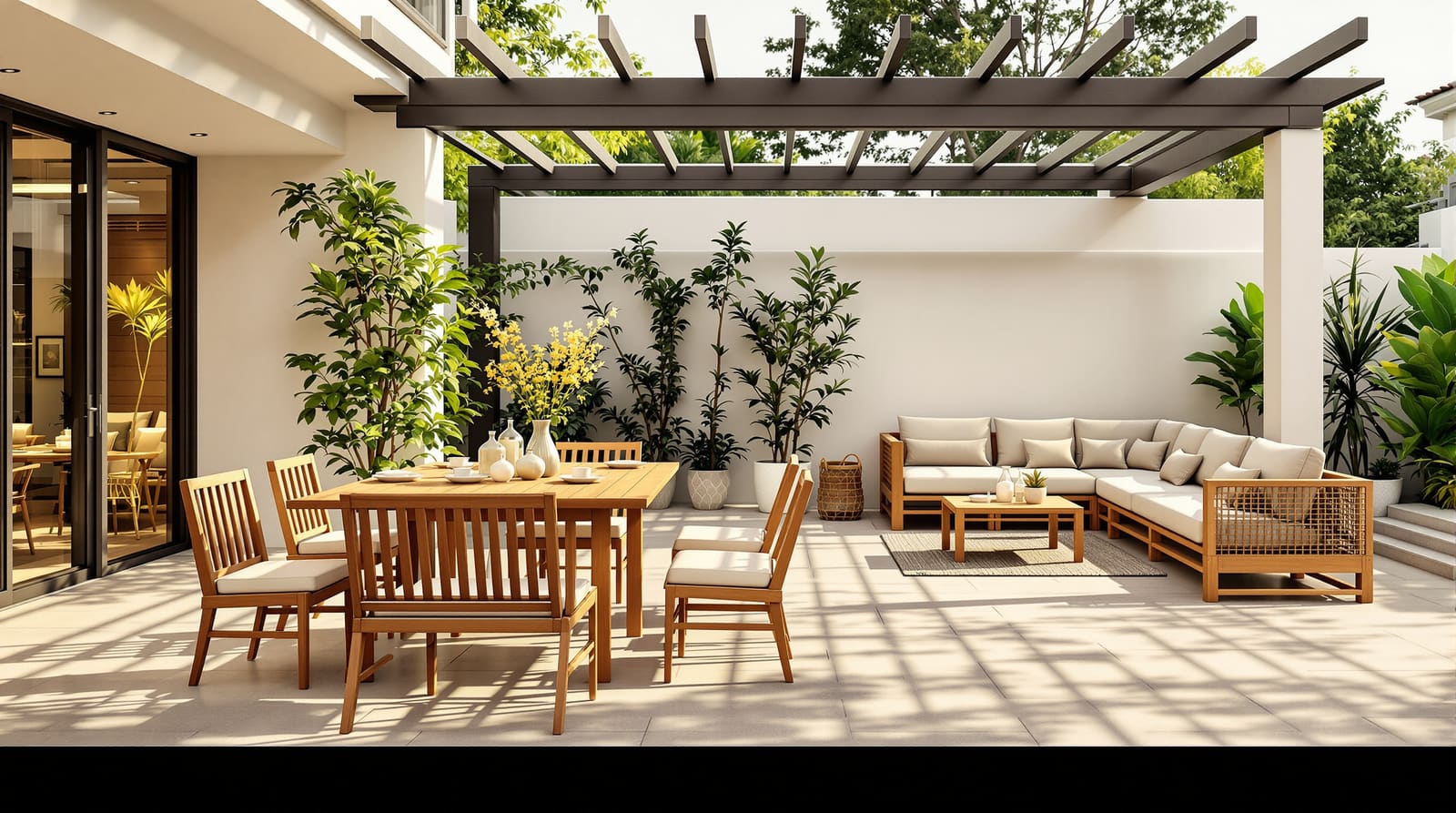
Outdoor Furniture Planning
Planning the outdoor room — sizing and clearances, materials for the Indian climate, cushions and fabrics, shade, maintenance and monsoon storage
Good outdoor furniture begins as a floor plan, not a shopping list — decide the rooms your garden, terrace or balcony will hold, size each one to how people actually move and sit, then choose pieces in materials that can take Indian sun, monsoon and salt without surrendering. Indoors you can buy a sofa you love and the room forgives it. Outdoors the climate is unforgiving and the space is rarely rectangular, so the discipline runs the other way: plan the zones, fix the clearances, then specify materials to match the punishment they will take.
This guide stays deliberately in one lane: how to plan and choose furniture for gardens, terraces, balconies and outdoor rooms. The hard surface it stands on — the deck, tile or stone — is covered in the pillar Outdoor Flooring Guide, and the wider composition of the space in Backyard Design Ideas. Here we talk about the chairs, tables, day-beds and swings, and the cushions and shade that make them usable through an Indian year.
Plan the outdoor room before you buy a single chair
The most expensive mistake in outdoor furniture is buying first and planning never. A terrace becomes a graveyard of one orphan dining set baking in full sun while the shaded corner sits empty. Reverse it. Walk your space at the times you will actually use it — early morning chai, evening, after dinner — and note where the shade falls, where the breeze comes from, and where you would want to sit. Outdoor rooms are defined by use, exactly like indoor ones:
- Dining — the workhorse zone. Needs the flattest, most sheltered patch and proximity to the kitchen door.
- Lounge / conversation — softer seating in a loose grouping, ideally facing a view, planting or a water feature.
- Day-bed / swing (jhoola) — the rest zone; the single most-loved piece in most Indian homes, deserves a sheltered, breezy spot.
- Work / solo — a single chair-and-side-table nook for a laptop or a book, often tucked where the dining set will not reach.
Match furniture to these zones rather than filling the floor evenly. A 400 sqft terrace might comfortably hold a 4-seater dining set, a two-seater lounge corner and a swing — three rooms, not one big scatter. The art is in editing: leave deliberate empty floor so the space breathes and circulation flows. This zoning logic dovetails with the planting and movement strategy in Climate-Responsive Landscape Design.
Sizing and layout: the clearances that make or break it
This is the section most homeowners skip and most regret. Outdoor furniture is bought from photos that flatter scale, and the pieces arrive bigger than imagined. Over-sizing is the cardinal sin — a 6-seater on a balcony that wanted a bistro set, a sectional that swallows a small terrace. Plan to clearances, not to catalogue lust.
Dining clearances
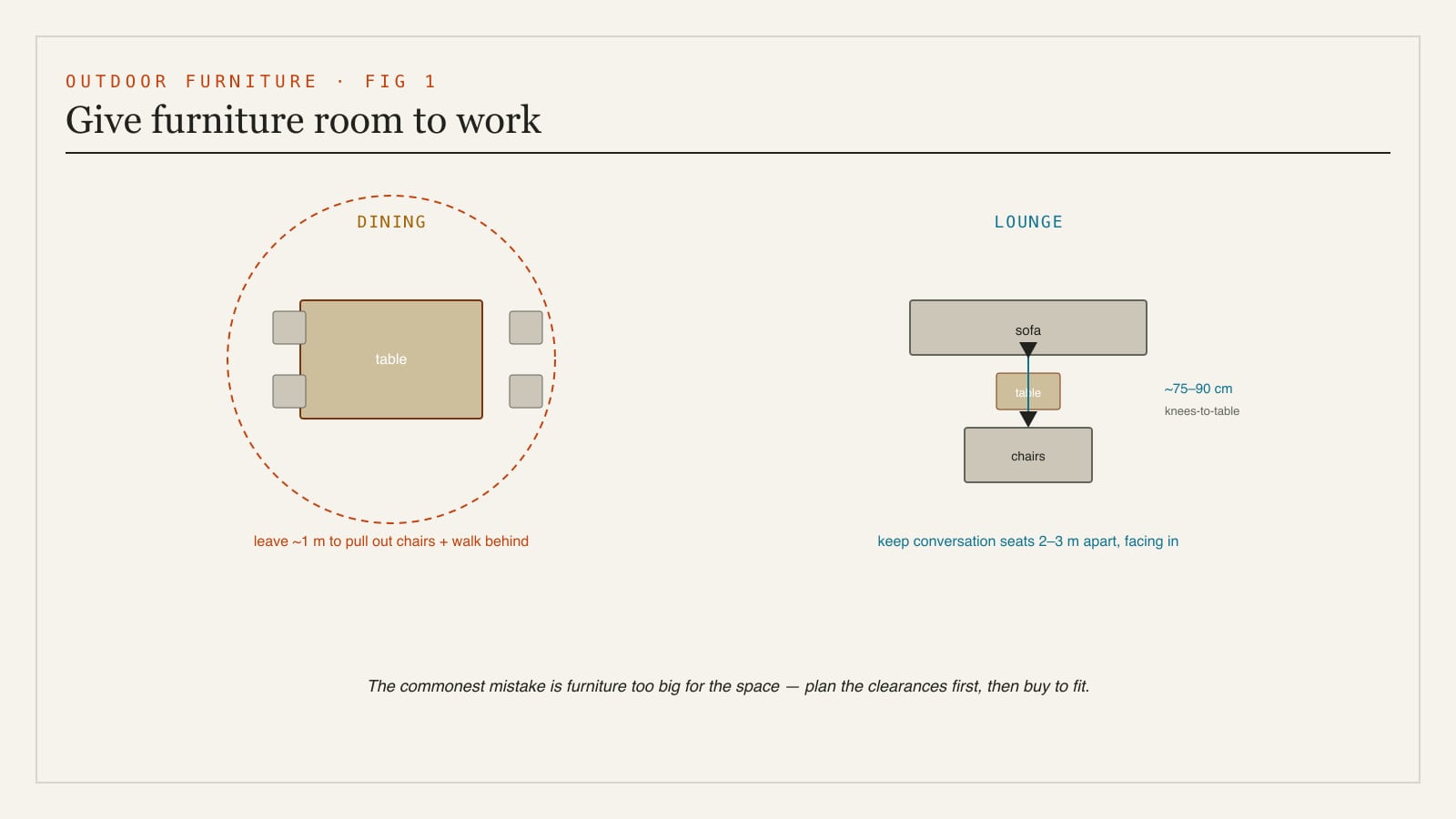
A diner needs roughly 600 mm of table edge to themselves, and you must be able to pull a chair back and walk behind a seated person. The numbers below are the ones that prevent a cramped, knock-the-knees setting.
| Dining metric | Minimum | Comfortable |
|---|---|---|
| Chair pull-back (seat to obstruction behind) | 750 mm | 900 mm |
| Walkway behind a seated diner | 900 mm | 1100 mm |
| Per-person table width | 600 mm | 700 mm |
| Round table dia. for 4 | 900 mm | 1050 mm |
| Round table dia. for 6 | 1200 mm | 1350 mm |
| Rectangular 6-seater | 1500 × 900 mm | 1800 × 1000 mm |
| Total floor for a 6-seater set | ~3.0 × 3.0 m | ~3.6 × 3.6 m |
A useful rule of thumb: a dining set needs its own footprint plus roughly one metre of clear floor on every side. An 8-seater (table ~2100 × 1000 mm) therefore wants a clear zone of about 4.1 × 3.0 m before umbrellas or planters intrude.
Lounge / conversation clearances
Lounge seating is about distance between people, not around them. Seats that are too far apart kill conversation; too close feels like a waiting room.
| Lounge metric | Target |
|---|---|
| Face-to-face seat distance (knees to knees) | 1.0–1.4 m |
| Coffee table to seat front | 350–450 mm |
| Coffee/centre table height vs seat | within ~50 mm of seat height |
| Walkway through a grouping | ≥ 700 mm |
| Conversation grouping diameter (4–5 seats) | keep within ~3.6 m |
Keep a conversation circle tight — beyond about 3.6 m across, people raise their voices and the grouping stops feeling intimate. On balconies under 5 sqm, abandon the sofa idea entirely: two compact chairs and a folding bistro table seat two and fold away in monsoon, which is what a balcony actually wants.
Scale to the space
Choose pieces that leave at least one-third of the floor empty. Low-profile, open-frame furniture (slim aluminium, rope, see-through rattan) reads lighter and suits small Indian terraces far better than chunky teak blocks. Save the heavy hardwood for genuinely large gardens.
Materials for the Indian climate, compared honestly
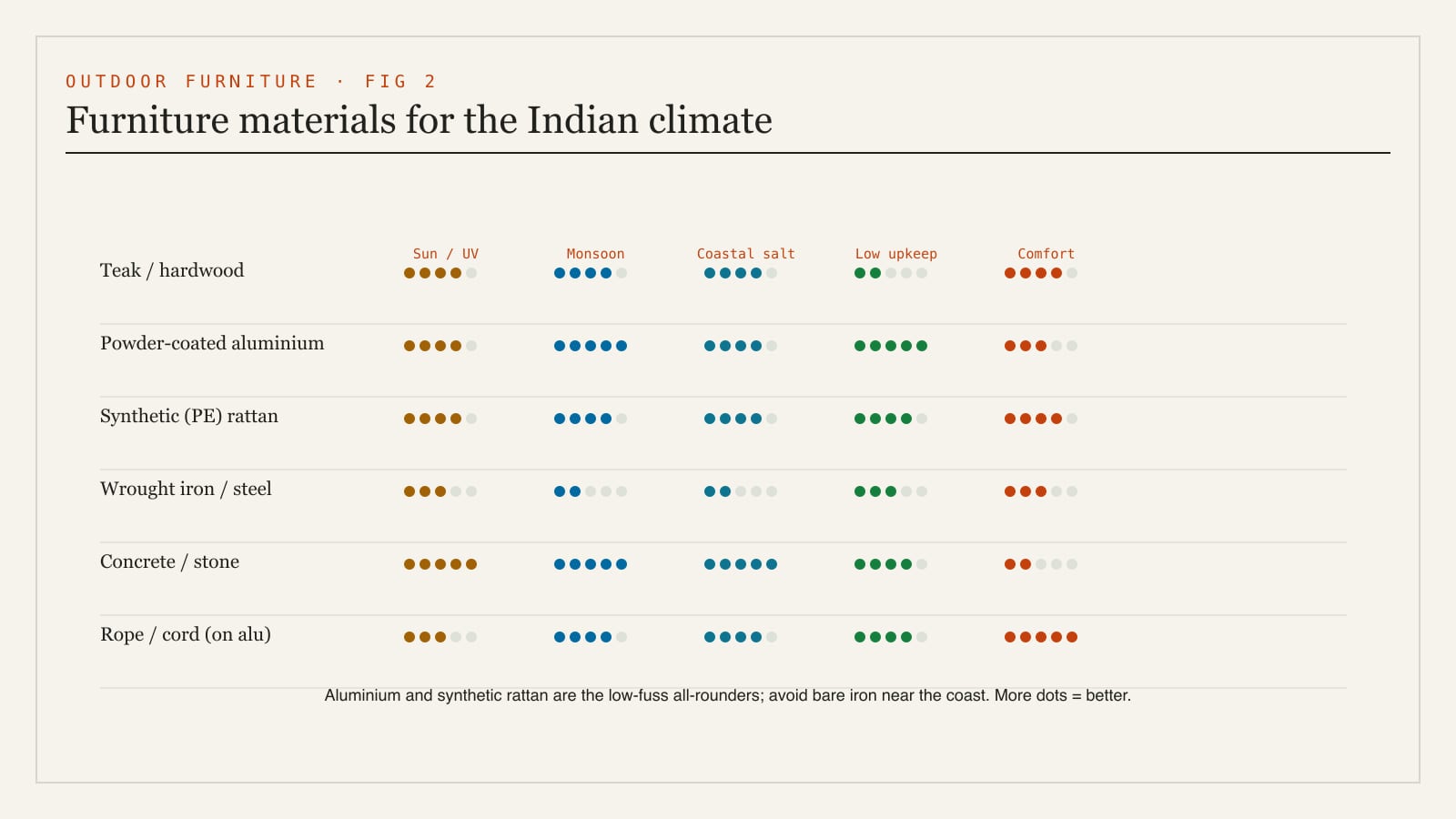
Outdoor furniture in India faces four assaults at once: UV that bleaches and embrittles, monsoon that swells, rots and rusts, summer heat that makes metal untouchable, and — within ~10 km of the coast — salt that corrodes everything faster. No single material wins on all fronts; choose for your site.
- Teak & tropical hardwoods (teak, Burma teak, sheesham/rosewood for covered use): the gold standard. Naturally oily, dimensionally stable, handles monsoon and sun for decades. Silvers to grey if left untreated (purely cosmetic). Heavy, expensive, and genuine teak is increasingly scarce — beware "teak-finish" rubberwood sold as the real thing, which will not survive a season outdoors.
- Powder-coated aluminium: the smart all-rounder. Will not rust, light enough to move, takes a tough powder coat in any colour. Best choice near the coast. Heats up in direct sun (use cushions) and a cheap coat can chalk under UV — specify a quality polyester powder coat.
- Synthetic / PE rattan & wicker (HDPE or PE resin over an aluminium frame): the most popular ready-made category in India. UV-stabilised PE strands woven on a non-rusting aluminium core resist sun, rain and salt well; the cheap PVC versions crack and fade within two summers. Insist on the aluminium frame, not iron.
- Wrought iron / mild steel: beautiful, heavy, stable in wind — but it rusts. Acceptable only powder-coated or galvanised and kept away from the coast; expect annual touch-ups. Stainless steel (SS 316 marine grade) is the rust-proof premium alternative, costly but salt-immune.
- Concrete & natural stone (cast benches, stone slabs, Kota/granite tops): effectively permanent and immovable — ideal for built-in seating and tables that never need storing. Cold and hard, so pair with cushions. Stone can develop algae in shade during monsoon.
- Rope / cord (braided olefin or PE rope on aluminium): the contemporary look. Comfortable, breathable, dries fast — but quality varies wildly; cheap rope sags and frays under UV within a year. Buy UV-rated marine-grade cord only.
- Plastic / HDPE (moulded chairs, poly-lumber "recycled plastic" furniture): cheapest and genuinely weatherproof. Moulded monobloc chairs are throwaway-grade; poly-lumber (recycled HDPE planks that mimic timber) is a serious, maintenance-free option gaining ground in India.
| Material | UV resistance | Monsoon | Heat (touch) | Coastal salt | Relative cost | Maintenance |
|---|---|---|---|---|---|---|
| Teak / hardwood | Excellent | Excellent | Cool–warm | Good | High | Med (oil annually or let grey) |
| Powder-coated aluminium | Good | Excellent | Hot in sun | Excellent | Med–high | Low |
| Synthetic PE rattan | Good (if UV-rated) | Excellent | Warm | Excellent | Med | Low |
| Wrought iron / MS | Good | Poor (rusts) | Hot in sun | Poor | Low–med | High |
| Stainless 316 | Excellent | Excellent | Hot in sun | Excellent | High | Low |
| Concrete / stone | Excellent | Good (algae in shade) | Cool | Excellent | Med–high | Low |
| Rope / cord | Fair–good | Excellent | Cool | Good | Med | Med |
| HDPE / poly-lumber | Good | Excellent | Warm | Excellent | Low–med | Very low |
Indicative ₹ ranges (frame only, before cushions): a moulded HDPE chair ₹1,200–3,000; a synthetic-rattan 4-seater lounge set ₹25,000–70,000; a powder-coated aluminium dining set (table + 6) ₹45,000–1,20,000; a solid teak 6-seater dining set ₹90,000–2,50,000+; SS 316 or designer rope sets run higher still. Built-in concrete or masonry seating costs roughly ₹1,800–4,000 per running ft to build — often the best value per seat over a 20-year horizon, as detailed in the Landscape Cost Guide.
Cushions and fabrics: where outdoor furniture really fails
Frames last decades; cushions are what rot, fade and breed mildew. Indoor upholstery foam acts like a sponge outdoors and stays wet for days. Specify properly:
- Fabric: solution-dyed acrylic is the benchmark — the colour goes through the fibre, so it resists UV fading for years and shrugs off rain. (The category-defining brand is Sunbrella; "solution-dyed acrylic" is the spec to ask for.) Avoid printed polyester, which fades in one summer.
- Foam: quick-dry / reticulated open-cell foam lets water drain straight through and air-dry. Pair with a mesh underside. Never use ordinary PU foam outdoors.
- Storage: even the best cushions should come indoors during the heaviest monsoon weeks and when unused for long spells. Build a deck box, ottoman with storage, or allot a dry cupboard. A cushion that lives permanently in the rain will mildew regardless of fabric grade.
A practical compromise for most Indian homes: weatherproof the frames fully, but treat cushions as semi-disposable — buy good fabric, store it in monsoon, and plan to recover every 4–6 years.
The jhoola, the swing and built-in seating
The jhoola (swing seat) is the heart of the Indian outdoor room, from a brass-chain wooden swing on a veranda to a contemporary hanging egg-chair on a terrace. Two non-negotiables: the anchorage and the swing clearance. A swing must hang from a structural beam or a properly engineered frame — never from a false ceiling or a thin pergola rafter. Allow at least 600 mm of clear space behind and in front of the seat at full swing, and 400–500 mm to either side. A free-standing swing frame needs a stable, level base; on a terrace, confirm the slab can take the dynamic load.
Built-in seating — masonry or concrete benches finished in stone, tile or IPS, often wrapping a corner or a planter — is the unsung hero of small spaces. It seats more people per square metre than loose furniture, never needs storing, doubles as a low wall, and can hide storage beneath. Top it with a quick-dry cushion and it rivals any sofa. It also pairs naturally with built-in planting; see how it threads into a scheme in Villa Landscape Design.
Shade: furniture is only as usable as its shadow
In most of India, unshaded furniture is unusable from roughly 10 am to 4 pm for eight months of the year. Plan shade with the furniture, not after:
- Cantilever / side-post umbrellas (₹8,000–40,000) keep the pole out of the table and swing to track the sun — the most flexible option, but must be weighted (50–90 kg base) or they become a monsoon-wind hazard. Always close and tie them down before a storm.
- Centre-pole market umbrellas (₹3,000–15,000) suit a dining table with a built-in hole; cheaper but block the table centre.
- Pergolas and overhead structures give permanent, generous shade and let you treat the space beneath as a true outdoor room — the strongest long-term solution, and the one that makes a terrace work year-round.
- Trees are the cheapest and coolest shade of all; site furniture under existing canopy where you can, drawing on Best Trees for Indian Homes.
Orientation matters: a west-facing terrace bakes in the evening and needs the most aggressive shade; an east-facing one is golden for breakfast and forgiving thereafter.
Maintenance and monsoon storage
A realistic seasonal rhythm keeps outdoor furniture looking good for a decade:
- Pre-monsoon: oil teak (or accept the grey), check and re-tighten all bolts, touch up any chips in powder coat or galvanising before rust takes hold, and service umbrella mechanisms.
- During monsoon: bring cushions in; tilt or store light furniture against wind; keep aluminium and rattan off pooled water (raise on feet or pads). Wipe stone/concrete to discourage algae.
- Post-monsoon: wash salt and grime off (especially coastal aluminium and SS), clean rattan weave with a soft brush, dry cushions thoroughly before re-deploying.
- Year-round: a quick wipe-down monthly does more for longevity than any annual deep-clean.
Stackable or folding pieces and a single weatherproof storage box transform monsoon management from a chore into a five-minute job. This is exactly why over-buying hurts: every extra piece is another thing to wrestle indoors each June.
Buying tips
- Buy the frame for life, the cushion for now. Spend on a rust-proof, UV-stable frame; treat fabric as a renewable.
- Verify the core. Ask whether "rattan" is over aluminium (good) or iron (rusts), and whether "teak" is solid teak or veneered rubberwood.
- Demand IP-honest specs. UV-rated, marine-grade, 316 stainless, polyester powder coat — get it in writing, not just "weatherproof".
- Coastal homes: default to aluminium, SS 316, PE rattan, stone and poly-lumber. Treat iron and untreated steel as disposable.
- Measure your space, then subtract. Tape out the footprint on the floor with chalk and walk the clearances before you order. If it feels tight on paper, it will feel worse in person.
- Test-sit before you commit where possible; outdoor seat depth and back angle vary enormously and a photo cannot tell you.
Pieces chosen this way — zoned to real use, sized to honest clearances, specified for your climate — turn an exposed terrace or scrappy garden into the most-used room of an Indian home. The furniture is the easy part once the planning is right. For the wider composition that holds it all together, continue with Backyard Design Ideas, the deck it may sit on in Wooden Decks for Indian Homes, and how the floor underneath should perform in the pillar Outdoor Flooring Guide. For a calmer, restorative take on the lounge zone, see Outdoor Wellness Spaces.
References & further reading
- Bureau of Indian Standards, IS 1003 (Timber Panelled and Glazed Shutters) and IS 4021 / IS 401 (Preservation of Timber) — guidance on seasoning and treatment relevant to outdoor hardwood furniture.
- National Building Code of India 2016, Part 10 (Landscaping, Signs and Outdoor Display Structures) — circulation, outdoor structures and shade-element guidance.
- Bureau of Indian Standards, IS 4759 (Hot-Dip Zinc Coatings on Structural Steel) — the galvanising standard that governs rust-resistant outdoor steel frames.
- Julius Panero & Martin Zelnik, Human Dimension and Interior Space — the standard reference for seating, dining and circulation clearances used throughout this guide.
- Indian Society for Trenchless Technology and BIS marine-environment corrosion notes (IS 9077, atmospheric corrosion of metals) — basis for coastal material selection.
- Manufacturer-neutral guidance on solution-dyed acrylic outdoor fabric and reticulated quick-dry foam (industry technical datasheets) for cushion specification.
Export this guide
Related Guides — Deep-dive reading
From Space to Place: Turning Empty Rooms into a Home
How to transform a bare builder flat into a warm, lived-in home — through scale, zones, layering, retreat corners and flow
Design EducationStorage Planning Before Interior Design
Why storage must be planned first — audited, budgeted and given its floor area — before a single layout, colour or sofa is chosen. The homeowner's plan-it-first master guide for Indian homes.
StorageFreestanding Bathtub India: Materials, Floor Load, Concealed Plumbing & Cost (2026)
The statement centrepiece tub that stands free of every wall — how acrylic, stone-resin and cast-iron differ, the floor load a filled tub imposes, the concealed rough-in you must set out before the flooring goes down, the clear space it needs all around, drainage, and honest 2026 rupee costs.
BathroomsRelated Tools — Try Free
False Ceiling Cost Estimator
Live ₹/sqft across 8 ceiling types — POP, gypsum, designer, metal, PVC, wooden — with cove and spot lighting for 20 Indian cities.
Cost CalculatorCross-Ventilation Analyzer
Estimate airflow and air changes per hour (ACH) from room size, window areas, layout, and local wind — with NBC 2016 Part 8 compliance check.
Ventilation CalculatorApartment Furniture Size Chart
Standard furniture dimensions for Indian apartments — sofas, beds, tables, dining, storage.
Reference Chart