
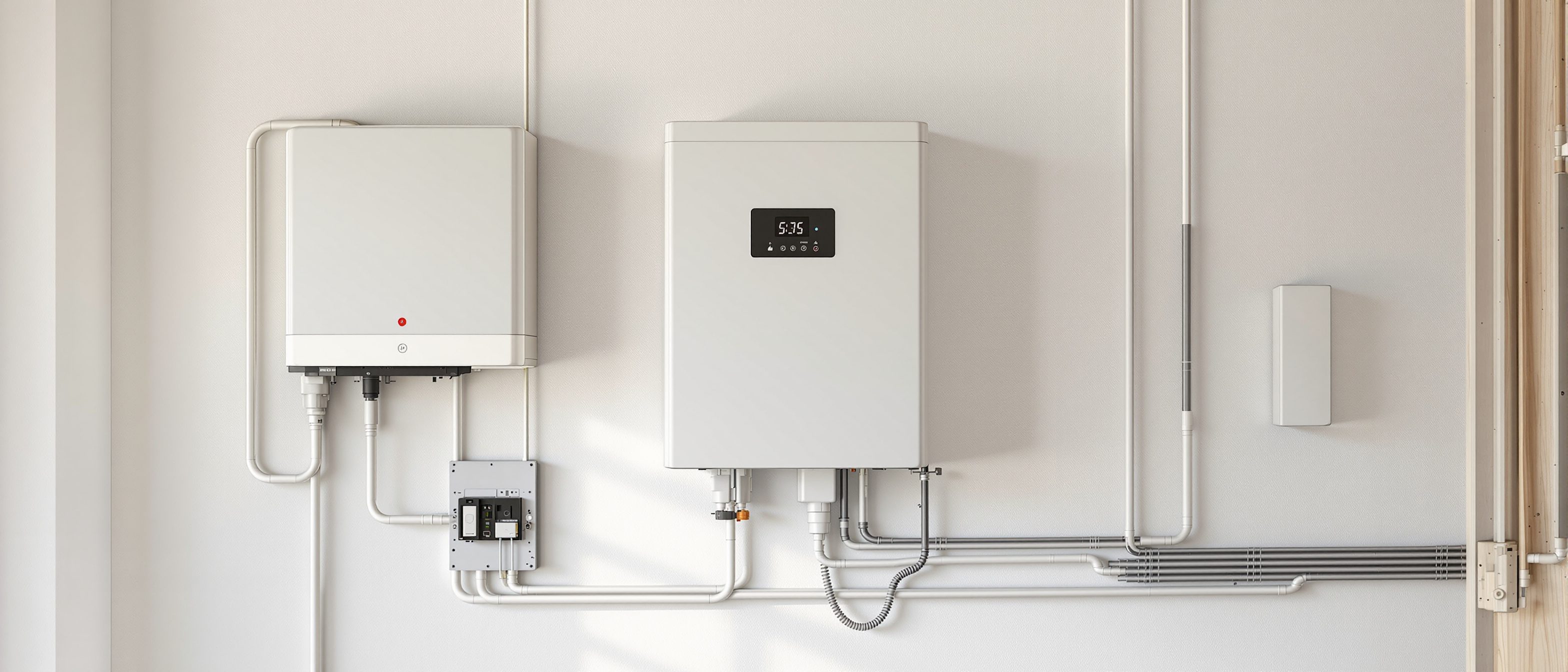
Home Battery & Backup Power for Indian Homes
Staying powered through cuts today, storing your own solar tomorrow
There is a particular sound an Indian home makes when the power goes: the descending whine of fans slowing, the chorus of UPS beeps from three flats away, the scramble for phone torches. For most of us it is so routine we have stopped noticing it. We have also stopped designing for it. The backup arrangement in the average new home is an afterthought bought from whoever the electrician knows, sized by guesswork, and bolted to a wall with no ventilation and no plan to ever change it.
That is a mistake, because the next fifteen years of Indian home energy are going to be about storage, not just supply. The grid is getting better in patches and worse in others; rooftop solar is now genuinely cheap; lithium battery prices have fallen faster than almost anyone predicted; and time-of-day tariffs are arriving that will reward homes that can shift their own power around the clock. The home that wins is the one whose walls were built to hold a battery and route a backup circuit, whether or not the battery is there on day one.
This guide is strictly about the storage and backup layer: how you stay powered through a cut today, and how you store your own solar tomorrow. It is the boring, structural half of the energy story, and it is the half that decides whether your future upgrades are a clean afternoon's work or a wall-chasing renovation.
Provision the backup wall and a dedicated backup circuit while the house is open, choose your battery on cost-per-usable-kWh rather than sticker price, and you turn every future power problem from a demolition project into a plug-in one.
1. The backup hierarchy: four ways to stay powered
Before sizing anything, understand the four options and where each genuinely belongs. They are not competitors so much as rungs on a ladder, and most Indian homes end up using two of them.
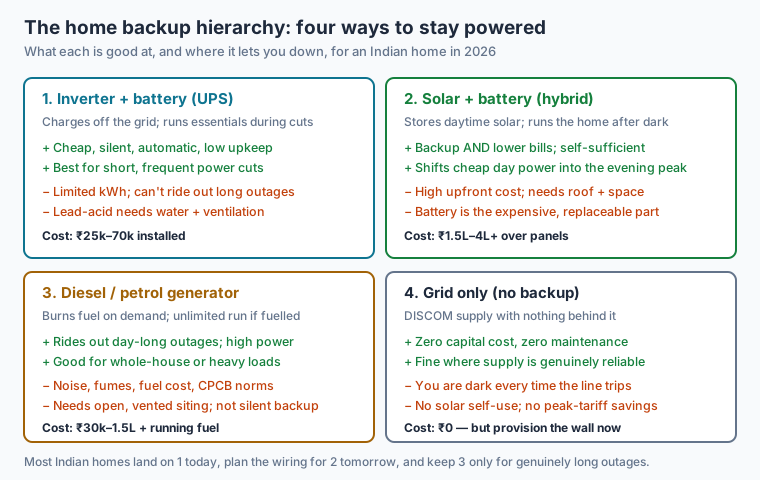
Figure 1: The four rungs of home backup, with what each is good and bad at for an Indian home.
The inverter-plus-battery UPS is the workhorse of the Indian home: it charges silently off the grid and runs your essentials the moment the line trips. It is cheap, automatic and low-fuss, and it is the right answer for the short, frequent cuts that define most cities. Its limit is energy: a typical home unit holds a couple of usable units, so it carries you through a thirty-minute outage comfortably and a four-hour one only if you are disciplined about loads.
The solar-plus-battery hybrid is the same idea grown up. A hybrid inverter charges the battery from your rooftop solar during the day and discharges it in the evening, so the pack does double duty: backup when the grid fails, and bill-reduction every single night. This is where home energy is heading, but it is also where the money is, and the battery is the expensive, replaceable component. The panels themselves belong to a separate decision covered in solar-ready home design and the payback maths in solar power for homes; here we care only about the storage bolted to them.
The fuel generator is the brute-force option: a diesel or petrol genset that burns fuel on demand and will run as long as you keep feeding it. It is the only thing that comfortably rides out a day-long outage or powers heavy loads like multiple air-conditioners. It is also noisy, smelly, governed by CPCB emission and noise norms, and needs open, ventilated siting. For a single home it is rarely the primary backup; it is the insurance for the rare multi-hour blackout, or the default in tier-2 and rural areas where cuts are long.
Grid-only — no backup at all — is a legitimate choice in the handful of pockets where supply is genuinely reliable. But even then, the smart move is to provision the wall and the circuit now so that adding storage later is trivial.
A useful principle: back up comfort, not consumption. The goal of home storage is to keep the lights, fans, fridge and router alive and the family unbothered — not to run the whole house as if nothing happened. That single decision halves the cost of everything downstream.
2. Which circuits to back up — and why less is more
The biggest money mistake in home backup is sizing it to run the entire house. You do not need backup on the geyser, the iron, the microwave, the washing machine or the central AC. Those are short, deferrable, high-wattage loads — exactly the ones a battery hates. Back them up and you are paying for a pack two or three times larger than you need.
What you actually want on backup is the essential evening load: lighting, fans, the refrigerator, the Wi-Fi router, a television or laptop, and device charging. Optionally, one inverter air-conditioner if you live somewhere a summer evening cut is genuinely unbearable. Everything else stays on the raw grid and simply goes dark during a cut — which, for a microwave, is fine.
This split is a wiring decision, and it is the single most important provision you make. It means a dedicated backup sub-distribution board: a small consumer unit fed from the inverter that carries only the backed-up circuits, separate from the main DB. The detailed circuit and board design lives in future-proof wiring systems; the point here is that the backup DB and its wiring must be planned at construction, because retrofitting a separate backed-up ring into a finished home means tracing and re-routing half the lighting circuits.
3. Sizing the battery: the kWh and VA maths
Two numbers size a backup system, and people routinely confuse them. Kilowatt-hours (kWh) is how much energy you store — it sets how long you last. Volt-amperes (VA) is how much power you can draw at once — it sets what you can switch on simultaneously. A battery can be large in kWh but limited in VA, or the reverse.
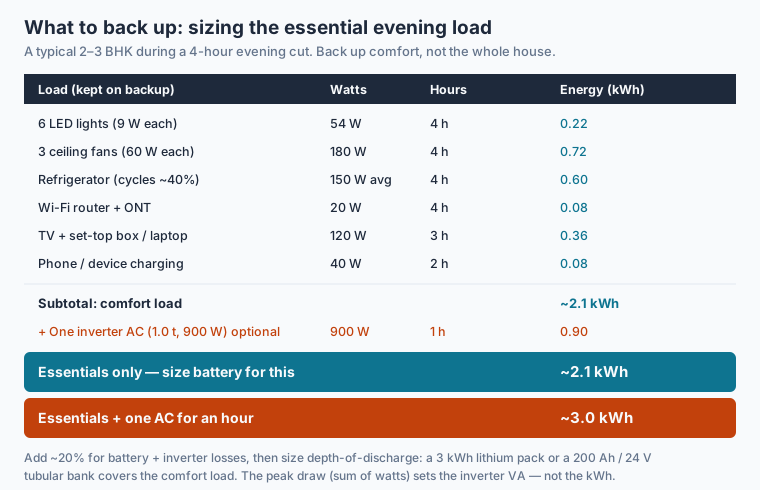
Figure 2: Worked sizing for a typical 2–3 BHK essential load during a four-hour evening outage.
Work the energy side first. Add up each backed-up load's wattage, multiply by the hours you want it to run, and sum. For a typical 2–3 BHK — six LED lights, three fans, the fridge, router, TV and charging — the comfort load comes to roughly 2.1 kWh over a four-hour evening cut. Add one inverter AC for an hour and you are near 3.0 kWh. Then add about 20% for inverter and battery round-trip losses, and divide by your battery's usable depth-of-discharge (more on that next) to get the nominal pack you must buy.
Now the power side. The inverter VA rating must cover the worst-case simultaneous draw — the sum of watts that could be on at the same instant, including the brief surge when a fridge compressor or pump kicks in. For the comfort load above, the steady draw is under 600 W, but a fridge start can spike to a couple of thousand watts for a fraction of a second, so a 1,500–2,500 VA inverter is the usual home choice. If you want that one AC on backup, jump to 3,000 VA or more. Get this wrong and the inverter trips on overload even though the battery is full.
| Home profile | Essential load | Battery (usable) | Inverter (VA) |
|---|---|---|---|
| 1–2 BHK, lights/fans/router only | ~1.0 kWh | 1.0–1.5 kWh | 1,000–1,500 VA |
| 2–3 BHK, + fridge + TV (typical) | ~2.1 kWh | 2.5–3.0 kWh | 1,500–2,500 VA |
| 3 BHK + one inverter AC | ~3.0 kWh | 4.0–5.0 kWh | 3,000–3,500 VA |
| Villa, hybrid solar self-use + backup | 6–12 kWh | 8–15 kWh | 5,000 VA+ |
The smart home cost calculator is a quick way to sanity-check the capital outlay once you have settled on a tier.
4. Battery chemistry, honestly
This is where the marketing is thickest, so be clinical. There are two realistic chemistries for an Indian home: tubular lead-acid (the traditional inverter battery) and lithium iron phosphate, or LFP (the new wall-mounted packs). Do not compare them on sticker price; compare them on cost per usable kWh over the home's life.
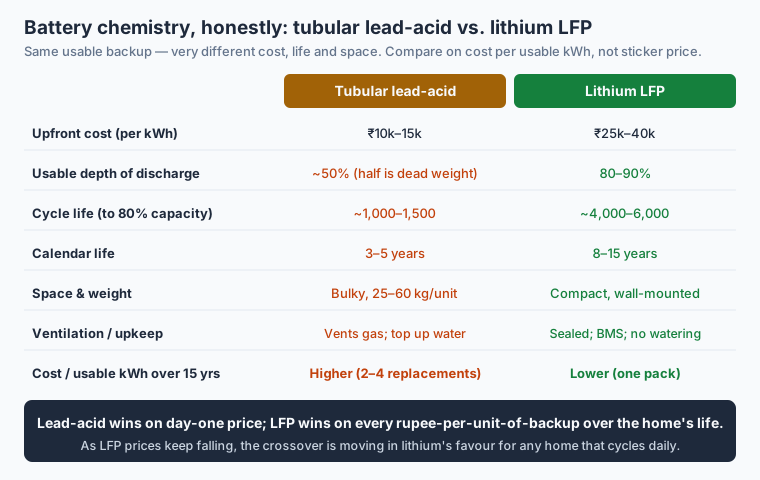
Figure 3: Tubular lead-acid against lithium LFP across the things that actually decide value.
Lead-acid is cheap to buy and that is its only real advantage. You can only safely use about half its rated capacity before you damage it, so a "150 Ah" battery gives you far less usable energy than the number suggests. It lasts roughly 1,000–1,500 cycles or three to five years, it is heavy and bulky, and a flooded tubular unit vents hydrogen and needs distilled-water top-ups — which is why it must sit somewhere ventilated, not in a sealed cupboard.
LFP costs two to three times more per kWh on day one and earns it back. You can use 80–90% of its capacity, it lasts 4,000–6,000 cycles or eight to fifteen years, it is compact enough to wall-mount, and it is sealed with a built-in battery management system — no watering, no gassing in normal use. LFP is also the safest lithium chemistry, far more thermally stable than the NMC cells in laptops and phones, which is exactly why it has become the home-storage default.
The verdict is uncomfortable for the cheap option: if your battery only sits there for the occasional cut and rarely cycles, lead-acid can still make sense. But if you are pairing with solar and cycling the pack every single day, LFP is cheaper per unit of backup delivered, because you will buy two to four lead-acid replacements in the time one LFP pack lasts.
Note on space and safety: whatever the chemistry, the battery needs a cool, dry, ventilated location away from direct sun and living areas. Lead-acid for the gassing; lithium because heat is the enemy of cycle life and a hot meter cupboard quietly ages the pack. Plan the location as carefully as the capacity.
5. Hybrid inverters and pairing with solar
If there is any chance you will add rooftop solar — and over a fifteen-year horizon, there almost certainly is — buy a hybrid inverter rather than a plain backup one, or at least wire the wall so a hybrid can drop in. A hybrid inverter manages three sources at once: solar, battery and grid. It charges the battery from the sun by day, runs the house off stored solar in the evening, and falls back to the grid only when both are exhausted.
This is what makes storage pay for itself beyond backup. As time-of-day tariffs roll out — already mandated for many consumers and spreading to households — grid power will cost more in the evening peak and less off-peak. A battery lets you fill up on cheap day-time solar or off-peak grid and avoid the expensive evening units entirely. The whole-home version of this balancing act is covered in net-zero energy homes; the storage layer is simply its beating heart.
The provisioning move here is small and cheap: run an empty conduit from the roof to the inverter wall during construction, so that when the panels go up, the DC string cable pulls through in an afternoon instead of being surface-clipped down an outside wall. The generation side — tilt, shading, structural roof allowance — is the subject of solar-ready home design; pair that conduit with this battery wall and the two halves meet cleanly.
6. Provision now vs. retrofit later
This is the cluster's signature move, and backup power is one of its clearest examples. Almost everything expensive about retrofitting storage is the building work, not the battery. Provide the right blank canvas during construction and the upgrade is plug-and-play; skip it and you are chasing walls and re-plastering.
| What you provision NOW (during build) | Cost now | If you retrofit it later |
|---|---|---|
| Ventilated battery/inverter niche near the meter (cool, dry, vented) | ₹3,000–8,000 | Rebuild a cupboard, add a vent: ₹15,000–40,000 + mess |
| Dedicated backup sub-DB + separated essential circuits | ₹6,000–15,000 | Re-trace and re-route lighting rings: ₹30,000–80,000 |
| Empty conduit roof → inverter wall for future solar DC | ₹2,000–5,000 | Surface trunking down an external wall, or chase it: ₹15,000–35,000 |
| Spare way + isolator for a future battery in the main board | ₹2,000–4,000 | Board upgrade + an electrician's afternoon: ₹8,000–20,000 |
| Earthing point and 1 sq m clear floor/wall for the pack | negligible | Awkward relocation; sometimes simply impossible |
The pattern is the same every time: a few thousand rupees of provisioning removes a five-figure demolition decision a few years out. You are not buying the battery now — lithium will be cheaper and better when you do — you are buying the option to add it without tearing the house apart. That is the whole thesis of designing homes for 2040, applied to electrons.
7. Maintenance and the real ten-to-fifteen-year cost
The number that matters is not what you pay on day one but what the system costs you across the home's life, because batteries are the one part of your electrical system that wears out on a clock. Plan for replacement from the start.
Lead-acid demands the most attention: distilled-water top-ups every few months, terminal cleaning, and a full replacement every three to five years. Over fifteen years that is two to four battery purchases plus the recurring upkeep. Lithium LFP is close to maintenance-free — the BMS handles balancing, there is no watering — and on a daily-cycling home a single pack often sees out the fifteen years, or needs one replacement at most. Both lead-acid and lithium are recyclable, and lead-acid in particular has an established buy-back ecosystem in India that offsets a little of the replacement cost.
| Item | Tubular lead-acid (15 yr) | Lithium LFP (15 yr) |
|---|---|---|
| Replacements expected | 2–4 packs | 0–1 pack |
| Routine maintenance | Water top-ups, terminal care | Essentially none |
| Typical 3 kWh-usable lifetime spend | High — repeated purchases | Lower — one big purchase |
| End of life | Recyclable, buy-back exists | Recyclable, BMS-managed |
The honest summary: a cheap battery is expensive over time, and an expensive battery is cheap over time, as long as you actually cycle it. Budget for the replacement now — in your sinking fund and in your wall layout — so that swapping a pack in year eight is a thirty-minute job, not a renovation.
8. Where home storage is heading — and the EV in your driveway
Two forces are reshaping this decision faster than most homeowners realise. The first is falling lithium prices: LFP cell costs have dropped sharply and continue to, which is steadily pulling the crossover point in lithium's favour for any home that cycles daily. A battery that looks marginal today will look obvious in three years. The second is tariff reform: as time-of-day pricing spreads to households, the financial case for storage shifts from "backup insurance" to "everyday bill management", and that changes who should buy a battery at all.
Then there is the largest battery you will ever own — the one in your car. An electric vehicle carries 30–60 kWh of storage, ten to twenty times a home pack, and vehicle-to-home (V2H) technology is beginning to let that battery power the house during an outage. It is early in India and needs a compatible vehicle and a bidirectional charger, but the provisioning is identical to what you do for any backup wall: a ventilated location, a clean tie-in to the backup DB, and conduit headroom. If you are already laying the groundwork for an EV — see EV-ready home design — you are most of the way to a future where the car becomes the home's emergency battery. You do not have to buy any of this today. You only have to build the wall so it is ready when you do.
Sources & further reading
- Bureau of Indian Standards — IS 13314 (stationary lead-acid batteries) and IS 16270 / IS 16893 series (lithium-ion cells and battery packs for stationary and solar applications).
- Central Electricity Authority (CEA) — Measures relating to Safety and Electric Supply Regulations and guidance on consumer installations, distribution boards and earthing.
- Ministry of New and Renewable Energy (MNRE) — PM Surya Ghar: Muft Bijli Yojana programme guidelines for rooftop solar, hybrid inverters and storage eligibility.
- Bureau of Energy Efficiency (BEE) — star-labelling and efficiency data for appliances (fans, refrigerators, air-conditioners) used in load estimation.
- Central Pollution Control Board (CPCB) — noise and emission norms for diesel generator sets used as home backup.
- Ministry of Power — time-of-day (ToD) tariff rules under the Electricity (Rights of Consumers) Rules, as amended.
- National Building Code of India (NBC) — Part 8, electrical and allied installations, for siting, ventilation and safety of battery rooms and inverter locations.
Pairs with the pillar designing homes for 2040, and its siblings net-zero energy homes and future-proof wiring systems.
Export this guide
Related Guides — Deep-dive reading
Future-Proof Wiring Systems for Indian Homes
Build electrical headroom now so tomorrow's loads are plug-and-play, not demolition.
Future-Ready HomesResidential Electrical Systems: The Complete Guide for Indian Homes
How the electricity in an Indian home actually works — from the utility supply and meter through the distribution board, circuits, wiring, earthing and protection, to lighting, safety, energy efficiency, smart controls, solar and backup — written so a homeowner can understand, plan and judge it, and know exactly where a licensed electrician must take over.
Electrical & WiringDesigning a Naturally Energy-Efficient Indian Home
Comfort first, gadgets last — passive design, orientation, insulation, ventilation and the climate wisdom that cuts Indian energy bills
SustainabilityRelated Tools — Try Free
Cross-Ventilation Analyzer
Estimate airflow and air changes per hour (ACH) from room size, window areas, layout, and local wind — with NBC 2016 Part 8 compliance check.
Ventilation CalculatorElectrical Safety & Load Audit
Home electrical audit — 10 categories, 65+ checkpoints across earthing, RCCB, MCB, wiring, switchboards, appliance circuits, DG/inverter backup.
Safety AuditRainwater Tank Sizer
How big should your rainwater tank be? Computes annual harvest, recommended tank capacity in litres, water-bill savings, and payback — for 10 Indian cities.
RWH Calculator