
Morphogenesis Façade Design: The Computed Jaali, Breathing Double Skin and Stepwell Cooling of India's Leading Practice
How Morphogenesis re-engineered India's jaali, courtyard and stepwell with computation and sustainability data — building the contemporary, high-performance façade that keeps Pearl Academy Jaipur about 20°C cooler than the desert summer.
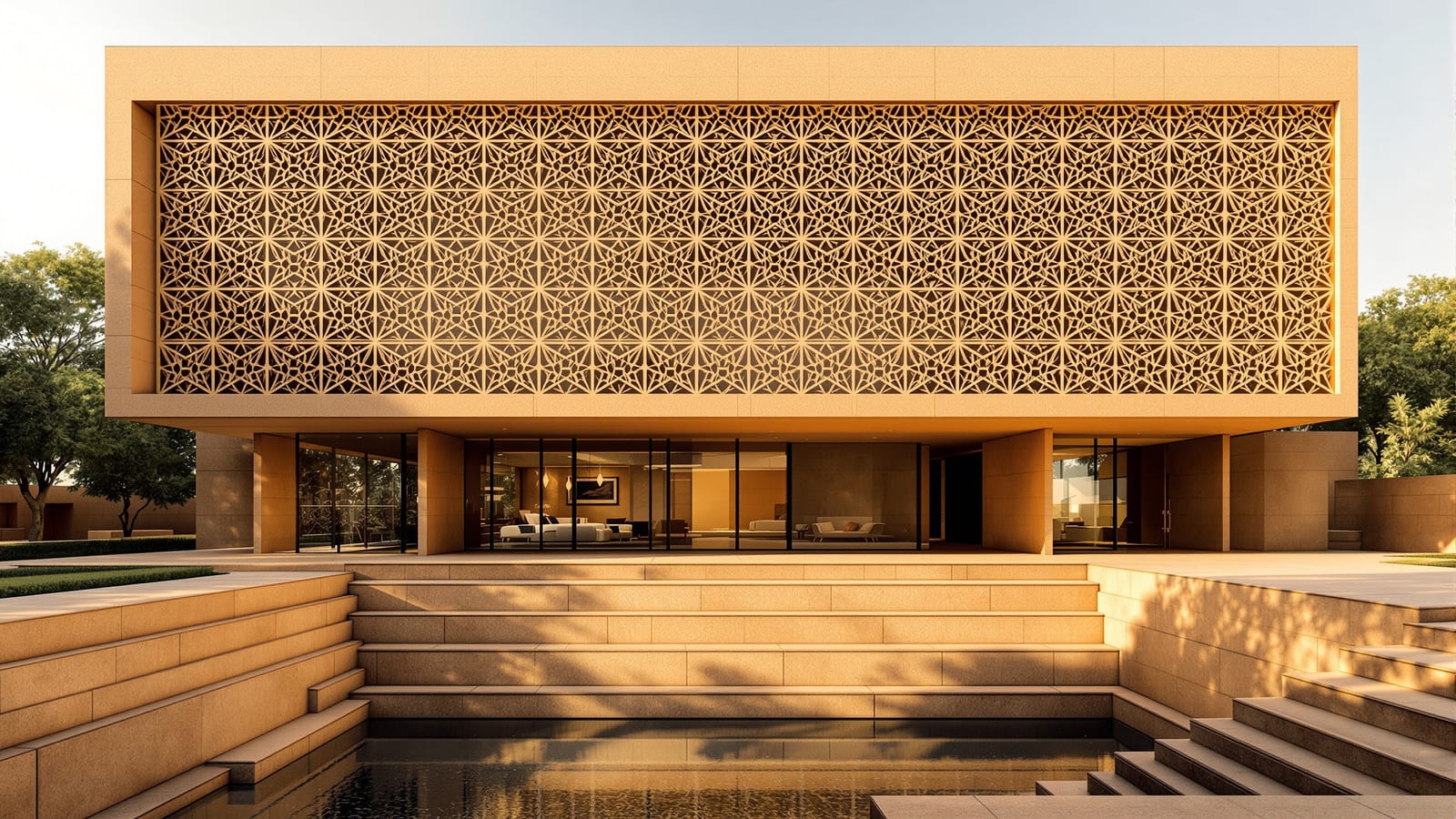
On the edge of Jaipur, where the desert sun pushes the afternoon to 47°C, there is a building that stays roughly twenty degrees cooler inside than the air outside — without the wall of air-conditioning that number would normally demand. It does this not with a machine but with a wall. A second wall, actually: a perforated stone-and-concrete screen held about four feet off the building, casting a deep lattice of shade, sitting above a sunken pool of water cut into the earth like an old Rajasthani stepwell. Hot wind enters, is shaded, brushes the water, sinks as it cools, and arrives indoors gentled. That building is the Pearl Academy of Fashion, and the practice that designed it, Morphogenesis, has spent nearly three decades turning that single idea — the wall as a climate instrument — into a discipline.
Morphogenesis was founded in 1996 in New Delhi by Sonali Rastogi and Manit Rastogi. It is, today, the most globally recognised contemporary Indian architecture practice, with offices in Delhi, Mumbai and Bengaluru and a long list of international awards. But the reason it matters to a discussion of façades is narrower and sharper than its reputation. Morphogenesis is the firm that took everything Charles Correa, B. V. Doshi and Laurie Baker taught about the climate-correct Indian wall — the jaali, the courtyard, thermal mass, the building that shades itself — and re-engineered it with computation and hard sustainability data. They are the contemporary heirs of that lineage, made digital and measurable.
This is the contemporary capstone of the climate-correct Indian façade. Where the masters worked by intuition and craft, Morphogenesis works by intuition, craft and a sun-path simulation. The result is a façade idiom that is unmistakably Indian and unmistakably high-performance — and a method any architect or homeowner in this country can learn from.
This is part of our Building Façades series — specifically our Masters of the Façade set, which profiles how the great architects designed façades. Morphogenesis is the contemporary end of a line you can trace back through Charles Correa, B. V. Doshi and Laurie Baker — and outward to the global parallel of the computed screen, Jean Nouvel. Their signature device — the computed jaali — sits at the centre of our guides to the jaali and traditional Indian façades, to smart, kinetic and parametric façades, to double-skin and ventilated façades, and to climate-responsive façades. And their masterpiece has its own deep dive: our Pearl Academy Jaipur case study.
1. Who Morphogenesis is, and why their façades are different
Sonali and Manit Rastogi started Morphogenesis with a stated mission: to define a sustainable architecture for contemporary India. That phrasing matters. Not a sustainable architecture borrowed from cold-climate Europe, where the problem is keeping heat in; an architecture for India, where the problem in most of the country is keeping heat out. Indian climate-correct building has always solved that at the skin — the jaali screens the sun, the courtyard ventilates, thermal mass slows the heat, the stepwell cools by evaporation.
What Morphogenesis added is the computer. Parametric or computational design means the façade geometry is generated and tuned by software against measured inputs — the sun path for that exact latitude, the prevailing wind, the views to protect, the privacy required on each face. Instead of drawing one jaali pattern and repeating it, they let the building's orientation drive the pattern, face by face. The screen stops being decoration and becomes an instrument. That single shift — from a beautiful but uniform screen to a performative jaali computed for performance — is the heart of the Morphogenesis façade.
2. The performative, computed jaali
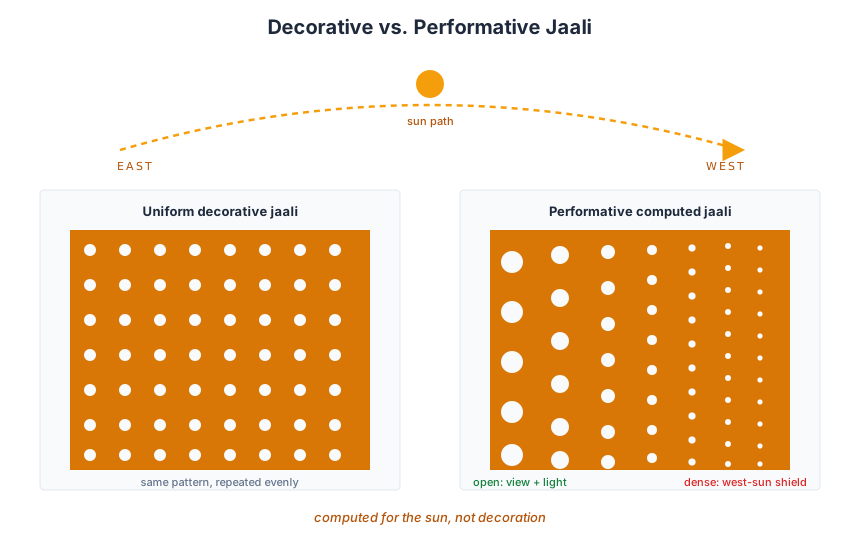
The jaali is the perforated screen — historically carved stone or latticed brick — that India has used for centuries to screen private spaces, filter glare into soft patterned light, and let breeze through while blocking sun. Traditionally it is laid out as a single repeating geometric pattern across a whole elevation, chosen for beauty.
Morphogenesis broke that uniformity. On their buildings, the perforation ratio — the proportion of open holes to solid material — is not constant. It varies across the face and from face to face. On the harsh western and southern elevations, where the low afternoon sun is brutal, the weave tightens: smaller holes, denser screen, more shade. Where the building wants a view, daylight or a cooler northern light, the weave opens up. At Pearl Academy, the practice has been explicit that the density of the perforated outer skin was derived using computational shadow analysis based on the orientation of the façades. The jaali serves, in their own description, as three filters at once: air, light and privacy — each tuned per face.
This is the move that connects Morphogenesis to the global story of the parametric and kinetic façade, and specifically to Jean Nouvel, whose Institut du Monde Arabe wraps a building in a computed mashrabiya-like screen. Nouvel and Morphogenesis arrived at the same idea — the computed Islamic-Indian screen — from opposite ends of the world. The difference is that Morphogenesis kept it rooted in passive climate logic and local craft rather than mechanism.
3. The breathing double skin
A jaali pressed flat against a wall shades the wall. A jaali held off the wall does something more powerful: it creates a cavity. This is the double-skin façade — two layers of envelope with a ventilated air gap between them. The outer skin (the jaali) takes the solar hit and heats up; the cavity behind it stays shaded; the inner wall, the one that actually encloses the rooms, never sees direct sun.
At Pearl Academy the jaali second skin is held roughly four feet off the building, and that four-foot cavity is the engine. It acts as a thermal buffer, a shaded corridor of air between the desert and the rooms. It is also, not incidentally, a usable space — students move along it, so the climate device is also a verandah. This is the lineage of the double-skin and ventilated façade made architectural rather than merely technical.
The performative jaali and the breathing double skin: Pearl Academy
Here is the technical heart of the Morphogenesis façade, assembled in one building.
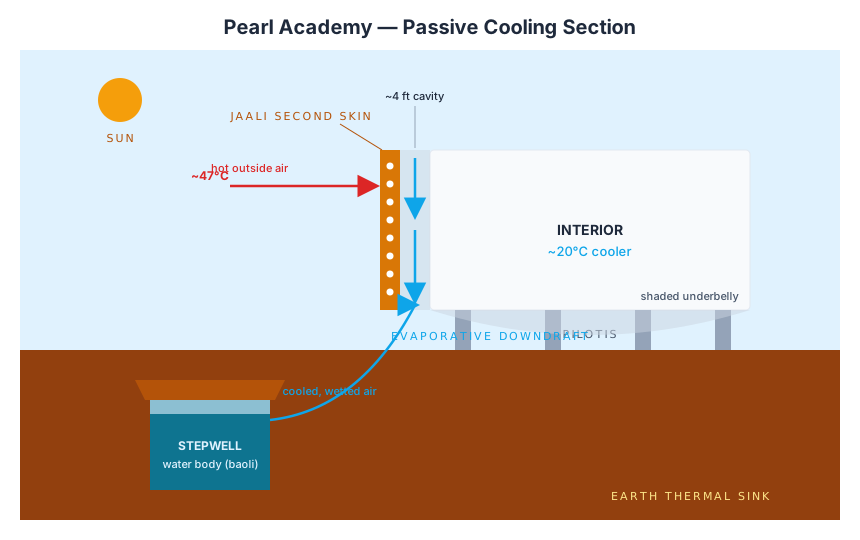
Pearl Academy of Fashion sits in the hot-dry desert climate on the outskirts of Jaipur. The brief — a fashion-and-design campus — meant lots of studios, lots of glare to control, and a punishing thermal load. Morphogenesis solved it as a layered passive system, and the façade is inseparable from the section.
First, the computed jaali second skin. A contemporary jaali wraps the building, held about four feet off the inner wall, its perforation density derived per orientation from computational shadow analysis. It filters air, light and privacy, and creates the four-foot ventilated cavity.
Second, drip channels on the jaali. Along the inner face of the screen run drip channels of water. As incoming desert wind passes the wetted screen, some water evaporates, and evaporation absorbs heat — this is passive downdraft evaporative cooling: the air is cooled at the screen, becomes denser, and sinks downward into the building rather than being pushed by any fan. No machine; just physics.
Third, the revived stepwell. Drawing directly on the stepwell or baoli — the ancient Rajasthani sunken water structure where people once descended to escape the heat — the building scoops into the earth around a large sunken water body, fed by rainwater harvesting. The earth itself is a heat sink, the water a cooling reservoir; the sunken courts and self-shading sliver courts keep their own microclimate cool while still admitting daylight.
Fourth, pilotis. The whole building is raised on pilotis — columns lifting it off the ground — so the scooped-out underbelly becomes a shaded thermal sink, cooled by the water bodies, from which cool air rises into the building above.
Put together — jaali skin, evaporative drip cooling, sunken stepwell water, earth-coupled raised base — the passive system delivers interior temperatures about twenty degrees Celsius lower than the outside when Jaipur hits the high forties, with only minimal mechanical cooling. The full mechanics, the section drawings and the numbers are in our dedicated Pearl Academy Jaipur case study. For the purpose of this guide, the lesson is the assembly: the façade is not a face stuck on a building, it is the building's cooling system.
4. The courtyard and stepwell, revived as climate devices
It is worth pausing on what Morphogenesis did with the stepwell, because it is the clearest example of their method: take a traditional Indian device, understand why it worked thermodynamically, and rebuild it with contemporary engineering. The stepwell cooled by combining three things — shade (you descend below grade, out of the sun), thermal mass (the earth is a stable cool reservoir), and evaporation (water at the bottom). Correa called this kind of thinking the architecture of the warm climate; Morphogenesis quantified it. The courtyard or chowk does the same job above ground: a shaded, ventilated void that the building wraps around, pulling cooler air down and stale hot air up by stack effect. At The British School in Delhi, internal chowks, jaalis and stepped wells do exactly this work. This is the Doshi-and-Correa courtyard tradition — see B. V. Doshi — carried forward.
5. The self-shading, orientation-driven form
The best shading device is the building itself. A self-shading form is one massed and oriented so its own geometry throws shadow on its own glass — deep recesses, offset volumes, sliver courts, overhangs — before any screen is even added. Morphogenesis treats orientation as a first design move, not an afterthought. At the Infosys campus in Nagpur, the office blocks are rotated to ±22.5 degrees from north precisely so that, combined with the jaali second skin, every window and wall is shaded. The form and the screen are designed together as one shading system.
6. Net-zero and the passive-first method
This is the discipline that separates Morphogenesis from architects who bolt sustainability on at the end. Their method is passive-first: design the building envelope — the skin, walls, roof, openings — to cut the energy demand before adding any technology. Only once the envelope has done all the free work do you size the mechanical systems, and they are small because there is little load left to serve. This is the opposite of designing a glass box and then specifying a giant chiller to fix it.
The numbers validate the method. The Infosys Nagpur campus is designed as a net-zero energy-enabled campus and is optimised to consume substantially less energy than the GRIHA benchmark for air-conditioned buildings — reported at roughly 52% below it. The Surat Diamond Bourse — at the time the world's largest office building — consumes on the order of 50% less energy than comparable buildings and holds an IGBC Platinum rating. Those savings are won, first and foremost, at the façade.
7. Local materials and craft, at scale
Morphogenesis works overwhelmingly in materials that belong to their sites and that local craft can execute — sandstone, local stone, terracotta, and GFRC (glass-fibre reinforced concrete), a thin, strong, mouldable cement composite that can be cast into intricate jaali panels far lighter than carved stone. The point is twofold: the materials suit the climate (thermal mass, locally weather-tested) and they keep the work of building inside the local economy of masons and fabricators. It is the jaali tradition executed with modern methods — a carved screen's logic, delivered by a cast or CNC-cut panel at building scale.
8. The signature strategies, in one table
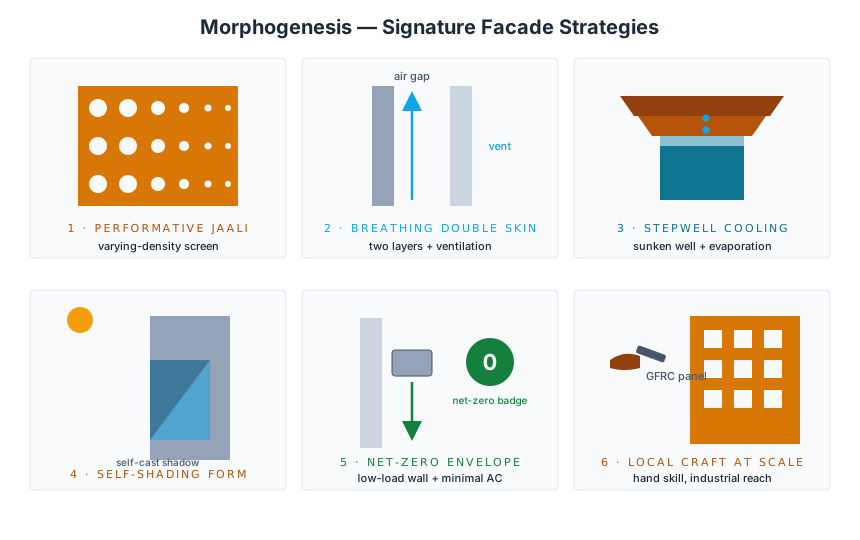
| Strategy | What it is | Building | Why it works | India lesson |
|---|---|---|---|---|
| Performative computed jaali | Perforation density varied per face by sun-path simulation, not a uniform pattern | Pearl Academy, Infosys Nagpur, British School | Tunes shade exactly where the sun is harsh; opens for view and light elsewhere | Compute your screen for your orientation — the west face needs a tighter weave than the north |
| Breathing double skin | Jaali held ~4 ft off the wall, ventilated cavity as thermal buffer | Pearl Academy | The outer skin takes the solar hit; the inner wall never sees direct sun | Hold the screen off the wall, even by inches, and you gain a cooling air gap |
| Stepwell / courtyard water cooling | Sunken baoli water body + drip channels drive evaporative downdraft cooling | Pearl Academy, British School | Shade + earth thermal mass + evaporation cool air without machines | Revive the courtyard and water — they are climate machines, not just landscape |
| Self-shading form | Building massed and rotated so it shades its own glass | Infosys Nagpur (±22.5° rotation) | The cheapest shade is the building's own shadow | Decide orientation before you decide style |
| Net-zero, passive-first envelope | Cut load with the skin before sizing any AC | Infosys Nagpur, Surat Diamond Bourse (IGBC Platinum) | A small machine on a good envelope beats a big machine on a bad one | Spend on the wall first; the chiller gets smaller |
| Local material + craft at scale | Sandstone, stone, terracotta, GFRC cast/CNC into jaali panels | Across the portfolio | Climate-tested, locally executable, keeps craft alive | Use what your region's masons know and your climate has tested |
Real buildings, not renders
These are verified Morphogenesis projects and how each façade actually works.
Pearl Academy of Fashion, Jaipur — the icon. A computed jaali second skin held ~4 ft off the building, drip-channel evaporative cooling, a sunken stepwell water body, self-shading sliver courts and a building raised on pilotis above an earth-coupled thermal sink. Interiors run about 20°C cooler than a high-forties Jaipur summer with minimal AC. It won a World Architecture Festival Award in 2009. Full study: Pearl Academy Jaipur.
Infosys campus, Nagpur — a net-zero-enabled office campus in a composite climate. Blocks rotated to ±22.5° from north combined with a jaali second skin to shade every window and wall; optimised to consume roughly 52% less energy than the GRIHA air-conditioned benchmark. The façade-as-shading-system applied to corporate scale.
Surat Diamond Bourse, Surat — at the time of completion among the world's largest office buildings. It consumes on the order of 50% less energy than comparable buildings and holds IGBC Platinum, again driven by a high-performance, passively-conceived envelope.
The British School, New Delhi — a school expanded using the practice's full vocabulary of local devices: verandahs, perforated jaali surfaces, internal courtyards (chowks) and self-shading sliver courts with open stepped wells, all keeping classrooms cool while admitting daylight. Proof the method scales to everyday institutional building, not just showpieces.
Apollo Tyres — the firm's first project and an early statement of intent that contemporary Indian corporate architecture could be climate-rooted rather than imported glass.
What this means for India
Morphogenesis is the practical proof of something this whole Masters series has argued: the climate-correct Indian façade — the jaali, the courtyard, the stepwell, thermal mass — is not nostalgia. It is high performance. A building that stays twenty degrees cooler than a 47°C afternoon with almost no air-conditioning is not a heritage gesture; it is an engineering result. And computation is what lets you tune those old devices precisely — the jaali for this sun, on this face, at this latitude — instead of copying a pattern and hoping.
That makes Morphogenesis the model for the contemporary Indian façade: passive-first, then tech. Design the skin to cut the load before you specify a single machine. It is the correction India most needs as the glass-curtain-wall office — designed for London, air-conditioned brutally for Gurugram — keeps getting built. Our Norman Foster façade guide makes the same point from the other direction: even the masters of the glass tower only made it work by burying serious environmental engineering inside the skin.
The honest caveats are real, and worth stating plainly. The full Morphogenesis system — a computed double skin, a sunken stepwell water body, pilotis over an earth-coupled void — is bespoke. It needs genuine design sophistication, sun-path simulation capability, and a budget. A performative jaali cast in GFRC or carved in stone costs more than a flat plastered wall, and the complete passive-cooling apparatus suits campus and institutional scale far better than a single small house, where you cannot economically scoop a stepwell into the earth. None of these buildings is cheap or simple.
But the principle scales all the way down, and that is the point. Compute — or at least carefully consider — the screen for your sun, so the west face is denser than the north. Hold the screen off the wall, even by a few inches, to win a shading air gap. Revive the courtyard and bring water and planting into it. And design the envelope to cut energy before you reach for the air-conditioner. A homeowner who does even two of those things is building in the Morphogenesis lineage — and in the Correa, Doshi and Baker lineage before it.
What this means for you
If you are briefing an architect for a home, an office or an institution in India, ask the Morphogenesis questions. Which way does the building face, and does its own form shade its glass? Is there a screen — a jaali — and is its density tuned to the sun on each face, or is it the same everywhere? Is that screen held off the wall to make a cooling cavity? Is there a courtyard, and is there water or planting in it doing real thermal work? And, above all: has the envelope been designed to cut the cooling load before anyone sized the AC?
You do not need a parametric studio to apply the logic. You need orientation decided first, a screen that respects the sun, a shaded cavity if you can afford it, a green and shaded court at the heart of the plan, and the discipline to spend on the wall before the machine. That is the contemporary Indian façade Morphogenesis has spent three decades proving — climate-correct, computed, and exactly right for this country.
Sources
- Morphogenesis — practice founded 1996, New Delhi, by Sonali Rastogi and Manit Rastogi; offices in Delhi, Mumbai and Bengaluru; the "SOUL" (Sustainable, Optimised, Unique, Liveable) design philosophy.
- Pearl Academy of Fashion, Jaipur — computed jaali second skin held ~4 ft off the building, derived by computational shadow analysis per orientation; drip-channel passive downdraft evaporative cooling; sunken stepwell/baoli water body; pilotis and earth-coupled thermal sink; interiors about 20°C cooler than the high-forties summer; World Architecture Festival Award, 2009.
- Infosys campus, Nagpur — net-zero-enabled; blocks at ±22.5° to north plus jaali second skin for full shading; reported roughly 52% less energy than the GRIHA benchmark.
- Surat Diamond Bourse, Surat — among the world's largest office buildings; reported on the order of 50% energy reduction; IGBC Platinum.
- The British School, New Delhi — verandahs, jaalis, chowks, self-shading sliver courts and stepped wells.
- Morphogenesis awards — World Architecture Festival Award (2009) and other international honours.
- Studio Matrx in-house: Pearl Academy Jaipur case study, jaali and traditional Indian façades, climate-responsive façades.
Export this guide
Related Guides — Deep-dive reading
Pearl Academy, Jaipur — How a Jaali and a Stepwell Cool a Desert Campus
Morphogenesis wrapped a modern institute in a perforated GRC jaali and floated it over a sunken water court — turning two pieces of Rajasthani genius into a contemporary passive-cooling machine.
Design StylesDouble-Skin & Ventilated Facades in India: The Layered Envelope That Buffers Heat, Noise & Glare
What a double-skin facade is, how the ventilated cavity cuts solar gain, noise and glare, the four cavity types, how it differs from a rainscreen, honest India cost and monsoon caveats, plus real examples.
Building FacadesCharles Correa's Façade Signature: How India's Master Made the Climate-Correct Wall
How Charles Correa eroded the flat sealed wall into deep, shaded, porous layers — verandahs, terraces, pergolas and open-to-sky courts — so the Indian façade filters sun and drives air instead of sealing it out.
Building FacadesRelated Tools — Try Free
Brise-Soleil Visualizer
Interactive horizontal-louvre cut-off angle calculator — sun altitude, louvre depth, and spacing inputs with a live shadow preview. Computes θ = arctan(spacing/depth) for façade shading, ECBC envelope compliance, hospital daylight design, and tropical sun-control detailing.
Sun Shading ToolCross-Ventilation Analyzer
Estimate airflow and air changes per hour (ACH) from room size, window areas, layout, and local wind — with NBC 2016 Part 8 compliance check.
Ventilation CalculatorWindow Orientation Planner
Pick the best window type, glass and shading by wall direction — north, east, south and west.
Window Tool