
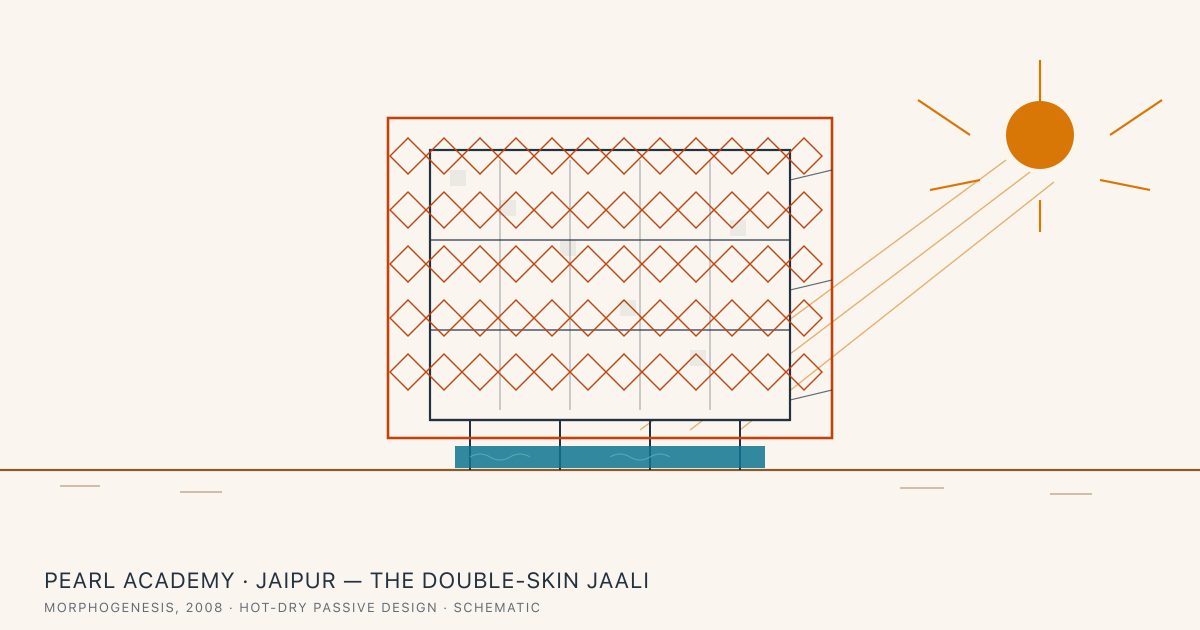
Pearl Academy, Jaipur — How a Jaali and a Stepwell Cool a Desert Campus
Morphogenesis wrapped a modern institute in a perforated GRC jaali and floated it over a sunken water court — turning two pieces of Rajasthani genius into a contemporary passive-cooling machine.
Drive north-east out of Jaipur towards Kukas, and the landscape strips itself back to essentials: ochre earth, a flat hard horizon, and a sun that does not negotiate. This is the Thar's threshold — a hot, dry desert climate where summer afternoons are punishing and the difference between shade and no-shade is the difference between a usable place and an empty one. It is here, completed in 2008, that the Delhi-based practice Morphogenesis — founded by Manit Rastogi and Sonali Rastogi — set down the Pearl Academy of Fashion, a campus for a fashion and design institute that has since become one of the most frequently cited examples of contemporary climate-responsive architecture in a hot-dry climate.
What makes the building remarkable is not a sculptural flourish or an imported gesture. It is that the architects went looking for answers in the place itself — in Jaipur's own deep memory of how to live with heat. The result reads, from the road, as a crisp modern box wrapped in a veil of patterned concrete. Spend an afternoon inside it, though, and you begin to understand that the veil is not decoration. It is the building doing its thinking.
The problem of building in the desert
Every building in a hot-dry climate faces the same brutal arithmetic. The sun delivers enormous radiant load to any surface it touches. Glass, which architects love for daylight and views, is a thermal liability here: it lets solar radiation straight in, and the interior bakes. The conventional twenty-first-century answer is to seal the building, mirror-glaze it, and run air-conditioning hard enough to overpower the climate — an approach that is expensive to run, fragile when power fails, and faintly absurd in a region that solved comfort centuries before electricity.
The older, wiser tradition of Rajasthan did something different. It did not fight the sun; it managed it. Thick walls stored coolness. Lattice screens filtered light and broke the wind into gentle eddies. Courtyards and water bodies set up their own micro-weather. Stepwells plunged down into the cool earth. Pearl Academy is, in essence, an attempt to translate that intelligence into a working contemporary institution — to make a glazed, modern building behave like a vernacular one.
The ambition was not to look traditional. It was to perform traditionally — to let a craft-derived screen and a sunken court carry the comfort load that a vernacular haveli once did.
The double-skin jaali: a building that wears a second skin
The signature move, and the first thing anyone notices, is the double-skin facade. The building has two outer layers. Set back behind it is the real, inner enclosure — a largely glazed wall that admits daylight and frames the desert. Held off in front of it, like a loose-fitting coat, is an outer screen: a perforated jaali made of GRC, glass-fibre reinforced concrete, cast into a lattice pattern derived directly from the traditional Rajasthani jaali.
What the jaali actually does
The genius of a jaali is that it is a filter, not a wall. Its dense field of small openings does several jobs at once:
- It intercepts direct solar radiation before it can reach the glass, throwing most of the facade into shadow.
- It still lets diffuse daylight and air pass through, so the interior is bright and ventilated rather than dark and sealed.
- It breaks incoming wind into many small streams, softening gusts and the dust they carry.
- It dapples the light, casting the shifting, lace-like shadow patterns that are the emotional signature of Rajasthani architecture.
In the Pearl Academy, the screen is held a meaningful distance off the inner wall, and that gap is the second half of the idea.
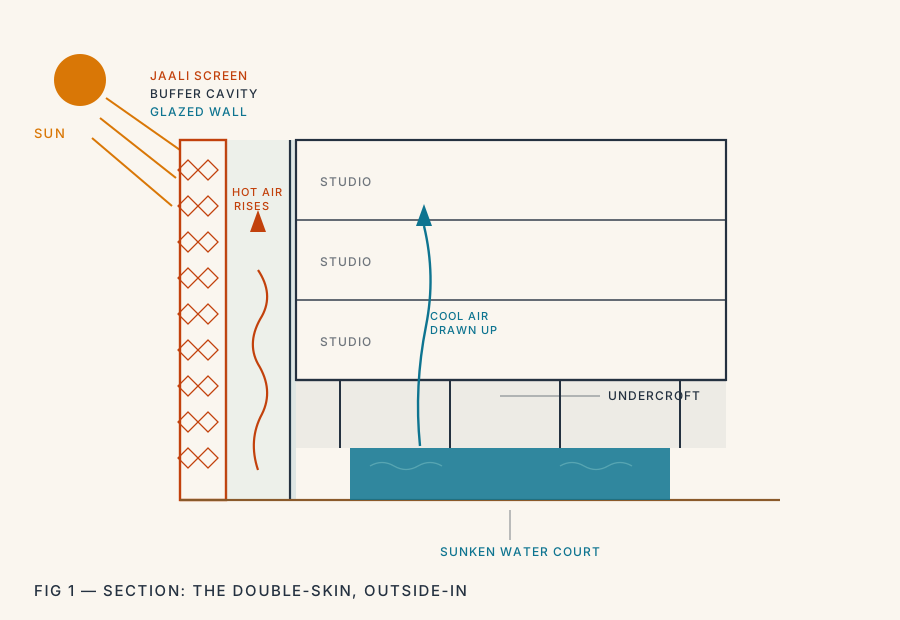
The buffer cavity
The space between the outer jaali and the inner glass is a thermal buffer zone. The sun's energy is absorbed and re-radiated mostly by the outer concrete screen, not by the occupied building. Air in the cavity heats and rises, and because the cavity is open it tends to flush that hot air up and away rather than letting it pool against the glass. The inner wall therefore sees a softened, pre-tempered environment instead of the raw desert sun. This is the same principle behind a ventilated rainscreen or a double-skin glass facade in a corporate tower — but here it is executed in cast concrete patterned after a four-hundred-year-old craft.
The cultural lineage is impossible to miss, and entirely deliberate. Jaipur's own Hawa Mahal is essentially a giant jaali — a honeycomb of screened openings designed so that breeze and filtered light do the work that air-conditioning does today. The screened balconies and lattice windows of Amber Fort follow the same logic. Pearl Academy simply scales that idea up and rationalises it into a modern structural system.
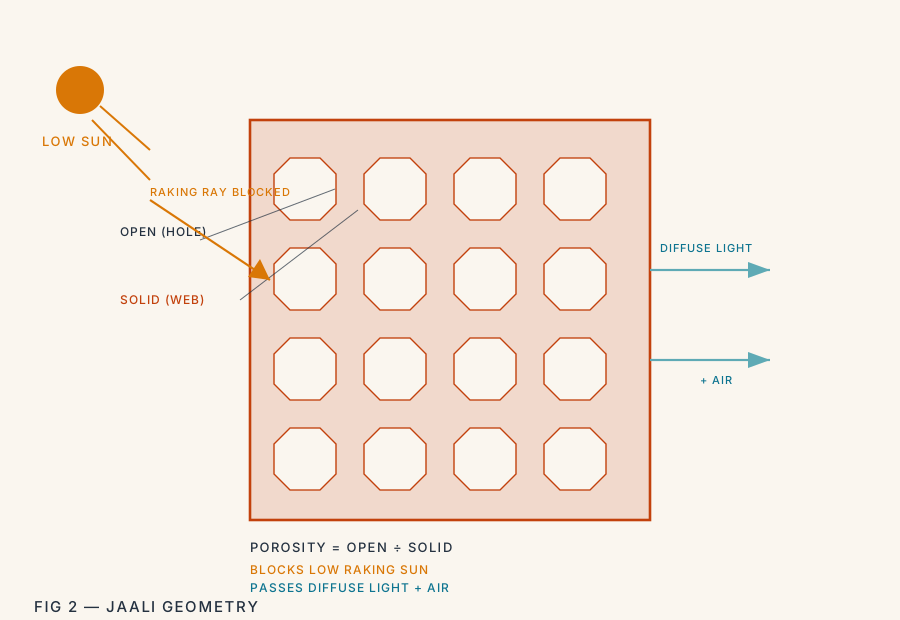
The geometry of the perforation matters. A jaali's porosity — the ratio of open area to solid — tunes the trade-off between shade and airflow. Too open and it stops shading; too dense and it chokes light and ventilation. The pattern's angle and depth also control which sun it blocks: a deeper, finer screen is very effective against the low, raking sun of morning and evening, which is the hardest to shade with simple horizontal overhangs.
The stepwell logic: cooling with water and earth
If the jaali handles the sun, the second great move handles the air — and for that, Morphogenesis reached for one of Rajasthan's most beautiful inventions: the stepwell, or baoli.
A stepwell is a well you walk down into, its tiers of steps descending many storeys to the water table. Functionally it was a reservoir; experientially it was a refuge, because as you descend you leave the surface heat behind and enter air that has been cooled by shade, by the thermal mass of stone, and by the evaporation off the water below. Jaipur's exquisite Panna Meena ka Kund, near Amber, is a textbook example — a geometry of crisscrossing stairs dropping into cool shadow.
Pearl Academy borrows this logic directly. The building is raised up on an undercroft, partly lifted off the ground so that its underside is self-shaded, and beneath and around it sits a sunken court with a water body — a contemporary baoli. The court is shaded and below grade, so it stays cool. Air moving across the water picks up moisture and, in doing so, gives up heat: this is evaporative cooling, the workhorse of comfort in dry climates.
Why evaporative cooling works so well here
The physics is elegant and, crucially, it only works in dry air — which is exactly what the desert provides. When water evaporates, it absorbs latent heat from the surrounding air, dropping that air's temperature. In humid climates the air is already near saturation and can't take up much more moisture, so the effect is weak. In a hot-dry climate the air is thirsty, evaporation is vigorous, and the temperature drop can be substantial. Rajasthan's misery — bone-dry heat — is precisely the condition that makes a water court a cooling machine.
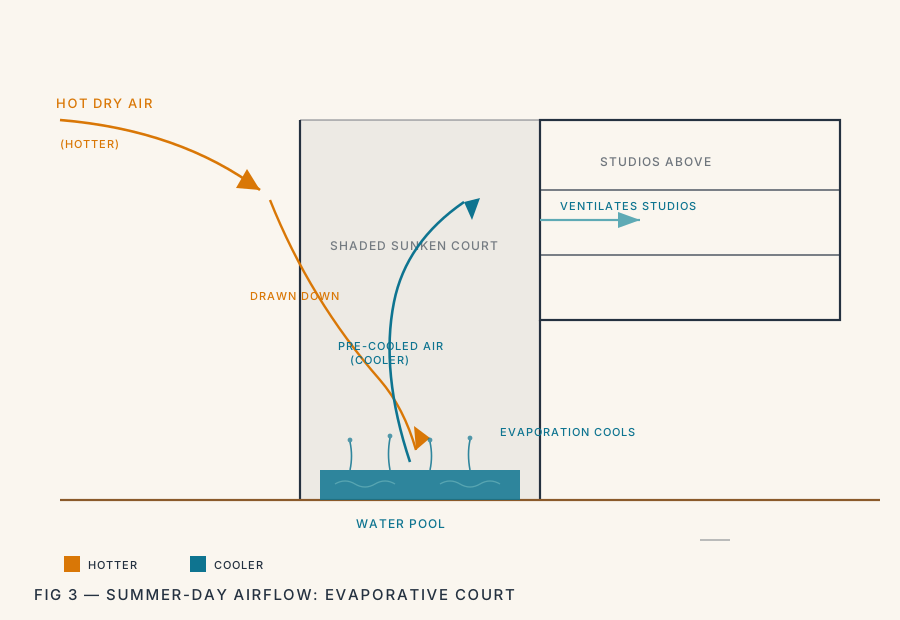
So the sequence reads like a chain of hand-offs: hot, dry desert air arrives at the building; it is drawn down into the shaded, sunken court; passing over the water and through the cool undercroft it is pre-cooled by evaporation and contact with thermal mass; and this tempered air then rises up through the scooped open courts to ventilate the studios and workshops above. The jaali has already taken the edge off the radiant load; the water court takes the edge off the air temperature. Between them, by all accounts, they keep the interiors markedly cooler than the harsh exterior with very little mechanical cooling.
| Passive strategy | How it works | Traditional precedent |
|---|---|---|
| Perforated GRC jaali screen | Intercepts direct sun, casts the facade into shade, still passes light and air | Rajasthani jaali; Hawa Mahal; lattice screens of Amber Fort |
| Double-skin buffer cavity | Outer skin absorbs solar heat and flushes it away before it reaches the glazed inner wall | Deep verandahs and screened loggias of the haveli |
| Raised undercroft | Building lifted so its underside is self-shaded and cool | Plinths and shaded platforms of vernacular courtyard houses |
| Sunken water court | Shaded, below-grade water pre-cools air by evaporation | Stepwell / baoli (e.g. Panna Meena ka Kund) |
| Scooped open courts | Channel pre-cooled air up and through the interiors | Courtyard (aangan) of the traditional Indian house |
How the building lives
The lived experience is what separates a clever diagram from good architecture. Inside Pearl Academy, the daylight is generous but never glaring — it arrives filtered through the jaali, soft and even, ideal for studios where students judge colour and fabric. The screen casts those characteristic patterned shadows that move across floors and walls through the day, so the building keeps a connection to the sun and the hour without surrendering to the heat.
The courts are the social heart. Because they are cool and shaded, they invite people to gather, sit, and cross between spaces outdoors — a rarity in a desert campus, where outdoor space is usually abandoned to the sun for much of the year. The water court, the raised mass, and the screened skin together produce a sequence of microclimates: harsh outside, tempered in the buffer, genuinely pleasant in the shaded sunken court. Walking through the building is, in a small way, like descending a stepwell — moving from glare into calm.
It is worth being precise about the claim. Passive design does not abolish mechanical systems; it dramatically reduces how hard they must work. By shedding solar gain at the skin and pre-cooling ventilation air at the base, the building lowers its cooling demand so that comfort can be maintained with far less energy than a sealed, fully air-conditioned box of the same size would need. That is the real prize, and it is why the project is so widely published and frequently cited.
What architects and homeowners can learn
The most valuable thing about Pearl Academy is that its lessons are not exotic. They are principles, and principles scale down to a single house as readily as up to a campus.
Comfort is cheaper to design in than to engineer out. Every degree you keep off the building with shade and evaporation is a degree you never have to pay an air-conditioner to remove.
| What to borrow | The principle | How it shows up in a home |
|---|---|---|
| Shade the skin first | Stop solar heat before it reaches glass | Deep overhangs, pergolas, a jaali or louvre screen on west and south walls |
| Add a buffer layer | A gap or second skin tempers the wall behind it | Verandahs, screened balconies, double-skin or ventilated cladding |
| Use water in dry heat | Evaporation cools dry air; place water in shade | A shaded courtyard pool, a small water feature in a cool court |
| Borrow the courtyard | A shaded open void organises cooling and light | A central or side courtyard that draws cool air up through the home |
| Read your own climate | What works in a desert can fail in the humid coast | Match strategy to climate — evaporative cooling needs dry air to work |
If you are planning a home in a hot-dry region, these moves belong in the very first sketches, not bolted on at the end. The orientation of the house, where the openings face, where shade falls, and where a cool court might sit are decisions that cost little on paper and pay back every summer for the life of the building. Many of these ideas run through climate-responsive house plans and the wider body of passive-design thinking in our guides.
A closing reflection
What Pearl Academy of Fashion demonstrates, quietly and convincingly, is that climate-responsive design need not be a nostalgic retreat or a high-tech gadget. Morphogenesis took two pieces of Rajasthani genius — the jaali screen and the stepwell — understood exactly why they worked, and rebuilt them in the materials and geometry of contemporary architecture. The building looks forward and remembers at the same time. In a warming world where cooling demand is rising fastest in exactly the hot, dry regions this project speaks to, that is not a stylistic choice. It is a roadmap.
References & further reading
- Morphogenesis — the practice's own published project descriptions of the Pearl Academy of Fashion, Jaipur, including their accounts of the jaali screen, undercroft and water court.
- ArchDaily — feature on the Pearl Academy of Fashion by Morphogenesis, with project photographs and passive-design narrative.
- Manit Rastogi and Sonali Rastogi — interviews and lectures on climate-responsive design, widely available in the architectural press.
- General building-science background on jaali screens, double-skin facades, thermal mass and evaporative cooling — standard passive-design and architectural-science texts.
- Background on Rajasthani precedents: the Hawa Mahal and Amber Fort, Jaipur, and the stepwell Panna Meena ka Kund near Amber, as documented in architectural histories of Jaipur.
Export this guide
Related Guides — Deep-dive reading
Morphogenesis Façade Design: The Computed Jaali, Breathing Double Skin and Stepwell Cooling of India's Leading Practice
How Morphogenesis re-engineered India's jaali, courtyard and stepwell with computation and sustainability data — building the contemporary, high-performance façade that keeps Pearl Academy Jaipur about 20°C cooler than the desert summer.
Building FacadesCharles Correa's Façade Signature: How India's Master Made the Climate-Correct Wall
How Charles Correa eroded the flat sealed wall into deep, shaded, porous layers — verandahs, terraces, pergolas and open-to-sky courts — so the Indian façade filters sun and drives air instead of sealing it out.
Building FacadesDesigning a Naturally Energy-Efficient Indian Home
Comfort first, gadgets last — passive design, orientation, insulation, ventilation and the climate wisdom that cuts Indian energy bills
SustainabilityRelated Tools — Try Free
Brise-Soleil Visualizer
Interactive horizontal-louvre cut-off angle calculator — sun altitude, louvre depth, and spacing inputs with a live shadow preview. Computes θ = arctan(spacing/depth) for façade shading, ECBC envelope compliance, hospital daylight design, and tropical sun-control detailing.
Sun Shading ToolCross-Ventilation Analyzer
Estimate airflow and air changes per hour (ACH) from room size, window areas, layout, and local wind — with NBC 2016 Part 8 compliance check.
Ventilation CalculatorWindow Orientation Planner
Pick the best window type, glass and shading by wall direction — north, east, south and west.
Window Tool