
Balkrishna Doshi's Façade Signature: Earth Berms, China Mosaic Vaults and the Building as Landscape
How India's first Pritzker laureate turned the façade into a continuous earth-sheltered skin — half-buried, white broken-tile vaults that reflect the sun, deep shaded layers, and open frameworks ordinary families complete themselves.
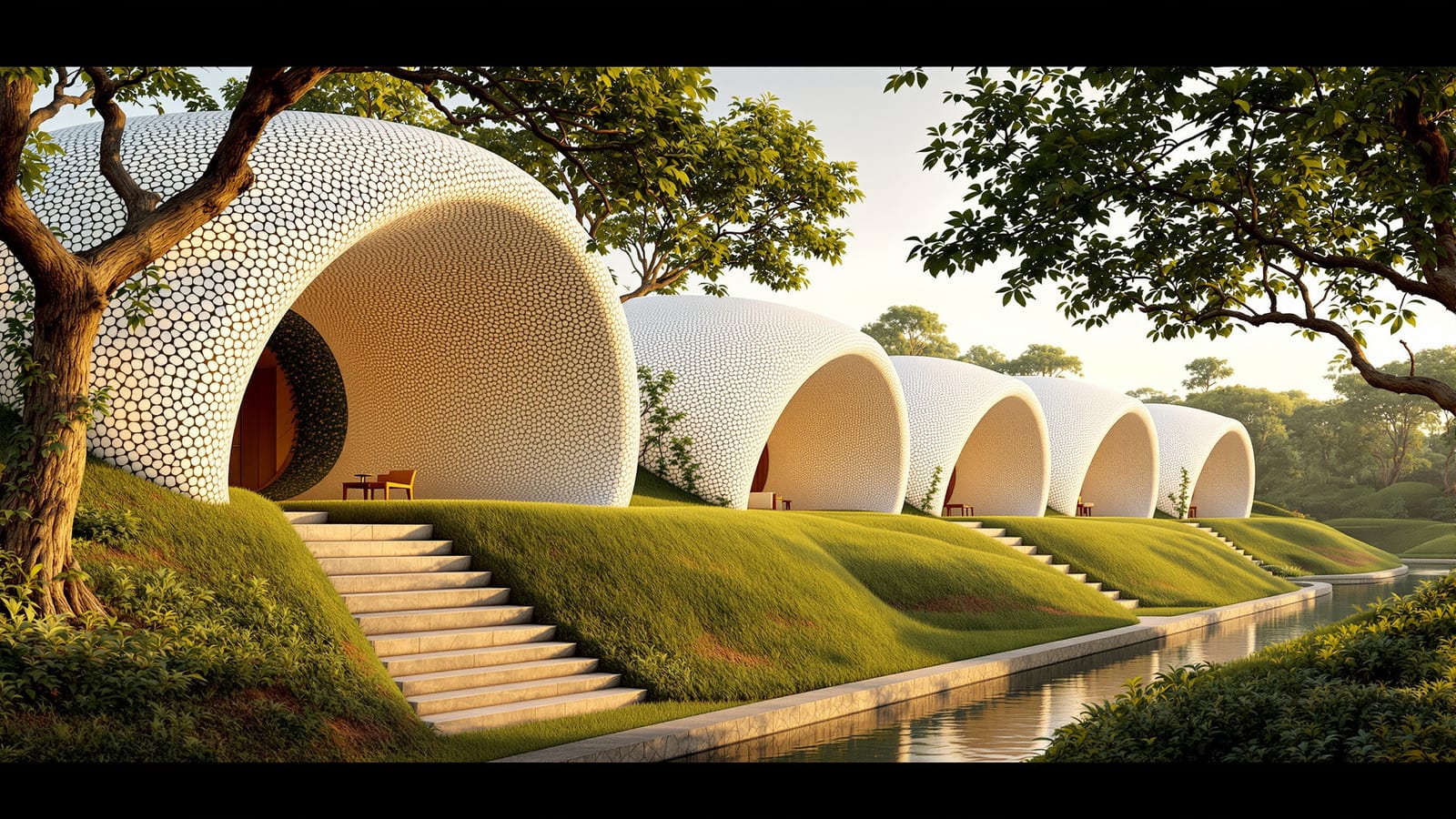
Walk up to Sangath, B. V. Doshi's own studio on the edge of Ahmedabad, and you will spend a confused, delighted minute trying to find the front. There is no front. There are grassy mounds, a cascade of water down stone steps, terraces you can sit on, and a run of low white vaults that seem to grow out of the ground like the backs of half-buried animals. The building is mostly underground. What you read as its "façade" is a continuous curved skin — roof, wall and ground all the same surface — sheathed in chips of broken white china tile that throw the harsh Gujarati sun straight back at the sky. It is one of the most intelligent, generous, and genuinely cheap pieces of climate architecture anywhere in India.
That is the Doshi paradox. He trained under the two hardest masters of twentieth-century architecture — he supervised Le Corbusier's Ahmedabad and Chandigarh projects, then built Louis Kahn's IIM Ahmedabad — and could have spent his life making monumental concrete. Instead he spent seventy years making architecture gentler, more Indian, more affordable, and rooted in our heat. In 2018 he became the first Indian to win the Pritzker Prize, architecture's highest honour, for exactly that: a body of work that touched every social class, from his own studio to housing for the poorest.
This guide is about one narrow thing: how Doshi designed façades — the outward, weather-facing, public face of his buildings. And his great move was to stop thinking of the façade as a flat front at all.
This is part of our Building Façades series — specifically our Masters of the Façade set, where we study how one great architect handled the building's skin. Read it alongside Doshi's full biography and our deep Sangath case study. Doshi sits at a remarkable crossroads, so cross-read his two masters — the Le Corbusier façade signature and the Louis Kahn façade signature — and his great Indian contemporary in the climate project, the Charles Correa façade signature. For the materials underneath it all, see our guides to concrete façades, exposed brick façades and climate-responsive façades.
1. The façade that refuses to be a façade
Start with the single idea that organises everything Doshi did to a building's skin: the building as landscape. In conventional architecture there is a wall (vertical, the façade), a roof (horizontal, on top), and the ground (separate, below). Doshi blurred all three into one flowing surface. The roof curves down to become a wall; the wall sinks into a grassy earth berm (a mound of soil banked against the building); the berm becomes a terrace you walk on; the terrace steps down into a water channel and a garden. You cannot point to where the façade begins and the ground ends.
This is not a stylistic quirk. It is a climate strategy and a social one at the same time. By dissolving the hard vertical front, Doshi removed the very surface that the Indian sun beats hardest on. By making the skin continuous and curved, he could clad the whole thing in one cheap, reflective material. And by letting the building merge into mounds, steps and planting, he made the boundary between inside and outside soft and inhabitable — the deep Indian instinct that the best room is often a shaded outdoor one.
2. The earth-bermed mosaic vault: Sangath
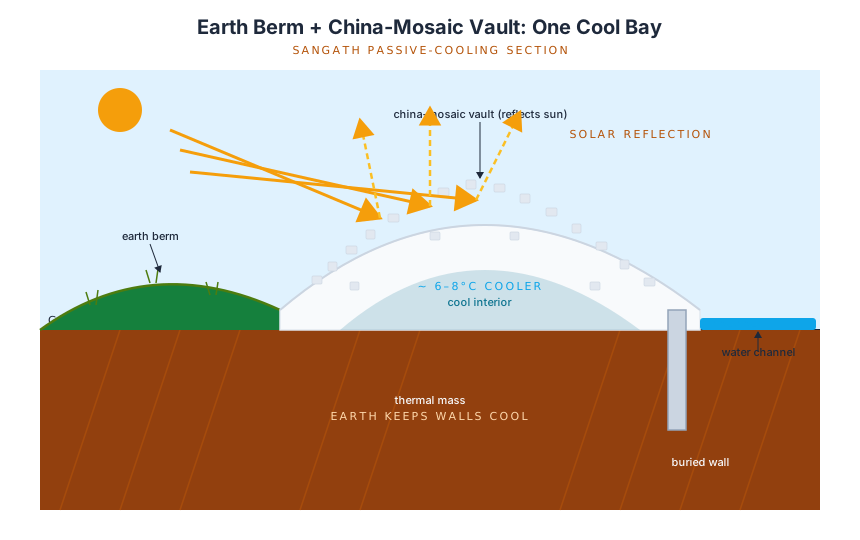
This is the technical heart of Doshi's façade thinking, so it is worth slowing down. At Sangath (1980), Doshi did four things at once, and together they make the façade.
First, he half-buried the building. The main studio sinks partly below ground, banked with earth berms. Soil has enormous thermal mass — it absorbs heat slowly and releases it slowly, so the earth around a buried wall stays close to a stable, cool ground temperature while the air above shimmers at 43°C. An earth-sheltered wall barely needs to be cooled. The berm also keeps the building's silhouette low and lets terraces sit comfortably at garden height.
Second, he roofed it with barrel vaults — long half-cylinder roofs. A vault is structurally efficient (it carries load in compression, so it can be thin) and it shrugs rain off its curve. Crucially, the vaults at Sangath are insulated: built as a double skin with a layer of broken ceramic and trapped air inside, so the roof itself resists heat gain.
Third — the signature move — he clad the vaults in china mosaic: chips of broken white porcelain and waste tile, set in cement (a technique close to Spanish trencadís, the broken-tile mosaic of Gaudí, but here done as the cheapest finish imaginable). White china mosaic has very high solar reflectance. It throws the sun's radiation back before it can heat the structure, and unlike paint it does not fade or peel — it is glass-hard ceramic. So the bright, glittering skin you see is doing real thermal work.
Fourth, he wrapped the whole thing in water and landscape — a cascade running down the steps, channels beside the vaults — so evaporative cooling and planting drop the air temperature around the building before it ever touches the skin.
Put it together and the "façade" of Sangath is a single curved white surface that is simultaneously roof, wall and ground, reflecting the sun off its top, insulated by trapped air in its shell, and cooled by the earth packed against its base. It is a brilliant, low-cost, fully Indian climate response — and we treat it in full in our Sangath case study.
3. China mosaic: the cheap Indian skin that works
It is worth pulling china mosaic out on its own because it is the most transferable thing in this whole guide. It is made from broken crockery, off-cut tiles and ceramic waste — material that would otherwise go to a dump — pressed into cement render and grouted. In white, it is one of the most reflective cladding finishes available, which is exactly why it has been the traditional terrace-waterproofing finish across western India for generations. It is durable (ceramic does not weather like paint or lime), it is locally made everywhere, and it costs next to nothing.
Doshi did not invent it; he elevated it. He took a humble, utilitarian Indian waterproofing finish and made it the proud, gleaming skin of a Pritzker-winning building — at Sangath, and most spectacularly at the Husain-Doshi Gufa (Section 7). The lesson for an Indian designer is direct: high-performance reflective cladding does not have to be imported aluminium composite. It can be broken tile, set by a local mason.
4. Exposed concrete, exposed brick, honest plaster
Doshi's other façade language is the one he inherited from his masters and then softened. From Le Corbusier came exposed concrete — béton brut, concrete left raw and unfinished, the material honest about what it is. From Louis Kahn, whose IIM Ahmedabad Doshi built, came monumental exposed brick — load-bearing brick arches and walls, the material expressing the structure.
But where Corbusier's concrete is sculptural and aggressive, and Kahn's brick is grave and monumental, Doshi's combinations are gentler, more domestic, more Indian. His characteristic façade — most visible at CEPT (Section 6) — is exposed brick and exposed concrete used together honestly: robust brick walls forming the bays, exposed concrete floors and beams stepping in and out, raw and unplastered, sometimes washed with simple lime plaster, never tarted up. Nothing pretends to be something it is not. This honest-material palette is cheap (no expensive cladding or finishes to buy and maintain), it weathers gracefully in our climate, and it reads as warm rather than cold. For the deeper material logic, see our concrete façades and exposed brick façades guides.
5. Deep verandahs, jaalis, pergolas, terraces — the shaded layered skin
The third strand of Doshi's façade work is the one he shares most closely with his great contemporary Charles Correa: the layered, shaded Indian skin. Rather than a single sealed glass wall, the Doshi façade is a sequence of in-between zones — a verandah (covered open edge), a pergola (an open beam framework that casts a moving lattice of shade and over time fills with creepers), a jaali (a perforated screen that filters light and lets breeze through), a courtyard that pulls the outside into the plan's centre, and roof terraces for sleeping and sitting in the cool.
Each layer is a buffer. The sun has to pass through a pergola, across a verandah, behind a jaali before it reaches an actual occupied room — and at every step it loses heat and glare. This is the climate-correct alternative to the sealed, air-conditioned glass box, and it is the heart of our climate-responsive façades guide. The façade stops being a thin membrane and becomes a thick, breathing, shaded thickness.
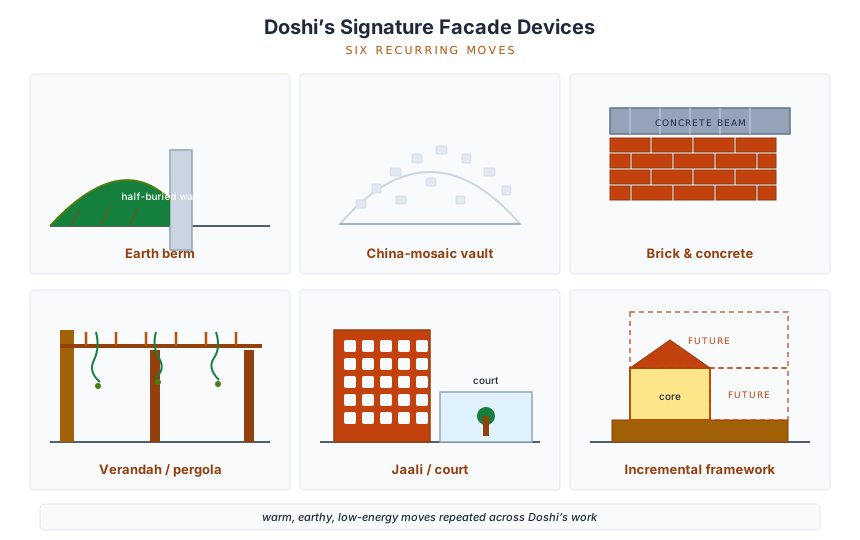
Signature façade devices at a glance
| Device | What it is | Why Doshi used it | Where to see it | India lesson |
|---|---|---|---|---|
| Earth berm / earth-shelter | Building half-buried, soil banked against walls | Earth's thermal mass keeps interiors cool; low silhouette | Sangath, Ahmedabad | Free cooling from the ground itself in hot-dry zones |
| China-mosaic vault | Barrel-vault roof clad in broken white tile | High reflectance bounces the sun; durable, near-free | Sangath; Amdavad ni Gufa | A cheap, local, high-reflectance skin from waste tile |
| Building-as-landscape | Roof, wall, ground merged into one surface | Dissolves the hard sun-facing front; soft inside-outside | Sangath; IIM Bangalore | The best façade may be no façade — mounds and terraces |
| Exposed brick + concrete | Raw brick and béton brut used honestly together | Cheap, durable, warm; weathers well | CEPT, Ahmedabad | Honest local materials beat imported cladding |
| Deep verandah / pergola / jaali | Layered shaded in-between zones | Buffers sun and glare before rooms; breeze flows | IIM Bangalore; most work | Thicken the skin with shade, don't seal it with glass |
| Incremental open framework | A core house residents complete themselves | The façade as an evolving framework, not a fixed design | Aranya, Indore | A humane, real answer to mass housing fronts |
6. CEPT and IIM Bangalore: the institutional façade
Doshi's campus buildings show the same instincts at a large scale. At CEPT (the School of Architecture he founded and designed in Ahmedabad), the façade is the open, honest one: proud exposed-brick walls forming generous bays, exposed concrete floors stepping front and back to make great double-height volumes, north-light glazing borrowed from the industrial shed, and an iconic ramp and splayed stairs. The whole concept is an "open building" that blurs the line between formal and informal, inside and outside — there is barely a sealed façade at all; the building breathes through its open edges and shaded courtyards.
At IIM Bangalore (1983, with Stein and Bhalla), the façade idea becomes a whole town. Inspired by Fatehpur Sikri, Doshi laid the campus out as a network of long, high corridors-as-streets — sometimes open, sometimes skylit, sometimes covered only by concrete pergolas now thick with creepers. The exterior is rough-textured local stone; the "façade" is really these pergola-shaded, planted streets that dissolve the distinction between interior and exterior. You walk through patterned, moving shade for the length of the campus. It is the layered Indian skin scaled up to an institution.
7. Real buildings, not renders
Five verified projects, read for how the façade actually performs:
- Sangath, Ahmedabad (1980) — Doshi's own studio, and his manifesto. Half-buried under earth berms, roofed with china-mosaic barrel vaults, wrapped in steps, terraces, mounds and water cascades. The façade is a continuous white reflective curved skin merging roof, wall and ground. The single most important demonstration of an affordable Indian climate façade.
- Aranya Low-Cost Housing, Indore (1989) — Housing planned for tens of thousands of people on a site-and-services model; winner of the Aga Khan Award for Architecture. Doshi provided a basic core (a service core and one room) on a serviced plot, plus demonstration houses, and left the rest to the residents. The façade is deliberately incremental and participatory — an open framework that families complete and grow themselves over years. (See Section 8.)
- CEPT / School of Architecture, Ahmedabad — Open exposed-brick-and-concrete volumes, shaded courtyards and stairs, blurred indoor-outdoor edges. The façade is honest material and open structure rather than a designed front.
- IIM Bangalore (1983) — A campus of pergola-shaded stone corridors-as-streets, courtyards and lush planting, modelled on Fatehpur Sikri. The façade is layered shade and greenery dissolving inside and outside.
- Amdavad ni Gufa / Husain-Doshi Gufa, Ahmedabad (1994) — An underground art gallery for M. F. Husain's work. Wavy, dome-and-cave shell built in ferrocement only an inch thick, clad on the outside in china mosaic made from broken crockery and waste tile, with a mosaic snake winding over the domes. Built by local labour with hand tools. The undulating mosaic shell rising from the ground is the purest expression of Doshi's continuous-skin, waste-tile façade idea.
8. The incremental façade: Aranya's open framework
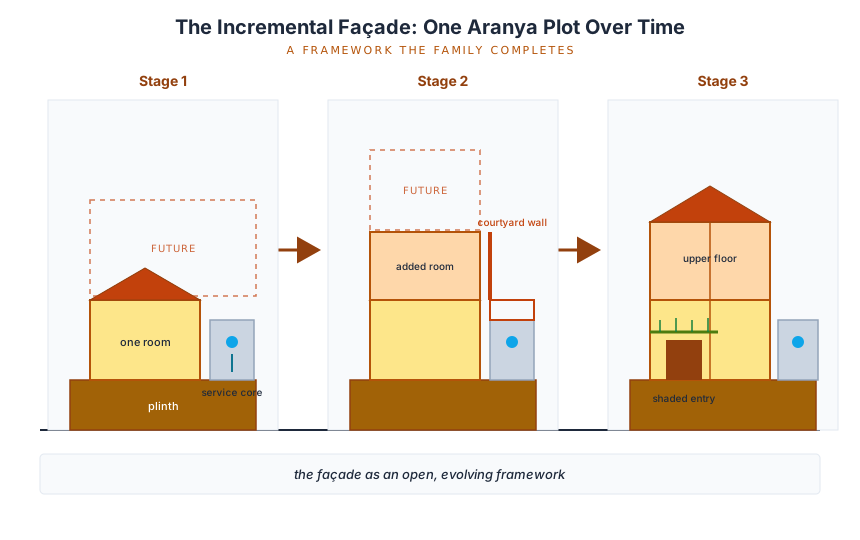
Aranya deserves its own section because it carries Doshi's most radical idea about the façade. In a normal housing project, the architect designs every front and freezes it. Doshi did the opposite. He designed the infrastructure (roads, water, sewer, plot layout, a few demonstration houses) and a basic core, and then left the façade unfinished — on purpose.
This is the open-framework façade. The architect provides the bones — a plinth, a service core, a starter room, party walls shared with neighbours to cut cost and heat gain — and the family completes and grows the front over years as money allows: a second room, a courtyard wall, an upper floor, a shaded entry, their own ornament. The façade is not a fixed design but an evolving framework. Across a neighbourhood this produces exactly the rich, varied, lived-in street you see in any organically grown Indian settlement — because real people made it, not a single drawing. It is a humane and genuinely workable answer to mass housing, and it is why Aranya became a global reference for inclusive urban development.
What this means for India
Doshi is, more than anyone, India's model for an affordable, climate-correct, deeply Indian façade. Almost everything in his toolkit costs little and performs brilliantly in our heat. Earth berms give you free cooling from the ground's thermal mass. China mosaic — broken waste tile — is a genuinely cheap, reflective, durable, locally-made cladding that reads as a luxury but is made from refuse and set by an ordinary mason; in white, it bounces the sun the way no paint can and never needs repainting. Shaded layers — verandahs, pergolas, jaalis, courtyards — buffer the sun before it reaches a room, the climate-correct alternative to a sealed glass box. Honest local materials — exposed brick and concrete — outlast and outperform imported cladding for a fraction of the cost. And the incremental open framework at Aranya is a real, dignified answer to the question of how the poorest millions get a home with a face of their own.
Now the honest caveats, because Doshi's work is admired but not always copied well. Earth-bermed and vaulted forms need careful waterproofing for the monsoon — a buried wall or a curved roof that leaks is a far bigger problem than a leaking flat slab, and you must detail drainage, membranes and the berm's run-off with real care. China mosaic needs periodic re-grouting — the cement between the chips weathers, and a neglected mosaic surface cracks and lets water in. And not every site or budget suits half-burying a building — high water tables, tight urban plots and small budgets can rule the vault-and-berm approach out. These are real limits. But notice that they are details of execution, not flaws in the idea. The underlying principles — high reflectance, thermal mass, shaded layers, cheap local materials, and an evolving framework — are exactly right for India, and they are available to any project at any budget.
What this means for you
You will probably never build a half-buried mosaic vault, and you do not need to. Take the principles instead. If you are building or renovating in a hot Indian climate, ask of your façade the questions Doshi asked: Is the sun-facing surface reflective and light, or dark and absorbing? Is there mass — earth, masonry, water — to steady the temperature? Is there a layer of shade — a verandah, a pergola, a deep reveal, a jaali — between the sun and the room behind? Are the materials local, honest and low-maintenance, or imported and fragile? And is the front allowed to grow and change with the life inside it?
A white china-mosaic or light reflective terrace, a deep shaded verandah on the west face, a jaali screen over a hot window, honest brick instead of expensive cladding — these are small, affordable Doshi-isms any Indian home can use. The façade, he taught, is not a mask you put on a building. It is where the building meets the sun, the rain, the ground and the people — and if you get that meeting right, beauty and comfort and economy all arrive together.
To go deeper, read Doshi's biography and our Sangath case study, then his masters — Le Corbusier and Louis Kahn — and his contemporary Charles Correa. For the materials and climate logic, see concrete façades, exposed brick façades and climate-responsive façades.
Sources
- The Pritzker Architecture Prize — Balkrishna Doshi, 2018 Laureate (pritzkerprize.com): biography, citation, and project list.
- ArchDaily — "Balkrishna Doshi Named 2018 Pritzker Prize Laureate" and the 2023 obituary (archdaily.com).
- RIBA Journal — profile of Doshi and Sangath on his Royal Gold Medal (ribaj.com).
- ArchEyes / Hidden Architecture / Iwan Baan — Sangath Office: earth berms, china-mosaic barrel vaults, water cascades and climate strategy.
- Aga Khan Development Network (akdn.org) and The Architectural Review — Aranya Community Housing, Indore: site-and-services, incremental model, Aga Khan Award.
- CEPT University tributes and Architizer — Ahmedabad School of Architecture / CEPT: exposed brick-and-concrete open building.
- IIM Bangalore (iimb.ac.in) and Re-Thinking The Future — pergola-shaded stone corridors-as-streets, Fatehpur Sikri inspiration.
- Encyclopaedia and project records — Amdavad ni Gufa: one-inch ferrocement shell clad in china mosaic, built by local labour.
- Studio Matrx in-house: Balkrishna Doshi biography, Sangath case study, climate-responsive façades.
Export this guide
Related Guides — Deep-dive reading
Amdavad ni Gufa: How Doshi and Husain Buried a Gallery to Set Art Free
In Ahmedabad, architect B.V. Doshi and painter M.F. Husain sank a public art cave into the ground — a one-inch ferrocement shell of interconnected domes, computer-resolved and hand-built by unskilled labour. It argues that the future of architecture might run low-tech, low-cost and continuous with the earth rather than high and iconic above it.
The Future of ArchitectureCharles Correa's Façade Signature: How India's Master Made the Climate-Correct Wall
How Charles Correa eroded the flat sealed wall into deep, shaded, porous layers — verandahs, terraces, pergolas and open-to-sky courts — so the Indian façade filters sun and drives air instead of sealing it out.
Building FacadesSangath: How B.V. Doshi Buried a Studio in the Ground to Cool It
Balkrishna Doshi's own Ahmedabad studio, completed around 1980, sinks its china-mosaic vaults into the earth and lets water, shade and convection do the work of air-conditioning. It is a low-tech manifesto for a climate-responsive, place-rooted modernism — and a preview of where sustainable architecture is quietly heading.
The Future of ArchitectureRelated Tools — Try Free
Brise-Soleil Visualizer
Interactive horizontal-louvre cut-off angle calculator — sun altitude, louvre depth, and spacing inputs with a live shadow preview. Computes θ = arctan(spacing/depth) for façade shading, ECBC envelope compliance, hospital daylight design, and tropical sun-control detailing.
Sun Shading ToolMonsoon-Readiness Checklist
Pre-rain home audit across 9 categories — terrace, drains, waterproofing, electrical, HVAC, pest, vehicles, documents.
Seasonal AuditHealing View Impact Calculator
Evidence-Based Design dashboard quantifying the recovery impact of nature view + daylight factor on analgesic use, length of stay, and HCAHPS patient-experience uplift. Calibrated against Ulrich 1984 (Science), Park & Mattson 2008, and the CHD EBD evidence base.
EBD Calculator