
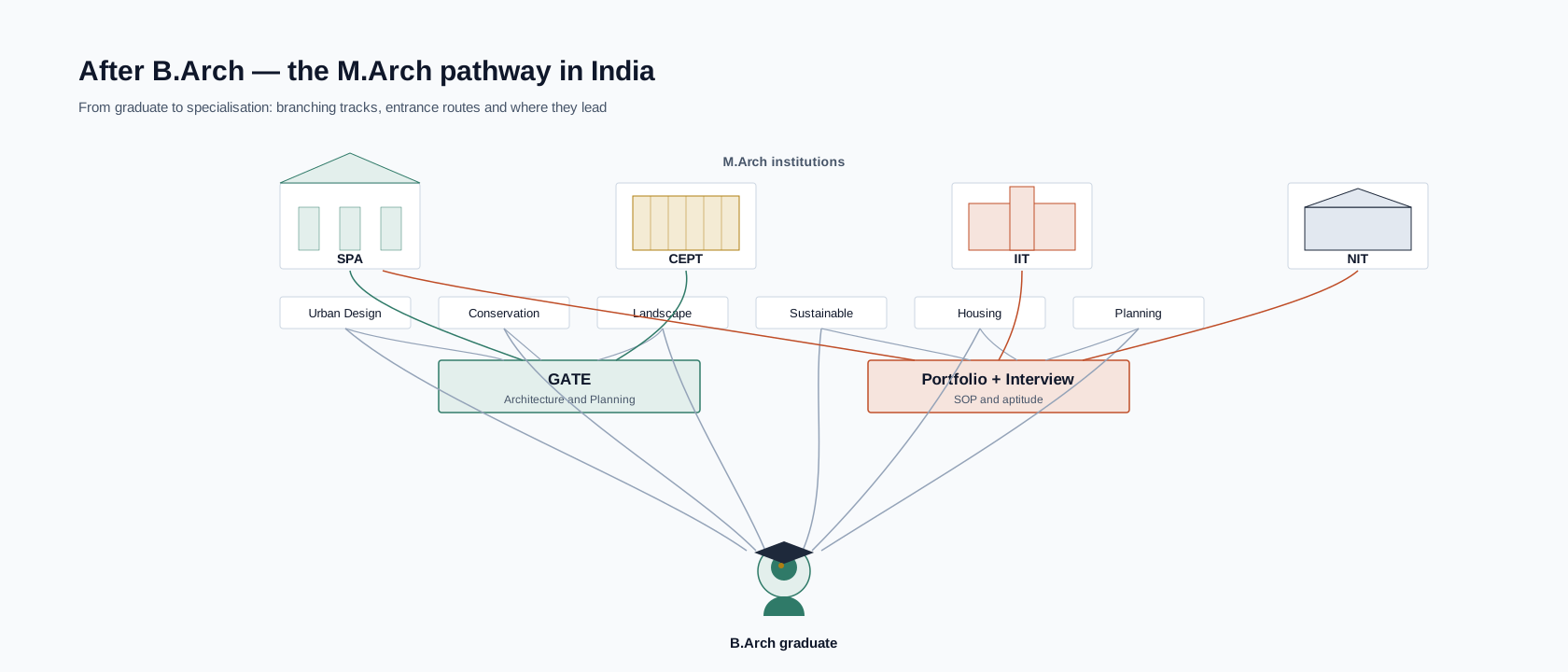
The M.Arch in India: Specialisations, Entrance, Institutions & Cost (2026)
A complete 2026 pathway to a Master of Architecture in India — the specialisation map, GATE/CCMT/COAP and portfolio routes, the institution shortlist, and what it really costs.
It is February, and somewhere in a small studio above a stationery shop in Pune, a final-year B.Arch student is staring at two browser tabs. One is the GATE registration page. The other is a spreadsheet of M.Arch programmes — Urban Design at SPA Delhi, Conservation at CEPT, Sustainable Architecture at NIT Trichy — with a column for "fees" that is half-empty because every website says something different. She has a portfolio she is proud of and a CGPA she is unsure about. She wants to know one thing before she commits a year and a small fortune: what actually gets you into a good M.Arch in India, and what does it really cost?
This guide is the long answer to that question. An M.Arch in India is a two-year post-B.Arch specialisation from a COA-recognised institution — it deepens your expertise in one domain (conservation, landscape, urban design, sustainability and so on), but it is not a second professional licence, and the route in depends as much on which institution you target as on which exam you sit. The selection landscape is genuinely fragmented — GATE feeds some doors, portfolios and interviews open others — so the smart move is to reverse-engineer your application from the specific institutions you want, not the other way round.
This is written for B.Arch students and recent graduates weighing a domestic master's. It is one of four pathway guides under our decision pillar, Should you do a Master's in architecture or design?. If you are also looking outward, read the companion M.Arch abroad guide; if your leaning is spatial-and-interior rather than architectural, see Master's in interior design — India and abroad. For undergraduate-stage decisions, our architecture schools shortlist and career pathways after B.Arch are good neighbours.
A master's degree does not make you a better architect by default. It makes you a deeper one in a chosen direction — and only if you choose the direction, and the institution, with your eyes open.
1. What an M.Arch in India is — and is not
The Master of Architecture is a two-year postgraduate degree that follows the five-year B.Arch. Its purpose is specialisation: you take the generalist foundation of undergraduate architecture and go deep into one domain — heritage conservation, landscape, urban design, environmental performance, housing, construction management, and so on.
Three things matter before anything else:
- The degree must come from a COA-recognised institution. The Council of Architecture (coa.gov.in) is the statutory body for architectural education in India. A master's from an institution whose programme is not properly recognised is an expensive way to learn very little. This is the single non-negotiable filter — check it first, always on the official site.
- It is not a higher licence. In India, the licence to call yourself an "Architect" and practise comes from registering with the Council of Architecture after a recognised B.Arch — not from an M.Arch. A master's adds depth, credibility, teaching eligibility and access to specialised roles. It does not upgrade or replace your registration. (More on this in the myths section.)
- It is a specialisation, not a do-over. An M.Arch assumes you already know how to make a building stand up. It is about going further in one direction, not relearning the basics.
A quick note on terminology: some specialisations — particularly city and regional planning — are offered as an M.Plan rather than an M.Arch, and admission often runs through the same machinery. Where that matters below, it is flagged.
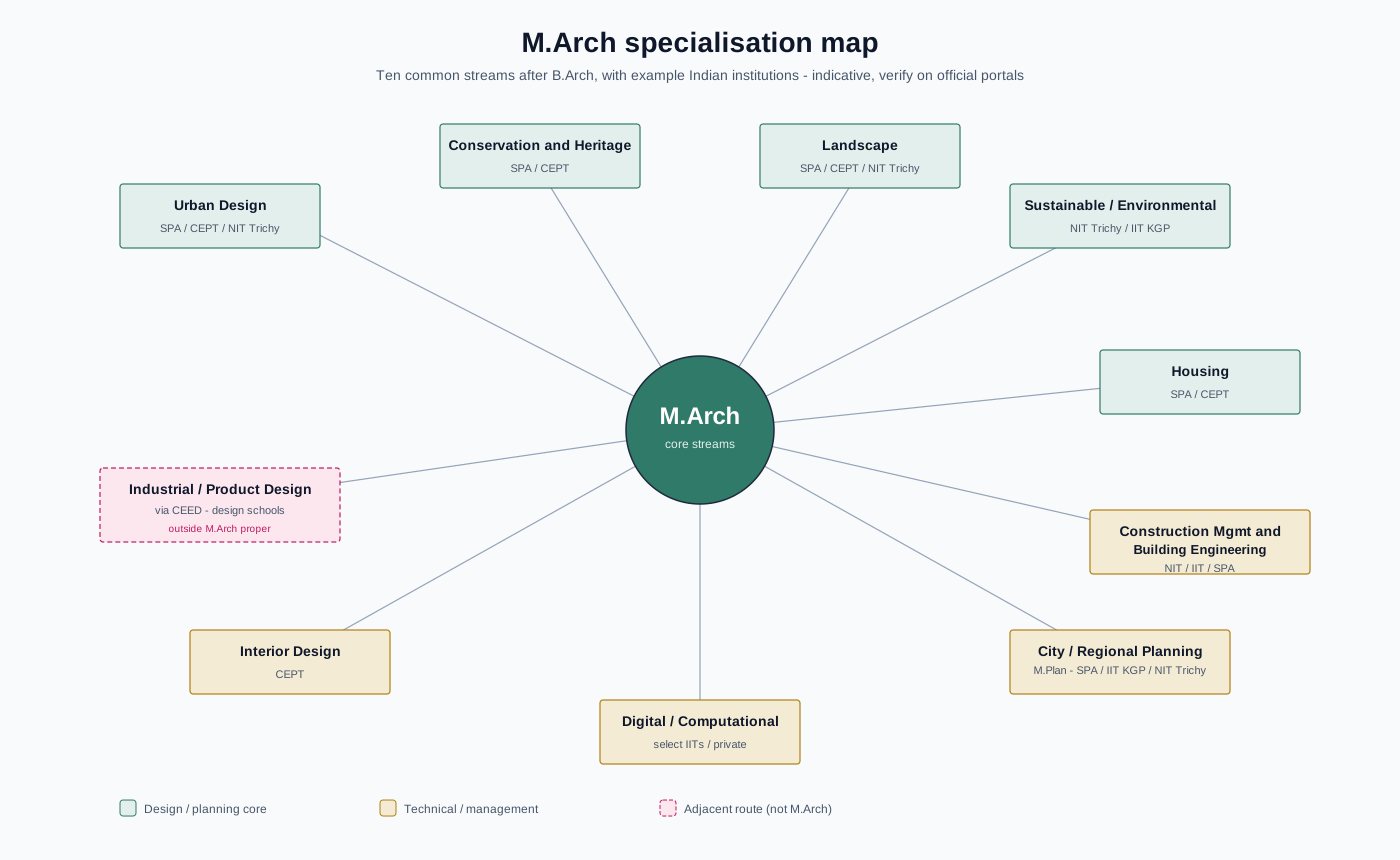
2. Specialisations — the working map
There is no single national list of M.Arch streams; each institution names and bundles them slightly differently, and the exact menu shifts year to year. But the working map below covers the streams a serious applicant will actually encounter, and which institutions are commonly associated with each. Treat the institution column as "known for / a good place to look," not an exhaustive list.
| Specialisation | What it is, briefly | Often associated with |
|---|---|---|
| Urban Design | Design at the scale between a building and a city — streets, blocks, public realm | SPA Delhi, CEPT, NIT Trichy |
| Architectural / Settlement Conservation & Heritage | Repair, adaptive reuse and management of historic fabric | SPA Delhi, CEPT (Conservation & Regeneration) |
| Landscape Architecture | Designing land, ecology, parks and outdoor systems | SPA Delhi, CEPT, NIT Trichy |
| Sustainable / Environmental / Energy-efficient Architecture | Building performance, climate-responsive and low-energy design | NIT Trichy, IIT Kharagpur (Sustainable Built Environment) |
| Housing | Mass and affordable housing, policy and design | SPA Delhi, CEPT |
| Building / Construction Management & Building Engineering | The delivery, cost and engineering side of building | NIT Trichy, SPA, IITs |
| City / Regional Planning (often M.Plan) | Statutory and strategic planning of towns and regions | SPA, IIT Kharagpur (City Planning), NIT Trichy (Urban Planning) |
| Digital / Computational Architecture | Parametric design, computation, fabrication | Select IITs and private/deemed schools |
| Interior Design / Interior Architecture | Interior-scale spatial design as a master's stream | CEPT (Interior Design) |
| Industrial / Product Design | Not strictly M.Arch — design master's via the CEED route | Design schools (CEED-based admission) |
A few honest caveats. First, CEPT is unusual in offering a wide spread of architecture streams under one roof — including Architectural History & Research, Tectonics, Conservation & Regeneration, Housing, Interior Design and Landscape — which is part of why it features so often above. Second, industrial and product design sit outside the M.Arch family proper; if your interest is products and objects rather than buildings, the relevant entrance is CEED (the Common Entrance Examination for Design), not GATE. Third, the line between "M.Arch" and "M.Plan" is institutional, not conceptual — pick the stream by content, then check which degree label and which entrance it uses.
3. Selection methods — the deep version
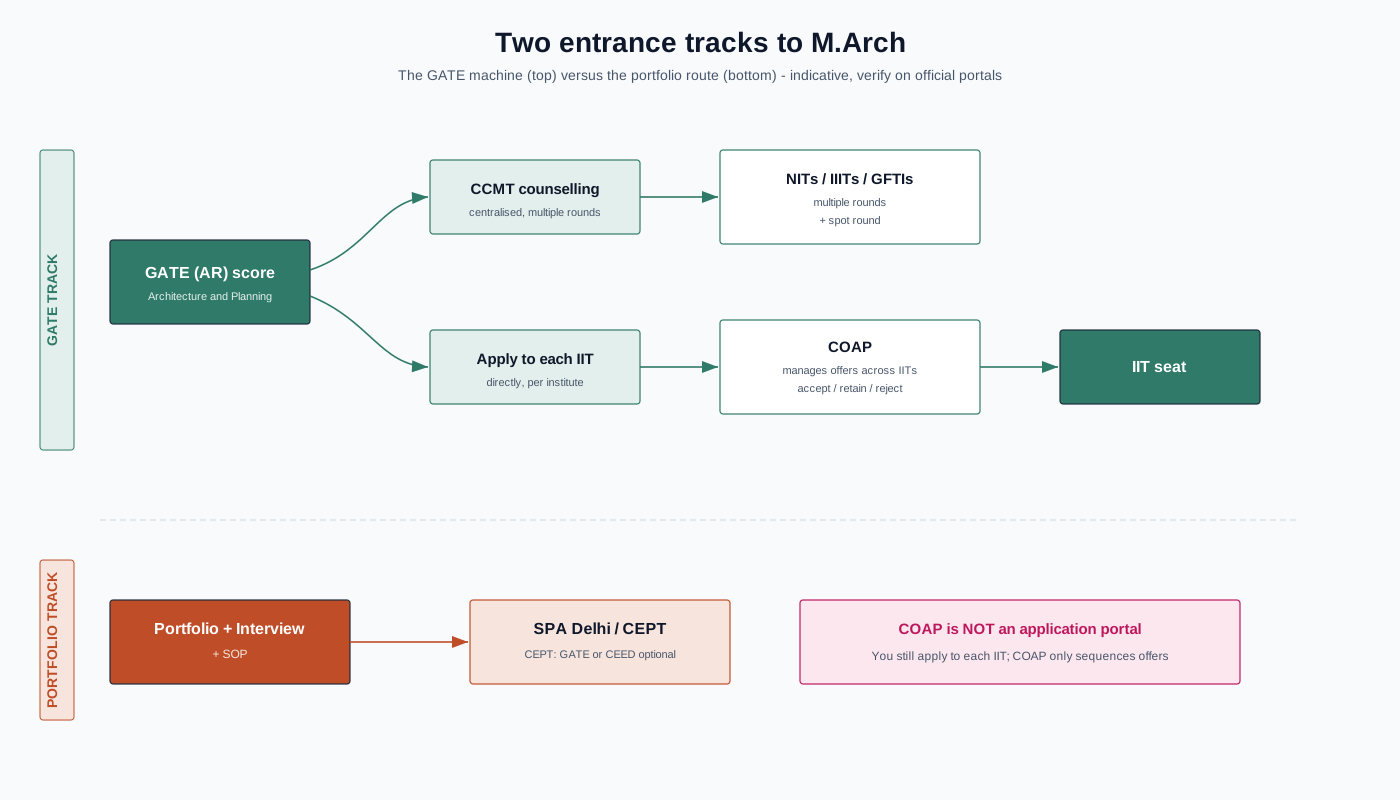
This is where most students lose time, because they assume "M.Arch admission = one exam." It is not. There are essentially four machines, and different institutions plug into different combinations of them. Understand all four, then map them to your shortlist.
3.1 GATE Architecture & Planning (AR)
The Graduate Aptitude Test in Engineering is the dominant gateway for the publicly-funded technical institutions — the IITs, NITs and IIITs. The relevant paper for our field is Architecture & Planning (paper code AR).
Key structure to know:
| GATE (AR) feature | Detail |
|---|---|
| Conducting body | IISc Bangalore and seven IITs, on rotation — GATE 2026 is conducted by IIT Guwahati |
| Mode | Computer-Based Test (CBT) |
| Duration | 3 hours |
| Questions / marks | 65 questions, 100 marks total |
| Composition | 10 questions / 15 marks General Aptitude + 55 questions / 85 marks subject (AR) |
| Negative marking | Yes, on MCQs |
| Score validity | 3 years |
Two practical points. First, that three-year validity is a gift — a strong GATE score taken in your final year stays usable, which matters if you want to work for a year or two before doing the master's. Second, "good score" heuristics are not official cutoffs. You will see students online quote target scores for particular institutions; treat these strictly as indicative folklore. The real cutoffs are set per-institution, per-specialisation, per-category, per-year, and are only knowable after counselling. Aim high, but do not anchor your decision to an unofficial number.
3.2 CCMT — the counselling platform for NITs, IIITs and GFTIs
Having a GATE score is not admission; you still have to be allocated a seat. For the NITs, IIITs and Government-Funded Technical Institutes (GFTIs), that allocation happens through CCMT — the Centralized Counselling for M.Tech / M.Arch / M.Plan (ccmt.admissions.nic.in).
| CCMT feature | Detail |
|---|---|
| What it is | A single, centralised counselling platform across participating NITs/IIITs/GFTIs |
| Score used | Valid GATE scores (within the last three years) |
| Process | Multiple rounds of seat allotment, followed by a spot round for vacant seats |
| Verification | Online document verification |
| Typical eligibility | ~60% / 6.5 CGPA (General) or 55% / 6.0 (reserved categories), plus a valid GATE score |
You register once, fill choices (institution + specialisation), and the system allots seats across rounds based on your GATE score, category and preferences. The spot round mops up vacancies — useful if you missed earlier allotments but flexible about where you go.
3.3 COAP — the offer-acceptance portal for IITs
The IITs run their own machinery. COAP — the Common Offer Acceptance Portal (accessible via gate.iisc.ac.in) is frequently misunderstood, so be precise:
- COAP is NOT an application portal. You do not apply to IIT programmes through COAP.
- You apply to each IIT separately, on its own admissions pages, for the specific M.Arch/M.Plan programme you want.
- COAP exists only to manage the offers the IITs make you — through accept / retain / reject windows across multiple rounds, so that a single candidate does not block multiple seats.
So the IIT route is: GATE score → apply directly to each target IIT → receive offers → manage them via COAP. Plan for the application deadlines of each IIT individually; do not assume one portal covers them.
3.4 Institution-specific routes — where GATE is optional or absent
Here is the part students miss: several of the best M.Arch programmes do not require GATE at all. They run their own entrances built around portfolio and interview, because architecture is a design discipline and a transcript only says so much.
| Institution | Selection method |
|---|---|
| SPA New Delhi (PG) | GATE or CEED + portfolio + personal interaction / written test + Statement of Purpose. Sponsored-candidate route additionally needs ≥2 years' experience + an employer guarantee |
| CEPT, Ahmedabad | University entrance + portfolio review (plagiarism-checked) + interview. GATE/CEED optional |
| NIT Trichy | B.Arch CGPA + GATE, allocated via CCMT |
| State-route institutions | State entrance exams — TANCET (Tamil Nadu), Karnataka PGCET, TS PGECET (Telangana) |
The headline: at SPA Delhi and CEPT, your portfolio and interview carry real weight. A student with an average transcript but an exceptional, original body of work has a genuine path here — which is precisely the path that does not exist on the pure-GATE side. Note CEPT's plagiarism check on portfolios; present only your own work, clearly attributed. If you need to build that body of work, our architecture portfolio guide is the place to start.
3.5 Eligibility — the common baseline
Across the board, the baseline is broadly the same:
- A B.Arch from a COA / AICTE-approved school of architecture.
- A minimum aggregate of roughly 50%, though many top institutions require 55% (General) / 50% (reserved), and CCMT applies the ~60% / 55% bands noted above for its institutions.
- A valid GATE or CEED score where the institution requires one.
One subtle but important point: it is the degree that must be COA-recognised, not you personally. Personal COA registration is not a stated admission gate for M.Arch. You do not need to be a registered architect to start a master's — you need a recognised qualifying degree. Verify the exact percentage and document requirements on each institution's official page, because they vary and they change.
4. The institution shortlist
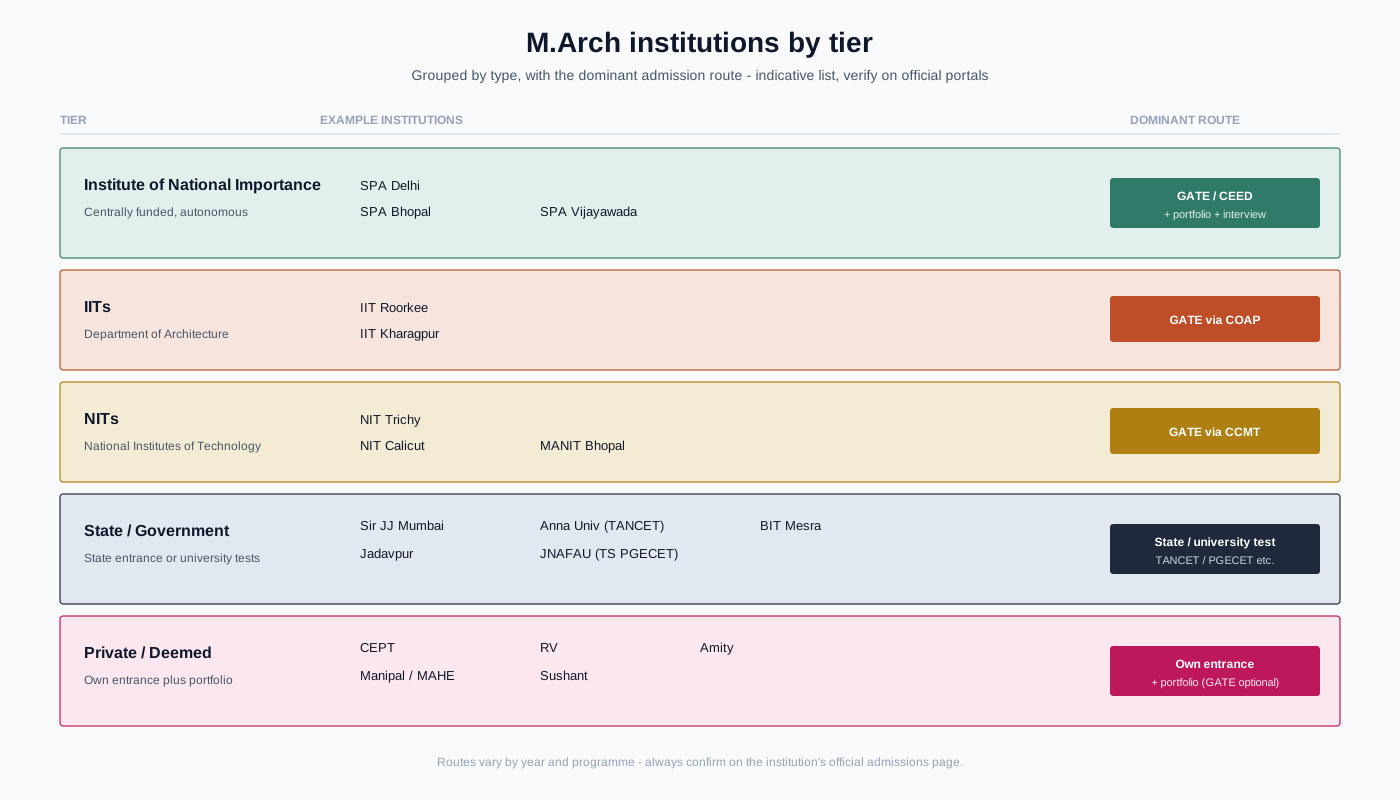
Names matter, so here is a concrete, honest shortlist. Be warned up front: exact streams, seat counts and admission rules shift every year. Use this to orient your research, then verify everything on the official site.
| Institution | Type | Notable specialisations | Admission route |
|---|---|---|---|
| SPA New Delhi | Institute of National Importance | Architectural Conservation, Landscape, Urban Design | GATE/CEED + portfolio + interview |
| SPA Bhopal | Centrally-funded | Architecture & planning streams | GATE + institute process |
| SPA Vijayawada | Centrally-funded | Architecture & planning streams | GATE + institute process |
| CEPT, Ahmedabad | Highly-regarded (deemed) | ~6 M.Arch streams: Architectural History & Research, Tectonics, Conservation & Regeneration, Housing, Interior Design, Landscape | University entrance + portfolio + interview |
| IIT Roorkee | IIT | Architecture & Planning, Building Services, Disaster Mitigation | GATE via COAP |
| IIT Kharagpur | IIT | City Planning, Sustainable Built Environment (relatively new M.Arch) | GATE via COAP |
| NIT Trichy | NIT | Urban Design, Urban Planning, Landscape, Sustainable Architecture, Construction Management | GATE via CCMT |
| NIT Calicut | NIT | Architecture & planning streams | GATE via CCMT |
| MANIT Bhopal | NIT | Architecture & planning streams | GATE via CCMT |
| Sir JJ College, Mumbai | Government / state | Architecture streams | GATE and/or state entrance |
| Jadavpur University | State | Architecture streams | GATE and/or state entrance |
| Anna University, Chennai | State | Architecture & planning streams | GATE and/or TANCET |
| JNAFAU, Hyderabad | State | Architecture & planning streams | GATE and/or TS PGECET |
| BIT Mesra | Government / deemed | Architecture & planning streams | GATE and/or state entrance |
| Manipal / MAHE, RV, Sushant, Amity | Strong private / deemed | Varied streams | Institute process (verify) |
A few editorial notes:
- SPA Delhi is an Institute of National Importance and is the reference point for conservation, landscape and urban design in the country. Its portfolio-and-interview route rewards genuine design strength.
- CEPT is the breadth play: the widest menu of architecture master's streams, with a research-heavy culture and an entrance that takes your portfolio seriously.
- The IITs (Roorkee, Kharagpur) approach architecture through a technical, research lens — Building Services, Disaster Mitigation, Sustainable Built Environment, City Planning. If you want architecture married to engineering rigour, look here, and remember the route is direct application + COAP.
- The NITs (Trichy especially) offer a strong, affordable spread via CCMT.
- State and private options widen the field but require the most careful verification — both of COA recognition and of which entrance actually governs admission.
5. Cost of education
Now the part that empties the spreadsheet column. Every figure below is approximate, several sources actively conflict, and you must verify the current number on the official portal before you commit. That caution is not boilerplate — M.Arch fee data online is genuinely unreliable, and a lot of it is stale or quietly copied from B.Arch pages.
5.1 Centrally-funded institutions (SPA / IIT / NIT)
The headline here is the good news of Indian higher education: the best public M.Arch programmes are remarkably cheap to attend. Tuition is low and subsidised; your real spend is living and hostel.
| Cost item | Approximate range (verify on official site) |
|---|---|
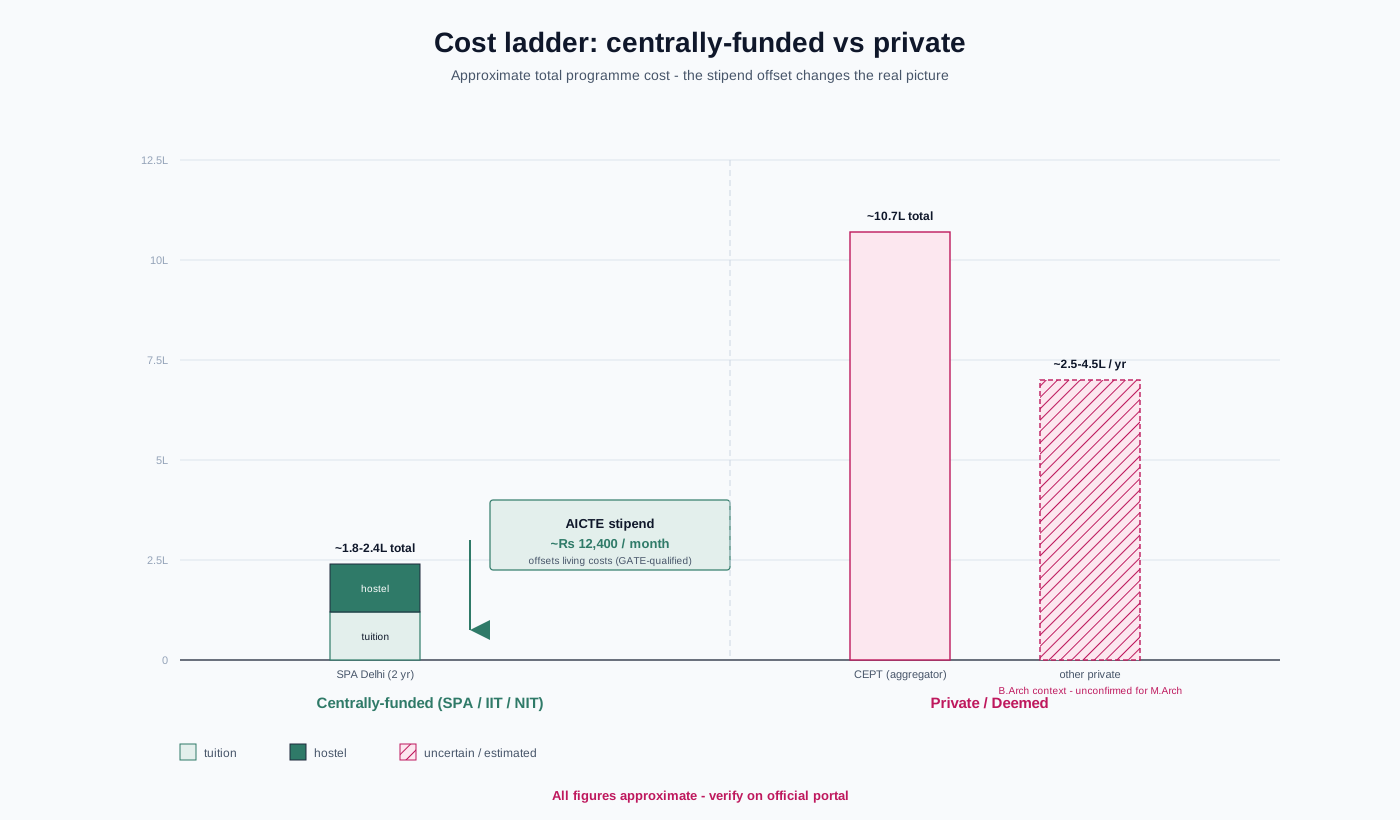
| SPA Delhi M.Arch — total programme | Reported around ₹1.8–2.4 lakh total (sources conflict — treat as a band) |
| IIT / NIT M.Arch — tuition | Broadly low, roughly ₹50,000–₹1.5 lakh per year |
| Hostel | ~₹20,000–₹40,000 per year |
| Living / mess (by city) | ~₹3,000–₹8,000 per month |
So for a centrally-funded M.Arch, a realistic all-in two-year estimate sits in the low-single-digit lakhs — and that is before scholarships and stipends (section 5.3), which can offset much of it. This is the structural reason a public M.Arch is one of the best-value postgraduate degrees in the country.
5.2 Private and deemed institutions
Here precision collapses, so hold these loosely:
| Cost item | Approximate figure (verify — do not treat as confirmed) |
|---|---|
| CEPT — total programme | Aggregator-reported around ₹10.7 lakh total — verify on cept.ac.in |
| Other private architecture fees | Roughly ₹2.5–4.5 lakh per year — but this band is mostly B.Arch context; do NOT assume it is the confirmed M.Arch fee |
That second row deserves a warning in bold: the ₹2.5–4.5 lakh/year band you find quoted for private architecture schools is largely undergraduate (B.Arch) data. Treat any private M.Arch fee as unconfirmed until you read it on the institution's own current fee page. This is the single most common place students get a nasty surprise.
5.3 Funding — the part that changes the maths
Public M.Arch is not just cheap; for GATE-qualified candidates it can effectively pay you to study.
| Funding source | Detail (verify current rules) |
|---|---|
| AICTE PG stipend | ₹12,400 per month for GATE-qualified, full-time M.Arch students at AICTE / IIT institutes, plus ₹5,000/year contingency, for roughly 22–24 months. Requires about 8–10 hours/week of teaching-assistant work |
| Status of the stipend amount | Unrevised since 2015. A roughly 50% hike has been proposed but is NOT confirmed — do not budget on it |
| Category / institutional concessions | SC / ST / PwD and other category concessions and institutional scholarships, varying by institution |
Run the arithmetic and it is striking: a GATE-qualified student at a centrally-funded institution can have low tuition + a monthly stipend that covers much of living costs. That combination is the core financial argument for the public route over a private programme costing many lakhs.
Two honesty flags. The stipend has not been revised since 2015, so its real value has eroded with inflation — and while a hike has been proposed, it is not confirmed, so plan your budget on the current ₹12,400, not on a hoped-for increase.
6. Application timeline and cycle
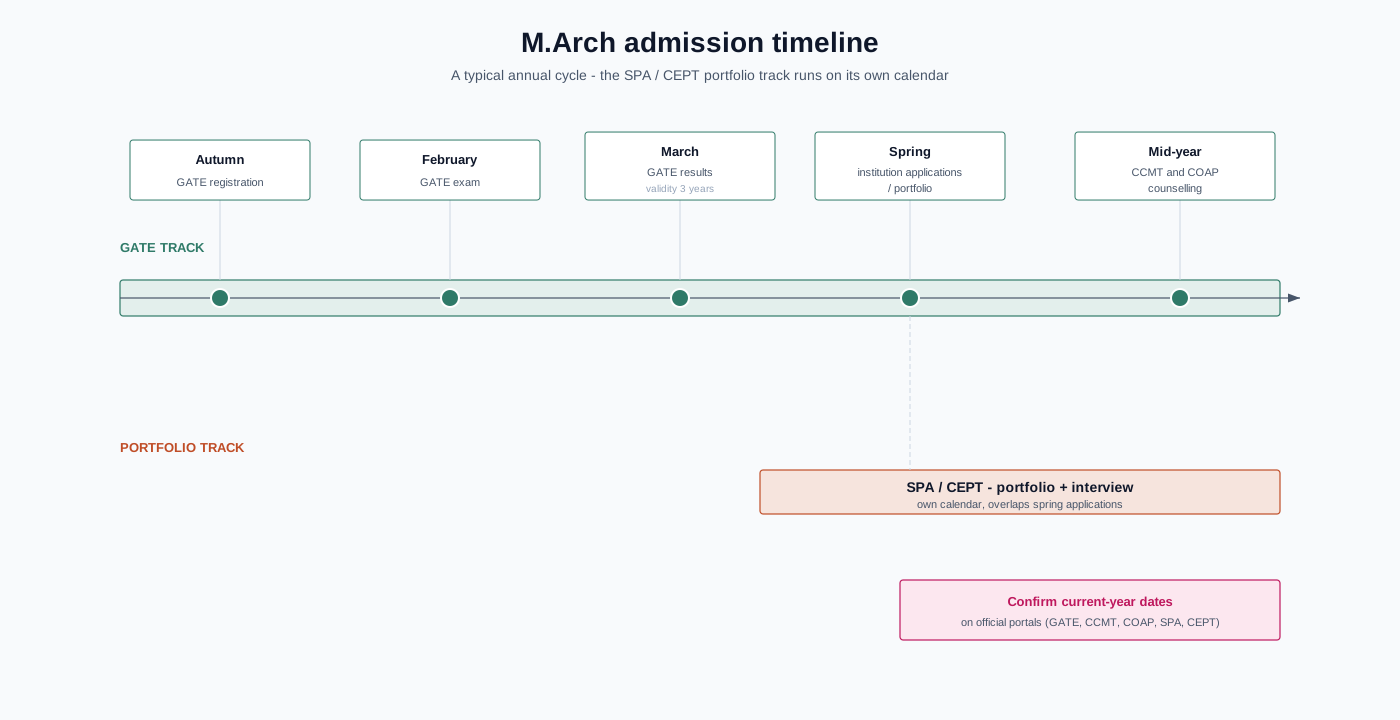
The annual rhythm is reasonably stable in shape, even though exact dates move every year. Use this as a mental calendar, then confirm the current-year dates on each official portal.
| Phase | Approximate timing | What happens |
|---|---|---|
| GATE registration | Previous year, autumn | Register for the AR paper |
| GATE exam | February | Computer-based test |
| GATE results | March | Scores published; validity runs 3 years |
| Institution applications | Spring onwards | Direct applications to IITs / SPA / CEPT; portfolio prep |
| CCMT / COAP counselling | Mid-year | Seat allotment (CCMT) and offer management (COAP) |
| State entrances (TANCET / PGCET / PGECET) | Varies by state | Separate timelines — check state portals |
The practical takeaway: the portfolio-and-interview institutions (SPA, CEPT) run on their own application calendars, often in parallel with GATE results — so if those are on your list, you are managing two timelines at once. Build the portfolio early; do not leave it to the spring scramble.
7. A decision framework — who should choose what
There is no universally "best" M.Arch; there is the one that fits your money, your strengths and your goals. Here is how the senior-in-the-studio would steer you.
| If you are... | Lean towards | Because |
|---|---|---|
| Strong on exams, budget-conscious, research-minded | IIT / NIT via GATE | Lowest cost, stipend, technical-research culture |
| Strong portfolio, average transcript, design-led | CEPT or SPA Delhi | Portfolio + interview routes reward genuine work over marks |
| Set on conservation, landscape or urban design | SPA Delhi | The national reference point for these specialisations |
| Wanting the widest stream menu under one roof | CEPT | ~6 distinct M.Arch streams, research-heavy |
| Tied to a state / regional context or budget | State institutions (Anna, JNAFAU, Jadavpur, JJ) | State entrances, local rootedness, lower cost |
A few cross-cutting judgements:
- The GATE-vs-portfolio question. If your design work is your strongest asset, do not let a fear of GATE narrow your world — SPA and CEPT exist precisely for you. If your transcript and test temperament are your strength, GATE opens the entire IIT/NIT system cheaply. Most ambitious students sit GATE and build a portfolio, keeping both doors open.
- Value. A centrally-funded M.Arch with a stipend is, financially, hard to beat. Justify any multi-lakh private alternative with a specific reason — a unique stream, a specific faculty member, a specific city.
- When to look abroad instead. If your goal is global practice, a specialism India teaches thinly, or you have the funds and risk appetite, weigh the M.Arch abroad pathway before committing. And if you are still unsure a master's is the right move at all, return to the decision pillar and the career pathways after B.Arch guide.
8. Myths and pitfalls
Clearing these saves money and disappointment.
- Myth: "An M.Arch gives you a higher licence." No. Your licence to practise comes from B.Arch + Council of Architecture registration. A master's adds depth and eligibility (including for teaching), not a tier of licensure.
- Myth: "You must have GATE to do an M.Arch." No. GATE is essential for the IIT/NIT/IIIT route, but CEPT and SPA Delhi admit through portfolio-and-interview routes where GATE is optional or one of several accepted scores.
- Myth: "Any M.Arch is as good as any other." No. Programmes differ enormously in faculty, culture and recognition. Verify COA recognition and look hard at the faculty and studio culture before you pay.
- Pitfall: trusting fee figures you find online. Much of what is published is stale, or quietly lifted from B.Arch pages. Always confirm the current M.Arch fee on the institution's own portal.
- Pitfall: budgeting on an unconfirmed stipend hike. The AICTE PG stipend is unrevised since 2015; a hike is proposed, not confirmed. Plan on ₹12,400/month.
- Pitfall: portfolio plagiarism. CEPT (and others) plagiarism-check portfolios. Show only your own work, attributed honestly.
References and Further Reading
All figures, fees, exam structures and eligibility rules above are approximate and revised yearly. Verify every number on the official portal at the time you apply.
Official / Statutory
- Council of Architecture (COA) — coa.gov.in — recognition of degrees and architect registration.
- GATE (Architecture & Planning, AR) — gate.iitg.ac.in — exam structure, schedule, scores (GATE 2026 conducted by IIT Guwahati).
- CCMT — Centralized Counselling for M.Tech/M.Arch/M.Plan — ccmt.admissions.nic.in — counselling for NITs/IIITs/GFTIs.
- COAP — Common Offer Acceptance Portal — via gate.iisc.ac.in — manages IIT offers (not an application portal).
- SPA New Delhi — spa.ac.in — PG admissions, specialisations.
- CEPT University — cept.ac.in — M.Arch streams, entrance and portfolio review.
- NIT Tiruchirappalli — nitt.edu — programmes and CCMT admission.
- State entrances — TANCET (Tamil Nadu), Karnataka PGCET, TS PGECET (Telangana) — respective state portals.
Funding & Scholarships
- AICTE — the GATE-qualified PG stipend (₹12,400/month at present), contingency grant, and category concessions — verify current figures and any revision.
- Institutional and SC / ST / PwD scholarships — check each institution's official scholarship page.
Companion Studio Matrx Guides
- Should you do a Master's in architecture or design? (the decision pillar)
- M.Arch abroad — the 2026 pathway
- Master's in interior design — India and abroad
- Architecture schools shortlist — India 2026
- Career pathways after B.Arch
- Building an architecture portfolio in India
- Architecture thesis methodology
- Sections: /students · /architects · /landscape-architects · /guides
Author's Note: I have watched too many talented students treat the master's decision as an exam-prep problem when it is really a fit problem. The exam is the easy part to optimise; the hard part is being honest about what you want to go deep on, and whether a particular studio will actually take you there. Choose the direction first, the institution second, and let the entrance method follow from those two — not the other way round.
Disclaimer: Fees, exam structures, stipends, eligibility criteria and deadlines are revised every year and frequently differ between sources. Every figure in this guide is approximate and provided for general orientation only. Always verify the current details on the relevant official portals (coa.gov.in, gate.iitg.ac.in, ccmt.admissions.nic.in, spa.ac.in, cept.ac.in, nitt.edu and the official sites of any institution or state entrance you are considering) before making any financial or academic decision. This guide is informational and carries no liability.
Export this guide
Related Guides — Deep-dive reading
Indian Architecture Schools — A Working Shortlist
The 2026 Reference for B.Arch Aspirants — COA-Approved Institutions, Tier Map, Cost-of-Attendance Ranges, Pedagogy Profiles, Faculty Strengths, Geographic Distribution, Application Deadlines, and the Decision Framework for Choosing the School That Fits You
Student FoundationsA Master's in Interior Design in India: Degrees, Entrance, Institutions & Cost (2026)
An honest, India-first guide to the confusingly-named degree landscape, the entrance methods (CEED, NID DAT and institute tests), a real institution shortlist, and what it all actually costs — in a field that has no statutory licence.
Student FoundationsNATA & JEE B.Arch Entrance Preparation
The 2026 Reference for the Indian B.Arch Aspirant — Test Structures, Eligibility, the Two-Year Calendar, Drawing Practice Discipline, Aptitude & Math Programmes, Mock-Test Cycles, Scoring, JoSAA & State Counselling, and the Foundational Path from Class 11 to Admission
Student FoundationsRelated Tools — Try Free
Cross-Ventilation Analyzer
Estimate airflow and air changes per hour (ACH) from room size, window areas, layout, and local wind — with NBC 2016 Part 8 compliance check.
Ventilation CalculatorInterior Budget Allocation Map
How ₹5L / ₹10L / ₹20L budgets should be distributed across rooms with visual charts and tier breakdown.
Reference GuideMaterial Decision Framework (M-Score)
Score 30+ Indian construction materials across cost, durability, climate fit, maintenance, and sustainability.
Materials