
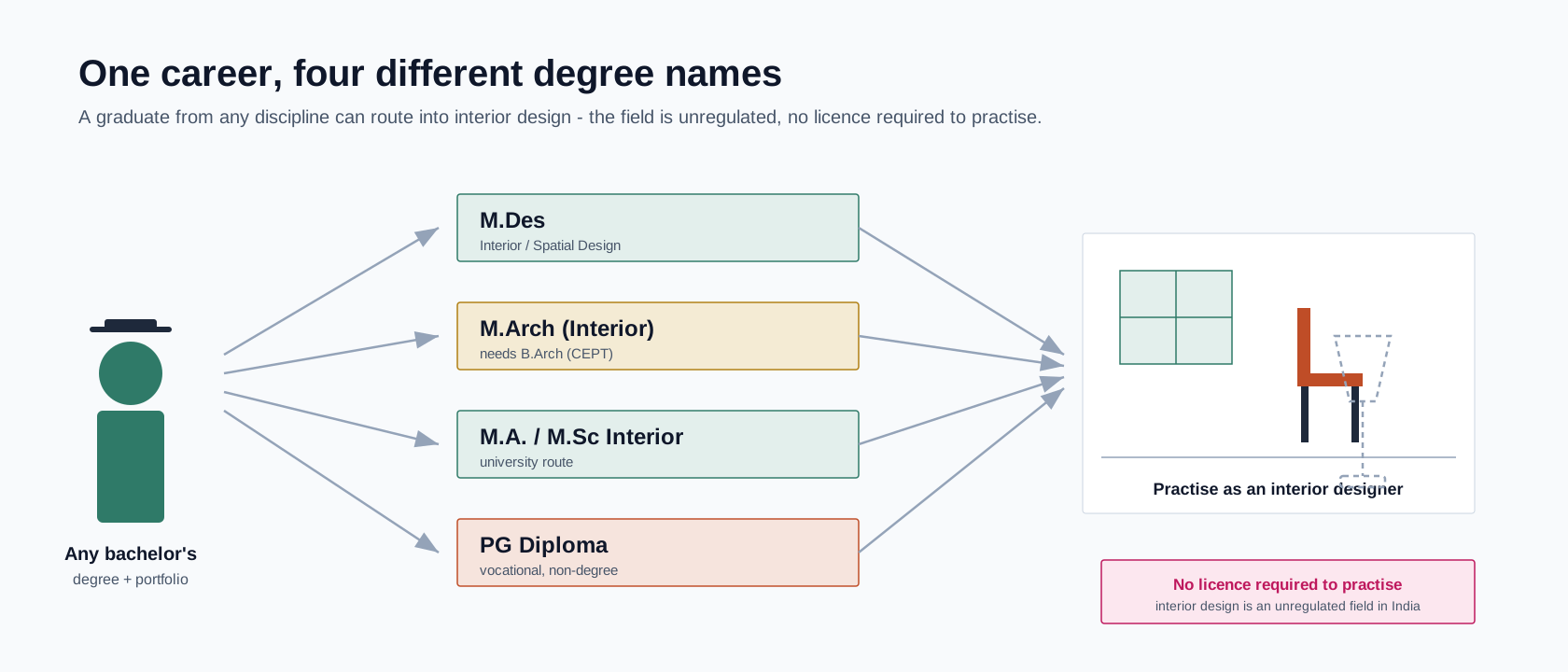
A Master's in Interior Design in India: Degrees, Entrance, Institutions & Cost (2026)
An honest, India-first guide to the confusingly-named degree landscape, the entrance methods (CEED, NID DAT and institute tests), a real institution shortlist, and what it all actually costs — in a field that has no statutory licence.
It is a humid evening in Bengaluru, and a graphic-design graduate is scrolling through admission pages with a growing sense of confusion. She loves spaces — the way a badly-lit room can be rescued by a single window, the way furniture choreographs a family's day — and she wants a master's that will let her do this seriously. But the more she reads, the murkier it gets. One school calls it M.Des Interior Space & Furniture Design. Another calls it M.A. Interior Design. A friend insists she should "just crack CEED and go to an IIT." Somewhere in the noise is a simpler truth nobody has told her plainly: in India, nobody is legally required to have any of these degrees to call themselves an interior designer at all.
This guide is the calm, honest version of that conversation. A master's in interior design in India is a credibility, skill and network accelerator — not a licence — and because the field is unregulated, your real decision is a trade-off between the cheap-prestige routes (which have no dedicated interior track) and the genuine interior master's programmes (which cost several times more). Getting that trade-off right is worth more than any exam-prep tactic, so we will spend most of our time there.
This is written for anyone — design, architecture, fine-arts, home-science, or an unrelated bachelor's entirely — weighing a postgraduate qualification in interiors. It is one of four pathway guides under our decision pillar, Should you do a Master's in architecture or design?. If your eyes are set overseas, read the companion Master's in interior design abroad; if you are weighing the architecture route instead, see M.Arch in India and abroad. And if you are still at the undergraduate stage, our B.Des interior design student track is the right neighbour.
A master's in interior design in India does not give you the right to practise — you already have that. What it can give you is the depth, the studio discipline and the name on the door that the open market will not hand you for free.
1. The honest framing — an unregulated field
Before any exam or fee, understand the ground you are standing on. Interior design in India is unregulated. There is no statutory licence, no legally protected title, and no Act of Parliament that says you must hold a particular degree to design interiors for a living. This is a genuine, structural difference from architecture, where the Architects Act, 1972 and the Council of Architecture (COA) make "Architect" a protected, registered title.
The body people most often confuse with a regulator is the Institute of Indian Interior Designers (IIID) — iiid.net.in. Founded in 1972, with roughly 10,000 members across about 35 chapters (including one in Dubai), IIID is a respected, influential voluntary professional society. It runs awards, events and continuing education, and membership is a credibility signal. But it is not a statutory regulator. It does not license you, it cannot stop anyone from practising without it, and it does not control who may use the title "interior designer."
The practical consequences for your master's decision are large, and worth stating bluntly:
- A master's is not legally required. You can practise interior design in India with a diploma, an undergraduate degree, or — strictly speaking — none at all. The market, not the law, decides who succeeds.
- The degree's value is reputational and substantive, not regulatory. It buys you skill, a portfolio, a studio network, faculty mentorship and a recognisable name — all of which open doors. It does not buy you a protected status, because no such status exists.
- Therefore "where" and "how much" matter more than "whether you have the paper." Because the paper is optional, paying many lakhs for a weak programme is poor value. The whole point of this guide is to help you spend wisely inside an unregulated market.
In architecture, the law decides who may call themselves an architect. In interiors, the market decides who gets hired. A master's is your way of influencing the market — never confuse it with a licence.
2. The degree landscape — same career, many names
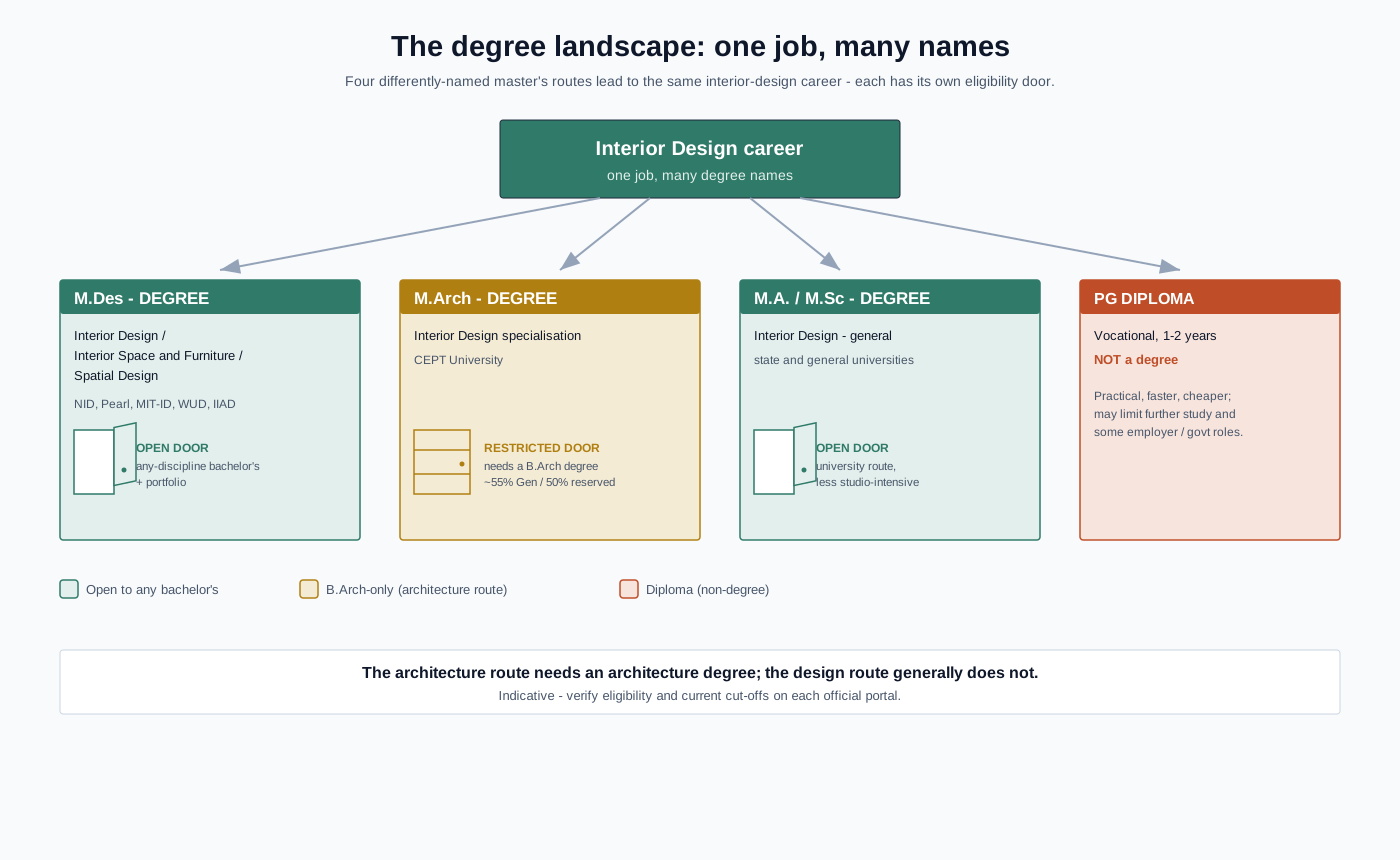
The single most disorienting thing about this field is that one career hides behind many degree names. The table below maps the routes you will actually meet. They lead to broadly the same work; they differ in flavour, intensity, eligibility and prestige.
| Degree route | Typical names you will see | Who offers it | Character |
|---|---|---|---|
| M.Des (Master of Design) | Interior Design; Interior Space & Furniture Design; Interior Architecture & Design; Spatial Design | NID, private design schools (Pearl, MIT-ID, WUD, IIAD) | The dominant, studio-intensive route; design-led |
| M.Arch — Interior Design specialisation | Interior Design (as an M.Arch stream) | CEPT Ahmedabad | The architecture-route master's; requires a B.Arch |
| M.A. / M.Sc Interior Design | Interior Design / Interior Decoration | General & state universities (often home-science / fine-arts faculties) | University route; generally less studio-intensive |
| PG Diploma | Interior Design (1–2 year) | Vocational institutes | Non-degree; vocational, shorter, lower cost |
The deepest distinction here is eligibility, and it is the point most students miss:
- The design-route master's (M.Des, M.A./M.Sc) is broadly open to graduates of almost any discipline. The CEED-gated M.Des at the IITs/IISc accepts any 3-year-or-longer bachelor's, with no age limit and no cap on attempts; NID and the private design schools accept an any-discipline bachelor's plus a portfolio and entrance test. A commerce, science, arts or engineering graduate with genuine spatial talent can enter.
- The M.Arch interior route at CEPT requires a B.Arch. This is the architecture door, and it is only open to those who already hold an architecture degree (broadly ~55% for General, ~50% for reserved categories on the qualifying degree — verify on cept.ac.in).
So the rule of thumb is simple: the architecture-route master's needs an architecture degree; the design-route master's generally does not. If you do not hold a B.Arch, the M.Des / M.A. world is where your options live.
3. Selection methods — the deep version
There is no single national entrance for interior-design master's. Instead there are a handful of distinct machines, and each institution plugs into one. Understand all of them, then map them to your shortlist.
3.1 CEED — and a critical warning attached to it
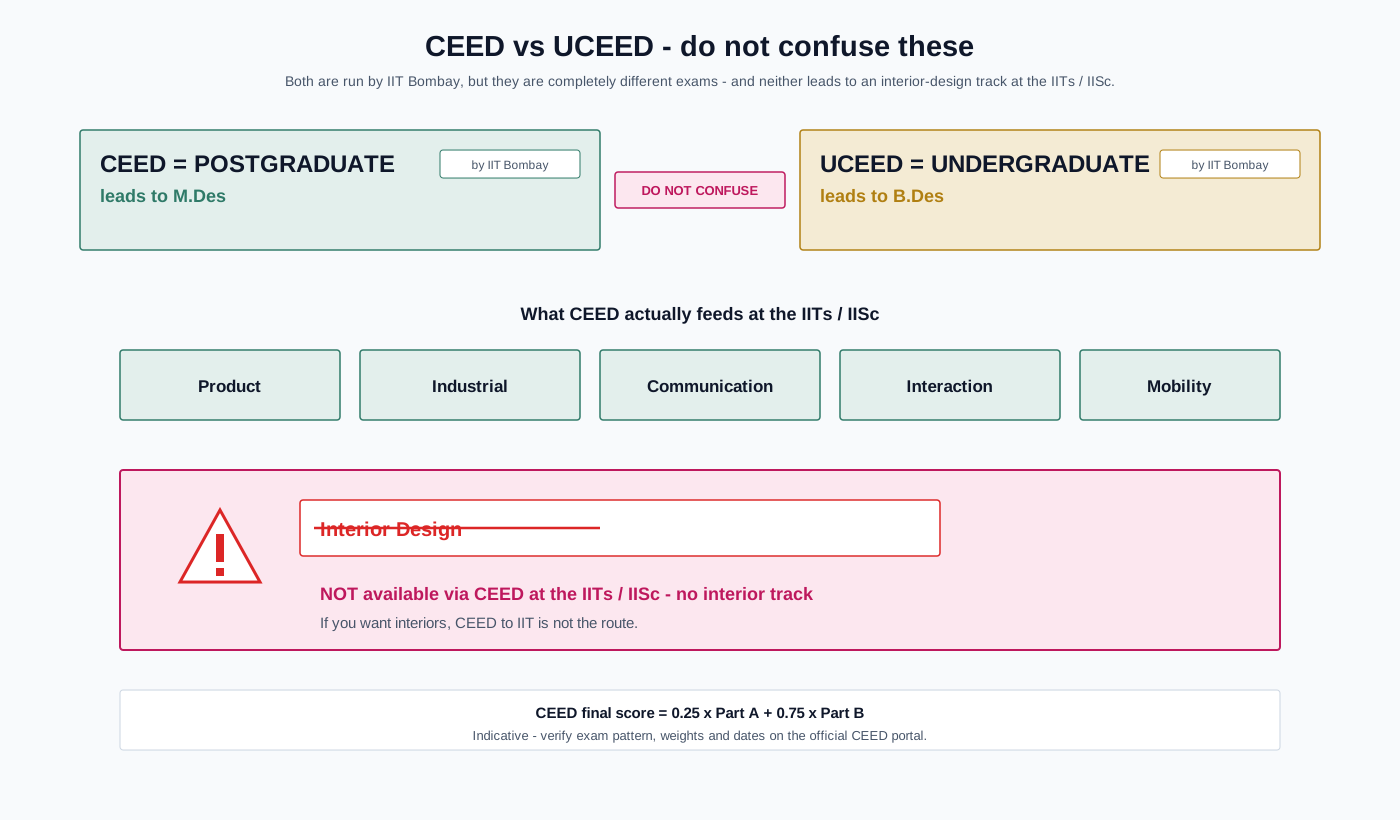
The Common Entrance Examination for Design (CEED) is conducted by IIT Bombay on behalf of the Ministry of Education (ceed.iitb.ac.in). It gates admission to M.Des (and PhD by Design) programmes at IISc and the IITs. For 2026, roughly 11 primary institutes use CEED for their own admissions, and around 14 further "result-sharing" institutes accept the score.
The exam is in two parts, and the order matters:
| CEED feature | Detail |
|---|---|
| Part A | Computer-based, objective (NAT / MCQ / MSQ). Tests visual and spatial ability, design and environment awareness, analytical reasoning, language, and design sensitivity |
| Gatekeeping | Only candidates who clear Part A get their Part B evaluated at all |
| Part B | Five hand-written questions — design, drawing and writing — assessing creativity, problem-solving and communication |
| Final score | 0.25 × Part A + 0.75 × Part B — Part B dominates the result |
| Eligibility | Any bachelor's of 3 years or more; no age limit, no cap on attempts |
Note the weighting: even though Part A is the qualifying filter, the final score is three-quarters Part B. Hand skill and design thinking, not multiple-choice speed, decide your rank.
Now the two clarifications that save students from expensive mistakes:
- CEED is NOT UCEED. Both are run by IIT Bombay, but CEED is the postgraduate exam (for M.Des) while UCEED is the undergraduate exam (for B.Des). They are routinely confused. If you are a graduate seeking a master's, your exam is CEED.
- CEED at the IITs/IISc has NO dedicated interior-design specialisation. The M.Des disciplines on offer through CEED are product / industrial / communication / interaction / mobility design. There is no interior-design master's at the IITs or IISc. A student who specifically wants interiors should not assume "CEED gets me into interior design." It does not. This single misconception derails more interior-minded applicants than any other.
3.2 NID DAT — the Design Aptitude Test
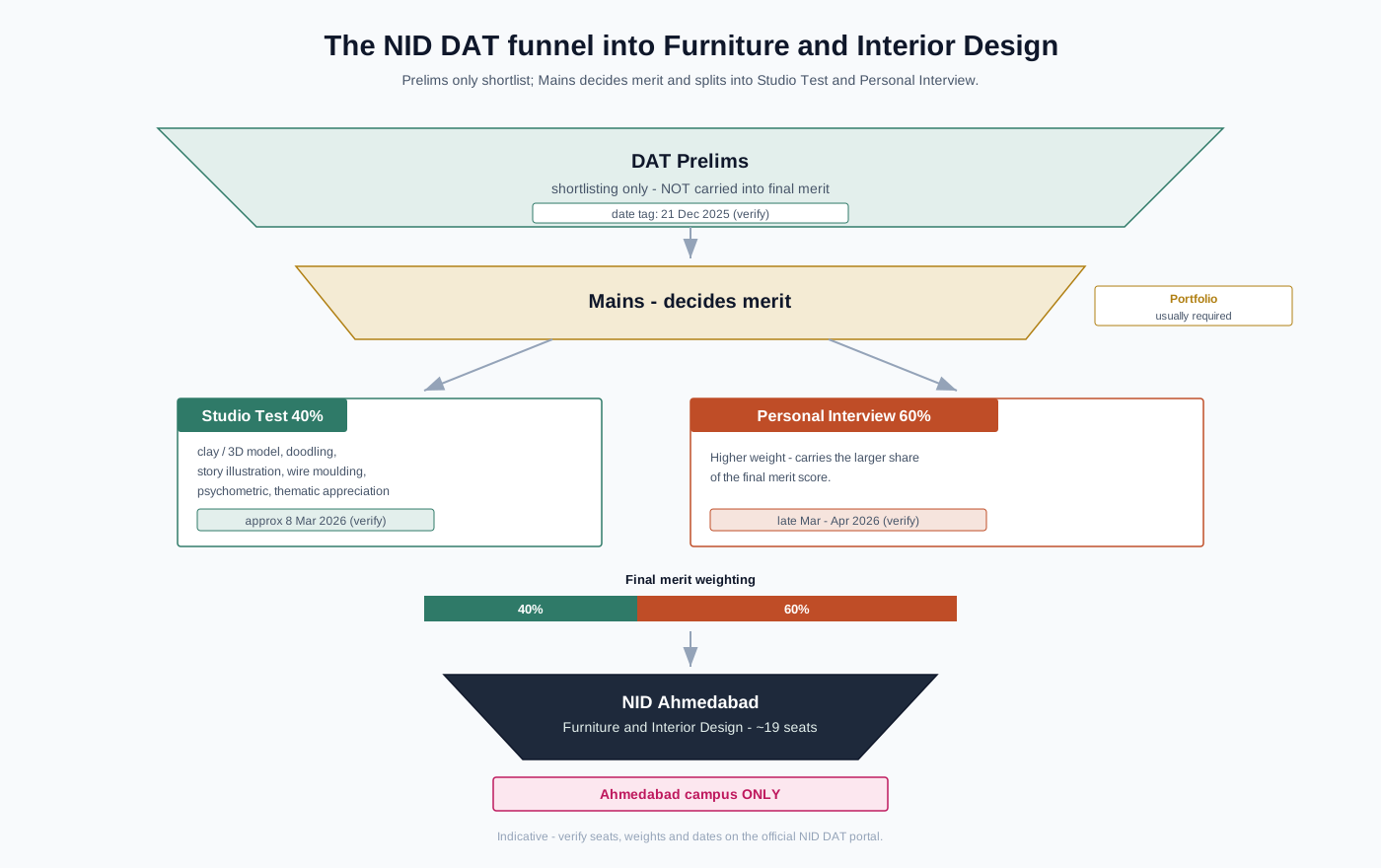
For NID's M.Des, admission runs through the Design Aptitude Test (DAT), conducted in two stages:
| NID DAT stage | What it is |
|---|---|
| Prelims | A shortlisting filter only — the prelims score is not carried into the final merit |
| Mains | Two components: a Studio Test and a Personal Interview |
| M.Des mains weighting | Studio Test 40% / Personal Interview 60% |
| Studio tasks | Clay / 3D model-making, doodling, story illustration, wire moulding, a psychometric test, thematic appreciation |
| Portfolio | Usually required |
The headline for interior aspirants is precise: the genuine interior discipline at NID is "Furniture & Interior Design," and it exists only at NID Ahmedabad (roughly 19 seats) — not at the Gandhinagar or Bengaluru campuses. If your heart is set on interiors at NID, Ahmedabad is the only door.
The 2026 NID DAT (M.Des) timeline, as published, runs roughly:
| Stage | Approximate 2026 date (verify on admissions.nid.edu) |
|---|---|
| Prelims | 21 December 2025 |
| Studio Test | around 8 March 2026 |
| Interviews | late March to April 2026 |
3.3 Institution-specific entrances
The private and design-school end of the market runs its own tests, and at this end portfolio and interview carry decisive weight.
| Institution | Selection method |
|---|---|
| Pearl Academy | GPT (General Proficiency Test) + DAT + portfolio + interview |
| MIT Institute of Design (MIT-ADT) | Own aptitude test + studio / interview |
| Symbiosis (SID) | SEED + studio + interview — note: SID interior is largely undergraduate; confirm PG availability |
| Srishti Manipal, WUD, IIAD, Anant | Institute aptitude test + portfolio + interview |
A pattern emerges across all three machines: at the NID and private end, your portfolio and interview can outweigh your transcript. A graduate from an unrelated discipline with a genuinely strong, original body of work has a real path here. If you need to build that body of work, our architecture portfolio guide is a good starting point even for interior portfolios.
3.4 Eligibility — the common baseline
- Design route (M.Des / M.A. / M.Sc): any-discipline bachelor's plus the relevant entrance and (usually) a portfolio. The CEED route specifically allows any 3-year-plus bachelor's, with no age or attempt limit.
- Architecture route (CEPT M.Arch-Interior): a B.Arch is required; merit is largely on the qualifying degree (broadly ~55% General / ~50% reserved — verify).
Verify the exact percentage and document requirements on each institution's official page; they vary and they change.
4. The institution shortlist
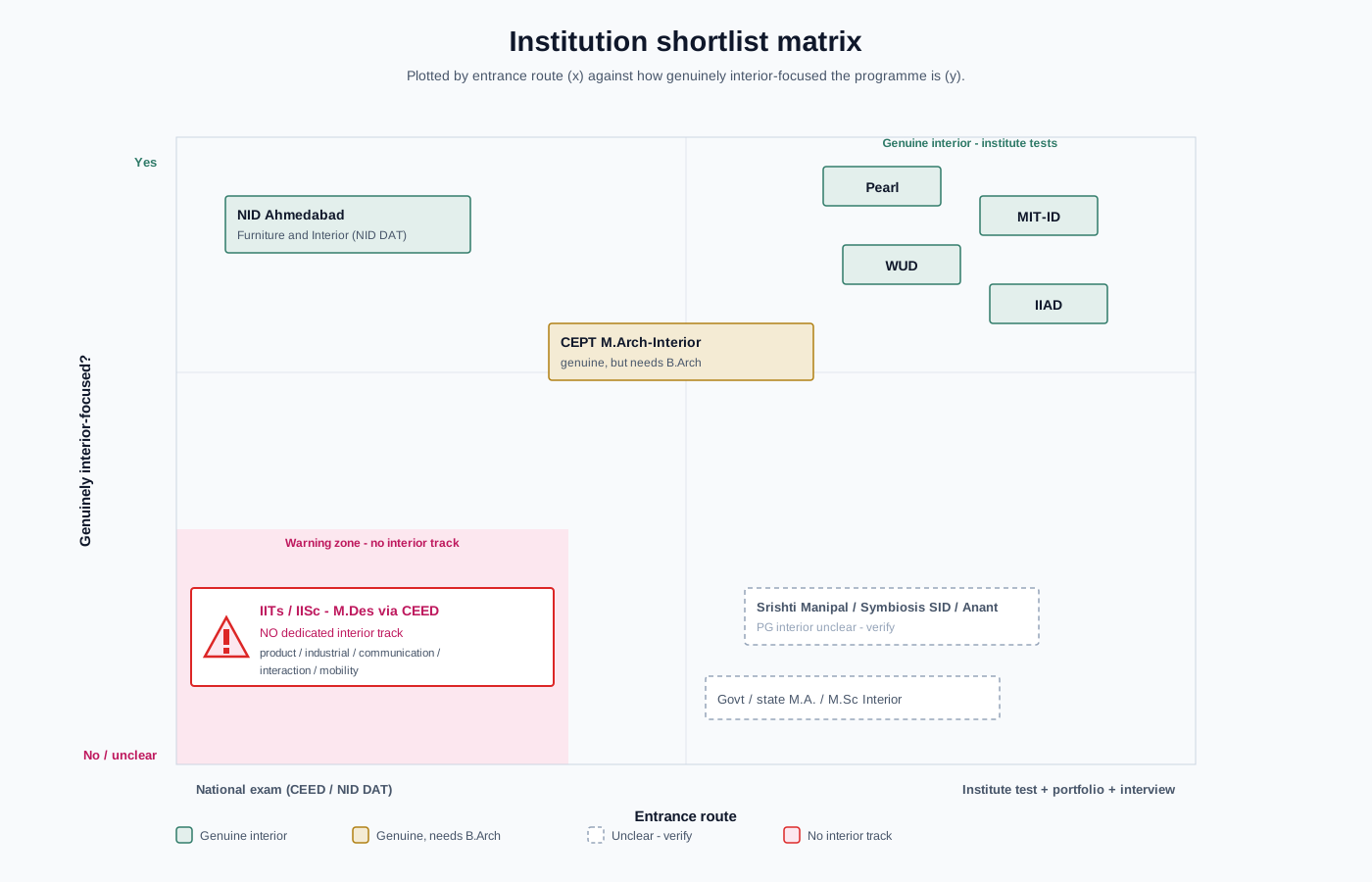
Names matter, so here is a concrete, honest shortlist. Be warned: streams, seat counts and rules shift every year — use this to orient, then verify everything on the official site. The most important column is the middle one: is the programme genuinely interior-focused, or is it a general design master's that people assume is about interiors?
| Institution | Programme | Genuinely interior-focused? | Entrance |
|---|---|---|---|
| NID Ahmedabad | M.Des Furniture & Interior Design (~19 seats) | Yes — the genuine NID interior track | NID DAT |
| IITs (IDC Bombay, Delhi, Guwahati, etc.) + IISc | M.Des via CEED | No — product / industrial / communication / interaction / mobility; no dedicated interior track | CEED |
| CEPT Ahmedabad | M.Arch — Interior Design specialisation | Yes (architecture route) — needs B.Arch | Merit on qualifying degree |
| Pearl Academy | M.Des Interior Design | Yes | GPT + DAT + portfolio + interview |
| MIT Institute of Design (MIT-ADT, Pune) | M.Des Interior Space & Furniture Design | Yes | Own aptitude test + studio / interview |
| World University of Design (Sonipat) | M.Des Interior Architecture & Design | Yes | Institute aptitude + portfolio + interview |
| IIAD New Delhi (with Kingston University London) | PG / M.Des Interior Design & Styling | Yes | Institute aptitude + portfolio + interview |
| Srishti Manipal / Symbiosis SID / Anant | Interior largely at UG level | Unclear — PG interior not clearly confirmed; verify | Institute process |
| Government / state universities | M.A. / M.Sc Interior (no widely-documented dedicated PG interior degree at govt level) | Varies | University process |
A few editorial notes:
- NID Ahmedabad is the prestige interior route in the design system — but the genuine interior discipline ("Furniture & Interior Design") is Ahmedabad-only and small (~19 seats). Do not assume any NID campus will do.
- The IITs and IISc are the cheap-prestige routes — and they have no dedicated interior track. This is the most common misunderstanding in the whole field. If you go CEED, you are going into product, industrial, communication, interaction or mobility design, not interiors.
- CEPT offers interiors as an M.Arch specialisation — excellent, but only for B.Arch holders.
- Pearl, MIT-ID, WUD, IIAD are the genuinely interior-focused private design schools; they are where most non-architecture graduates seeking interiors specifically will end up.
- Government routes to a dedicated interior degree are thin; the typical public option is an M.A./M.Sc Interior at a general or state university, often through a home-science or fine-arts faculty.
5. Cost of education
Now the part that empties the spreadsheet column. Every figure below is approximate, several sources actively conflict, and you must verify the current number on the official portal before you commit. This is not boilerplate — interior-design fee data online is genuinely unreliable, and much of it confuses per-year with total, or is simply stale.
5.1 Tuition — the routes ranked by cost
| Route / institution | Approximate tuition (verify on official site) |
|---|---|
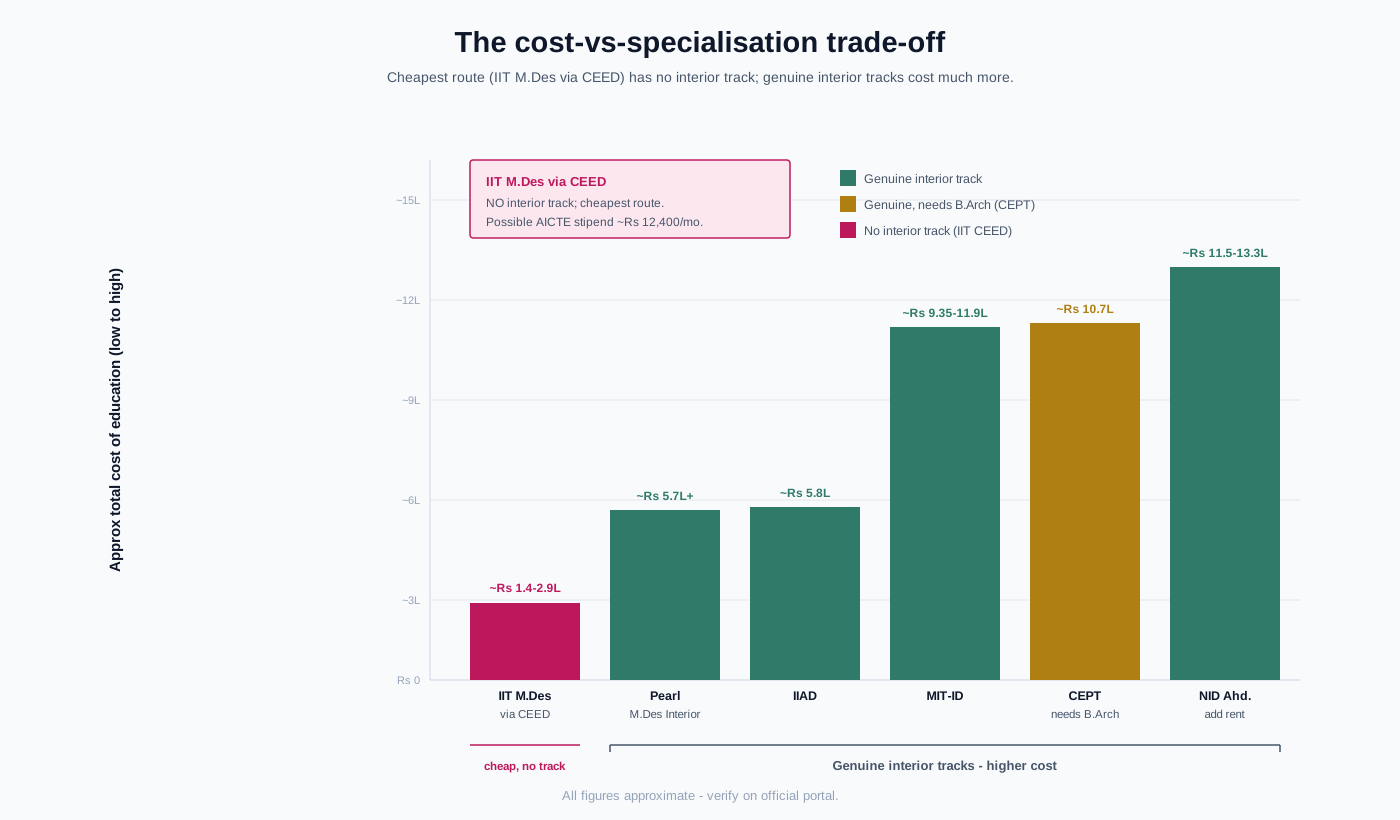
| IIT M.Des via CEED | ~₹1.4–2.9 lakh total (e.g. IIT Delhi ~₹1.6L; IIT Jodhpur ~₹1.43L; IIT Hyderabad ~₹2.86L) — the cheapest route, but not interior-specific |
| NID M.Des (Ahmedabad) | ~₹11.5–13.3 lakh total (~₹2.44L per semester; ~2.5 years; Ahmedabad M.Des is non-residential) |
| Pearl Academy M.Des Interior | ~₹2.85 lakh per year (~₹5.7L+ total — verify) |
| MIT-ID M.Des | ~₹9.35–11.9 lakh total (sources vary; a ~31% year-on-year hike has been noted) |
| IIAD | ~₹5.8 lakh first year (treat as a total — verify) |
| CEPT M.Arch-Interior | ~₹5.35 lakh per year → ~₹10.7 lakh total |
| WUD / Anant | Verify on official site |
The structural story jumps out: the CEED route to an IIT M.Des is dramatically cheaper than everything else — but it has no interior track. The genuine interior master's degrees sit in the ₹6–13 lakh+ band. Hold every figure loosely and confirm it before you commit a rupee.
5.2 Living costs
| City cluster | Approximate living (hostel + mess + living, per year) |
|---|---|
| Ahmedabad / Pune / Delhi-NCR / Bengaluru | ~₹1.0–2.5 lakh per year |
| Mumbai / Delhi (high-cost pockets) | Higher than the above |
One specific flag: NID Ahmedabad's M.Des is non-residential, so you must budget for off-campus rent rather than a subsidised hostel. That changes the all-in maths meaningfully.
5.3 Funding — the part that changes the maths
| Funding source | Detail (verify current rules) |
|---|---|
| AICTE PG stipend | ₹12,400 per month for CEED / GATE-qualified, full-time M.Des students at AICTE / IIT institutes, for up to 2 years, with about 8–10 hours/week of assistantship. Unrevised since 2015 — confirm current figure |
| NID | Merit and need-based scholarships |
| Private (Pearl / MIT-ID / WUD) | Merit / need scholarships; Pearl auto-considers applicants for scholarships |
Run the arithmetic and the contrast is stark: a CEED-qualified student at an IIT can pay ~₹1.5–3 lakh total tuition and receive ₹12,400/month, which covers much of living costs. That combination is the core financial argument for the public route — with the enormous caveat from section 3 that this route offers no dedicated interior track.
6. The cost-versus-specialisation trade-off
This is the single most important decision in the whole guide, and it deserves its own section because the two things you most want — low cost and a genuine interior specialisation — pull in opposite directions.
- The cheap-prestige route (CEED → IIT M.Des) costs roughly ₹1.5–3 lakh total, may pay you ₹12,400/month, and carries the prestige of an IIT name — but offers no dedicated interior-design track. You would study product, industrial, communication, interaction or mobility design, and pivot towards interiors later through your own work.
- The genuine interior master's — NID Ahmedabad's Furniture & Interior Design, or the focused private schools (Pearl, MIT-ID, WUD, IIAD), or CEPT's M.Arch-Interior for B.Arch holders — costs ₹6–13 lakh+ but actually teaches interiors.
| If your priority is... | Lean towards | The trade you accept |
|---|---|---|
| Lowest cost / IIT prestige / a stipend | CEED → IIT M.Des | No interior track — you adapt a broader design master's |
| Genuinely studying interiors (design route) | NID Ahmedabad, Pearl, MIT-ID, WUD, IIAD | Several lakhs more, fewer scholarships |
| Interiors via the architecture route | CEPT M.Arch-Interior | Requires a B.Arch; high fees |
| A public, low-cost, interior-ish path without a B.Arch | M.A. / M.Sc Interior at a state university | Less studio-intensive, lower prestige in the design market |
There is no universally right answer — only the one that fits your money, your discipline of origin, and how literally you need the word "interior" on the degree. Make this trade-off consciously, in writing, before you fall in love with a single brochure.
7. Career and value — what the master's is actually worth
Because the field is unregulated, the master's is not legally required — which paradoxically makes the cheap-prestige routes the strongest value, and the portfolio more important than the paper.
- In the private market, portfolio beats paper. Clients and studios hire on demonstrated work. A strong portfolio from a cheaper route can outperform an expensive degree with a thin body of work.
- The best ROI is usually cheap prestige plus a great portfolio — the IIT/NID names cost little (in IIT's case) or carry outsized recognition (NID), and what you build there matters more than the certificate.
- Pay a premium only for a specific reason — a unique studio culture, a particular faculty member, a city, or the genuine interior curriculum you cannot get on the cheap route.
A few changes to note for the 2025/26 cycle:
- The CEED result-sharing list has widened to roughly 14 institutes.
- NID fees have risen to around ₹13 lakh.
- MIT-ID's PG fee reportedly jumped about 31% year-on-year.
- The NID DAT (M.Des) 2026 timeline: Prelims 21 December 2025, Studio Test around 8 March 2026, interviews late March to April 2026.
If your ambition is global practice or a specialism India teaches thinly, weigh the interior design abroad pathway before committing. And if you are not yet sure a master's is the right move at all, return to the decision pillar.
8. Myths and pitfalls
Clearing these saves money and disappointment.
- Myth: "You need a licence or a master's to be an interior designer in India." False. The field is unregulated; there is no statutory licence and no protected title. A master's is an accelerator, not a permission slip.
- Myth: "CEED gets you into interior design at the IITs." False. The CEED-fed IIT/IISc M.Des disciplines are product, industrial, communication, interaction and mobility design. There is no dedicated interior track there.
- Myth: "UCEED and CEED are the same." False. UCEED is undergraduate (B.Des); CEED is postgraduate (M.Des). Both are by IIT Bombay — do not confuse them.
- Myth: "All M.Des programmes are about interiors." False. Most IIT M.Des programmes are product or industrial design. The genuine interior tracks are NID Ahmedabad's Furniture & Interior Design and the focused private schools.
- Pitfall: trusting online fee figures. They are often stale, or confuse per-year with total. Always confirm the current total on the institution's own portal.
- Pitfall: budgeting on the stipend as a constant. The AICTE PG stipend is unrevised since 2015; confirm the current figure rather than assuming.
- Pitfall: paying NID-level fees forgetting Ahmedabad is non-residential — add off-campus rent to your all-in estimate.
References and Further Reading
All figures, fees, exam structures and eligibility rules above are approximate and revised yearly. Verify every number on the official portal at the time you apply.
Official / Statutory
- CEED — Common Entrance Examination for Design (IIT Bombay) — ceed.iitb.ac.in — exam structure, schedule, scores; note CEED is postgraduate (M.Des), distinct from undergraduate UCEED.
- NID — National Institute of Design — nid.edu and admissions.nid.edu — DAT structure, M.Des programmes (Furniture & Interior Design at Ahmedabad), timeline.
- CEPT University — cept.ac.in — M.Arch Interior Design specialisation, eligibility and fees.
- Pearl Academy — pearlacademy.com — M.Des Interior Design, GPT/DAT, fees and scholarships.
- MIT Institute of Design (MIT-ADT) — mitid.edu.in — M.Des Interior Space & Furniture Design.
- Indian Institute of Art & Design (IIAD) — iiad.edu.in — PG/M.Des Interior Design & Styling (with Kingston University London).
- World University of Design — worlduniversityofdesign.ac.in — M.Des Interior Architecture & Design.
- IIID — Institute of Indian Interior Designers — iiid.net.in — voluntary professional society (not a regulator).
Funding & Scholarships
- AICTE — the CEED/GATE-qualified PG stipend (₹12,400/month at present, unrevised since 2015) and contingency — verify current figures and any revision (also via buddy4study and official AICTE notices).
- NID and private institutions — merit and need-based scholarships; Pearl auto-considers applicants — check each official scholarship page.
Companion Studio Matrx Guides
- Should you do a Master's in architecture or design? (the decision pillar)
- Master's in interior design abroad — the 2026 pathway
- M.Arch in India and abroad
- B.Des interior design student track — India
- Architecture schools shortlist — India 2026
- Building an architecture portfolio in India
- Career pathways after B.Arch
- Sections: /students · /architects · /landscape-architects · /guides
Author's Note: The thing I most want an interior-design aspirant to internalise is that this field will not hand you status for money — it is unregulated, so no degree can buy you a protected title. What a good master's buys is something subtler and more durable: the discipline of the studio, a body of work you are proud of, and a network that remembers you. Choose the route that gets you those for the least money you can justify, and resist the brochure that confuses an expensive name with a guaranteed career. The lamp on the door is lit by your work, not your certificate.
Disclaimer: Fees, exam structures, stipends, eligibility criteria and deadlines are revised every year and frequently differ between sources. Every figure in this guide is approximate and provided for general orientation only. Always verify the current details on the relevant official portals (ceed.iitb.ac.in, nid.edu, admissions.nid.edu, cept.ac.in, pearlacademy.com, mitid.edu.in, iiad.edu.in, worlduniversityofdesign.ac.in, iiid.net.in and the official sites of any institution or funding body you are considering) before making any financial or academic decision. This guide is informational and carries no liability.
Export this guide
Related Guides — Deep-dive reading
Indian Architecture Schools — A Working Shortlist
The 2026 Reference for B.Arch Aspirants — COA-Approved Institutions, Tier Map, Cost-of-Attendance Ranges, Pedagogy Profiles, Faculty Strengths, Geographic Distribution, Application Deadlines, and the Decision Framework for Choosing the School That Fits You
Student FoundationsShould You Do a Master's in Architecture or Interior Design? An Honest Decision Framework for India (2026)
Whether, when, why, and where — the read-me-first guide to deciding on a postgraduate degree in architecture or interior design, with India-vs-abroad costs, the licence and accreditation reality, and a clear decision tree.
Student FoundationsNATA & JEE B.Arch Entrance Preparation
The 2026 Reference for the Indian B.Arch Aspirant — Test Structures, Eligibility, the Two-Year Calendar, Drawing Practice Discipline, Aptitude & Math Programmes, Mock-Test Cycles, Scoring, JoSAA & State Counselling, and the Foundational Path from Class 11 to Admission
Student FoundationsRelated Tools — Try Free
Interior Budget Planner
Live room-wise and component-wise cost breakdown in ₹ with contingency, GST, and PDF summary.
Budget CalculatorCross-Ventilation Analyzer
Estimate airflow and air changes per hour (ACH) from room size, window areas, layout, and local wind — with NBC 2016 Part 8 compliance check.
Ventilation CalculatorBOQ & Quantity Takeoff
Build a live, priced bill of quantities — add materials at city-adjusted rates, take off room quantities, apply wastage, contingency and GST, export PDF or CSV.
Estimating Tool