
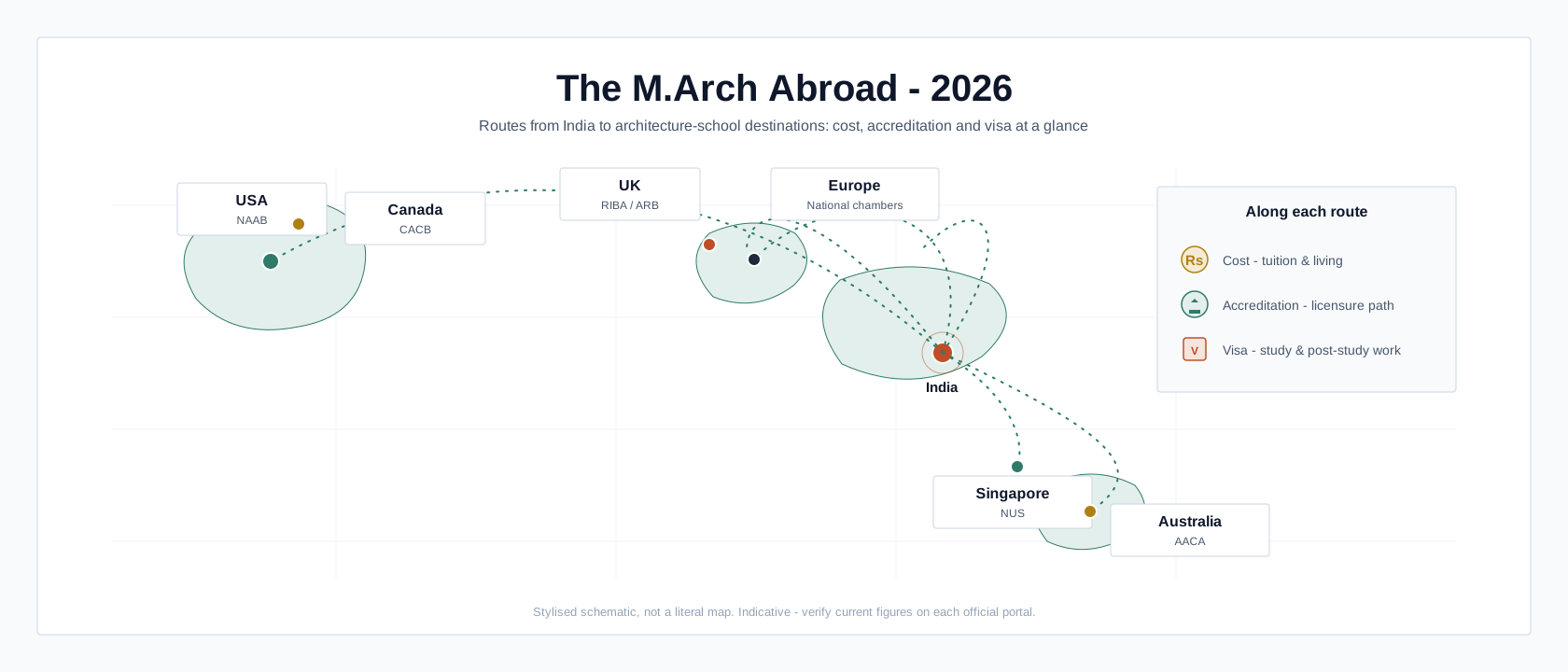
The M.Arch Abroad: USA, UK, Europe & Beyond — A 2026 Guide for Indian Students
Degree structures, accreditation, selection, cost, funding and visas — what an Indian student must actually know before applying for a Master of Architecture overseas.
Picture a sixth-semester B.Arch student in Ahmedabad, scrolling through a Harvard GSD studio review at 2 a.m., screenshotting projects, half-dreaming. The dream is real and reachable for many Indian students — but the price tag, the licensing fine print, and the visa clock are rarely understood until the deposits are already paid. An M.Arch abroad can be one of the best investments of a young architect's life, or one of the most expensive misunderstandings. The difference is information.
This guide is the honest version. It lays out, region by region, how the degree is actually structured, how schools select Indian applicants, what it costs once living and currency are factored in, what funding genuinely exists, and what the right to work and to practise looks like after graduation. An M.Arch abroad buys you a world-class education and, sometimes, a path to that country's licence — but it does not buy you the right to practise everywhere, and the headline tuition is often half the real cost.
This is for the Indian student — recent B.Arch graduate or a few years into practice — weighing a master's abroad. It is one of four pathway guides. Start at the decision pillar, Should you do a Master's in Architecture or Design?, and read the India counterpart, The M.Arch in India: A 2026 Guide, before committing. If interiors are your field, see Masters in Interior Design Abroad and its India sibling.
An abroad master's is a passport to a discipline, not a passport to practise. Read the licensing rules of the country you actually want to work in — first, not last.
1. Why go abroad — and the big caveats
The case for an M.Arch abroad is genuine. You get studio cultures and faculty that shape global discourse, exposure to research and computation that is still thin in many Indian programmes, a peer network that spans continents, and — for some — a pathway to that country's professional licence and a few years of legal work experience. For a certain student, this is transformative.
But three caveats decide whether it is wise or ruinous.
Cost is an order of magnitude higher. A two-year M.Arch at a US private school can cost more in tuition alone than an entire B.Arch plus M.Arch in India. We are talking tens of lakhs per year, not per degree. Funding exists, but it is competitive and rarely covers everything.
A licence is country-specific and does NOT transfer automatically. This is the single most misunderstood fact in the entire decision. A degree accredited in the USA does not let you register in the UK; a UK Part 2 does not let you sit the US exam without further steps; an Indian B.Arch is not automatically recognised in any of these systems. Each country runs its own registration board, its own accredited-degree requirement, and its own experience-and-exam path.
Migration intent matters. Be honest with yourself: do you want to settle and practise in that country, or return to India? The two goals demand different choices — different degree types, different schools, different cost-benefit maths. A US M.Arch I aimed at US licensure is a very different decision from a one-year post-professional M.Arch II you take for prestige and then bring home.
2. Degree structure & accreditation by region
There is no single "M.Arch." The name hides very different degrees with very different purposes. The most important distinction — the one Indian B.Arch holders constantly get wrong — is first-professional vs post-professional.
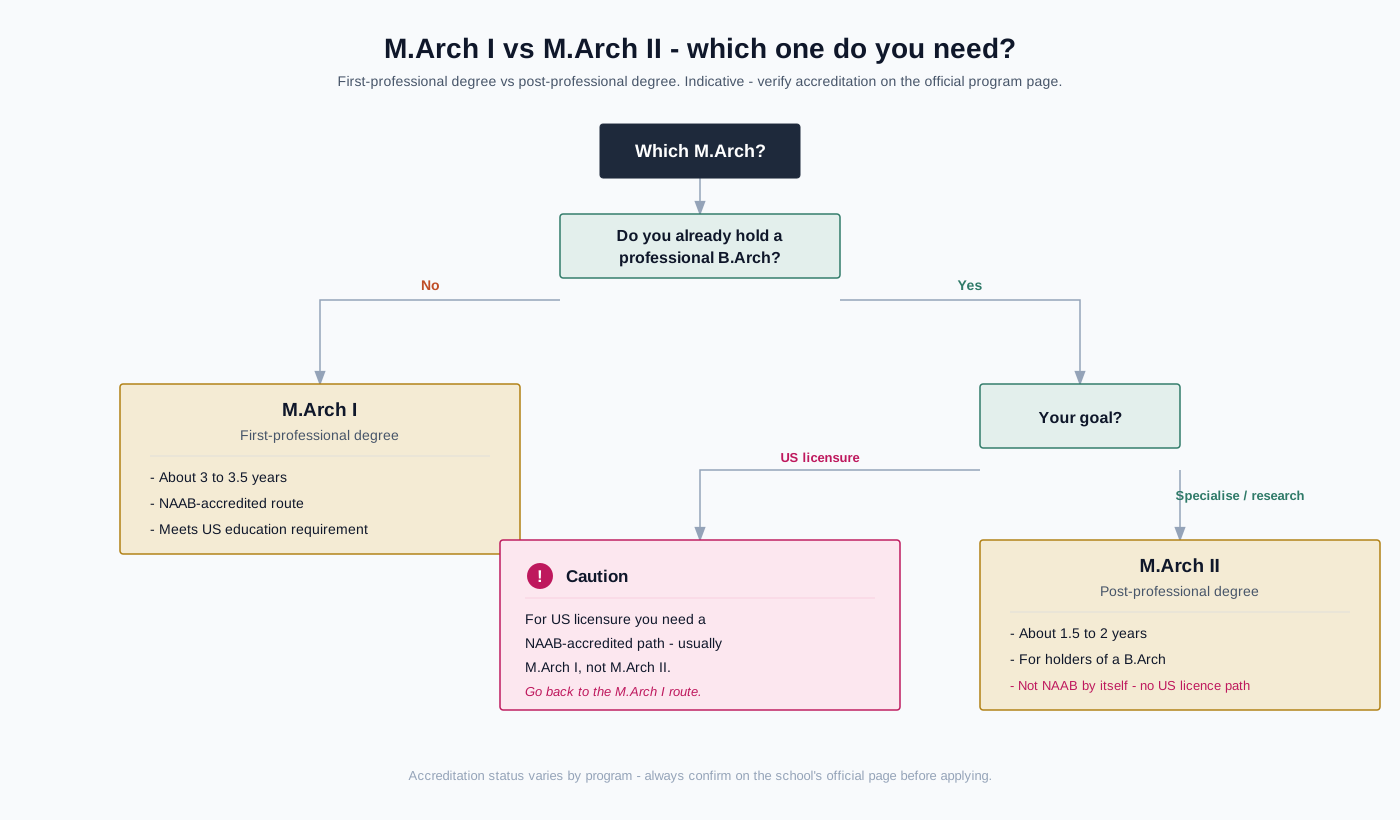
A first-professional degree is for someone who does not yet have an accredited professional architecture qualification; it is long, comprehensive, and is what a country's licensure system recognises. A post-professional degree assumes you already hold a professional degree (your B.Arch) and want to specialise or research; it is shorter and usually does NOT, by itself, satisfy that country's education requirement for a licence.
| Region | Degree & length | Accreditor / registration body | Notes for Indian B.Arch holders |
|---|---|---|---|
| USA | M.Arch I (first-professional, ~3–3.5 yr) OR M.Arch II (post-professional, ~1.5–2 yr) | NAAB accredits professional degrees; NCARB runs licensure | Most of the ~55 US jurisdictions require a NAAB-accredited degree for licence. M.Arch II / MS is generally NOT NAAB-accredited and does not by itself satisfy the US education requirement |
| UK | "MArch" = RIBA/ARB Part 2 (~2 yr) | ARB registers architects (Architects Registration Act 1997); RIBA validates | Indian B.Arch is NOT automatically recognised; often treated as Part 1-equivalent — verify with ARB individually |
| Continental Europe | ~2-yr MSc Architecture (TU Delft, Politecnico di Milano); ETH Zurich; IAAC Barcelona. The Berlage = 3-semester POST-master | National architects' chamber, country by country | Right-to-practise is country-specific; an English-taught MSc does not auto-confer the title |
| Canada | CACB-accredited M.Arch (~2 yr) | CACB accredits; provincial associations register | Toronto, UBC, McGill, Waterloo |
| Australia | Master of Architecture (~2 yr) | AACA / state boards | Registration via AACA |
| Singapore | NUS M.Arch (~2 yr) | Board of Architects Singapore | — |
The USA in detail
Because the US is the most-targeted and most-confusing destination, slow down here. The M.Arch I runs roughly three to three-and-a-half years and is built for people without a professional architecture degree — including some Indian students whose undergraduate work the school treats as non-professional, and anyone aiming squarely at US licensure. The M.Arch II is the post-professional, roughly one-and-a-half to two years, for those who already hold a B.Arch and want to deepen a specialism.
The US licensure path, run by NCARB (ncarb.org), is a three-stage gate: a NAAB-accredited degree → AXP (the Architectural Experience Program — logged, supervised work hours) → the ARE (Architect Registration Examination). The accreditor is NAAB (naab.org). The catch for B.Arch holders: if you take an M.Arch II that is not NAAB-accredited, you generally have not met the education requirement, no matter how famous the school. Always confirm a programme's accreditation status on naab.org and with the school.
The UK in detail
The UK uses a three-part system overseen by ARB (arb.org.uk), with RIBA (riba.org) validating courses. Part 1 is roughly the undergraduate stage, the two-year MArch is Part 2, and Part 3 is the professional practice examination taken after experience. Registration is governed by the Architects Registration Act 1997. Crucially, an Indian B.Arch is not automatically recognised: students typically still do Part 2, then Part 3 plus 24 months of experience. Sometimes the Indian degree is treated as Part 1-equivalent — but this is assessed individually, so verify your own case directly with ARB before assuming anything.
Europe, Canada, Australia, Singapore
Continental Europe offers some of the best value in the world: typically a two-year MSc Architecture at TU Delft or Politecnico di Milano, the rigorous programme at ETH Zurich, the computation-forward IAAC Barcelona, and The Berlage at TU Delft — which is a three-semester POST-master and therefore needs you to already hold a master's. The trap: an English-taught MSc does not automatically confer the legal right to use the architect's title; that is decided by each country's architects' chamber. Canada offers the CACB-accredited two-year M.Arch (Toronto, UBC, McGill, Waterloo); Australia the two-year Master of Architecture with registration via AACA; Singapore the two-year NUS M.Arch.
3. Selection methods — what Indian applicants actually submit
This is where students lose offers they could have won. The components are broadly common, but the weightings — and the exam requirements — differ sharply by school. Do not generalise from one school's rules to another.
| Component | What it is | Reality for Indian applicants |
|---|---|---|
| Portfolio | A curated book of your design work | The single most important component everywhere. Harvard GSD wants recent creative work and prefers individual over group projects; NUS asks for a 10–20 page A4 portfolio |
| GRE | Graduate Record Examination | VARIES — do not assume. Harvard GSD M.Arch I still REQUIRES it; MIT does NOT accept/review it; Yale & Columbia make it OPTIONAL. Verify per school |
| English test | TOEFL / IELTS | MIT: TOEFL 100 / IELTS 7. NUS: TOEFL 92 / IELTS 6.5. GSD moves to TOEFL's new 1–6 banded scale from 26 Jan 2026 |
| LORs | Letters of recommendation | Usually 3. GSD prefers at least 2 academic referees |
| SOP / statement | Personal statement of purpose | Required almost everywhere; your story and intent |
| Transcripts | Academic records | Required; some schools also interview |
The portfolio is everything
Across every destination, the portfolio decides more than any other single element. It is not a dump of your best renders. It is an argument about how you think — sequencing, diagramming, the ideas behind the images. Harvard GSD explicitly favours individual work over group projects, so where a studio project was collaborative, isolate and label your specific contribution. NUS specifies a 10–20 page A4 format; respect each school's page and file limits exactly. If you have time before applying, build the book deliberately — our architecture portfolio guide walks through curation for Indian students.
The GRE: the most dangerous assumption
There is a widespread belief that "all the top US schools dropped the GRE." It is false. Harvard GSD's M.Arch I still requires the GRE. MIT does not accept or review it at all. Yale and Columbia make it optional. So three of the most-targeted US schools have three different policies. Build your test plan around the specific schools on your list, and recheck their admissions pages the season you apply, because these policies move.
English tests and the GSD's 2026 change
Plan for TOEFL or IELTS early. Indicative bars: MIT around TOEFL 100 / IELTS 7; NUS around TOEFL 92 / IELTS 6.5. Note a structural change: Harvard GSD is moving to TOEFL's new 1–6 banded scale from 26 January 2026, so read its current requirement rather than older score thresholds you might find online.
Timelines
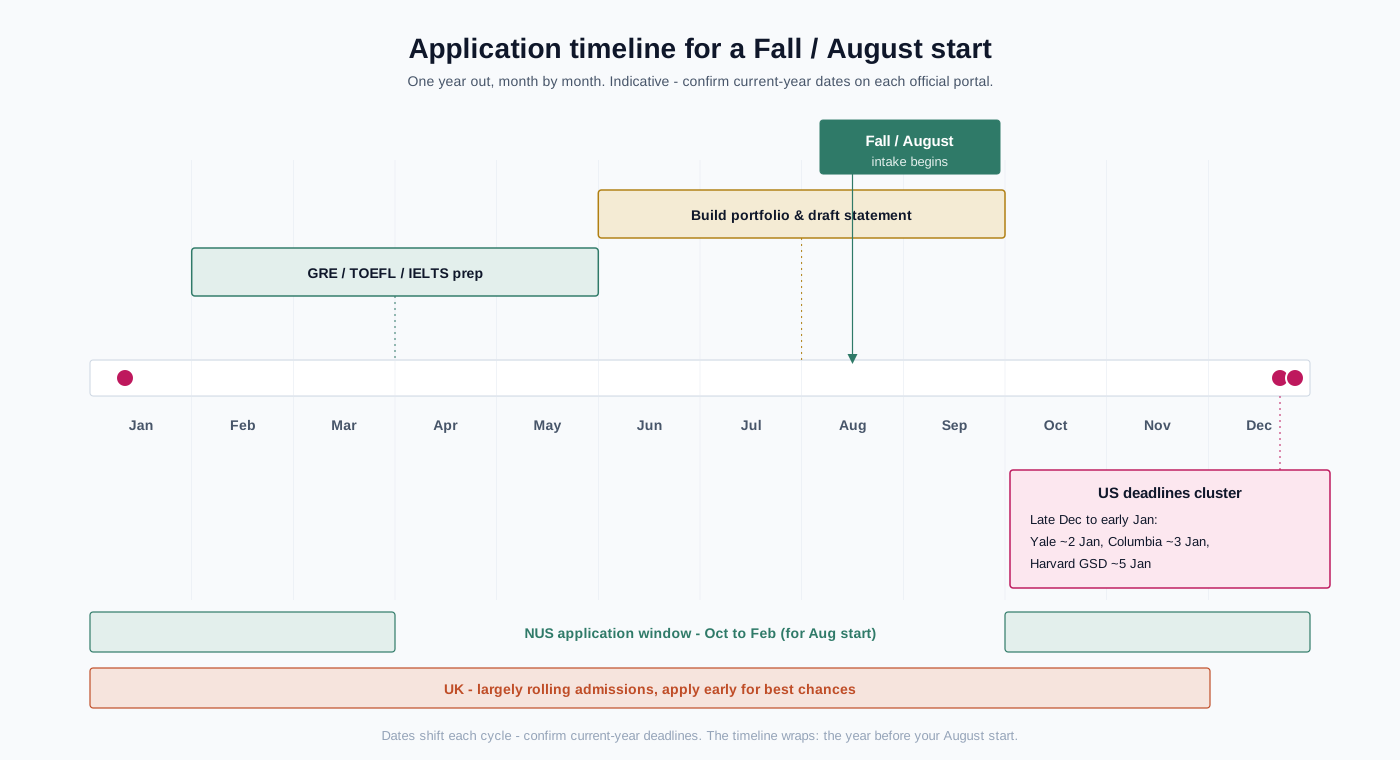
US deadlines cluster in early December to early January for a Fall start. As indicative 2026-cycle examples: Yale around 2 Jan 2026, Columbia around 3 Jan 2026, Harvard GSD around 5 Jan 2026 — always confirm exact dates on each school's site. UK applications are largely rolling, so apply early for the best chance and for accommodation. NUS runs roughly October to January/February for an August start.
| Destination | Typical application window (Fall/main intake) | Style |
|---|---|---|
| USA (Yale ~2 Jan, Columbia ~3 Jan, GSD ~5 Jan, 2026) | Early Dec – early Jan | Fixed deadlines |
| UK | Largely rolling | Apply early |
| Singapore (NUS) | ~Oct – Jan/Feb | For Aug start |
4. The school shortlist by region
The list below is a working shortlist of commonly-targeted schools. Ranking is editorial, not fact — there is no single true ordering, and "best" depends on your specialism, your funding, and the country where you intend to practise. Use this as a starting set, then research faculty, studios, and accreditation for each.
| Region | Commonly-targeted schools |
|---|---|
| USA | Harvard GSD, MIT, Columbia GSAPP, Yale, Princeton, UC Berkeley, UCLA, Cornell, SCI-Arc, Michigan, Penn (Weitzman) |
| UK | AA School, UCL Bartlett, Cambridge, Manchester, Sheffield |
| Europe | ETH Zurich, TU Delft, Politecnico di Milano, IAAC Barcelona, The Berlage |
| Canada | Toronto, UBC, McGill, Waterloo |
| Australia | Melbourne, Sydney, RMIT, UNSW, Monash |
| Singapore | NUS |
A note on fit over fame: the AA School and SCI-Arc are radically experimental; ETH Zurich and TU Delft are rigorous and technically deep; IAAC and The Berlage lean computational and research-forward. A school that suits a computation-obsessed student may bore a heritage-conservation student. Match the studio culture to your work, not the brand to your ego. For how Indian students think about school selection more broadly, see our architecture schools shortlist.
5. Cost of education
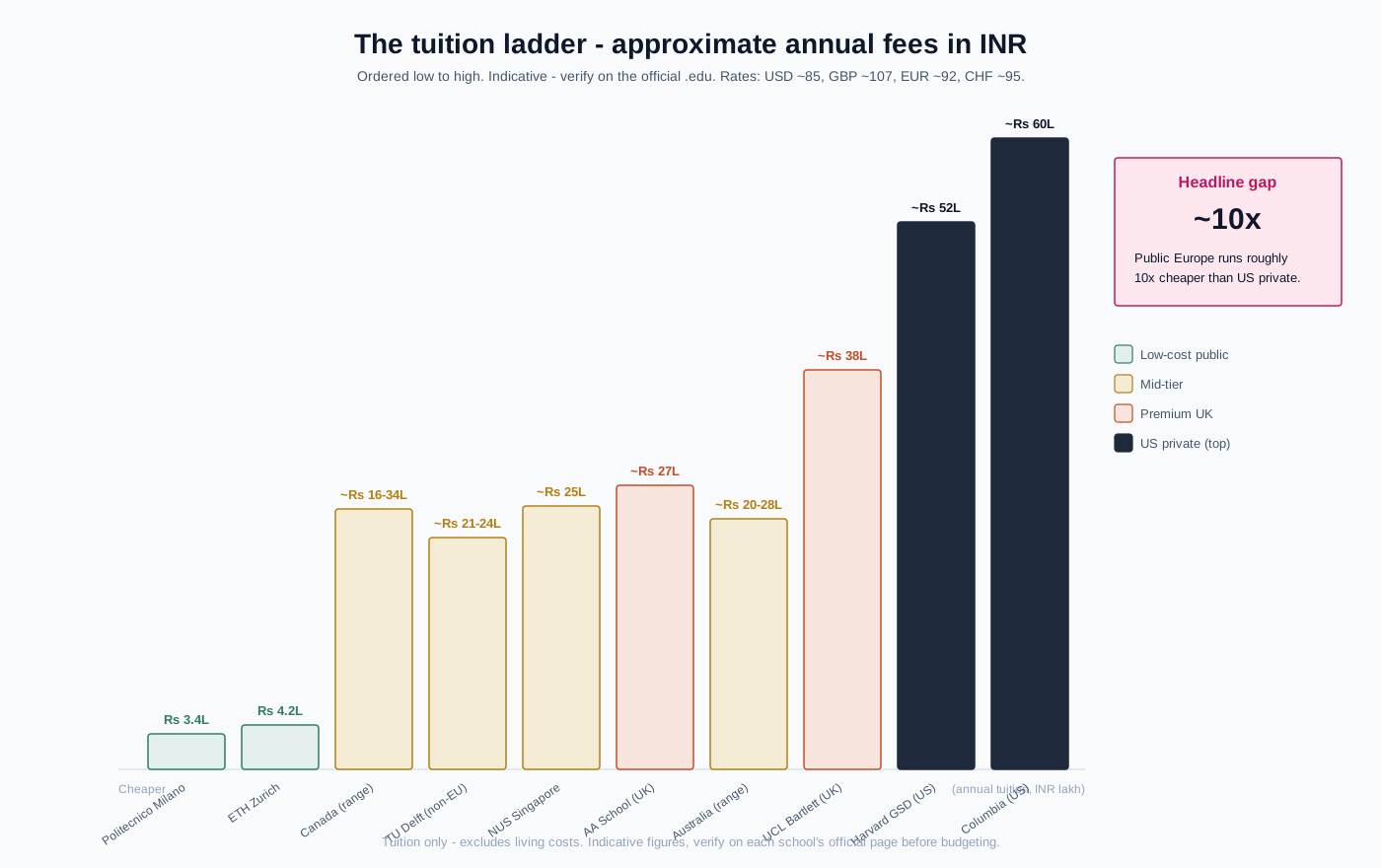
This is where dreams meet arithmetic. Every figure below is approximate and must be verified on the official .edu / university page at application time — fees rise yearly and vary by programme. INR equivalents use these approximate rates: USD 1 ≈ INR 85, GBP 1 ≈ INR 107, EUR 1 ≈ INR 92, CHF 1 ≈ INR 95, CAD 1 ≈ INR 62, AUD 1 ≈ INR 56, SGD 1 ≈ INR 63.
Tuition by country
| Country / school | Tuition per year (approx) | Notes |
|---|---|---|
| US private M.Arch (general) | ~USD 55k–70k/yr (≈ ₹47L–₹60L) | M.Arch I total over 3–3.5 yr ≈ USD 180k–250k+ tuition alone |
| Harvard GSD | ~USD 61,510/yr (≈ ₹52L) | — |
| Columbia GSAPP | ~USD 70k/yr (≈ ₹60L) | — |
| SCI-Arc | ~USD 56k/yr (≈ ₹48L) | — |
| UCL Bartlett (MArch, overseas) | ~GBP 35,400/yr (≈ ₹38L) | 2-yr MArch total ~GBP 50k–71k |
| AA School | ~GBP 25k/yr (≈ ₹27L) | — |
| Politecnico di Milano | max ~€3,726/yr (≈ ₹3.4L) | Public — dramatically cheaper |
| ETH Zurich | ~CHF 2,190/semester (~CHF 4,380/yr ≈ ₹4.2L) | Public |
| TU Delft (non-EU) | ~€22,290 (25/26), rising ~€25,633 (26/27) | (≈ ₹20.5L → ₹23.6L) |
| IAAC Barcelona | ~€31,800 total (≈ ₹29.3L) | Programme total |
| The Berlage | ~€27,000 total (≈ ₹24.8L) | Post-master total |
| Canada (international) | ~CAD 25k–55k/yr (≈ ₹15.5L–₹34L) | — |
| Australia (international) | ~AUD 35k–50k+/yr (≈ ₹19.6L–₹28L+) | 2-yr total AUD 70k–100k+ |
| NUS Singapore | ~SGD 40k/yr (≈ ₹25L) | — |
The headline: a US private M.Arch I, the full three-to-three-and-a-half-year first-professional degree, runs roughly USD 180k–250k+ in tuition alone — well over a crore, and that is before you have eaten or paid rent. By contrast, public European programmes are a different universe. Politecnico di Milano at a maximum of around €3,726 a year and ETH Zurich at roughly CHF 4,380 a year are not typos. This single fact reshapes the whole decision for many Indian students.
Living costs (rough, per year)
Tuition is only half the story. Add living costs — and remember high-cost cities (Zurich, London, US metros) can rival tuition.
| Destination | Living cost per year (approx) | INR (approx) |
|---|---|---|
| US metros | USD 20k–30k | ₹17L–₹25.5L |
| London | GBP 15k–18k | ₹16L–₹19.3L |
| Netherlands / Switzerland | EUR/CHF 14k–24k (Zurich high) | ₹13L–₹22.8L |
| Canada | CAD 15k–20k | ₹9.3L–₹12.4L |
| Australia | AUD 24k+ | ₹13.4L+ |
| Singapore | SGD 12k–20k | ₹7.6L–₹12.6L |
Put tuition and living together and a two-year US private M.Arch can cross ₹1.5–2 crore all-in; the same two years at a public European school might land closer to ₹30–50 lakh all-in, mostly living costs. That gap is the real story of studying abroad — and the reason the next section matters so much.
6. Funding for Indian students
Funding exists, but treat the most prestigious awards as reach prizes, not a plan. Some are needs-based, several need prior work experience, and the most competitive admit well under a tenth of applicants. Verify every detail on each scheme's own site — eligibility (age, work experience, field), deadlines, and coverage change yearly.
| Scheme | Covers | Key eligibility notes |
|---|---|---|
| Inlaks Shivdasani | Tuition + living + travel (up to ~USD 120k) | Age under 30 (born on/after 1 Jan 1996 for the 2026 cycle); architecture eligible |
| JN Tata Endowment | Loan-scholarship | Age ≤ 45 |
| Fulbright-Nehru (US) | US study support | Needs ≥ 3 years work experience; IAS/IPS officers ineligible |
| Chevening (UK) | UK master's | ~2 years work experience required |
| Commonwealth (UK) | UK master's, needs-based | Requires MoE nomination; reach award |
| DAAD (Germany) | Germany | German public universities often charge low/no tuition |
| Institutional aid + TA/RA-ships | Partial-to-full, school-specific | Especially for M.Arch II / research tracks |
Inlaks Shivdasani is the marquee Indian award for studying abroad — generous, covering tuition, living and travel up to around USD 120k, and architecture is eligible. Watch the age bar carefully: for 2026 you must be under 30, born on or after 1 January 1996. JN Tata Endowment is a loan-scholarship (you repay part of it) open up to age 45 — useful for slightly older applicants. Fulbright-Nehru funds US study but requires at least three years of work experience and excludes serving IAS/IPS officers. For the UK, Chevening wants about two years of work experience, and Commonwealth is needs-based and runs through a Ministry of Education nomination. Germany is the quiet value play: between low public tuition and DAAD support, a funded German master's can be remarkably affordable.
Apply for funding as if your whole plan depends on it — because for most Indian students at US/UK private schools, it does. But never assume you will win the reach awards: Commonwealth and Chevening admit somewhere from under 1% to single-digit percentages.
A realistic strategy stacks sources: one or two flagship Indian scholarships, institutional aid and a teaching/research assistantship from the school itself, and an education loan to bridge the rest. M.Arch II and research-track students should ask every target school explicitly about TA/RA funding, which is far more common at the post-professional and research level.
7. Visa & post-study work
For many students, the right to work after graduation is half the value of the degree. These rules change frequently and are tightening across multiple countries — treat the table as a snapshot and check the official government source (for the UK, gov.uk) before you rely on any of it.
| Country | Post-study work | Critical conditions |
|---|---|---|
| USA | OPT 12 months + 24-month STEM extension | The STEM extension applies ONLY if the I-20 CIP code is STEM-designated. Many M.Arch are, but NOT all — verify per school. Do not assume it |
| UK | Graduate Route 2 years now | Dropping to 18 months for courses completing after 1 Jan 2027; apply before 31 Dec 2026 to keep 2 years |
| Canada | PGWP up to 3 years for master's | CLB/NCLC 7 language required for permits on/after 1 Nov 2024; field-of-study rules tightening — verify |
| Australia | Subclass 485 ~2 years | Max age ~35; fee ~AUD 4,600 from 1 Mar 2026 |
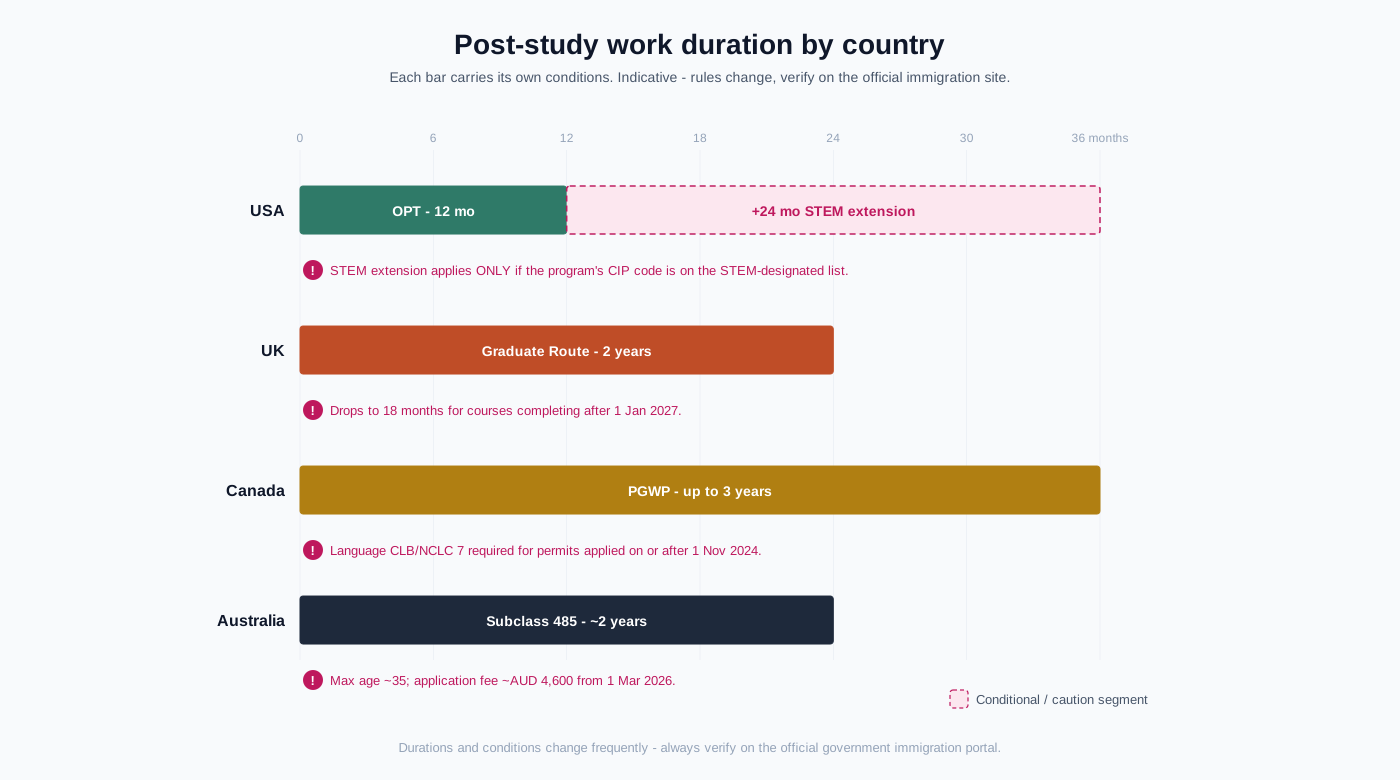
The US story has a trap inside it. Standard OPT gives 12 months of work authorisation; the prized 24-month STEM extension — three years of US work in total — applies only when the programme's I-20 carries a STEM-designated CIP code. Many M.Arch programmes are STEM-designated, but not all are, and you cannot assume yours is. Ask the specific school in writing before you enrol if those extra two years matter to you.
The UK Graduate Route is currently two years but is being shortened: for courses completing after 1 January 2027 it drops to 18 months, and you must apply before 31 December 2026 to keep the full two years. Canada's PGWP can run up to three years for a master's, but a language requirement (CLB/NCLC 7) now applies to permits issued on or after 1 November 2024, and field-of-study rules are tightening. Australia's subclass 485 gives roughly two years, with a maximum age around 35 and a fee around AUD 4,600 from 1 March 2026.
8. A decision framework
Strip away the prestige and the decision comes down to a handful of honest questions.
- Where do you actually want to practise? If the answer is "that country," you need a degree its board recognises — a NAAB-accredited M.Arch (usually M.Arch I) for the US, RIBA/ARB Part 2 plus Part 3 for the UK, a CACB degree for Canada — and you must plan for AXP/ARE, Part 3, or the local equivalent. If the answer is "back in India," a one-year M.Arch II for skills and network may be the smarter, cheaper buy, and you should re-read the India M.Arch guide.
- Can you fund it? Map total cost (tuition + living, all-in) against realistic funding. A US private M.Arch I without major aid is a ₹1.5–2 crore commitment; a public European master's is a fraction of that. Do not assume reach scholarships.
- M.Arch I or M.Arch II? If you already hold a B.Arch and want US licensure, you may still need a NAAB-accredited route — a famous post-professional M.Arch II generally will not, on its own, meet the US education requirement. If you want depth and will return to India, M.Arch II is efficient.
- How does your Indian B.Arch map? It is not automatically recognised anywhere abroad. The US may treat it as non-professional for licensure; the UK may treat it as Part 1-equivalent or not — verify individually with ARB.
When India is the smarter choice: if your goal is to practise in India, if funding is uncertain, or if a one-year specialised degree gets you most of the benefit, the maths often favours staying. A funded or affordable Indian M.Arch leaves you debt-free and well-positioned at home. Read the pillar, Should you do a Master's?, alongside Career pathways after B.Arch.
9. Myths & pitfalls
- Myth: "All the top US schools dropped the GRE." FALSE. Harvard GSD's M.Arch I still requires it. MIT does not review it; Yale and Columbia make it optional. Three top schools, three different policies — verify each.
- Myth: "Design is STEM, so I automatically get three years of US work." NOT guaranteed for architecture. The 24-month STEM OPT extension depends on the programme's CIP code being STEM-designated. Confirm with the school; never promise it to yourself.
- Myth: "An abroad master's lets me practise anywhere." FALSE. A licence is country-specific. A NAAB degree does not register you in the UK; a UK Part 2 does not let you sit the ARE without more steps; nothing auto-recognises your Indian B.Arch.
- Myth: "Europe is unaffordable." FALSE. Public EU programmes — Politecnico di Milano at roughly €3,726/yr, ETH Zurich at roughly CHF 4,380/yr — are dramatically cheaper than US/UK private schools, and Germany's public universities often charge little or no tuition.
- Pitfall: treating the portfolio as an afterthought. It is the most important component everywhere. Build it deliberately over months, not a panicked week.
- Pitfall: ignoring the visa clock. UK's Graduate Route shortens for courses finishing after 1 Jan 2027; apply before 31 Dec 2026 to keep two years. Canada's new language requirement and Australia's age cap can quietly disqualify people.
References and Further Reading
All figures, fees, deadlines and eligibility rules above are approximate and change yearly. Always verify on the official university (.edu) page and the scheme's own site at application time.
Official / Statutory
- NAAB — naab.org (US degree accreditation)
- NCARB — ncarb.org (US licensure: AXP, ARE)
- RIBA — riba.org (UK course validation)
- ARB — arb.org.uk (UK architect registration; Architects Registration Act 1997)
- gov.uk — UK visas and the Graduate Route
- National architects' chambers (Europe), CACB (Canada), AACA (Australia), Board of Architects Singapore — for country-specific right-to-practise
- University official pages (.edu / university domains) for current tuition, requirements and deadlines
Funding & Scholarships
- Inlaks Shivdasani Foundation — official site (age and eligibility, 2026 cycle)
- JN Tata Endowment — official site (loan-scholarship)
- Fulbright-Nehru / USIEF — for US study (work-experience requirement)
- Chevening and Commonwealth Scholarships — for the UK (work experience; MoE nomination)
- DAAD — daad.in / daad.de (Germany)
Companion Studio Matrx Guides
- Should you do a Master's in Architecture or Design? (the decision pillar)
- The M.Arch in India: A 2026 Guide
- Masters in Interior Design Abroad · Masters in Interior Design in India
- Architecture schools shortlist (India) · NATA/JEE B.Arch entrance prep
- Building your architecture portfolio · Architecture thesis methodology
- Career pathways after B.Arch · B.Des interior design student track
- Sections: Students · Architects · Landscape Architects · All Guides
Author's Note: I have watched bright students sign for a US private M.Arch on the strength of a brochure and an Instagram feed, then discover in their second year that the post-professional degree they chose will not, on its own, let them sit the ARE — or that the STEM extension they counted on was never theirs. None of that diminishes the value of a great education abroad. It just means the homework comes first: read the licensing board's rules of the country you want to live in, run the all-in cost honestly, and let the answer — even if it points back to India — be the one your future self will thank you for.
Disclaimer: Fees, exam policies, scholarship eligibility, deadlines, accreditation and visa rules are revised every year and differ by school and jurisdiction. Every number here is approximate and provided for general guidance only. Verify all details on the official university (.edu) pages and the relevant statutory and scholarship bodies before making any decision. This guide is informational and carries no liability.
Export this guide
Related Guides — Deep-dive reading
A Master's in Interior Design Abroad: USA, UK & Europe — A 2026 Guide for Indian Students
Degree types, accreditation, selection, the school shortlist, real costs, funding — and the visa caveat that changes everything
Student FoundationsShould You Do a Master's in Architecture or Interior Design? An Honest Decision Framework for India (2026)
Whether, when, why, and where — the read-me-first guide to deciding on a postgraduate degree in architecture or interior design, with India-vs-abroad costs, the licence and accreditation reality, and a clear decision tree.
Student FoundationsA Master's in Interior Design in India: Degrees, Entrance, Institutions & Cost (2026)
An honest, India-first guide to the confusingly-named degree landscape, the entrance methods (CEED, NID DAT and institute tests), a real institution shortlist, and what it all actually costs — in a field that has no statutory licence.
Student FoundationsRelated Tools — Try Free
Before vs After — Cost Reality Check
Compare what you expected to pay vs what you actually paid, category by category.
Reality CheckBefore & After Studio
Generate AI before-and-after renders to preview how your redesign could look.
DesignAICross-Ventilation Analyzer
Estimate airflow and air changes per hour (ACH) from room size, window areas, layout, and local wind — with NBC 2016 Part 8 compliance check.
Ventilation Calculator