
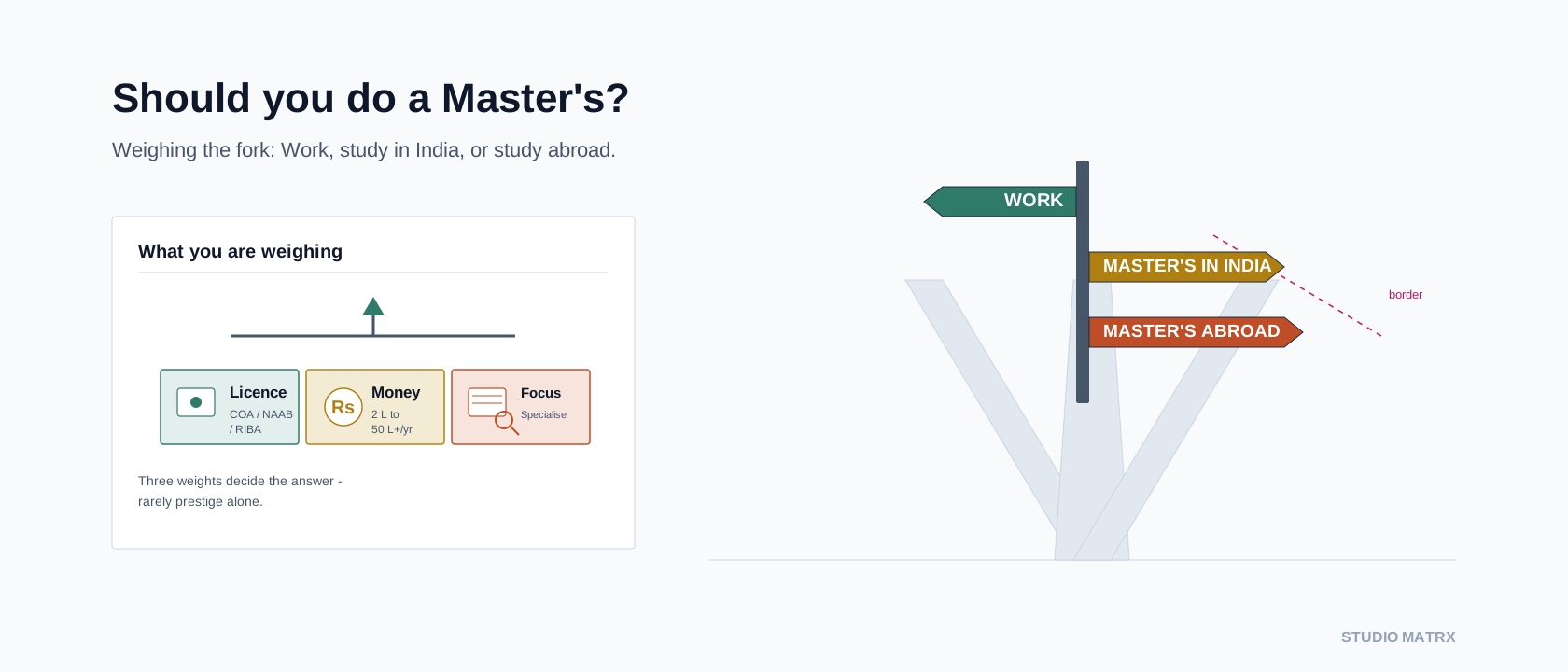
Should You Do a Master's in Architecture or Interior Design? An Honest Decision Framework for India (2026)
Whether, when, why, and where — the read-me-first guide to deciding on a postgraduate degree in architecture or interior design, with India-vs-abroad costs, the licence and accreditation reality, and a clear decision tree.
A graduate sits across from me with an offer letter from a foreign university in one hand and a job offer from a respectable firm in the other. The fees on the offer letter run past fifty lakh rupees. The question is not really "which university?" The real question, the one no brochure answers, is simpler and harder: do I need this degree at all, or am I about to spend a small fortune solving a problem I do not have?
This guide exists to slow you down before you sign anything. It is the calm conversation I wish every Indian B.Arch, B.Des, and design graduate had before they applied. The single most important truth in the whole field is this, and most students get it backwards:
A master's in architecture is for specialisation or academia — not a licence; and a master's in interior design in India is a credibility accelerator, not a legal requirement to practise. Once you internalise that, half of the panic evaporates and the decision becomes a clear-eyed cost-benefit calculation instead of a status reflex.
This is the "read me first" guide of a five-part cluster. After you finish here you will know whether, when, why, and where — and then you can dive into the right deep-dive: M.Arch in India, M.Arch abroad, Interior design master's in India, or Interior design master's abroad. It is for anyone holding a design undergraduate degree (or pivoting into design from another field) and wondering if a second degree is the next right move.
A master's is a tool, not a trophy. The students who regret it are almost never the ones who chose it for a reason — they are the ones who chose it for the absence of one.
1. The honest first question: do you actually NEED a master's?
Before reasons, before rankings, before money — establish whether the degree is required for what you want, or merely helpful. These are wildly different things, and the architecture and interior tracks answer them differently.
Architecture in India is statutorily regulated. Under the Architects Act, 1972, the Council of Architecture (COA) governs who may use the title "Architect" and who may sign and submit building drawings. A B.Arch from a COA-recognised school, plus COA registration, already gives you the right to practise and sign. A master's adds depth in a sub-discipline — it does not add the licence, because you already hold it. If someone tells you that you "need" an M.Arch to be a "real" architect in India, they are simply wrong about the law.
Interior design in India is NOT statutorily licensed. There is no Architects-Act equivalent for interiors. The Institute of Indian Interior Designers (IIID) — founded in 1972, with roughly 10,000 members across about 35 chapters — is a voluntary professional society, not a regulator. It runs events, awards, and standards conversations; it does not issue a licence, because none exists to issue. No master's is legally required to practise interior design in India. A master's here is a skill, credibility, and network accelerator — valuable, sometimes transformative, but never a legal gate.
| Field | Regulated in India? | Statutory body | What the licence comes from | What a master's adds |
|---|---|---|---|---|
| Architecture | Yes (Architects Act, 1972) | COA | B.Arch (COA-recognised) + COA registration | Specialisation / academia, not the licence |
| Interior design | No | None (IIID is voluntary) | No statutory licence exists | Credibility, skill depth, network |
So the honest first question splits in two. If you are an architect, a master's is a choice about your career direction. If you are an interior designer, a master's is a choice about acceleration. In neither case is it a survival requirement. Treat any feeling of "I must" with suspicion — it is usually social pressure wearing the costume of necessity.
2. The five legitimate reasons — and the four bad ones
There are five reasons that, in my experience, reliably justify the time and money. There are four that reliably do not.
The five legitimate reasons:
1. Specialise into a discipline your B.Arch could not give depth in — urban design, architectural conservation, landscape architecture, sustainability / building science, or computational design. A five-year general degree cannot make you a conservation expert; a focused two-year master's can.
2. Pivot fields — architecture into interior design (or the reverse), or a non-design graduate moving into design altogether. Here the master's is genuinely a conversion credential, not a top-up.
3. Academia, teaching, or research — a postgraduate degree is effectively the entry ticket to teaching at most schools and the foundation for a PhD.
4. A deliberate migration pathway — when the master's is the legitimate route to studying, then working and possibly settling, in another country (more on accreditation below — this is where most people miscalculate).
5. A reset after a weak undergrad — a poor-fit or low-rigour bachelor's experience can be genuinely repaired by a strong master's, both in skill and in signalling.
The four bad reasons (be honest with yourself):
- Avoiding the job market. A degree is an expensive way to defer a hard conversation with the working world. The job market will still be there in two years — only now you will have a loan.
- Vague prestige-chasing. "It would look good" is not a plan. Prestige with no specialisation goal rarely pays back.
- Parental or social pressure. A legitimate reason for them is not a legitimate reason for you.
- "Everyone is doing it." Cohort momentum is the single most expensive herd instinct in Indian education.
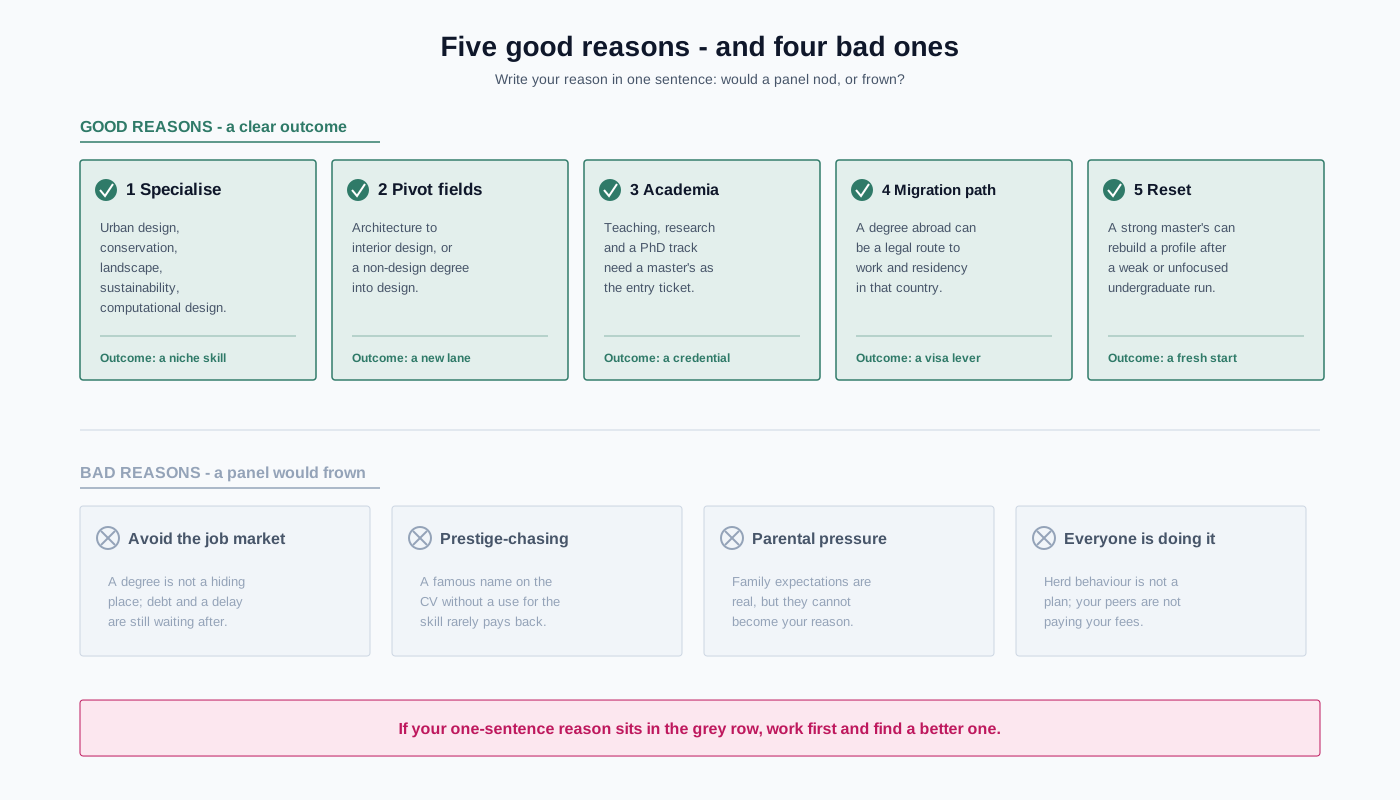
A simple test: write your reason in one sentence, then ask whether a hiring manager or admissions committee would nod or frown at it. "I want to specialise in heritage conservation because I want to work on adaptive reuse" earns a nod. "I want to do a master's because I'm not sure what else to do" earns a frown — from them, and eventually from you.
3. Master's now, work first, or both? The timing question
Timing is where good candidates quietly sabotage themselves. The instinct after graduation is momentum — keep studying while the study muscles are warm. But most of the field, and almost every prestige scholarship, rewards the opposite.
Most disciplines reward one to three years of practice before a master's. Working first does three things a fresh graduate cannot fake: it tells you which specialisation you actually want (so you don't pay to discover you chose wrong), it sharpens your portfolio with real built or near-built work, and it makes your statement of purpose concrete instead of aspirational. An admissions panel can tell the difference between "I am interested in sustainability" and "I spent eighteen months detailing facades and want to go deeper into building-energy performance."
Sponsored and government scholarships frequently require work experience. Fulbright-Nehru typically expects at least three years of professional experience. Chevening expects around two years. If a funded route abroad is your plan, working first is not optional — it is eligibility.
| Path | Best for | Trade-off |
|---|---|---|
| Straight-through (UG → master's) | Field-pivot, academia track, weak-undergrad reset where momentum matters | Thin portfolio, vaguer focus, usually ineligible for work-experience scholarships |
| Work first (1–3 yrs, then master's) | Specialisation seekers, scholarship-funded routes, most architecture sub-disciplines | Requires patience; you re-enter study mode after a break |
| Both / part-time / sponsored | Working professionals upskilling without quitting | Slower, harder to balance; fewer programmes offer it |
My default advice: unless you are pivoting fields or correcting a weak undergrad, work for one to three years first. You will choose better, get in more easily, and quite possibly get someone else to pay for it.
4. India vs Abroad — the decision matrix
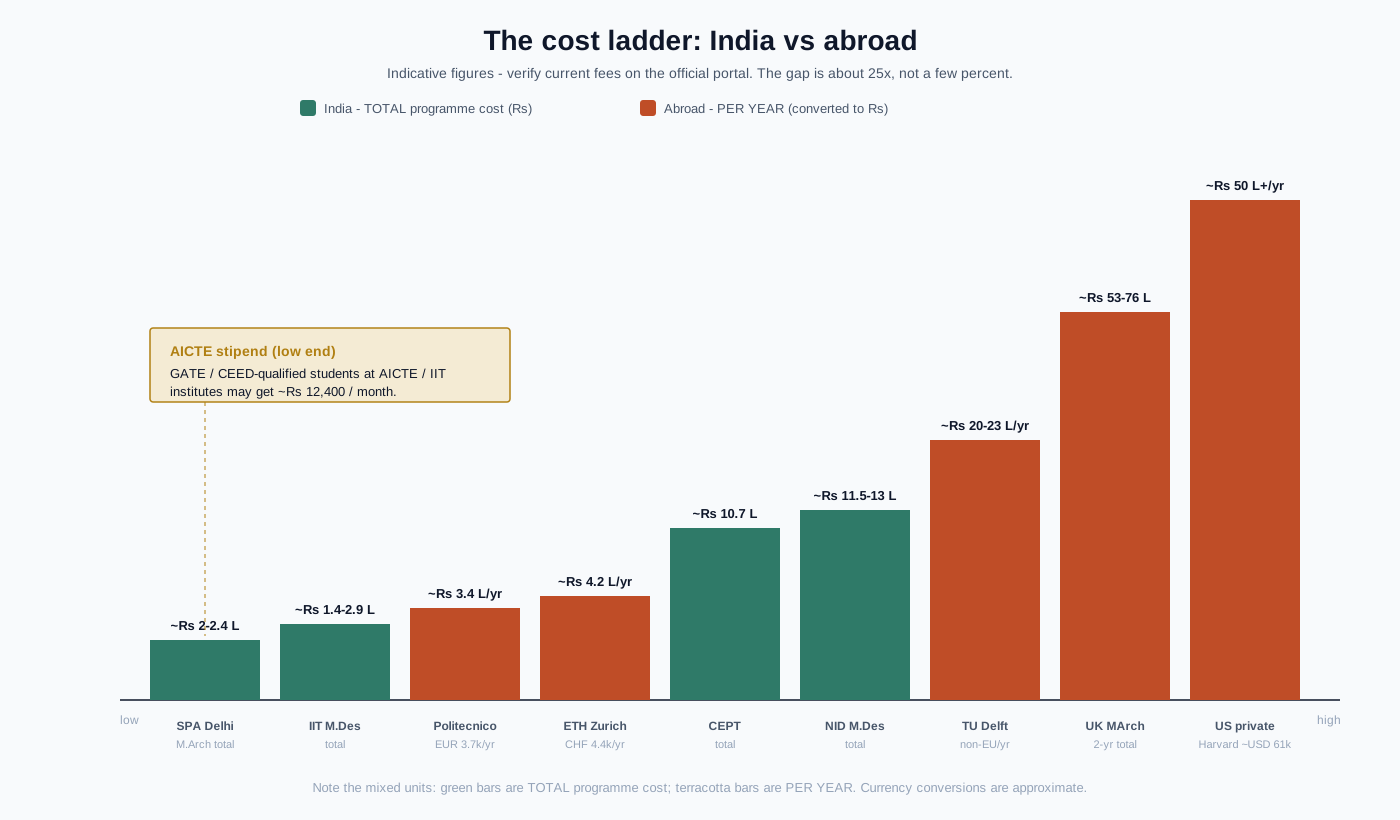
This is the decision most people make emotionally and should make arithmetically. The variables that matter are cost (by an order of magnitude, not a few percent), licence and registration implications, migration intent, whether your specialisation even exists in India, and ROI. State all numbers as approximate — verify on the official portal at application time. I use approximate rates of USD 1 ≈ INR 85, GBP 1 ≈ INR 107, EUR 1 ≈ INR 92, and CHF 1 ≈ INR 95.
The headline is the cost gap. A centrally-funded Indian M.Arch can cost roughly ₹2–11 lakh total for the whole programme — and GATE/CEED-qualified students at AICTE/IIT institutes may receive an AICTE postgraduate stipend of about ₹12,400 per month (unrevised since 2015; a roughly 50% hike has been proposed but is not confirmed — do not budget on it). Abroad spans from very affordable public European programmes to eye-watering US private ones.
| Option | Approx. total / annual tuition | Notes |
|---|---|---|
| SPA Delhi (M.Arch) | ~₹2–2.4 L total | Centrally funded; among the lowest-cost serious routes |
| CEPT (M.Arch) | ~₹10.7 L total | Higher than centrally-funded peers, strong studio reputation |
| IIT M.Des | ~₹1.4–2.9 L total | Note: IIT M.Des is product/industrial, not a dedicated interior track |
| NID M.Des | ~₹11.5–13 L total | NID Ahmedabad has the genuine Furniture & Interior Design track |
| Private Indian design schools | ~₹6–13 L+ | Varies widely; scrutinise outcomes |
| Politecnico di Milano (Italy) | ~€3.7 k/yr (≈₹3.4 L) | Public EU; very low tuition |
| ETH Zürich (Switzerland) | ~CHF 4.4 k/yr (≈₹4.2 L) | Public; tuition low, living cost high |
| TU Delft (Netherlands) | ~€22–25 k/yr non-EU (≈₹20–23 L) | Public but non-EU rate is substantial |
| UK 2-yr MArch | ~£50–71 k total (≈₹53–76 L) | Plus living costs |
| US private M.Arch I | ₹50 L+/yr (e.g. Harvard ≈ USD 61 k ≈ ₹52 L tuition alone) | The most expensive serious route |
Read that table twice. The difference between SPA Delhi and a US private school is not 20% — it is roughly twenty-five times. That gap should reframe the entire question from "where is best?" to "what am I actually buying, and does the premium pay back?"
The matrix below is how I weigh it:
| If your priority is… | Lean toward |
|---|---|
| Lowest cost / fastest ROI | Centrally-funded India (SPA / IIT / NIT) |
| A specialisation India teaches well | India |
| A specialisation India barely offers | Abroad (verify the programme exists first) |
| Migration / working abroad long-term | Abroad — but only an accreditation-aligned programme (Section 5) |
| Building an India-based practice | India, almost always |
| A funded prestige route + 2–3 yrs work exp | Abroad via scholarship |
Migration intent is the cleanest tiebreaker. If you genuinely intend to build a practice in India, a foreign degree's premium is hard to justify on economics alone. If you intend to work abroad, then the accreditation of the specific programme — not its ranking — decides whether the degree even functions for you.
5. The accreditation and licence reality that changes everything
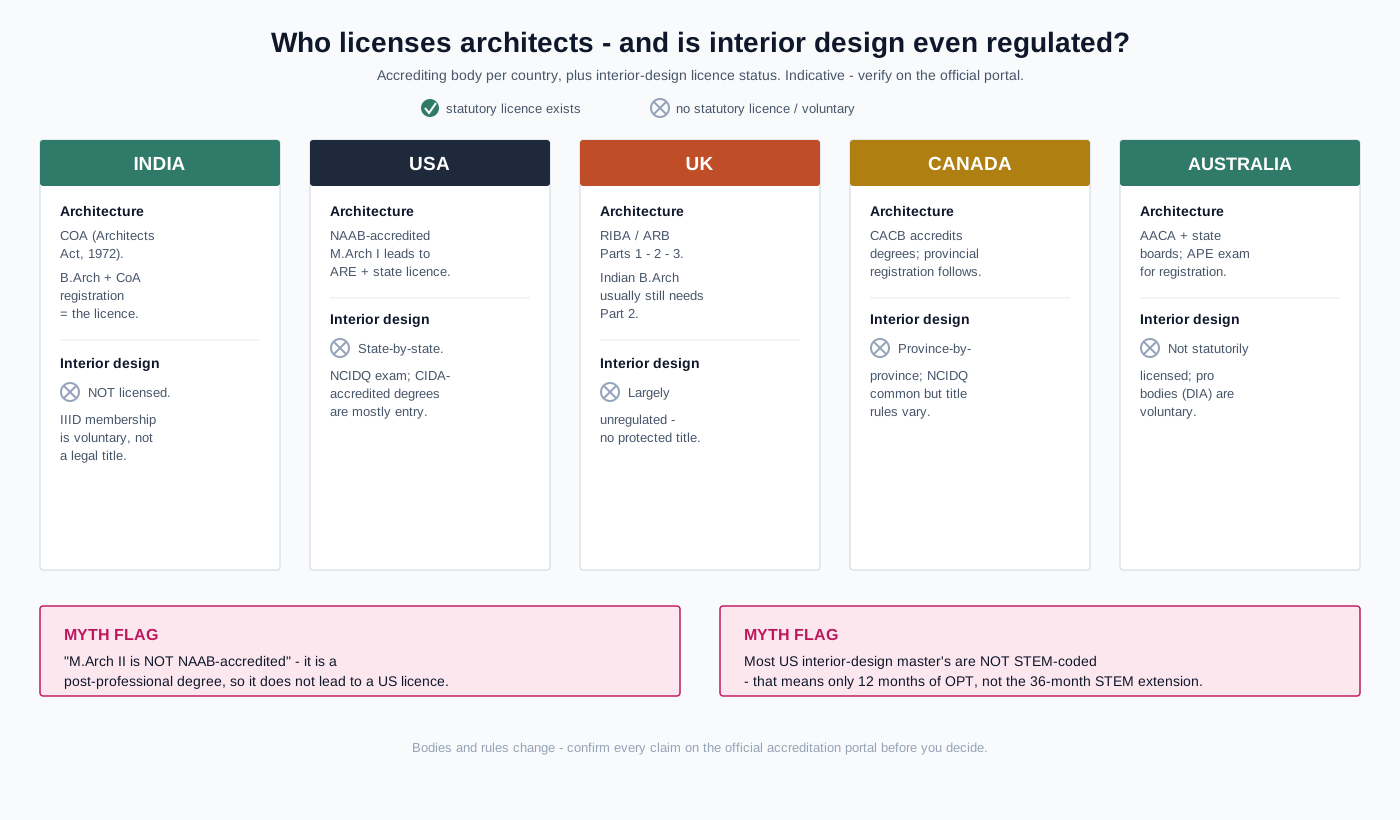
This is the section that quietly saves people fifty lakh rupees, so read it slowly. A master's abroad is only a migration pathway if it leads to licensure in that country, and licensure runs on accreditation rules that brochures rarely explain.
- United States — NAAB. Only a NAAB-accredited professional degree (the M.Arch I) leads toward US architect licensure. A post-professional M.Arch II is NOT NAAB-accredited and does not lead to licensure — it is for research and specialisation. Indian students chasing a US licence sometimes enrol in an M.Arch II by mistake and discover too late that it does not count. Confirm NAAB status on naab.org.
- United Kingdom — RIBA / ARB Parts 1, 2, 3. UK qualification runs through Part 1, Part 2 (the master's-level stage), and Part 3 (professional practice). An Indian B.Arch is usually still expected to clear Part 2 — verify your specific status directly with the ARB (arb.org.uk), because prescription rules change.
- Canada — CACB, and Australia — AACA: each has its own accreditation/registration architecture; check the national board before assuming your degree transfers.
- Interior design has no statutory licence in India — covered above. In the US, interior design uses the NCIDQ exam plus state-by-state regulation; some states regulate the title or practice, many do not. CIDA accredits US interior design programmes, but mostly at the entry-level — and critically, many interior design master's programmes are not CIDA-accreditable, and that is normal, not a red flag.
Now the visa myth that costs students the most, stated plainly:
Most US interior design master's are NOT STEM-CIP-coded, which means only 12 months of OPT — not the 36 months (12 + 24) that STEM fields receive. Do not assume "design = STEM."
For M.Arch the STEM status depends on the specific I-20's CIP code and varies by school — some are STEM-designated, some are not. Verify the CIP code per programme before you bank on a three-year US work window. And the UK Graduate Route is currently 2 years, dropping to 18 months for courses completing after 1 January 2027 — so the exact length depends on when you finish.
| Country | Architecture accreditation → licence | Interior design status |
|---|---|---|
| India | COA (Architects Act 1972); B.Arch + registration | No statutory licence; IIID voluntary |
| USA | NAAB M.Arch I → licensure; M.Arch II does NOT | NCIDQ + state-by-state; CIDA (mostly entry-level) |
| UK | RIBA/ARB Parts 1–2–3 (Indian B.Arch often needs Part 2) | No single national licence regime |
| Canada | CACB | Province-dependent |
| Australia | AACA | State-dependent |
The lesson is uniform across every row: the credential only works if it is the right credential. Ranking is a vanity metric; accreditation alignment is the load-bearing one.
6. ROI and cost-benefit — when the spend pays back
A master's pays back when the increment it buys is something the market will pay a premium for, and that you could not have acquired otherwise. That is the whole test.
It tends to pay back when: it unlocks a specialisation with genuine demand (conservation, computational design, sustainability consulting); it is the accreditation-correct route to a market that pays in a stronger currency; it is centrally funded so the downside is small; or it repairs a weak undergrad in a way the market rewards. It tends not to pay back when: it is a general degree on top of a general degree; it is funded by an expensive loan against an India-based salary; or it is the post-professional / non-licence variant bought by someone who needed the licence variant.
Run the brutally simple arithmetic. A ₹50-lakh foreign degree serviced by a loan, against an early-career India-based salary, can take a decade-plus to clear. The same specialisation from SPA Delhi at ~₹2 lakh with a stipend changes the equation entirely. The degree is identical in intent; the financial physics are not.
Funding can change the math — if you qualify. Most prestige routes require work experience.
| Scholarship | For | Key eligibility note |
|---|---|---|
| Inlaks Shivdasani | Study abroad (various) | Age cap ~30 (born on/after 1 Jan 1996 for the 2026 cycle) |
| JN Tata Endowment | Study abroad | Loan-scholarship; typically ≤45 years |
| Fulbright-Nehru | Master's in the USA | Requires ≥3 years work experience |
| Chevening | Master's in the UK | Requires ~2 years work experience |
| Commonwealth | Master's in the UK | Competitive; development focus |
| DAAD | Study in Germany | Various programmes |
Notice the pattern: the best-funded routes are gated behind work experience — which is one more reason Section 3's "work first" advice is not just wise but financially strategic.
7. The decision tree — which guide should you read next?
Here is the framework distilled. Walk it honestly.
1. Is a master's required for your goal, or merely helpful? If you are an Indian architect who wants to practise in India, it is helpful at best — go work, and only return for a specialisation. If you are an interior designer in India, it is never legally required — decide if you want the acceleration.
2. Do you have a one-sentence reason a panel would nod at? If no, stop. Work first, find the reason.
3. Have you worked 1–3 years? If no and you are not pivoting fields, strongly consider doing so — for choice, portfolio, and scholarship eligibility.
4. Is your goal migration? If yes, the only thing that matters next is accreditation alignment (NAAB I, ARB Part 2, etc.) — not ranking.
5. Can India teach your specialisation well, affordably? If yes, India is usually the rational default.
Then route yourself:
| Your situation | Read next |
|---|---|
| Architect, specialising, staying in India | M.Arch in India |
| Architect, migration / global specialisation | M.Arch abroad |
| Interior design master's, India-based | Interior design master's in India |
| Interior design master's, abroad | Interior design master's abroad |
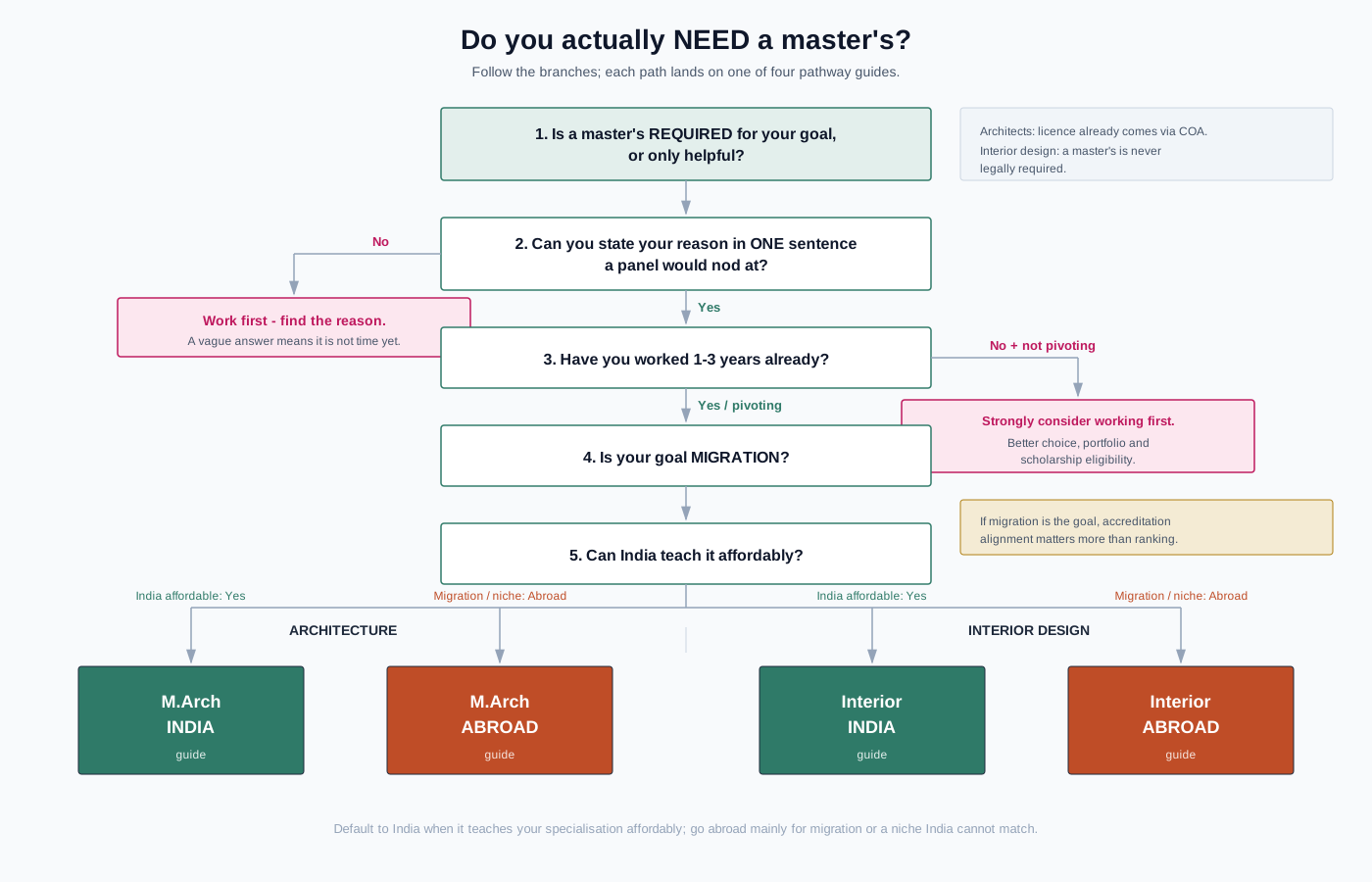
If you are still earlier in the journey — choosing an undergraduate school or entrance route — the companion guides Architecture schools shortlist, NATA/JEE B.Arch entrance prep, and B.Des interior design student track come first. And if you are weighing whether to work instead, read career pathways after B.Arch.
8. Myths & pitfalls — flagged plainly
- Myth: "You need an M.Arch to be a real architect in India." False. B.Arch (COA-recognised) + COA registration already confers the right to practise and sign. A master's is specialisation.
- Myth: "You need a master's to legally do interior design in India." False. Interior design is unregulated; IIID is voluntary, not a regulator.
- Myth: "Design is STEM, so a US master's gives 3 years of OPT." Usually false for interiors — most are not STEM-coded → only 12 months OPT. For M.Arch it depends on the CIP code per school — verify, never assume.
- Myth: "Any US M.Arch leads to a licence." False. Only NAAB-accredited M.Arch I does; the post-professional M.Arch II does not.
- Myth: "An Indian B.Arch lets me practise in the UK directly." Usually false — you typically still need ARB Part 2; verify with the ARB.
- Myth: "CEED at IIT gives me an interior design master's." Misleading — CEED routes into IIT M.Des, which is product/industrial design, not a dedicated interior track. The genuine Furniture & Interior Design master's is NID Ahmedabad.
- Myth: "The AICTE PG stipend is going up to ~₹18k soon." A hike is proposed, not confirmed; the current figure is ~₹12,400/month (unrevised since 2015). Budget on the confirmed number.
- Pitfall: doing a master's to avoid the job market. The most common, most expensive mistake. The market waits; the loan does not.
- Pitfall: chasing ranking over accreditation. A top-50 degree that doesn't lead to your target licence is worth less to you than a humbler one that does.
References and Further Reading
All fees, stipends, exam structures, eligibility windows, and accreditation rules change frequently. Treat every number here as approximate and verify on the official portal at application time. Currency conversions are approximate (USD 1 ≈ INR 85, GBP 1 ≈ INR 107, EUR 1 ≈ INR 92, CHF 1 ≈ INR 95).
Official / Statutory bodies
- Council of Architecture (COA), Architects Act 1972 — coa.gov.in
- GATE (Architecture & Planning paper; 3-year score validity) — gate.iitg.ac.in (host IIT rotates yearly)
- CCMT (centralised M.Tech/M.Arch/M.Plan counselling for NITs/IIITs/GFTIs) — ccmt.admissions.nic.in
- COAP (Common Offer Acceptance Portal, IITs) — coap.iitm.ac.in
- CEED (Common Entrance Exam for Design, IIT Bombay) — ceed.iitb.ac.in
- NID Design Aptitude Test (DAT) — admissions.nid.edu
- AICTE (PG stipend policy) — aicte-india.org
- NAAB (US architecture accreditation) — naab.org
- RIBA — architecture.com · ARB (UK registration / Parts 1–3) — arb.org.uk
- CACB (Canada) — cacb-ccca.ca · AACA (Australia) — aaca.org.au
- CIDA (US interior design accreditation) — accredit-id.org · NCIDQ / CIDQ — cidq.org
- IIID (Institute of Indian Interior Designers, voluntary) — iiid.in
Funding & Scholarships
- Inlaks Shivdasani Foundation — inlaksfoundation.org
- J.N. Tata Endowment — jntataendowment.org
- Fulbright-Nehru (USIEF) — usief.org.in
- Chevening (UK FCDO) — chevening.org
- Commonwealth Scholarships — cscuk.fcdo.gov.uk
- DAAD (Germany) — daad.in
Companion Studio Matrx guides
- The four pathway deep-dives: M.Arch in India · M.Arch abroad · Interior design master's in India · Interior design master's abroad
- Architecture schools shortlist (India)
- NATA/JEE B.Arch entrance prep
- B.Des interior design student track
- Career pathways after B.Arch
- Architecture portfolio building · Architecture thesis methodology
- Hubs: Students · Architects · Landscape architects · All guides
Author's Note: I have watched brilliant graduates take on crushing debt for a degree they did not need, and equally watched the right master's, taken at the right time for the right reason, change a career completely. The difference was almost never the school's ranking. It was whether the person could say, in one honest sentence, why they were going — and whether the law and the accreditation actually backed up the plan. Spend more time on that sentence than on the brochures. — Amogh N P
Disclaimer: Fees, stipends, exam patterns, eligibility windows, accreditation rules, visa policies, and scholarship criteria are revised regularly and vary by year, institution, and country. Every figure in this guide is approximate and provided for general informational purposes only. Verify all current details on the relevant official portals before making any decision. This guide carries no liability for decisions made on its basis.
Export this guide
Related Guides — Deep-dive reading
The M.Arch Abroad: USA, UK, Europe & Beyond — A 2026 Guide for Indian Students
Degree structures, accreditation, selection, cost, funding and visas — what an Indian student must actually know before applying for a Master of Architecture overseas.
Student FoundationsA Master's in Interior Design Abroad: USA, UK & Europe — A 2026 Guide for Indian Students
Degree types, accreditation, selection, the school shortlist, real costs, funding — and the visa caveat that changes everything
Student FoundationsA Master's in Interior Design in India: Degrees, Entrance, Institutions & Cost (2026)
An honest, India-first guide to the confusingly-named degree landscape, the entrance methods (CEED, NID DAT and institute tests), a real institution shortlist, and what it all actually costs — in a field that has no statutory licence.
Student FoundationsRelated Tools — Try Free
Before vs After — Cost Reality Check
Compare what you expected to pay vs what you actually paid, category by category.
Reality CheckStamp Duty Calculator — All Indian States
Stamp duty + registration charges for all 28 states and 8 UTs — gender concessions, urban/rural variants, metro cess built in.
Stamp DutyBefore & After Studio
Generate AI before-and-after renders to preview how your redesign could look.
DesignAI