
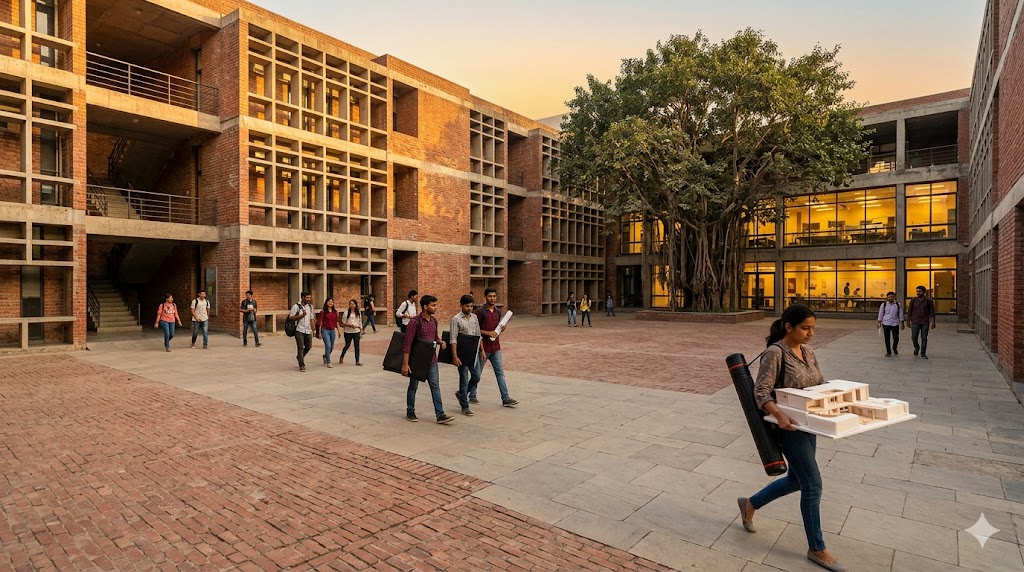
Indian Architecture Schools — A Working Shortlist
The 2026 Reference for B.Arch Aspirants — COA-Approved Institutions, Tier Map, Cost-of-Attendance Ranges, Pedagogy Profiles, Faculty Strengths, Geographic Distribution, Application Deadlines, and the Decision Framework for Choosing the School That Fits You
The B.Arch aspirant who has reached this guide has typically completed a NATA or JEE Paper 2 attempt and faces the next decision: which schools to apply to and which offer to accept. The Indian B.Arch ecosystem in 2026 contains roughly 250 COA-approved institutions distributed across centrally-funded, state-funded, and private categories — with cost of attendance ranging from ₹4 lakh to ₹45 lakh over the five-year programme, faculty quality varying by an order of magnitude, pedagogy from rigorously design-led to broadly technical, and graduate outcomes ranging from immediate employment at top studios to pathways requiring substantial post-graduate redirection.
This guide is the working shortlist. It is the companion-decision reference to the NATA & JEE B.Arch Entrance Preparation guide — that guide tells the candidate how to score; this guide tells the candidate where the score becomes an admission. The orientation throughout is towards the Indian B.Arch aspirant in 2026 navigating the choice between a Tier-1 destination school and a Tier-3 regional college, between a centrally-funded SPA and a private design-led institution, between the home-state quota and the all-India counselling round.
The treatment is organised into four clusters. The map cluster (sections 1-3) covers the COA recognition framework, the four-tier landscape, and the geographic distribution. The deep-dive cluster (sections 4-7) profiles the destination schools (SPA Delhi, CEPT, IITs), the strong regional schools (JJ Mumbai, NITs, RV/BMS Bengaluru), and the institute-specific design schools (NID, Pearl, Symbiosis). The cost cluster (sections 8-10) covers tuition, hostel, materials, scholarships, and education loans. The decision cluster (sections 11-14) covers application deadlines, the campus-visit framework, the comparison rubric, and the school-choice decision tree.
"The school you attend matters most for the first job after graduation. From year five of practice onwards, the portfolio dominates. Choose for fit and finances — not status." — Common observation across senior Indian architects who have hired across the school spectrum
1. The COA Recognition Framework — The Non-Negotiable Gate
Every B.Arch programme in India is regulated by the Council of Architecture (COA), the statutory body established under the Architects Act 1972. The COA recognises B.Arch programmes that meet its prescribed standards on:
- Programme structure — five-year duration, minimum studio hours, mandatory subjects across history, theory, structures, services, environmental design, and professional practice
- Faculty composition — minimum staff-to-student ratios, minimum number of full-time architectural faculty
- Physical infrastructure — studio space per student, library size, computer lab, model-making workshop, materials lab
- Industry exposure — mandatory practical training (typically 16 weeks of internship in the fourth year)
- Pedagogical accreditation — periodic review under the COA Inspection Mechanism
The candidate's first discipline before applying or accepting any B.Arch admission is to verify the institution's current COA recognition status. Recognition is reviewed periodically; institutions whose recognition has lapsed or is under review will not produce graduates eligible for COA registration — a consequence that materialises only when the graduate attempts to register as an Architect in the year following graduation, and which is essentially un-fixable at that stage.
The authoritative list is published at coa.gov.in under "List of Recognised Institutions" and is updated annually. As of 2026, the list contains approximately 250 active institutions across India.
1.1 Why COA Recognition Matters
The Architects Act 1972, §29 reserves the use of the title Architect in India to persons registered with the COA. Only graduates from COA-recognised institutions may apply for COA registration on graduation. A graduate from a non-recognised programme:
- Cannot use the title Architect in India
- Cannot authenticate building plan submissions in any Indian state requiring architect-signed drawings (most states)
- Cannot independently practise as an Architect in the legal sense
- May find their degree treated as a "design education" credential rather than an "architecture professional" credential by employers
The decision is binary: COA-recognised, or do not enrol. The candidate who joins a non-recognised programme is choosing a path that closes the architect-statutory route from Day 1.
1.2 Categories of COA-Recognised Institutions
| Category | Funding model | Tuition (5-yr typical) | Examples |
|---|---|---|---|
| Centrally-funded autonomous | Government of India | ₹4-8L | SPA Delhi · SPA Bhopal · SPA Vijayawada · IIT Roorkee · IIT Kharagpur |
| Centrally-funded NIT/IIIT | Government of India | ₹4-8L | NIT Calicut · NIT Tiruchirapalli · NIT Patna · NIT Raipur · MNIT Jaipur · IIIT Gwalior |
| State-funded universities | State Government | ₹3-12L | Sir J J Mumbai · JNAFAU Hyderabad · Anna University Chennai · WBJEEB-counselled |
| State-private (deemed) | Mixed funding | ₹15-30L | Manipal · Sushant · MIT-ADT · CEPT (private trust) |
| Private (autonomous) | Private trust / corporate | ₹20-45L | Pearl Academy · Symbiosis · RV (private) · BMS (private) · Apeejay |
The candidate's choice across these categories is partly financial (centrally-funded is dramatically cheaper than private), partly pedagogical (design-led private schools sometimes offer pedagogy not available in state colleges), and partly geographic (the candidate's home state cell may offer significant cost advantages for state-funded institutions).
2. The Four-Tier Map
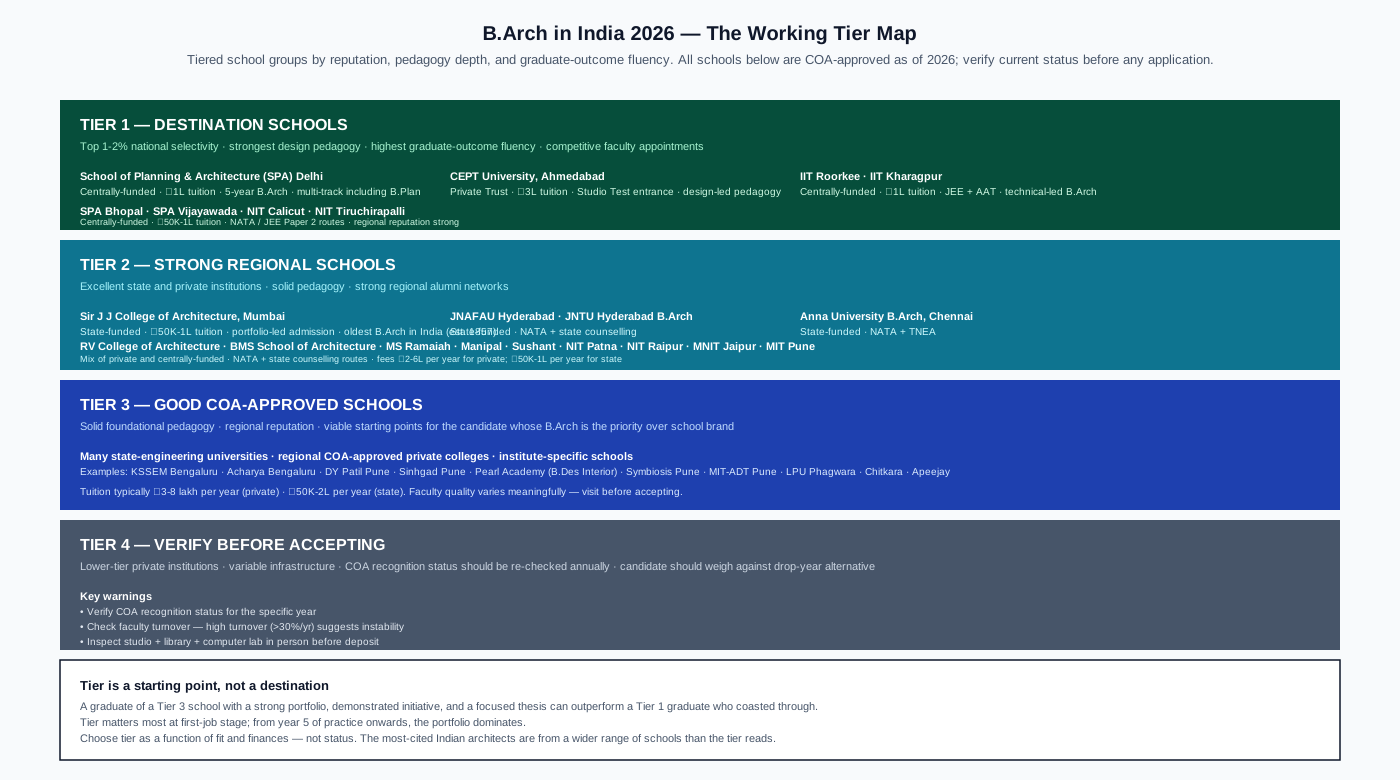
The 250-institution landscape resists simple ranking; reputation, pedagogy depth, faculty quality, and graduate-outcome fluency vary in non-aligned ways. The working framework below uses four tiers — practical groupings for orientation, not a strict ranking system.
2.1 Tier 1 — Destination Schools
The candidate who scores at the Tier-1 entrance band (NATA 150+ / JEE Paper 2 AIR ≤ 1500) typically has the option of one of these institutions. The shortlist:
- School of Planning & Architecture (SPA), Delhi — centrally-funded, established 1955, the historical reference school for Indian architectural education. Multi-track including B.Arch, B.Plan, M.Arch (multiple specialisations). Faculty across architecture, urban design, planning, conservation. Tuition ~₹1L per year + hostel.
- CEPT University, Ahmedabad — private trust foundation established by BV Doshi (Vastushilpa), distinctive Studio Test entrance, design-led pedagogy. Strong in interior, urban design, conservation. Tuition ~₹3L per year. The only Tier-1 school with a non-NATA-only entrance.
- IIT Roorkee & IIT Kharagpur — the two IITs offering B.Arch, requiring JEE Main + JEE Advanced + AAT. Technical-led pedagogy with strong structures, services, sustainability emphasis. Tuition ~₹1L per year + hostel + mess.
- SPA Bhopal & SPA Vijayawada — the two newer SPAs (established post-2008), centrally-funded, generally accessible at slightly lower NATA cutoffs than SPA Delhi.
- NIT Calicut & NIT Tiruchirapalli — the two NITs with the strongest B.Arch reputation, JEE Paper 2 entry, technical-led pedagogy.
2.2 Tier 2 — Strong Regional Schools
The Tier-2 candidate (NATA 120-149 / JEE Paper 2 AIR 1501-5000) has access to a substantial range of institutions:
- Sir J J College of Architecture, Mumbai — established 1857, the oldest B.Arch institution in India. Portfolio-led admission alongside NATA. Strong design pedagogy with Mumbai's practitioner network as the immediate first-job ecosystem.
- JNAFAU Hyderabad & JNTU Hyderabad B.Arch — Telangana's principal architecture schools, NATA + state counselling.
- Anna University B.Arch, Chennai — Tamil Nadu's principal state-funded architecture programme.
- NIT Patna · NIT Raipur · NIT Hamirpur · MNIT Jaipur · IIIT Gwalior B.Arch — second-tier NITs with good JEE Paper 2 access.
- RV College of Architecture, Bengaluru · BMS School of Architecture · MS Ramaiah · MIT Pune · MIT-ADT · Manipal — strong private and deemed institutions with mature pedagogies.
- Sushant University Gurgaon · Symbiosis Pune · Pearl Academy — design-led private schools with industry-collaboration emphasis.
2.3 Tier 3 — Good COA-Approved Schools
The Tier-3 candidate (NATA 100-119 / JEE Paper 2 AIR 5001-12000) finds admission at a wide range of state-engineering universities and regional COA-approved private colleges. The institutions in this tier are heterogeneous — some have excellent local faculty and good infrastructure, others are weaker. The candidate's discipline is to visit the campus and meet the faculty before accepting.
Examples include: KSSEM Bengaluru · Acharya Bengaluru · DY Patil Pune · Sinhgad Pune · LPU Phagwara · Chitkara · Apeejay · the various state engineering universities with B.Arch programmes (Aligarh Muslim University, Jamia Millia Islamia, Hamdard, Jadavpur in older streams).
2.4 Tier 4 — Verify Before Accepting
The Tier-4 grouping comprises institutions whose COA recognition status should be re-verified annually, where infrastructure or faculty turnover is high, or where graduate-outcome data is limited. The candidate offered admission only at a Tier-4 institution should weigh seriously against the drop-year + re-attempt path covered in the NATA prep guide.
3. The Geographic Distribution
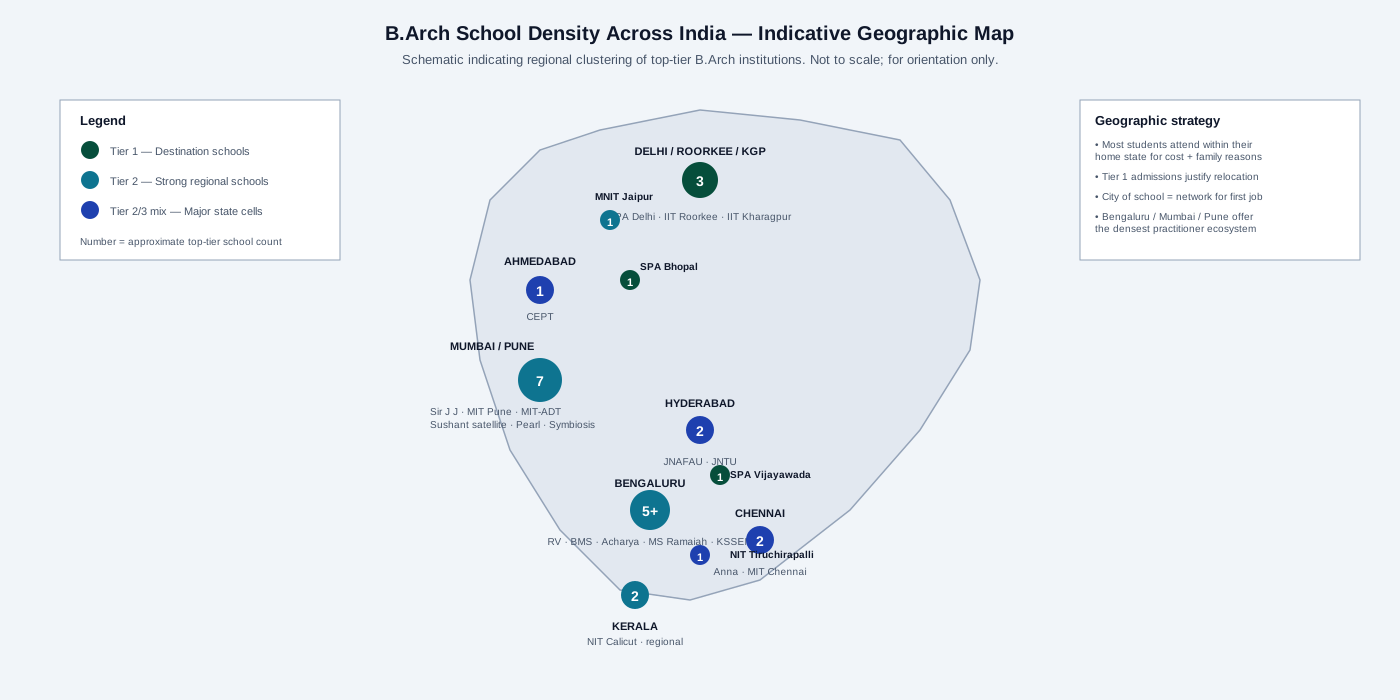
Indian B.Arch institutions cluster around metropolitan and Tier-2 cities. Geographic strategy matters because (a) home-state quota in state counselling produces meaningful cutoff differences, (b) cost of living varies by city, and (c) the city of education becomes the candidate's primary first-job network.
| Region | Top-tier schools | Cost-of-living index (vs national avg) |
|---|---|---|
| Delhi NCR | SPA Delhi · IIT Delhi (M.Arch) · Sushant Gurgaon | High |
| Mumbai/Pune | Sir J J · MIT Pune · MIT-ADT · Sushant satellite · Symbiosis · Pearl | Very high |
| Bengaluru | RV · BMS · Acharya · MS Ramaiah · KSSEM | High |
| Ahmedabad | CEPT | Moderate |
| Chennai | Anna University · MIT Chennai · NIT Trichy (1.5h south) | Moderate |
| Hyderabad | JNAFAU · JNTU | Moderate |
| Kerala | NIT Calicut · regional COA | Low-moderate |
| Eastern India | IIT Kharagpur · Jadavpur · IIEST Shibpur · NIT Patna · NIT Raipur | Low-moderate |
| Northern India | IIT Roorkee · MNIT Jaipur · NIT Hamirpur · Chandigarh College of Architecture | Moderate |
The candidate planning the geographic strategy should weigh home-state quota against destination-school relocation. A Karnataka home-state candidate typically gains 15-20% cutoff advantage at Karnataka schools through KEA quota; the same candidate writing for Maharashtra schools writes against the all-India quota with no home-state benefit.
4. The Centrally-Funded Schools — Profiles
4.1 SPA Delhi — School of Planning & Architecture
| Dimension | Detail |
|---|---|
| Founded | 1955 (as Department of Architecture; SPA from 1979) |
| Funding | Centrally-funded, autonomous |
| Admission | NATA + Class 12 + counselling |
| Annual intake (B.Arch) | ~80 |
| Tuition (5-yr total) | ~₹4-5L + hostel (~₹50K/yr) |
| Faculty strengths | Architecture history, urban design, conservation, planning |
| Pedagogy | Mixed design + theory; strong international visiting faculty |
| Notable alumni | Many leading Indian architects and urban planners |
| First-job pathway | Strong direct placement to Delhi practitioners; M.Arch admissions to global top schools |
The SPA Delhi B.Arch is the most centrally-located, most-historically-established Indian architectural education. The institution's faculty network — historically including senior practitioners from Delhi's architectural ecosystem — provides direct exposure to professional practice.
4.2 CEPT University, Ahmedabad
| Dimension | Detail |
|---|---|
| Founded | 1962 (Vastushilpa Foundation, BV Doshi); CEPT University 2002 |
| Funding | Private trust, supported by Gujarat state |
| Admission | NATA + CEPT Studio Test (additional) |
| Annual intake (B.Arch) | ~120 |
| Tuition (5-yr total) | ~₹15-18L + hostel |
| Faculty strengths | Design pedagogy, vernacular, sustainability, urban design |
| Pedagogy | Strongest design-led pedagogy in Indian B.Arch ecosystem; studio-heavy |
| Notable alumni | Doshi-lineage architects (Sangath, sP+a), Kundoo, several younger-generation contemporary practitioners |
| First-job pathway | International M.Arch placement strong; direct Indian practitioner network includes most leading studios |
CEPT operates outside the standard NATA-only admission framework. The Studio Test is an additional all-day examination of drawing, observation, and design thinking that meaningfully filters for design aptitude beyond what NATA measures. Candidates whose drawing strength is significantly above NATA's structured-prompt level should weight CEPT.
4.3 IIT Roorkee & IIT Kharagpur
| Dimension | IIT Roorkee | IIT Kharagpur |
|---|---|---|
| Department founded | 1856 (Thomason College); architecture from 1955 | 1951 (with IIT) |
| Admission | JEE Main + JEE Advanced + AAT | JEE Main + JEE Advanced + AAT |
| Annual intake (B.Arch) | ~40 | ~40 |
| Tuition (5-yr total) | ~₹4L + hostel/mess | ~₹4L + hostel/mess |
| Pedagogy | Technical-led: structures, services, sustainability strong | Technical-led: structures, services, sustainability strong |
| Faculty strengths | Strong technical core; B.Tech-faculty integration | Strong technical core; B.Tech-faculty integration |
| First-job pathway | M.Tech / M.Arch pathways popular; corporate placements strong | M.Tech / M.Arch pathways popular; corporate placements strong |
The IIT B.Arch is technically rigorous — students share calculus, structural analysis, and computational courses with B.Tech students — and the design pedagogy is correspondingly less studio-intensive than at design-led schools. Graduates often pursue M.Tech (specialised structures, building physics, urban systems) or M.Arch abroad. The brand value at first-job stage and for further study is significant.
4.4 NIT Calicut & NIT Tiruchirapalli
| Dimension | NIT Calicut | NIT Tiruchirapalli |
|---|---|---|
| Department founded | 1967 (as REC; B.Arch from 1980) | 1964 (B.Arch from 1973) |
| Admission | JEE Main Paper 2 | JEE Main Paper 2 |
| Annual intake | ~40 | ~40 |
| Tuition (5-yr total) | ~₹4-5L + hostel | ~₹4-5L + hostel |
| Pedagogy | Mix of technical + design | Mix of technical + design |
| First-job pathway | South-India practitioner network strong; technical roles also available | South-India practitioner network strong; technical roles also available |
Both NITs are well-established within the southern Indian architectural ecosystem with strong direct-placement networks.
5. The State University Schools — Profiles
5.1 Sir J J College of Architecture, Mumbai
| Dimension | Detail |
|---|---|
| Founded | 1857 — oldest B.Arch institution in India |
| Funding | State-funded (Maharashtra) |
| Admission | NATA + portfolio review + state counselling (MHTCET) |
| Annual intake | ~80 |
| Tuition (5-yr total) | ~₹4-6L (state quota) |
| Faculty strengths | Mumbai practitioner network; conservation; design |
| Pedagogy | Mixed design + technical; strong professional integration |
| First-job pathway | Mumbai practitioner network is the densest in India; immediate first-job pipeline |
JJ College Mumbai's portfolio-review admission is meaningfully different from pure-NATA. Strong portfolio candidates with moderate NATA scores have admitted; weak portfolio candidates with high NATA scores have been declined. The portfolio is visible, original work — sketches, photographs, models, paintings — assembled across the candidate's Class 11-12 years.
5.2 JNAFAU Hyderabad
Telangana's principal architecture institution, founded 1947 as part of Jawaharlal Nehru Architecture & Fine Arts University. Strong regional reputation; good faculty; access to Hyderabad's growing architectural ecosystem.
5.3 Anna University B.Arch, Chennai
Tamil Nadu's principal state-funded B.Arch programme; strong technical foundation; state-counselling (TNEA) admission. Limited annual intake makes admission competitive within Tamil Nadu state.
5.4 Other State-Funded B.Arch Programmes
| State | Notable institutions |
|---|---|
| Karnataka | Visvesvaraya College of Engineering · Bangalore Institute of Technology |
| West Bengal | Jadavpur University Architecture (older stream) · IIEST Shibpur |
| Punjab | Chandigarh College of Architecture (Punjab University) |
| Uttar Pradesh | Aligarh Muslim University Architecture · Jamia Millia Islamia |
| Kerala | College of Architecture (Trivandrum) · CET (College of Engineering Trivandrum) |
6. The Strong Private and Deemed Schools — Profiles
6.1 RV College of Architecture, Bengaluru
| Dimension | Detail |
|---|---|
| Founded | 1992 |
| Funding | Private (Rashtreeya Vidyalaya) |
| Admission | NATA + Karnataka counselling (KEA / COMEDK / management quota) |
| Tuition (5-yr total) | ~₹15-22L |
| Faculty strengths | Bengaluru practitioner network; mixed pedagogy |
| Pedagogy | Design + technical; strong studio culture |
| First-job pathway | Bengaluru's practitioner network is extensive; tech-startup-adjacent design roles also available |
6.2 BMS School of Architecture, Bengaluru
| Dimension | Detail |
|---|---|
| Founded | 1991 |
| Funding | Private (BMS Educational Trust) |
| Admission | NATA + Karnataka counselling |
| Tuition (5-yr total) | ~₹14-20L |
| Pedagogy | Strong studio + technical; well-established |
6.3 MIT Pune & MIT-ADT
The MIT Pune (Maharashtra Institute of Technology) and MIT-ADT University offer well-established B.Arch programmes with industry-collaboration emphasis. MIT Pune in particular has strong design pedagogy and Pune's practitioner network as the first-job ecosystem.
6.4 Manipal Academy of Higher Education
Manipal University's Faculty of Architecture, established 1990s, offers B.Arch with NATA + interview admission. Strong international exposure (exchange programmes), modern infrastructure, design-led pedagogy.
6.5 Sushant University, Gurgaon
Established 2002 (formerly Ansal University), Sushant is a design-led private institution with industry-collaboration emphasis. NATA + portfolio admission; tuition at the higher end (₹25-35L total).
6.6 Symbiosis School of Design, Pune
Symbiosis offers B.Arch and B.Des programmes; SET-Design entrance; strong design pedagogy. The B.Des Interior stream attracts candidates who prefer interior design over architecture-statutory practice.
6.7 Pearl Academy, Multi-City
Pearl Academy offers B.Des Interior Design (not B.Arch — important distinction) at multiple campuses (Delhi, Mumbai, Jaipur, Bengaluru). Industry-led pedagogy; B.Des Interior route is suitable for candidates whose interest is interior design over architecture.
7. The Institute-Specific Design Schools — NID, JJ, CEPT
Beyond the NATA / JEE Paper 2 ecosystem, India has a small set of design-led institutions whose admission is portfolio-and-test-based rather than score-based. These schools attract candidates whose design-thinking strength is above their test-taking strength.
7.1 National Institute of Design (NID), Ahmedabad / Bengaluru / Vijayawada
NID admits B.Des Interior Design candidates through DAT (Design Aptitude Test) — a two-stage examination with Mains (drawing + visualisation + cognitive abilities) and Studio Test (in-person, three-day evaluation). NID B.Des is not a B.Arch — graduates are interior designers, not architects — but it is the strongest design education in India.
7.2 J J School of Art, Mumbai (Architecture vs Fine Art)
JJ College of Architecture (covered in §5.1) is part of the broader JJ School of Art ecosystem. The portfolio-led admission distinguishes JJ from other state institutions.
7.3 CEPT Studio Test (covered in §4.2)
The CEPT Studio Test is the most rigorous design-led admission examination in Indian architectural education. The all-day test combines drawing, on-the-spot composition, and a design-thinking exercise that filters for design aptitude beyond NATA's measure.
8. Cost of Attendance — The Working Bands
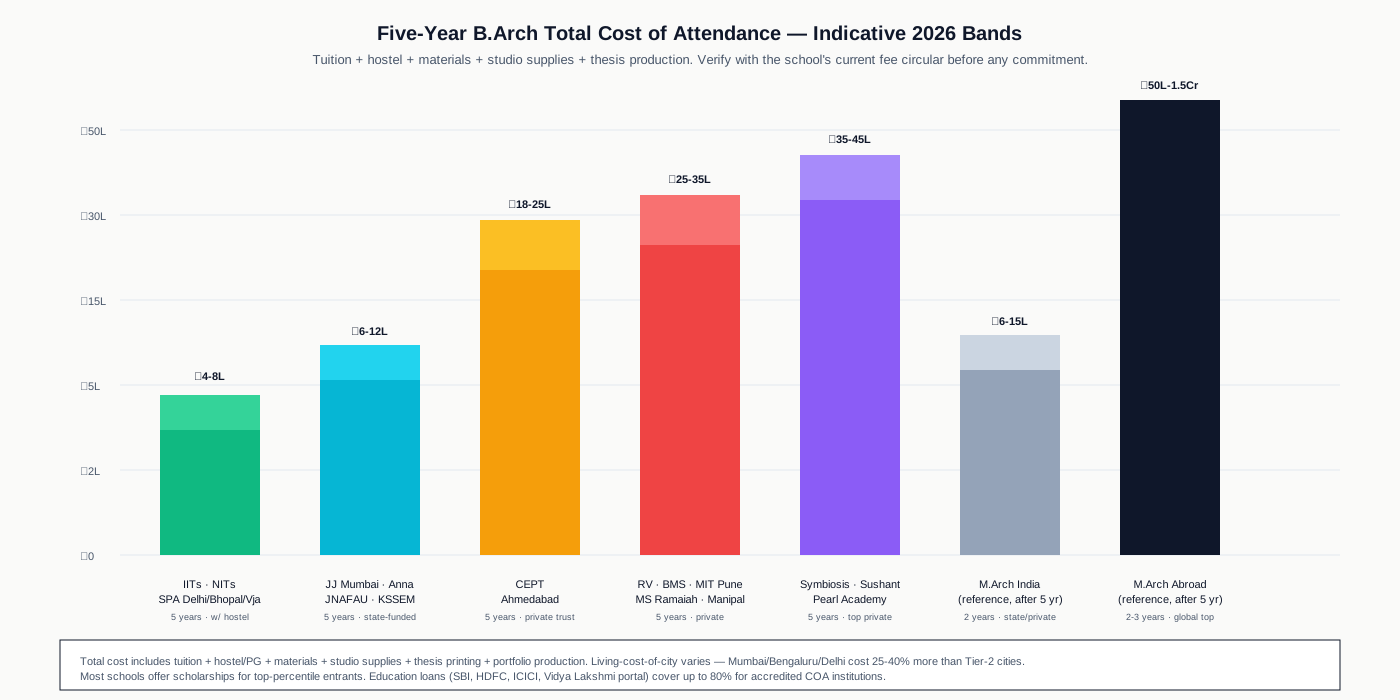
The total five-year cost of attendance varies dramatically across the four-tier landscape. The candidate's family financial planning must account for tuition + hostel + materials + studio supplies + thesis printing + portfolio production.
8.1 Tuition Bands (5-Year Total)
| Category | Annual tuition | 5-year total tuition |
|---|---|---|
| Centrally-funded (SPA, IIT, NIT) | ₹50K-1L | ₹2.5-5L |
| State universities | ₹50K-1.5L | ₹2.5-7.5L |
| CEPT | ₹3-3.5L | ₹15-17.5L |
| Strong private (RV, BMS, Manipal, MIT) | ₹3-4.5L | ₹15-22.5L |
| Top private (Sushant, Symbiosis, Pearl) | ₹4.5-7L | ₹22.5-35L |
| Premium private | ₹6-8L | ₹30-40L |
8.2 Hostel and Living Costs
| City | Hostel/PG annual | Mess + food annual | Total living/yr |
|---|---|---|---|
| Delhi | ₹80K-1.5L | ₹60K-1L | ₹1.4-2.5L |
| Mumbai | ₹1.2-2L | ₹80K-1.2L | ₹2-3.2L |
| Bengaluru | ₹1-1.5L | ₹60K-1L | ₹1.6-2.5L |
| Pune | ₹80K-1.2L | ₹50K-80K | ₹1.3-2L |
| Tier-2 cities | ₹40K-80K | ₹40K-70K | ₹80K-1.5L |
8.3 Materials, Studio Supplies, Thesis Production
| Category | Annual cost | 5-year total |
|---|---|---|
| Drawing supplies (sheets, pencils, colours) | ₹15-25K | ₹75K-1.25L |
| Model-making supplies (foamboard, basswood, tools) | ₹10-20K (rising in later years) | ₹75K-1.5L |
| Software licences (Adobe student plan, etc.) | ₹10-20K | ₹50K-1L |
| Site visits + travel + study tours | ₹15-30K | ₹75K-1.5L |
| Thesis printing + portfolio production | ₹0-5K (yrs 1-4); ₹50K-1L (yr 5) | ₹70K-1.2L |
The "hidden" cost in B.Arch is materials and model supplies. Year 4 and Year 5 thesis projects routinely cost ₹40-80K each. The candidate's family budget should include a 10-15% buffer above tuition + hostel for studio costs.
8.4 Total Cost of Attendance Summary
| Tier | Tuition | Hostel + living | Materials | 5-year total |
|---|---|---|---|---|
| SPA Delhi (centrally-funded, hostel) | ₹4-5L | ₹7-12L | ₹4-6L | ₹15-23L |
| IIT Roorkee/Kharagpur (centrally-funded, hostel) | ₹4L | ₹7-10L | ₹4-6L | ₹15-20L |
| CEPT (private trust, Ahmedabad) | ₹15-17L | ₹6-9L | ₹4-6L | ₹25-32L |
| Sir J J Mumbai (state, day-scholar typical) | ₹4-6L | ₹0-15L (varies) | ₹4-6L | ₹8-27L |
| RV / BMS Bengaluru (private) | ₹15-22L | ₹8-12L | ₹4-6L | ₹27-40L |
| Sushant / Symbiosis / Pearl (premium) | ₹25-35L | ₹8-15L | ₹4-6L | ₹37-56L |
9. Scholarships and Education Loans
9.1 Government Scholarships
| Scholarship | Eligibility | Amount |
|---|---|---|
| Central Sector Scheme of Scholarship for College and University Students | Top 20% Class 12 board, family income <₹4.5L | ₹10K/yr (UG) |
| AICTE Pragati Scholarship (Girls) | Female candidates, family income <₹8L | ₹50K/yr |
| Post-Matric Scholarship for SC/ST/OBC | Caste-category students, family income limits | Tuition + maintenance |
| MoMA Merit-cum-Means Scholarship | Minority community, family income <₹2.5L | ₹20K-25K/yr |
| State scholarships | State-domicile students; varies by state | Varies |
9.2 Institutional Scholarships
Most centrally-funded institutions offer merit-based scholarships of 25-50% tuition waiver for top-percentile entrants. CEPT offers a need-based scholarship programme covering up to 100% tuition for selected candidates. Private institutions (Sushant, Symbiosis, Manipal) offer founder's scholarships and sports/extracurricular scholarships of 10-50% tuition.
9.3 Education Loans
| Loan | Coverage | Interest rate | Notes |
|---|---|---|---|
| SBI Education Loan | Tuition + hostel + materials | 9-11% | Flagship; multiple variants |
| HDFC Credila | Same | 10-12% | Competitive private bank |
| ICICI / Axis | Same | 9.5-12% | Competitive private banks |
| Vidya Lakshmi Portal | Multi-bank gateway | Variable | Common application across 35+ banks |
Banks generally lend up to ₹10L without collateral and up to ₹40L with collateral for COA-approved institutions. The interest rate for women applicants is typically 0.5% lower than the standard rate.
10. Application Calendar and Deadlines
10.1 The Cycle Overview
| Period (Class 12 senior year) | Activity |
|---|---|
| August - September | NATA Session 1 application opens; JEE Main January application opens |
| October - November | NATA Session 1 results; JEE Main January results; institute-specific applications open (CEPT, NID, JJ) |
| December | NID DAT Mains; CEPT Studio Test (typically); state counselling registrations open |
| January - February | JEE Main April session application; NATA Session 2 application |
| March - April | Class 12 board exams; JEE Main April session; NATA Session 2 |
| May - June | NATA Session 3; JEE Advanced (for IIT B.Arch); JoSAA registration |
| June - July | JoSAA rounds 1-6; AAT (after JEE Advanced); state counselling rounds |
| July - August | Final admissions; institute reporting; programme starts |
10.2 Critical Deadlines (Indicative — Verify Current Year)
The candidate's discipline is to maintain a deadline tracking sheet with the following:
- COA Information Bulletin release date (typically February)
- NTA JEE Main bulletin release date (typically September)
- JoSAA registration window
- State counselling registration deadlines (KEA, MHTCET, TNEA, WBJEEB, etc.)
- CEPT Studio Test application window
- NID DAT application window
- JJ College portfolio submission window
- Institution-specific deadlines (RV, BMS, Manipal, Sushant)
Missing a deadline is the most common preventable admission failure. The candidate should set calendar reminders three weeks before each deadline.
11. The Campus-Visit Framework
Where geography and family budget permit, the candidate should visit at least three campuses before accepting any offer. The campus visit reveals what brochures cannot.
11.1 What to Look For
| Dimension | What to inspect | What to ask |
|---|---|---|
| Studio space | Per-student desk area; daylight; ventilation; storage | "How many hours/week do students spend here?" |
| Library | Architecture book count; recent journals; subscription to El Croquis / DETAIL / AR | "What is your annual book acquisition budget?" |
| Computer lab | Number of workstations; software licences; printing facilities | "Are AutoCAD, Revit, Rhino, Adobe Suite licensed for student use?" |
| Model-making workshop | Tool quality; workshop hours; safety equipment | "Is laser cutting / 3D printing available, and at what cost?" |
| Faculty interaction | Faculty availability; tutor-student ratio; visiting faculty | "Who teaches the studio in Years 3-5? How often do visiting faculty teach?" |
| Studio culture | Student work on display; informal feedback culture | "Can I attend a studio review while I'm here?" |
| Practitioner exposure | Distance to nearby practitioners; internship pipeline | "Where do students typically intern in Year 4?" |
| Hostel/accommodation | Conditions; mess quality; safety | "Can I see the hostel I would live in?" |
| Alumni network | Recent alumni in practice / academia / further study | "Where did your last graduating batch go?" |
11.2 Faculty-Quality Indicators
The single most important factor in B.Arch outcomes is faculty quality at the studio level. Indicators to look for:
- Active practitioners on faculty — at least 30-40% of design-studio faculty should be actively practising (not retired or full-time-teaching only)
- Faculty publication and research output — visible in conferences, publications, awards
- Visiting-faculty programme — strong schools bring in 4-8 visiting practitioners per year for studio reviews and short workshops
- Faculty-student ratio — better than 1:15 in design studios is a strong indicator
- Faculty turnover — high turnover (>30%/yr) is a flag
The candidate's working method on a campus visit is to engage one student in conversation — the student tells the truth more directly than the brochure does.
12. The Comparison Rubric
When the candidate has multiple offers in hand, the decision rubric below structures the choice:
| Dimension | Weight | How to score |
|---|---|---|
| COA recognition status | Gate | Recognised & stable = pass; under review = avoid |
| Faculty quality (active practitioners %) | High | 40%+ = strong; 20-40% = adequate; <20% = weak |
| Pedagogy fit (design-led vs technical-led) | High | Match to candidate's strength |
| Student-faculty ratio in studios | High | <1:15 = strong; 1:15-25 = adequate; >1:25 = weak |
| Geographic fit (city, distance from family) | Medium-High | Subjective |
| Cost vs family budget | High | Total 5-yr cost <= 60% of available budget |
| Alumni outcomes data | Medium | Recent placement / further-study record |
| Infrastructure (studio, library, lab, workshop) | Medium | Site visit |
| First-job network density (city's practitioner ecosystem) | Medium-High | Bengaluru/Mumbai/Pune/Delhi highest |
| Rank/brand value | Low-Medium | Matters at first-job; less afterwards |
The candidate scores each offer across these dimensions; the highest-scoring offer is typically the right answer. A common mistake is to over-weight rank/brand and under-weight pedagogy fit + faculty quality + cost.
13. The School-Choice Decision Tree
13.1 Multiple Tier-1 Offers
If you hold offers at SPA Delhi and CEPT and IIT, the decision is between:
- Pedagogy fit — design-led (CEPT) vs mixed (SPA Delhi) vs technical-led (IIT)
- Geographic fit — Delhi vs Ahmedabad vs Roorkee/Kharagpur
- Cost — IIT/SPA cheaper than CEPT; CEPT cheaper than top-private
- Network for first job — Delhi vs Ahmedabad's practitioner network
There is no objectively "best" answer. The candidate's design strengths and family circumstances should drive the choice.
13.2 Tier-1 vs Tier-2 Tradeoff
A Tier-1 offer (SPA Delhi) with a 25%+ cost premium vs a Tier-2 offer (NIT Patna or RV Bengaluru) is a common dilemma. Considerations:
- The Tier-1 brand value at first-job stage is real but moderate; from Year 5+ of practice, portfolio dominates
- Cost differential of ₹10-20L can be invested in M.Arch Abroad scholarships, internships, or independent practice startup
- Geographic / pedagogy fit may favour the Tier-2 option
The decision is not a clean answer. It depends on the family's financial elasticity and the candidate's discipline at portfolio-building.
13.3 Tier-2 vs Tier-3 Tradeoff
A Tier-2 offer at a strong regional school (RV / BMS / MIT Pune) vs a Tier-3 offer at a regional COA-approved school in the candidate's home state typically has a clearer answer: Tier-2 is the right choice if cost is bearable and the home-quota tier-3 cost advantage is <15%. The faculty and pedagogy difference between Tier-2 and Tier-3 is real and visible in graduate outcomes.
13.4 Tier-3 vs Drop Year
The hardest decision in the matrix. Considerations:
- Drop-year success rates at established coaching institutes are 60-70% for candidates targeting 30+ point improvements
- The drop-year cost (coaching fees + 12 months of foregone earning) is significant
- A Tier-3 COA-approved B.Arch with a strong portfolio and motivated student trajectory can match a Tier-2 outcome at first-job stage — the school is a starting point, not a determinant
- A Tier-4 institution (recognition concerns, weak infrastructure) is generally not preferable to a drop year
The candidate at this decision should consult senior practitioners, family, and financial planners — and read the Career Pathways After B.Arch guide for the long-horizon framework.
14. Beyond the B.Arch — When the Schools Don't Fit
For candidates whose entrance scores or portfolio strength does not align with the B.Arch ecosystem they want, the alternative paths are:
- B.Des Interior Design — NID, Pearl, Symbiosis, Sushant. Different statutory framework (interior designer vs architect), but for candidates whose interest is interior design the path is direct.
- B.Planning — SPA Delhi and SPA Bhopal offer B.Plan alongside B.Arch. The professional outcome (urban planner) is distinct from architect; the curriculum overlaps in the early years.
- B.Tech in Construction Technology / Architectural Engineering — regional engineering colleges. Suitable for candidates whose strength is technical and whose interest is in the building-engineering side rather than the design side.
- Architecture-adjacent design degrees — UX/UI design, industrial design, landscape design — at NID, NIFT, IIT Design programmes. These are not B.Arch and do not lead to COA registration, but produce strong design-discipline graduates.
Each alternative has its own admission framework. The candidate considering an alternative should research the specific institution's track record for graduate outcomes in the chosen path.
15. References and Further Reading
Statutory and Regulatory References
- Architects Act 1972, Government of India. §29 (registration), §35-36 (penalties for misuse), §45 (statutory regulation framework).
- Council of Architecture (COA), India. List of Recognised Institutions (annual). coa.gov.in
- Council of Architecture, Minimum Standards of Architectural Education Regulations, 2020. The current standards-of-education framework.
Institutional References
- School of Planning and Architecture, Delhi. Programme Handbooks and Annual Reports. spa.ac.in
- CEPT University, Ahmedabad. B.Arch Programme Brochure and Studio Test Information. cept.ac.in
- IIT Roorkee Department of Architecture & Planning. Programme Information. iitr.ac.in
- Sir J J College of Architecture, Mumbai. Admission Information and Annual Report. sirjjcoa.com
- Institute publication archives — published programme overviews, alumni journals, annual student showcases.
B.Arch Education and Practice Studies
- Mehrotra, R. (2011). Architecture in India since 1990. Pictor Publishing. — Practitioner-trajectory context.
- Lang, J., Desai, M., Desai, M. (1997). Architecture and Independence: The Search for Identity, India 1880-1980. OUP. — Historical context for Indian architectural education.
- Vasanthakumar, P. (Various). Studies of Indian Architecture Education. — School comparison studies in academic literature.
- Salama, A. M. (2016). Spatial Design Education: New Directions for Pedagogy in Architecture and Beyond. Routledge. — Architectural education theory.
Cost and Financial Planning References
- Vidya Lakshmi Portal (Government of India). vidyalakshmi.co.in — Multi-bank education-loan gateway.
- National Scholarship Portal. scholarships.gov.in — Government scholarship aggregator.
- AICTE Pragati Scholarship. aicte-india.org — Female-student-specific scholarship.
- Inlaks Shivdasani Foundation. inlaksfoundation.org — Major M.Arch scholarship after B.Arch.
Companion Studio Matrx Guides
- NATA & JEE B.Arch Entrance Preparation — the prior-decision guide.
- Career Pathways After B.Arch — the next-decision guide for graduates.
- Architectural Drawing & Representation Fundamentals — Module 1 of the Student Foundations Track.
- Building Your Architecture Portfolio — for portfolio-led admission tracks (JJ, Manipal, Sushant).
- Student Resources Hub — software, templates, reading list, timeline.
Author's Note: The school you attend in B.Arch matters, but it matters less than candidates and parents typically believe. By the fifth year of practice — and certainly by the tenth — the portfolio you have built, the projects you have shipped, and the professional habits you have developed dominate any school-brand effect. Choose for fit and finances, not status. A motivated graduate of a Tier-3 school with a strong portfolio routinely outperforms a coasting graduate of a Tier-1 school. The school is the starting point. What you do with it is the destination.
Disclaimer: COA recognition status, tuition fees, hostel costs, scholarship amounts, and admission criteria are revised by institutions periodically and the Council of Architecture annually. All figures and tier groupings in this guide are indicative as of the 2026 admission cycle; verify current information directly with the institution and the COA before any application or admission decision. This guide is for informational and educational purposes only; Studio Matrx, its authors, and contributors accept no liability for outcomes based on it.
Export this guide
Related Guides — Deep-dive reading
B.Des Interior Design — The Student Track
The 2026 Reference for the Indian B.Des Interior Aspirant — How It Differs from B.Arch, the Top Schools (NID · Pearl · Symbiosis · NIFT · Sushant), the Four-Year Curriculum, the Software Stack, FF&E and Materials Vocabulary, Studio Discipline, Portfolio Building, Internship Pathways, Career Trajectories, and the Long-Horizon Practice Map
Student FoundationsNATA & JEE B.Arch Entrance Preparation
The 2026 Reference for the Indian B.Arch Aspirant — Test Structures, Eligibility, the Two-Year Calendar, Drawing Practice Discipline, Aptitude & Math Programmes, Mock-Test Cycles, Scoring, JoSAA & State Counselling, and the Foundational Path from Class 11 to Admission
Student FoundationsCase-Study Analysis — How to Read an Architectural Project
Module 7 of the Student Foundations Track — Selecting Case Studies that Match Your Design Problem, Five-Layer Analysis Framework (Site, Programme, Form, Material, Detail), Data Collection Methods, How to Apply Findings to Your Own Studio Project, the Citation Discipline, and a Twelve-Test Pre-Submission Diagnostic for Indian B.Arch Students
Student FoundationsRelated Tools — Try Free
Window Orientation Planner
Pick the best window type, glass and shading by wall direction — north, east, south and west.
Window ToolCross-Ventilation Analyzer
Estimate airflow and air changes per hour (ACH) from room size, window areas, layout, and local wind — with NBC 2016 Part 8 compliance check.
Ventilation CalculatorVastu Window Planner
Vastu guidance for window placement and size by wall direction and room — rating and remedies.
Vastu