
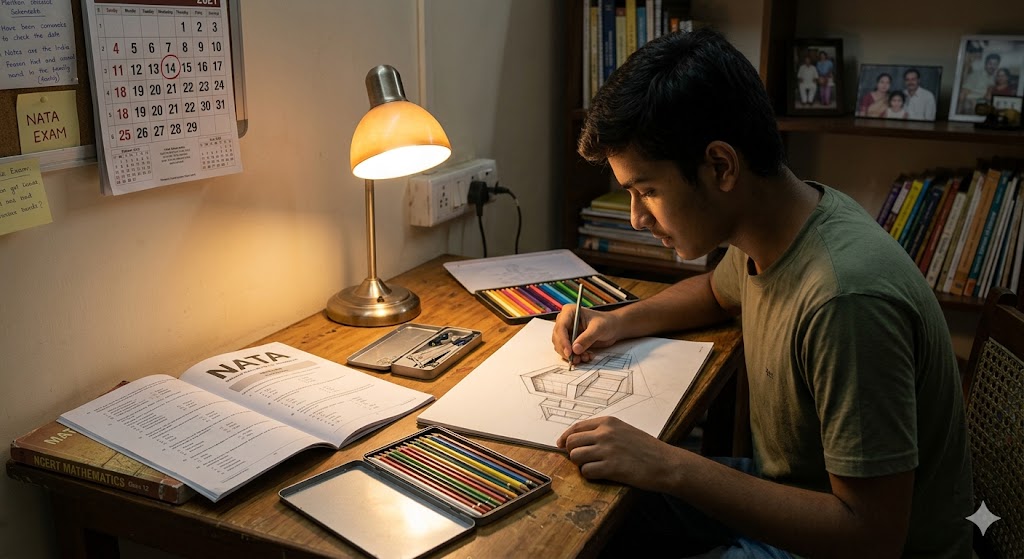
NATA & JEE B.Arch Entrance Preparation
The 2026 Reference for the Indian B.Arch Aspirant — Test Structures, Eligibility, the Two-Year Calendar, Drawing Practice Discipline, Aptitude & Math Programmes, Mock-Test Cycles, Scoring, JoSAA & State Counselling, and the Foundational Path from Class 11 to Admission
Architecture is one of the few professional degrees in India whose admission is gated not only by mathematical ability but by visual ability. This is the test the engineering aspirant has not faced and the medical aspirant will never face — a three-hour drawing test in which the candidate is judged on composition, perspective, colour, atmosphere, and the believability of an imagined urban scene. The student who treats the B.Arch entrance as a math-and-aptitude paper with an extra drawing layer is the student who underperforms; the student who treats it as a drawing examination with a math-and-aptitude support layer is the student who walks into a Tier-1 school.
This guide is the working reference for that aspirant. It is the pre-college counterpart to the Student Foundations track — the eight-module deep-research series that begins on the first day of B.Arch and runs through Career Pathways. This guide answers the prior question: how do I get into a B.Arch programme worth attending? The orientation throughout is towards the Class 11 and Class 12 student in India in 2026, with reference to the NATA framework administered by the Council of Architecture (COA) and the JEE Main Paper 2 framework administered by the National Testing Agency (NTA).
The treatment is structured around three clusters. The map cluster (sections 1-4) covers the entrance landscape, the two national exams, the eligibility framework, and the test structure. The programme cluster (sections 5-11) covers the two-year preparation calendar, the daily drawing discipline, the aptitude and math programmes, coaching evaluation, and mock-test cadence. The outcomes cluster (sections 12-18) covers the day-of-test playbook, score-to-school mapping, the JoSAA and state counselling routes, the reservation framework, the institute-specific entrance ecosystem, and the decision tree after results. The references at the end include the canonical B.Arch entrance-prep texts (Mosaic, Silica) alongside the COA Information Bulletin and NTA Information Brochure that students must verify against directly.
"The drawing test is not a hurdle. It is the part of the examination that most reveals whether you should study architecture for five years. Take it seriously, and the rest of the entrance becomes manageable." — Faculty paraphrase, school of architecture admissions panel
1. The Indian B.Arch Entrance Landscape in 2026
India offers approximately 30,000 B.Arch seats across 250+ COA-approved institutions. Three-quarters of these seats are filled through one of two national examinations — NATA or JEE Main Paper 2 — with the remainder filled through institute-specific entrance examinations at design-led institutions (CEPT Ahmedabad, NID, JJ College, MIT-ADT, Symbiosis, MIT Pune, RV Bengaluru, BMS Bengaluru, and a small number of others).
The candidate who is starting Class 11 with B.Arch as a target should think of the entrance landscape as four overlapping zones:
- Zone 1 — National examinations (NATA, JEE Main Paper 2). These are the principal gateways. NATA is the sole admission path at most COA-approved private and state-funded colleges; JEE Main Paper 2 is the path to the IITs (additionally requiring AAT after JEE Advanced), the NITs, the IIITs, and the GFTIs. Many candidates write both — a strategy this guide recommends.
- Zone 2 — State counselling routes. Karnataka (KEA / COMEDK), Maharashtra (MHTCET cell), Tamil Nadu, Telangana, Andhra Pradesh, West Bengal (WBJEEB) operate state-level counselling using NATA scores. Home-state candidates secure home-state quota seats at meaningfully lower cutoffs than out-of-state candidates, which is consequential for college selection.
- Zone 3 — Institute-specific entrance. CEPT, NID (B.Des Interior), JJ College Mumbai, MIT-ADT, RV Bengaluru, Sushant Gurgaon — each has its own entrance test in addition to or instead of NATA. The format varies; CEPT uses a dedicated Studio Test with sketching and on-the-spot composition; NID administers DAT (Design Aptitude Test); JJ College uses a portfolio-led admission. The candidate targeting one of these institutions must research the specific format at the start of Class 12, not later.
- Zone 4 — Allied design programmes. B.Des Interior Design (NID, Pearl, Symbiosis, NIFT in some streams), B.Planning (SPA Delhi, SPA Bhopal — same campuses as the architecture schools), B.Tech in Construction Technology / Architectural Engineering (regional engineering colleges) — these are adjacent paths, not B.Arch. The student who fails to achieve a competitive NATA / JEE Paper 2 score should evaluate these allied programmes as alternatives, not as failure paths. The Student Resources hub covers B.Des and the broader career-pathway map.
The candidate's first task is to decide which zone(s) to target. This decision depends on the candidate's geographic flexibility, the family's financial bandwidth, and the candidate's design portfolio strength relative to test-taking strength. A candidate with a strong portfolio but modest math fluency may be better positioned at a CEPT-style institute-specific test than at JEE Paper 2; a candidate with strong math and adequate drawing may be best positioned for the JEE Paper 2 / IIT route.
2. The Two National Examinations
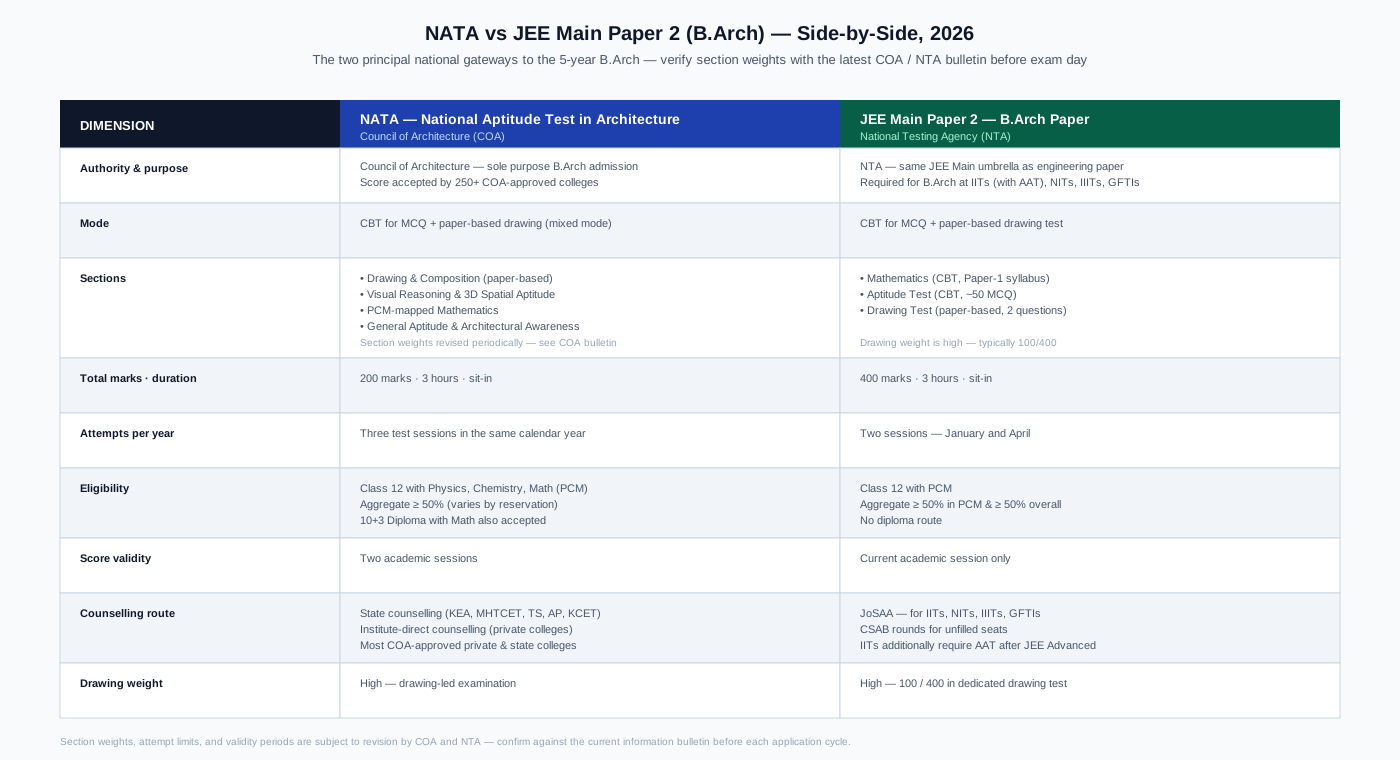
2.1 NATA — National Aptitude Test in Architecture
NATA is administered by the Council of Architecture (COA), the statutory body that registers architects in India under §29 of the Architects Act 1972. The COA also accredits the institutions whose B.Arch graduates are eligible for COA registration; only graduates from COA-approved institutions can use the title Architect in India.
Purpose. NATA is the single national examination whose score is accepted at the largest number of B.Arch institutions. It is the principal admission route at most state-funded and COA-approved private colleges outside the IIT/NIT/IIIT ecosystem.
Sourcing note. Everything in this section is taken from the NATA 2026 Information Brochure V2.0, released 10 April 2026 — the current version, and the highest that exists as of 16 July 2026. One trap is worth knowing before you download anything: nata.in serves two different brochures at the same time. The current V2.0 is published as Final-NATA-BROCHURE-2026.pdf, but the older and more widely-linked nata-brochure-final.pdf still serves the superseded V1.0 — and the two contradict each other on NATA 2025 score carry-over. Confusingly, both are titled "NATA BROCHURE 2026 final". Check the version box at Appendix VI of whatever copy you have open; if it says V1.0, you are reading withdrawn rules. Section references below (§) are to V2.0. Verified 16 July 2026.
Mode. NATA 2026 is conducted in two parts on the same day, three hours in total, 200 marks (§4.0). Part A is taken first, then Part B. A ten-minute break is permitted, but the candidate may not leave the centre.
| Part A | Part B | |
|---|---|---|
| Name | Drawing and Composition Test | MCQ and NCQ |
| Mode | Offline — pen, paper, and a physical kit | Computer-based, adaptive |
| Duration | 90 min | 90 min (108 seconds per question) |
| Marks | 80 | 120 |
| Questions | 3 | 50 |
Part A — 80 marks, three questions, on paper. A1 Composition and Colour (25) · A2 Sketching and Composition in Black and White (25) · A3 3D Composition (30). A3 is not a drawing: the centre issues a kit of foam forms plus a foam base sheet, the candidate glues a composition together, and it is then photographed in three views (front, oblique-left, oblique-right) and uploaded (Test Center Manual §9.3). Permitted materials are austere — pencils, ball pen, eraser, dry colours, and a scale up to 15 cm. No instruments: no compass, no set squares (Manual §11.1). Wet media are out.
Part B — 120 marks, 50 questions, adaptive. 42 MCQ + 8 NCQ ("No Choice Questions" — the brochure's own expansion). Available in English and Hindi. Questions appear one after another under a 108-second budget; there is no evidence of a review screen, so the JEE habit of skipping, flagging and returning does not transfer. No calculators are permitted.
A caution on the numbers: the official brochure contradicts itself — §4.0 states 42 MCQ + 8 NCQ, while §13.0(b) refers to "the 40 MCQs and 10 NCQs". The total is 50 either way. This is COA's own inconsistency, not a reporting error. Prepare for 42 + 8: §4.0 is the pattern specification and is independently corroborated by the Test Center Manual, whereas §13.0 is a relaxations clause whose figures appear to be stale. In practice the distinction changes nothing you would actually do differently.
Part B syllabus — the six areas the current bulletin actually names (§4.0):
- Visual Reasoning — understanding and reconstructing 2D and 3D composition
- Logical Derivation — decoding a situation or context and drawing conclusions
- General Knowledge, Architecture and Design — current issues, important buildings, historical progression, innovation in materials and construction
- Language Interpretation — meaning of words and sentences, English grammar
- Design Sensitivity and Thinking — observing and analysing people, space, product, environment; semantics, metaphor, problem identification
- Numerical Ability — basic mathematics and its association with creative thinking; unfolding space using geometry
No weightings are published for any of the six. Note also what is absent: "Cognitive skills", "Diagrammatic Reasoning", "Inductive Reasoning", "Abstract Reasoning", "Situational Judgement", and "Mathematics" or "General Aptitude" as standalone sections. Those belong to the 2023–24 format and are no longer in the syllabus — but they are still widely reprinted by coaching sites and aggregators, so a candidate revising from those lists is revising the wrong exam.
Marks per question and negative marking. Not stated anywhere in the official brochure. The commonly-repeated claim of "1–3 marks per question, no negative marking" is sourced only to coaching sites and should be treated as unverified. (120 marks across 50 questions averages 2.4, which is consistent with variable weighting under an adaptive engine — but that is inference, not policy.)
Attempts. Up to two attempts in Phase 1 (weekly Friday and Saturday sittings, 4 April – 13 June 2026), or one attempt in Phase 2 (7–8 August 2026) — never both (§3.0). Phase 2 is open only to candidates who did not appear in Phase 1. Where two attempts are taken, the best raw score is carried into the percentile calculation.
Scoring. There is no minimum qualifying score. §10.1 is explicit: "No minimum Raw Score is prescribed for qualifying in NATA 2026." Any non-zero percentile on the final scorecard is a valid qualifying score. Admission authorities may rank on either the best raw score or the percentile, according to their own rules (§3.0). Percentile is computed only after all Phase-1 sessions close, against the whole examinee population — which is why a candidate cannot read their standing from raw marks mid-window. Phase-1 scorecards carry raw score and percentile and feed CAP counselling; Phase-2 scorecards carry a raw score only and are used for vacant seats after CAP.
Validity. The NATA 2026 score is valid for the 2026-27 academic session only (§10.2). There is no two-year validity — a widely-repeated claim that does not appear in the brochure. A candidate planning a drop year must re-sit.
Eligibility. Regulation 4(1) of the COA (Minimum Standards of Architectural Education) Regulations 2020, quoted verbatim at §5.2, requires 10+2 with Physics and Mathematics as compulsory subjects, plus one of Chemistry, Biology, Technical Vocational, Computer Science, Information Technology, Informatics Practices, Engineering Graphics or Business Studies, with at least 45% in aggregate; or a 10+3 Diploma with Mathematics compulsory and at least 45% aggregate. Physics is as compulsory as Mathematics — a point often dropped in summaries, and one that constrains Class 11 subject choice. There is no age limit. Candidates who are still appearing in the qualifying examination may sit NATA (§5.1). Reservation is governed entirely by State/UT rules and is outside the exam's purview (§5.3). Qualifying NATA "does not constitute a right or guarantee" of admission — COA admits no one; State and institutional authorities do (§2.0, §5.1).
2.2 JEE Main Paper 2 — B.Arch Paper
JEE Main is administered by the National Testing Agency (NTA), the central testing body for JEE Main and JEE Advanced. Within the JEE Main framework, Paper 1 is the engineering paper and Paper 2 is the architecture paper. The two are entirely separate; a candidate writes Paper 2 specifically to pursue B.Arch admission.
Purpose. JEE Paper 2 is the gateway to the architecture programmes at the centrally-funded institutions — the IITs (with the additional AAT — Architecture Aptitude Test — after JEE Advanced), the NITs (NIT Calicut, Tiruchirapalli, Patna, Raipur, Hamirpur, Jaipur in particular), the IIITs that offer B.Arch, and selected GFTIs (Government-Funded Technical Institutes).
Mode. Same mixed mode as NATA — Mathematics and Aptitude are administered as CBT; the Drawing Test is paper-based. All three are completed within a single three-hour window on the same day.
Sections.
- Mathematics — CBT, mapping to JEE Main Paper 1 mathematics syllabus (the same Class 11 + 12 PCM math at higher question difficulty than NATA math)
- Aptitude Test — CBT, ~50 MCQs covering visual reasoning, 3D spatial perception, awareness of buildings & materials
- Drawing Test — paper-based, two questions, dedicated 100/400 marks
Total marks. 400 (typical distribution: Mathematics 100, Aptitude 200, Drawing 100 — but verify the latest JEE Main Information Brochure for the year of writing).
Attempts. Two sessions per year — January and April. The candidate may write both; the better of the two NTA-percentile scores is used for the JoSAA counselling rank.
Validity. JEE Paper 2 scores are valid for the current academic session only. NATA is the same in this respect — its 2026 score is valid for 2026-27 only (§10.2). A candidate planning a drop year must re-write both.
Eligibility. Class 12 with PCM, with at least 50% aggregate in PCM and at least 50% overall (relaxed for reservation categories — verify the current bulletin). The 50% PCM threshold is stricter than NATA's 50% aggregate floor; candidates whose Class 12 PCM marks are borderline should weight NATA over JEE Paper 2.
2.3 Why Most Serious Aspirants Write Both
The dominant strategy for a B.Arch aspirant aiming at the broadest admission optionality is to write both NATA and JEE Paper 2. The reasons:
- Complementary college coverage. NATA opens state colleges, private COA-approved colleges, and most state-counselling routes; JEE Paper 2 opens IITs, NITs, IIITs, and GFTIs. A candidate who writes only one is closing off roughly half of the available B.Arch seats.
- Risk diversification. A bad NATA day does not invalidate a JEE Paper 2 attempt; a bad JEE day does not invalidate a NATA attempt. With two NATA attempts available in Phase 1 and two JEE Paper 2 sessions in the year, a serious candidate has up to four drawing-and-aptitude examinations to find their best score.
- Neither score is a fallback for a later year. This is worth stating plainly, because the opposite is widely believed: a NATA 2026 score is valid for the 2026-27 session only (§10.2), and a JEE Paper 2 score is likewise valid for the current session only. Neither examination banks a score for a future drop-year cycle. A candidate who drops a year re-sits both. Writing both exams buys you two independent shots this cycle — it does not buy you insurance against the next one.
- Common preparation base. ~75% of the preparation overlaps. The drawing discipline, the aptitude and visual-reasoning practice, the math syllabus — all transfer from one examination to the other. The marginal cost of preparing for both, given the candidate is preparing for one, is roughly 15-20% additional effort.
The candidate writing only one should write NATA if the target schools are state colleges, private COA-approved schools, CEPT-tier institute-specific colleges, or the J J / RV / Manipal stream; the candidate should write JEE Paper 2 if the target schools are IITs, the top NITs, or the IIITs.
3. Eligibility Under the Architects Act 1972
3.1 Academic Eligibility
The Council of Architecture, under the Architects Act 1972 (§21 — qualifications for admission to register), specifies the academic qualification required for B.Arch admission and (consequently) for COA registration on graduation. The current floor is:
| Eligibility component | Requirement |
|---|---|
| Class 12 (10+2) with PCM | Yes — Mathematics is mandatory; Physics and Chemistry as commonly required (verify the COA bulletin) |
| Aggregate marks | 50% (general); 45% (reservation categories) — verify with current bulletin |
| PCM aggregate | 50% in PCM (especially relevant for JEE Paper 2 — JoSAA additionally requires this) |
| 10+3 Diploma route | Recognised, with Mathematics as a subject |
| NATA / JEE Paper 2 score | Required at the COA-prescribed minimum (typically 70-80 / 200 for NATA — verify) |
| Age limit | None for NATA; verify NTA brochure for JEE Paper 2 |
The 50% aggregate threshold is decisive. Candidates whose Class 12 board marks are below this floor are not eligible for B.Arch admission even with a strong NATA score, except in the limited reservation-category cases. The student in Class 11 who is on the borderline of 50% should treat board marks as equally consequential as NATA / JEE preparation; underperforming the board floor will eliminate the entrance score's relevance.
3.2 Why the Architects Act Eligibility Matters Beyond Admission
The eligibility framework is set by the Architects Act 1972 because B.Arch is a statutorily-controlled professional degree. Only graduates of COA-recognised institutions are eligible for COA registration on graduation, and only COA-registered persons may use the title Architect and authenticate building plans for sanction across most Indian states. A candidate admitted to a non-COA-recognised programme (or a programme whose recognition has lapsed) may complete the degree but will not be able to register as an architect — a distinction that becomes acute on the day of starting independent practice.
The candidate's discipline at admission is therefore to verify the institution's COA recognition status for the current academic year before accepting a seat. The COA publishes an annual list of recognised institutions on its website; institutions whose recognition has been suspended or whose B.Arch programme is under review should be approached with caution.
The deeper professional context — the Architect's Scope of Services, the Council of Architecture's Code of Conduct 1989, and the Choosing an Architect or Designer framework — are all downstream of this initial COA recognition gate. A candidate who joins a non-recognised programme is choosing a path that closes the architect-statutory route from Day 1.
3.3 The Reservation Framework
NATA and JEE Paper 2 admissions are subject to the standard Indian central-government reservation framework:
| Category | Reservation in central institutions (typical) | NATA cutoff relaxation |
|---|---|---|
| General (UR) | None | None |
| EWS (Economically Weaker Sections) | 10% | Modest |
| OBC-NCL (Other Backward Classes — Non-Creamy Layer) | 27% | 5% absolute marks relaxation typically |
| SC (Scheduled Castes) | 15% | 5% absolute marks relaxation |
| ST (Scheduled Tribes) | 7.5% | 5% absolute marks relaxation |
| PWD (Persons with Disabilities) | 5% (horizontal) | 5% absolute marks relaxation |
| Defence wards | Varies by state | Per state-counselling rules |
State counselling routes (KEA, MHTCET cell, etc.) have additional state-specific quotas — Karnataka has separate quotas for Karnataka-domicile candidates, rural-area candidates, language-medium candidates, and so on. The state-counselling brochure for the year of admission is the authoritative reference.
The candidate's discipline is to know their reservation category and to apply for the relevant certificates well in advance of the admission cycle. A candidate eligible for OBC-NCL but without the certificate at the time of counselling will be processed under the General category — a cutoff difference of 5-15% in many state colleges.
4. Test Structure — The Detailed Breakdown
4.1 NATA Section-by-Section
The NATA 2026 Information Brochure V2.0 (§4.0) is the authoritative source, and unlike previous cycles it publishes an exact split rather than an indicative one. These are the actual figures, not a typical range:
| Part | Section | Mode | Marks | Time | What is tested |
|---|---|---|---|---|---|
| A1 | Composition and Colour | Offline, paper | 25 | 90 min for all of Part A | Colour composition, imagination, atmosphere |
| A2 | Sketching and Composition (Black and White) | Offline, paper | 25 | (shared) | Line, tone, perspective, observation |
| A3 | 3D Composition | Offline, physical foam kit | 30 | (shared) | Three-dimensional composition, built and photographed |
| B1 | MCQ | Adaptive CBT | (part of 120) | 90 min for all of Part B | The six syllabus areas (§4.0) |
| B2 | NCQ (No Choice Questions) | Adaptive CBT | (part of 120) | (shared) | The six syllabus areas (§4.0) |
Part A totals 80 marks; Part B totals 120. The brochure does not publish a per-question mark value or a per-area weighting within Part B, so any source that gives you one is inferring.
Two structural consequences follow, and they matter more than any syllabus list:
Part A concentrates enormous risk in three questions. Eighty marks across three tasks means each is worth 25–30 — roughly 13% of the entire exam per question. There is no salvaging a bad question by volume, the way a 50-question MCQ paper allows. A candidate who freezes on A3 has lost 15% of the total before Part B begins.
A3 is close to unpractisable at home, by design. The kit contents are unknown until the invigilator hands them over, and the question paper carries a kit code (D1, D2, D3…) matching the forms issued. What can be trained is the underlying capability — composing with primitive volumes at speed, under a fixed base area — not the specific artefact. Treat anyone selling "the NATA foam kit" as selling a proxy.
4.2 JEE Paper 2 Section-by-Section
The JEE Main Information Brochure (current year, NTA website) is the authoritative source. The typical 400-mark distribution across 2024-2026 cycles:
| Section | Question type | Marks (typical) | Time (typical) | What is tested |
|---|---|---|---|---|
| Mathematics | CBT MCQ + numerical | 100 | ~60 min | JEE-Main-Paper-1 syllabus (Class 11 + 12 at JEE difficulty) |
| Aptitude Test | CBT MCQ | 200 | ~90 min | Visual reasoning, 3D rotation, awareness of buildings, materials |
| Drawing Test | Paper-based, two questions | 100 | ~30 min | Composition + perspective + colour + scenic imagination |
The JEE Paper 2 math is harder than NATA math — closer to engineering JEE Main difficulty than to NATA's Class-12-board difficulty. A candidate writing both examinations must prepare math at the higher (JEE) standard; the lower (NATA) standard will follow.
The JEE Paper 2 aptitude section is the largest single block of marks. Candidates who treat aptitude as easy and drawing as hard often discover the inverse — aptitude preparation requires sustained daily drilling, while drawing rewards consistent practice over months.
4.3 The Drawing Test — What Is Actually Examined
The drawing test in both NATA and JEE Paper 2 examines five capabilities, not one. Candidates who treat drawing as a single skill miss this. The five are:
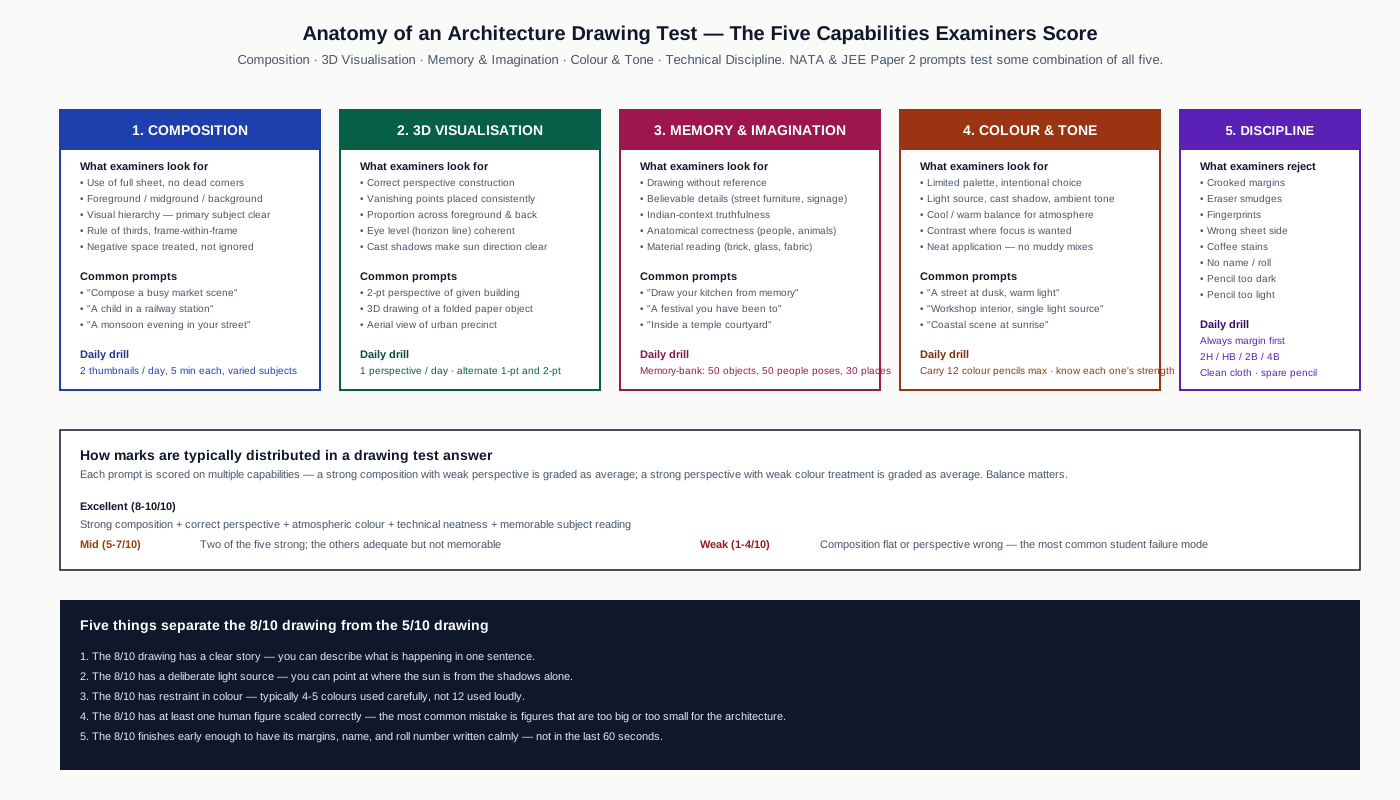
The candidate's preparation must address all five, not just the most-visible one (perspective). A candidate who can draw a perfect 2-pt perspective but fails at composition (the page reads dead) will not reach a Tier-1 score; a candidate with adequate perspective and excellent composition + colour + atmosphere will outrank the technically-perfect-but-flat candidate.
4.4 The Aptitude Test — The Five Question Families
The aptitude section across both examinations draws from five recurring question families:
| Family | Example | Skill |
|---|---|---|
| 3D Rotation / Mental Rotation | Given a 3D form, identify which of four rotated views is the same form | Spatial reasoning |
| Mirror & Reflection | Given a 2D pattern, identify the mirror image across a given axis | Pattern recognition |
| Mental Folding | Given a 2D net, identify which 3D solid it folds into | Spatial transformation |
| Sectional / Slicing | Given a 3D solid, identify the cross-section produced by a slice | Architectural drawing instinct |
| Pattern Completion | Given a sequence of patterns, identify the next | Logical reasoning |
The candidate's preparation discipline is daily drilling — 30 minutes per day, alternating across the five families — for the full Class 12 year. Candidates who cram aptitude in the final eight weeks under-perform candidates who drill steadily for twelve months.
5. The Two-Year Preparation Calendar
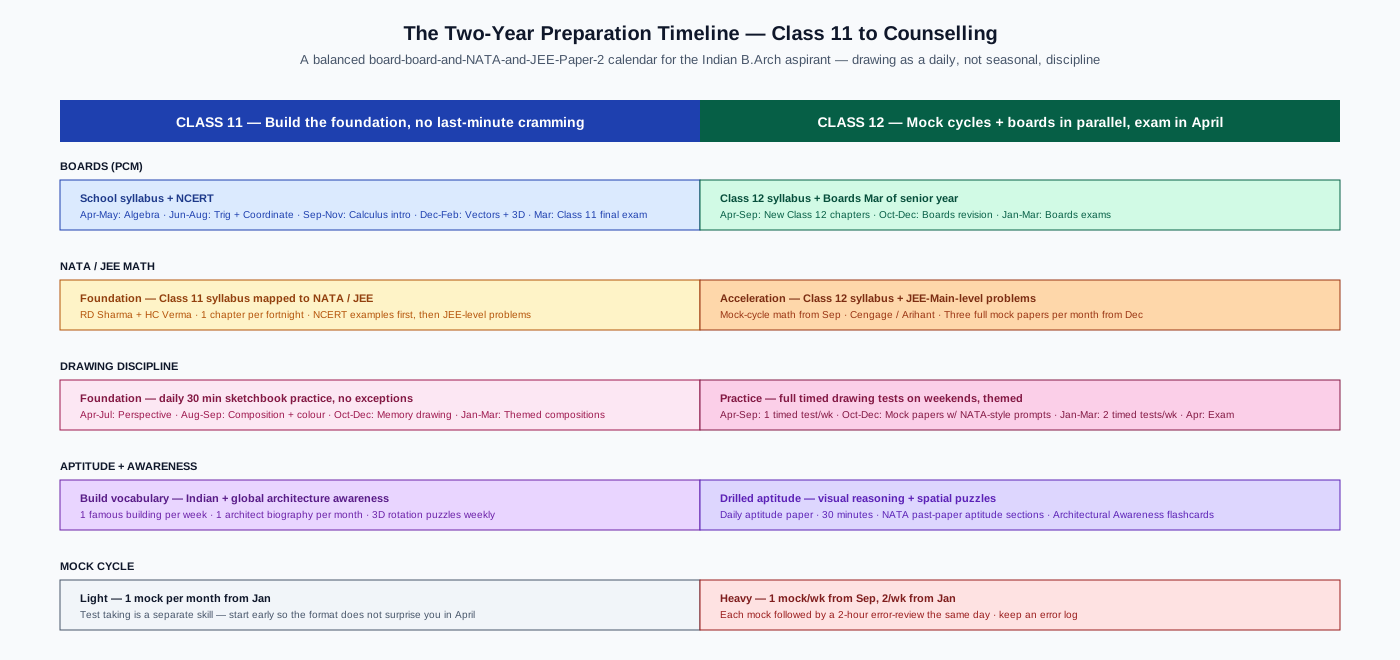
The serious B.Arch aspirant begins preparation on the first day of Class 11. The calendar below is the working framework — a balanced board-and-NATA-and-JEE-Paper-2 programme in which each capability builds steadily without crowding the others.
5.1 The Class 11 Year — Foundation, Not Cramming
Class 11 is the year for foundation-building. The candidate who treats Class 11 as a low-pressure year and defers preparation to Class 12 is the candidate who arrives in Class 12 already behind — both on board syllabus and on entrance preparation.
Boards (PCM). The Class 11 syllabus is the foundation of everything that follows. Calculus, vectors, 3D geometry, coordinate geometry — all carry forward to Class 12 and to JEE / NATA math. Mastery of Class 11 PCM is non-negotiable.
Math (entrance-level). Begin with NCERT exemplar problems for each Class 11 chapter; once NCERT is comfortable, move to RD Sharma and Cengage / Arihant for JEE-level practice. One chapter every two weeks, paced through the year.
Drawing. This is the year when daily drawing practice begins — no exceptions, no gaps, no festival breaks. Thirty minutes per day, at the same time each day, in a dedicated A4 sketchbook. The discipline matters more than the volume. A candidate who draws 30 minutes / day for 24 months will outperform a candidate who draws 4 hours / day for 6 months.
Aptitude. Begin building the vocabulary of architecture — one famous building per week (with a notebook entry on architect, year, location, key idea), one architect biography per month. Begin daily 3D-rotation puzzles using NATA past papers and aptitude books.
Mock tests. No formal mocks in Class 11. The candidate's first formal mock should be at the end of Class 11, in March, as a baseline reading.
5.2 The Class 12 Year — Acceleration
Class 12 is the year of acceleration and consolidation. The foundation built in Class 11 is now stress-tested under timed-mock conditions, and gaps surface and are closed one by one.
Boards (PCM). New Class 12 chapters from April through September; revision and board-pattern practice from October. Boards are typically in March-April of the senior year, before NATA and JEE Paper 2 sessions begin.
Math. Class 12 syllabus through September; JEE Main Paper 2 mock papers from September onwards. The candidate should be able to solve a complete JEE Paper 2 math section under exam conditions by November.
Drawing. Move from open-ended sketchbook practice to timed drawing tests — one full timed drawing test per weekend from April onwards, with the prompt sourced from a NATA past paper. Two timed tests per week from January. Each test is followed by a 30-minute self-review against the five-capability framework (composition, perspective, memory, colour, discipline).
Aptitude. Daily aptitude drilling intensifies — 45 minutes per day with rotating focus across the five families. NATA past papers from 2018-2025 form the practice corpus.
Mock tests. The mock-test cadence ramps up: one full mock per month from April; one per fortnight from August; one per week from September; two per week from January. Each mock is followed by a same-day error-review session in which every wrong answer is logged and the underlying gap identified.
5.3 The Compressed One-Year Plan
For the candidate who decides on B.Arch only in Class 12 — typically October-November — the calendar compresses. The compressed plan reduces drawing-foundation time but cannot eliminate it. The minimum drawing-practice period required to reach a Tier-2 score is roughly six months of daily 60-minute practice; the compressed plan allocates this from November through April.
| Month | Math | Drawing | Aptitude | Mocks |
|---|---|---|---|---|
| Nov | NCERT Class 11+12 | 60 min/day, basic perspective | 30 min/day, all 5 families | None |
| Dec | RD Sharma / Cengage | 60 min/day, urban scenes | 45 min/day | 1 full mock (baseline) |
| Jan | JEE Paper 2 mocks | 90 min/day, themed prompts | 45 min/day | 2 mocks/wk |
| Feb | Mock revision | 90 min/day, timed tests | 45 min/day | 2 mocks/wk |
| Mar | Board exams; revision | Maintenance only | Maintenance only | Pause for boards |
| Apr | Final revision | Resume timed tests | Resume daily drilling | NATA / JEE Paper 2 attempts begin |
The compressed plan's success rate is meaningfully lower than the two-year plan. A candidate writing the compressed plan should target a Tier-2 outcome (NATA 120-149) and treat any Tier-1 outcome as a positive surprise.
5.4 The Drop-Year Plan
A candidate who scores below their target band in the first NATA / JEE attempt has two structural options: re-attempt within the same admission cycle (using the second NATA Phase-1 attempt and JEE Paper 2's two sessions) or drop a year and re-attempt in the following admission cycle.
Be precise about what the same-cycle option actually offers in 2026, because the old "three sessions" folklore overstates it. NATA allows two attempts in Phase 1, or one in Phase 2 — never both (§3.0). If both Phase-1 attempts are spent, there is no third bite: Phase 2 is closed to anyone who appeared in Phase 1. And a Phase-2 score returns a raw score with no percentile, usable only against seats left vacant after CAP counselling — a materially weaker position than a Phase-1 score, not an equivalent one.
The re-attempt-same-cycle option is the right answer for candidates whose first-attempt score was within 15-20 points of the target band — the gap is closeable with focused 8-10 weeks of preparation.
The drop-year option is the right answer for candidates whose first-attempt score is significantly below the target band (more than 20 points away from a Tier-2 entry) and whose drawing capability is the limiting factor. A drop year invested entirely in drawing practice and aptitude drilling can lift a Tier-3 candidate to Tier-1; the drop-year cohort at Mosaic / Silica / NATA-coaching centres regularly produces strong improvements where the underlying gap was foundation-time, not innate aptitude.
The drop-year decision should not be made unilaterally — discuss with parents, current school faculty, and an independent senior architect or B.Arch graduate who can assess your portfolio fit.
6. Drawing Preparation — The Core Discipline
Drawing preparation is the single most important capability cluster for the B.Arch aspirant. It is also the capability where 60% of aspirants under-prepare. The principles below are the operational framework.
6.1 The Daily Sketchbook Discipline
A dedicated A4 spiral-bound sketchbook, used only for entrance preparation. One page per day, dated, signed. The page is the candidate's promise to themselves. The discipline is to draw something — anything — every day. A bad sketch is better than no sketch; the muscle memory and the eye develop only through daily practice.
Subject rotation across the week:
- Monday — Perspective drill. A 1-pt or 2-pt perspective of an imagined room, building, or street.
- Tuesday — Memory drawing. A scene drawn from memory — your kitchen, the bus stop, a temple courtyard.
- Wednesday — Object study. A still-life arrangement — a fruit, a vessel, a folded cloth — drawn with attention to volume, light, and shadow.
- Thursday — Urban observation. A street, market, or public space with people, furniture, signage — anatomically correct figures, scaled correctly to the architecture.
- Friday — Themed composition. A NATA-style themed prompt — "monsoon evening", "festival", "old age home courtyard". Practiced against the timer.
- Saturday — Colour study. A coloured composition — pencil colour, marker, or watercolour — focused on a limited palette and a clear light source.
- Sunday — Free choice / weak-area focus. Whichever capability the candidate scored lowest on the previous mock test.
6.2 The Five-Capability Framework
Every drawing the candidate produces is to be self-graded against the five capabilities described in §4.3:
1. Composition — full use of sheet, foreground / midground / background, visual hierarchy
2. 3D Visualisation — correct perspective, consistent eye level, scaled figures
3. Memory & Imagination — believable details, anatomical correctness, contextual truthfulness
4. Colour & Tone — limited palette, consistent light source, intentional contrast
5. Technical Discipline — clean margins, no smudges, readable name and roll number, no fingerprints
Self-grading discipline matters because the examiner grades on these five — not on the single capability the candidate is most proud of.
6.3 The Materials Kit
| Item | Specification | Note |
|---|---|---|
| Pencils | 2H, HB, 2B, 4B (graphite, branded — Faber-Castell, Staedtler, Camlin) | Sharpened to a long taper, not a stub |
| Eraser | Faber-Castell or equivalent dust-free, plus a kneadable eraser | Kneadable for highlights; never share with neighbour |
| Sharpener | Single-hole hand sharpener; carry two | A broken sharpener mid-test is the most common avoidable failure |
| Colour pencils | A 12-colour set (Faber-Castell Polychromos is the gold standard; Camel student set is acceptable) | More than 12 is more confusion; learn to mix from 12 |
| Markers | A 6-colour fine-tip set (Copic Sketch / Stabilo) for outlining | Optional; only if the candidate has practised with them |
| Watercolour pencils | 12-colour set, plus a flat brush and a small water container | Optional; only if the candidate has built sufficient practice |
| Compass & protractor | Standard set, in a case | Required for some aptitude geometric questions |
| Ruler & scale | 30 cm steel-edged ruler; small set-square | For straight margins and aptitude diagrams |
| Cleaning cloth | Two soft cotton handkerchiefs | One for hands, one for the sheet — essential discipline |
| Spare pencils | Three of each grade | Test centres do not refill |
6.4 Common Drawing-Test Mistakes That Reduce a 7/10 to a 4/10
- Margin first, every time. A drawing with no margin reads unfinished even when the drawing itself is excellent. The first 60 seconds of any drawing test go to margin-drawing — 15 mm on all four sides.
- Light pencil, then commit. A heavy pencil-pressed line cannot be cleanly erased. Begin with a 2H or HB ghost-line; commit with 2B / 4B only when the composition is settled.
- The horizon line first. In any perspective drawing, the horizon line (eye level) is the first commitment. All vanishing points sit on the horizon line. Inconsistent horizon lines are the most common perspective failure.
- Figures at consistent scale. A common student mistake is to draw the foreground figure at the right scale and then the background figures too large or too small. The scale rule: a standing figure's eye level matches the horizon line, regardless of distance from the viewer.
- Cast shadows match a single sun direction. If the sun is to the upper-left, every cast shadow falls to the lower-right. Inconsistent shadow directions are visible from across the room and are graded down severely.
- Limited colour palette. Twelve colours in the box is a menu, not a recommendation. A great drawing typically uses 4-5 colours. The candidate who uses all 12 is the candidate whose drawing reads as "trying too hard."
- Sign and date the bottom-right. The unsigned drawing reads as incomplete. Sign in pencil, in clean handwriting, in the bottom-right margin.
6.5 Recommended Practice Resources
| Resource | Author / Publisher | Best for |
|---|---|---|
| NATA & B.Arch Drawing Practice Sheets | Mosaic Publications | Themed prompt practice with examiner-graded sample answers |
| Architecture Aptitude Test | Silica Institute / TMH | NATA past-paper-style aptitude practice |
| A Visual Dictionary of Architecture | Francis D. K. Ching | Architectural awareness vocabulary — the global classic |
| Sketching from the Imagination | Various, 3DTotal Publishing | Imagination-and-memory drawing practice from concept artists |
| Drawing for Architects | Natascha Meuser | Hand-drawing technique reference |
| NATA past papers (2018-2025) | COA / Mosaic compilation | Question-pattern familiarity, timed-test material |
The candidate's home library should include at least three of the above. None of them is sufficient on its own; the combination is what builds the repertoire.
7. Aptitude & Visual Reasoning Preparation
The aptitude section is the second-largest block of marks (in JEE Paper 2 it is the largest at 200/400). A candidate cannot reach a Tier-1 score without fluent aptitude.
7.1 The Five Question Families — Detailed
3D Rotation. Given a 3D form, the candidate must identify which of four rotated views matches. The drilling resource is physical block-rotation practice — wooden cubes, isometric paper, and the rotation puzzles in NATA past papers. Daily 10-15 puzzles for the full Class 12 year is the floor.
Mirror & Reflection. Given a 2D pattern, identify the mirror image across a vertical or horizontal axis. The trap is that mirror reflection across a diagonal axis is harder than along the cardinal axes; candidates over-prepare cardinal reflections and under-prepare diagonals.
Mental Folding. Given a 2D net (dice, package, polyhedron), identify which 3D solid it folds into. Practice resource: paper-folding kits, geometry textbook nets, IIT JEE aptitude books.
Sectional Slicing. Given a 3D solid, identify the cross-section produced by a slice. This is the most directly architecture-relevant aptitude skill — the same instinct used in producing architectural sections in college. Practice resource: take a building's plan and ask yourself what does the section look like at this point?
Pattern Completion. Given a visual sequence, identify the next pattern. The traps are sequences with overlapping rules (rotation + colour + size simultaneously). Practice via R. S. Aggarwal Quantitative Aptitude visual-reasoning chapters.
7.2 The Aptitude Drill Schedule
| Day | Family | Time | Source |
|---|---|---|---|
| Mon | 3D Rotation | 30 min | NATA past papers |
| Tue | Mirror & Reflection | 30 min | Aptitude book |
| Wed | Mental Folding | 30 min | Geometry net practice |
| Thu | Sectional Slicing | 30 min | Architecture-context puzzles |
| Fri | Pattern Completion | 30 min | Quantitative Aptitude book |
| Sat | Mixed full aptitude paper (timed) | 90 min | Past paper |
| Sun | Review of Saturday's errors | 60 min | Self-graded |
7.3 Architectural Awareness — The Vocabulary
The general aptitude / awareness section tests architectural vocabulary. The candidate's discipline is to maintain a flashcard set (paper or Anki) covering:
- 50 famous global buildings — Pyramids of Giza, Parthenon, Pantheon Rome, Hagia Sophia, Notre Dame, Taj Mahal, Versailles, Sydney Opera House, Guggenheim Bilbao, Sagrada Família, Burj Khalifa, Fallingwater, Villa Savoye, Pompidou, Pantheon-style classics through 2020s landmarks
- 30 famous Indian buildings — Sanchi Stupa, Khajuraho, Brihadeeswarar Thanjavur, Konark Sun Temple, Hampi, Qutub Minar, Taj Mahal, Red Fort, Chandigarh, IIM Ahmedabad, Lotus Temple, Akshardham, IIM Bangalore, the State Capitols
- 20 architects — Le Corbusier, Frank Lloyd Wright, Mies van der Rohe, Walter Gropius, Louis Kahn (with India connection), Charles Correa, BV Doshi, Raj Rewal, Anant Raje, Geoffrey Bawa, Tadao Ando, Renzo Piano, Norman Foster, Frank Gehry, Zaha Hadid, Bjarke Ingels, Rahul Mehrotra, Bijoy Jain, Anupama Kundoo, Sonali Rastogi
- 30 materials and finishes vocabulary — RCC, brick (clay, fly-ash, AAC), terracotta, granite, marble, sandstone, limestone, kota, basalt, oxide flooring, IPS, Kadappa, jaggery-finished concrete, lime plaster, mud plaster, bamboo, timber, structural steel
- 20 environmental terms — passive cooling, courtyard, jaali, brise-soleil, double-skin, BIPV, GRIHA rating, IGBC LEED, embodied carbon, U-value, solar chimney, Trombe wall, evaporative cooling, water harvesting, grey-water, sewage-treatment plant
The flashcard set is reviewed weekly. The candidate should be able to identify any of the 100+ items in 5 seconds.
8. Mathematics Preparation
8.1 The Syllabus Map
NATA math and JEE Paper 2 math draw from the standard Class 11 + 12 PCM syllabus. The chapters that recur most heavily:
| Topic | Class 11 weight | Class 12 weight | NATA / JEE difficulty |
|---|---|---|---|
| Algebra (sequences, quadratic, complex numbers) | High | Medium | Moderate |
| Coordinate Geometry (lines, circles, parabola, ellipse, hyperbola) | High | High | Hard |
| Trigonometry | High | Medium | Moderate |
| Calculus (limits, derivatives, integrals, differential equations) | Medium | Very high | Very hard |
| Vectors & 3D Geometry | Medium | High | Hard (especially for B.Arch) |
| Probability | Medium | High | Moderate |
| Statistics | Medium | Medium | Easy |
| Sets, Relations, Functions | High | Low | Easy-Moderate |
The B.Arch aspirant should pay particular attention to 3D geometry and vectors — these are the most directly architecture-relevant chapters and the ones where the JEE Paper 2 question difficulty sits at the highest level.
8.2 NATA Math vs JEE Paper 2 Math
NATA math sits at Class 12 board difficulty — most questions are solvable using NCERT and RD Sharma practice. JEE Paper 2 math sits at JEE Main Paper 1 difficulty — Cengage / Arihant / past JEE Main papers are required. A candidate writing both must prepare at the JEE level; the NATA level becomes a subset.
8.3 Recommended Math Resources
| Resource | Level | Best for |
|---|---|---|
| NCERT Class 11 + 12 Mathematics | Foundation | First read; problem-set foundation |
| NCERT Exemplar | Foundation+ | Harder problem variants |
| RD Sharma Class 11 + 12 | Intermediate | Question-pattern coverage |
| Cengage Mathematics for JEE Main | Advanced | JEE Paper 2 difficulty |
| Arihant JEE Main / NATA | Advanced | Past-paper-style practice |
| HC Verma / DC Pandey | Cross-reference | Physics-supporting math |
| Mosaic NATA Math practice | NATA-specific | NATA past-paper-style problems |
9. Coaching — Institute or Self-Study?
9.1 The Indian B.Arch Coaching Landscape
Several specialised coaching institutes operate in the Indian B.Arch entrance market. The major names:
| Institute | Mode | Cost (typical, 2026) | Strength |
|---|---|---|---|
| Mosaic Institute of Design | Classroom + online; multi-city | ₹70K - ₹1.5L (full course) | Drawing pedagogy; large past-paper bank |
| Silica Institute | Classroom + online; multi-city | ₹60K - ₹1.4L | Aptitude drilling; mock-test discipline |
| NATA Crash / Bhanwar Rathore Design Studio | Classroom; Mumbai-led | ₹50K - ₹1.2L | Drop-year intensives; scholarship pathway |
| Aakash IIT-JEE | Classroom; large network | Varies | JEE Paper 2 math + aptitude (drawing weaker) |
| FIITJEE / Resonance | Classroom; large network | Varies | JEE Paper 2 math; drawing weaker |
| Various local institutes | Local | ₹15K - ₹50K | Variable; quality depends on individual faculty |
9.2 What to Evaluate Before Joining
The decision coach vs self-study is rarely a clean answer. The following dimensions matter:
- Drawing pedagogy quality. Visit the institute. Sit in a drawing class. If the instructor is teaching mechanically (perspective construction without atmosphere) the candidate should consider an alternative. Ask to see graded student work from the previous year — quality is visible immediately.
- Mock-test infrastructure. Does the institute offer at least 15 full-format timed mocks across the year? Do they offer same-day examiner-graded review? An institute that gives mock papers without graded review is offering practice without feedback — a half-product.
- Faculty drawing capability. Ask the senior drawing instructor to draw a 2-pt perspective from imagination, in front of the candidate. If they hesitate, the candidate has a problem.
- Outcome data. Ask for the past three years' output — number of students who joined, number who scored above NATA 140 / 120 / 100, schools where students were admitted. Reluctance to share data is a flag.
- Cost vs candidate's family budget. The full-course fees at Mosaic / Silica are non-trivial. A candidate from a tighter family budget should evaluate the online-only version of these institutes (typically 40-60% of the classroom cost) or a self-study path supplemented with selective workshop attendance.
9.3 The Self-Study Framework
For the candidate choosing self-study (cost reasons, geography reasons, or personal preference), the framework is:
| Component | Self-study source | Approximate cost |
|---|---|---|
| Drawing pedagogy | Ching books + 3DTotal Sketching from Imagination + YouTube reference videos | ₹4,000 |
| Math | NCERT + RD Sharma + Cengage | ₹3,000 |
| Aptitude | NATA past papers + R. S. Aggarwal + online aptitude books | ₹2,500 |
| Mock-test corpus | NATA past papers + Mosaic mock-test compilation + 1 paid online mock subscription | ₹3,500 |
| Awareness | A Visual Dictionary of Architecture + flashcards + weekly architectural-news consumption | ₹2,000 |
| External graded review | Two paid mock-paper graded reviews from a senior student or working architect mentor | ₹3,000 |
Total self-study cost: ~₹18,000 (versus institute cost ₹60,000-1,50,000). The self-study path requires ~25% more weekly time than the institute path because the mock-test review and feedback cycle is self-managed; it succeeds for candidates with strong self-discipline and adequate drawing-foundation interest.
The hybrid path — self-study for math and aptitude, paid drawing workshop or mentor for the drawing component — is the most common pattern among successful B.Arch aspirants without unlimited family budgets.
10. Mock-Test Discipline — The Decisive Lever
The single largest differentiator between candidates with similar foundation-time is mock-test discipline. The candidate who writes 25 full mocks under timed conditions across Class 12 will outperform the candidate who writes the same content untimed.
10.1 The Mock-Test Cadence
| Class 12 month | Mocks per period | Format |
|---|---|---|
| April-July | 1 per month | Full 3-hour timed mock |
| August-September | 1 per fortnight | Full 3-hour mock + same-day error review |
| October-December | 1 per week | Full timed mock; alternate NATA / JEE format |
| January-February | 2 per week | Full timed mocks |
| March | Pause for boards | Maintenance practice only |
| April (test month) | 2 per week up to test day | Tapered |
10.2 The Same-Day Error Review
Each mock is followed by a structured error review on the same day:
1. Score yourself honestly. Use a marking scheme where available; for drawing, use the five-capability framework.
2. Categorise every wrong answer by section (math / aptitude / drawing / awareness) and by underlying gap (concept gap / careless mistake / time pressure / unfamiliar topic).
3. Maintain an error log. A spreadsheet or notebook with date, paper, section, gap-category, the corrected answer, and the source.
4. Re-attempt the wrong questions one week later without referring to the log. If still wrong, the gap is foundational and requires concept revision.
10.3 Score Tracking
Maintain a tracking sheet:
| Date | Paper source | Math | Aptitude | Drawing | Awareness | Total | Format (NATA/JEE) | Notes |
|---|
The tracking sheet's value is in the trend — month-over-month improvement, plateau identification, weak-section identification. A candidate whose drawing scores plateau for three consecutive mocks must change the practice mix; the candidate whose math scores climb steadily can reduce math-time and reallocate to weak sections.
11. The Day-of-Test Playbook
11.1 The Three Days Before
- Three days before: Last full mock. Same time of day as the actual test.
- Two days before: Light review only. No new content. Re-read the error log.
- One day before: No academic work. Sleep early. Pack the materials kit.
11.2 The Materials Kit (Recheck)
Repeat the §6.3 materials checklist. Add:
- Admit card (printed, two copies)
- Photo ID (Aadhaar / Passport / school ID)
- Two passport-size photographs
- Water bottle (transparent only — most centres permit this)
- Light snack for the gap between sections (where permitted)
- Wristwatch (analogue — phones are not allowed)
- Hand sanitiser, tissues
11.3 The Time Allocation
| Section | Time budget | Discipline |
|---|---|---|
| Drawing (paper) | 80-90 min | First 5 min: read prompt twice. Next 5 min: thumbnail composition sketches. Next 60 min: drawing. Last 10 min: shading, finishing, signature, cleanup. |
| Math (CBT) | 40-50 min | Easy questions first, hard questions last. Mark uncertain ones for review; never spend more than 90 sec on a single question. |
| Aptitude (CBT) | 40-50 min | 3D rotation and pattern completion first (highest accuracy under time pressure); folding and slicing last. |
| Awareness (CBT) | 15-20 min | Read all options. If unsure, eliminate two and pick the most-likely; do not leave blank if there is no negative marking — verify the bulletin. |
11.4 If You Blank Out Mid-Test
- Breathe. Three deep breaths. Look up from the paper. Look down again. The blank lasts 30 seconds, not 30 minutes.
- Move to a different section. If drawing blanks, switch to aptitude. If aptitude blanks, switch to math. The brain re-engages on a different task.
- Do not panic about a single section. A weak drawing section can be compensated by a strong aptitude section, and vice versa. The score is the aggregate, not any single section.
- Finish the easy questions first. A guaranteed 60 marks beats a hoped-for 80 marks.
12. Cutoffs & Score Interpretation
First, a correction that overrides a great deal of what is written elsewhere about NATA, including earlier versions of this guide.
There is no NATA qualifying cutoff. Brochure V2.0 §10.1 states it directly: "No minimum Raw Score is prescribed for qualifying in NATA 2026." Any non-zero percentile is a qualifying score. You cannot "fail" NATA by missing a threshold, because no threshold exists. The widely-quoted "NATA cutoff is 70/200" is folklore — and the sources repeating it do not even agree with each other (70, 60 and 75 all circulate). None of them traces to a COA document.
What does exist is an admission cutoff: the score at which a given college, in a given category and quota, happened to stop admitting in a given year. That is an outcome of demand, not a rule of the exam, and it is set by State and institutional authorities — never by COA (§2.0).
Two further cautions before reading the bands below. Percentile, not raw score, is often the operative currency — admission authorities may rank on either (§3.0), and percentile is only computed after all Phase-1 sessions close, against the entire cohort. A raw score therefore does not tell you where you stand until the window shuts. And Phase-2 candidates receive no percentile at all — only a raw score, usable only against seats left vacant after CAP.
With that framing, the bands below are indicative targets only — historically observed, not published, and varying year-on-year, by category, by home-state quota, and by seat changes. Treat them as a planning aid, never as a pass mark.
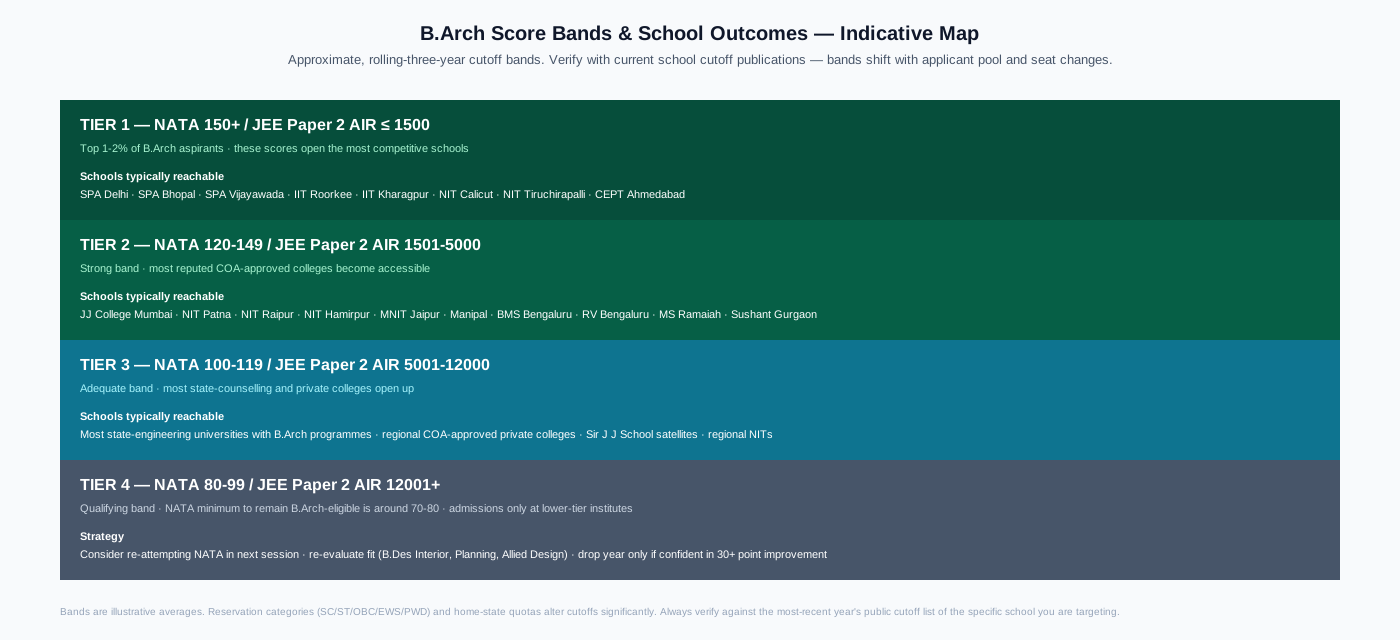
12.1 What is a "Good" NATA Score in 2026
| Score band | Tier label | Reachable schools (typical) |
|---|---|---|
| 150-200 | Tier 1 | SPA Delhi · SPA Bhopal · SPA Vijayawada · CEPT · NIT Calicut · NIT Tiruchirapalli |
| 120-149 | Tier 2 | JJ Mumbai · most major NITs · MNIT Jaipur · BMS Bengaluru · RV Bengaluru · Manipal |
| 100-119 | Tier 3 | Most state-engineering universities · regional COA-approved private colleges |
| 80-99 | Tier 4 | Lower-tier private colleges; consider re-attempt |
| <80 | Narrow options | Still a qualifying score if the percentile is non-zero; re-attempt or consider allied design programmes |
12.2 What is a "Good" JEE Paper 2 Rank
| Rank band (CRL) | Reachable schools (typical) |
|---|---|
| AIR ≤ 500 | IIT Roorkee · IIT Kharagpur (with AAT) · top NIT B.Arch programmes |
| AIR 501-1500 | NIT Calicut · NIT Tiruchirapalli · MNIT Jaipur · NIT Hamirpur |
| AIR 1501-5000 | NIT Patna · NIT Raipur · IIIT Gwalior B.Arch · GFTIs |
| AIR 5001-12000 | Lower-tier NITs · CSAB rounds · home-state quota at marginal NITs |
| AIR > 12000 | State counselling alternatives via NATA |
12.3 Reading the Cutoffs Correctly
The candidate should always check three things about a published cutoff:
1. The year. Cutoffs can shift 5-10% year-on-year.
2. The category. The OBC-NCL cutoff is meaningfully below the General cutoff.
3. The home-state status. KCET / MHTCET cutoffs for home-state candidates run 10-15% below out-of-state candidates at the same school.
A cutoff is a band, not a number. Plan against the band's middle, not its low end.
13. Counselling — JoSAA, CSAB, State, Institute
The examination is only half the admission process. Counselling is the second half — the candidate must navigate one or more counselling routes to convert a score into an admission. Mistakes in counselling regularly cost candidates schools they could have entered.
13.1 JoSAA (Joint Seat Allocation Authority)
JoSAA is the central counselling body for IITs, NITs, IIITs, and GFTIs — for both engineering and architecture. Six rounds of seat allocation typically occur, with a candidate's chosen preference order determining the outcome.
Discipline at JoSAA:
- Choice filling is consequential. Fill at least 20-30 choices in priority order. Do not skip lower-priority schools you would still attend; a half-filled choice list closes off positive surprises.
- Float / Slide / Freeze in subsequent rounds. Float keeps you eligible to upgrade to a higher-preference seat in the next round; Slide keeps you in the current institution but moves you to a higher-preference branch; Freeze locks the current seat.
- Reporting deadlines are strict. A candidate who delays reporting by even one day forfeits the seat, regardless of academic standing.
13.2 CSAB (Central Seat Allocation Board)
CSAB conducts supplementary rounds for unfilled NIT / IIIT / GFTI seats after JoSAA closes. Candidates who narrowly missed JoSAA rounds get a second chance through CSAB. A candidate at the borderline of NIT cutoffs should monitor CSAB even after accepting a non-NIT seat — late upgrades are common.
13.3 AAT (Architecture Aptitude Test) for IIT B.Arch
The IITs (IIT Roorkee, IIT Kharagpur — the two with B.Arch) require an additional Architecture Aptitude Test after JEE Advanced. AAT is conducted on a single day shortly after JEE Advanced results; it is a 3-hour drawing-and-design test.
The AAT is qualifying — the candidate either passes or fails. The candidate's JEE Advanced rank is the basis for ranking; AAT only confirms eligibility for B.Arch within IIT.
13.4 State Counselling
Each state with a state-counselling cell operates an independent counselling round using NATA scores:
| State | Cell | Notable schools (B.Arch) |
|---|---|---|
| Karnataka | KEA / COMEDK | RV · BMS · MS Ramaiah · Acharya · KSSEM |
| Maharashtra | MHTCET cell | JJ Mumbai (state quota) · Sir J J · MIT Pune (state quota) |
| Tamil Nadu | TNEA / Anna University | Anna · MIT Chennai · SAP |
| Telangana / AP | TS / AP EAMCET cell | SPA Vijayawada (state quota) · regional COA colleges |
| West Bengal | WBJEEB | IIEST Shibpur · Jadavpur (where applicable) · regional COA |
State counselling deadlines and choice-filling discipline mirror JoSAA's. The candidate must register with the relevant state cell well in advance — registration deadlines often pre-date results.
13.5 Institute-Direct Counselling
CEPT, NID, JJ Mumbai, MIT-ADT, RV, BMS, Manipal, Sushant, Pearl — these institutions run their own counselling rounds, separate from state and JoSAA. Each has its own application form, fees, and deadline. The candidate targeting any of these must research their counselling calendar in October-November of Class 12 — well before the entrance examination.
14. Beyond NATA & JEE — The Institute-Specific Tests
14.1 CEPT University, Ahmedabad
CEPT requires NATA but conducts its own Studio Test — an additional drawing-and-design examination. The Studio Test is the most CEPT-specific filter; candidates who score adequately on NATA but underperform the Studio Test are not admitted. The Studio Test rewards original design thinking and unconventional composition more than NATA's structured prompts.
14.2 NID (National Institute of Design) — DAT
NID conducts the Design Aptitude Test (DAT) for B.Des programmes, including B.Des Interior Design. DAT-Mains (Studio Test) tests visualisation, observation, and presentation. The B.Des Interior route is not a B.Arch path — the graduate is an interior designer, not a registered architect — but it is the strongest design education in India for the candidate whose interest lies in interior design rather than architecture.
14.3 J J School of Art, Mumbai
JJ College admits via NATA + portfolio. The JJ portfolio review is competitive — candidates submit 8-12 pages of original work; admission is contested based on portfolio strength alongside NATA score. This is one of the few B.Arch schools in India where a strong portfolio can compensate for a moderate NATA score.
14.4 MIT-ADT University, Pune
MIT-ADT operates its own entrance test (MIT-ADTU CET) for B.Arch, accepting either NATA or its own test. The institution has a strong industry-collaboration track record but is regionally weighted.
14.5 Other Institute-Specific Routes
| Institution | Test | Admission notes |
|---|---|---|
| Pearl Academy (Delhi/Mumbai/Jaipur/Bengaluru) | Pearl GAT | Design-led admission, B.Des Interior emphasis |
| Symbiosis (Pune) | SET-Design | Multi-discipline design school |
| Manipal | NATA + interview | Strong design pedagogy |
| Sushant University (Gurgaon) | NATA + portfolio | Industry-collaboration emphasis |
| RV Bengaluru / BMS Bengaluru | NATA + KEA counselling | State-counselling Karnataka |
The candidate's discipline is to research the institute-specific routes by November of Class 12 — not later. A candidate who learns about CEPT's Studio Test in February of the senior year has missed six months of preparation time.
15. The Decision Tree After Results
15.1 Scenario 1 — Strong Score, Multiple Offers
The candidate with a Tier-1 / Tier-2 score will receive multiple admission offers across JoSAA, state counselling, and institute-direct routes. The decision is between:
- Reputation — IIT / NIT / SPA / CEPT
- Geographic fit — home city or distant
- Pedagogy fit — design-led (CEPT, JJ, NID-adjacent) vs technical-led (NIT, IIT)
- Cost — central institutions are dramatically cheaper than private institutions
- Network — alumni density in the target city for future practice
The discipline is to visit the campus before accepting where geography permits. A campus visit reveals more than the brochure does. The Architecture Schools Shortlist 2026 guide covers school-by-school comparisons in detail.
15.2 Scenario 2 — Borderline Score, One Offer
The candidate with a Tier-3 score who receives one admission offer at a regional COA-approved college faces a harder decision. The right answer depends on the specific college:
- A COA-approved college with adequate faculty and reasonable infrastructure is a fine starting point. Five years from now, the candidate's portfolio matters more than the school's brand.
- A COA-approved-but-marginal college (faculty turnover, infrastructure issues, recognition under review) is a flag. The candidate should re-evaluate against the drop-year + re-attempt path.
15.3 Scenario 3 — Score Below Every Reachable Admission Cutoff
To be clear about what this scenario is and is not: the candidate here has qualified NATA — a non-zero percentile is all that qualification requires (§10.1) — but their score is below the level at which any college they can reach actually stopped admitting. That is a placement problem, not an exam failure, and the distinction matters for what you do next. Three structured options:
- Drop-year re-attempt. Strong recommendation if the candidate's drawing and aptitude are improvable; success rate at established coaching institutes is 60-70% for candidates with 30+ point improvement targets.
- Allied design programme. B.Des Interior Design (NID, Pearl, Symbiosis, NIFT), B.Planning (SPA Delhi, SPA Bhopal), B.Arch through state engineering university with weaker recognition. The B.Des Interior path is the most coherent allied option and produces strong career outcomes for the candidate whose interests align.
- Reapply with portfolio. JJ Mumbai, Manipal, Sushant — schools where portfolio strength can compensate for a weak score. The candidate must invest 6-9 months in building a portfolio of original work.
The drop-year decision is consequential and must be made with parental and mentor input. The Career Pathways After B.Arch guide covers the full alternative-paths framework.
16. Common Mistakes That Kill Otherwise-Good Aspirants
- Underestimating drawing. Candidates with strong PCM marks often assume drawing is "easy" — a single weekend's practice will be enough. The drawing test is the highest-weight section in both examinations and rewards months of daily practice. A perspectival error or compositional flatness on the day costs 20-30 marks.
- Overcommitting to coaching. Coaching is a supplement, not a replacement, for daily self-discipline. Candidates who attend coaching but skip the daily sketchbook practice underperform candidates who self-study with daily discipline.
- Skipping mocks before December. The candidate who writes their first full mock in January has missed 9 months of timed-test conditioning. The first mock should be in March of Class 11 (for two-year prep) or November of Class 12 (for compressed prep) — never later.
- Choosing one examination only. Writing only NATA closes off IIT / NIT routes; writing only JEE Paper 2 closes off the wider COA-approved-college network. Most successful candidates write both.
- Ignoring boards. A candidate with NATA 160 but Class 12 PCM 47% is ineligible for most central institutions. Board marks are not optional; they are a parallel admission gate.
- Late research on counselling. State counselling deadlines and JoSAA rounds operate on tight timelines that pre-date entrance results in some cases. The candidate who learns about a counselling deadline a week before the deadline is the candidate who misses an admission.
- Under-researching the school. Candidates who join a B.Arch programme without verifying its current COA recognition status sometimes discover, in Year 4 or Year 5, that the recognition has lapsed. This forecloses COA registration on graduation. Verify the COA list before accepting any offer.
- Burnout from over-preparation. A candidate practising drawing 6 hours a day from October produces worse drawings in April than a candidate practising 90 minutes a day for 18 months. Sustainability of preparation matters more than peak intensity.
17. Twelve-Test Self-Diagnostic for the Class 11 Aspirant
Use this diagnostic at the start of Class 11 and again at the end of Class 11 to assess preparation maturity:
1. Daily sketchbook. Have I drawn every day for the past 30 days?
2. Two-point perspective. Can I draw a 2-pt perspective of an imagined building from memory in under 10 minutes?
3. Memory drawing. Can I draw my kitchen or my street from memory with believable proportions and figures?
4. Class 11 PCM. Am I tracking with the school syllabus and scoring above 70% on internal exams?
5. NATA past papers. Have I attempted at least three NATA past papers (any year, any section) under timed conditions?
6. Aptitude vocabulary. Can I name 30 famous global buildings and 20 famous Indian buildings without prompting?
7. Math foundation. Have I solved the Class 11 NCERT exemplar problems for at least three chapters?
8. Mock-test discipline. Do I have a tracking sheet of practice scores?
9. School identification. Have I researched at least 10 specific schools I would accept admission at?
10. Counselling literacy. Do I know the difference between JoSAA, state counselling, and institute-direct counselling?
11. Time management. Am I balancing boards, NATA / JEE preparation, and rest, or is one of the three squeezed?
12. Portfolio start. Have I begun a digital archive of my own drawings, photographs, and creative work?
A candidate scoring "yes" on 9+ of the 12 at the start of Class 12 is well-positioned for a Tier-1 / Tier-2 outcome. A candidate scoring "yes" on 6-8 is on the Tier-2 / Tier-3 trajectory. A candidate scoring below 6 should re-evaluate the preparation programme with a senior mentor.
18. References and Further Reading
Statutory and Regulatory References
- Architects Act 1972, Government of India. The statutory framework for architectural education and registration in India. (§29, §37)
- Council of Architecture (COA) — Information Bulletin (current year). The authoritative reference for NATA syllabus, attempts, eligibility, and validity. Available at coa.gov.in
- National Testing Agency (NTA) — JEE Main Information Brochure (current year). Authoritative reference for JEE Paper 2. Available at jeemain.nta.nic.in
- JoSAA Counselling Information (current year). josaa.nic.in
Drawing Pedagogy References (Global Classics)
- Ching, F. D. K. (2014). Architecture: Form, Space, and Order. Wiley. — Foundational architectural representation reference.
- Ching, F. D. K. (2003). A Visual Dictionary of Architecture. Wiley. — Architectural awareness vocabulary.
- Meuser, N. (2014). Drawing for Architects. DOM Publishers. — Hand-drawing technique reference.
- 3DTotal Publishing (multiple). Sketching from the Imagination series. — Imagination and memory drawing.
- Pallasmaa, J. (2009). The Thinking Hand. Wiley. — On drawing as a cognitive instrument.
NATA / JEE Paper 2 Preparation References (Indian)
- Mosaic Institute of Design — Practice Sheets and Mock Papers (Mumbai/multi-city). The most-comprehensive NATA-specific drawing practice corpus.
- Silica Institute — NATA & B.Arch Aptitude Workbook. Aptitude drilling and visual reasoning.
- Bhanwar Rathore Design Studio — NATA Crash & Drop Year Programmes. Drawing pedagogy at a focused intensity.
- TMH (Tata McGraw-Hill) — NATA Aptitude Test compilation. Past-paper-style problem bank.
Mathematics References
- NCERT Mathematics Class 11 + 12. The starting point for both NATA and JEE Paper 2 math.
- NCERT Exemplar Problems Class 11 + 12. Harder NCERT-aligned variants.
- Sharma, R. D. (2024 ed). Mathematics for Class 11 / Class 12. Dhanpat Rai. — Question-pattern coverage.
- Cengage Mathematics for JEE Main. JEE-difficulty coverage.
Indian Architecture Awareness References
- Mehrotra, R. (2011). Architecture in India since 1990. Pictor Publishing. — The most-cited contemporary Indian architecture survey.
- Correa, C. (2010). A Place in the Shade. Hatje Cantz. — Selected writings of India's most influential post-Independence architect.
- Vastushilpa Foundation (2018). Balkrishna Doshi: Architecture for the People. (Pritzker monograph).
- Studio Matrx — Indian Architecture Timeline — visual timeline reference.
Peer-Reviewed Academic References — Architecture Education
- Salama, A. M. (2016). Spatial Design Education: New Directions for Pedagogy in Architecture and Beyond. Routledge.
- Schön, D. A. (1983). The Reflective Practitioner. Basic Books. — On design thinking and pedagogy.
- Cuff, D. (1991). Architecture: The Story of Practice. MIT Press. — Sociology of architectural careers.
- Goldschmidt, G. (2014). Linkography: Unfolding the Design Process. MIT Press. — On the cognitive role of sketching.
Companion Studio Matrx Guides
- Architectural Drawing & Representation Fundamentals — Module 1 of the Student Foundations Track; the next reference once admitted.
- Building Your Architecture Portfolio — for portfolio-led admission tracks (JJ, Manipal, Sushant).
- The Software Stack — A Working Learning Path — software stack you will encounter in Year 1.
- Career Pathways After B.Arch — the long-horizon framework for the post-graduate decision.
- Student Resources Hub — software, templates, reading list, timeline, glossary.
Author's Note: The B.Arch entrance is one of the more humane Indian professional examinations. It is hard, but it rewards consistent practice over crammed preparation. It is gated, but the gate is a drawing examination — a kind of test that rewards the student who has been observing the world rather than the student who has been memorising it. If you have read this guide carefully, you have already done the most important thing — you have understood that the entrance examines five capabilities, not one, and that the daily sketchbook is non-negotiable. The examination is not your enemy; it is the discipline that prepares you for five years of studio life. Take it that way.
Disclaimer: NATA syllabus, attempt limits, and validity periods are revised periodically by the Council of Architecture; JEE Main Paper 2 structure is revised periodically by the National Testing Agency. Cutoff bands and counselling deadlines change year-on-year. Verify all section weights, eligibility thresholds, and counselling calendars against the current-year information bulletins published on the COA, NTA, and JoSAA websites at the time of application. This guide is for informational and educational purposes only; Studio Matrx, its authors, and contributors accept no liability for outcomes based on it.
Export this guide
Related Guides — Deep-dive reading
Indian Architecture Schools — A Working Shortlist
The 2026 Reference for B.Arch Aspirants — COA-Approved Institutions, Tier Map, Cost-of-Attendance Ranges, Pedagogy Profiles, Faculty Strengths, Geographic Distribution, Application Deadlines, and the Decision Framework for Choosing the School That Fits You
Student FoundationsB.Des Interior Design — The Student Track
The 2026 Reference for the Indian B.Des Interior Aspirant — How It Differs from B.Arch, the Top Schools (NID · Pearl · Symbiosis · NIFT · Sushant), the Four-Year Curriculum, the Software Stack, FF&E and Materials Vocabulary, Studio Discipline, Portfolio Building, Internship Pathways, Career Trajectories, and the Long-Horizon Practice Map
Student FoundationsArchitectural Drawing & Representation Fundamentals
Module 1 of the Student Foundations Track — Orthographic Projection, Axonometric, Isometric, Perspective, BIS Line-Weight Standards, Material Hatching Conventions, the Sketchbook Discipline, and the Hand-to-Software Translation for Indian B.Arch and B.Des Students
Student FoundationsRelated Tools — Try Free
Brise-Soleil Visualizer
Interactive horizontal-louvre cut-off angle calculator — sun altitude, louvre depth, and spacing inputs with a live shadow preview. Computes θ = arctan(spacing/depth) for façade shading, ECBC envelope compliance, hospital daylight design, and tropical sun-control detailing.
Sun Shading ToolCross-Ventilation Analyzer
Estimate airflow and air changes per hour (ACH) from room size, window areas, layout, and local wind — with NBC 2016 Part 8 compliance check.
Ventilation CalculatorHome Building & Interior Cost Calculator — 20 Cities
Construction + interior costs for 20 Indian cities across kitchen, wardrobes, flooring, painting, ceiling.
Cost Calculator