
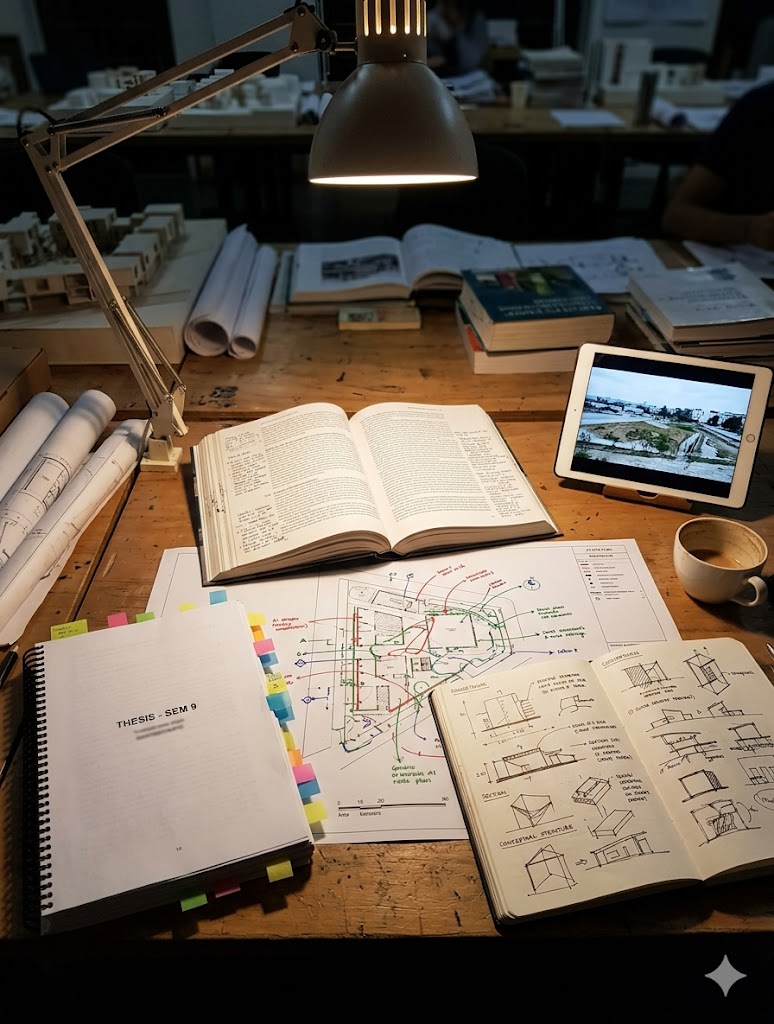
Thesis Methodology — Research, Programming, Site Selection
Module 6 of the Student Foundations Track — Topic Selection Framework, Primary Research Methods, Programme Development, Site Selection Criteria, the Thesis Document Structure, the Twelve-Month Thesis Calendar, and the Common Pitfalls of the B.Arch Final-Year Thesis in Indian Schools
The B.Arch thesis is the largest single project of your architectural education. It is also, for most students, the first project they undertake without a faculty-issued brief — the first time they choose what to design, where, for whom, and why. The result, predictably, is highly variable: some thesis projects are the strongest piece of work in a graduating portfolio (often the cover project); others are sprawling, theoretical, under-developed proposals that dilute an otherwise strong portfolio.
The difference between the strong and weak thesis is methodology, not talent. Strong thesis projects share a methodology: a deliberately-chosen topic, a defensible research base, a real (not invented) site, a programme grounded in evidence, and a 12-month calendar that converts research into design. Weak thesis projects skip one or more of these. Module 6 is the working methodology reference for the B.Arch / M.Arch thesis in India.
The orientation is towards the Indian B.Arch student in Sem 9-10 (final two semesters) — the standard thesis window in most Indian institutions — with reference to the M.Arch one-year thesis where applicable. The treatment is operational: topic selection, research methods, programme development, site selection, document structure, the 12-month calendar, and a 12-test diagnostic.
"The thesis is not the place to demonstrate everything you know. It is the place to demonstrate that you know how to ask one architectural question deeply, research it rigorously, and propose a building that answers it." — Thesis coordinator, IIT Roorkee, 2026
1. Topic Selection — The Three-Filter Framework
The most consequential thesis decision is the topic. The wrong topic produces a year of frustration; the right topic produces a year of accelerated learning. The three-filter framework below is what produces topic decisions you will not regret in March of your final semester.
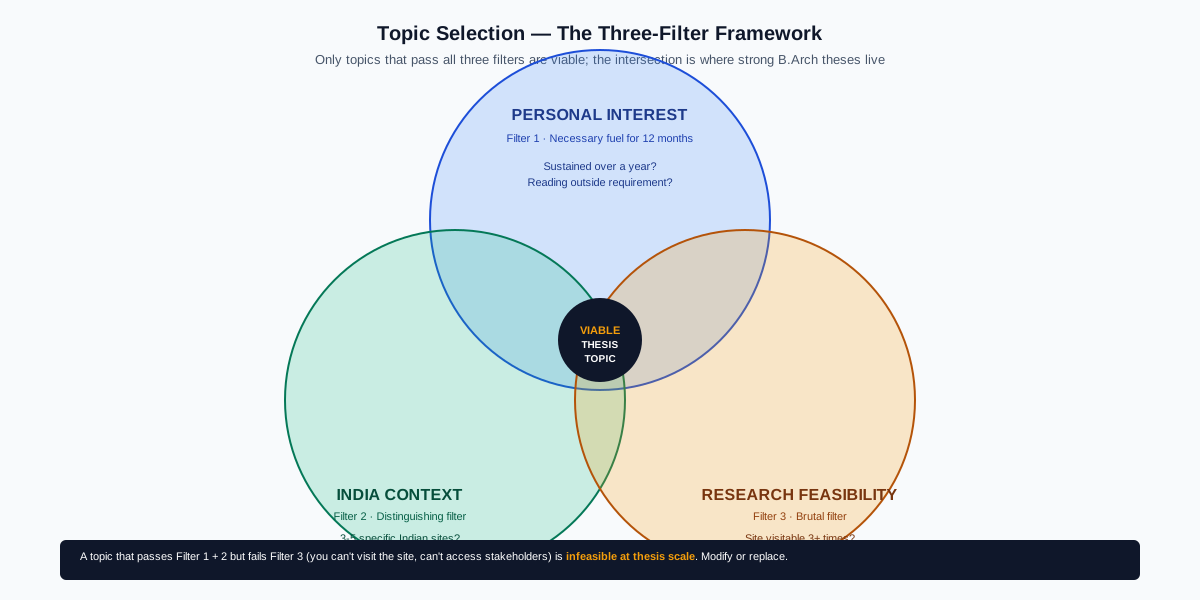
Filter 1 — Personal Interest (Necessary but not Sufficient)
The thesis is twelve months. You will spend ~1,500 hours on it. Genuine sustained interest is the only fuel that gets you to submission. The test:
- Can you sketch your topic at 11 PM on a Tuesday for 30 minutes without checking your phone?
- Are you reading about the topic outside the thesis requirement?
- Would you continue the project after thesis if no one was grading it?
If two of three are "yes," the interest is genuine. If less, the topic is wrong — even if your supervisor approves it.
Filter 2 — India Context (The Distinguishing Filter)
A thesis on "sustainable housing" is a generic topic that has been done thousands of times. A thesis on "flood-resilient self-built housing in Brahmaputra char-lands of Assam" is specific, India-contextual, and immediately distinct. The Indian-context filter is what differentiates a thesis from a generic-globalism design exercise.
The test:
- Can you name 3-5 specific Indian sites / regions / contexts where the topic has direct relevance?
- Is there a regulatory framework (RERA, NBC, IS code, state-specific bylaws) that the topic engages with?
- Can you cite Indian-context literature (CEPT publications, IIA Journal, COA reports, Indian-architect monographs) on the topic?
If yes to all three, the topic is genuinely India-rooted. If no, the topic is borrowed and likely thin.
Filter 3 — Research Feasibility (The Brutal Filter)
You can be passionate about a topic and have it be India-contextual and still be unable to research it adequately in 12 months. The feasibility filter:
- Can you access the primary site for at least 3 visits during thesis?
- Can you access primary stakeholders (residents, users, officials) for interviews?
- Can you find sufficient secondary literature (academic + grey) to ground the work?
- Are there case studies (built, comparable projects) you can study?
- Is the budget of any travel / data collection within your means?
If you cannot answer "yes" to 4 of 5, the topic is infeasible at thesis scale and should be modified or replaced.
Topic Patterns That Work in Indian B.Arch (2026)
| Pattern | Example |
|---|---|
| Vernacular re-interpretation | Modern courtyard housing for Bhuj using earth-and-stone vernacular |
| Climate-responsive prototype | Passive-cooled school for Rajasthan desert climate |
| Heritage adaptive re-use | Repurposing colonial-era railway station for civic-cultural use |
| Marginalised-community programme | Transitional housing for Mumbai pavement-dweller communities |
| Disaster-resilient typology | Cyclone-shelter community centre for Odisha coast |
| Indigenous-knowledge integration | Traditional Naga morung as programmatic generator for community space |
| Public-realm intervention | Reclaiming Chennai marina as a productive public-and-ecological asset |
| Specialised typology | Hospice + palliative-care facility for Tier-2 city (under-served typology in India) |
| Computational / parametric | Climate-responsive façade system for institutional building |
| Theoretical-practical | The thinking-architect's manifesto built into a small institutional building |
Topic Patterns That Often Fail
| Pattern | Why it fails |
|---|---|
| Smart city | Too broad; under-defined; political weight overwhelms architectural specificity |
| Sustainable city | Same problem; requires urban-planning thesis, not B.Arch |
| Mixed-use development | Generic; under-distinguished from any commercial project |
| Design language inspired by [name] | Imitative; does not advance student's own thinking |
| Future of architecture in [year] | Speculative without research base |
| Hospital / school in major city | Has been done thousands of times; needs a specific angle |
The strongest thesis topics combine one specific question with one specific site with one specific user community. The weakest thesis topics combine many topics with generic site with unspecified user.
2. Primary Research Methods
Every thesis rests on a research base. The methods below are the working set; thesis projects typically deploy 3-4 in combination.
Method 1 — Site Ethnography
Direct observation and engagement with the site over multiple visits. The discipline:
- Minimum 3 site visits across the year (early, mid, late thesis)
- Photographs at consistent times of day / season for documentation
- Maps annotated with observation
- 2-5 stakeholder interviews — residents, neighbours, officials, users
- Field notes with date, time, weather, observed activity
Method 2 — Climate and Environmental Analysis
Site-specific environmental data:
- Temperature and humidity (CPCB data; or on-site measurement with Hobo logger)
- Sun-path analysis (Andrew Marsh's free climate consultant tool, or Ladybug for Grasshopper)
- Wind rose (Indian Meteorological Department + on-site)
- Rainfall patterns (IMD data)
- Solar radiation
- Topography + vegetation surveys
Method 3 — Archive and Literature Research
| Source | Use |
|---|---|
| National Archives of India | Historical site records, colonial-era documents |
| State archaeology departments | Heritage and conservation sites |
| Census of India + NFHS | Demographic and socio-economic data |
| Municipal records | Bylaws, master plans, FAR / setback frameworks |
| CoA / IIA / CEPT publications | Profession-specific literature |
| Academic journals (JID, JAE, ITPI Journal, etc.) | Peer-reviewed architectural research |
| Indian-architect monographs | Doshi, Correa, Mehrotra, Bawa (Sri Lanka), Studio Mumbai, etc. |
Method 4 — Case-Study Analysis
Detailed analysis of 3-6 built precedents, drawing on Module 7 (Case-Study Analysis). Mix:
- 1-2 international precedents (canonical for the typology)
- 1-2 Indian precedents (closest contextual fit)
- 1-2 challenging or alternative precedents (to widen your design space)
Method 5 — Stakeholder Interviews
| Interview type | Who | Use |
|---|---|---|
| Semi-structured user interviews | 5-10 prospective users / community members | Understand needs, conflicts, aspirations |
| Expert interviews | 2-3 specialists (climate, programme, regulatory) | Technical guidance |
| Practitioner interviews | 1-2 Indian architects who have done similar work | Methodological + design feedback |
The student's discipline: plan research methods at thesis-proposal stage. By Sem 9 mid-term, you should have identified the methods and started executing. The student who waits until Sem 10 to start primary research has too little time to produce a defensible research base.
3. Programme Development
The programme is the list of spaces (with areas) that the building must accommodate, derived from the research. A weak thesis has an invented programme; a strong thesis has a researched programme.
Programme Sources
| Source | Approach |
|---|---|
| Stakeholder interviews | Direct: "what spaces do you need? for what activities?" |
| Comparable case studies | Programme analysis of precedents, with adjustment for your context |
| Statutory / regulatory | Mandatory spaces (per RPwD Act 2016 for accessibility, per state hospital bye-laws for healthcare, etc.) |
| Climate / environmental | Spaces driven by climate response (chajja, courtyard, double-height) |
| Cultural / contextual | Spaces specific to the Indian context (puja room, courtyard, semi-public verandah) |
Programme Document Structure
| Element | Detail |
|---|---|
| Total area | Built-up area target ± 15% |
| Space list | Each space with name, area, capacity, activity description |
| Adjacency matrix | Which spaces relate to which (visually, physically, functionally) |
| Sectional logic | Which spaces are at which level; double-heights; mezzanines |
| Service provisions | MEP, plumbing, accessibility, fire egress |
| Phasing | If the project is phased, when each phase comes online |
The programme should be specific enough that another architect could design from it but not so specific that it determines the architecture. A balance between precise (areas, adjacencies) and open (form, materiality, expression).
4. Site Selection — The Five-Criterion Rubric
The site is half the thesis. A thesis on a generic plot in nowhere produces generic architecture. A thesis on a site with specific characteristics produces specific architecture.
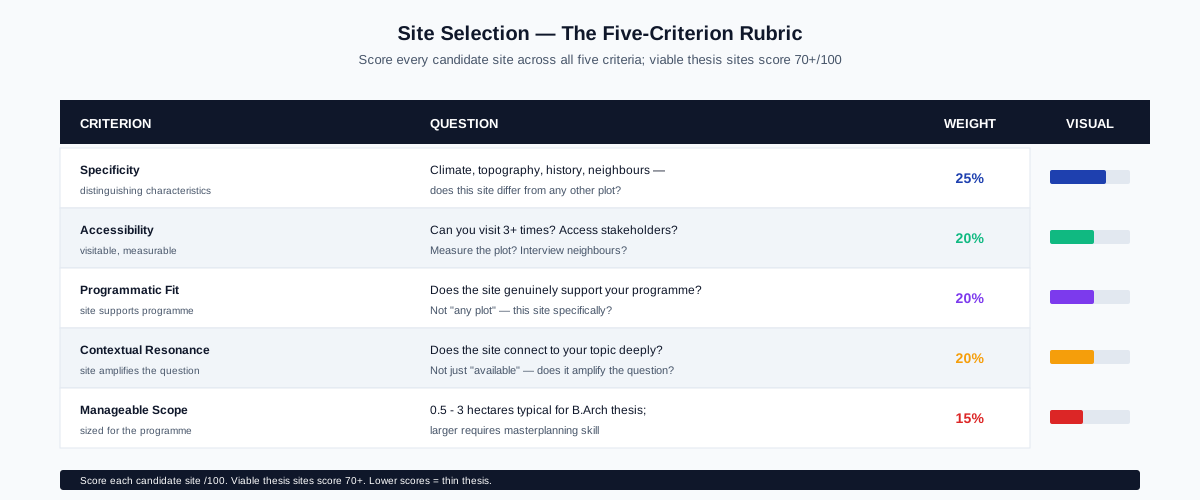
| Criterion | Question | Weight |
|---|---|---|
| Specificity | Does the site have characteristics that distinguish it from any other plot? (climate, topography, history, neighbours) | 25% |
| Accessibility | Can you visit it 3+ times? Can you access stakeholders? Can you measure it? | 20% |
| Programmatic fit | Does the site genuinely support your programme? (Not "any plot" — this site specifically) | 20% |
| Contextual resonance | Does the site connect to your topic at a deeper level? (Not just "available land" — does it amplify the question?) | 20% |
| Manageable scope | Is the plot sized for the programme? (Most thesis sites are 0.5-3 hectares; larger requires masterplanning skill) | 15% |
The site must score 70+/100 across all five criteria to be a viable thesis site. Lower scores produce thin thesis projects.
Real vs Hypothetical Sites
| Approach | When to use |
|---|---|
| Real site (preferred) | Always preferred. You can visit, measure, photograph, talk to neighbours. The thesis becomes a real proposition. |
| Hypothetical site | Acceptable when: (a) the topic is typological and not site-specific; (b) the real site is inaccessible (e.g., conflict zone); (c) the site is intentionally generic to test programmatic ideas. |
Even a hypothetical site should be based on a real reference site — its dimensions, climate, and context should match a real place even if the specific plot is invented.
5. The Thesis Document Structure
The B.Arch thesis document is, increasingly, a book in addition to drawings and a model. Most Indian institutions in 2026 require a thesis report of 60-150 pages alongside the design submission.
| Chapter | Content | Length |
|---|---|---|
| Introduction | Topic, question, scope, methodology | 6-10 pages |
| Literature review | What's been done; gaps; positioning | 10-20 pages |
| Research findings | Site ethnography, climate analysis, interviews, case studies | 20-40 pages |
| Programme | Areas, adjacencies, derivations | 6-12 pages |
| Design narrative | Concept evolution, design moves, iterations | 10-25 pages |
| Drawings (referenced) | Plans, sections, elevations, axonometric, details — typically as foldout / appendix | 15-40 pages or separate volume |
| Conclusion | What was learned, what is unresolved, future work | 4-8 pages |
| Bibliography | Cited sources | 4-10 pages |
| Appendices | Interview transcripts, climate data, questionnaires | 10-30 pages |
The document is complementary to the drawings, not a substitute. Some Indian institutions weight the document heavily (CEPT, IIT); others weight the drawings heavily (some private schools). Verify weighting at the start of thesis with your faculty.
6. The Twelve-Month Thesis Calendar
The thesis is typically two semesters (12 months in most Indian programmes). The calendar below is the working pattern that produces complete submissions.
| Month | Phase | Key deliverables |
|---|---|---|
| Month 1 | Topic exploration | 3-5 candidate topics; faculty discussions; provisional choice |
| Month 2 | Topic confirmation | Topic locked; literature review begins; site shortlist |
| Month 3 | Research begins | Literature review 60% done; first site visits; case studies underway |
| Month 4 | Programme + site | Programme document drafted; site finalised; first programme review |
| Month 5 | Synthesis | Research synthesised; thesis-proposal review; concept generation begins |
| Month 6 | Concept design (mid-term jury) | First concept submitted; mid-term jury; iteration |
| Month 7 | Schematic design | Plans, sections, elevations at concept level; programme refinement |
| Month 8 | Design development | Detailed plans; first 3D model; second site visit |
| Month 9 | Design completion | Drawings 80% complete; document drafting in parallel |
| Month 10 | Document writing | Document 70% complete; final drawings; rendering begins |
| Month 11 | Final production | Document complete; final drawings; physical model; final renders |
| Month 12 | Submission + jury | Print + bind; submit; final jury / external review |
The pattern that fails: concept design beginning in Month 7-8 instead of Month 5-6. Late concept design produces under-developed designs at submission.
The pattern that succeeds: front-loaded research (Months 1-5) followed by sustained design development (Months 6-11). Research-heavy first half, design-heavy second half.
7. Common B.Arch Thesis Pitfalls
| Pitfall | Symptom | Fix |
|---|---|---|
| Topic too broad | "Sustainable city" or "Smart city" without further specificity | Filter through three-filter framework; narrow to specific question + site + user |
| Theoretical without design | Document is 80 pages, drawings are 5 sheets | Re-balance: drawings are the primary deliverable; document supports |
| Designed without research | Drawings are 30 sheets, document is 10 pages, no literature review | Add literature review, primary research, case studies |
| Site invented | Plot has no specificity; could be anywhere | Choose a real Indian site; visit; document |
| Programme invented | Areas chosen by guess, not derivation | Derive programme from research (interviews + case studies + statutes) |
| Over-scoped (1000+ sqm when 300 is enough) | Cannot resolve at design stage | Reduce programme; strong B.Arch theses are often small and dense, not sprawling |
| Late start | Concept design in Month 8 | Front-load research; concept by Month 5-6 |
| No primary research | All secondary sources | Add stakeholder interviews + site ethnography |
| Generic case studies | Same Le Corbusier / Doshi / Tadao Ando references everyone uses | Find 1-2 obscure-but-relevant case studies; demonstrates research depth |
| No supervisor relationship | Met faculty 3 times in 12 months | Meet supervisor every 2-3 weeks; document discussions |
The common thread in all pitfalls: insufficient discipline at the front of the process. The thesis that fails was often the one that did not invest in topic clarification, research methodology, and calendar discipline at the start.
8. Twelve-Test Thesis-Readiness Diagnostic
Apply at the end of Month 5 (mid-thesis) and Month 11 (pre-submission). Failing more than three at either checkpoint suggests intervention.
| Test | Question | Pass criterion |
|---|---|---|
| 1 | Can you state the thesis question in one sentence? | Yes — specific, India-contextual, design-anchored |
| 2 | Have you completed ≥60% of literature review by Month 5? | Yes — 30+ citations, key positions mapped |
| 3 | Have you visited the site at least 2× by Month 5? | Yes — with documented photographs + notes |
| 4 | Have you conducted at least 3 stakeholder interviews by Month 5? | Yes — recorded or notated |
| 5 | Is the programme derived from research, not invention? | Yes — every space has a research source |
| 6 | Does the site score 70+/100 on the 5-criterion rubric? | Yes — defensible site choice |
| 7 | Have you analysed ≥3 case studies in depth? | Yes — drawings, programme, lessons applied |
| 8 | Are concept-design moves identifiable by Month 6? | Yes — at least 3 design moves articulated |
| 9 | Have you met your supervisor at least 6 times by Month 6? | Yes — documented progress |
| 10 | By Month 11, are drawings 90%+ complete? | Yes — only refinement remaining |
| 11 | By Month 11, is the document 80%+ written? | Yes — only editing remaining |
| 12 | Will you submit on time without missing 1+ deliverables? | Yes — all materials accounted for |
Students who pass 10+ tests at both checkpoints typically submit on time with strong work.
9. Companion Resources at Studio Matrx
- Module 7 — Case-Study Analysis — the research method this module references
- Module 1 — Architectural Drawing & Representation Fundamentals — the drawing discipline behind thesis drawings
- Module 3 — Building Your Architecture Portfolio — your thesis becomes the cover project of your graduating portfolio
- Architecture Academy — Student Resources Hub
- Student Foundations Track — full 8-module curriculum
- The Architect's Scope of Services in India — practitioner-side counterpart
10. References
Foundational Architectural Research Methodology
- Groat, L. N., & Wang, D. (2013). Architectural Research Methods (2nd ed.). Wiley. — The single most-prescribed B.Arch / M.Arch research-methods textbook globally.
- Lucas, R. (2016). Research Methods for Architecture. Laurence King.
- Buchanan, P., & Mash, J. (2017). Lessons of Practice — Reflections on the Past for the Architectural Profession Today. Architecture Foundation.
- Borden, I., & Ray, K. R. (2014). The Dissertation: An Architecture Student's Handbook (3rd ed.). Routledge. — Specifically on the architecture dissertation / thesis.
Peer-Reviewed Academic References — Architectural Research
- Till, J. (2007). Architecture and contingency. Field Journal, 1(1), 120–135.
- Frichot, H., & Loo, S. (Eds.). (2013). Deleuze and Architecture. Edinburgh University Press.
- Nesbitt, K. (Ed.). (1996). Theorizing a New Agenda for Architecture: An Anthology of Architectural Theory 1965–1995. Princeton Architectural Press.
- Wang, W. (2019). Toward an architectural research methodology. Architectural Theory Review, 23(2), 185–202.
Indian Thesis-Pedagogy References
- CEPT University Faculty of Architecture — published B.Arch / M.Arch thesis frameworks.
- SPA Delhi — thesis-handbook publications.
- IIT Roorkee · IIT Kharagpur — published architectural-thesis methodologies.
- Council of Architecture (CoA), India — Standards for Architectural Thesis Submission.
- Indian Architectural and Building Research (Various Indian PhD theses available via Shodhganga) — primary source for India-context architectural research.
Companion Studio Matrx Guides
See §9 above for the full cross-reference list.
Author's Note: The B.Arch thesis is the project that, more than any other, becomes part of your architectural identity. Twenty years after graduation, when you describe yourself as an architect, the project most likely to come up is your thesis. Choose it, research it, design it with that horizon in mind. The student who treats the thesis as a course requirement to complete graduates with a generic submission. The student who treats it as the first piece of architectural work that is genuinely theirs graduates with a project that defines a career. The methodology above — three-filter topic selection, five research methods, programme derivation, site rubric, twelve-month calendar — is what produces the second outcome. Apply it, even if your faculty does not require it. The thesis that emerges will be the project you continue to refer to for decades.
Disclaimer: Thesis frameworks vary by institution; the methodology above reflects common conventions in Indian B.Arch / M.Arch programmes in 2026. Students should follow institution-specific guidelines where they conflict with this guide. Studio Matrx, its authors, and contributors accept no liability for outcomes based on this guide.
Export this guide
Related Guides — Deep-dive reading
Case-Study Analysis — How to Read an Architectural Project
Module 7 of the Student Foundations Track — Selecting Case Studies that Match Your Design Problem, Five-Layer Analysis Framework (Site, Programme, Form, Material, Detail), Data Collection Methods, How to Apply Findings to Your Own Studio Project, the Citation Discipline, and a Twelve-Test Pre-Submission Diagnostic for Indian B.Arch Students
Student FoundationsSite Analysis for Architecture in India — A Student's Working Reference
Seven Dimensions · Five-Phase Process · Indian-Context Specifics · 30-Page Deliverable
Student FoundationsHeritage Documentation & Measured Drawing Studio
The 2026 Working Reference for the Indian B.Arch Year-3/Year-4 Heritage Documentation Studio — Three-Stage Process (Preliminary Survey, Detailed Measurement, Drawing Production), Eight Typologies (Haveli, Temple, Vernacular Cluster, Urban Precinct, Industrial, Colonial, Stepwell, Single Element), Tools (Tape to Total Station to Photogrammetry), Drawing Conventions, INTACH and ASI Frameworks, and the Conservation Career Pathway
Student FoundationsRelated Tools — Try Free
Brise-Soleil Visualizer
Interactive horizontal-louvre cut-off angle calculator — sun altitude, louvre depth, and spacing inputs with a live shadow preview. Computes θ = arctan(spacing/depth) for façade shading, ECBC envelope compliance, hospital daylight design, and tropical sun-control detailing.
Sun Shading ToolCross-Ventilation Analyzer
Estimate airflow and air changes per hour (ACH) from room size, window areas, layout, and local wind — with NBC 2016 Part 8 compliance check.
Ventilation CalculatorConcept Generator
Get 3 AI-generated design concepts for any room with style, materials, and cost estimate.
DesignAI