

Career Pathways After B.Arch — Practice, Specialisation, Alternatives
Module 8 of the Student Foundations Track — The Four Trunks (Practice in India, M.Arch India, M.Arch Abroad, Alternative Careers), 5-Year and 10-Year Salary Trajectories, Decision Framework for Final-Year Choice, Top Schools by Pathway, the Twelve-Test Fit Diagnostic, and the Long-Run View on Architectural Career Trajectories in 2026 India
The B.Arch graduates a designer with five years of training, a degree credential, and (you hope) a strong portfolio. The decision that follows — what to do next — is among the most consequential of an architectural career. Most Indian B.Arch graduates have four real options:
1. Practice in India (most common — 60-70% of graduates)
2. M.Arch in India (15-20%)
3. M.Arch abroad (8-12%)
4. Alternative / parallel careers (8-15% — and rising)
Module 8 closes the Student Foundations track with the working framework for choosing among these. The orientation is towards the Indian B.Arch graduate in 2026, with reference to data from CoA-registered practice statistics, top Indian and international architecture schools, and observed career trajectories from the past decade of Indian B.Arch alumni.
The treatment goes beyond the brief overview in the Student Resources Hub Career Pathways section. For each of the four pathways, this module provides: timeline, cost, salary trajectory at 1, 5, and 10 years, top schools or firms, pros, cons, who it fits, and the typical 10-year horizon. The module closes with a twelve-test fit diagnostic and a long-run reflection on architectural careers.
"There is no universally best path after B.Arch. There are paths that fit your portfolio, your finances, your family situation, and what you discovered about yourself in the final two years. The student who chooses the path that fits is the student who flourishes; the student who chooses the prestigious-sounding path that doesn't fit underperforms in any setting." — Senior architect, Mumbai, 30+ years in practice
1. The Four Trunks — At a Glance
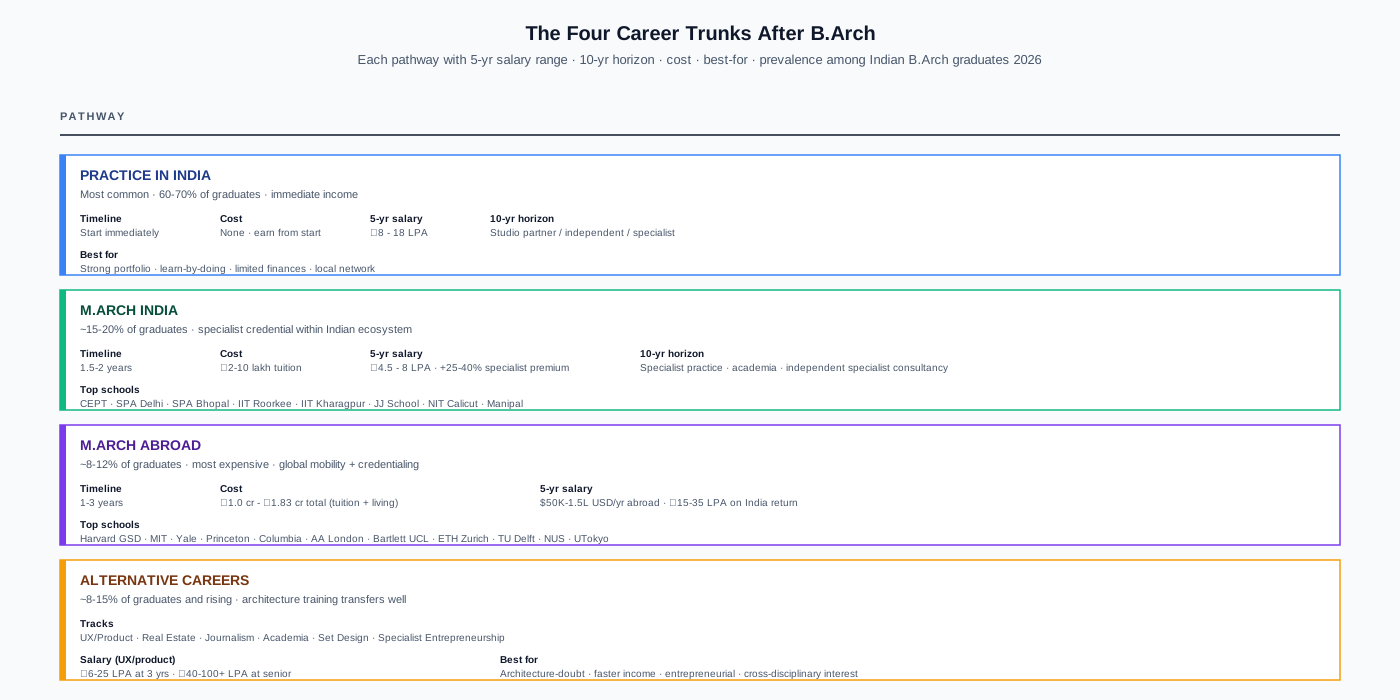
| Pathway | Typical timeline | Typical cost | 5-yr salary range (₹ LPA) | 10-yr horizon |
|---|---|---|---|---|
| Practice in India | Start immediately post-B.Arch | None (you earn from start) | 8-18 LPA | Studio partner / independent practice / specialist role |
| M.Arch in India | 2 yrs after B.Arch (or 1.5) | ₹2-10 lakh tuition | Pre-M.Arch ₹3 LPA → Post ₹4.5-8 LPA | Specialist (urban / sustainability / conservation), academic |
| M.Arch Abroad | 1-3 yrs (most 2 yr) | ₹50 lakh - ₹1.5 cr | Abroad ₹50K-1.5L USD/yr; on return ₹15-35 LPA | Global mobility, academia, top-tier practice |
| Alternative careers | Variable | Variable | UX/product ₹6-25 LPA at 3 yrs; others vary | Founder, specialist, lateral career builder |
The decision is not "which is best" — it is "which fits me, given my portfolio strength, financial position, family situation, and what I discovered about my interests". The framework below treats each in detail.
2. Trunk 1 — Practice in India
The most common pathway. ~65% of Indian B.Arch graduates enter practice within 6 months of graduation.
Career Trajectory
| Years post-grad | Role | Salary range (₹ LPA) | What you do |
|---|---|---|---|
| 0-1 | Junior Architect / Architectural Assistant | 2.5-6 | Drawing production · site visits · model-making |
| 2-3 | Architect | 5-10 | Project ownership · client interaction · documentation |
| 4-6 | Senior Architect | 8-18 | Project lead · team management · BD support |
| 7-10 | Associate / Project Architect | 15-35 | Multiple projects · client lead · partner-track |
| 10+ | Studio Partner / Independent Practitioner | 25-100+ (variable) | Practice ownership · brand recognition · mentor role |
These ranges are for Tier-1 Indian metros (Mumbai, Bengaluru, Delhi, Pune, Hyderabad). Tier-2 city ranges run 30-50% lower; Tier-3 lower still. Independent practice income is highly variable — successful practitioners can far exceed these ranges; struggling practices fall well below.
Best For
- Students with strong portfolios who want immediate industry exposure
- Students who learn best by doing, not by more schooling
- Students with limited financial resources for further education
- Students with strong local network / family in architecture / regional anchoring
What to Optimise For in First 3 Years
- Quality of mentorship — work for a senior whose work you respect, not for the firm with the highest salary
- Project diversity — early career is the time to see many typologies
- Site exposure — architects who never visit construction sites in their first 3 years carry that gap permanently
- Documentation discipline — strong working-drawing fluency separates senior architects from senior draftsmen
- Network building — your peers today are the firm partners of 2035
Typical 10-Year Horizon for Practice-in-India Graduates
| Outcome | Frequency |
|---|---|
| Studio partner / equity partner at the firm where they trained | ~10-15% |
| Independent practice | ~25-35% |
| Senior architect at established firm | ~30-40% |
| Lateral move to design-build / development / specialist firm | ~10-15% |
| Exit from architecture (to alternative careers) | ~10-20% |
The exit rate is higher than students typically realise. Architecture practice in India in 2026 has structural challenges (client-side fee compression, tight project margins, work-life-balance issues) that produce higher attrition than equivalent professions. Choose practice with eyes open.
3. Trunk 2 — M.Arch in India
A specialist credential within the Indian architectural ecosystem. ~17% of Indian B.Arch graduates take an M.Arch in India.
Top Indian M.Arch Programmes (2026)
| Institution | Strengths | Specialisations | Annual fees (₹) |
|---|---|---|---|
| CEPT University, Ahmedabad | Most research-active; strongest urban-design programme | Urban Design, Conservation, Sustainability, Digital Design | ~₹3-5 lakh/yr |
| SPA Delhi | Government-rate fees; deep alumni network | Urban Design, Industrial Design, Building Engineering | ~₹50K-1 lakh/yr |
| SPA Bhopal | Younger institution; growing | Urban Planning, Sustainable Architecture | ~₹50K-1 lakh/yr |
| IIT Roorkee | Strong engineering integration | Urban Design, Architectural & Sustainable Design | ~₹2-3 lakh/yr |
| IIT Kharagpur | Research-led; PhD pathway | Urban Design, City Planning | ~₹2-3 lakh/yr |
| JJ School Mumbai | Heritage strength; Mumbai network | Conservation, Urban Design | ~₹50K-1.5 lakh/yr |
| Manipal Institute of Technology | Private; well-resourced | Architecture, Interior Design, Sustainability | ~₹4-5 lakh/yr |
| Pearl Academy | Industry-linked private | Interior + spatial design | ~₹4-6 lakh/yr |
| NIT Calicut | Strong technical base; affordable | Architecture, Urban Design | ~₹50K-1 lakh/yr |
Common Specialisations + Career Outcomes
| Specialisation | Career outcome | Salary premium over B.Arch |
|---|---|---|
| Urban Design | Urban-design firms; municipal-corporation consultants | +25-40% |
| Sustainability | Green-building consultants; large firms with sustainability practices | +20-35% |
| Conservation | Heritage-architecture firms; INTACH; ASI | +10-25% (lower; smaller market) |
| BIM / Computational | Large-firm specialist roles; tech-architecture firms | +30-50% |
| Architectural History / Theory | Academia; PhD pathway | Variable; mostly academic-track |
| Landscape Architecture | Landscape-specific firms | +10-30% |
Best For
- Students who want a specialist credential within Indian context
- Students who have decided on a sub-discipline (urban design, sustainability, etc.)
- Students aiming at academia or large-firm specialist roles
- Students whose financial resources support 1.5-2 years of additional education
Pros vs Cons
| Pro | Con |
|---|---|
| Specialised credential | 1.5-2 year delay before practice |
| Academic / research access | Cost ₹2-10 lakh tuition |
| Teaching pathway | Not all specialisations command salary premium |
| Indian-context depth | Limited international mobility vs M.Arch abroad |
Typical 10-Year Horizon for M.Arch India Graduates
| Outcome | Frequency |
|---|---|
| Specialist practice in chosen area | ~50-60% |
| Academia (lecturer / assistant professor) | ~15-25% |
| Independent specialist consultancy | ~15-25% |
| Lateral move to general practice | ~5-15% |
4. Trunk 3 — M.Arch Abroad
The most expensive and most credentialing-intensive pathway. ~10% of Indian B.Arch graduates undertake an M.Arch abroad.
Top International M.Arch Programmes (2026)
| Institution | Country | Strengths | Annual cost (USD) |
|---|---|---|---|
| Harvard GSD | USA | Most prestigious; research-heavy | ~$70,000 + living |
| MIT Architecture | USA | Computational / technology integration | ~$70,000 + living |
| Yale School of Architecture | USA | Design-led; strong studio culture | ~$65,000 + living |
| Princeton School of Architecture | USA | Theory-rich; small cohort | ~$60,000 + living |
| Columbia GSAPP | USA | Urban-architecture intersection | ~$70,000 + living |
| Sci-Arc | USA | Computational / experimental | ~$50,000 + living |
| Architectural Association (AA) | UK | Theory + design intersection; non-degree-equivalent | ~£28,000 + living |
| Bartlett UCL | UK | Strongest research output globally | ~£35,000 + living |
| Cambridge | UK | Traditional design rigour | ~£35,000 + living |
| ETH Zurich | Switzerland | Engineering + design integration; near-free | ~CHF 1,500/yr (!) |
| TU Delft / Berlage | Netherlands | Strong urbanism + tech | ~€20,000-25,000 |
| RMIT / UNSW | Australia | Practical orientation; English-medium | ~AUD 45,000 |
| NUS Singapore | Singapore | Strong Asia-Pacific network | ~SGD 35,000 |
| University of Tokyo | Japan | Cutting-edge; small intake | ~JPY 535,000 (heavily subsidised) |
Cost Reality — Total 2-Year M.Arch Abroad
| Component | Range (USD) | Indian rupee equivalent (₹) |
|---|---|---|
| Tuition | $80,000 - $140,000 | ₹66 lakh - ₹1.16 crore |
| Living | $40,000 - $80,000 | ₹33 lakh - ₹66 lakh |
| Total | $120,000 - $220,000 | ₹1.0 cr - ₹1.83 cr |
This is the largest single financial commitment most Indian families make outside of property purchase. The decision must factor:
- Family financial capacity / education loans (typical ₹40-80 lakh borrowing cap)
- Scholarship availability (Inlaks, Aga Khan, KRF, Felix, Hornby, Tata, GSD-funded — competitive)
- Return-on-investment timeline (most M.Arch-abroad graduates need 5-8 years of post-grad work to recoup costs)
- Visa / immigration risk (US H1B, UK Graduate Route, etc.)
Best For
- Students with strong portfolios that can compete in international admissions
- Students with family financial capacity or scholarship eligibility
- Students aiming at academia, research, or top-tier international practice
- Students with strong English / language fluency
- Students who can navigate cultural transition and reverse-culture-shock on return
Pros vs Cons
| Pro | Con |
|---|---|
| Global professional network | Cost (₹1-1.83 crore total) |
| Access to research / advanced practice | Visa risk |
| Academic-credentialing prestige in India and abroad | 2-year delay |
| Lateral options into academia / global firms | Cultural transition |
| US STEM-OPT / UK Graduate Route enable post-grad work | Reverse-culture-shock if returning |
Typical 10-Year Horizon for M.Arch Abroad Graduates
| Outcome | Frequency |
|---|---|
| Settle abroad (US, UK, EU, Australia) | ~30-40% |
| Return to India for senior practice / academia | ~30-40% |
| Move to alternative careers (often tech, real estate, design adjacent) | ~15-25% |
| PhD pathway / academic career | ~10-15% |
5. Trunk 4 — Alternative & Parallel Careers
The fastest-growing pathway. ~12% of Indian B.Arch graduates entered alternative careers in the 2020-2025 cohort, up from ~5% a decade earlier.
The Six Most Common Alternative Tracks
| Track | What it is | Why architecture training transfers | Salary trajectory |
|---|---|---|---|
| UX / Product Design | Digital product + interface design | Systems thinking, user research, visualisation | ₹6-25 LPA at 3 yrs; ₹40-100+ LPA at senior |
| Real Estate / Development | Property analysis, asset management, development | Spatial thinking, regulatory fluency, project management | ₹8-20 LPA at 3 yrs; ₹30-80 LPA at senior |
| Architecture Journalism / Writing | Magazine, newspaper, online architecture writing | Subject knowledge, drawing literacy, writing | ₹4-12 LPA at 3 yrs; variable senior; supplemented by freelance |
| Academia / PhD | University teaching, research | Subject knowledge, design pedagogy | ₹6-15 LPA Indian academia; higher abroad |
| Specialist Entrepreneurship | Prefab, materials, design-tech startups | Design-build understanding, vendor relationships | High variance; founder track |
| Set / Production Design | Film, TV, theatre | Spatial thinking, visualisation, storytelling | ₹5-25 LPA at 3 yrs; project-based |
Why Architecture Transfers Well to Alternative Careers
Architecture training provides skills that few other undergraduate degrees match:
- Systems thinking at multiple scales simultaneously
- Visualisation of complex 3D / spatial information
- Project management of long-duration multi-stakeholder projects
- Visual communication through drawing, diagram, and rendering
- Critique and iteration as professional habits
- Constraint optimisation — designing within budgets, codes, and physical limits
These transfer to UX, product, real estate, tech-architecture, journalism, and entrepreneurship in ways that finance, engineering, or marketing degrees do not.
Best For
- Students who discovered during B.Arch that they prefer adjacent fields
- Students whose financial pressure requires faster income (UX/product careers compensate higher than early architecture practice in India)
- Students with strong communication / writing / programming skills alongside design
- Students with entrepreneurial intent
The Cost of Alternative Careers
The trade-off is unused credentialing. A B.Arch graduate who exits architecture has invested 5 years in a credential they will not use. The discipline:
- Acknowledge the sunk cost as sunk
- Articulate the transfer narrative clearly when interviewing for the alternative role
- Maintain a connection to architecture (occasional residential design for friends, blog posts, conference talks) — keeps the door open and retains identity
Typical 10-Year Horizon for Alternative-Career Graduates
| Outcome | Frequency |
|---|---|
| Settled in chosen alternative field | ~60-70% |
| Returned to architecture | ~15-25% |
| Founder of own venture | ~10-20% |
| Hybrid practice (architecture + alternative) | ~10-20% |
6. The Decision Framework — Which Path Fits
The four-pathway framework can be applied through five questions. Answer them honestly; the answers narrow your viable paths.
| Question | If yes... | If no... |
|---|---|---|
| Q1: Did you genuinely enjoy the production side of architecture (drawing, modelling, site work)? | Practice or M.Arch India | Consider Alternative |
| Q2: Do you have ₹50 lakh+ available for M.Arch abroad (family / scholarship / loan)? | M.Arch Abroad viable | Practice or M.Arch India only |
| Q3: Have you discovered a specific specialisation interest (urban, conservation, sustainability)? | M.Arch India or Abroad | Practice (general) |
| Q4: Do you want to live abroad long-term (10+ years)? | M.Arch Abroad | Practice India or M.Arch India |
| Q5: Are you energised by alternative-discipline work (tech, real estate, writing, founding)? | Alternative | Stay in architecture pathways |
Common Decision Patterns
| Pattern | Recommended pathway |
|---|---|
| Strong portfolio + financial capacity + want international exposure | M.Arch Abroad |
| Strong portfolio + want immediate practice + strong local network | Practice India |
| Solid portfolio + clear specialisation interest + India-rooted | M.Arch India |
| Strong portfolio but architecture-doubt during B.Arch | Alternative (often UX or real estate) |
| Solid portfolio + family business + intent to take over | Practice India (then specialised role) |
| Top portfolio + research interest + scholarship potential | M.Arch Abroad → Academia / PhD |
| Top portfolio + climate-design interest + Indian commitment | Practice India + concurrent M.Arch (sustainability) |
The decision is reversible to a degree. Practice → M.Arch is common (3-5 years into practice); M.Arch → practice is the default; alternative → practice is harder but possible. No path is permanent except the one you double down on.
7. The Twelve-Test Fit Diagnostic
Apply at end of Sem 9 (mid-final-year) to test your default pathway choice.
| Test | Question | Pass criterion |
|---|---|---|
| 1 | Have you discussed your pathway choice with at least 3 alumni who took that path? | Yes — recent graduates' lived experience |
| 2 | Have you discussed with 1 alumnus who took a different path? | Yes — checks for blind spots |
| 3 | Are your financial calculations realistic (5-yr cumulative cost vs 5-yr cumulative income)? | Yes — verified with parent / financial advisor |
| 4 | Is your portfolio strong enough for the path's typical applicant pool? | Yes — for M.Arch Abroad, peer-reviewed by faculty |
| 5 | Have you applied to backup options (scholarships, alternative schools, parallel jobs)? | Yes — risk-managed |
| 6 | Does the path align with what you discovered you enjoy in B.Arch (not what you thought you would)? | Yes — Year 1 self vs Year 5 self can differ |
| 7 | If pathway is Practice India — have you interned or worked with the firm-type? | Yes — informed firm choice |
| 8 | If pathway is M.Arch India — have you visited the campus + spoken with current students? | Yes — fit verified |
| 9 | If pathway is M.Arch Abroad — have you taken GRE / IELTS / TOEFL by Sem 8? | Yes — admissions-cycle aligned |
| 10 | If pathway is Alternative — have you done at least one internship / project in that field? | Yes — minimum exposure |
| 11 | Have you talked to family about the path implications? | Yes — alignment / disagreement managed |
| 12 | Do you have a Plan B if Plan A doesn't work? | Yes — scenario-planned |
Students who pass 10+ tests typically navigate the post-B.Arch transition without major regret.
8. Companion Resources at Studio Matrx
- All 7 prior modules of the Student Foundations Track — the complete curriculum
- Architecture Academy — Student Resources Hub — career-pathway visual diagram + reading list
- Architecture Academy — five practitioner tracks for post-B.Arch reading
- The Architect's Scope of Services in India — reference for practice pathway
- Architect Fee Structures in India — reference for independent-practice viability
- Starting a Design Firm in India — reference if pathway leads to independent practice
9. References
Foundational Career Texts
- Boyer, E. L., & Mitgang, L. D. (1996). Building Community: A New Future for Architecture Education and Practice. Carnegie Foundation. — Career-trajectory framework.
- Cuff, D. (1991). Architecture: The Story of Practice. MIT Press. — Sociology of architectural careers.
- Greusel, D. (2020). How to Get a Job in an Architecture Firm. Wiley.
Indian Profession References
- Council of Architecture (CoA), India — registered-architect statistics, salary surveys.
- Indian Institute of Architects (IIA) — practice-pathway publications.
- CEPT University, SPA Delhi, IIT Roorkee, IIT Kharagpur — published M.Arch programme overviews and graduate placement statistics.
- Vastushilpa Foundation, RMA Archive, Studio Lotus, Morphogenesis — public alumni-trajectory information.
International M.Arch References
- Harvard GSD, MIT Architecture, Yale School of Architecture — admissions statistics and graduate-outcome reports.
- AA School London, Bartlett UCL, ETH Zurich — programme guides.
- Inlaks Shivdasani Foundation, Aga Khan Foundation, KRF (Kavi Razdan Fellowships) — major Indian-applicant scholarships.
Peer-Reviewed Academic References — Architectural Career Trajectories
- Imrie, R., & Street, E. (2011). Architectural Design and Regulation. Wiley-Blackwell.
- Larson, M. S. (1993). Behind the Postmodern Facade: Architectural Change in Late Twentieth-Century America. University of California Press. — On architectural-profession dynamics.
- Salama, A. M. (2016). Spatial Design Education: New Directions for Pedagogy in Architecture and Beyond. Routledge. — On architecture education's outcomes.
Companion Studio Matrx Guides
See §8 above for the full cross-reference list.
Author's Note: There is no universally best path after B.Arch. The path that fits your portfolio, your finances, your family situation, and your discovered interests is the path that produces a sustainable career. The student who chooses the prestigious-sounding path that doesn't fit is the student whose career underperforms; the student who chooses the path that fits — even if it's the less-glamorous-sounding one — is the student who flourishes. The 8-module Student Foundations track has covered the inputs to this decision: the drawing discipline, the software stack, the portfolio, the jury survival, the internship experience, the thesis project, the case-study research practice. With these in hand, the choice in this final module is yours. Take it with eyes open. Choose what fits, not what sounds best. The architectural career you build over the next 40 years rests on this decision and on the discipline that follows it.
Disclaimer: Salary ranges, programme costs, and pathway-statistics reflect 2026 Indian and international markets; verify current figures directly with target schools and firms. Career trajectories are individual; the patterns above represent observed averages, not guarantees. Studio Matrx, its authors, and contributors accept no liability for outcomes based on this guide.
Export this guide
Related Guides — Deep-dive reading
Indian Architecture Schools — A Working Shortlist
The 2026 Reference for B.Arch Aspirants — COA-Approved Institutions, Tier Map, Cost-of-Attendance Ranges, Pedagogy Profiles, Faculty Strengths, Geographic Distribution, Application Deadlines, and the Decision Framework for Choosing the School That Fits You
Student FoundationsB.Des Interior Design — The Student Track
The 2026 Reference for the Indian B.Des Interior Aspirant — How It Differs from B.Arch, the Top Schools (NID · Pearl · Symbiosis · NIFT · Sushant), the Four-Year Curriculum, the Software Stack, FF&E and Materials Vocabulary, Studio Discipline, Portfolio Building, Internship Pathways, Career Trajectories, and the Long-Horizon Practice Map
Student FoundationsCase-Study Analysis — How to Read an Architectural Project
Module 7 of the Student Foundations Track — Selecting Case Studies that Match Your Design Problem, Five-Layer Analysis Framework (Site, Programme, Form, Material, Detail), Data Collection Methods, How to Apply Findings to Your Own Studio Project, the Citation Discipline, and a Twelve-Test Pre-Submission Diagnostic for Indian B.Arch Students
Student FoundationsRelated Tools — Try Free
Client Brief Generator
8-section questionnaire that produces a professional design brief PDF with signature lines.
Brief GeneratorCross-Ventilation Analyzer
Estimate airflow and air changes per hour (ACH) from room size, window areas, layout, and local wind — with NBC 2016 Part 8 compliance check.
Ventilation CalculatorMaterial Decision Framework (M-Score)
Score 30+ Indian construction materials across cost, durability, climate fit, maintenance, and sustainability.
Materials