
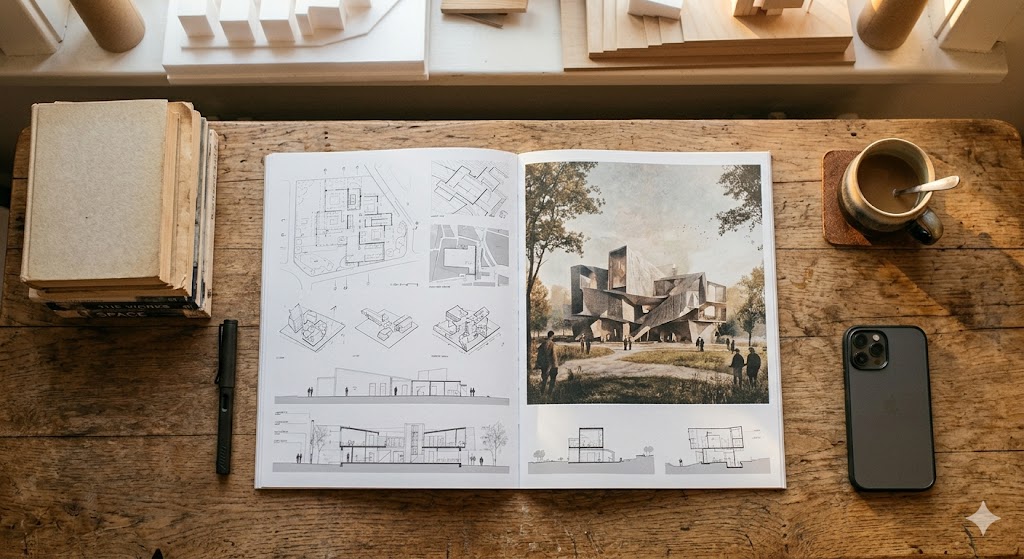
Building Your Architecture Portfolio
Module 3 of the Student Foundations Track — Project Selection, Narrative Structure, Layout Discipline, Print vs Digital, the Five Portfolio Stages, and What Indian Architecture Firms Actually Look For When Hiring B.Arch Graduates
Your portfolio is the single most important artefact you produce in your B.Arch / B.Des. Your degree is a credential; your portfolio is the evidence of what you can actually do. Every internship interview, every M.Arch admissions decision, and every first-job offer hinges on it. The student who produces a strong portfolio over their five years opens doors that the student with mediocre work — even with strong studio grades — does not.
This module is the working portfolio reference. It treats the portfolio as a cumulative discipline — built across five years, not assembled in the final semester — and as a narrative artefact — a curated story of how you think, not a complete log of every project you completed. The orientation is towards Indian B.Arch and B.Des students applying for internships in Indian firms, M.Arch programmes (India and abroad), and first-job applications post-graduation in 2026.
The treatment proceeds through the five portfolio stages (Year-1 baseline → Year-5 graduating portfolio), the project-selection rubric, the narrative structure, the layout grid and typography, the print vs digital decision, what Indian firms actually look for (drawn from interviews with hiring partners at Studio Lotus, sP+a, Studio Mumbai, RMA Architects, Hafeez Contractor, and Morphogenesis), the eight common mistakes, and a twelve-test diagnostic to run before any portfolio is sent.
"I do not look at your CV first. I open your portfolio. If the first three spreads tell me what kind of architect you are, I keep reading. If they don't, I move to the next applicant. There are 200 applications for the role." — Hiring partner, mid-size Mumbai studio, 2026
1. The Portfolio is Cumulative, Not Final
The single most consequential discipline for portfolio building: start in Year 1. The student who maintains a portfolio document from Sem 1 — adding to it after every studio submission, every site analysis, every elective project — produces a Year-5 graduating portfolio of compounding quality. The student who waits until Sem 9 to assemble a portfolio from scattered files produces a graduating portfolio that is rushed, incomplete, and visibly hurried.
The five portfolio stages and what each is for:
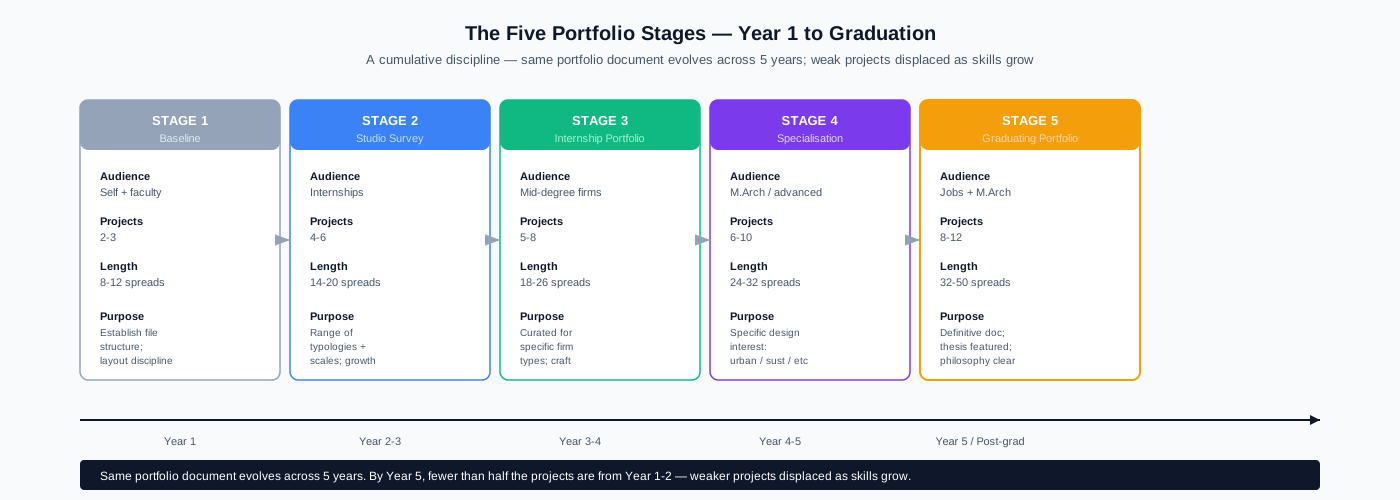
| Stage | Year | Audience | Project count | Length | Purpose |
|---|---|---|---|---|---|
| Stage 1 — Baseline | Year 1 | Self + faculty | 2-3 | 8-12 spreads | Establish portfolio file structure, layout discipline; document Year-1 studio + drawing exercises |
| Stage 2 — Studio Survey | Year 2-3 | Internship applications | 4-6 | 14-20 spreads | Show range of typologies, scales, design approaches; demonstrate growth |
| Stage 3 — Internship Portfolio | Year 3-4 | Mid-degree internship recruiters | 5-8 | 18-26 spreads | Curated for specific firm types; emphasises craft + design judgement |
| Stage 4 — Specialisation | Year 4-5 | M.Arch / advanced practice | 6-10 | 24-32 spreads | Demonstrates specific design interest (urban, conservation, sustainability, etc.) |
| Stage 5 — Graduating Portfolio | Year 5 / Post-grad | Job applications + M.Arch admission | 8-12 | 32-50 spreads | The definitive document; thesis featured prominently; design philosophy articulated |
The same physical portfolio document evolves through the five stages. Files are versioned, content is curated, and weak projects are replaced with stronger ones as your skills grow. By Year 5, fewer than half the projects in your portfolio will be from Year 1-2; the rest are Year 3-5 work that displaces earlier projects.
2. The Project-Selection Rubric — What to Include, What to Cut
Every B.Arch student completes 10-15 studio projects across five years, plus electives, internships, competitions, and personal work. The graduating portfolio includes 8-12 projects, not all of them. The selection is the most consequential editorial decision in the portfolio.
The Five-Question Selection Test
For each project, ask:
1. Does it show design judgement? Not "did I get a good grade" but "does the project demonstrate a defensible design decision the viewer can read"?
2. Is it your strongest work in its category? If you have two residential projects, only the better one belongs.
3. Does it cover a typology / scale gap? A portfolio of all houses is weaker than one with house + institutional + urban.
4. Can you present it well in 2-4 spreads? Some projects, however good, do not photograph or draw well at portfolio scale.
5. Does it support the narrative? Your portfolio is one story; each project is a chapter. If it doesn't fit the story, cut it.
A project that fails 2+ of these tests should be cut, even if you spent a semester on it. Cumulative selection discipline is what separates the strong portfolio from the comprehensive one. Comprehensive is not the goal.
The Project-Type Coverage Matrix
The strong B.Arch graduating portfolio typically covers most of:
| Project type | Typical source | Why include |
|---|---|---|
| Single-family residence | Year 1-2 studio | Demonstrates spatial thinking at small scale |
| Multi-family / apartment | Year 2-3 studio | Demonstrates programmatic complexity, density |
| Institutional (school, library, healthcare) | Year 3-4 studio | Demonstrates scale + public-realm thinking |
| Public / civic | Year 4-5 studio or thesis | Demonstrates mature spatial + cultural thinking |
| Urban-design / masterplan | Year 4-5 studio or elective | Demonstrates contextual thinking at city scale |
| Conservation / heritage | Elective / internship | Demonstrates sensitivity, research depth |
| Sustainability-focused | Studio + elective | Demonstrates climate-and-site responsiveness |
| Computational / parametric (optional) | Elective / thesis | Demonstrates technical depth (only if genuinely strong) |
| Internship project (with attribution) | Internship | Demonstrates ability to contribute in a real practice |
| Personal / self-initiated | Outside curriculum | Demonstrates intrinsic interest beyond assignments |
| Thesis | Year 5 | The capstone; almost always 4-6 spreads |
A portfolio with 4+ of these typologies is stronger than one with 8 residences. Range demonstrates flexibility; flexibility is what firms actually hire for.
3. The Narrative Structure — One Portfolio, One Story
A strong portfolio reads as a single argument about the kind of architect you are becoming. Every project supports the argument. The argument is articulated explicitly in two places: the opening spread (cover + introduction) and the closing spread (thesis project + design philosophy statement).
The recommended narrative structure:
| Spread | Content | Purpose |
|---|---|---|
| 1 | Cover — your name, "Architecture Portfolio," institution, year | Identification |
| 2 | Title page + table of contents | Navigation |
| 3 | About (200-word designer statement; what you find architecturally interesting) | Narrative anchor |
| 4-5 | Project 1 — strongest project, in 2-4 spreads | Establishes the argument |
| 6-7 | Project 2 — complementary typology / scale | Builds the argument |
| 8-12 | Projects 3-6 — varied typology, each in 2-4 spreads | Develops the argument |
| 13-14 | Internship project (with attribution) | Real-world dimension |
| 15-16 | Personal / self-initiated work | Intrinsic-interest dimension |
| 17-22 | Thesis — 4-6 spreads | The capstone of the argument |
| 23 | Process spread — sketches, models, hand drawings | Demonstrates how you think |
| 24 | Closing — design philosophy + contact | The argument summarised |
Total: ~24 spreads for a graduating portfolio. Adjust to 32-50 if your projects warrant more depth.
The argument-driven approach is described in Brillembourg & Klumpner's Torre David / Informal Vertical Communities (2013) and in the Yale GSD admissions criteria publications: "We are looking for portfolios that articulate a coherent architectural sensibility — not necessarily a developed one, but a discernible one."
4. The Layout Grid and Typography Discipline
Even a portfolio of strong projects fails if the layout is amateur. The discipline is consistency, restraint, and grid adherence.

Layout Grid Standards
- Page size: A3 landscape (297 × 420 mm) is the most common; A4 portrait acceptable; never letter / non-ISO sizes
- Margins: 15-20 mm consistent on all sides
- Columns: 6-column grid is standard; 8-column for complex projects; 4-column for simpler narratives
- Gutters: 5-8 mm between columns
- Baseline grid: 12-14 pt baseline for body text; align ALL text to it
Typography Rules
| Element | Size | Style |
|---|---|---|
| Project title | 28-36 pt | Same typeface as body, bold or extra-bold |
| Section heading | 14-18 pt | Same typeface, semi-bold |
| Body text | 9-10 pt | Sans-serif (Helvetica, Inter, Aktiv Grotesk) or serif (Georgia, Spectral) |
| Captions | 7-8 pt | Same typeface as body, italic or lighter weight |
| Drawing labels | 7-9 pt | Sans-serif, all caps, tight letter-spacing |
| Page numbers | 8 pt | Bottom corners, consistent placement |
The Typography Disciplines
- One typeface family per portfolio. Use Helvetica or Inter throughout, with weight variation (Light, Regular, Medium, Bold) — not multiple typefaces.
- Maximum two type sizes on any one spread. A heading + body is plenty; mixing 4 sizes looks busy.
- Left-align body text. Justified text creates "rivers" in narrow columns; centred body text is unprofessional outside of titles.
- Line height 1.4-1.5×. Tight line height looks cramped; loose line height looks unfinished.
The inspiration to study: El Croquis (Spanish architectural monograph series) and 2G (Galician monograph series) — both use understated typography that lets architectural drawings dominate. Their layout discipline is the gold standard for architecture publications.
5. Print vs Digital — The Decision
In 2026, both formats are required. The question is which one for what audience.
| Aspect | Print Portfolio | Digital Portfolio |
|---|---|---|
| Cost | ₹1,500-4,000 per copy (good binding) | Free (PDF/website) |
| Best for | In-person interviews, M.Arch admissions (where required), studio submissions | Online applications, screening rounds |
| Resolution | 300 DPI required | 150 DPI screen (PDF), 72 DPI web |
| Length flexibility | Constrained by binding (32-60 spreads typical) | Almost unlimited |
| Page size | A3 landscape (most common); A4 if travelling | A3 landscape PDF or scrolling web format |
| Tactile quality | Matte paper (not glossy); good binding (perfect-bound or saddle-stitched) | Smooth scrolling, fast loading |
| Update cost | High — reprinting | Trivial |
| Reach | One reviewer per copy at a time | Unlimited simultaneous reviewers |
| First impression | Material, weight, paper choice all signal effort | Web design + speed signal effort |
The recommended dual-format approach:
1. Master InDesign / Affinity Publisher source file — the canonical portfolio
2. Print PDF (300 DPI, embedded fonts, A3 landscape) — for printing 2-3 copies for in-person interviews
3. Screen PDF (150 DPI, slightly compressed, max ~25 MB) — for email applications
4. Web portfolio (Cargo, Squarespace, Behance, or Figma-hosted) — for online discoverability
A student who maintains all four through Year 5 is prepared for any application format. A student who only has one is constrained.
Print-Quality Specifications (2026 Indian Market)
| Element | Specification |
|---|---|
| Paper | 170-200 GSM matte coated for body; 300 GSM for cover |
| Binding | Perfect-bound (preferred for 32+ spreads); saddle-stitched (acceptable for 16-24 spreads) |
| Cover | Soft-cover with matte lamination; hard-cover only for final graduating portfolio |
| Print bureaus | Bombay Litho (Mumbai), KPM Print (Bengaluru), Saraswati Press (Delhi), Repro (Kolkata) |
| Cost (~32 spreads, 2 copies, A3) | ₹2,500-5,000 in 2026 prices |
6. Per-Project Spread Discipline
Every project in your portfolio gets 2-4 spreads, depending on its scale and complexity. The internal structure of those spreads is consistent.
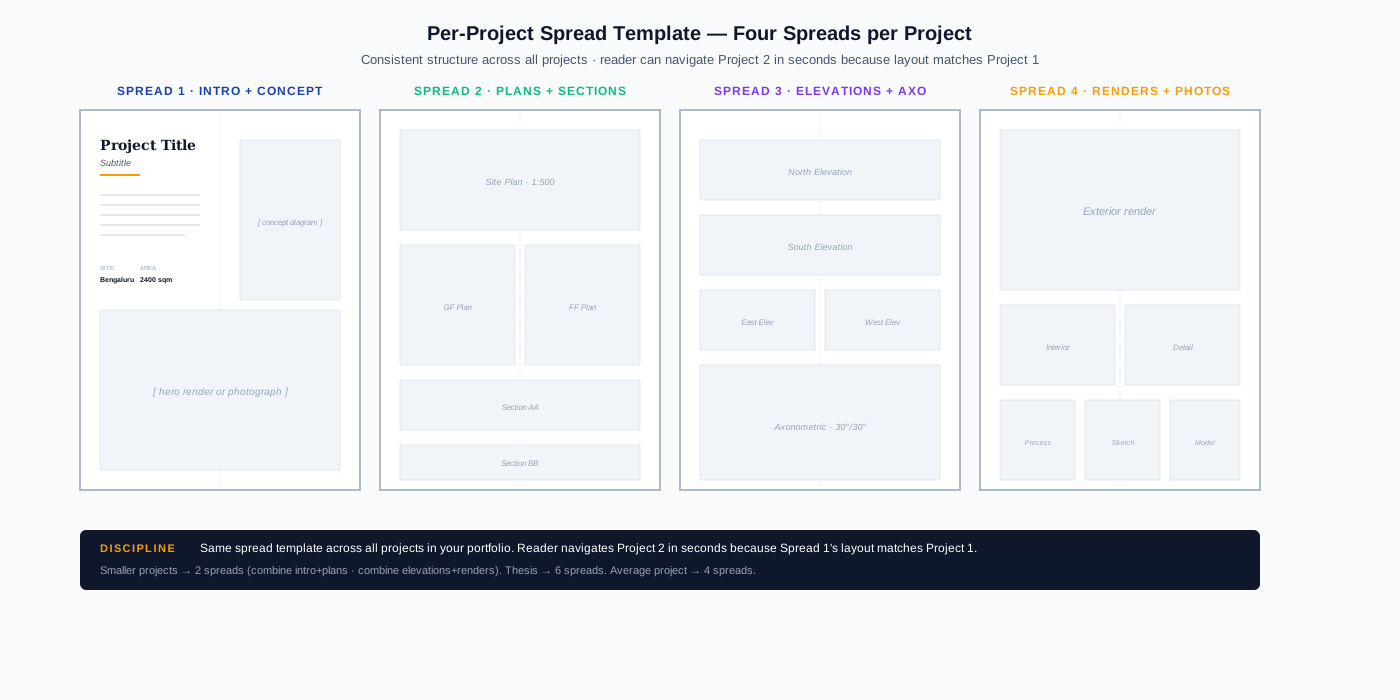
Spread 1 — Introduction + Concept
- Project title (typography hierarchy)
- One-line subtitle / location
- 200-word project description
- Concept diagrams or hero image
- Programme / area / brief metadata in a small block
Spread 2 — Plans + Sections
- Site plan (1:500 typically, with north arrow + scale bar)
- Floor plans (each at 1:200 or 1:100)
- One or two sections at the same scale as plans
- Material hatching, line-weight discipline, BIS conventions (per Module 1)
Spread 3 — Elevations + Axonometric
- Two to four elevations (depending on project geometry)
- One axonometric or exploded axonometric
- Material call-outs as needed
Spread 4 — Renders + Photos
- 1-3 rendered perspectives (interior + exterior)
- Model photographs (if relevant)
- 2-3 process photos or sketches
- Closing comment / what-I-learned (1 sentence, optional)
The discipline: the same spread structure across all projects. A reader who has parsed Project 1's structure can navigate Project 2 in seconds because the layout is consistent. Inconsistent layouts force the reader to re-parse — and impatient reviewers stop reading.
7. What Indian Architecture Firms Actually Look For
Drawn from interviews with hiring partners at six prominent Indian firms during 2025-26:
| What firms prioritise | Detail |
|---|---|
| Hand drawing | Almost universally cited as the strongest signal. Firms can teach software; they cannot teach the eye. A portfolio with strong hand drawings is read more carefully than one with only renders. |
| Drawing discipline | BIS line weights, plan-section-elevation correctness, hatching conventions. Sloppy drawings communicate sloppy thinking. |
| Project depth (not breadth) | Firms prefer 4 deeply-developed projects over 8 superficial ones. Show your process, your iterations, not just your final renders. |
| Material thinking | Evidence of material specification + understanding (concrete, brick, timber, stone, terracotta, etc. used appropriately). |
| Site-and-context responsiveness | Site analysis + climate response visible in plans + sections. Generic-looking projects underperform Indian-context-rooted projects. |
| Internship attribution | If an internship project is in the portfolio, attribute it clearly: "Worked under Ar. X at Y Studio; my contribution was Z." |
| Restraint | Heavy use of effects (drop shadows, gradients, neon callouts) signals over-decoration. Quiet portfolios outperform loud ones. |
| What firms de-prioritise | Detail |
|---|---|
| Every studio project included | Quantity of projects ≠ quality of portfolio. |
| Stock-library renders | Lumion-default-tree-and-person renders look generic. Custom-styled renders or hand-rendered work outperform. |
| Animation videos | Almost never watched in interviews. PDF still images are the actual medium. |
| Software tool list | Software fluency is assumed if the work is well-produced. Listing tools you used is unnecessary. |
| Awards / honours over project work | Strong work speaks; awards are bonus, not substitute. |
The single most-cited message from hiring partners: "Show me how you think, not just what you produced." The student who answers that question in the first three spreads earns a long read. The student who does not is filtered out within 60 seconds.
8. The Eight Common Portfolio Mistakes
| Mistake | Consequence | Fix |
|---|---|---|
| 1. Portfolio assembled in final semester | Rushed quality; gaps in early-year work | Start in Year 1; maintain the file across all 10 semesters |
| 2. Including every studio project | Diluted impact; reader fatigue | Curate to 8-12 strongest projects |
| 3. Inconsistent layout across projects | Reader has to re-parse each spread | Establish a 6-column grid + spread template; apply uniformly |
| 4. Multiple typefaces / inconsistent type | Looks amateur | One typeface family with weight variation |
| 5. Renders dominating, drawings absent | Reader cannot judge design thinking | At minimum 1 plan + 1 section per project |
| 6. No site / context drawings | Project reads as floating in nowhere | Site plan + analysis for every project |
| 7. Internship project unattributed | Looks like plagiarism | Attribute clearly with your contribution stated |
| 8. No closing statement / philosophy | Reader cannot place you | 200-word designer statement in the opening, 100-word philosophy in the closing |
The fix in every case is editorial discipline — being willing to cut projects, simplify layouts, reduce text, attribute properly. Most weak portfolios are weak because the student tried to include too much.
9. Twelve-Test Pre-Submission Diagnostic
Before sending a portfolio for any application, run the following twelve tests. Failing more than three suggests revision is needed before submission.
| Test | Question | Pass criterion |
|---|---|---|
| 1 | Does the portfolio open with a clear designer statement? | Yes — 150-250 words on Spread 3 |
| 2 | Are all spreads on the same grid (6-column / 4-column)? | Yes — visual consistency throughout |
| 3 | Is the typography consistent (one family, weights varied)? | Yes — no random Comic Sans surprises |
| 4 | Does each project include at least one plan + one section? | Yes — even render-heavy projects show drawings |
| 5 | Are line weights and material hatching per BIS conventions? | Yes — Module 1 discipline applied |
| 6 | Is each project introduced with location + brief + area? | Yes — metadata block on Spread 1 of each project |
| 7 | Are internship projects attributed correctly? | Yes — supervisor + your specific contribution stated |
| 8 | Does the project mix cover at least 4 typologies / scales? | Yes — house, institutional, urban, public minimum |
| 9 | Is the file size reasonable (PDF <25 MB)? | Yes — compressed appropriately |
| 10 | Are images at appropriate resolution (300 DPI for print)? | Yes — no pixelation visible |
| 11 | Are all proper nouns spell-checked? | Yes — typo-free |
| 12 | Is your contact information on the closing spread? | Yes — email + phone + portfolio website |
Students who pass 10+ tests before sending the portfolio see meaningfully higher response rates from internship and M.Arch applications.
10. Companion Resources at Studio Matrx
- Module 1 — Architectural Drawing & Representation Fundamentals — the drawing discipline that drives portfolio drawing quality
- Module 2 — The Software Stack: A Working Learning Path — InDesign / Figma / Photoshop production fluency
- Architecture Academy — Student Resources Hub — downloadable portfolio-spread template
- Student Foundations Track — full 8-module curriculum
- Working Drawings Documentation in India — practitioner-side counterpart on production drawings
11. References
Foundational Texts
- Linton, H. (2012). Portfolio Design (4th ed.). W. W. Norton — the most-prescribed portfolio reference for architecture students globally.
- Lupton, E. (2010). Thinking with Type: A Critical Guide for Designers, Writers, Editors, & Students (2nd ed.). Princeton Architectural Press.
- Lupton, E. (2017). Design Is Storytelling. Cooper Hewitt.
- Müller-Brockmann, J. (1996). Grid Systems in Graphic Design (Reprint ed.). Niggli Verlag — the foundational layout-grid reference.
Peer-Reviewed Academic References — Architectural Communication
- Robbins, E. (1994). Why Architects Draw. MIT Press. — On the role of drawing in architectural identity.
- Allen, S. (2009). Practice: Architecture, Technique and Representation (2nd ed.). Routledge.
- Pérez-Gómez, A., & Pelletier, L. (1997). Architectural Representation and the Perspective Hinge. MIT Press.
- Forty, A. (2000). Words and Buildings: A Vocabulary of Modern Architecture. Thames & Hudson — on how architects describe their own work.
Indian Hiring-Practice References
- Studio Lotus, Morphogenesis, Studio Mumbai, RMA Architects, sP+a, Hafeez Contractor, Stapati — public hiring guidelines and partner interviews (2024-26 industry roundtables).
- Council of Architecture (CoA) — National Architectural Education Standards portfolio competencies.
- CEPT University, SPA Delhi, IIT Roorkee — published M.Arch admissions portfolio criteria.
Design Publication References (for layout study)
- El Croquis — Spanish architectural monograph series; gold standard for architectural-drawing-led layouts.
- 2G — Spanish/Galician architectural monograph series.
- a+u (Architecture and Urbanism) — Japanese architectural magazine.
- Pratt Architecture, Yale School of Architecture, GSD — published student portfolio examples (admissions websites).
Companion Studio Matrx Guides
See §10 above for the full cross-reference list.
Author's Note: The portfolio is the lever that converts five years of B.Arch effort into the doors that open after graduation. The student who treats it as a final-semester deliverable is the student who walks out of B.Arch under-prepared. The student who treats it as a five-year cumulative discipline — adding to it after every studio submission, curating ruthlessly each year, refining the typography and grid each semester — graduates with a document that does the work of fifty cover letters. There is no shortcut. There is no "just do it in software" replacement. The portfolio is built, deliberately, over time, with the architectural-drawing discipline of Module 1 and the software fluency of Module 2 as its production infrastructure. Build it from Year 1.
Disclaimer: Hiring practices vary by firm, region, and year; the references in §7 reflect publicly-stated practices and 2024-26 industry-roundtable summaries, not formal employment commitments. Students should verify current expectations with target firms directly. Studio Matrx, its authors, and contributors accept no liability for outcomes based on this guide.
Export this guide
Related Guides — Deep-dive reading
Case-Study Analysis — How to Read an Architectural Project
Module 7 of the Student Foundations Track — Selecting Case Studies that Match Your Design Problem, Five-Layer Analysis Framework (Site, Programme, Form, Material, Detail), Data Collection Methods, How to Apply Findings to Your Own Studio Project, the Citation Discipline, and a Twelve-Test Pre-Submission Diagnostic for Indian B.Arch Students
Student FoundationsInternship Interview Prep & Résumé Content for Architecture Students
The 2026 Working Reference for Indian B.Arch and B.Des Students — Building the One-Page Résumé (Twelve Sections), Writing the Cover Letter That Lands, the Five-Stage Interview Process, the Portfolio Walk-Through, the Sketch Test, Salary Discussion, Offer Evaluation, the Common Failure Modes, and the Sustained Discipline of Internship Application Across Year 3 and Year 4
Student FoundationsArchitectural Drawing & Representation Fundamentals
Module 1 of the Student Foundations Track — Orthographic Projection, Axonometric, Isometric, Perspective, BIS Line-Weight Standards, Material Hatching Conventions, the Sketchbook Discipline, and the Hand-to-Software Translation for Indian B.Arch and B.Des Students
Student FoundationsRelated Tools — Try Free
Concept Generator
Get 3 AI-generated design concepts for any room with style, materials, and cost estimate.
DesignAIMaterial Decision Framework (M-Score)
Score 30+ Indian construction materials across cost, durability, climate fit, maintenance, and sustainability.
MaterialsApartment Video Door System Planner
Enter flats, entrances, floors and guard desk for a first-pass building intercom plan — door stations, indoor monitors, guard station, the right architecture and an indicative cost band.
Building Planner