
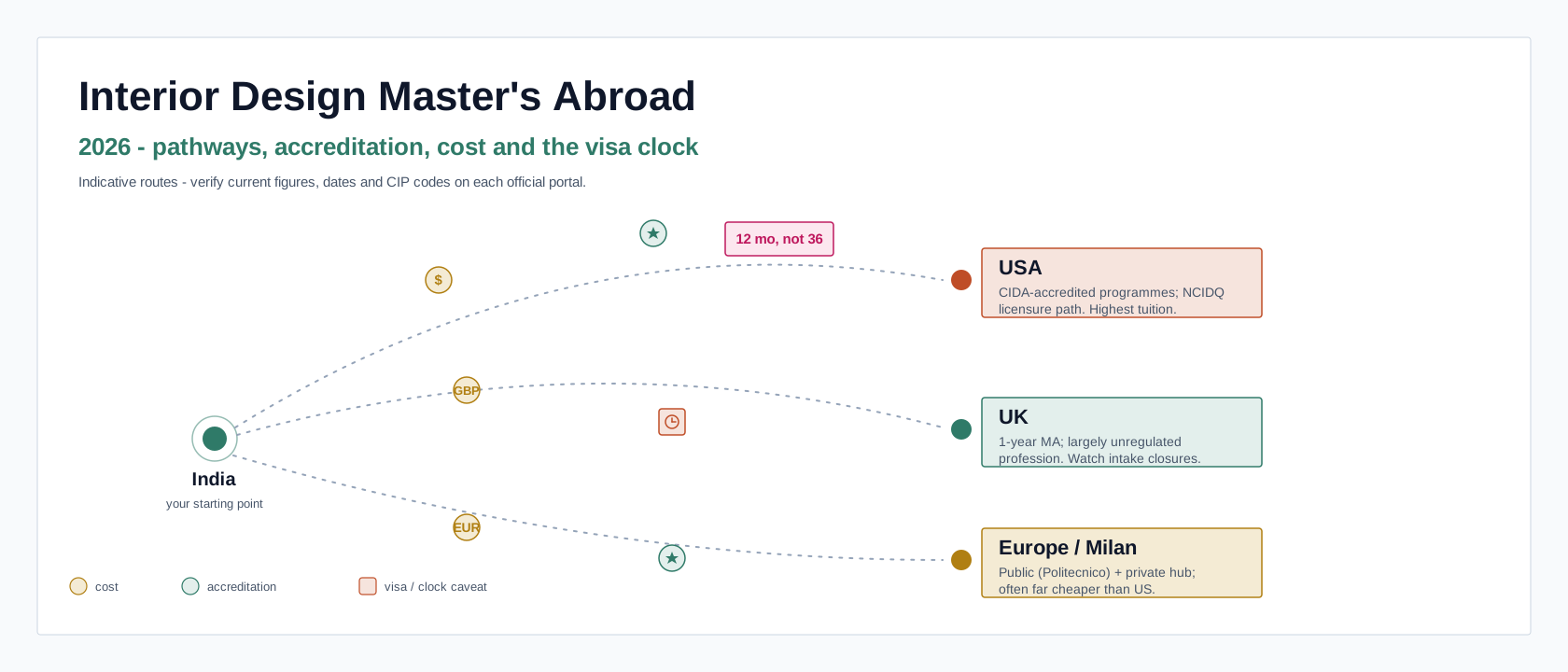
A Master's in Interior Design Abroad: USA, UK & Europe — A 2026 Guide for Indian Students
Degree types, accreditation, selection, the school shortlist, real costs, funding — and the visa caveat that changes everything
A final-year B.Des student in Pune has three browser tabs open: a Pratt MFA studio reel, a Milan apartment-tour video, and a loan EMI calculator. She has been told, by a coaching counsellor and by half of Instagram, that "design is STEM" and that a master's abroad means three years of work in the United States afterwards. She is about to pay a deposit on that belief. For an interior designer, that belief is almost always wrong — and discovering it after the deposit is the most expensive lesson in this field.
This guide is the honest version, written for the Indian student weighing a Master's in interior design or interior architecture abroad. It walks through the confusing terminology, what accreditation actually does (and does not) buy you, how schools select Indian applicants, what the whole thing costs once living and currency are factored in, what funding genuinely exists, and the one visa fact that quietly reshapes the entire decision. An interior-design master's abroad buys you a world-class studio education and a global network — but it rarely buys you the long US work runway people assume, and the headline tuition is often half the real cost.
This is one of four pathway guides. Start at the decision pillar, Should you do a Master's in Architecture or Design?, and read the India counterpart, A Master's in Interior Design in India: A 2026 Guide, before you commit to anything. If your field is architecture rather than interiors, see The M.Arch Abroad and The M.Arch in India.
A design master's abroad is a passport to a discipline, not a passport to three years of work. Read the visa fine print — the six-digit code on your I-20, not the title on your diploma — first, not last.
1. The terminology trap: Interior Design vs Interior Architecture vs Spatial Design
The first thing that confuses Indian applicants is that three different-sounding degrees often teach overlapping things — and the names are not legally protected terms. They are curricular labels chosen by marketing departments. Judge a programme by its curriculum and its accreditation, never by its name.
| Label | What it emphasises | Typical framing |
|---|---|---|
| Interior Design | Furnishing, finishes, FF&E (furniture, fixtures & equipment), space planning, materials, lighting, codes | The term most tied to US licensure paths (NCIDQ); the "professional" interior label in North America |
| Interior Architecture | Structural and spatial intervention, adaptive reuse, working with the existing building shell | Sounds architectural — but it is NOT a licensed-architect qualification anywhere |
| Spatial Design | The broadest and most conceptual — interiors plus exhibition, set, installation and narrative environments | Common UK and European framing; favours concept and storytelling over technical detailing |
The single most important caution: "Interior Architecture" does not make you an architect. It is a design label, not a route to architect registration. If you want to be a registered architect, you need an M.Arch on a NAAB/RIBA path, which is an entirely different track. And because none of these three labels is legally protected, two programmes with identical names can be wildly different in depth. Open the module list. Ask what the studios actually produce. Check the accreditation. The name is the least reliable signal you have.
2. Accreditation, degree types & the licensing question
This section quietly decides whether your money buys you anything beyond an education. The rules differ sharply by country, and the most common Indian misreading — that "no accreditation = bad programme" — is simply false at the master's level.
USA — CIDA, the MFA, and the M.Arch detour
In the United States, interior design programmes are accredited by CIDA (Council for Interior Design Accreditation — cida.org), which is recognised by CHEA. Here is the part nobody explains: CIDA primarily accredits entry-level (first professional) programmes. Many post-professional master's degrees are not CIDA-accreditable, and that is normal, not a red flag. What matters for licensure is whether you already hold a CIDA-equivalent first degree — not whether the master's itself carries the CIDA seal.
The degree types also mean different things:
- MFA is the recognised terminal degree in the field. If you ever want to teach interior design at university level, this is the credential that qualifies you.
- MA / MS degrees are more academic or research-oriented and are often shorter.
- M.Arch (NAAB-accredited) is a different track entirely — it leads to a licensed architect, not an interior designer. Do not confuse "Interior Architecture" (a design label) with an "M.Arch" (an architecture degree).
UK — the one-year taught MA
The UK standard is a one-year taught MA — Interior Design, Interior Architecture, or Interior & Spatial Design depending on the school. Fast, intense, and considerably cheaper than two US years.
Licensing — regulated in the US, largely free in the UK and Europe
| Region | Is interior design licensed? | The mechanism |
|---|---|---|
| USA | Regulated state-by-state — not nationally | The NCIDQ exam, administered by CIDQ (cidq.org), is required in regulating states. California uses its own IDEX California exam. NCIDQ is recognised in roughly half of US states plus several Canadian provinces; about 17 states considered ID-licensing legislation in 2026 |
| UK | Largely unregulated | No mandatory licence to practise as an interior designer |
| Europe | Largely unregulated | No mandatory licence in most countries |
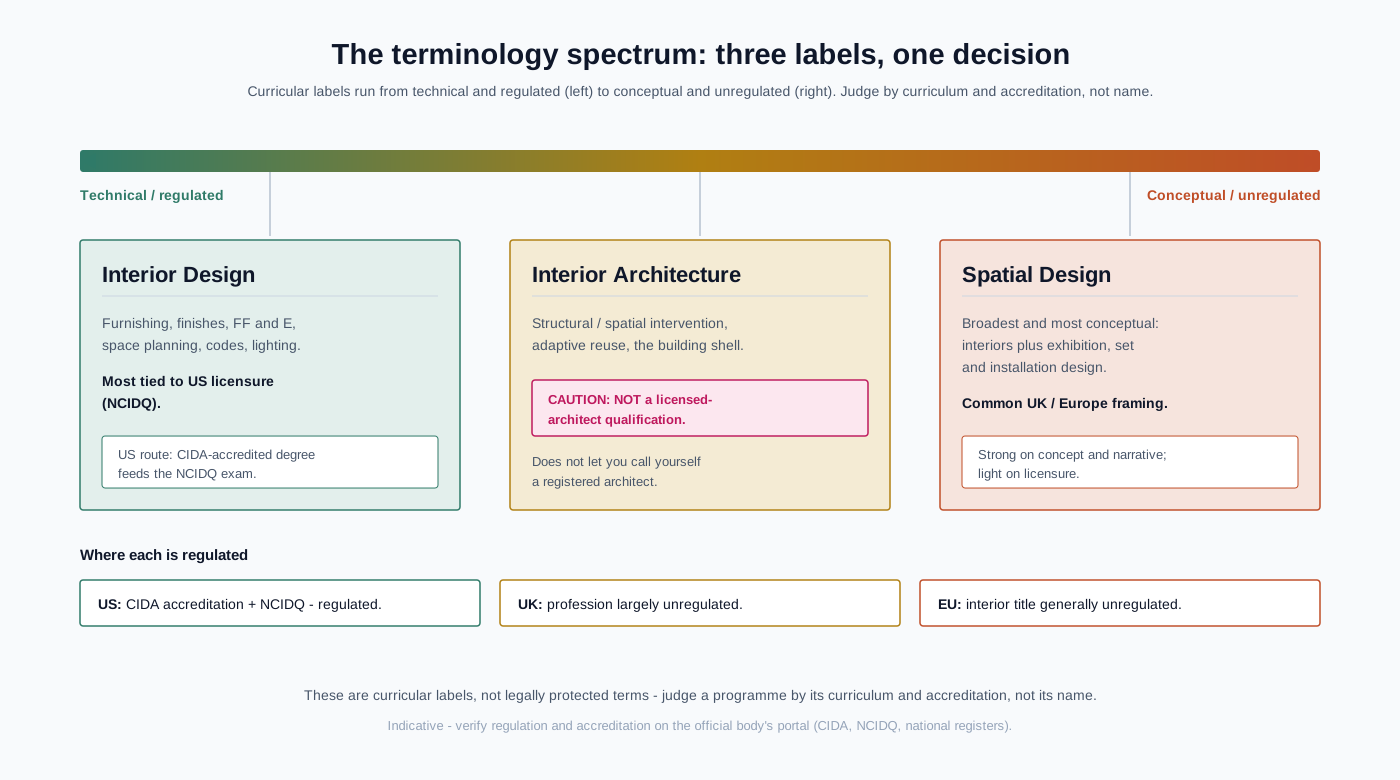
The practical takeaway: in the US, if you want the protected ability to call yourself a licensed interior designer in a regulating state, you will eventually face the NCIDQ (or IDEX in California) — and that exam has its own education-plus-experience prerequisites independent of any master's. In the UK and most of Europe, you can practise without a licence at all, which makes the portfolio and network the things you are really buying.
3. Selection methods — what Indian applicants actually submit
This is the part students underestimate most. For interior design master's abroad, the portfolio is the single most important element. Test scores barely figure; the work is everything.
The portfolio comes first
Each school has its own brief, but the pattern is consistent — recent, curated, well-presented work, usually via SlideRoom.
| School | Portfolio expectation (verify on the official site) |
|---|---|
| Pratt MFA | 12–15 pieces from the last 2–3 years, submitted via SlideRoom |
| Parsons MFA | 10–15 images + an optional 3-minute video; AI-assisted work must be disclosed |
| NYSID | At least 15 images, including at least one comprehensive project with plans, sections, elevations and 3D |
| RCA (UK) | Portfolio plus a video |
A few things to internalise. First, "recent" matters — schools want to see who you are now, not your second-year studio. Second, at least one comprehensive project (plans, sections, elevations, 3D) shows you can resolve a space, not just style it. Third, Parsons' explicit instruction to disclose AI-assisted work is becoming the norm; treat AI as a tool you declare, never a secret you hide.
The GRE — generally not required
Forget the GRE for most design master's. Pratt explicitly states none of its programs require the GRE. Parsons, RISD, NYSID and SCAD do not list it either. The one place to check carefully is Cornell's research-oriented DEA MA, which is more academic and may differ — verify directly.
English-language tests
| Programme | English requirement (approximate — verify) |
|---|---|
| RCA (UK) | IELTS 6.5 overall / 5.5 each band; waived for a recent 2:1+ from a majority-English-speaking country |
| US art schools (typical) | Commonly around IELTS 7 / TOEFL 92, but exact bands vary by school — treat as approximate |
The rest of the file
Beyond portfolio and English, expect a statement of purpose / personal statement, 2–3 letters of recommendation, transcripts, and sometimes an interview or portfolio review. The SOP is where you connect your Indian context — the spaces, materials and constraints you have actually worked with — to the programme's particular strengths.
Timelines — and the closed door for 2026
| Milestone | Approximate timing (verify) |
|---|---|
| RISD application deadline | ~January 5 |
| NYSID recommended dates | ~March 1 (fall) / ~October 1 (spring) — meet these for scholarship consideration |
| RCA September-2026 intake | Already CLOSED — Indian students should target 2027 entry |
| General US/UK fall-2027 cycle | Applications open ~Sept–Oct 2026, close ~Dec 2026–Mar 2027 |
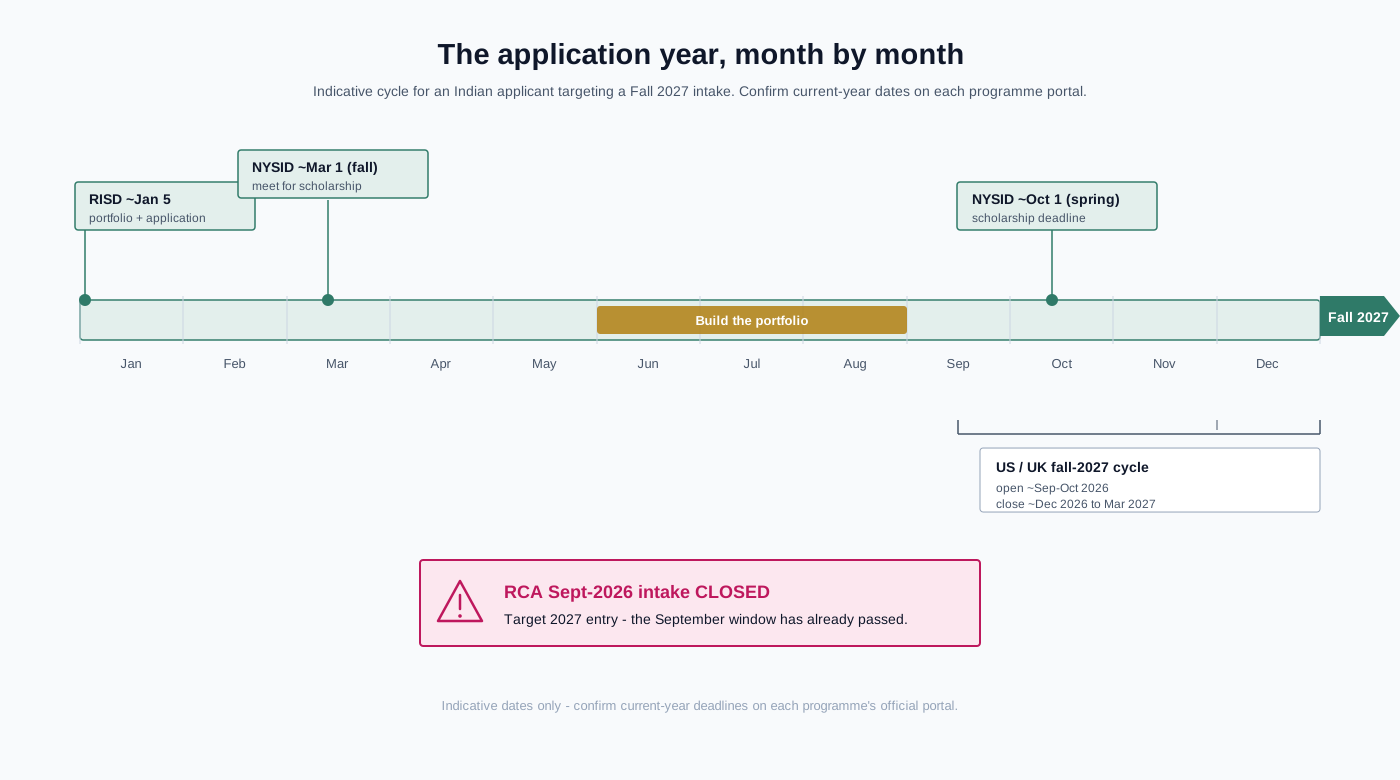
The honest scheduling advice for most readers in 2026: you are likely looking at fall 2027 entry. That is not a delay to mourn — it is a gift of twelve extra months to build the portfolio that actually decides your application.
4. The school shortlist — realistic Indian targets
Ranking here is editorial, not official; these are the schools Indian students most plausibly target. Region by region.
USA
| School | Programme | Notes |
|---|---|---|
| Pratt Institute (pratt.edu) | MFA Interior Design | 60-credit, plus a 24-credit Core year if you have no design BA; no GRE |
| Parsons / The New School (newschool.edu) | MFA Interior Design | ~2 years / 65 credits; disclose AI work |
| RISD (risd.edu) | MDes Interior Architecture | Streams in Adaptive Reuse and Exhibition & Narrative Environments |
| NYSID (nysid.edu) | MFA and MPS | Specialist interior-only school; MPS runs evenings/weekends |
| SCAD (scad.edu) | MFA Interior Design | Large programme, strong industry links |
| Cornell | MA Design & Environmental Analysis | Research-oriented; check GRE policy |
| Drexel | MS Interior Architecture & Design | CIDA-linked, ~3 years |
| Academy of Art, SF | MFA | CIDA-accredited |
UK (the one-year MA hub)
| School | Programme |
|---|---|
| Royal College of Art (rca.ac.uk) | MA Interior Design, 12 months |
| UAL — Chelsea / Camberwell | MA Interior & Spatial Design (check current availability) |
| Glasgow School of Art | MA / MDes interior pathways |
| Kingston · Westminster · Manchester · Edinburgh (ECA) | Interior / interior-architecture master's |
Europe — Milan is the centre of gravity
| School | Programme | Type |
|---|---|---|
| Politecnico di Milano (polimi.it) | MSc Interior & Spatial Design | Public — very low fees |
| Domus Academy, Milan | Master Interior & Living Design | Private |
| IED Milan | Master Interior Design | Private |
| NABA Milan | MA Interior Design | Private |
| IAAD Turin | Interior / design master's | Private |
Canada & Australia (verify the interior stream exists)
- Canada: Emily Carr and OCAD offer an MDes (Design) rather than a clearly-named "Interior Design" MA — verify that a genuine interior stream exists before applying.
- Australia: RMIT — Master of Interior Design (MC275) is the flagship. UTS and Melbourne offer design master's, but a dedicated interior MA at UTS is not confirmed — verify.
5. The cost of education — tuition, living, and the rupee reality
Every number below is approximate and changes every year. Verify on the official .edu page at application time. INR equivalents use approximate rates of USD 1 ≈ INR 85, GBP 1 ≈ INR 107, EUR 1 ≈ INR 92.
US private schools (the expensive end)
| School | Approximate cost (verify) |
|---|---|
| Parsons | ~USD 58,350/yr (~₹99 lakh for a 2-year degree) |
| RISD | ~USD 2,770/credit |
| NYSID | MFA ~USD 24,600/semester; MPS ~USD 1,640/credit |
| SCAD | Grad ~USD 936/credit; international cost of attendance ~USD 66,714/yr |
| Cornell DEA | ~USD 1,940/credit |
| Drexel | ~USD 36,234/yr + fees |
As a rule of thumb, US private design master's run roughly USD 45k–65k per year in tuition — and that is before living costs.
UK (one-year MA, international)
| School | Approximate cost (verify) |
|---|---|
| RCA | ~GBP 39,200 for the whole programme (~₹42 lakh) |
| Glasgow | ~GBP 25,900/yr |
| General UK range | broadly GBP 25k–40k |
Italy — where the maths changes completely
| School | Approximate cost (verify) |
|---|---|
| Politecnico di Milano (public) | ~€3,898/yr maximum (non-EEA); the cheapest option here — roughly ₹3.6 lakh/yr |
| Domus Academy | ~€22,200/yr (2-year) or ~€28,900 total (1-year, 60 ECTS) |
| IED Milan | ~€20,300/yr |
| NABA Milan | ~€20,600/yr |
| Private Milan range | broadly €18k–35k total |
Read that Politecnico number twice. A public Italian master's at roughly ₹3.6 lakh/year is in a different universe from a US private school — and Milan is the global furniture-and-interiors capital. This single fact dismantles the "Europe is unaffordable" myth.
Living costs (per month, approximate)
| City | Per month | Approx INR |
|---|---|---|
| Milan | ~€1,200–1,500 | ~₹1.1–1.4 lakh |
| London | ~GBP 1,200–1,800 | ~₹1.3–1.9 lakh |
| New York | ~USD 2,500–3,500 | ~₹2.1–3.0 lakh |
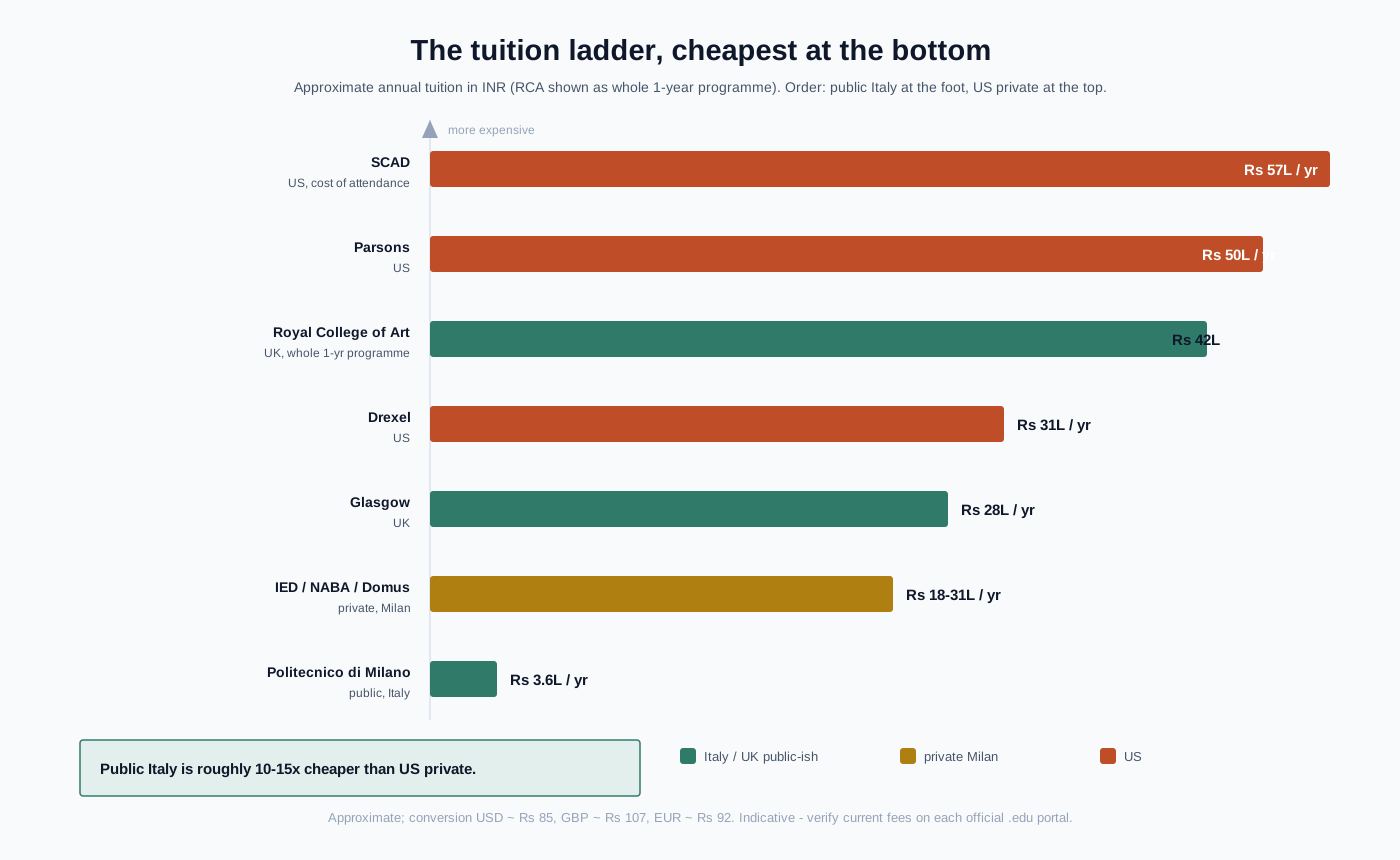
Add living to tuition and the gap widens further: a two-year US private MFA in New York can clear ₹1.5 crore all-in, while a public Politecnico master's with Milan living costs is a small fraction of that. The total cost — not the brochure — is the number that should drive your decision.
6. Funding for Indian students
Funding exists, but the marquee scholarships are genuinely competitive. Map your realistic all-in cost against what you can actually win, and never assume a reach award.
| Scheme | What it offers | Key eligibility (verify) |
|---|---|---|
| Inlaks Shivdasani (inlaksfoundation.org) | Up to USD 120k; art/design assessed mainly on portfolio | Min 65% / CGPA 6.8 for arts/architecture; born on/after 1 Jan 1996 for the 2026 cycle; cannot already hold a foreign PG; opens ~15 Feb 2026, closes late March |
| JN Tata Endowment | Loan-scholarship | Age ≤ 45; ≥ 60% in UG/PG |
| Fulbright-Nehru Master's (usief.org.in) | Funded US study | ~55%+ bachelor's + ≥ 3 years work experience; civil servants ineligible |
| Chevening (chevening.org) | UK study | ~2 years / ~2,800 hours work experience; the 2026-27 cycle closed 7 Oct 2025; next opens ~Aug 2026 |
| Commonwealth Master's | UK study (FCDO) | MoE nomination ~31 May 2026 |
| Institutional merit | RISD / Pratt / SCAD / Polimi awards | Polimi merit can cover full tuition + accommodation |
| Education loans | SBI / HDFC Credila / Avanse | The realistic backbone for most students |
A reality check on the prestige awards: Commonwealth has a sub-1% success rate and Chevening roughly 4–8%. Treat them as reach awards — wonderful if won, never the plan you build on. The two most accessible levers for interior-design students are the portfolio-driven Inlaks (where your work, not your marks, carries the application) and institutional merit — and Politecnico's full-tuition-plus-accommodation merit awards, layered on already-low public fees, can make Milan the cheapest serious option on the table.
7. Visa & post-study work — THE big caveat
This is the most important section in the guide. Read it before you fall in love with any school.
USA — why "design = STEM = 3 years" is usually FALSE for interiors
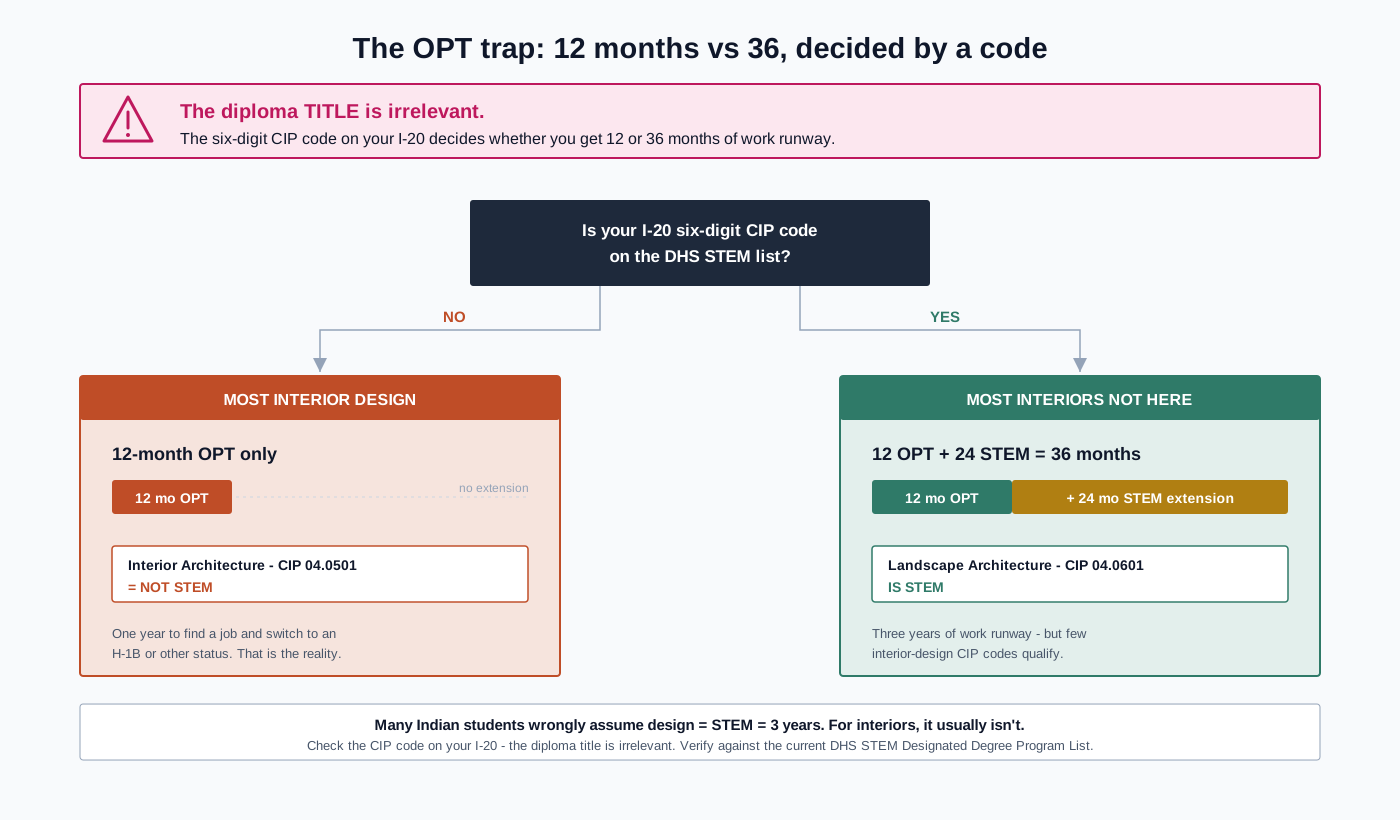
The US F-1 visa gives you 12 months of OPT (Optional Practical Training) after graduation — work that must relate to your major. There is a famous 24-month STEM OPT extension that takes the total to 36 months — but it applies ONLY if your I-20's six-digit CIP code is on the DHS STEM list.
Here is the fact that reshapes the whole decision: Interior Architecture (CIP 04.0501) and most interior-design CIP codes are NOT on the STEM list. So most interior-design master's give you only 12 months of US work, not 36. The diploma title is irrelevant — what matters is the CIP code printed on your I-20. (For contrast: Landscape Architecture, CIP 04.0601, is STEM. Interiors is not.)
Many Indian students wrongly assume "design = STEM = three years in the US." For interior design, check the six-digit CIP code on your I-20 — not the word "architecture" in the course title. That number, and only that number, decides whether you get 12 months or 36.
Other countries
| Country | Post-study work (verify on the official portal) |
|---|---|
| USA | F-1 OPT = 12 months; +24-month STEM extension only if the CIP code is STEM (most interior codes are not) |
| UK | Graduate Route = 2 years now, dropping to 18 months for courses completing after 1 Jan 2027 — apply on/before 31 Dec 2026 to keep 2 years (gov.uk) |
| Australia | Subclass 485 (18 months–4 years by qualification); max age 35; fee ~AUD 4,600 from 1 Mar 2026 |
| Canada | PGWP tied to program length; 2026 field-of-study rules tightening — verify your program qualifies |
| Italy / EU | Post-study residence permit (~12 months), then EU Blue Card — verify on the official portal |
The pattern: the US, the most expensive option, often gives interior designers the shortest legal work runway. The UK gives two years (for now). Europe is unregulated and modest on post-study work but cheap to study in. None of this is a reason not to go — it is a reason to go with your eyes open.
8. A decision framework
Strip away the prestige and it comes down to a few honest questions.
- USA — Expensive, with state-by-state NCIDQ regulation if you want a US licence, and mostly non-STEM, 12-month post-study work for interiors. Choose it for a specific school, faculty or specialism worth the premium, not for a work runway it usually will not give you.
- UK — A fast one-year MA, cheaper than two US years, with 2-year post-study work shrinking to 18 months. Strong for spatial/conceptual interiors and for returning to India quickly with a respected degree.
- Italy / Europe — Milan is the hub. Politecnico is public and remarkably cheap; Domus, IED and NABA are private and design-forward. Practice is unregulated, so you are buying the studio, the network and the city — at a fraction of US cost.
- Come back to India — If your goal is to practise in India, if funding is uncertain, or if the maths simply does not work, an Indian interior master's leaves you debt-free and well-placed at home. Read the pillar alongside it.
Above all: portfolio over prestige. A strong body of work opens more doors — and more scholarship money — than a famous logo on a degree you cannot afford.
9. Myths & pitfalls
- Myth: "A design master's abroad = STEM = three years of US work." FALSE for interiors. Most interior CIP codes are not on the DHS STEM list, so you usually get 12 months, not 36. Check the CIP code on your I-20.
- Myth: "An MFA or MA lets me practise as an interior designer anywhere." Mostly true in the UK and Europe (unregulated) — but the US regulates state-by-state via NCIDQ/IDEX, with its own education-and-experience prerequisites.
- Myth: "No CIDA accreditation means a bad programme." FALSE for post-professional master's. CIDA primarily accredits entry-level degrees; many master's are not CIDA-accreditable, and that is normal.
- Myth: "Europe is unaffordable." FALSE. Politecnico di Milano is a public school at roughly ₹3.6 lakh/year — cheaper than most Indian private options, in the world's interiors capital.
- Myth: "I need the GRE." Generally FALSE for design. Pratt explicitly requires none of its programs to submit it; most peer schools do not list it. (Verify Cornell's research MA.)
- Pitfall: treating the portfolio as an afterthought. It is the single most important component everywhere — build it over months, not in a panicked week. See Building your architecture portfolio.
- Pitfall: missing the visa clock. The UK Graduate Route shortens for courses finishing after 1 Jan 2027; Australia has an age cap; Canada's field-of-study rules are tightening. Verify before you deposit.
References and Further Reading
All figures, fees, deadlines and eligibility rules above are approximate and change yearly. Always verify on the official university (.edu) page and the scheme's own site at application time. Do treat every rupee figure as a guide, not a quote.
Official / Statutory
- CIDA — cida.org (US interior design accreditation; CHEA-recognised)
- NCIDQ / CIDQ — cidq.org (US interior design licensing exam; IDEX in California)
- NAAB — naab.org (US architecture accreditation — the separate M.Arch track)
- DHS STEM list — studyinthestates.dhs.gov / ice.gov (check whether a CIP code is STEM-designated)
- UK visas & the Graduate Route — gov.uk
- University official pages (.edu / university domains) for current tuition, requirements and deadlines
Schools (verify programmes & fees on their own domains)
- Pratt — pratt.edu · Parsons / The New School — newschool.edu · RISD — risd.edu
- NYSID — nysid.edu · SCAD — scad.edu · Politecnico di Milano — polimi.it · RCA — rca.ac.uk
Funding & Scholarships
- Inlaks Shivdasani Foundation — inlaksfoundation.org (portfolio-led; 2026 cycle eligibility)
- JN Tata Endowment — official site (loan-scholarship)
- Fulbright-Nehru / USIEF — usief.org.in (US study; work-experience requirement)
- Chevening — chevening.org and Commonwealth Scholarships (UK; work experience; MoE nomination)
- Education loans — SBI, HDFC Credila, Avanse
Companion Studio Matrx Guides
- Should you do a Master's in Architecture or Design? (the decision pillar)
- A Master's in Interior Design in India: A 2026 Guide
- The M.Arch Abroad · The M.Arch in India
- B.Des interior design student track · Building your architecture portfolio
- Career pathways after B.Arch · Architecture schools shortlist (India)
- Sections: Students · Architects · Landscape Architects · All Guides
Author's Note: I have watched gifted interior designers sign for a US private MFA on the strength of a brochure and a belief — "design is STEM, I'll get three years to work" — only to learn in their final term that the CIP code on their I-20 gave them twelve months, not thirty-six. None of that diminishes the value of a great education abroad; Milan, London and New York can change how you see a room forever. It just means the homework comes first: read the visa code, run the all-in cost in rupees honestly, build the portfolio that actually decides everything, and let the answer — even if it points back to India — be the one your future self will thank you for.
Disclaimer: Fees, exam policies, scholarship eligibility, deadlines, accreditation, CIP/STEM designations and visa rules are revised every year and differ by school and jurisdiction. Every number here is approximate and provided for general guidance only. Verify all details on the official university (.edu) pages and the relevant statutory and scholarship bodies before making any decision. This guide is informational and carries no liability.
Export this guide
Related Guides — Deep-dive reading
The M.Arch Abroad: USA, UK, Europe & Beyond — A 2026 Guide for Indian Students
Degree structures, accreditation, selection, cost, funding and visas — what an Indian student must actually know before applying for a Master of Architecture overseas.
Student FoundationsShould You Do a Master's in Architecture or Interior Design? An Honest Decision Framework for India (2026)
Whether, when, why, and where — the read-me-first guide to deciding on a postgraduate degree in architecture or interior design, with India-vs-abroad costs, the licence and accreditation reality, and a clear decision tree.
Student FoundationsA Master's in Interior Design in India: Degrees, Entrance, Institutions & Cost (2026)
An honest, India-first guide to the confusingly-named degree landscape, the entrance methods (CEED, NID DAT and institute tests), a real institution shortlist, and what it all actually costs — in a field that has no statutory licence.
Student FoundationsRelated Tools — Try Free
Apartment Interior Planning Checklist
51-item checklist across structural, ceiling, lighting, furniture, storage, electrical, kitchen, bathroom.
ChecklistConcept Generator
Get 3 AI-generated design concepts for any room with style, materials, and cost estimate.
DesignAIFalse Ceiling Cost Estimator
Live ₹/sqft across 8 ceiling types — POP, gypsum, designer, metal, PVC, wooden — with cove and spot lighting for 20 Indian cities.
Cost Calculator