
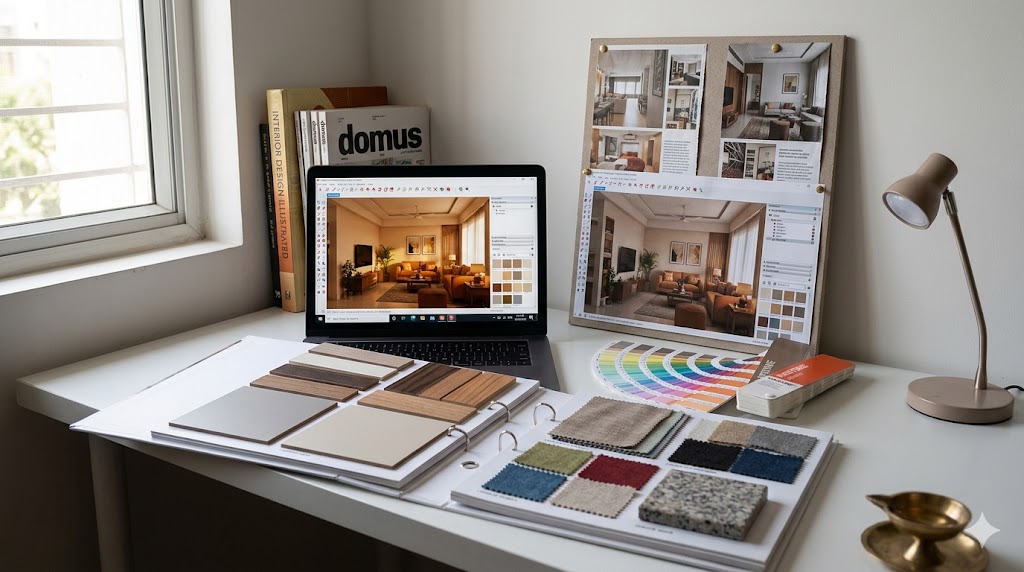
B.Des Interior Design — The Student Track
The 2026 Reference for the Indian B.Des Interior Aspirant — How It Differs from B.Arch, the Top Schools (NID · Pearl · Symbiosis · NIFT · Sushant), the Four-Year Curriculum, the Software Stack, FF&E and Materials Vocabulary, Studio Discipline, Portfolio Building, Internship Pathways, Career Trajectories, and the Long-Horizon Practice Map
India's interior design education sits in a curious gap. The architecture aspirant has a clear pathway — NATA, B.Arch, COA registration, the Architects Act 1972 statutory route. The interior design aspirant has no equivalent statutory framework. The Indian Institute of Interior Designers (IIID), founded in 1972 (the same year as the Architects Act), remains a voluntary professional body; no Indian statute defines, registers, or regulates the interior design profession. The B.Des Interior Design degree is therefore a design-education credential rather than a statutory-professional credential — and that distinction shapes the entire ecosystem of schools, curricula, and careers.
This guide is the working reference for the Indian B.Des Interior Design aspirant. It is the parallel-track counterpart to the NATA & JEE B.Arch Entrance Preparation guide and the Architecture Schools Shortlist 2026 guide. The orientation throughout is towards the candidate who has chosen interior design as a primary aspiration — not as a fallback for missed B.Arch admission. The B.Des Interior path is meaningful in its own right; the candidate who treats it as second-best does not flourish in it.
The treatment is structured around four clusters. The map cluster (sections 1-3) covers the structural distinction from B.Arch, the IIID framework, and the entrance landscape across major schools. The curriculum cluster (sections 4-7) covers the four-year curriculum, the software stack, the materials and FF&E vocabulary, and the lighting / acoustics layer. The practice cluster (sections 8-10) covers internship pathways, portfolio building, and the studio discipline. The career cluster (sections 11-14) covers first-job pathways, salary expectations, the long-horizon practice map, and the relationship with architects on shared projects.
"Interior design is not a smaller version of architecture. It is a discipline of its own — focused, material-rich, FF&E-deep, and increasingly client-direct. The candidate who chooses it for the right reasons builds a career as substantial as any architect's." — IIID-affiliated faculty paraphrase
1. B.Des Interior vs B.Arch — The Three Practical Differences
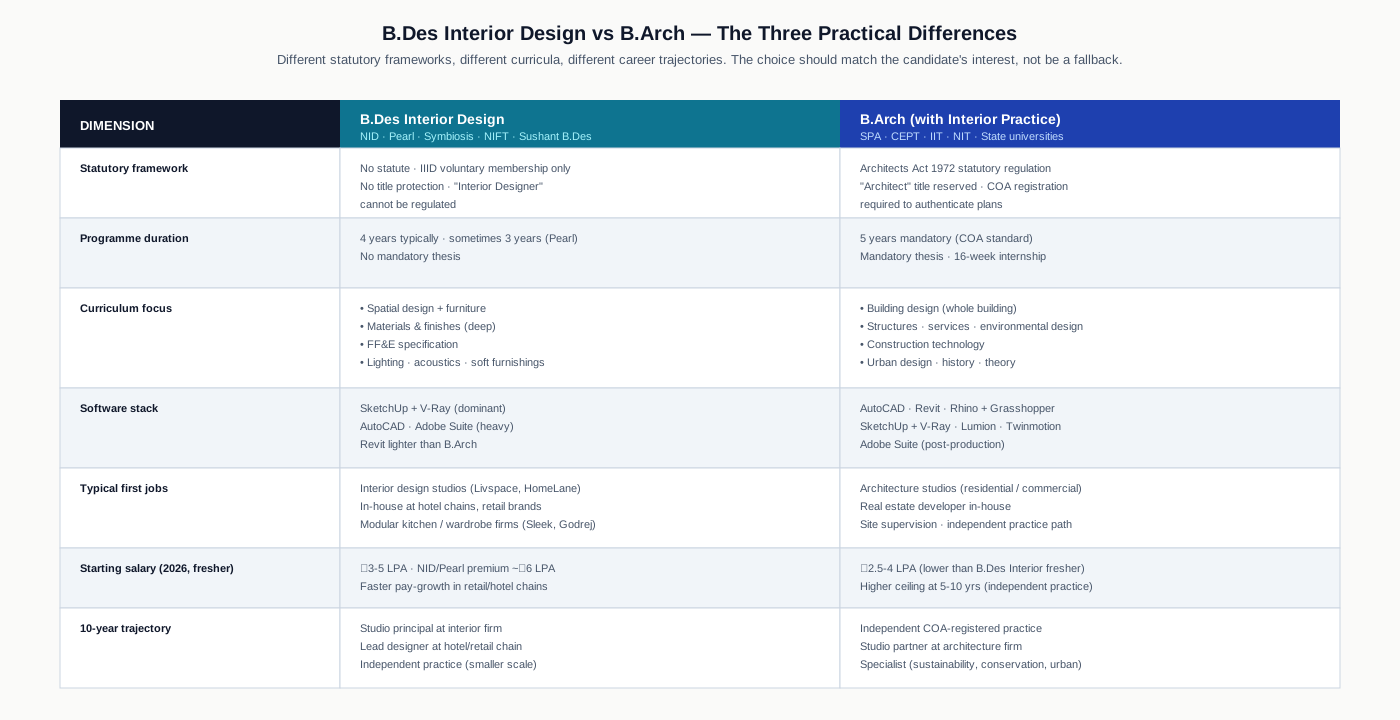
Before the candidate chooses a school, they must understand how B.Des Interior differs structurally from B.Arch. The differences are not just curriculum-deep; they are statutory, programmatic, and career-trajectory deep.
1.1 Statutory Framework
B.Arch is governed by the Architects Act 1972 — graduates from COA-recognised programmes can register as Architects, can authenticate building plans, and can use the title Architect in India. B.Des Interior has no equivalent. The Indian Institute of Interior Designers (IIID) is a voluntary body; IIID membership signals professional commitment but is not legally required. Anyone in India can call themselves an Interior Designer — there is no title protection, no statutory qualification floor, no mandatory register.
This freedom is also a constraint. The B.Des Interior graduate does not authenticate plans, does not have a statutorily-defined scope of services, and operates within the contractual scope agreed with the client. The architect's drawings sit on top of the interior designer's; the building's statutory submission depends on the architect, not the interior designer.
The practical implication for the student: the B.Des Interior path is contract-based. The interior designer's value is in the quality and clarity of the work delivered, supported by reputation and portfolio. There is no statutory floor protecting the profession, but also no statutory ceiling limiting it.
1.2 Programme Duration
B.Arch is five years by COA standard; B.Des Interior is typically four years (some institutions, like Pearl Academy in certain streams, run three-year B.Des programmes). The shorter duration reflects the narrower disciplinary scope — interior design does not need the structural-engineering, urban-design, or building-services depth that B.Arch requires for whole-building practice.
1.3 Curriculum Focus
B.Arch teaches whole-building design. B.Des Interior teaches interior space design and FF&E. The four-year B.Des Interior curriculum is therefore deeper on:
- Materials and finishes (laminate, veneer, stone, fabric, paint — to a depth B.Arch never reaches)
- FF&E specification (furniture, fixtures, equipment — the operational vocabulary)
- Lighting design (layered lighting, CCT, CRI, fixture types)
- Soft furnishings (curtains, upholstery, rugs)
- Acoustics (where B.Arch treats it briefly)
- Smart-home and audio-visual integration
And lighter on:
- Structural design and analysis
- Building services (HVAC, plumbing) at the design level
- Urban design and planning
- Architectural history and theory at the depth of B.Arch
- Construction technology at the building scale
For the candidate whose interest is what people see, touch, and live with in a finished space — the materials, the furniture, the lighting, the atmosphere — B.Des Interior is the more direct path. For the candidate whose interest is the whole building — the structure, the form, the urban context, the statutory framework — B.Arch is the more direct path.
1.4 Career Trajectory
B.Arch graduates typically join architecture studios, real-estate developers, or specialised design-build firms; the long-horizon trajectory points to independent COA-registered practice. B.Des Interior graduates typically join interior design studios (Livspace, HomeLane, design-led independent firms), in-house teams at hotel chains and retail brands (Taj, ITC, Lemon Tree, large retailers), or modular kitchen / wardrobe firms (Sleek, Godrej, Nilkamal, Wood & Beyond). The long-horizon trajectory often leads to studio-principal at an interior firm, lead designer at a hospitality / retail chain, or an independent practice in residential and commercial interiors.
Starting salaries for B.Des Interior graduates from top schools are typically higher than for B.Arch graduates from comparable schools (₹3-5 LPA vs ₹2.5-4 LPA, with NID/Pearl premium adding ~₹1L) — because the interior design industry has more direct industry-led pay structures. The 10-year trajectory inverts this: B.Arch graduates with established independent practices reach higher ceilings (₹25+ LPA) than typical B.Des Interior trajectories, though specialist B.Des Interior trajectories (lighting design, hospitality interior, exhibition design) can match B.Arch ceilings.
2. The Indian Institute of Interior Designers (IIID) Framework
The IIID was established in 1972 — the same year as the Architects Act — by a group of practising interior designers who recognised the absence of a professional body. In 2026, the IIID:
| Dimension | IIID detail |
|---|---|
| Founded | 1972 |
| Membership | Voluntary; multiple categories (Associate, Fellow, Student, Practising) |
| Code of Ethics | Voluntary, applies only to members |
| Educational standards | No standardisation authority — the IIID does not accredit B.Des Interior programmes |
| Practising-designer register | Maintained by IIID for members; no legal status |
| Continuing professional development | Voluntary CPD framework |
| Annual events | IIID Awards, regional chapter events, design weeks |
The candidate's relationship to the IIID is aspirational, not gatekeeping. Joining IIID after graduation signals professional commitment and provides access to networks, awards, and continuing education — but it is not required to practise. Most major interior design studios in India have IIID-affiliated principals; many do not.
The deeper context — including how interior designers and architects coordinate on residential projects in India — is covered in the practitioner-side Scope Boundaries — Architect, Interior Designer & Contractor guide. Students reading the present guide should glance at that practitioner-side reference towards the end of Year 3 / start of Year 4 — it explains the contracting environment that the B.Des Interior graduate will enter.
3. The Entrance Landscape
The B.Des Interior admission ecosystem is heterogeneous. Each major school operates its own admission test; candidates aiming at multiple schools must prepare for multiple formats.
3.1 The Major Schools — Admission Routes
| School | Test | Typical timeline | Typical intake |
|---|---|---|---|
| NID Ahmedabad / Bengaluru / Vijayawada | DAT (Design Aptitude Test) — Mains + Studio Test | Mains Dec, Studio Test Mar-Apr | ~30 per stream |
| Pearl Academy (Delhi/Mumbai/Jaipur/Bengaluru) | Pearl GAT (General Aptitude Test) | Multiple cycles, Apr-Jun | ~60 across campuses |
| Symbiosis Institute of Design, Pune | SET-Design | May | ~80 |
| NIFT Delhi/Mumbai/Bengaluru | NIFT Entrance Exam | Feb | ~40 (interior space focus) |
| Sushant University, Gurgaon (B.Des Interior) | NATA / Pearl-style + portfolio | Multiple cycles | ~60 |
| Srishti Institute of Art, Design and Technology | Srishti Entrance | Multiple cycles | ~40 (interior stream) |
| MIT-ADT University Pune | MIT-ADT entrance | Multiple cycles | Variable |
| CEPT (B.Des in Interior, when offered) | NATA + CEPT Studio Test | Standard CEPT cycle | ~30 |
| State universities offering B.Des Interior | Varies by state | Varies | Variable |
3.2 NID DAT — The Most Rigorous Design-Led Admission
The National Institute of Design's Design Aptitude Test (DAT) is the most distinctive and most-rigorous design-led admission in India. The two-stage structure:
DAT Mains (December, written exam): Drawing, visualisation, cognitive abilities, observation, design awareness. ~3-hour written paper.
DAT Studio Test (Mar-Apr, in-person at NID campus, three days): On-the-spot observation drawing, visual reasoning, group activity, individual interview, mini-project work. The Studio Test is the most decisive filter — candidates who pass Mains comfortably are still rejected at Studio Test if their design-thinking under pressure is weak.
NID's pedagogy is craft-and-design-led — strong cross-disciplinary coverage including product design, textile design, communication design, and lifestyle accessory design alongside Interior Space & Lifestyle Design. The B.Des Interior graduate from NID is exposed to design thinking that crosses into product, branding, and craft — broader than typical interior design education.
3.3 Pearl GAT — Industry-Aligned
Pearl Academy's General Aptitude Test (GAT) is more commercial in character — emphasising visual communication, observation, reasoning, and current-affairs awareness. Pearl's pedagogy is industry-aligned with strong commercial-interior emphasis (retail, hospitality, brand design).
3.4 Symbiosis SET-Design
Symbiosis Institute of Design (Pune) admits via the Symbiosis Entrance Test for Design (SET-Design). The test covers design awareness, visualisation, and aptitude. Symbiosis's pedagogy combines design with management — useful for the candidate aiming at studio-principal or design-management trajectories.
3.5 NIFT Entrance
NIFT (National Institute of Fashion Technology) operates its own entrance with both written (CAT — Creative Ability Test, GAT — General Ability Test) and Situation Test. While NIFT is best known for fashion, its B.Des in Interior Space & Lifestyle Design at the Bengaluru and Delhi campuses is a solid B.Des Interior offering.
3.6 The Portfolio Layer
Beyond the test, most B.Des Interior schools require a portfolio at the application stage — typically 8-15 pages of original work showing drawings, photographs, models, paintings, or any creative output. The portfolio is a meaningful filter; candidates with strong portfolios and moderate test scores often outrank candidates with strong test scores and weak portfolios. Portfolio building begins in Class 11; the Building Your Architecture Portfolio guide covers the universal portfolio-building framework (the principles transfer from B.Arch to B.Des).
4. The Four-Year Curriculum
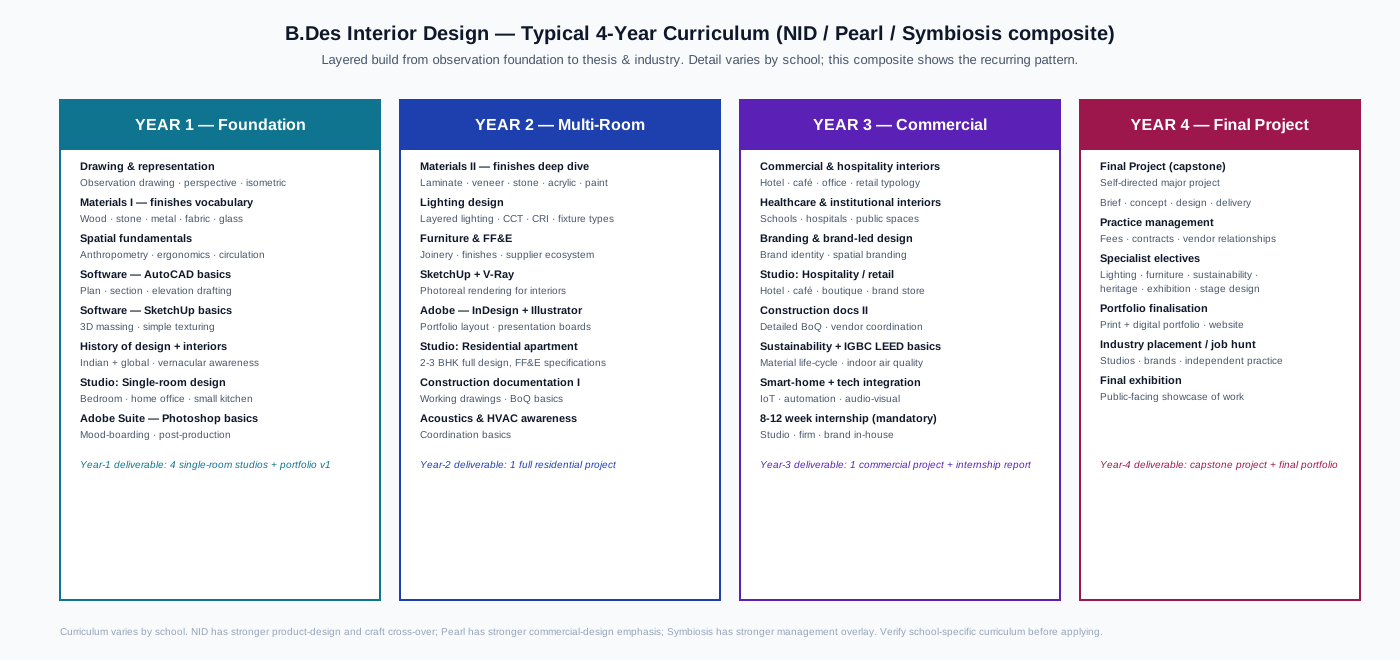
The B.Des Interior curriculum varies by school, but a recurring four-year pattern holds across NID, Pearl, Symbiosis, and other major institutions.
4.1 Year 1 — Foundation
The first year builds the foundational discipline:
- Drawing & representation — observation drawing, perspective, isometric, paraline (drawing-discipline overlap with B.Arch Module 1)
- Materials I — finishes vocabulary — wood, stone, metal, fabric, glass at introductory depth
- Spatial fundamentals — anthropometry (standard human dimensions), ergonomics, circulation
- AutoCAD basics — plan, section, elevation drafting
- SketchUp basics — 3D massing, simple texturing, view setup
- Adobe Photoshop basics — mood-boarding, basic post-production
- History of design + interiors — Indian + global, vernacular awareness, key periods (Bauhaus, mid-century modern, post-modernism, contemporary)
- Studio: Single-room design — bedroom, home office, small kitchen — typically four single-room studio projects
The Year 1 deliverable is a portfolio v1 with single-room studio projects, drawing exercises, and material studies.
4.2 Year 2 — Multi-Room
Year 2 scales from single rooms to multi-room residential design:
- Materials II — finishes deep dive — laminate, veneer, stone, acrylic, paint, hardware (the ten material families covered in detail in the Wardrobe Finish Ideas guide)
- Lighting design — layered lighting (ambient, task, accent), CCT (correlated colour temperature), CRI (colour rendering index), fixture types, control systems
- Furniture & FF&E — joinery, fabrication, supplier ecosystem (Indian + global brands), specification writing
- SketchUp + V-Ray — photoreal rendering for interiors, the dominant Indian rendering pipeline for B.Des graduates
- Adobe — InDesign + Illustrator — portfolio layout, presentation boards, branding integration
- Studio: Residential apartment — full 2-3 BHK design with FF&E specifications
- Construction documentation I — working drawings, BoQ basics, material schedules
- Acoustics & HVAC awareness — coordination basics, where the interior designer must coordinate with consultants
4.3 Year 3 — Commercial & Branding
Year 3 broadens to commercial and institutional interiors:
- Commercial & hospitality interiors — hotel, café, office, retail typologies
- Healthcare & institutional interiors — schools, hospitals, public spaces
- Branding & brand-led design — brand identity translation to spatial design
- Studio: Hospitality / retail — hotel, café, boutique, brand store project
- Construction documentation II — detailed BoQ, vendor coordination, site management exposure
- Sustainability + IGBC LEED basics — material life-cycle, indoor air quality, low-VOC, sustainable sourcing
- Smart-home + tech integration — IoT, automation, audio-visual systems
- Internship (8-12 weeks) — typically at studios, brand in-house teams, or design-build firms
4.4 Year 4 — Final Project
Year 4 is the capstone year:
- Final Project — self-directed major project (brief, concept, design, delivery)
- Practice management — fees, contracts, vendor relationships
- Specialist electives — lighting design, furniture design, sustainability, heritage interiors, exhibition design, stage design
- Portfolio finalisation — print + digital portfolio, website
- Industry placement / job hunt
- Final exhibition — public-facing showcase
The Final Project deliverable is a comprehensive portfolio piece — typically the candidate's most-shown work in first-job interviews.
4.5 The Mandatory Internship
Year 3 internships are typically 8-12 weeks, placed at one of:
- Interior design studios — established firms (Studio Lotus interior arm, Morphogenesis interior, Khosla Associates) or smaller boutique studios
- Hotel chain in-house design teams — Taj Hotels Resorts and Palaces, ITC, Oberoi, Lemon Tree, Marriott India operations
- Retail brand in-house design teams — Reliance Retail, Trent (Tata), Aditya Birla Fashion, large-format retail chains
- Modular kitchen / wardrobe firms — Sleek (Asian Paints subsidiary), Godrej Interio, Nilkamal, regional firms
- Furniture brands — Stanley, Wood's Royal Oak, Pepperfry, Urban Ladder
- Exhibition / event design firms — for candidates exploring exhibition specialism
The internship is meaningfully consequential — many B.Des Interior graduates receive their first-job offers from their internship firm.
5. The Software Stack
The B.Des Interior software stack differs from the B.Arch software stack in two respects: SketchUp + V-Ray dominates over Revit, and Adobe Suite usage is heavier (because portfolio production and brand-presentation are more central).
| Software | Year of introduction | Use for | Time-to-basic |
|---|---|---|---|
| AutoCAD | Year 1 | 2D drafting — plan, section, elevation, working drawings | ~20 hrs |
| SketchUp | Year 1 | 3D modelling — quick concept, interior massing | ~12 hrs |
| V-Ray for SketchUp / 3ds Max | Year 2 | Photoreal rendering | ~40 hrs |
| Adobe Photoshop | Year 1 | Mood-boards, render post-production | ~15 hrs |
| Adobe InDesign | Year 2 | Portfolio layout, presentation boards | ~10 hrs |
| Adobe Illustrator | Year 2 | Logo, branding integration, vector graphics | ~15 hrs |
| Lumion / Twinmotion | Year 3 | Real-time rendering, walkthroughs | ~10 hrs |
| Revit (introductory) | Year 3 | BIM coordination basics | ~30 hrs |
| Figma | Year 3 | Portfolio web design, presentation | ~5 hrs |
| AutoCAD Architecture / Chief Architect | Optional | Specialised interior CAD | ~15 hrs |
The dominant production pipeline is SketchUp + V-Ray + Photoshop. A B.Des Interior graduate fluent in this pipeline can produce client-ready interior renderings with measurable speed advantage over a Revit-only practitioner. The Software Stack — A Working Learning Path guide covers the broader software ecosystem; the B.Des Interior student should reference it but treat SketchUp + V-Ray as the primary fluency target rather than the secondary Revit fluency that B.Arch students target.
5.1 Indian Licensing for B.Des Interior Students
| Software | Indian student licence | Annual cost |
|---|---|---|
| AutoCAD | Autodesk Education (3-year free) | Free |
| SketchUp | Free Web version; Pro education licence available | Free / discounted |
| V-Ray | Chaos Group student licence (1 year) | Free / discounted |
| Adobe Creative Cloud | Adobe Student plan | ~₹880/month |
| Lumion / Twinmotion | Education licences available | Free |
| Revit | Autodesk Education | Free |
| Figma | Free Education plan | Free |
Total software cost for a four-year B.Des Interior student is typically ₹3,000-5,000 per year (Adobe Student plan dominant). All other software is free under student licensing.
6. Materials & FF&E Vocabulary — The Core Practical Knowledge
The B.Des Interior graduate's everyday operational knowledge is materials and FF&E. This section maps the vocabulary that the four-year curriculum builds.
6.1 The Material Families
| Family | Examples | Indian standards | Where you specify |
|---|---|---|---|
| Wood — solid | Teak, sheesham, oak, walnut, mahogany | IS 1141 (timber); IS 287 | Furniture, flooring, panelling |
| Wood — engineered | Plywood (BWP, BWR), MDF, particle board, blockboard | IS 1659 (BWP plywood); IS 12406 (MDF) | Wardrobe carcasses, modular kitchen, panelling |
| Wood finishes | Laminate, veneer, PU paint, melamine | IS 2046 (HPL); IS 1328 (decorative veneer) | Wardrobe doors, kitchen shutters, panelling — see Wardrobe Finish Ideas |
| Stone | Granite, marble, sandstone, limestone, kota, basalt | IS 1130 (marble); IS 14223 | Flooring, kitchen counters, claddings |
| Metal | Mild steel, stainless steel, aluminium, brass, copper | IS 1977; IS 5905 | Hardware, fixtures, structural elements |
| Glass | Float, toughened, laminated, frosted, mirror | IS 14900; IS 2553 | Doors, partitions, balcony rails, mirrors |
| Fabric | Cotton, linen, jute, silk, synthetic, leather | Multiple textile standards | Upholstery, curtains, soft furnishings |
| Paint & finish | Emulsion, enamel, distemper, textured, Venetian | IS 5410; IS 133 | Walls, ceilings, accent finishes |
| Hardware | Hinges, drawer slides, handles, locks | IS 363 (hinges) | Furniture, doors, kitchen, wardrobe |
| Floor & tile | Vitrified, ceramic, natural stone, terrazzo, oxide, IPS, wood-veneer | IS 13753 (vitrified); IS 13755 | Flooring throughout |
The material knowledge is not memorised in a single year — it accumulates over four years of studio work, vendor visits, and hands-on specification writing.
6.2 The FF&E Specification Skill
FF&E (Furniture, Fixtures, Equipment) is the operational deliverable that distinguishes B.Des Interior practice. The graduate must be able to specify — not just select — every item in a finished space:
| Specification component | What it includes |
|---|---|
| Reference number | Unique identifier in the FF&E schedule |
| Item description | Plain-language identification |
| Manufacturer / brand | Specific vendor, with sub-vendor where applicable |
| Model / SKU | The vendor's catalogue reference |
| Dimensions | Length, width, height, depth |
| Materials | Substrate, finish, fabric (if applicable) |
| Colour / finish code | RAL or vendor-specific |
| Quantity | Per the schedule |
| Unit price & total | For the BoQ |
| Lead time | Critical for project timeline |
| Installation requirement | Vendor-led, designer-led, contractor-coordinated |
The FF&E schedule for a 3-BHK residential project typically runs 80-150 line items; for a hotel project, 800-2,500 line items.
6.3 The Lighting Layer
Lighting is one of the most distinctive B.Des Interior deepenings. The graduate must be fluent in:
- Layered lighting — ambient (general illumination), task (focused work), accent (highlighting features)
- Colour Temperature (CCT) — warm 2700-3000K (residential evenings, hospitality), neutral 3500-4000K (offices), cool 5000-6500K (clinical/retail)
- Colour Rendering Index (CRI) — >90 for residential and retail, >80 acceptable for general-purpose
- Lumen output and lux requirements — 100-200 lux ambient living; 300-500 lux task/kitchen; 500-1000 lux office working surfaces
- Fixture types — recessed, surface, suspended, track, wall, floor — and Indian + global brand ecosystem
- Control systems — manual, dimmable, programmable, smart-home integration
6.4 Acoustics — The Often-Skipped Layer
Interior acoustics is treated lightly in many B.Des Interior programmes, but matters in commercial and hospitality projects:
- Reverberation time (RT) — <0.5s for offices, ~0.7-1.0s for restaurants/cafés, ~0.6s for residential living
- NRC (Noise Reduction Coefficient) of materials — carpets, soft furnishings, acoustic panels, ceiling treatments
- STC (Sound Transmission Class) of partitions — 35-45 STC for office partitions, 50-60 for hotel guest-room walls
The candidate aiming at hospitality interior design specialism should over-prepare on acoustics relative to the standard curriculum.
7. Studio Discipline — How B.Des Interior Studios Operate
The studio discipline at B.Des Interior schools differs subtly from B.Arch studios:
| Dimension | B.Des Interior studio | B.Arch studio |
|---|---|---|
| Hours per week | 12-16 contact hours | 16-20 contact hours |
| Group size | Smaller — typically 8-15 students per studio | Larger — typically 15-25 |
| Faculty | Often practising interior designers, mix of full-time + visiting | Mix of practising architects and academics |
| Project duration | 6-10 weeks per project, multiple per semester | 12-16 weeks per project |
| Emphasis | Material exploration, FF&E, atmosphere | Spatial concept, volumetric reading, structure |
| Site visits | Frequent — vendors, fabrication units, completed interiors | Frequent — building sites, completed buildings |
| Output | Material samples, FF&E samples, V-Ray rendered boards, presentation | Plans, sections, 3D renderings, models, presentation |
The studio discipline of daily presence still applies — the studio space is the laboratory. The Studio Jury Survival guide covers the universal jury-survival framework; B.Des Interior juries lean towards material-and-detail interrogation, while B.Arch juries lean towards concept-and-structure interrogation, but the underlying discipline is shared.
8. The Internship Pathway
Year 3 internships are the most consequential single experience in the B.Des Interior calendar. The first-job pipeline often runs through the internship firm.
8.1 Where to Intern
Interior design studios — boutique: Studio Lotus (interior arm), Morphogenesis (interior team), Khosla Associates (interior projects), Sameep Padora & Associates (sP+a interior work), Anagram Architects, Ashiesh Shah, ASRA, Bobby Mukherji, Sussanne Khan's The Charcoal Project, Studio Maine, Adda. Each studio has its own admission process for interns.
Hotel chain in-house design teams: Taj Hotels Resorts and Palaces (TIDC — Taj Interior Design Centre), ITC Hotels, Oberoi Group, Lemon Tree, Marriott India, Hyatt India. Internship at these chains offers exposure to brand-aligned-design practice at scale.
Retail brand in-house teams: Reliance Retail, Trent, Aditya Birla Fashion & Retail, Westside, Lifestyle. Retail interior design has shorter cycles and high project throughput.
Modular kitchen / wardrobe firms: Sleek (Asian Paints), Godrej Interio, Nilkamal, Wood & Beyond, Hettich (German global), Häfele India. These firms operate at industrial scale and offer exposure to product-and-design integration.
Exhibition / event design firms: Mathilda Design, Shobha Mehta & Associates, exhibition booth designers for trade fairs. Niche but useful for the candidate aiming at exhibition specialism.
Furniture brands: Stanley, Wood's Royal Oak, Urban Ladder (Reliance Retail), Pepperfry. These brands offer product design + interior-context exposure.
8.2 The Internship Application Discipline
The application is portfolio-led: 8-12 page PDF showcasing studio work, plus a one-page CV (the Architecture Internship Readiness guide covers the universal CV-and-cover-letter framework). Apply 4-6 months before the desired start date; many leading studios fill internships 6+ months in advance.
8.3 What to Optimise For
The candidate's goal in the internship should be exposure across the project lifecycle — not just rendering. The strongest internship learning comes from:
- Vendor visits — fabrication units, factories, showrooms
- Site visits during construction — observing how drawings translate to execution
- Material specification writing — actual project FF&E schedules
- Client presentations — observing how design is communicated
- Snagging and handover — how a project closes
A studio that confines the intern to rendering for 12 weeks is offering a narrower experience than a studio that rotates the intern across these phases.
9. Portfolio Building for B.Des Interior
The B.Des Interior portfolio differs from the B.Arch portfolio in three respects:
1. More material samples + photographs. Interior design portfolios benefit from physical material samples, photographs of completed work (where the candidate has had any, even student work), and detail shots.
2. Stronger brand / presentation layer. B.Des Interior students typically use heavier Adobe InDesign / Illustrator post-production than B.Arch students.
3. Atmospheric renders dominate. V-Ray photoreal renders showing atmosphere (lighting, materials in context) carry more weight than the concept-diagram-led B.Arch portfolio.
The universal portfolio framework — the layout grid, the project-spread template, the five stages of portfolio building — is covered in Building Your Architecture Portfolio. The B.Des Interior student should follow that framework with the three adaptations above.
9.1 The Portfolio Layout
A typical B.Des Interior portfolio:
- Cover — name, B.Des candidate, contact, single signature image
- About — one-paragraph statement, plus skills + software list
- Project 1 — flagship Year-4 final project, 4-6 spreads
- Project 2-5 — Year-3 commercial, Year-2 residential, electives
- Process work — sketchbook spreads, mood-boards, material samples
- Closing — references, full contact, social media
Total length: 30-50 pages typical for student portfolio; trim to 15-25 pages for short-form (e.g., LinkedIn-attached or initial-screening) version.
10. Career Trajectories — The Ten-Year Map
10.1 First Job (0-2 years)
The fresher B.Des Interior graduate from a top school typically lands at:
- Interior design studio (boutique) — junior designer, ₹3-5 LPA. Strong portfolio-building learning curve.
- Studio (large, e.g., Livspace, HomeLane) — design associate, ₹4-6 LPA. Higher salary, more standardised work.
- Hotel chain in-house — assistant designer, ₹4-6 LPA. Brand-aligned, slower-paced.
- Retail brand in-house — designer trainee, ₹4-7 LPA. Fast-paced, project-throughput-heavy.
- Modular firm (Sleek, Godrej) — design executive, ₹4-6 LPA. Product-and-design integration.
10.2 Mid-Career (2-5 years)
- Senior designer at studio — ₹6-12 LPA, leading projects independently
- Project manager at large studio (Livspace) — ₹8-15 LPA
- Specialist (lighting / FF&E / acoustics) — ₹8-15 LPA
- In-house lead designer at brand chain — ₹10-18 LPA
- Hospitality interior specialist — ₹10-20 LPA (Taj/ITC/Oberoi internal track)
10.3 Established (5-10 years)
- Studio principal at boutique interior firm — ₹15-30 LPA + project share
- Independent practice principal — ₹15-50 LPA (varies dramatically by city, client base)
- Hospitality / retail design lead at major chain — ₹20-40 LPA
- Specialist consultant (lighting / acoustics / sustainable) — ₹15-35 LPA
- Design-school faculty + practice — ₹12-25 LPA + practice income
10.4 Long Horizon (10+ years)
- Independent firm principal with team — broad income range; depends on brand, network, scale
- Studio partner at established interior firm — ₹25-60 LPA + share
- Crossover into adjacent fields — product design, exhibition, set design, branding studio principals — leveraging interior design as a foundation
The 10-year B.Des Interior trajectory has wider variance than the 10-year B.Arch trajectory. The graduates who flourish are those who specialise (lighting, hospitality, retail, sustainability, conservation interior) and build a recognisable portfolio in their specialism over the first 5-7 years.
11. Working with Architects — The Practical Coordination
The B.Des Interior graduate working in residential or commercial practice will frequently coordinate with architects on shared projects. The coordination discipline is governed by:
- No statutory hierarchy — neither role outranks the other in legal terms; the contract specifies who does what
- Plan authentication is the architect's exclusive role — only the COA-registered architect signs building plans for sanction
- The interior designer's scope is contract-defined — the engagement letter specifies furniture, finishes, lighting, FF&E, and any layout-modification authority
The Scope Boundaries — Architect, Interior Designer & Contractor guide is the practitioner-side reference for this coordination. The B.Des Interior graduate should treat that guide as essential reading in the second half of Year 4 — it is the operational manual for the coordination environment they will enter.
The five most common areas of architect-IDs coordination friction:
1. False ceiling — interior designer designs the FF&E, MEP consultant designs the AC ducts and lighting circuits, the architect's reflected ceiling plan must integrate both
2. Modular kitchen — interior designer specifies the kitchen, architect ensures plumbing and electrical points support the design
3. Wet-area waterproofing — architect-led specification, interior designer's finish layer must respect the waterproofing detail
4. Façade lighting — exterior boundary; architect-led with interior designer's input on interior-visible elements
5. FF&E — interior designer's primary domain; architect's compliance review only
12. The IIID Membership Path
The B.Des Interior graduate aiming for an IIID-affiliated career typically progresses:
| Stage | IIID category | Eligibility |
|---|---|---|
| Student | Student Member | Enrolled in B.Des / M.Des Interior programme |
| 0-2 yrs post-grad | Associate Member | B.Des Interior + at least one year practice |
| 3-5 yrs | Practising Member | Continued practice + portfolio review |
| 5-10 yrs | Fellow | Senior practice + IIID nomination |
IIID membership is voluntary and not required for practice. It signals professional commitment and provides access to chapter events, awards (the IIID Awards are a recognised industry recognition), and continuing education. Membership fees are modest (₹3,000-10,000 per year depending on category).
13. Common Mistakes for B.Des Interior Aspirants
- Treating B.Des Interior as B.Arch's fallback. Candidates who choose B.Des Interior because they "didn't make it" to B.Arch typically underperform their B.Des cohort. The B.Des Interior aspirant who chooses for the right reasons — material interest, FF&E fascination, atmosphere-led design thinking — flourishes.
- Skipping AutoCAD. The B.Des Interior student tempted to learn only SketchUp + V-Ray will be limited in working drawings, BoQ production, and coordination with architects. AutoCAD remains the lingua franca of construction documentation.
- Under-investing in materials knowledge. Material vocabulary is the everyday operational knowledge of the B.Des Interior graduate. Candidates who treat materials as a one-semester subject and move on will struggle in practice.
- Ignoring lighting design. Lighting is one of the highest-leverage layers in interior design and one of the most-undertaught in many B.Des programmes. Candidates should over-invest in lighting electives and on-site observation.
- Portfolio that's all rendering, no material. A portfolio of beautiful V-Ray renderings without material samples, sketches, or process work reads as one-dimensional. Strong portfolios show the thinking and the making, not just the final render.
- Skipping the architect-coordination layer. The B.Des Interior graduate enters a working environment where coordination with architects, MEP consultants, and contractors is daily practice. Candidates who graduate without practical coordination experience struggle in the first year.
- No exposure to commercial / hospitality / retail. Residential interior design is the most-taught typology but is the most price-competitive segment. Candidates with strong commercial / hospitality / retail exposure (through internships and electives) typically command higher first-job salaries and have wider trajectory options.
14. Twelve-Test Self-Diagnostic for the B.Des Interior Aspirant
1. Material vocabulary. Can I name 8 wood types, 6 stone types, 5 metal finishes, and 4 paint families without prompting?
2. FF&E specification. Have I written one full FF&E specification for a single room, including SKUs, quantities, and dimensions?
3. Lighting literacy. Do I know what CCT, CRI, and lux mean, and what range applies to a residential living room?
4. AutoCAD fluency. Can I produce a clean, dimensioned floor plan of a 3-BHK apartment in AutoCAD?
5. SketchUp + V-Ray. Have I produced a photoreal interior render with consistent lighting and materials?
6. Portfolio v1. Do I have at least 15 pages of layouted portfolio work?
7. Internship discipline. Have I researched 10+ interior studios I would intern at, including application requirements?
8. Architect coordination awareness. Do I understand the coordination boundary between architect, interior designer, and contractor?
9. Sustainability literacy. Do I know what IGBC LEED, low-VOC, and indoor air quality mean in interior design context?
10. Branding awareness. Can I describe how a hotel brand's identity translates into spatial design choices?
11. History of design. Can I name 5 mid-century modern designers and 5 post-modern interior designers?
12. Indian craft awareness. Do I have a working knowledge of regional Indian crafts (Jaipur block printing, Madhya Pradesh stone carving, Kerala woodwork, etc.)?
A candidate scoring "yes" on 9+ of the 12 at end of Year 3 is well-positioned for first-job placement at a top-tier studio. A candidate scoring 6-8 is on track but needs targeted Year-4 preparation.
15. References and Further Reading
IIID and Voluntary Framework
- Indian Institute of Interior Designers (IIID). Code of Ethics, Member Categories, Annual Awards. iiid.org
- IIID Showcase publications — annual project showcases by IIID chapters.
Academic Programme References
- National Institute of Design (NID), Ahmedabad. Programme Handbook for B.Des Lifestyle & Interior Space Design. nid.edu
- Pearl Academy, Delhi/Mumbai/Jaipur/Bengaluru. Programme Brochure for B.Des Interior Design. pearlacademy.com
- Symbiosis Institute of Design, Pune. Programme Information. sid.edu.in
- NIFT. B.Des Interior Space & Lifestyle Design Programme. nift.ac.in
- Sushant University. B.Des Programme Information. sushantuniversity.edu.in
Materials & FF&E References
- Indian Standards (BIS): IS 2046 (HPL), IS 1659 (BWP plywood), IS 1130 (marble), IS 13753 (vitrified tile).
- Pile, J. F. (2007). A History of Interior Design. John Wiley & Sons. — Foundational reference.
- Ching, F. D. K., Binggeli, C. (2018). Interior Design Illustrated. Wiley. — The visual textbook of interior design.
- Steegmuller, F. (Various). Wood Joinery and Cabinetry References.
Lighting & Acoustics References
- Russell, S. (2008). The Architecture of Light. Conceptnine. — Lighting design textbook.
- Egan, M. D. (1988). Architectural Acoustics. McGraw-Hill. — Foundational acoustics reference.
- Indian Standards: IS 5305 (acoustical ceiling), IS 12200 (acoustic measurement).
Indian Practitioner-Side Reading
- Studio Lotus, Khosla Associates, Sameep Padora & Associates — published project monographs and Indian Architect & Builder magazine project features.
- DOMUS India, Architecture+Design (A+D), DesignPataki — for ongoing Indian interior design discourse.
Companion Studio Matrx Guides
- NATA & JEE B.Arch Entrance Preparation — for candidates choosing between B.Arch and B.Des Interior.
- Architecture Schools Shortlist 2026 — broader school landscape.
- Wardrobe Finish Ideas — material vocabulary deep dive used in B.Des Interior practice.
- Scope Boundaries — Architect, Interior Designer & Contractor — practitioner-side coordination reference.
- Building Your Architecture Portfolio — universal portfolio framework, applies to B.Des Interior with adaptations.
- Software Stack — A Working Learning Path — software ecosystem; B.Des students prioritise SketchUp + V-Ray over Revit.
- Architecture Internship Readiness — universal internship framework.
Author's Note: B.Des Interior Design is not a smaller version of architecture, and it is not a fallback for missed B.Arch admission. It is a discipline of its own — focused on the material, the made, the human-touched, and the atmospheric. The candidate who chooses it for the right reasons builds a career that is as substantial as any architect's, and that often runs at greater proximity to the day-to-day life of the people who occupy the spaces they design. If you are reading this guide because you are weighing the path, ask yourself this: do you light up when you handle a beautiful piece of veneer, or when you sketch a building's massing? The answer points you towards the right four-or-five-year programme. Choose accordingly.
Disclaimer: B.Des Interior Design programmes, admission tests, fees, and curricula vary by institution and are revised periodically. The IIID is a voluntary professional body and does not regulate the profession. Verify all programme details directly with the institution and the IIID for current guidance. This guide is for informational and educational purposes only; Studio Matrx, its authors, and contributors accept no liability for outcomes based on it.
Export this guide
Related Guides — Deep-dive reading
Scope Boundaries — Architect, Interior Designer & Contractor
The Architects Act 1972, the IIID Code, BOCW 1996 & RERA 2016 — Stage-by-Stage Role Map, Hot Boundary Zones, Liability Matrix, and the Tri-Party Contracting Discipline for Indian Residential Practice
ConstructionNATA & JEE B.Arch Entrance Preparation
The 2026 Reference for the Indian B.Arch Aspirant — Test Structures, Eligibility, the Two-Year Calendar, Drawing Practice Discipline, Aptitude & Math Programmes, Mock-Test Cycles, Scoring, JoSAA & State Counselling, and the Foundational Path from Class 11 to Admission
Student FoundationsInternship Interview Prep & Résumé Content for Architecture Students
The 2026 Working Reference for Indian B.Arch and B.Des Students — Building the One-Page Résumé (Twelve Sections), Writing the Cover Letter That Lands, the Five-Stage Interview Process, the Portfolio Walk-Through, the Sketch Test, Salary Discussion, Offer Evaluation, the Common Failure Modes, and the Sustained Discipline of Internship Application Across Year 3 and Year 4
Student FoundationsRelated Tools — Try Free
Acoustic Privacy (STC) Visualizer
Indian healthcare acoustic visualizer — compare wall assemblies and noise sources, see received SPL after STC attenuation, and check FGI 2018 / IS 1950 / NABH speech-privacy compliance with live dual-canvas waveform.
Acoustic ToolCircadian Light Meter
Patient-centric circadian lighting visualizer for Indian healthcare design — time-of-day × intensity → CCT, melanopic lux (EML / mEDI), melatonin suppression, and an alertness curve. Calibrated against WELL v2 L03 Circadian Lighting Design, CIE S 026:2018, Brainard 2001, and Lucas et al. 2014.
Circadian ToolFalse Ceiling Cost Estimator
Live ₹/sqft across 8 ceiling types — POP, gypsum, designer, metal, PVC, wooden — with cove and spot lighting for 20 Indian cities.
Cost Calculator