
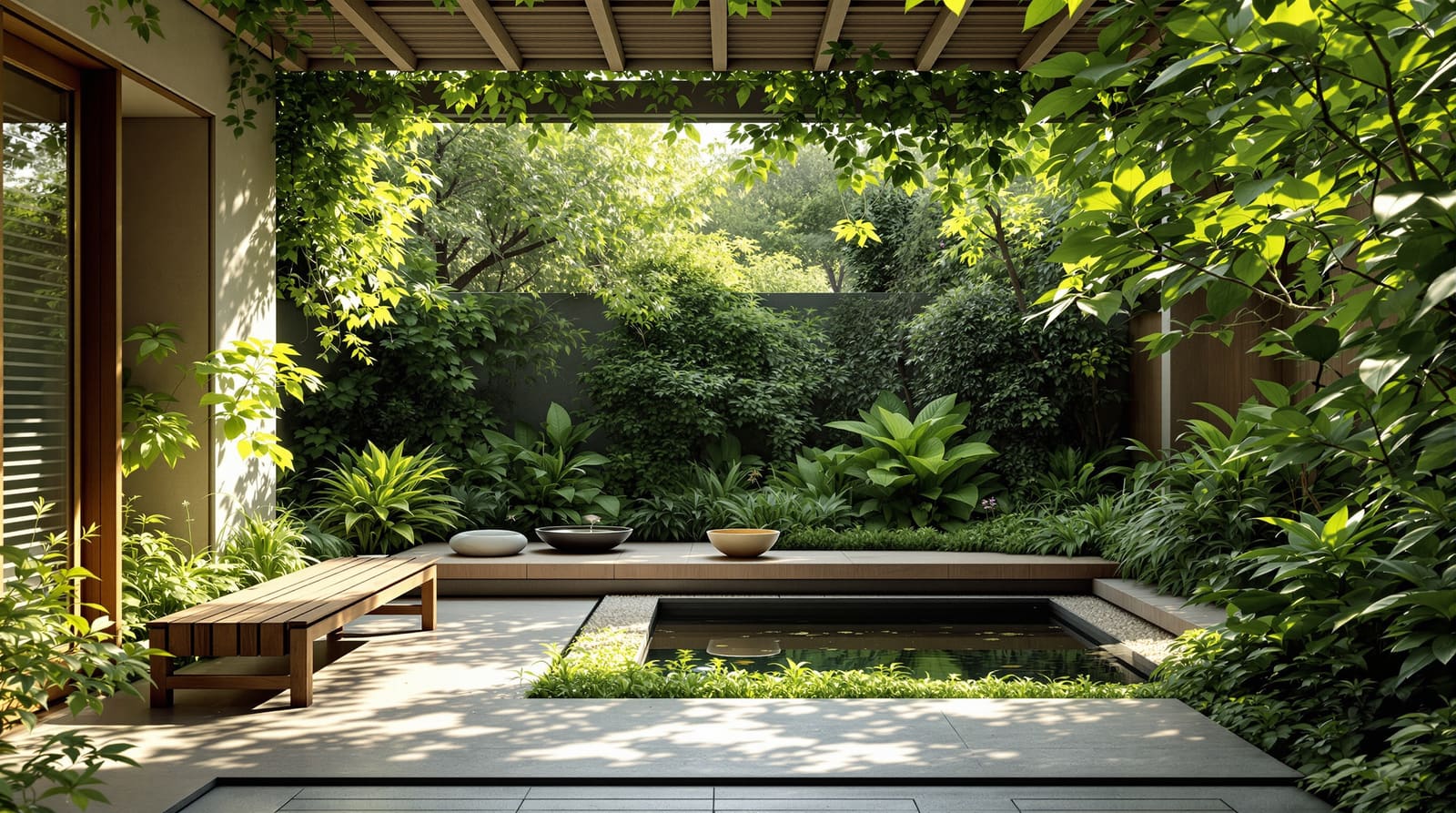
Landscape Design for Mental Wellbeing
The evidence for how outdoor space shapes the mind — Attention Restoration Theory, Stress Recovery Theory, biophilia and prospect-refuge — and a practical framework for a wellbeing garden at any size in India
It is seven in the evening in a Bengaluru apartment, and the day has not let go. The phone has buzzed perhaps two hundred times since morning. There were meetings that became more meetings, a commute that crawled, group chats that never quietened, and a low electrical hum of low-grade worry running under all of it. You step out onto the small balcony with a cup of tea, almost without thinking. There is a curry-leaf plant in a clay pot, a jasmine that has begun to climb the railing, and beyond the building line, the last of the light catching the leaves of a rain tree. You exhale. Something in your shoulders drops. You are not doing anything — and yet, for the first time in hours, your mind has stopped sprinting.
That small, ordinary moment is one of the most reliably documented effects in environmental psychology. Across decades of research, from hospital wards to office windows to forest paths, contact with nature has been shown again and again to lower physiological stress, restore worn-out attention, and lift mood. The interesting question for anyone designing a home is not whether this happens, but how — and whether you can deliberately build an outdoor space that does it on purpose, rather than by accident.
An outdoor space supports mental wellbeing not through one feature but through a set of qualities — refuge, visible greenery, gentle sensory richness, choice, and movement — that together calm the nervous system and let a tired mind recover; and these qualities can be designed into anything from a half-acre garden to a four-foot balcony.
Why this matters now, in India
It is worth naming the context plainly. Indian cities have grown denser and louder, homes have grown smaller and more enclosed, and a great deal of life has migrated onto screens. The conversation around mental health — anxiety, burnout, sleep that will not come — has become franker and more public than it was a generation ago, which is a genuinely good thing. None of this is unique to India, but the combination of high density, long working hours, and a deep cultural memory of the garden, the courtyard, and the sacred tree gives the question a particular shape here. We do not need to import the idea that being among plants is good for the mind; the tulsi at the doorstep and the temple tank ringed by trees have known it for a very long time. What is new is that we can now say why it works, and use that understanding to design better.
A note on honesty before we go further: this guide deals in well-established research directions, not in precise promises. Studies consistently associate nature contact with lower stress and better mood; they do not licence anyone to claim a specific number of minutes in a garden cures a specific condition. Read it as a designer's framework grounded in evidence, not as medicine.
The science: four foundations
Four bodies of research, built up over forty years, explain most of what a restorative landscape does. They overlap, and a good space quietly satisfies all four at once.

Attention Restoration Theory (Rachel & Stephen Kaplan). The Kaplans argued that the focused, effortful attention we use to work, drive, and read screens is a finite resource that fatigues — and that natural settings replenish it. Their key idea is soft fascination: nature holds attention gently and involuntarily (leaves moving, water glinting, a bird crossing) without demanding it. A flickering notification grabs; a swaying branch invites. After a stretch in such a setting, directed attention recovers, which is why people often report being able to think clearly again after a walk in the park.
Stress Recovery Theory (Roger Ulrich). Ulrich's much-cited 1984 study in Science found that surgical patients whose hospital window looked onto trees recovered faster and needed less strong pain medication than those facing a brick wall. His broader theory is that humans have a fast, partly unconscious response to certain natural scenes — calm water, green vegetation, a sense of openness with cover nearby — that reduces stress arousal within minutes, before any conscious thought. This is the body letting go before the mind has caught up.
The biophilia hypothesis (E. O. Wilson). Wilson proposed that humans carry an innate affinity for life and living systems, shaped over the long arc of evolution. Biophilia is the deep reason the other findings hold: we are drawn to greenery, to other creatures, to the textures of the living world, because for almost all of human history our wellbeing depended on reading them. A landscape rich in life speaks to something old in us.
Prospect–refuge (Jay Appleton). Drawing on this tradition, Appleton observed that people feel most at ease in places that offer both prospect — an open view, a sense of what is around us — and refuge — a sheltered spot with something solid at our back. The seat under the canopy that looks out over the garden is the classic instance. We relax when we can see without being exposed.
Underneath all four runs a single physiological thread. Research associates nature contact with a shift away from the body's stress-arousal state — lower cortisol, slower heart rate, a calmer nervous system — and toward the "rest and digest" mode in which recovery actually happens. The Japanese research tradition of shinrin-yoku, forest bathing, has explored this most closely, linking time among trees to reduced stress hormones and even changes in immune markers, partly attributed to phytoncides, the airborne compounds plants release. The mechanisms are still being mapped; the direction of the effect is not seriously in doubt.
A framework for wellbeing-supportive landscape
If the science tells us that nature restores, design has to answer how to arrange a real space so it does. The following eight principles are the organising spine of this guide. They are not a checklist to tick once but qualities to balance — and almost every restorative garden you have ever loved was honouring most of them without announcing it.

1. Refuge and safety. Give at least one spot that feels held — a seat with a wall, hedge, or canopy behind it, looking outward. A mind cannot rest where the body feels exposed.
2. Visible greenery. The view matters as much as the use. A window or doorway that frames green has value even on the days you never step out. Layer planting so there is depth, not a flat green wall.
3. Water and sound. Moving water masks traffic and gives the ear something soft to settle on. It need not be grand — a small recirculating bowl or urn does the work. The wider craft of this is its own subject; see water features in landscape design.
4. Sensory richness — gently. Scent, texture, dappled light, the rustle of bamboo. Richness soothes; clutter agitates. The art is variety without chaos.
5. Solitude and gathering. A wellbeing space serves two opposite needs at different hours: a private corner to be alone, and somewhere to sit with people. If you can, design for both, even in miniature.
6. Movement and a path. A route to walk, however short, turns a space from a picture into an experience. The slow loop around the garden is itself restorative.
7. Choice and control. Sun or shade, open or sheltered, near the house or away from it — agency over your own comfort is quietly therapeutic. Build in options rather than dictating one.
8. Biodiversity and life. Plants that draw butterflies, sunbirds, and bees make a garden feel alive rather than merely decorated. This is biophilia in its most literal form, and it deepens every other principle.
These echo the design guidelines that Clare Cooper Marcus and Marni Barnes drew up for healing gardens, and the thread of "therapeutic landscapes" that the geographer Wilbert Gesler traced through places people have long gone to feel well. The principles are general; the application is where this cluster of guides divides the labour.
Mapping needs to design moves
The framework becomes practical when you read it as a translation between what a tired mind needs and what a designer actually does. The table below is the heart of it.
| Wellbeing need | What the research points to | Landscape design move | India-aware example |
|---|---|---|---|
| Recover depleted attention | Soft fascination & effortless interest | Movement, light & subtle change to rest the eye on | Bamboo or a peepal whose leaves stir in the slightest breeze |
| Lower stress arousal fast | Calm scenes, water, green cover | A sheltered seat with a green outlook & gentle water | Shaded ledge by a small urn fountain, jasmine behind |
| Feel safe enough to relax | Prospect with refuge | Solid backing, canopy overhead, open view ahead | Verandah or pergola edge looking onto the courtyard |
| Quiet a racing mind | Repetition, slowness, ritual | A path to walk & a place to simply sit | A pradakshina-style loop around a tulsi or central tree |
| Restore mood & vitality | Biodiversity, scent, living detail | Nectar plants, fragrance, layered texture | Mogra, raat ki rani, curry leaf, lemongrass, ferns |
| Regain a sense of control | Choice between conditions | Both sun & shade, both solitude & company | Two seats — one private, one social — with movable shade |
How it scales: from a garden to a balcony
The most common objection in an Indian city is "this is lovely, but I have a balcony, not a garden." The framework's quiet strength is that it is about qualities, not square footage. Every principle has a small-space form.
In a full garden, refuge becomes a planted arbour or a tree seat; water becomes a small pond; the path becomes a real walking loop; biodiversity becomes a layered, multi-species planting. This is the territory the healing gardens guide covers in build-it-yourself detail, and the broader principles of pleasant, restful planting are explored in why some gardens feel peaceful.
In a courtyard or small terrace — the traditional Indian aangan updated — refuge is a single well-placed bench against a wall; water is a recirculating bowl; greenery climbs the boundary so the eye meets green at every turn; one fragrant tree or large shrub anchors the whole. Courtyards have their own deep logic, traced in courtyard landscape design.
On a balcony, the principles miniaturise without disappearing. Refuge is a single chair angled into the corner with a tall plant at your shoulder. Visible greenery is a vertical garden or a railing of trailing pots so that, sitting, you see leaves and not concrete. Water is a tabletop bowl with a small pump. Sensory richness is two or three plants chosen for scent and movement rather than ten chosen at random — mogra for evening fragrance, curry leaf for use and texture, a fern for soft green, lemongrass for both. Choice is a movable chair that can chase the morning sun or retreat into afternoon shade. You will not get a walking path, so let the balcony do the one thing it can do supremely well: be the single, reliable, green, sheltered spot you step into to put the day down.
An India-aware planting note
Plant selection carries much of the load, and India's palette is generous. Favour species that earn their place on more than one principle at once — fragrance and pollinators, say, or texture and use. Tulsi (holy basil) for its scent, ritual meaning, and place by the door; jasmine and mogra for evening fragrance; raat ki rani (night-blooming jasmine) where you sit out after dark; champa (frangipani) for sculptural calm; vetiver (khus) and lemongrass for cooling aroma; curry leaf for the daily kitchen ritual of stepping out to pick a sprig; ferns for soft shade-loving green; bamboo for movement and sound; and a small flowering tree or large shrub to draw sunbirds and butterflies. For choosing the right larger tree for an Indian home and climate, the dedicated guide on the best trees for Indian homes is the place to go.
Where to go deeper
This guide is the umbrella. Each principle, taken seriously, opens into a craft of its own, and the rest of this cluster takes them up. If you want a space designed around a specific health intention or for vulnerable users, read therapeutic landscapes. For a still, contemplative corner built for sitting and breathing, see meditation garden design. To bring the Japanese practice of slow, sensory immersion home, there is forest bathing at home. For a garden organised deliberately around scent, sound, touch, and taste, turn to sensory garden design. And for the bigger picture — weaving nature through a whole way of living rather than a single space — the lifestyle pillar is nature-based living, with the broader principles in biophilic landscape design.
Finally, the outdoors is only half the home. The same evidence and instincts apply indoors, where most of us spend most of our hours; that counterpart is covered in homes that improve mental wellbeing. A restorative landscape and a restorative interior are two faces of one idea — that the spaces we live in should help us, quietly, to feel like ourselves again.
References
- Ulrich, R. S. (1984). "View through a window may influence recovery from surgery." Science, 224(4647), 420–421.
- Kaplan, R., & Kaplan, S. (1989). The Experience of Nature: A Psychological Perspective. Cambridge University Press.
- Wilson, E. O. (1984). Biophilia. Harvard University Press.
- Appleton, J. (1975). The Experience of Landscape. John Wiley & Sons.
- Li, Q. (2018). Shinrin-Yoku: The Art and Science of Forest Bathing. Penguin Life.
- Cooper Marcus, C., & Barnes, M. (1999). Healing Gardens: Therapeutic Benefits and Design Recommendations. John Wiley & Sons.
- Gesler, W. M. (2003). Healing Places. Rowman & Littlefield. (On the concept of therapeutic landscapes.)
To sketch a wellbeing-supportive outdoor space for your own home — balcony, courtyard, or garden — try planning it with DesignAI, then go deeper with meditation garden design and nature-based living.
Export this guide
Related Guides — Deep-dive reading
Healing Gardens: Designing Restorative Outdoor Space for Home
The evidence-based restorative garden for the Indian home — Ulrich's supportive-garden theory, attention restoration, the cortisol data, and a medicinal-aromatic plant palette of tulsi, jasmine, vetiver, brahmi and ashwagandha
LandscapeHomes That Improve Mental Wellbeing
The whole-home, indoor-biophilia approach to calm — how plants, light, air, quiet and the right balance of togetherness and retreat make an Indian home restorative.
Healthy HomesWhy Some Gardens Feel Peaceful — The Science and Art of Restorative Outdoor Space
How environmental psychology explains the calm of a great garden, and how to design it into an Indian balcony, courtyard or plot
LandscapeRelated Tools — Try Free
Healing View Impact Calculator
Evidence-Based Design dashboard quantifying the recovery impact of nature view + daylight factor on analgesic use, length of stay, and HCAHPS patient-experience uplift. Calibrated against Ulrich 1984 (Science), Park & Mattson 2008, and the CHD EBD evidence base.
EBD CalculatorCross-Ventilation Analyzer
Estimate airflow and air changes per hour (ACH) from room size, window areas, layout, and local wind — with NBC 2016 Part 8 compliance check.
Ventilation CalculatorGarden Planning Toolkit
Get a tailored garden plan — planting layers, Indian species, features and a checklist — from your climate, space, sun and goals.
Planner