
Nature-Based Living
A way of living, not just a garden — the dose of nature (20-5-3), daily Indian home rituals of indoor-outdoor flow, growing food, inviting wildlife and seasonal living, scaled honestly to the apartment
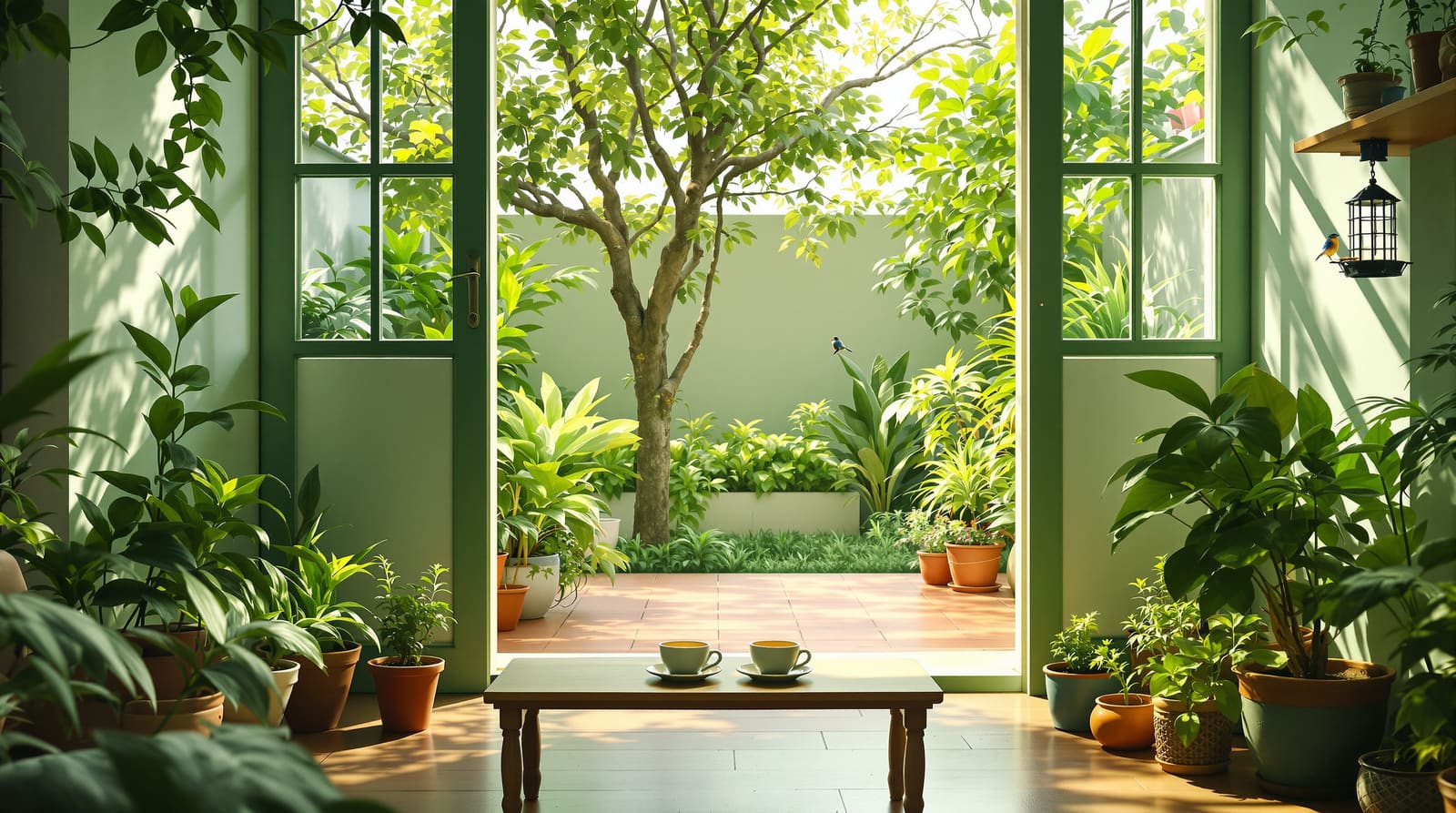
It is a quarter past six on a Tuesday in Pune, and the day has not yet become a list of things. A grandmother stands barefoot on the small patch of grass outside her kitchen door, the night's cool still in the soil, a steel tumbler of chai going lukewarm in her hand. A sunbird argues with a tailorbird over the hibiscus. Somewhere a child is being persuaded to water the tulsi before school, and is doing it badly, and that is fine. Nobody here is "spending time in nature". They are simply living, and nature happens to be in the room.
Contrast this with the more common modern arrangement: a beautifully landscaped garden, lit at night, photographed once, walked through rarely. The lawn is mowed by someone else. The owners admire it through glass on their way to the car. The garden is gorgeous and almost entirely unused — a painting hung outdoors. The difference between these two homes is not the quality of the planting. It is the quality of the relationship. Wellbeing does not come from owning a beautiful garden you occasionally admire; it comes from a daily, woven relationship with nature — a way of living, in which the landscape is merely the stage and the real practice is the habit of stepping onto it.
The science: it's the dose, not the view
There is a tempting misreading of the research on nature and health — that if you build something green enough, the benefits arrive automatically. The evidence points somewhere subtler. Roger Ulrich's celebrated 1984 study, published in Science, found that surgical patients with a window onto trees recovered faster and needed less pain medication than those facing a brick wall. But notice what the patients were doing: looking, over days, repeatedly. The benefit lived in the recurring contact, not in a single grand encounter.
This thread runs through the whole field. Rachel and Stephen Kaplan's Attention Restoration Theory describes how the directed attention we burn through at screens and in traffic becomes fatigued, and how natural settings — with their "soft fascination", the undemanding flicker of leaves and birds — let that faculty recover. E. O. Wilson's biophilia hypothesis proposes that this pull toward living things is not a luxury preference but something close to an inherited need. Qing Li and his colleagues in Japan, studying shinrin-yoku or forest bathing, have associated time spent slowly among trees with lower cortisol and raised natural killer (NK) cell activity, effects they attribute partly to phytoncides, the airborne compounds that plants release.
What unites these ideas is regularity. Researchers and clinicians increasingly talk about a "dose of nature", and a few rules of thumb have entered circulation. One widely cited figure associates roughly 120 minutes a week in nature with better self-reported health and wellbeing — an association, not a prescription. A popular shorthand, the "20-5-3" rule, suggests around 20 minutes in nearby everyday nature a few times a week, about 5 hours a month in wilder green space, and roughly 3 days a year fully immersed in something like a forest or coast. These are heuristics, honestly held — soft targets to live toward, not clinical doses. Their real value is the reframing: nature is something you take in small, frequent helpings, the way you eat, not something you binge on a holiday and then forget for eleven months.

This is also where this guide knows its lane. There is a companion piece on landscape design for mental wellbeing that lays out the design science — how to shape a space so that it restores. And there is a guide on biophilic landscape design about how to make the physical garden itself biophilic. Both are about designing the stage. This guide is about living on it: the behaviour, the dose, the rituals, the daily relationship — which matters whether your nature is two acres or two balcony pots.
Dissolving the threshold
The first pillar of nature-based living is to stop treating "indoors" and "outdoors" as separate countries with a border to be crossed only on special occasions. In much of the world this requires expensive architecture. In India it requires mostly remembering what we already had.
The verandah, the otla, the thinnai, the courtyard — the traditional Indian home was organised around in-between spaces where life spilled outward. Meals were eaten where a breeze could reach them; afternoons were slept away on the verandah; the courtyard pulled the sky and a little rain into the centre of the house. Modern flats and bungalows often engineer this out, sealing life behind glass and an air conditioner. Nature-based living is partly the work of reversing that — making the threshold disappear again.
In practice this is small and undramatic. Move one daily activity outdoors and keep it there. Take breakfast on the balcony rather than at the dining table. Shift the morning's first hour of laptop work to a shaded verandah or under a tree, where the soft fascination of moving leaves rests the eyes between tasks. Read in the evening on the otla instead of the sofa. The aim is not to renovate; it is to relocate ordinary habits a few feet outward, so the body spends accumulated hours in contact with air, light and green without anyone ever scheduling "nature time". The guide on outdoor wellness spaces goes deeper into shaping those outdoor rooms; here the point is simpler — use them, daily, for whatever you were going to do anyway.
The rituals that hold it together
Habits survive when they attach to anchors already in the day. A nature-based life is built less from willpower than from a handful of small rituals, repeated until they become unremarkable.
The morning chai taken in the garden, or on the balcony among the pots, is the keystone ritual for many Indian homes — fifteen unhurried minutes that quietly satisfy the "nearby nature" dose before the day's demands begin. Tending plants is another: the daily round of watering, the weekly deadheading and repotting, the noticing of a new bud. Watering by hand is not mere maintenance; it is a slow, attentive task with a living thing, the domestic cousin of the forest walk. A short barefoot moment on grass or bare earth — what some call grounding — adds a tactile, sensory beat that screens cannot give. Watching birds at a simple water bowl or feeder turns the garden into a changing show rather than a static picture. And the tulsi in its courtyard vrindavan, watered and circled each morning, is a reminder that this culture wove a daily plant ritual into the centre of the home long before anyone measured cortisol.
The point of naming these is not to impose a regimen. It is to show how many natural touchpoints already sit within reach of an ordinary Indian day, waiting only to be noticed and kept. A guide on why some gardens feel peaceful explores why these slow moments settle the nervous system; lived daily, they become the texture of the home.
| Rhythm | Cue in the day | Simple Indian home practice |
|---|---|---|
| Daily — morning | First chai or coffee | Take it on the verandah, balcony or beside the tulsi; a barefoot minute on grass or earth |
| Daily — work hours | Between tasks | Shift one work block outdoors; rest the eyes on moving leaves; lunch under a tree or on the otla |
| Daily — evening | Dusk, before dinner | Water and tend the pots; watch birds at a water bowl; sit out as raat ki rani & mogra release their scent |
| Weekly | Weekend morning | A slower hour gardening with children; a walk in the nearest park or society green |
| Monthly | A free half-day | Several hours in wilder green — a botanical garden, lake, hill or forest edge |
| Seasonal | Monsoon & festivals | Plant with the rains; mark Tulsi Vivah, harvest & flowering festivals; eat with the season |
| Annual | A few days | An immersion — hills, backwaters, a forest stay — the deepest dose of the year |
Growing, feeding wildlife, and living by the season
A relationship deepens when it asks something of you, and nature-based living becomes durable the moment the garden starts giving back and changing on its own.
Growing food is the most reliable hook. A few pots of curry leaf, mint, coriander, green chilli and tomato on a balcony, or a proper terrace kitchen garden, convert an abstract intention into a daily errand with a reward at the end. You go out because the chillies need checking, and you receive the dose as a side effect. Tending edible plants also pulls children outdoors with a purpose more compelling than instruction.
Then there is the choice to share the garden with creatures other than yourself. A garden planted partly for birds, butterflies and bees — nectar-rich flowers, a shallow water bowl, a fruiting tree, a refusal to spray everything — becomes a living, shifting thing rather than a static arrangement. The reward is soft fascination on tap: the sunbird at the firecracker plant, the lime butterfly laying on the curry leaf, the bee-loud tulsi. A living garden gives you reasons to look up from the phone that you did not have to manufacture.
Seasonal living ties the whole practice to the calendar India already keeps. Planting with the monsoon, following the flowering year — mogra and champa in the heat, raat ki rani perfuming the post-rain nights — and honouring the many festivals braided into nature's cycles all keep the relationship from going flat. Nature-based living is not a steady state; it is a year that turns, and noticing the turning is half the medicine.
A palette you live with, not just look at
Plants earn their place in this kind of life by what they offer to the senses and the routine, not only to the eye. The ones below reward daily contact — scent at dusk, leaves you pinch and use, flowers that bring wings.
| Plant | What it gives daily life | Where it works |
|---|---|---|
| Tulsi / holy basil | The keystone ritual plant; aromatic, ceremonial, watered each morning | Courtyard vrindavan, doorstep pot, balcony |
| Mogra / jasmine & raat ki rani | Evening and night scent that pulls you outdoors after dark | Near seating, windows, the verandah edge |
| Curry leaf & mint | Pinch-and-use kitchen plants; a reason to step out before cooking | Balcony pots, kitchen-garden bed |
| Champa / frangipani | Fragrant, low-care flowering tree anchoring an outdoor sitting spot | Courtyard or garden corner |
| Lemongrass & khus (vetiver) | Aromatic, brushed-past scent; calming, useful in chai | Borders, large pots, path edges |
| Hibiscus & firecracker plant | Nectar flowers that bring sunbirds and butterflies to watch | Near a window or the chai spot |
| Brahmi, ashwagandha, ferns | Quiet, tactile greenery and traditional herb interest | Shaded corners, indoor-edge pots |
The guide on the best trees for Indian homes goes further on the larger, shade-giving end; the brief here is only that you choose at least some plants for what they will add to a Tuesday morning, not just a photograph.
When you live in a flat: the honest version
It would be dishonest to describe nature-based living as if everyone reading had a courtyard and a thinnai. Most urban Indians do not. The reassuring truth is that the practice scales down further than people expect, because it was never really about acreage — it was about contact and frequency.
A balcony, even a narrow one, can hold the keystone rituals: chai among the pots, a curry-leaf and mint corner, a bird-water bowl on the railing, a tulsi by the door. The building's society green, however modest, is a legitimate patch of nearby nature — a place to take a barefoot minute or a child after homework. A terrace, if you can claim it, is the urban kitchen garden waiting to happen. And the nearest park does real work: it can be where the monthly "wilder green" dose is met, fifteen minutes' walk from the lift.
Indoor plants are the bridge on the days the weather or the building defeats you — not because a pot of pothos cleans the air dramatically (the popular claims there are overstated), but because tending it keeps the daily thread of contact unbroken. For families, this all matters most as a counterweight to screens: a balcony garden a child waters, birds to name, a weekend hour with soil under the nails. The home becomes a place where unstructured nature contact is simply available, which is most of the battle. The companion guide on homes that improve mental wellbeing connects this outdoor-facing life to the indoor environment it lives inside.
None of this requires a grand garden, and that is precisely the point of treating nature-based living as a pillar in its own right. The science pillar tells you how to design the stage; this is the practice of stepping onto it, every day, in whatever form you have.
References
- Ulrich, R. S. (1984). View through a window may influence recovery from surgery. Science, 224(4647), 420–421.
- Kaplan, R., & Kaplan, S. (1989). The Experience of Nature: A Psychological Perspective. Cambridge University Press.
- Wilson, E. O. (1984). Biophilia. Harvard University Press.
- Li, Q. (2018). Shinrin-Yoku: The Art and Science of Forest Bathing. Penguin Life.
- White, M. P., et al. (2019). Spending at least 120 minutes a week in nature is associated with good health and wellbeing. Scientific Reports, 9, 7730.
- Cooper Marcus, C., & Barnes, M. (1999). Healing Gardens: Therapeutic Benefits and Design Recommendations. John Wiley & Sons.
- Gesler, W. M. (1992). Therapeutic landscapes: medical issues in light of the new cultural geography. Social Science & Medicine, 34(7), 735–746.
Once the daily relationship is established, deepen it through practice — a slow forest bathing ritual at home and a quiet corner shaped as a meditation garden — and when you are ready to design the stage these habits live on, DesignAI can help you plan it.
Export this guide
Related Guides — Deep-dive reading
Healing Gardens: Designing Restorative Outdoor Space for Home
The evidence-based restorative garden for the Indian home — Ulrich's supportive-garden theory, attention restoration, the cortisol data, and a medicinal-aromatic plant palette of tulsi, jasmine, vetiver, brahmi and ashwagandha
LandscapeHomes That Improve Mental Wellbeing
The whole-home, indoor-biophilia approach to calm — how plants, light, air, quiet and the right balance of togetherness and retreat make an Indian home restorative.
Healthy HomesLandscape Design for Mental Wellbeing
The evidence for how outdoor space shapes the mind — Attention Restoration Theory, Stress Recovery Theory, biophilia and prospect-refuge — and a practical framework for a wellbeing garden at any size in India
LandscapeRelated Tools — Try Free
Healing View Impact Calculator
Evidence-Based Design dashboard quantifying the recovery impact of nature view + daylight factor on analgesic use, length of stay, and HCAHPS patient-experience uplift. Calibrated against Ulrich 1984 (Science), Park & Mattson 2008, and the CHD EBD evidence base.
EBD CalculatorCross-Ventilation Analyzer
Estimate airflow and air changes per hour (ACH) from room size, window areas, layout, and local wind — with NBC 2016 Part 8 compliance check.
Ventilation CalculatorCircadian Light Meter
Patient-centric circadian lighting visualizer for Indian healthcare design — time-of-day × intensity → CCT, melanopic lux (EML / mEDI), melatonin suppression, and an alertness curve. Calibrated against WELL v2 L03 Circadian Lighting Design, CIE S 026:2018, Brainard 2001, and Lucas et al. 2014.
Circadian Tool