
Forest Bathing and Home Landscapes
Shinrin-yoku brought home — the science of phytoncides and the calmer nervous system, how to build a layered native micro-forest on an Indian plot, and the slow multi-sensory walk that turns a garden into a forest
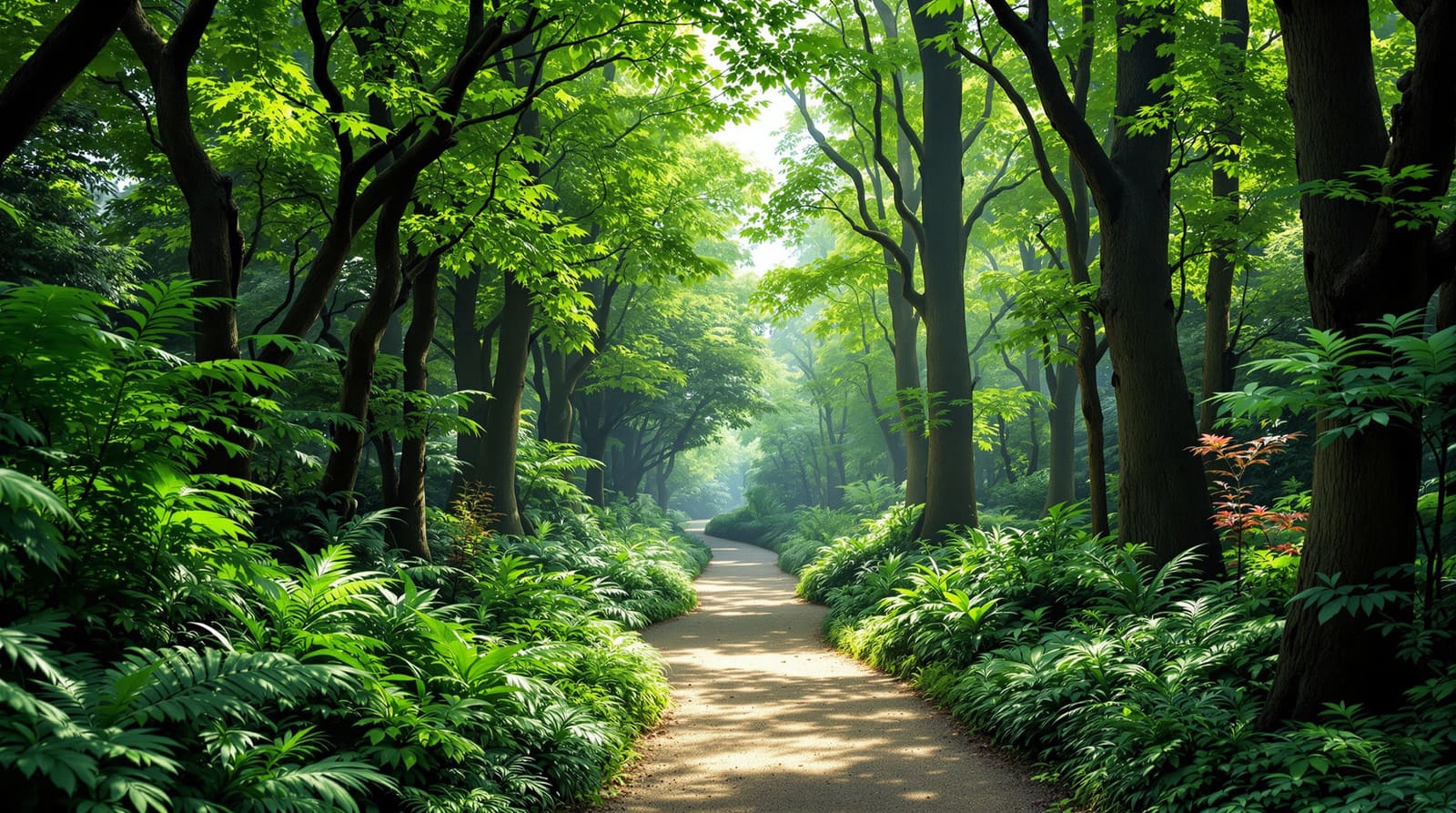
There is a particular kind of quiet that lives under a dense cluster of trees. You step off the open lawn, where the afternoon glare presses down, and within a few paces the light goes soft and green and broken into coins. The temperature drops. The traffic noise recedes behind a wall of leaves. Somewhere above you a koel calls, and the breeze moves through the canopy with a sound like distant water. You slow down without deciding to. Your shoulders come down from around your ears. You did not walk far — perhaps fifteen steps — but you have crossed into another world, and your body knows it before your mind does.
That feeling has a name. In Japan it is called shinrin-yoku — literally "forest bathing" — and it is not hiking, not exercise, not a brisk walk for your step count. It is the slow, deliberate, multi-sensory act of soaking in the atmosphere of a forest: the dappled light, the layered green, the cool damp air, the smell of leaves and bark, the small living sounds. The remarkable thing for anyone living on a city plot in India is that you do not need an actual forest to get the effect. You can engineer a forest atmosphere at home — a dense, layered, scented, immersive green that wraps around you the moment you enter it — and a small Indian garden, built the right way, can deliver the essence of shinrin-yoku in fifteen steps.
What forest bathing actually is — and the honest science
Shinrin-yoku was coined in 1982 by Japan's forestry agency, as much a public-health idea as a poetic one: a prescription for a nation under stress to spend unhurried time among trees. Over the following decades, physiologist Qing Li and other Japanese researchers set out to ask whether the felt effect had a measurable basis. Their work is the reason forest bathing is taken seriously and not dismissed as a pleasant mood.
The central biological character in this story is a family of compounds called phytoncides — the airborne volatile substances that trees and plants release, partly to defend themselves against insects and fungi. When we walk through dense greenery, we breathe these in. Japanese studies have associated time spent in forest environments with increased activity of natural killer (NK) cells — a part of the immune system — alongside lowered cortisol (the body's main stress hormone), reduced blood pressure, and a shift toward parasympathetic dominance, the "rest and digest" state that is the opposite of fight-or-flight. It is worth being careful here: these are associations observed in studies of modest size, and the effect of a backyard micro-forest is not identical to a Japanese cedar forest. But the direction of the evidence is consistent and it converges with a much broader body of work — Roger Ulrich's Stress Recovery Theory and his well-known 1984 finding that surgical patients with a window onto trees recovered faster; the Kaplans' Attention Restoration Theory, which describes how the "soft fascination" of natural scenes lets our depleted directed attention recover; and E. O. Wilson's biophilia hypothesis, the idea that we carry an innate affiliation with living things.

If biophilic landscape design is the broad principle of weaving nature into how we build and live, forest bathing is one specific, potent application of it: the deliberate immersion in a dense forest atmosphere. And it differs sharply from its quieter cousin. A meditation garden is still, minimal, pared back to a single focal point and a seat — you arrive, settle, and hold one spot. Forest bathing is the opposite temperament: abundance instead of restraint, movement instead of stillness, immersion instead of focus. You are not meant to sit and concentrate. You are meant to wander, dissolve, and let the forest do the work. Both belong under the same mental-wellbeing science, but they are designed almost as mirror images of each other.
Building a micro-forest: the layered green
The signature of a forest is not its trees — it is its layers. A real forest stacks vegetation vertically: a canopy of tall trees overhead, an understorey of smaller trees beneath, a shrub layer below that, and a ground layer of ferns, herbs and leaf litter at your feet. That stacking is what creates the enclosure, the filtered light, the cool humidity and the sheer density of living surfaces that distinguish a forest from a lawn with a few trees dotted across it. A garden that gives you the forest feeling is one that grows in four dimensions, not on a single flat plane.
The most useful method for small Indian plots is the Miyawaki technique, developed by the Japanese botanist Akira Miyawaki. It involves planting a wide mix of native species very densely — many saplings per square metre, across all the layers at once — into well-prepared soil. The plants compete for light, grow upward fast, and within a few years knit into a self-sustaining, dense, multi-storey thicket far smaller than a natural forest would need. Miyawaki forests have been raised on plots as small as a few hundred square feet across Indian cities, and they are precisely the tool a homeowner needs: maximum forest atmosphere from minimum ground.

You do not need the full Miyawaki rigour to begin. Even a single corner of the garden, planted in three or four layers and allowed to grow dense, becomes a pocket of forest. The essentials are density and dappled light: plant closely enough that the greenery closes over your head and around your sides, so that light arrives broken and soft rather than as open glare. The moment the canopy meets above a path, the corner stops being a garden bed and starts being a place you walk into.
The wandering path and the senses
The second signature of forest bathing, after the layers, is the path — and it must never be straight. A straight line says "get to the other side"; it is read by the body as a corridor, not a forest. A forest path curves, so that what lies ahead is always partly hidden and slowly revealed. This is the prospect–refuge instinct that Jay Appleton described: we are drawn to spaces that let us see a little way ahead from a place of partial shelter. A path that bends behind a clump of bamboo, opens onto a small clearing, then narrows again under low branches keeps offering that gentle "what's around the corner" pull — the soft fascination that lets the mind unclench.
Then layer in the senses, because immersion is the whole point. Sound: rustling leaves (plant species with papery foliage that moves in the breeze), birds (dense native planting brings them on its own), and ideally the trickle of moving water — even a small recirculating spill, as explored in water features for the landscape, masks the city and pulls you inward. Touch: textured bark, the soft heads of ferns, cool stone underfoot, a rough log to rest a hand on. Smell: this is where India is gifted, because so many of our plants are intensely aromatic. And somewhere along the path, a place to simply pause and be — a flat stone, a low bench tucked into the green, not framing a view but enclosed by leaves.
How to forest-bathe at home
The practice itself is almost embarrassingly simple, which is the point. Leave the phone indoors, or at least switch it to silent and pocket it. Cross your threshold into the green slowly and deliberately — pause for a breath at the edge, marking that you are entering. Then walk far more slowly than feels natural, and take the senses one at a time: spend a minute just looking, noticing how the light moves; then close your eyes and only listen; then breathe in and find the smells; then reach out and touch what is near you. Stop at your pausing-place and do nothing at all for a while. Ten or fifteen minutes is enough. The design exists to make this practice easy and inviting — to give the senses something worth engaging, so the walk almost does itself.
An Indian forest palette and how to build each quality
India's plant wealth makes the aromatic, layered forest atmosphere genuinely achievable. Native figs and other ficus species form generous canopies and draw birds; neem gives shade and a faint medicinal scent; bamboo groves create instant vertical density, sound and dappled shade; eucalyptus and, in the hills, pine, carry strong resinous aromatics; camphor and fragrant flowering species perfume the air. For deeper guidance on the right canopy and understorey trees for your conditions, see the best trees for Indian homes. The table below translates each quality of a forest atmosphere into something you can actually plant or build.
| Forest-atmosphere quality | How to create it in an Indian home garden |
|---|---|
| Layered canopy overhead | Native ficus, neem, jamun or a bamboo grove for the top storey; plant closely so crowns meet & close over the path |
| Understorey & mid-level density | Curry leaf, champa/frangipani, custard apple & tall shrubs filling the gap between canopy & ground |
| Shrub & ground layers | Ferns, brahmi, lemongrass & mixed groundcovers so the floor is green, soft & never bare |
| Phytoncides & forest scent | Aromatic species — neem, eucalyptus, camphor, curry leaf — releasing volatile compounds you breathe in |
| Fragrance through the day & night | Jasmine/mogra & champa by day, raat ki rani (night jasmine) for the evening walk |
| Cool, damp, earthy air | Density plus a small water spill & thick groundcover; mulched, living soil rather than paving |
| Living sound | Papery foliage that rustles, bird-attracting natives & the trickle of moving water |
| Dappled, broken light | Overlapping crowns so sunlight arrives in shifting coins rather than flat glare |
| Touch & texture | Rough bark, fern fronds, vetiver/khus, stone & a worn log to rest a hand on |
The Miyawaki spirit applies even at this smaller scale: mix many species, favour natives, and plant for density rather than tidy spacing. A forest is not a collection of specimens on a lawn — it is a crowd.
When you only have a balcony
Here honesty matters: a true micro-forest needs ground. The full layered, walk-into-it experience belongs to homes with at least a pocket of earth, and the Miyawaki method in particular wants open soil. If you live in an apartment, the answer is not to pretend otherwise but to scale the idea down and reach outward.
On a balcony, build density rather than display — a dense green wall of mixed potted foliage, a tall bamboo or two in big planters, ferns and trailing greenery layered so that even a small space closes around you and filters the light. It will not be a forest, but it can be a thicket, and a thicket scented with mogra and curry leaf does real work for the nervous system. Beyond the balcony, look to the shared green pocket many housing societies have but underuse — a corner that, with the committee's blessing, could be planted densely as a community micro-forest. And do not overlook the neighbourhood park: forest bathing was conceived as a public practice, and a quiet, tree-dense corner of a city park, walked slowly with the phone away, is the original article. The forest atmosphere is a dose you can build at home, find nearby, or both — which is exactly the everyday-nature habit at the heart of nature-based living.
References
- Qing Li, Shinrin-Yoku: The Art and Science of Forest Bathing (Penguin Life, 2018).
- Roger S. Ulrich, "View through a window may influence recovery from surgery," Science, 224 (1984), 420–421.
- Rachel Kaplan & Stephen Kaplan, The Experience of Nature: A Psychological Perspective (Cambridge University Press, 1989).
- Edward O. Wilson, Biophilia (Harvard University Press, 1984).
- Akira Miyawaki, The Healing Power of Forests — writings on native dense-forest restoration and the Miyawaki method.
- Wilbert M. Gesler, "Therapeutic landscapes: medical issues in light of the new cultural geography," Social Science & Medicine, 34 (1992).
- Jay Appleton, The Experience of Landscape (Wiley, 1975) — on prospect and refuge.
If you want stillness and a single focal point instead of immersion, read meditation garden design; for the broader principle of nature woven through the home, see biophilic landscape design; and to plan a layered micro-forest for your own plot, DesignAI can help you lay out the canopy, the path and the pauses.
Export this guide
Related Guides — Deep-dive reading
Homes That Improve Mental Wellbeing
The whole-home, indoor-biophilia approach to calm — how plants, light, air, quiet and the right balance of togetherness and retreat make an Indian home restorative.
Healthy HomesLandscape Design for Mental Wellbeing
The evidence for how outdoor space shapes the mind — Attention Restoration Theory, Stress Recovery Theory, biophilia and prospect-refuge — and a practical framework for a wellbeing garden at any size in India
LandscapeHealing Gardens: Designing Restorative Outdoor Space for Home
The evidence-based restorative garden for the Indian home — Ulrich's supportive-garden theory, attention restoration, the cortisol data, and a medicinal-aromatic plant palette of tulsi, jasmine, vetiver, brahmi and ashwagandha
LandscapeRelated Tools — Try Free
Healing View Impact Calculator
Evidence-Based Design dashboard quantifying the recovery impact of nature view + daylight factor on analgesic use, length of stay, and HCAHPS patient-experience uplift. Calibrated against Ulrich 1984 (Science), Park & Mattson 2008, and the CHD EBD evidence base.
EBD CalculatorCross-Ventilation Analyzer
Estimate airflow and air changes per hour (ACH) from room size, window areas, layout, and local wind — with NBC 2016 Part 8 compliance check.
Ventilation CalculatorAcoustic Privacy (STC) Visualizer
Indian healthcare acoustic visualizer — compare wall assemblies and noise sources, see received SPL after STC attenuation, and check FGI 2018 / IS 1950 / NABH speech-privacy compliance with live dual-canvas waveform.
Acoustic Tool