
Therapeutic Landscapes Explained
From Gesler's therapeutic-landscapes idea to the home — evidence-based gardens for the elderly and dementia, recovery and rehabilitation, children and neurodiverse users, plus horticultural therapy for an Indian household
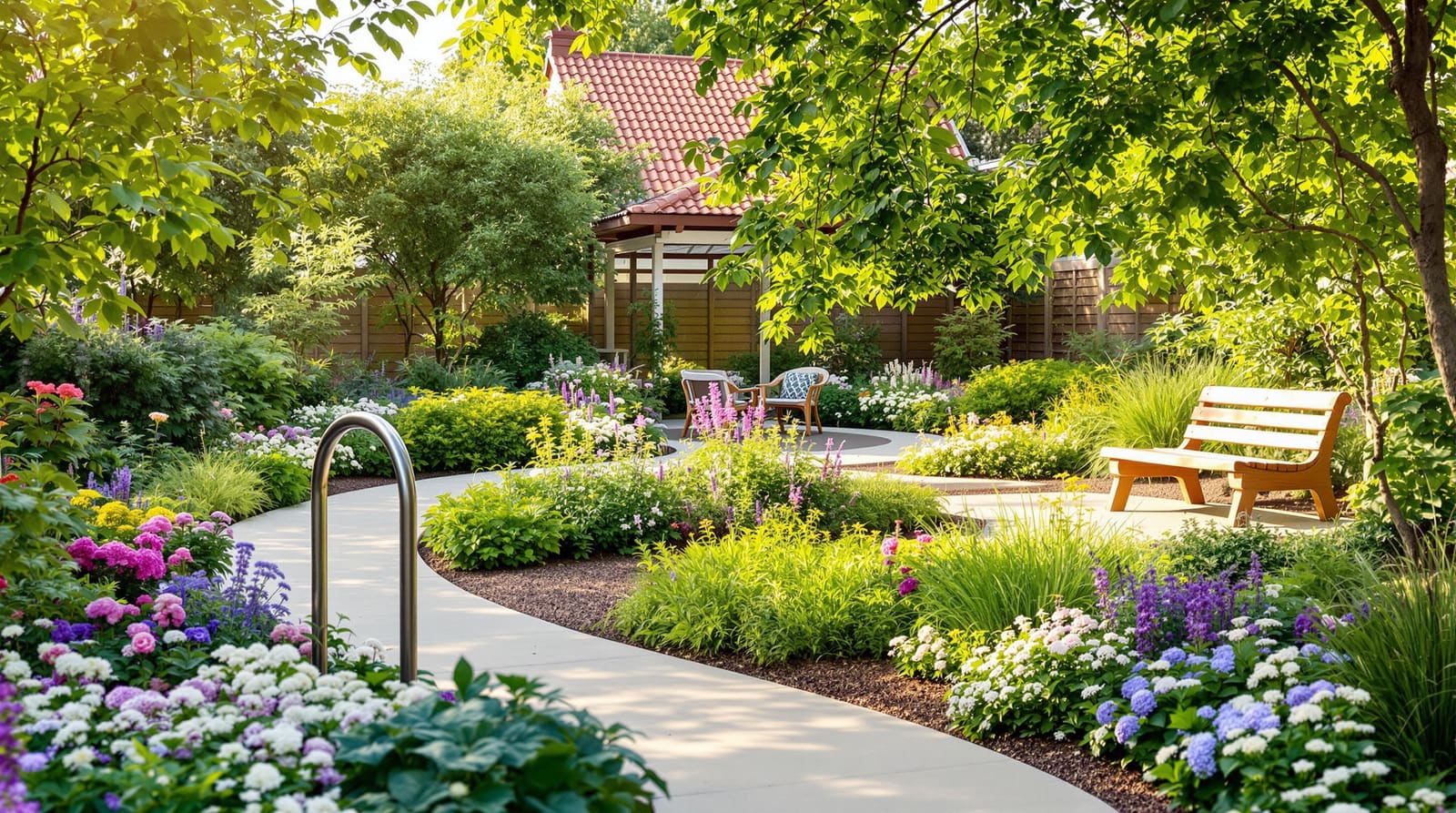
A retired schoolteacher in Pune walks the same loop of her son's small garden every morning. Her memory is fraying now — the early grey of dementia — and yet her feet know this path. It curves past the curry-leaf shrub she once cooked with, doubles back at a low stone wall warm in the sun, and never once strands her in a dead-end where she might stand confused and frightened. There is a bench exactly where her legs tire. There is jasmine she can smell before she can see it. The path was not an accident; her son and a thoughtful designer drew it that way, on purpose, for her.
That garden is doing something more specific than soothing a stressed mind after a long day. It is compensating for a failing memory, holding a vulnerable person safely, giving her body a reason to move and her hands a familiar plant to touch. It is medicine in the shape of a landscape. A therapeutic landscape is not simply a pleasant garden — it is a place deliberately designed for particular people and particular healing outcomes, where the physical setting, the social life around it and its symbolic meaning combine to help someone recover, cope or thrive.
The idea, and where it comes from
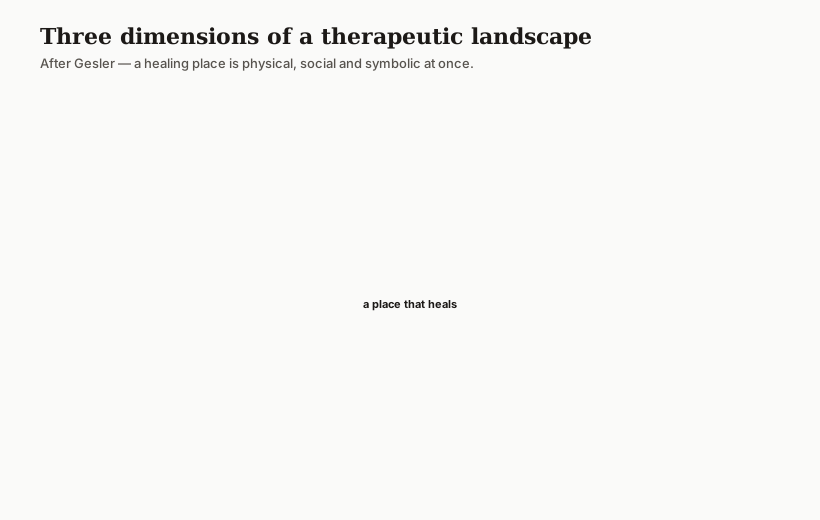
The phrase "therapeutic landscape" was coined in the early 1990s by the health geographer Wilbert Gesler, who noticed that certain places have, across cultures and centuries, gathered a reputation for healing. He argued that their power was not mystical but the product of three overlapping dimensions: the physical setting (climate, water, greenery, light), the social setting (the relationships, rituals and care that happen there) and the symbolic meaning (what the place represents — sanctuary, sacredness, belonging). When those align, a place heals more than its parts would suggest.
India has known such places for millennia. The temple tank where pilgrims bathe, the sacred grove preserved at the village edge, the riverside tirtha sought out for healing — these are therapeutic landscapes in Gesler's sense, long before the term existed. The ancient Greeks built the healing sanctuary at Epidaurus around the same instinct. What is new is that we can now design such places consciously, for named conditions, and test whether they work.
The evidence base is real and worth treating honestly. Roger Ulrich's much-cited 1984 study in Science found that surgical patients whose hospital windows looked onto trees rather than a brick wall recovered faster and needed fewer strong painkillers — his Stress Recovery Theory holds that natural scenes calm the nervous system. Rachel and Stephen Kaplan's Attention Restoration Theory describes how the "soft fascination" of leaves, water and birdsong lets our depleted directed attention recover. E. O. Wilson's biophilia hypothesis proposes we are simply wired to affiliate with living things. Studies of Japanese forest bathing, or shinrin-yoku, associate time among trees with lower cortisol and raised natural killer (NK) cell activity, attributed in part to airborne phytoncides. These ideas describe why nature restores us in general.
A therapeutic landscape takes that general restorative power and aims it. This is the line worth drawing clearly. A healing garden is the everyday restorative home garden — a place anyone can unwind in after a hard day. A therapeutic landscape is targeted: designed for a specific user with a specific need, with success measured in something like clinical terms — fewer falls, less agitation, restored confidence, a reason to get out of bed. If you want the broad framework behind both, the science of landscape and mental wellbeing is the pillar this guide sits under. And where that thinking moves into hospitals and clinics, the biophilic healing environments in healthcare guide is its institutional counterpart. This guide brings the same rigour home.
Designing for who, exactly
The discipline of a therapeutic landscape begins with a question most gardens never ask: who is this for, and what do we want to change? The answer reshapes every path, plant and seat. Clare Cooper Marcus and Marni Barnes, whose design guidelines for healing gardens remain a touchstone, insist on this specificity. Below are the four user groups most relevant to Indian homes and small communities.
The elderly and people with dementia. Here the garden must be navigable by a mind that may not hold a map. The single most important move is a continuous looping path with no dead-ends — so a wandering resident is always gently returned, never cornered into panic. Add clear, memorable landmarks (a distinctive tree, a coloured gate, a fountain) to anchor orientation. Keep the boundary safely and unobtrusively enclosed. Plant familiar, evocative species — the marigold, jasmine and tulsi of a lifetime — because scent and the textures of long memory reach people whose recent memory has gone. Raise beds to standing or seated height so a frail or wheelchair-using person can still touch soil. Remove trip hazards, level the joints, and light the route for dusk.
Recovery and rehabilitation. For someone convalescing after illness or surgery, or working through physiotherapy, the garden becomes a graded gym disguised as a pleasure. Provide paths of varying gentle gradient so walking can be progressively challenged, with sturdy handrails along the harder stretches and firm, non-slip, glare-free surfaces. Place rest points generously — a bench every short distance, ideally with arms to push up from. Offer reachable tasks: a few pots to deadhead, a tap to fill a can. The goal is to rebuild confidence and stamina in private dignity, away from the clinical gaze.
Children and neurodiverse users. Children, and especially autistic or sensory-sensitive children, need a garden that offers both stimulation and escape. Design distinct zones: a lively sensory patch of textures, sounds and scents to explore, and a separate calm retreat — a shaded nook, a quiet enclosure — to withdraw to when the world becomes too much. Predictable layout and clear edges reduce anxiety. Avoid sudden loud water or chaotic planting that overwhelms. If you want the full grammar of multi-sense planting, the sensory garden design guide goes deeper than this one should.
Mental-health recovery and care at home. For someone living with depression, anxiety or grief, or being nursed through serious illness at home, the garden offers what the indoors cannot: gentle purpose, daylight, and a low-pressure reason to step outside. Prospect-and-refuge thinking (after Jay Appleton) matters here — a sheltered seat with its back protected, looking out over a calm scene, feels safe in a way an exposed bench never does. Soft fascination, not spectacle, is the aim.

The table below condenses the principle: match the design move to the goal, and the goal to the person.
| User group | Therapeutic goal | Key design features |
|---|---|---|
| Elderly & dementia | Safe orientation, reduced agitation, dignity | Looping path with no dead-ends; clear landmarks; secure enclosure; familiar fragrant plants; raised beds; even, well-lit surfaces |
| Recovery & rehabilitation | Rebuild mobility, stamina & confidence | Graded path gradients; handrails; firm non-slip surfaces; frequent benches with arms; reachable light tasks |
| Children & neurodiverse | Balance stimulation & self-regulation | Distinct sensory zone plus calm retreat; predictable layout; clear edges; no overwhelming noise or chaos |
| Mental-health & home care | Lift mood, restore purpose, ease distress | Prospect-refuge seating; soft-fascination planting; daily care tasks; sunlight & sheltered shade |
Horticultural therapy: the gardening itself as the medicine
So far the garden has been a setting. But in a true therapeutic landscape, the activity of gardening is itself the treatment — this is horticultural therapy (a structured, goal-directed practice, often clinically guided) and its gentler cousin, therapeutic horticulture (the broader wellbeing benefit of engaging with plants). Both rest on a simple, profound insight: caring for something living gives a person purpose, routine, gentle exercise and the quiet pride of a harvest.
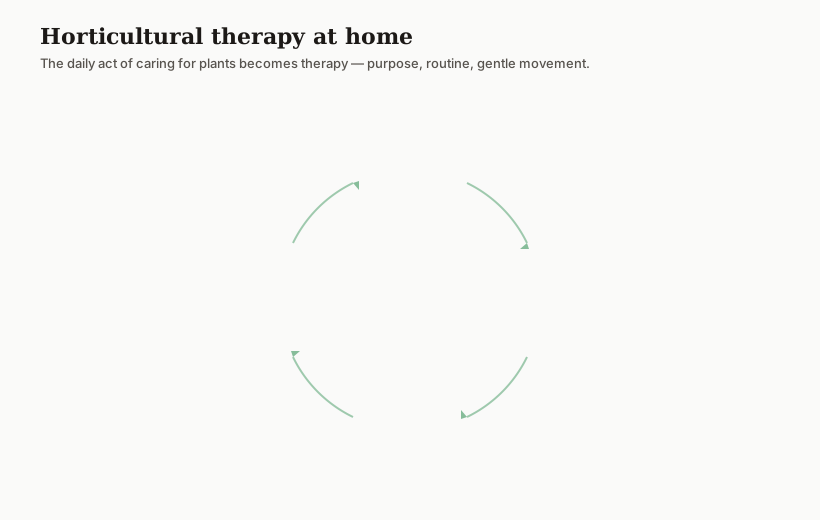
The cycle does the work. Sowing asks for hope and forward planning. Tending — watering, weeding, deadheading — imposes a daily routine and a reason to move the body, bend, reach and walk, for someone who might otherwise sit still all day. Harvesting delivers a tangible reward that depression and apathy struggle to deny. Sharing the produce or the flowers reconnects a person to family and neighbours, restoring the social dimension Gesler placed at the heart of healing. Each turn of the cycle is small, achievable and repeatable — which is precisely why it suits people who are frail, recovering or low.
India hardly needs to import this idea; it is already woven into domestic life. The tulsi in its raised vrindavan, watered each morning, is a daily ritual of care that doubles as gentle therapy. The kitchen garden — a row of curry leaf, chillies, lemongrass, mint and brahmi — gives an ageing parent a useful, dignified job and the household a reason to praise their work. The act of plucking jasmine at dusk, of feeding the parijat, of harvesting a handful of methi, is therapeutic horticulture under another name. The therapeutic landscape simply makes these tasks reachable and safe for the person who most needs them.
The Indian home as the place of care
In much of India, the home — not the institution — is where the elderly age and the sick recover, surrounded by family across three generations. This is a profound advantage for therapeutic landscaping. The garden, balcony or courtyard is already the shared heart of the house; making it therapeutic for the most vulnerable member need not mean building anything grand or costly.
Affordable adaptations go a long way. A raised planting bed can be built from leftover bricks for a few hundred rupees, sparing aching knees and bringing soil within a wheelchair's reach. A continuous, even path of compacted earth or simple kota stone — free of the little steps and lips we scatter without thinking — turns a hazard into a safe walking loop. A sturdy handrail along the route, and a shaded bench placed where someone naturally tires, transform a garden from decorative to usable. Choose plants that are tough, fragrant and familiar — tulsi, mogra, raat ki rani for the evening, vetiver (khus) for its cooling scent, a curry-leaf shrub for the kitchen — over fussy specimens that demand more than the household can give.
Even a small flat can hold a therapeutic corner. A few raised pots at the right height on a sunny balcony, a stable chair beside them, and a daily watering ritual can give a recovering or housebound relative the same loop of purpose. Privacy and a sense of safe enclosure matter more than size. For the wider lifestyle this kind of care fits into, the nature-based living guide takes the longer view; and if your aim is simply a calm, contemplative spot rather than condition-specific care, the meditation garden design guide is the better companion.
Plan the brief first — for whom, and to what end — and the garden almost designs itself. A tool like DesignAI can help you sketch a safe looping path, place raised beds and rest points, and visualise a familiar planting palette before you move a single brick, so the space you build is genuinely the one your loved one needs.
References
- Gesler, W. M. Healing Places (and his founding papers on therapeutic landscapes), Rowman & Littlefield, 2003.
- Ulrich, R. S. "View through a window may influence recovery from surgery," Science, 1984.
- Kaplan, R. & Kaplan, S. The Experience of Nature: A Psychological Perspective, Cambridge University Press, 1989.
- Cooper Marcus, C. & Barnes, M. Healing Gardens: Therapeutic Benefits and Design Recommendations, Wiley, 1999.
- Li, Q. Shinrin-Yoku: The Art and Science of Forest Bathing, Penguin, 2018.
- Wilson, E. O. Biophilia, Harvard University Press, 1984.
- American Horticultural Therapy Association — definitions and practice standards for horticultural therapy.
For the everyday restorative version of these ideas, see healing gardens for Indian homes; for the science that underpins them, the landscape design for mental wellbeing pillar — and when you are ready to design a space for someone you love, DesignAI can help you plan it.
Export this guide
Related Guides — Deep-dive reading
Homes That Improve Mental Wellbeing
The whole-home, indoor-biophilia approach to calm — how plants, light, air, quiet and the right balance of togetherness and retreat make an Indian home restorative.
Healthy HomesHealing Gardens: Designing Restorative Outdoor Space for Home
The evidence-based restorative garden for the Indian home — Ulrich's supportive-garden theory, attention restoration, the cortisol data, and a medicinal-aromatic plant palette of tulsi, jasmine, vetiver, brahmi and ashwagandha
LandscapeLandscape Design for Mental Wellbeing
The evidence for how outdoor space shapes the mind — Attention Restoration Theory, Stress Recovery Theory, biophilia and prospect-refuge — and a practical framework for a wellbeing garden at any size in India
LandscapeRelated Tools — Try Free
Healing View Impact Calculator
Evidence-Based Design dashboard quantifying the recovery impact of nature view + daylight factor on analgesic use, length of stay, and HCAHPS patient-experience uplift. Calibrated against Ulrich 1984 (Science), Park & Mattson 2008, and the CHD EBD evidence base.
EBD CalculatorCross-Ventilation Analyzer
Estimate airflow and air changes per hour (ACH) from room size, window areas, layout, and local wind — with NBC 2016 Part 8 compliance check.
Ventilation CalculatorAcoustic Privacy (STC) Visualizer
Indian healthcare acoustic visualizer — compare wall assemblies and noise sources, see received SPL after STC attenuation, and check FGI 2018 / IS 1950 / NABH speech-privacy compliance with live dual-canvas waveform.
Acoustic Tool