
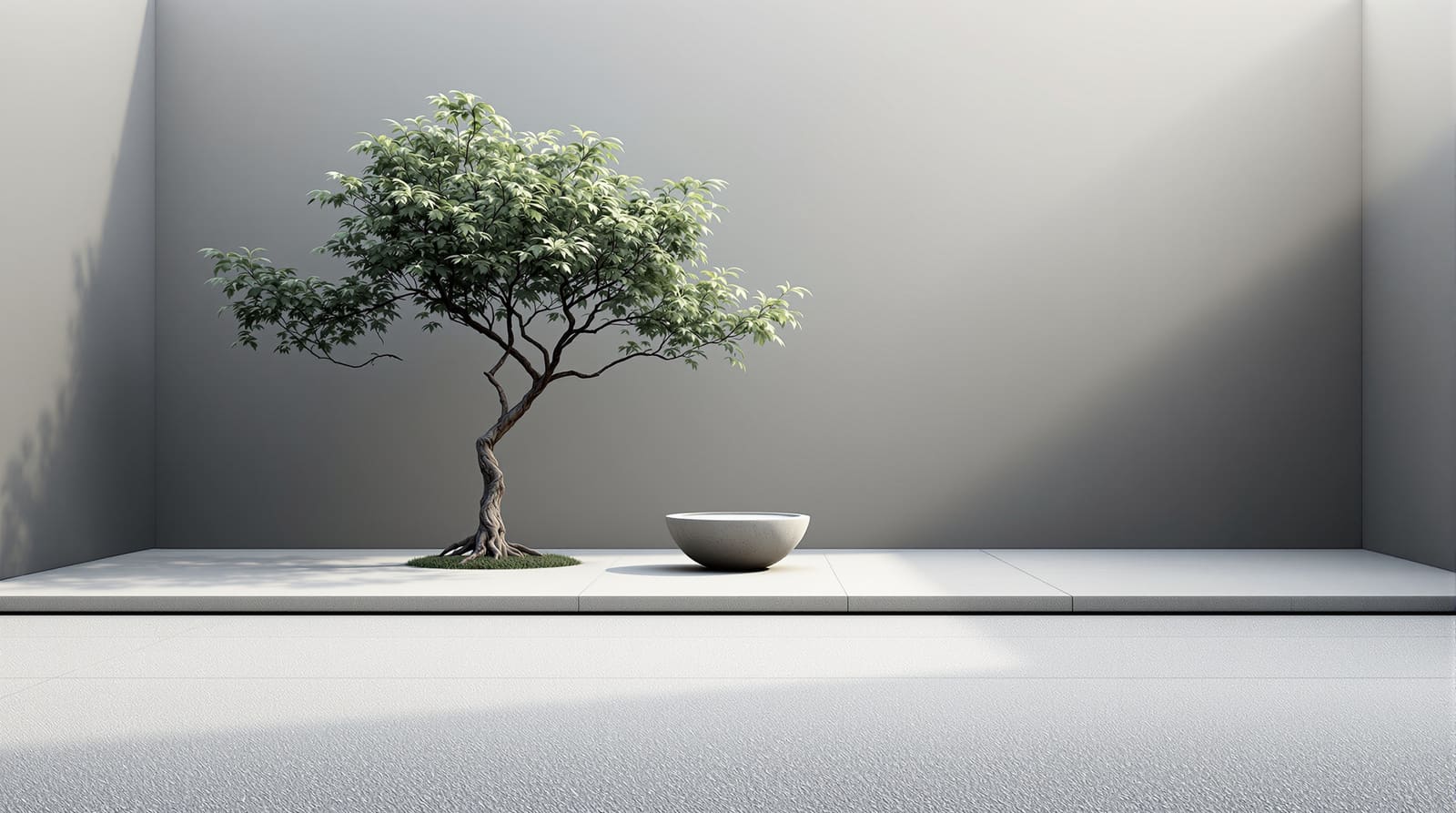
Meditation Garden Design
Designing a garden for stillness — Japanese Zen and India's own contemplative traditions, the anatomy of enclosure, focal point and sitting place, a quiet plant palette, and a meditation corner for the smallest balcony
There is a moment, just after dawn in a small Pune courtyard, when the world has not yet started. A woman steps barefoot onto a strip of raked grey gravel, crosses to a low stone platform set beneath a single frangipani tree, and sits. In front of her there is almost nothing: a weathered rock the colour of riverbed, a shallow bronze bowl holding still water, and the lightening sky framed by a plain wall. A koel calls somewhere beyond the boundary, then stops. She closes her eyes. The garden has only one thing to say, and it says it quietly.
This is not a garden you walk through, admire, or photograph for its blooms. It is a garden you sit in. Everything in it — the emptiness, the single tree, the deliberate threshold she crossed to enter — has been arranged to do one job: to make stillness easier. A meditation garden is a specific garden type whose entire design is subtracted down to support contemplative practice — where most gardens add interest, this one removes it, so that attention has somewhere to rest.
Why a garden made of less
The restorative science behind quiet outdoor space is well established, and we have set it out in full in our pillar on landscape design for mental wellbeing — Roger Ulrich's stress recovery work, the Kaplans' Attention Restoration Theory, E. O. Wilson's biophilia hypothesis. Here it is worth borrowing just one idea, because it explains why a meditation garden looks the way it does.
Rachel and Stephen Kaplan described what they called "soft fascination" — the way natural scenes hold attention gently, without demanding it, allowing the brain's tired directed-attention system to recover. A field of swaying grass, light moving on water, the slow turn of leaves: these occupy the mind just enough to quiet its chatter, but never enough to grip it. A meditation garden is, in effect, soft fascination distilled. Where a flower border offers a dozen competing things to look at, a meditation garden offers one — a rock, a tree, a bowl of water — and lets the eye and the breath settle there. Research associates this kind of low-demand natural attention with reduced rumination and lower physiological stress; the design simply gets out of its own way to make room for it.
That is the crucial distinction from its siblings. A sensory garden deliberately maximises stimulation — scent, texture, sound, colour, all at once — to wake the senses up. A meditation garden does the opposite: it reduces and quiets sensory input so the mind can grow still. And where forest bathing at home is an immersive, wandering practice through dense, layered greenery — a thing you move through — a meditation garden is somewhere you stop and sit. One is a walk; this is an asana.
A lineage of stillness — Japan and India together
Most people, hearing "meditation garden", picture the Japanese Zen karesansui — the dry garden of raked gravel and a few carefully placed rocks, the most famous being Ryoan-ji in Kyoto. The raked gravel suggests water or emptiness; the rocks are islands, or mountains, or nothing at all. Connected to it is the tea garden, or roji, whose genius lies in its threshold sequence: a path of stepping stones, a low gate, a stone basin to rinse the hands, each step shedding the outside world before one arrives at the teahouse. The roji teaches the single most transferable principle of meditation-garden design — that you do not simply enter a contemplative space, you are prepared for it.
But it would be a mistake, and a historical untruth, to treat the meditation garden as a Japanese import that India merely borrows. India's contemplative landscape traditions are at least as old and arguably deeper. The Buddha attained enlightenment seated beneath a tree, and the bodhi tree has been a planted, tended focal point of contemplation for over two millennia. The ashram garden — the grove around a teacher's dwelling — was a designed environment for study and meditation; the dhyana grove, a stand of trees set aside for sitting practice, predates the Japanese garden by centuries. In countless Indian homes the tulsi vrindavan, the raised masonry planter holding holy basil at the centre of the courtyard, is a daily focal point for prayer and quiet attention — a domestic meditation garden in miniature, complete before anyone called it that. And the Mughal charbagh, the four-fold paradise garden quartered by water channels, was conceived as an earthly image of stillness and order, a place to contemplate rather than merely stroll.
What Japan and India share is a single language: enclosure, threshold, restraint, a focal point, and emptiness given weight. A meditation garden in an Indian home need not choose between them. A strip of raked gravel can lead to a tulsi planter; a charbagh's axial calm can be reduced to a single still water bowl. The traditions converge on the same truth — that to design for contemplation, you design for less.
The anatomy of a meditation garden
Strip away the cultural dressing and a meditation garden is built from a small, repeatable set of elements. Each does a particular job for the sitting mind.
Enclosure and threshold. The space must feel separate from the household and the street — bounded by a wall, a screen, a hedge, or even a change in floor level. Then there must be a threshold: a gate, a step, a few stones, a single tree you pass under. Crossing it is the act of leaving the world behind, the roji lesson. Without enclosure there is no sense of refuge; without threshold there is no transition.
A single focal point. One thing for the eye to come to rest on, and only one. A weathered rock, a specimen tree, a shallow bowl of water, a lit diya, a small murti, or a purely abstract carved form. The discipline is to resist adding a second.
The sitting place — the asana spot. A meditation garden has a destination, and it is a seat: a low stone or timber platform, a flat boulder, a simple bench, a flagstone for a cushion. It should face the focal point, and ideally face east, so that morning practice meets the rising sun. This single fixed seat is what makes the type a place to be, not a place to pass through.
Raked ground or a simple path. Gravel that can be raked, a sweep of fine river pebble, or a plain stone path. The raking itself can be a meditative act; the swept ground reads as calm, ordered emptiness.
Emptiness and negative space. The hardest discipline. The empty gravel, the bare wall, the unplanted corner are not unfinished — they are the point. Negative space gives the focal point its power and the mind its rest.
Gentle sound and the framed sky. A trickle of water, the rustle of bamboo, wind through leaves — soft, continuous sound masks traffic and household noise without itself demanding attention. And wherever possible, frame a patch of open sky: it lifts the gaze and admits the largest, quietest thing of all.
Set out as a working brief, the elements and their Indian execution look like this.
| Design element | Its purpose for the sitting mind | Indian execution |
|---|---|---|
| Enclosure & threshold | Creates refuge; marks leaving the world behind | Compound wall, jaali screen or bamboo hedge; a single step or stone basin at entry |
| Single focal point | Gives attention one thing to rest on | A river boulder, a tulsi vrindavan, a brass water bowl, a stone lamp or small murti |
| Sitting place (asana spot) | A fixed destination to be still in | Low Kota-stone or timber platform facing east; a flat granite slab for a cushion |
| Raked ground / path | Reads as ordered calm; raking is itself practice | Fine river gravel or pebble; a path of cut stone or terracotta |
| Negative space | Lets the focal point and the breath settle | Bare swept courtyard, an unplanted corner, a plain lime-washed wall |
| Gentle sound | Masks noise without gripping attention | A slow water spout, rustling bamboo, wind chimes used sparingly |
| Subdued planting | Soft fascination, not stimulation | Evergreen structure & muted greens; scent kept faint and occasional |
We treat the broader question of why such arrangements feel calming — prospect and refuge, order, mystery — in why some gardens feel peaceful, and the design of restorative space generally in our guide to healing gardens. This guide stays narrowly on the meditation type.
A quiet plant palette for India
The planting in a meditation garden is the most counter-intuitive part, because the instinct is to fill. Resist it. The palette should provide evergreen structure, muted green, faint and occasional scent, and gentle movement — never a riot of colour or a crowd of competing species. Think of plants here as architecture, not decoration.
Choose two or three species and repeat them. A single specimen tree gives shade, scale and a focal canopy. Bamboo gives a screen and the essential soft sound of leaves. Low evergreen ground — mondo grass, dwarf ferns — reads as calm carpet. Scent should be present but subtle, which means using the fragrant favourites sparingly: a single jasmine, not a hedge of it. Avoid bedding annuals and high-colour ornamentals entirely; they pull the eye and break the stillness.
| Plant (common & botanical) | Role in the meditation garden | Note on restraint |
|---|---|---|
| Frangipani / champa (Plumeria) | Single specimen tree; sculptural bare-branch form & light scent | One tree as focal canopy, not a row |
| Bamboo (Bambusa spp.) | Living screen; the soft rustle that masks noise | A contained clump; choose non-invasive cultivars |
| Holy basil / tulsi (Ocimum sanctum) | Traditional sacred focal point in a vrindavan | A single raised planter as the heart of the space |
| Jasmine / mogra (Jasminum sambac) | Faint evening fragrance near the seat | One plant, trained — never a fragrant wall |
| Mondo grass (Ophiopogon japonicus) | Low evergreen ground, calm green carpet | Mass plainly; no variegated showy types |
| Ferns (Nephrolepis, Adiantum) | Soft texture in shade, gentle movement | Restful filler in a corner, kept simple |
| Khus / vetiver (Chrysopogon zizanioides) | Cooling earthy scent, fine grassy texture | Edge or screen; understated, not ornamental |
For choosing the single specimen tree that will anchor and shade the space, our guide to the best trees for Indian homes is the natural companion, and the broader logic of low-stimulation, calming green is set out in biophilic landscape design.
Making it real — a corner, a balcony, a tabletop
The meditation garden is one of the few garden types that loses nothing when shrunk, because its essence is reduction. You do not need a courtyard. You need an enclosed-feeling spot, one focal point, one seat, a little sound, and the discipline to leave the rest empty.
On a balcony. Screen one end with a bamboo blind or a jaali panel to create enclosure and a sense of threshold as you step out. Set a single floor cushion or a low stool facing the screened corner. For the focal point, choose one of: a contained bamboo in a tall pot, a single tulsi in a simple planter, or a small water bowl with a recirculating spout for sound. Keep the floor bare — a plain mat, a tray of raked sand. One plant, one seat, one quiet thing.
In a courtyard. This is the meditation garden's natural home in India; the traditional courtyard already gives enclosure and framed sky. Devote one quadrant to a strip of raked gravel leading to a low Kota-stone platform facing east. Place a tulsi vrindavan or a single river boulder as the focus. Our guide to courtyard landscape design covers the structural side of working such a space.
On a tabletop. The most contained version of all — a shallow tray of fine sand or gravel, one or three stones, a tiny rake, perhaps a sprig of moss. It will not seat you, but the act of raking it and resting the eye on it borrows the same quieting principle, and it brings the type indoors for a desk or a windowsill.
A word on the practice the garden serves, kept light because this is a design guide and not a how-to-meditate one. The garden does not meditate for you; it lowers the cost of beginning. The threshold prompts the shift in attention. The fixed seat removes the small decision of where to sit. The single focal point gives a wandering mind something neutral to return to — the rock, the water, the breath. The masking sound and the framed sky hold the edges of awareness. The emptiness leaves nothing to chase. Designed well, the space does its work before you have consciously asked it to, which is exactly what the restorative research would predict. The broader case for arranging a whole home and garden around calm is made in outdoor wellness spaces.
References
- Kaplan, R. & Kaplan, S. (1989). The Experience of Nature: A Psychological Perspective. Cambridge University Press. (Attention Restoration Theory; soft fascination.)
- Ulrich, R. S. (1984). "View through a window may influence recovery from surgery." Science, 224(4647), 420–421.
- Wilson, E. O. (1984). Biophilia. Harvard University Press.
- Cooper Marcus, C. & Barnes, M. (1999). Healing Gardens: Therapeutic Benefits and Design Recommendations. John Wiley & Sons.
- Keane, M. P. (1996). Japanese Garden Design. Tuttle Publishing. (Karesansui and the roji threshold sequence.)
- Slawson, D. A. (1987). Secret Teachings in the Art of Japanese Gardens. Kodansha. (Principles of stone setting and emptiness.)
- Gesler, W. M. (1992). "Therapeutic landscapes: medical issues in light of the new cultural geography." Social Science & Medicine, 34(7), 735–746.
If a meditation garden is the place to sit still, contrast it with the wandering immersion of forest bathing at home and the deliberate stimulation of a sensory garden — and when you are ready to design your own quiet corner, DesignAI can help you plan the enclosure, the focal point and the planting around your space.
Export this guide
Related Guides — Deep-dive reading
Healing Gardens: Designing Restorative Outdoor Space for Home
The evidence-based restorative garden for the Indian home — Ulrich's supportive-garden theory, attention restoration, the cortisol data, and a medicinal-aromatic plant palette of tulsi, jasmine, vetiver, brahmi and ashwagandha
LandscapeLandscape Design for Mental Wellbeing
The evidence for how outdoor space shapes the mind — Attention Restoration Theory, Stress Recovery Theory, biophilia and prospect-refuge — and a practical framework for a wellbeing garden at any size in India
LandscapeThe Best Trees for Indian Homes
A research-grade guide to choosing and placing trees around an Indian home — the real cooling and clean-air numbers, the right species for shade, flowers, fragrance and fruit, and the placement science that keeps roots out of your walls and drains.
LandscapeRelated Tools — Try Free
Healing View Impact Calculator
Evidence-Based Design dashboard quantifying the recovery impact of nature view + daylight factor on analgesic use, length of stay, and HCAHPS patient-experience uplift. Calibrated against Ulrich 1984 (Science), Park & Mattson 2008, and the CHD EBD evidence base.
EBD CalculatorCross-Ventilation Analyzer
Estimate airflow and air changes per hour (ACH) from room size, window areas, layout, and local wind — with NBC 2016 Part 8 compliance check.
Ventilation CalculatorCircadian Light Meter
Patient-centric circadian lighting visualizer for Indian healthcare design — time-of-day × intensity → CCT, melanopic lux (EML / mEDI), melatonin suppression, and an alertness curve. Calibrated against WELL v2 L03 Circadian Lighting Design, CIE S 026:2018, Brainard 2001, and Lucas et al. 2014.
Circadian Tool