
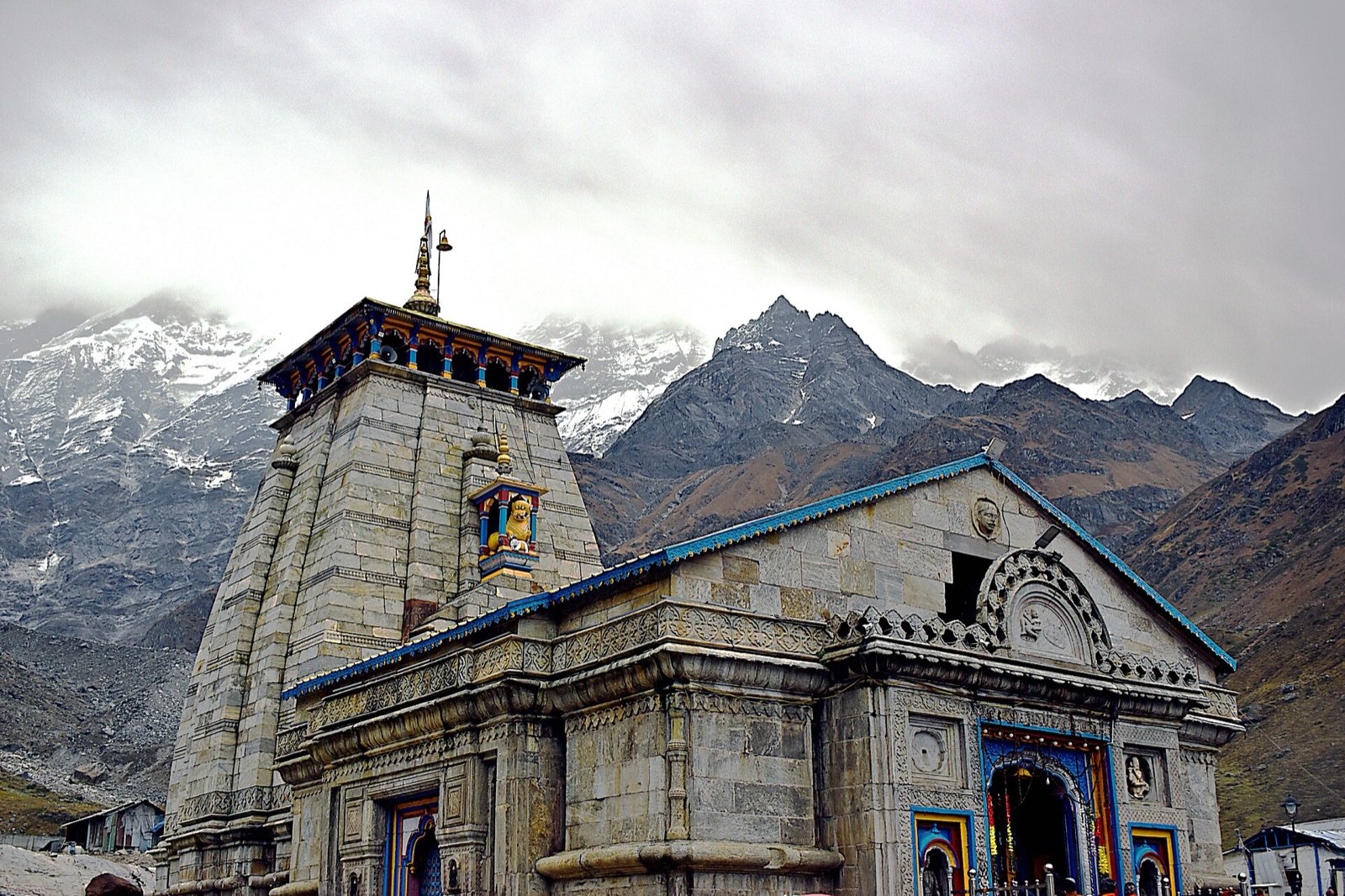
The Kedarnath Temple: The Shrine That Outlasts the Mountain
How a temple of huge interlocking stones, raised without mortar at nearly 3,600 metres in the high Himalaya, has stood against snow, ice, avalanche and flood for many centuries — and split a catastrophe around itself in 2013
The temples of the Indian plains could afford to be delicate. Sheltered by a warm climate and a stable earth, the builders of Khajuraho or Belur could dissolve their walls into lace-fine carving, pile up soaring towers, and trust them to stand for a thousand years. The Kedarnath temple could afford no such thing. It stands at nearly 3,600 metres in the high Garhwal Himalaya of Uttarakhand, in a place of almost unimaginable harshness — buried under deep snow for roughly six months of every year, battered by avalanche and glacial flood, gripped by the relentless freeze and thaw of high-altitude cold. And yet it has stood there for many centuries, one of the holiest shrines of Shiva in all of India. Kedarnath is the temple built not to be beautiful but to survive — and it is a masterclass in how architecture answers an environment at the edge of the possible.
A shrine at the roof of the pilgrim world
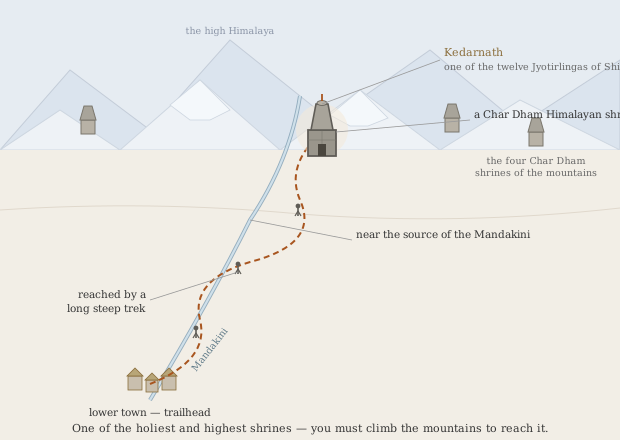
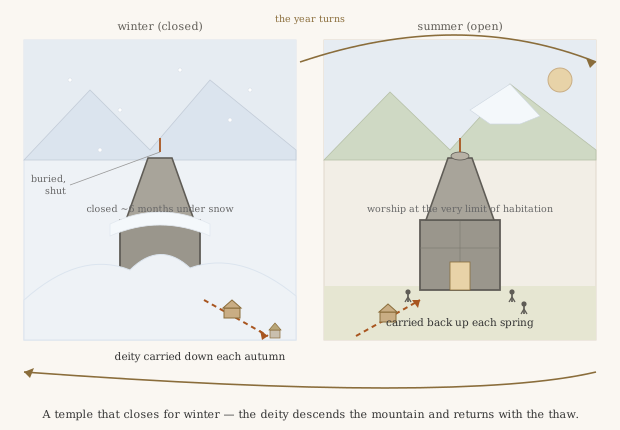
Kedarnath is among the most sacred sites in Hinduism: one of the twelve Jyotirlingas, the supreme shrines of Shiva, and one of the Char Dham pilgrimage destinations of the Himalaya. By tradition its origins reach back to the Pandavas of the Mahabharata, and its revival is attributed to the great philosopher Adi Shankara in the eighth century. To reach it, pilgrims must undertake a long, steep trek high into the mountains, to a remote valley near the source of the Mandakini river, backed by the towering Kedarnath peak. The temple is so high, and the winter so severe, that it is physically closed for half the year — its deity ceremonially carried down to a lower village each autumn as the snows close in, and carried back up each spring when they retreat. It is architecture at the very limit of where people can build and worship at all.
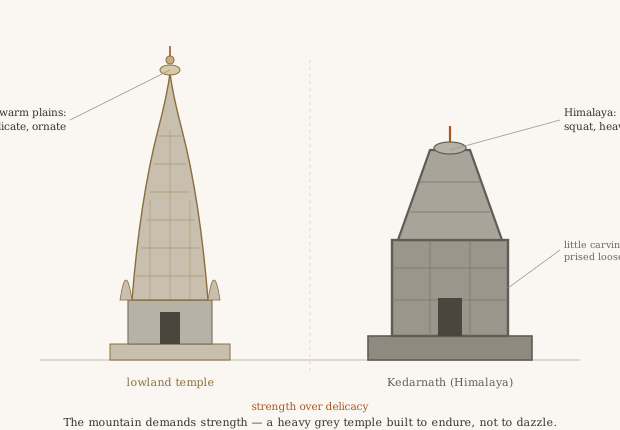
Everything about the temple's form is a response to this setting. It is built of massive, heavy blocks of grey stone; its tower is not the soaring, delicate rekha spire of Odisha but a simple, robust, conical mass; there is little of the intricate figure-carving that covers the temples of the warm plains. Where a lowland temple can be ornate, a Himalayan temple must be strong: squat, solid, heavy, presenting as little delicate detail as possible for the ice and avalanche to prise apart. The building's severe, muscular simplicity is not a lack of sophistication but the correct and hard-won answer to its brutal environment.
Built without mortar, to defeat the ice
The deepest intelligence of Kedarnath is in how those great stones are put together, and it is the key to its survival.
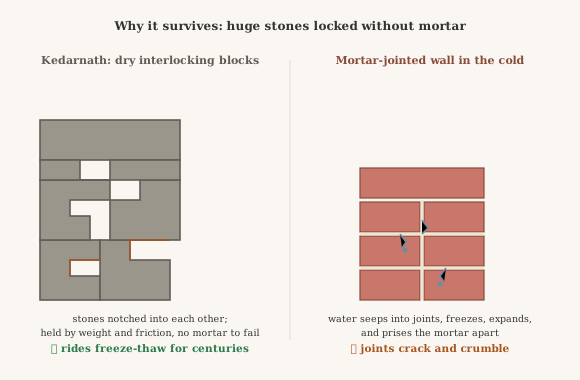
The temple is built of enormous stone blocks fitted together dry — without mortar — their faces cut and notched so that they interlock, holding the structure together by sheer weight, precision and friction. This is not a limitation; it is the solution. Consider what would happen to a mortar-jointed wall in this climate: water seeps into the joints, and when it freezes it expands with irresistible force, prising the mortar apart; repeated over thousands of freeze-thaw cycles, this "frost wedging" would crack and crumble any mortared wall within a few seasons. A wall of massive interlocking stones has no mortar to fail. It flexes minutely, sheds water through its joints, and holds together under its own colossal weight, riding the freeze-thaw of the mountain year after year, century after century. The very heaviness and interlock that would be excessive in a lowland temple are exactly what let Kedarnath endure. It is the same instinct we saw in the earthquake-engineered Ramappa temple — the builders reading their environment's specific violence and shaping the structure to defeat it — here answering not the earthquake but the ice.
The flood that proved it
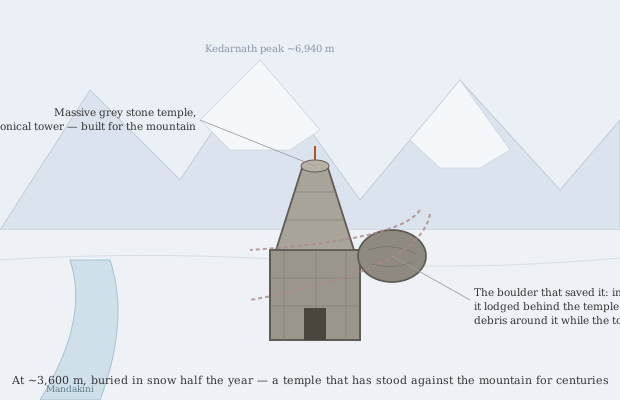
That defensive genius was tested, catastrophically and famously, in June 2013. A cloudburst and the collapse of a glacial lake sent a massive flood of water, mud and rock roaring down the Mandakini valley, and it devastated the town of Kedarnath, sweeping away buildings and killing thousands of people. But the ancient temple survived, essentially intact. The reason has become part of its legend: a huge boulder, carried down by the flood, is said to have lodged against the rear of the temple and acted as a barrier, splitting the torrent of water and debris and diverting it around the building on either side, so that the flood that destroyed the modern town flowed harmlessly past the thousand-year-old shrine. The stone has been revered since as the Bhim Shila, the "Bhima rock." Whether one reads it as providence or as the fortunate physics of a solid mass in a valley, the survival of Kedarnath amid the ruin of everything around it dramatised, in a single terrible event, what the temple had quietly been doing all along: standing, unmoved, against the worst the mountain could send.
Why Kedarnath matters
Kedarnath earns its place in this series as the supreme example of architecture as a response to extreme environment. Across this whole collection we have seen buildings shaped by their climates — the self-cooling palaces of the desert, the snow-shedding roofs of Kashmir, the brick temples of stone-less Bengal — but nowhere is the dialogue between a building and a hostile nature more total, or more a matter of sheer survival, than here. Kedarnath teaches that the "best" architecture is not always the most refined or the most soaring; sometimes it is the strongest, the simplest, the most perfectly matched to a merciless place. A temple of huge dry-laid stones, squat against the wind, buried in snow half the year, and standing regardless: it is a different kind of wonder from the Taj Mahal, but no less profound.
There is something fitting in the fact that one of the holiest shrines of Shiva — the god of both destruction and endurance — should be this: not a jewel in a garden, but a fortress of interlocking stone at the roof of the world, built to outlast the mountain itself, and, so far, doing exactly that. Stand before it with the snow peaks ringing the valley and the river roaring below, and you understand the austere, unbreakable faith the building embodies — a place where architecture and devotion have together defied, for a thousand years, everything the Himalaya can do.
Part of the Architectural Wonders series. For architecture answering other harsh climates, read the snow-roofed Martand Sun Temple of Kashmir, the desert-cooled Hawa Mahal, and the earthquake-engineered Ramappa temple.
Hero photograph: “Kedarnath Temple, Uttarakhand” by Rohit Sharma, via Wikimedia Commons, licensed under CC BY-SA 4.0.
Export this guide
Related Guides — Deep-dive reading
Great Zimbabwe: The Stone City Europe Refused to Believe Africans Built
In the hills of southern Africa stand the largest ancient stone ruins south of the Sahara — a whole city of massive granite walls built without a drop of mortar, the wealthy capital of a gold-trading kingdom. For a century, colonists refused to accept that Africans had raised it, and invented every other builder they could. This is the story of that architecture, and of the lie it outlived. The article that closes our chapter on the palaces and pleasures of worldly power.
Architectural WondersBrihadeeswara: The Chola Tower That Never Fell
How an 11th-century Tamil emperor raised a 216-foot tower of solid granite — with no mortar, no iron and no machine — and why this colossal corbelled mountain has stood for over a thousand years where Konark's fell. The engineering, the 80-tonne capstone, and the lesson.
Architectural WondersĠgantija: The Oldest Temple Standing, Built by 'Giants'
How a Neolithic island people on Malta — with no metal and no wheel — raised the oldest free-standing stone temples on Earth a thousand years before Stonehenge or the pyramids, moving fifty-tonne blocks on stone balls into clover-leaf sanctuaries for a faith we can trace but cannot read, then vanished, leaving stones so vast that later islanders swore only giants could have built them.
Architectural WondersRelated Tools — Try Free
Before & After Studio
Generate AI before-and-after renders to preview how your redesign could look.
DesignAICross-Ventilation Analyzer
Estimate airflow and air changes per hour (ACH) from room size, window areas, layout, and local wind — with NBC 2016 Part 8 compliance check.
Ventilation CalculatorGarden Planning Toolkit
Get a tailored garden plan — planting layers, Indian species, features and a checklist — from your climate, space, sun and goals.
Planner