
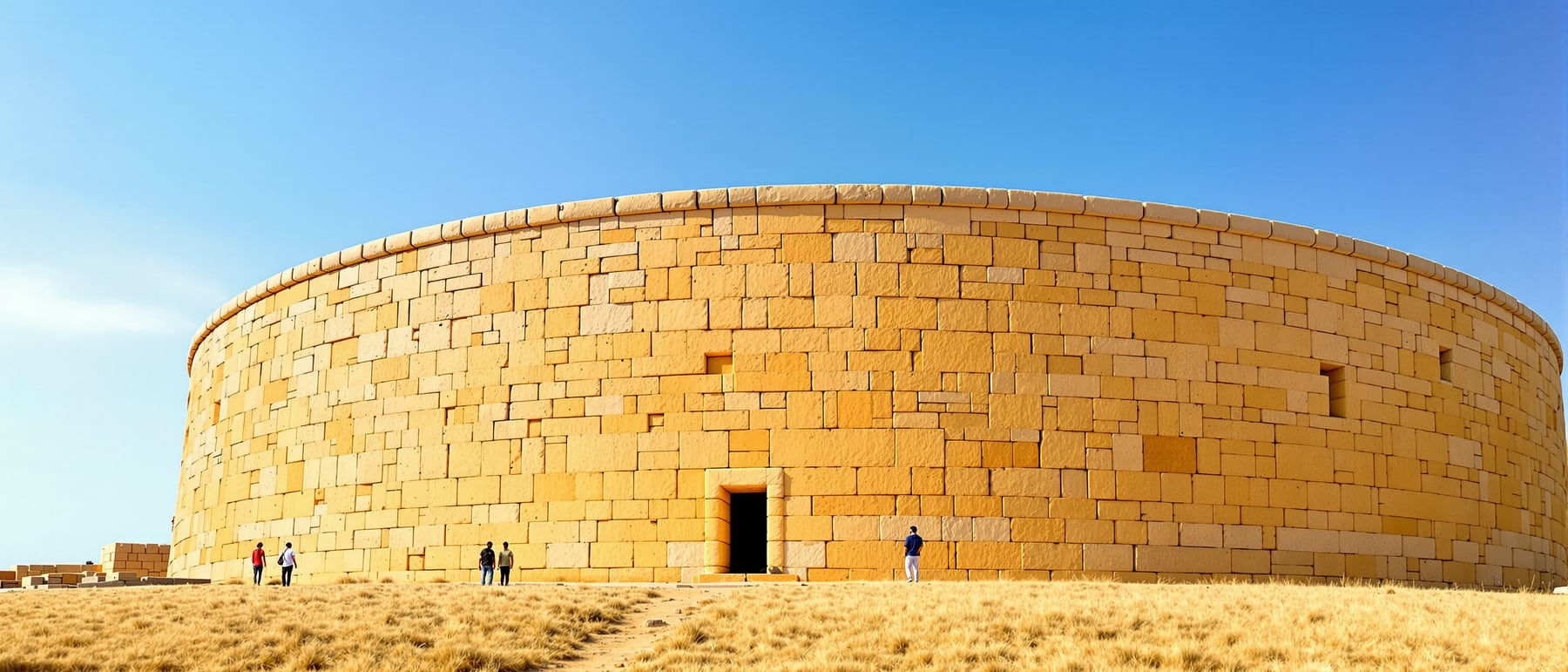
Ġgantija: The Oldest Temple Standing, Built by 'Giants'
How a Neolithic island people on Malta — with no metal and no wheel — raised the oldest free-standing stone temples on Earth a thousand years before Stonehenge or the pyramids, moving fifty-tonne blocks on stone balls into clover-leaf sanctuaries for a faith we can trace but cannot read, then vanished, leaving stones so vast that later islanders swore only giants could have built them.
We turn now from the great tombs of the world to its great temples and sacred places — the buildings humanity has raised, in every age and on every continent, to meet the divine. And we begin, as we must, at the very beginning: with the oldest free-standing temples anyone has ever found, on a small, sun-baked island in the middle of the Mediterranean.
On Gozo, in the Maltese islands, stands Ġgantija — a pair of vast Neolithic temples built around 3600 BCE, more than five and a half thousand years ago. That is roughly a thousand years before Stonehenge, and a thousand years before the first Egyptian pyramid. These are among the oldest free-standing stone structures on Earth, raised by a farming people who had no metal and no wheel — and whose stones were so colossal that, thousands of years later, the Maltese could only explain them by saying they had been built by a race of giants. It is the dawn of monumental sacred architecture, and the perfect place to open this new chapter.
This is the forty-eighth article in our Architectural Wonders series, and the first of a chapter on great temples and sacred places.
1. Older than the pyramids
The first thing to grasp about Ġgantija is when it was built — because it resets the clock on the whole history of temples.
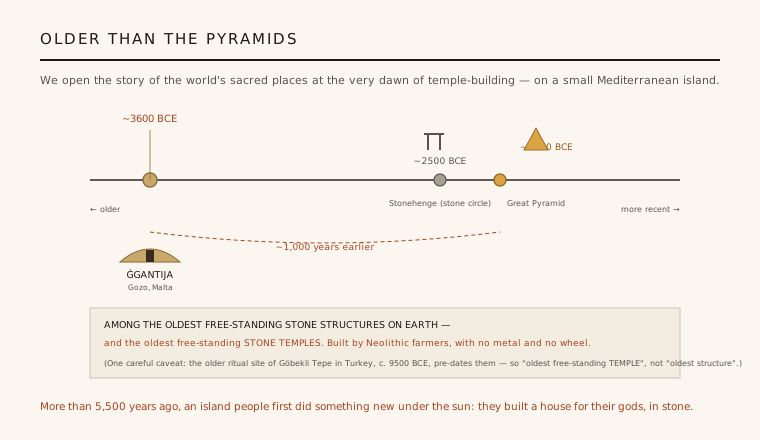
Ġgantija was raised around 3600 BCE, which places it a full millennium before the sarsen circle at Stonehenge and the Great Pyramid of Giza alike. It is, quite simply, among the oldest free-standing stone structures on Earth, and the oldest free-standing stone temples. (One honest caveat: the older ritual complex of Göbekli Tepe in Turkey, from around 9500 BCE, predates it — so Ġgantija is the oldest free-standing stone temple, not the single oldest structure of any kind.) What makes this almost impossible to absorb is who built it: not a great empire with armies of labour, but a Neolithic farming community on a tiny island, working with tools of stone, bone and wood — no metal, no wheel. Before writing, before the pharaohs, before almost everything we call "ancient," these islanders looked at the world and decided to build, out of enduring stone, a house for their gods. This is where the story of sacred architecture begins — the same Stone Age genius we met at Newgrange, turned for the first time to making a temple.
2. The temple of giants
Step up to it, and the reason for the name becomes obvious — the stones are simply too big for human hands.
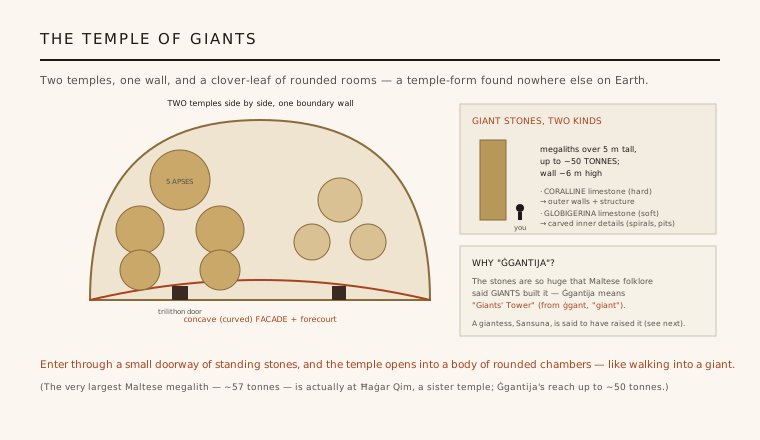
Ġgantija is actually two temples built side by side, sharing a single curving concave facade and wrapped in one massive boundary wall that still rises some six metres. Each follows the distinctive Maltese temple form: you pass through a trilithon doorway — two great uprights capped by a lintel — into a central corridor that opens out into a clover-leaf of rounded chambers, or apses (the larger, older temple has five). It is a plan found nowhere else in the world — as if the temple were shaped like a body, drawing you inward through a series of curved, womb-like rooms. The builders used two local stones with real understanding: hard coralline limestone for the structural megaliths and outer walls, and softer globigerina limestone, easier to carve, for the inner altars decorated with spirals and drilled pits. And those megaliths are titanic — some over five metres tall and weighing up to fifty tonnes. The stones are so far beyond ordinary human scale that Maltese folklore concluded the only possible builders were giants — Ġgantija means "Giants' Tower," and legend named the builder a giantess called Sansuna. How a Stone Age people actually moved such stones is the next wonder.
3. Moving mountains with stone balls
No metal, no wheel, no crane — and yet fifty-tonne blocks were quarried, dragged and stood upright. How?
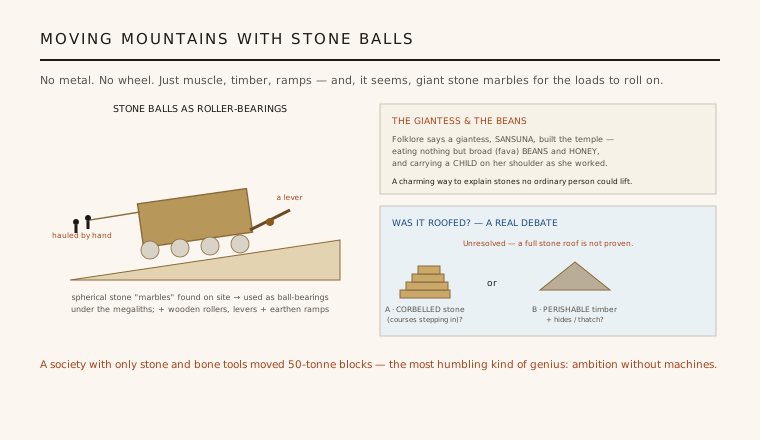
The answer lies partly in a curious find: small spherical stones scattered around the temples, which archaeologists interpret as roller-bearings — stone "marbles" laid under the megaliths so the giant blocks could be rolled, like a load on ball bearings, and hauled with ropes over wooden rollers, levered upright, and slid up earthen ramps. It was muscle and ingenuity in place of machinery — the most humbling kind of engineering, ambition with nothing but stone, timber and cooperation. (The legend, endearingly, gave the giantess Sansuna a simpler method: she built the temple while eating nothing but broad beans and honey, a child balanced on her shoulder.) One thing we still cannot settle is whether these chambers were roofed — in corbelled stone, the upper courses stepping gradually inward, or in perishable timber and hides long since rotted away. The evidence is ambiguous, and it remains a genuine, unresolved debate — one of many things these silent temples will not tell us.
4. The "fat ladies" and the goddess question
We know Ġgantija was a place of worship. What was worshipped there is one of prehistory's great open questions — and a caution against easy answers.
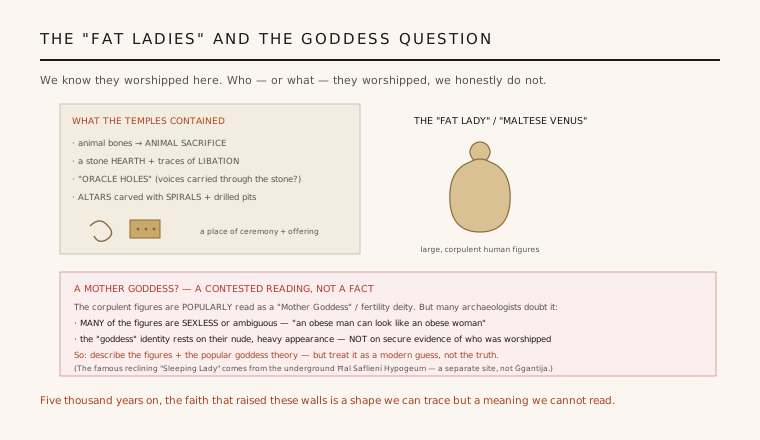
The physical evidence of ritual is clear enough: animal bones from sacrifice, a stone hearth, traces of libation, mysterious "oracle holes," and altars carved with spirals and drilled pits. And then there are the famous finds — statues of large, corpulent human figures, the so-called "fat ladies" or "Maltese Venus." For a long time these were confidently read as images of a Mother Goddess, a great fertility deity presiding over the temples. It is a seductive story — but it is a contested interpretation, not a fact, and honesty requires saying so plainly. Many of the figures are actually sexless or ambiguous; as one scholar drily noted, "an obese man can look like an obese woman." The "goddess" identity rests largely on the figures' heavy, nude appearance, not on any secure evidence of who was actually worshipped. So the truthful position is the humbler one: here was a people with a rich ceremonial life and a striking taste for the corpulent human form — and a faith whose shape we can trace but whose meaning we cannot read. (A related caution: the famous reclining "Sleeping Lady" comes not from Ġgantija but from the underground Ħal Saflieni Hypogeum, a separate site.)
5. The vanished temple-builders
And there is one final mystery, the largest of all: the people who built these temples, and this whole unique tradition, disappeared.
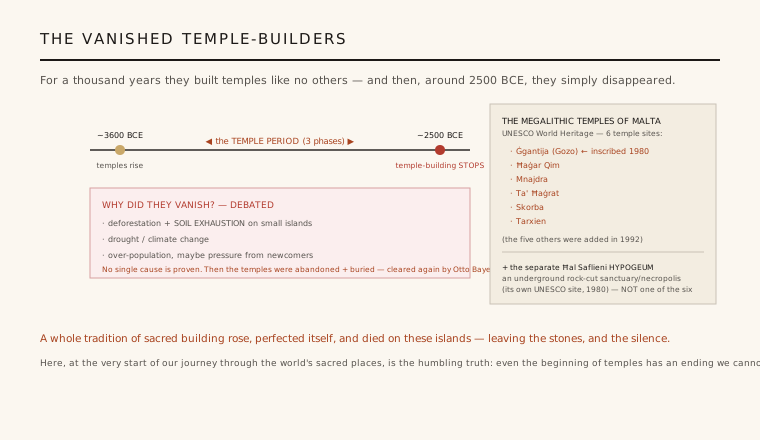
For over a thousand years — the "Temple Period," roughly 3600 to 2500 BCE — a distinctive temple-building culture flourished on these small islands, raising Ġgantija and its sisters through several architectural phases. And then, around 2500 BCE, temple-building simply stopped, and the culture declined and vanished. Why is genuinely debated: exhausted soils and deforestation on tiny islands, drought, over-population, perhaps pressure from newcomers — no single cause is proven. The temples were abandoned, collapsed, and buried, until Ġgantija was cleared of its debris by Otto Bayer in 1827. Today it stands at the head of the "Megalithic Temples of Malta," a UNESCO World Heritage Site of six temple sites — Ġgantija, Ħaġar Qim, Mnajdra, Ta' Ħaġrat, Skorba and Tarxien (with the separate, extraordinary underground Ħal Saflieni Hypogeum listed apart). It is a fitting, sobering way to open a journey through the world's sacred places: the very first great temples remind us that a whole tradition of building for the divine can rise, perfect itself, and die — leaving only the stones, and the silence, and a legend of giants.
6. What a modern architect can learn from Ġgantija
- Monumental architecture predates almost everything. No metal, no wheel, no writing, no empire — and still, a house for the gods in fifty-tonne stone. The urge and the ability to build greatly are far older and more universal than any technology. Ambition is the oldest tool.
- Shape space around the ritual, not the other way round. The clover-leaf of curved apses was designed for a specific ceremonial life — the body of the temple echoing the human body. Let the way a space will be used and felt dictate its form.
- Understand your materials precisely. Hard coralline for structure, soft globigerina for carving: the builders matched each stone to its job. Deep, practical knowledge of materials is the quiet foundation beneath every great building, ancient or modern.
- Ingenuity can replace machinery. Stone balls as bearings, ramps, levers, rope, and cooperation moved mountains. Constraint breeds cleverness; the absence of tools is not the absence of solutions.
- Be honest about what you don't know. The goddess, the roof, the collapse — all are debated. A responsible reading of any building, especially an ancient one, says clearly where knowledge ends and interpretation begins.
- Even traditions end — so build to be remembered. The temple culture vanished, but its stones still teach and move us 5,000 years on. What we make can outlast not just us but our entire civilisation; that is reason enough to make it beautiful, and to make it true.
References & further reading
1. UNESCO World Heritage Centre — Megalithic Temples of Malta (Ġgantija inscribed 1980, extended 1992). https://whc.unesco.org/en/list/132/
2. UNESCO World Heritage Centre — Ħal Saflieni Hypogeum (inscribed 1980). https://whc.unesco.org/en/list/130/
3. Heritage Malta — Ġgantija Temples. https://heritagemalta.mt/
4. World History Encyclopedia — Ġgantija. https://www.worldhistory.org/Ggantija/
5. Encyclopaedia Britannica — Ġgantija. https://www.britannica.com/topic/Ggantija
6. Wikipedia — Ġgantija and Megalithic Temples of Malta. https://en.wikipedia.org/wiki/%C4%A0gantija
Last verified 2026-07-04. Figures follow UNESCO, Heritage Malta and standard archaeological sources and are given as widely cited approximations that vary by source. Ġgantija (Gozo, Malta) was built c. 3600 BCE (the complex used through the Temple Period, c. 3600–2500 BCE) — a millennium older than Stonehenge and the Egyptian pyramids, and among the world's oldest free-standing stone structures and the oldest free-standing stone temples; the older ritual site of Göbekli Tepe (Turkey, c. 9500 BCE) predates it, so the careful claim is "oldest free-standing stone temple." Ġgantija is two temples sharing a concave facade and boundary wall (wall ~6 m high); the Maltese plan runs concave facade → trilithon doorway → clover-leaf of apses (the larger temple has five). It is built of coralline (structural) and globigerina (carved) limestone, with megaliths over 5 m and up to ~50 tonnes (the ~57-tonne largest Maltese megalith is at Ħaġar Qim, not Ġgantija). The stone spheres interpreted as roller-bearings, and the roofing question (corbelled stone vs. perishable), follow the record — the roof is unresolved. The "fat lady"/Mother-Goddess cult reading is popular but genuinely contested (many figures are sexless); the "Sleeping Lady" is from the separate Ħal Saflieni Hypogeum. The Temple-Period culture declined c. 2500 BCE for debated reasons (deforestation, soil exhaustion, drought, over-population). Ġgantija was cleared by Otto Bayer in 1827. The Megalithic Temples of Malta (six sites: Ġgantija, Ħaġar Qim, Mnajdra, Ta' Ħaġrat, Skorba, Tarxien) are a UNESCO World Heritage Site (Ġgantija 1980, extended 1992); the Ħal Saflieni Hypogeum is a separate UNESCO site (1980).
Export this guide
Related Guides — Deep-dive reading
The Pyramid of the Sun: A Mountain Raised Over a Cave by a People With No Name
In the Valley of Mexico, a civilisation we cannot name built one of the largest pyramids on Earth — a man-made mountain of a million cubic metres — and set it precisely over a sacred cave they believed was the womb of the world. They left no writing we can read; even the words 'Pyramid of the Sun' were given, a thousand years later, by the Aztecs, who found the city in ruins and called it the birthplace of the gods.
Architectural WondersStonehenge: The Stone Circle That Was Built Like Carpentry
How Neolithic Britons, over fifteen centuries and with nothing but antler picks and rope, dragged twenty-five-tonne sarsens and Welsh bluestones across an island to raise the only stone circle on Earth joined like woodwork — mortise, tenon, tongue and groove in solid stone — aligned it on the turning sun, filled it with the cremated dead, and left us a temple whose purpose we still cannot fully name.
Architectural WondersNewgrange: The Tomb That Catches the Sun
How Neolithic farmers in Ireland — with no metal, no wheel and no writing — raised a 200,000-tonne mound of turf and stone six centuries before the Great Pyramid, roofed a chamber that has stayed dry for 5,000 years, and aimed a stone box at the winter dawn so that once a year the sunrise reaches 19 metres into the dark and lights the heart of the tomb.
Architectural WondersRelated Tools — Try Free
Circadian Light Meter
Patient-centric circadian lighting visualizer for Indian healthcare design — time-of-day × intensity → CCT, melanopic lux (EML / mEDI), melatonin suppression, and an alertness curve. Calibrated against WELL v2 L03 Circadian Lighting Design, CIE S 026:2018, Brainard 2001, and Lucas et al. 2014.
Circadian ToolSociety Handover & NOC Checklist
Builder-to-RWA handover audit — 9 categories, 65+ checkpoints across legal docs, drawings, utilities, STP/WTP, fire safety, finances, warranties.
RWA HandoverAcoustic Privacy (STC) Visualizer
Indian healthcare acoustic visualizer — compare wall assemblies and noise sources, see received SPL after STC attenuation, and check FGI 2018 / IS 1950 / NABH speech-privacy compliance with live dual-canvas waveform.
Acoustic Tool