
The Hawa Mahal, Jaipur: A Palace That Is Almost Entirely a Window
How the rulers of Jaipur built a five-storey honeycomb of nine hundred latticed windows — a thin pink screen that let the royal women watch the city unseen and cooled itself on the desert breeze
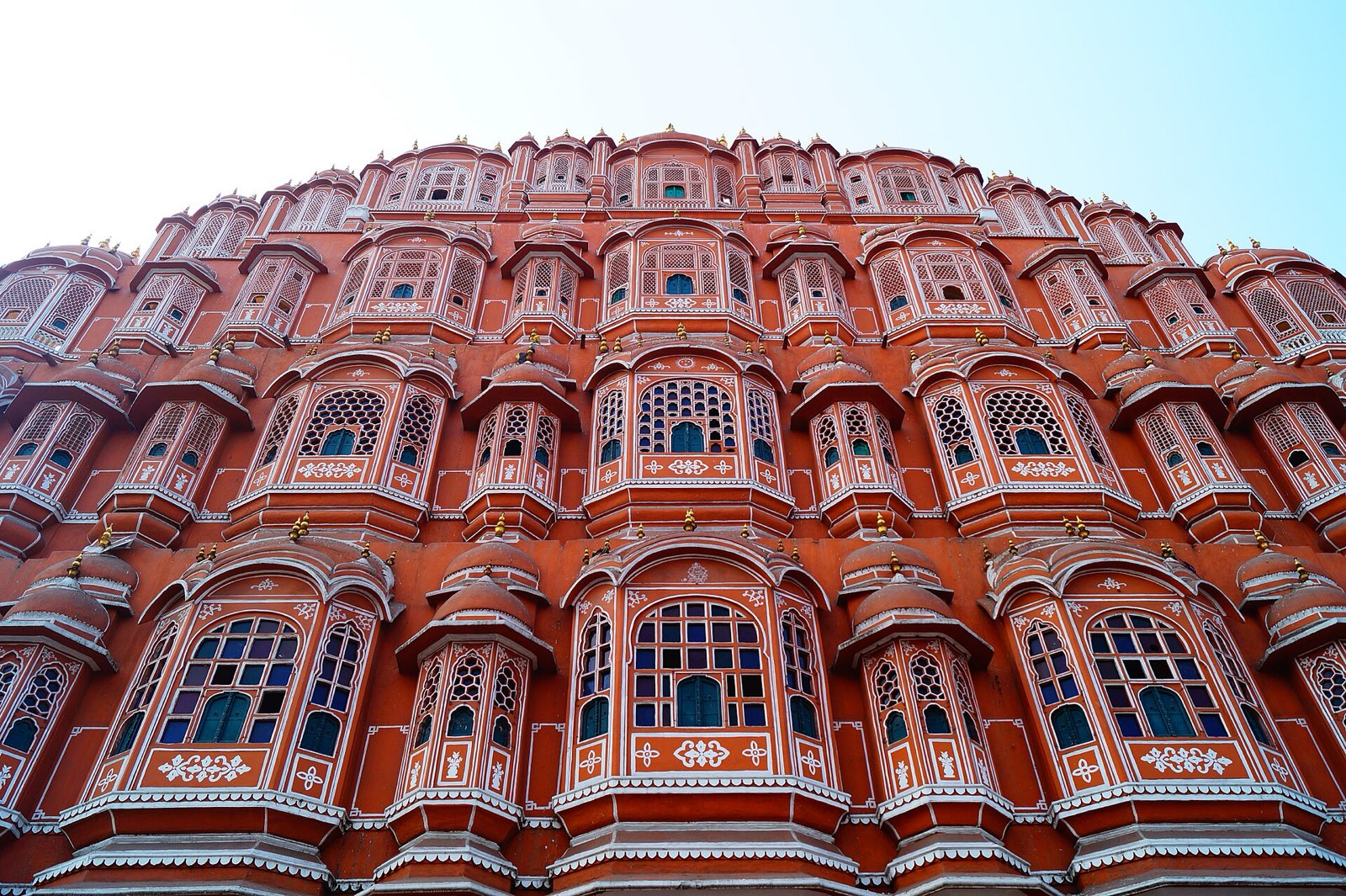
Most palaces are about mass — great blocks of building enclosing rooms and courts. The Hawa Mahal, the "Palace of Winds" in Jaipur, is about the opposite: it is one of the most famous buildings in India, and it is almost entirely a facade. Seen from the street it rises five storeys, a great pink-and-red honeycomb of small windows tapering upward like a crown; but step around it and you find it is scarcely more than a room deep. It is a building that is really a wall — an inhabited screen, pierced by nine hundred and more little latticed windows, built for two exquisitely practical purposes that between them explain everything about its extraordinary form.
Those two purposes are the key to reading it: it was built so that the women of the royal household could watch the life of the city without being seen, and so that the hot desert air could be drawn through it and cooled. See it as a machine for looking and for breathing, and its strange, screen-like shape becomes not a curiosity but a perfectly logical answer to a real problem.
A screen of nine hundred windows
The Hawa Mahal was built in 1799 by Maharaja Sawai Pratap Singh of Jaipur, designed by the architect Lal Chand Ustad, as an extension of the City Palace's women's quarters facing the main street of the old city. Its celebrated street front is its whole reason for being.
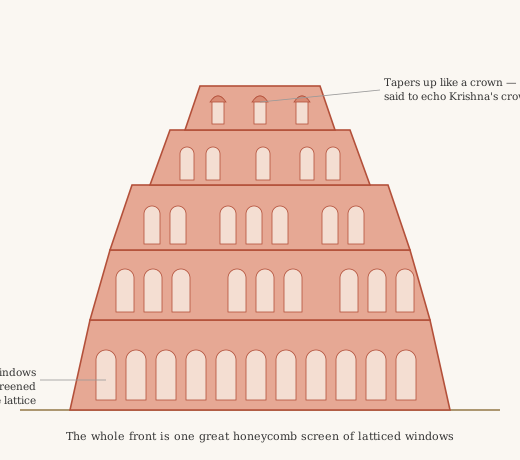
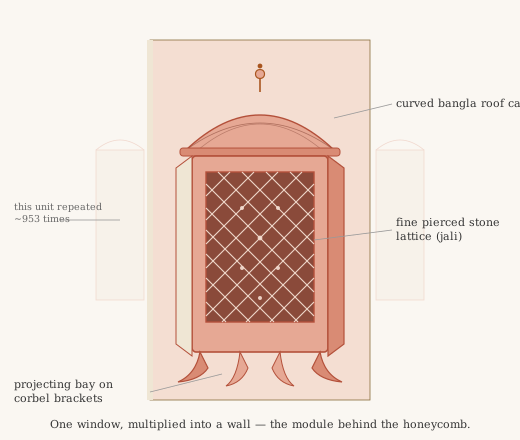
The facade is a five-storey pyramid, tapering as it rises — a silhouette said to echo the crown of the god Krishna. Across its whole surface march rows of small projecting bay windows, the jharokhas we first met at Amber, each one a little corbelled oriel topped by a curved bangla roof — and famously there are said to be 953 of them. Every window is filled with a finely pierced stone lattice, the jali, so that the entire front reads as a single vast honeycomb screen, a wall made mostly of holes. Built of Jaipur's characteristic pink sandstone, catching the low morning sun, it is one of the most instantly recognisable images in all of Indian architecture — and it works because it takes a single element, the latticed jharokha window, and repeats it into infinity.
Looking without being seen
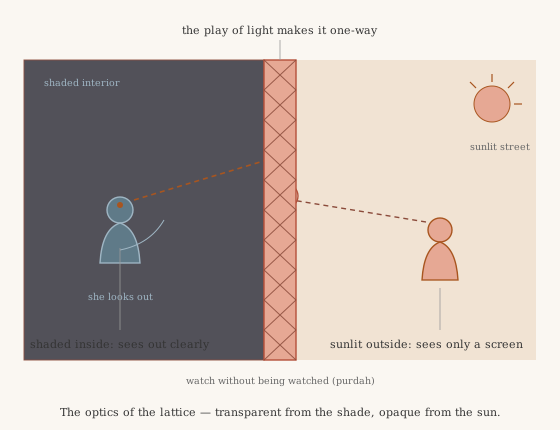
The first purpose written into every one of those windows is the practice of purdah — the seclusion of high-status women from the public gaze. The royal women of Jaipur lived, by the custom of the time, out of sight of men outside their family. But the main street below the Hawa Mahal was the stage for the city's life: markets, festivals, and above all the great royal and religious processions that wound through Jaipur. The women wished to see these, and the building was designed to let them.
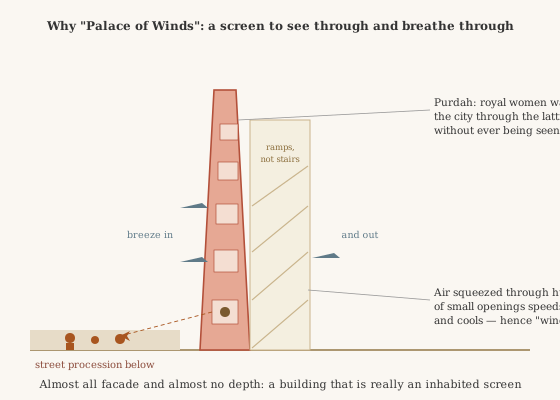
The lattice is the perfect instrument for this. From the shaded interior, a woman seated at a jharokha could look out through the fine stone tracery and see the whole bright street below in detail; but from the sunlit street, no one could see in through the same lattice — the play of light makes the screen opaque from outside and transparent from within. So the facade let the palace's women watch the city, the crowds, the processions, unseen, from any of nine hundred vantage points. The building's very thinness follows from this: it did not need deep rooms, only a tall screen of viewing windows facing the street, so it is barely one room deep, with gently sloping ramps rather than stairs connecting its storeys (some say to allow palanquins, or the elderly, to move easily between floors). It is architecture shaped almost entirely by the social requirement of the veiled gaze.
Breathing on the wind
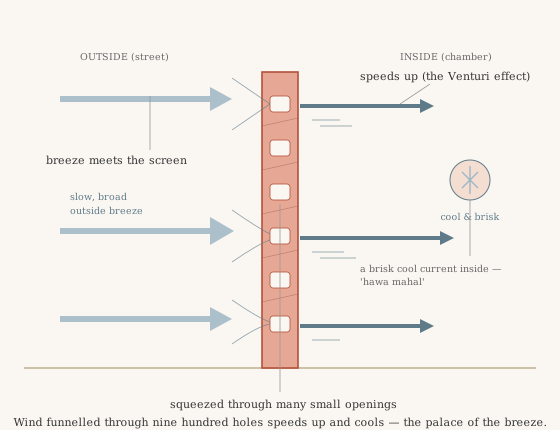
The second purpose is the one that gives the palace its name. Jaipur summers are ferocious, and a wall of hundreds of small openings turns out to be a superb cooling device. As a breeze meets the facade, the air is squeezed through the many small latticed windows, and — by the same principle that makes wind speed up when it funnels through a narrow gap — it accelerates as it passes through each opening, so that even a light outside breeze becomes a brisk, cool current inside. The lattices also throw the harsh sunlight into soft shade while letting the air pass freely. The result is that the interior stays cool and airy through the worst heat, ventilated entirely by the movement of the wind through its nine hundred windows. This is hawa mahal — the palace of winds — and it belongs to the same tradition of ingenious passive cooling we have seen again and again in this series, from the water channels of the Red Fort and Amber to the self-ventilating Lotus Temple: architecture that fights a hard climate not with machines but with clever form.
Why the Hawa Mahal matters
The Hawa Mahal is small and slight beside the great forts and temples of this series, and that is exactly why it is worth ending a run of mighty monuments with it. It shows that an architectural wonder need not be huge or heavy; it can be a single brilliant idea — the latticed window — refined and multiplied until it becomes unforgettable. It is the ultimate expression of two threads we have followed across many Rajput and Mughal buildings: the jharokha and the jali, those devices for looking out and cooling down, here liberated from being mere details on a larger building and made into the entire architecture. Where Amber used a jali here and a jharokha there, the Hawa Mahal is nothing but jharokhas and jalis, stacked five storeys high.
It is also a building shaped, with unusual honesty, by the lives of the women it was built for — a rare piece of architecture whose whole form is an answer to the question of how the secluded could still see the world. Stand in the street below at sunrise, when the pink stone glows and the nine hundred lattices catch the light, and imagine the unseen watchers behind them looking down on a procession two centuries ago, the desert breeze moving cool through the honeycomb around them, and you understand why this thin pink screen of windows is loved as one of the most human and ingenious of all Indian buildings.
Part of the Architectural Wonders series. For the jharokha and jali on the larger buildings they came from, read Amber Fort; for more architecture that cools itself without machines, the Red Fort and the Lotus Temple.
Hero photograph: “Hawa Mahal, Jaipur” by Sumit Das, via Wikimedia Commons, licensed under CC BY-SA 4.0.
Export this guide
Related Guides — Deep-dive reading
The Street, Mathura: How Sanjay Puri Turned a Corridor into a Community
At GLA University near Mathura, Sanjay Puri Architects folded 800 hostel rooms into five snaking, four-storey blocks so that the leftover space between them became a genuine pedestrian street — a low-cost, climate-tuned answer to the question of how young people should live together, drawn from the winding lanes of an old Indian city.
The Future of ArchitectureThe Lotus Temple, Delhi: A Flower of Concrete and Marble for All Faiths
How an Iranian architect folded twenty-seven marble petals into a nine-sided house of worship open to every religion — a modern icon that cools itself with water and air, and takes its shape from a flower sacred across India
Architectural WondersAmber Fort, Jaipur: The Rajput Palace That Learned to Speak Mughal
How the warrior-kings of the desert built a fortress-palace up a hillside above a lake — half stronghold, half pleasure-house — where mirrors, lattices and running water turned defence into delight
Architectural WondersRelated Tools — Try Free
Cross-Ventilation Analyzer
Estimate airflow and air changes per hour (ACH) from room size, window areas, layout, and local wind — with NBC 2016 Part 8 compliance check.
Ventilation CalculatorBrise-Soleil Visualizer
Interactive horizontal-louvre cut-off angle calculator — sun altitude, louvre depth, and spacing inputs with a live shadow preview. Computes θ = arctan(spacing/depth) for façade shading, ECBC envelope compliance, hospital daylight design, and tropical sun-control detailing.
Sun Shading ToolJaali Generator
Design a parametric jaali / perforated screen, see its open-area (daylight vs privacy), and download a print-ready SVG for CNC/laser fabrication.
Parametric Tool