
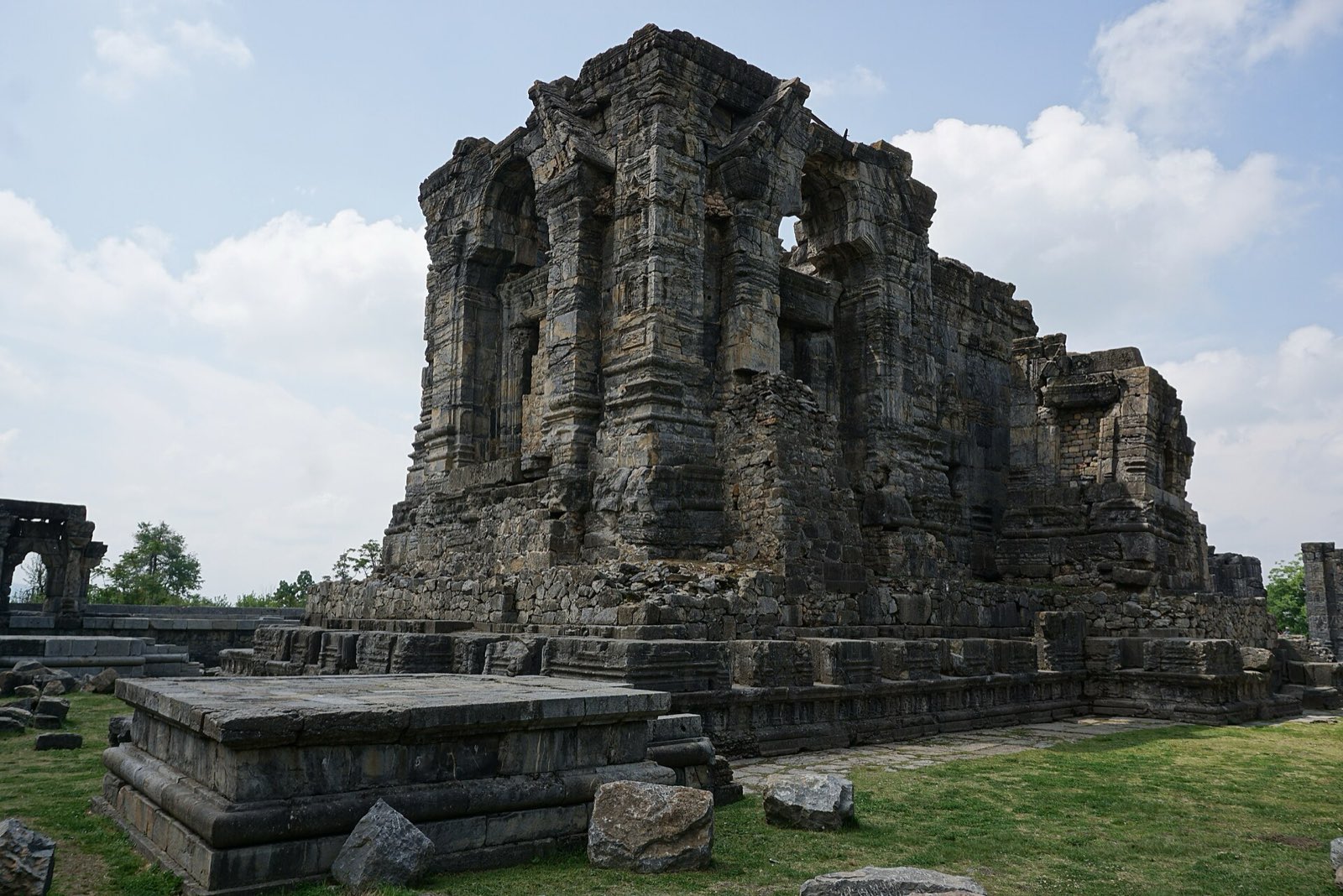
The Martand Sun Temple, Kashmir: A Temple at the Crossroads of the World
How eighth-century Kashmir built a sun temple like nowhere else in India — a shrine standing alone in a great colonnaded courtyard, with trefoil arches, classical pediments and steep snow-shedding roofs — a meeting of Indian, Persian and Greco-Roman ideas on the roof of the subcontinent
This series has already visited two great Indian temples to the sun — the colossal stone chariot of Konark in Odisha and the dawn-catching complex at Modhera in Gujarat. The Martand Sun Temple in Kashmir is the third, and it is the strangest and most unexpected of them all, because it belongs to a regional style so distinct that a visitor familiar with every other temple in India would scarcely recognise it as Indian at all. Standing ruined on a high plateau in the Kashmir valley, with the Himalaya ranged behind it, Martand looks less like a Hindu temple than like some lost outpost of the classical Mediterranean — a shrine in a colonnaded courtyard, with pillared cloisters, triangular pediments and fluted columns. It is one of the most fascinating buildings in India precisely because it stands where India met the wider world.
A temple at the crossroads of Asia
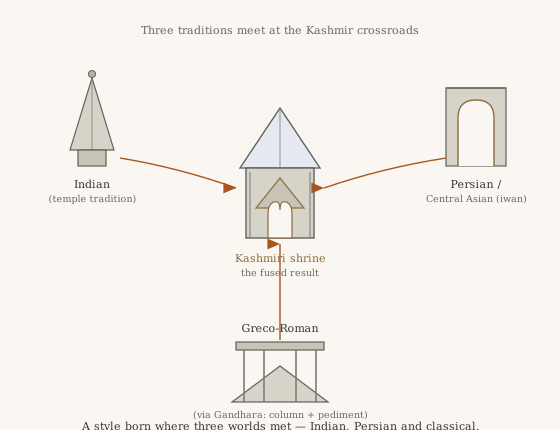
Kashmir sits at a geographical and cultural crossroads unlike anywhere else in the subcontinent. To its west lay the Gandhara region, where centuries of Greek, Persian and Buddhist contact — the legacy of Alexander's successors and the great Kushan empire — had produced a remarkable fusion of Hellenistic and Indian art. To the north and west lay Central Asia and Persia; to the south, the Indian plains. Kashmir absorbed all of these, and out of that meeting it developed, in the early medieval period, a temple architecture found nowhere else in India — one that carries unmistakable echoes of the classical, Greco-Roman world alongside its Indian core.
The Martand temple is the supreme surviving monument of this style. It was built in the eighth century, around 725–756 CE, by Lalitaditya Muktapida, the greatest king of the Karkota dynasty and one of the most powerful rulers Kashmir ever produced, whose armies are said to have ranged far across northern India and Central Asia. He dedicated it to Martanda — the sun, Surya — and set it on a commanding plateau (a karewa) with a panoramic view over the whole Kashmir valley, so that the temple of the sun looked out across the land in the light.
The peristyle: a courtyard like no other in India
The single most un-Indian feature of Martand is its plan, and it is the first thing to understand.
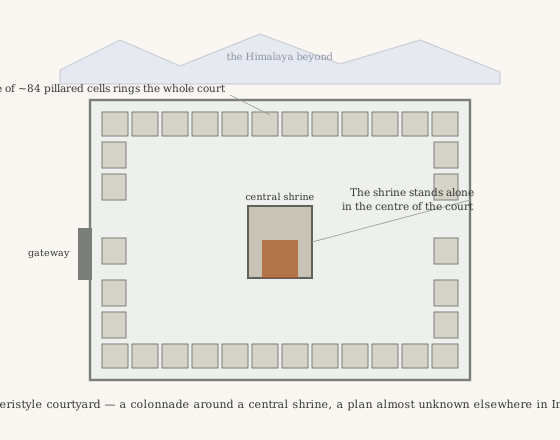
At most Indian temples, as we have seen throughout this series, the shrine is embedded in a mass of halls and enclosures, or wrapped in concentric walls and gateways. At Martand, the main shrine stands alone, free-standing, in the exact centre of a large rectangular courtyard — and that courtyard is surrounded on all four inner sides by a continuous colonnade of some eighty-four small pillared cells, each once housing a subsidiary image, forming a covered cloister running right around the enclosure. This arrangement — a colonnaded court, a peristyle, wrapped around a central object — is a classical Mediterranean and Hellenistic idea, the plan of a Greek or Roman temple precinct, and it is almost unknown elsewhere in Indian temple architecture. To stand in the courtyard of Martand, surrounded by rows of columns with the lone shrine at the centre, is to feel unmistakably the distant presence of the classical world, carried across the mountains from Gandhara.
Trefoil arches, pediments and snow-roofs
The details of the building tell the same crossroads story, and Martand's elevation is a catalogue of the distinctive Kashmiri vocabulary.
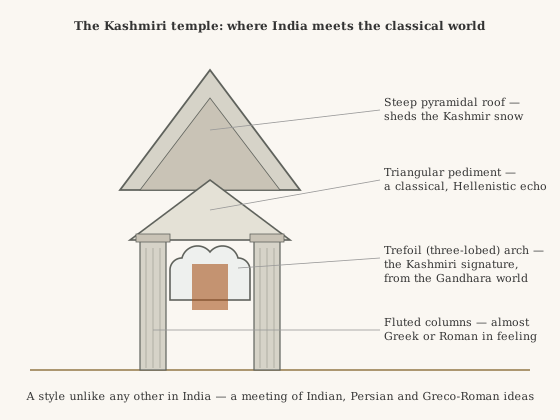
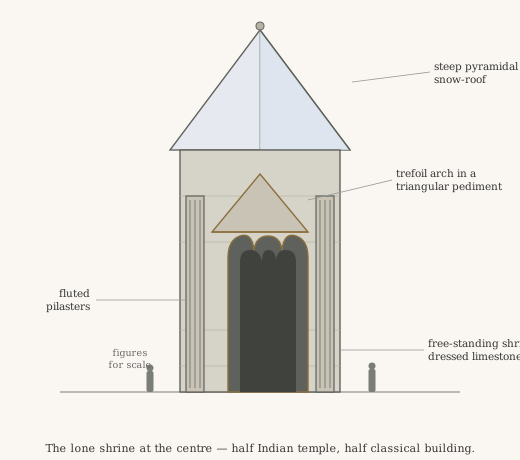
Three features define the style. First, the trefoil arch — a three-lobed arch, its opening scalloped into three curves — which is the signature of Kashmiri architecture and appears over its doorways and niches. It is thought to derive from the arch forms of the Gandhara–Buddhist world, and it gives the openings a distinctive, cusped, almost Islamic-looking silhouette centuries before Islamic architecture reached the region. Second, the trefoil is characteristically set within a triangular pediment — a steep gable exactly like the pediment crowning a Greek or Roman temple front, another direct echo of the classical world. Third, the columns are often fluted, their shafts channelled with vertical grooves in a manner that again recalls Greek and Roman work far more than the round or many-sided pillars of the Indian plains.
And over all of this rose steep, tall pyramidal roofs — for Kashmir, unlike the rest of India, has heavy winter snow, and its temples were roofed with sharply pitched gables and pyramids to shed it, rather than the flat or corbelled roofs of the warm south. Built of large blocks of grey limestone laid in fine ashlar masonry, without much of the dense figure-sculpture that covers temples like Khajuraho, Martand achieves its effect through mass, proportion and the crisp geometry of its arches and pediments — an austere, almost classical grandeur quite unlike the exuberant carved surfaces of temples elsewhere in this series.
A magnificent ruin
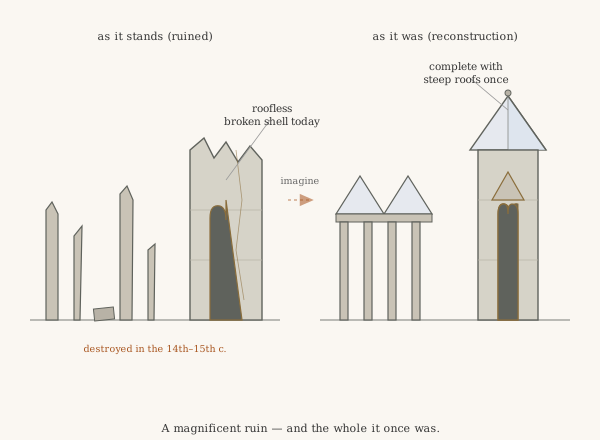
Martand is a ruin, and its ruin is part of its story. The temple was deliberately destroyed in the late fourteenth or early fifteenth century, under the iconoclastic Kashmiri sultan Sikandar, and what survives is the roofless, broken shell of the great courtyard and the battered central shrine — the colonnade reduced to ranks of stumps and fragments, the pediments cracked, the roofs long gone. Yet even in ruin it is overwhelming: the scale of the enclosure, the lone shrine at its heart, the mountains beyond, and the strange, half-classical dignity of the surviving arches and columns make it one of the most atmospheric places in all of India — a "melancholy grandeur," as early travellers described it, of a lost civilisation on the roof of the subcontinent.
Why Martand matters
Martand earns its place in this series by showing how astonishingly various Indian architecture really is — how a single subcontinent could produce, in the same broad centuries, the curvilinear towers of Odisha, the soaring Dravidian gopurams of the far south, and, up in the mountains of Kashmir, a temple that looks like a colonnaded shrine of the classical Mediterranean. It is the clearest proof that "the Indian temple" is not one thing but a family of profoundly different regional traditions, each shaped by its own climate, materials, history and neighbours. Kashmir's neighbours happened to include the Hellenised world of Gandhara, and so its temples learned to speak, uniquely, in a tongue that mingled the Indian, the Persian and the Greek.
Set Martand beside its fellow sun temples and the point becomes vivid: Konark dragged the sun across the sky as a stone chariot; Modhera turned to catch the equinox dawn; and Martand raised to the same god a colonnaded court of trefoil arches and classical pediments on a Himalayan plateau. Three sun temples, three utterly different architectural worlds, one subcontinent. Stand in the ruined peristyle of Martand with the mountains behind and the broken columns around you, and you are standing at the northern crossroads of Indian architecture, where the temple of the sun learned to speak the language of the classical world.
Part of the Architectural Wonders series. Compare India's other great sun temples, the stone chariot of Konark and the dawn-aligned complex at Modhera; and for the range of India's regional temple styles, the towers of Lingaraja.
Hero photograph: “Martand Sun Temple, Kashmir” by Deepank Ranka, via Wikimedia Commons, licensed under CC BY-SA 4.0.
Export this guide
Related Guides — Deep-dive reading
Khajuraho: The Temple Built to Be a Mountain
How the Chandela masons of 10th-century central India made the northern temple rise like a Himalayan peak — and why its sculpture, its engineering and its improbable survival still instruct the modern architect.
Architectural WondersPersepolis: The Palace Where Every Nation Came Bearing Gifts
On a vast stone terrace in southern Iran, the kings of Persia built the grandest ceremonial capital of the ancient world — a forest of impossibly tall columns whose walls, unlike those of any conqueror before them, carved not war and captives but a peaceful procession of twenty-three nations bringing gifts. It is the gentlest image of empire the ancient world produced — until Alexander burned it to the ground. The third article in our chapter on the palaces of worldly power.
Architectural WondersThe Mahabodhi Temple, Bodh Gaya: A Building Raised Over the Exact Spot of Enlightenment
How the holiest place in the Buddhist world produced one of India's strangest towers — a straight-sided brick pyramid built not to house a god but to mark a single point of ground beneath a tree
Architectural WondersRelated Tools — Try Free
Concept Generator
Get 3 AI-generated design concepts for any room with style, materials, and cost estimate.
DesignAIDesign Style Finder Quiz
Answer 10 visual questions to discover your Indian interior style profile with materials and colours.
Interactive QuizArchitectural Style Identifier
Upload a building photo and an on-device AI names its likely architectural style and era, with the visual cues — private and free.
On-device AI