
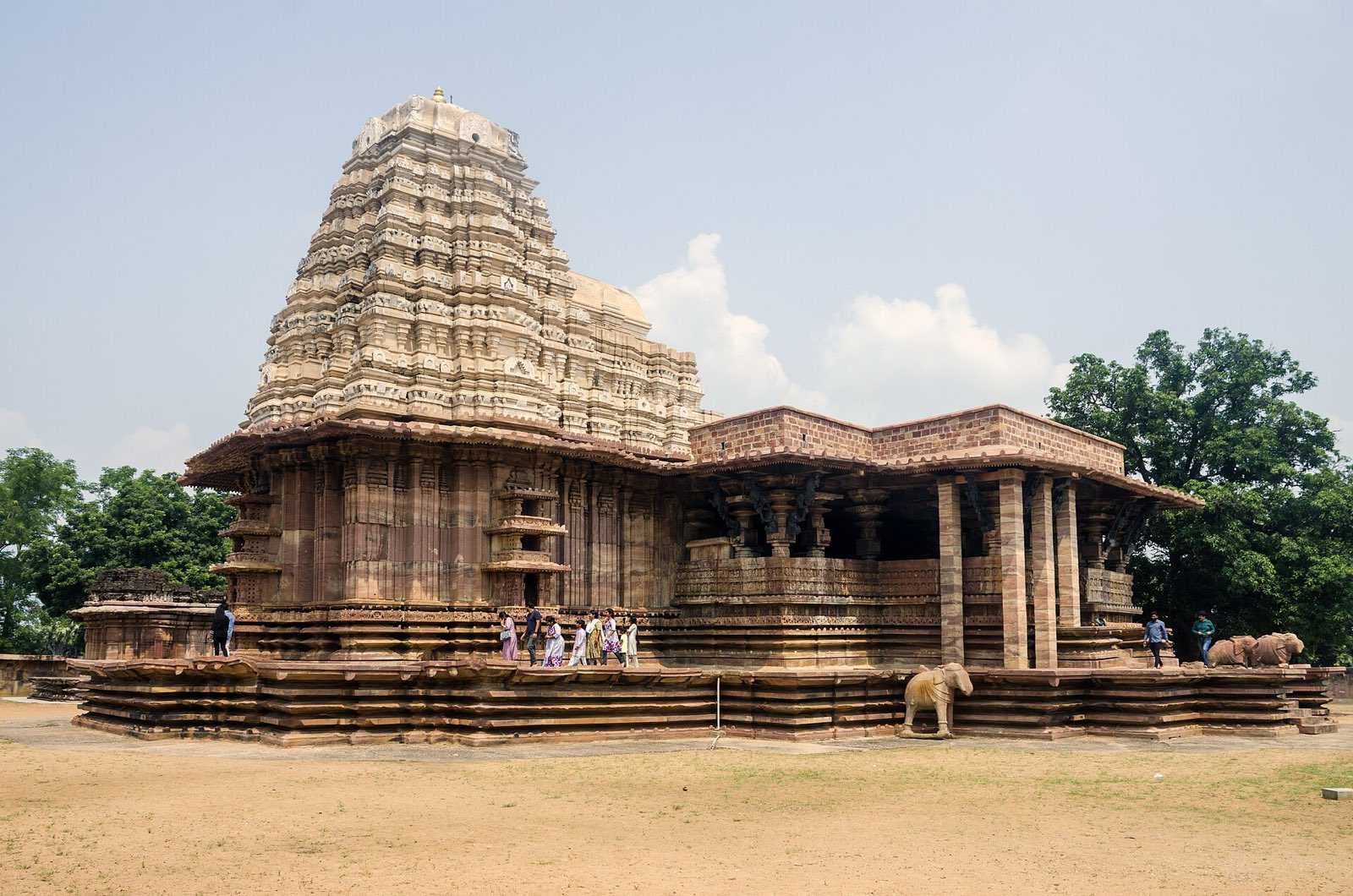
The Ramappa Temple: The Temple That Floats, and the One Named After Its Maker
How the Kakatiya builders of Telangana raised a temple on a cushion of sand with a tower of bricks light enough to float on water — an eight-hundred-year-old feat of earthquake engineering, crowned with mirror-polished black stone dancers, named not for a god or a king but for its sculptor
Most of the temples in this series impress by their size, their carving, or their soaring towers. The Ramappa temple in Telangana impresses, above all, by its engineering — by the fact that it is still standing at all. Built in the early thirteenth century, it has survived more than eight hundred years, including earthquakes that flattened lesser buildings, and it has done so because its builders understood, with remarkable sophistication, how to make a heavy stone temple light and how to make a rigid structure flexible. It is a temple that floats and springs, and it is one of the great, and least famous, feats of pre-modern Indian engineering — recognised only recently by the wider world when it was named a UNESCO World Heritage Site in 2021.
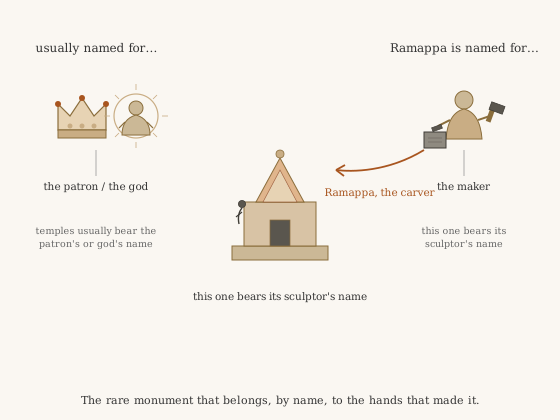
It has a second distinction that no other temple in this series can claim. It is named not for the god it houses, nor for the king who paid for it, but for the sculptor who carved it — a man named Ramappa. It is, by tradition, the only temple in India known by its craftsman's name, and that alone tells you how extraordinary its carving must have seemed even to the people who made it.
Built to survive an earthquake
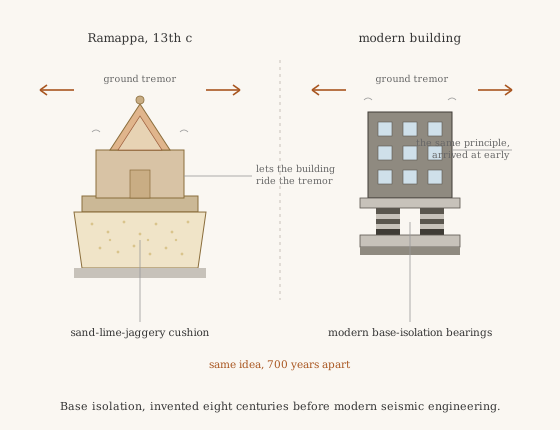
The genius of Ramappa is mostly invisible, hidden in its foundation and its tower, and understanding it is understanding why the temple still stands.
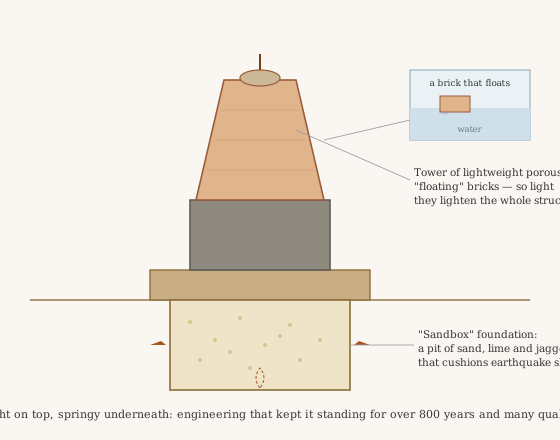
Two innovations work together. The first is the foundation. Instead of setting the temple directly on bedrock — which would transmit the full violence of an earthquake straight up into the rigid stone building, cracking it apart — the Kakatiya builders dug a deep pit beneath the temple and filled it with a springy, granular mixture of sand, lime, jaggery (unrefined sugar) and other materials. This "sandbox" foundation acts as a shock absorber, or what modern engineers call base isolation: when the ground shakes, the loose sand-bed shifts and cushions the movement, letting the temple ride the tremor rather than fight it. It is the same principle behind the flexible bearings placed under earthquake-resistant buildings today, arrived at eight centuries early, and it is the main reason Ramappa has survived so many quakes intact.
The second innovation is the tower. The shikhara rising over the sanctum is not built of solid stone, which would be enormously heavy and would strain the walls beneath it, but of specially made lightweight porous bricks — bricks so light, riddled with tiny air pockets, that they are said to float on water. By building the tall superstructure out of these floating bricks, the makers drastically reduced its weight, lessening the load on the temple below and the stress on the whole structure during a tremor. Light on top, springy underneath: the temple was engineered, deliberately and cleverly, to stay standing when the earth moved. Set this beside the intersecting arches of the Gol Gumbaz or the scale-as-precision of the Jantar Mantar and you see that the builders of medieval India were, again and again, sophisticated structural engineers as much as artists.
The dancers of black stone
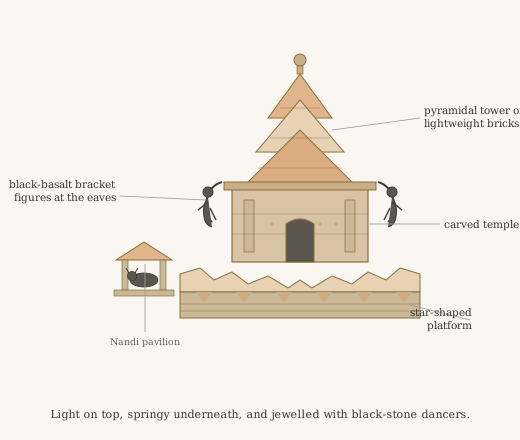
If the engineering is hidden, the artistry is not. Ramappa is a Kakatiya temple — the work of the Kakatiya dynasty that ruled this part of the Deccan from Warangal — and it was built around 1213 by Recharla Rudra, a general of the Kakatiya king Ganapati Deva. It sits on a star-shaped platform of the kind we saw in the Hoysala temples of neighbouring Karnataka, and its walls are richly carved. But its most celebrated sculptures are the bracket figures.
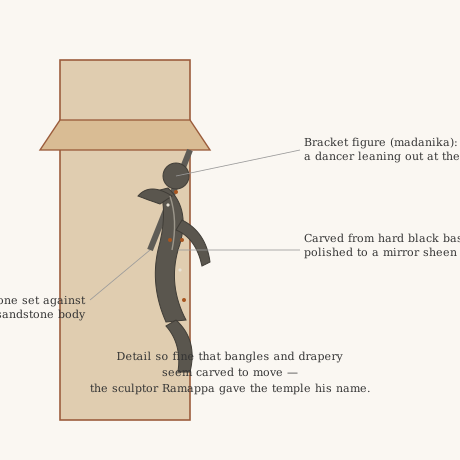
At the corners of the temple, beneath the projecting eaves, slender female figures — dancers and musicians, the madanikas — lean out on angled brackets, and they are carved not from the sandstone of the temple body but from a separate, much harder stone: a dark, dense basalt (dolerite), polished to a mirror sheen. The contrast is deliberate and striking — the black, gleaming figures set against the warmer sandstone walls — and the carving is of a fineness that has to be seen to be believed. The dancers are shown in the flexed, triple-bent poses of classical Indian dance, their limbs elongated, their jewellery, girdles and drapery cut in such minute detail that visitors have long marvelled that the bangles seem almost to hang loose and the whole figure seems caught in motion. To carve such detail in a stone as hard as basalt, and to polish it to a shine, was a virtuoso achievement, and it is why the temple carries the name of Ramappa the sculptor rather than of any god or patron. There is a tradition that the temple so dazzled visitors that a European traveller called it "the brightest star in the galaxy of temples" — praise that, true or legendary, captures the impression it makes.
Why Ramappa matters
Ramappa earns its place in this series by adding a dimension the great famous temples rarely foreground: the temple as a triumph of engineering as much as of art. Its builders solved, eight centuries ago, the two hardest problems of raising a heavy masonry building in an earthquake zone — how to keep the ground's violence out of the structure, and how to keep the structure's own weight from crushing it — and they solved them with a sandbox foundation and floating bricks, techniques whose logic modern earthquake engineering has only recently rediscovered. That the same building is also crowned with some of the finest sculpture in the Deccan, in mirror-polished black stone, makes it a rare and complete marvel: a temple that is at once a work of structural genius and a work of art, and that has stood, light and springing, through eight hundred years of tremors that its makers foresaw and defeated.
It also restores a name that architecture usually forgets. Across this whole series we have spoken of kings and dynasties and emperors — of Shah Jahan, of Rana Kumbha, of the Cholas and Pallavas and Mughals — the patrons who paid, and rarely of the craftsmen who actually built. At Ramappa, uniquely, it is the maker who is remembered: the temple bears the name of the man whose hands carved the dancers, not the ruler whose treasury paid for them. In a history of architecture told mostly through its patrons, Ramappa is the one great building that belongs, in name and in fact, to its artist.
Stand before it and look up at the black dancers leaning from the eaves, knowing that the tower above them is built of bricks that float and the ground beneath them is a cushion of sand — and you are looking at a temple that is, quietly, one of the cleverest and most beautiful things ever built in India.
Part of the Architectural Wonders series. For the star-platform temple tradition of the neighbouring Deccan, read the Hoysala temples of Belur and Halebidu; for more feats of pre-modern engineering, the Gol Gumbaz and the Jantar Mantar.
Hero photograph: “Ramappa Temple, Palampet” by Rangan Datta Wiki, via Wikimedia Commons, licensed under CC BY-SA 4.0.
Export this guide
Related Guides — Deep-dive reading
Belur and Halebidu: The Hoysala Temples Carved Like Ivory
How 12th-century Karnataka masons turned soft soapstone into architecture of impossible fineness — star-shaped temples wrapped in continuous friezes and carried on pillars that look turned on a lathe.
Architectural WondersKhajuraho: The Temple Built to Be a Mountain
How the Chandela masons of 10th-century central India made the northern temple rise like a Himalayan peak — and why its sculpture, its engineering and its improbable survival still instruct the modern architect.
Architectural WondersKonark Sun Temple: The Chariot of the Sun, Carved in Stone
How 13th-century Odisha built a god a vehicle — a colossal stone chariot with wheels that still tell the time — and what its triumph, and its collapse, can teach a modern architect.
Architectural WondersRelated Tools — Try Free
Pool Water Calculator
Chlorine, shock and salt doses plus top-up water for your pool — an indicative balancing guide.
Pool CalculatorAI Measurement Tool
Measure your room using voice, photos, or video sweep — no tape measure needed.
DesignAIApartment Furniture Size Chart
Standard furniture dimensions for Indian apartments — sofas, beds, tables, dining, storage.
Reference Chart