
The Terracotta Temples of Bishnupur: Where Bengal Built Its Epics in Baked Clay
How a land without stone made an entire architecture out of brick and moulded terracotta — temples shaped like the curved roofs of thatched huts, their walls covered in clay reliefs telling the whole of the Hindu epics
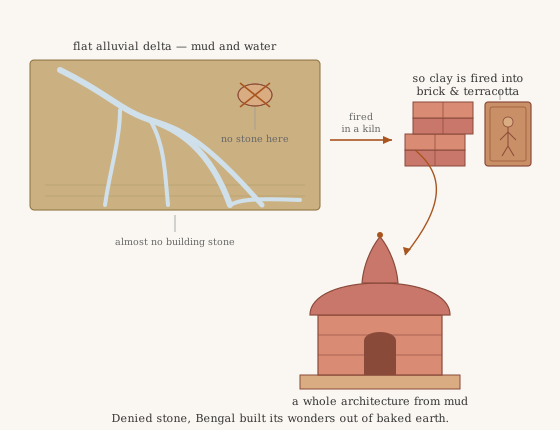
Almost every monument in this series so far has been made of stone — granite, sandstone, marble, the living rock of a hillside. But a great part of India has almost no building stone at all. The vast alluvial delta of Bengal, built up over millennia by the silt of the Ganges and the Brahmaputra, is a land of mud and water, where to find stone you must import it at great cost from far away. And yet Bengal produced one of the most distinctive and delightful of all India's regional architectures — not in spite of having no stone, but because of it. Denied stone, Bengal built in brick, and clothed its buildings in terracotta: baked clay, moulded into relief plaques and fixed to the walls in their thousands. The little town of Bishnupur, capital of the Malla kings, holds the finest surviving group of these temples, and they are like nothing else in India.
To walk among the temples of Bishnupur is to understand two beautiful ideas at once: how a vernacular building — the humble thatched village hut — became the model for sacred architecture, and how a wall of baked clay could become a storybook of the gods.
The hut that became a temple
The first thing you notice at Bishnupur is the shape of the roofs, and their origin is the key to the whole style.
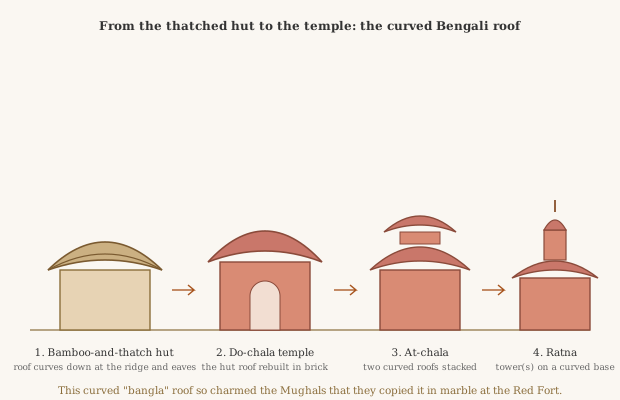
The ordinary house of the Bengal countryside is built of bamboo and thatch, and its roof has a characteristic, unmistakable shape: it curves, sagging gently downward at the ridge and sweeping down at the eaves, a natural consequence of bending springy bamboo poles and hanging thatch between them. This curved roof is the single most important form in Bengali architecture, and when Bengal came to build permanent temples in brick, it did not import a foreign temple-shape — it rebuilt its own beloved hut in baked clay, curves and all.
From this came a whole family of temple roof-forms. The simplest, the do-chala, is a single curved two-sloped roof, the hut translated directly into brick. Stack two of them and you get the at-chala, the "eight-roofed" form, a curved roof with a smaller curved roof rising above it. And a different line of development, the ratna ("jewel") style, sets one or more little pinnacle-towers on top of a curved roof-base — an ek-ratna with a single pinnacle, a pancha-ratna with five, a nava-ratna with nine. Every one of these forms carries, at its heart, the curved silhouette of the thatched hut. It is one of the purest examples in world architecture of the vernacular — the everyday building of ordinary people — being elevated, unchanged in spirit, into monumental sacred form.
And this curved Bengali roofline had a remarkable afterlife. The Mughals were so taken with it that they adopted it into their own imperial architecture, rendering the curved "bangla" roof in white marble on their pavilions — you can see it, as we noted, on the riverside palaces of the Red Fort. The roof of a Bengali peasant's hut, by way of the temples of Bishnupur, ended up crowning the pleasure-pavilions of the emperors of India.
Walls that tell the epics
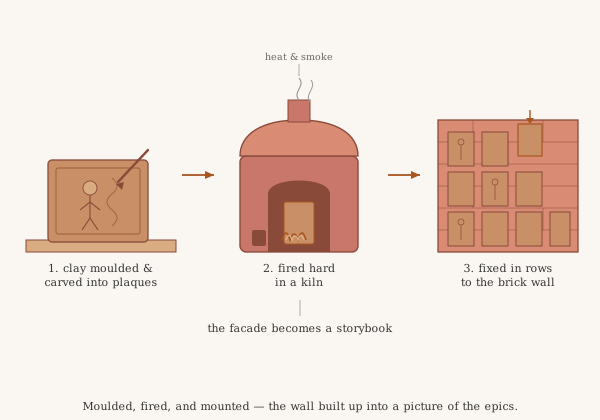
The second wonder of Bishnupur is the surface. Brick alone is a plain material, but Bengal had a genius for terracotta — clay moulded and carved and then fired hard — and it used terracotta to turn the walls of its temples into vast narrative pictures.
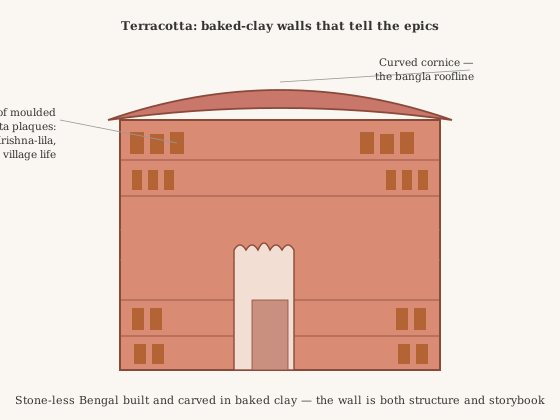
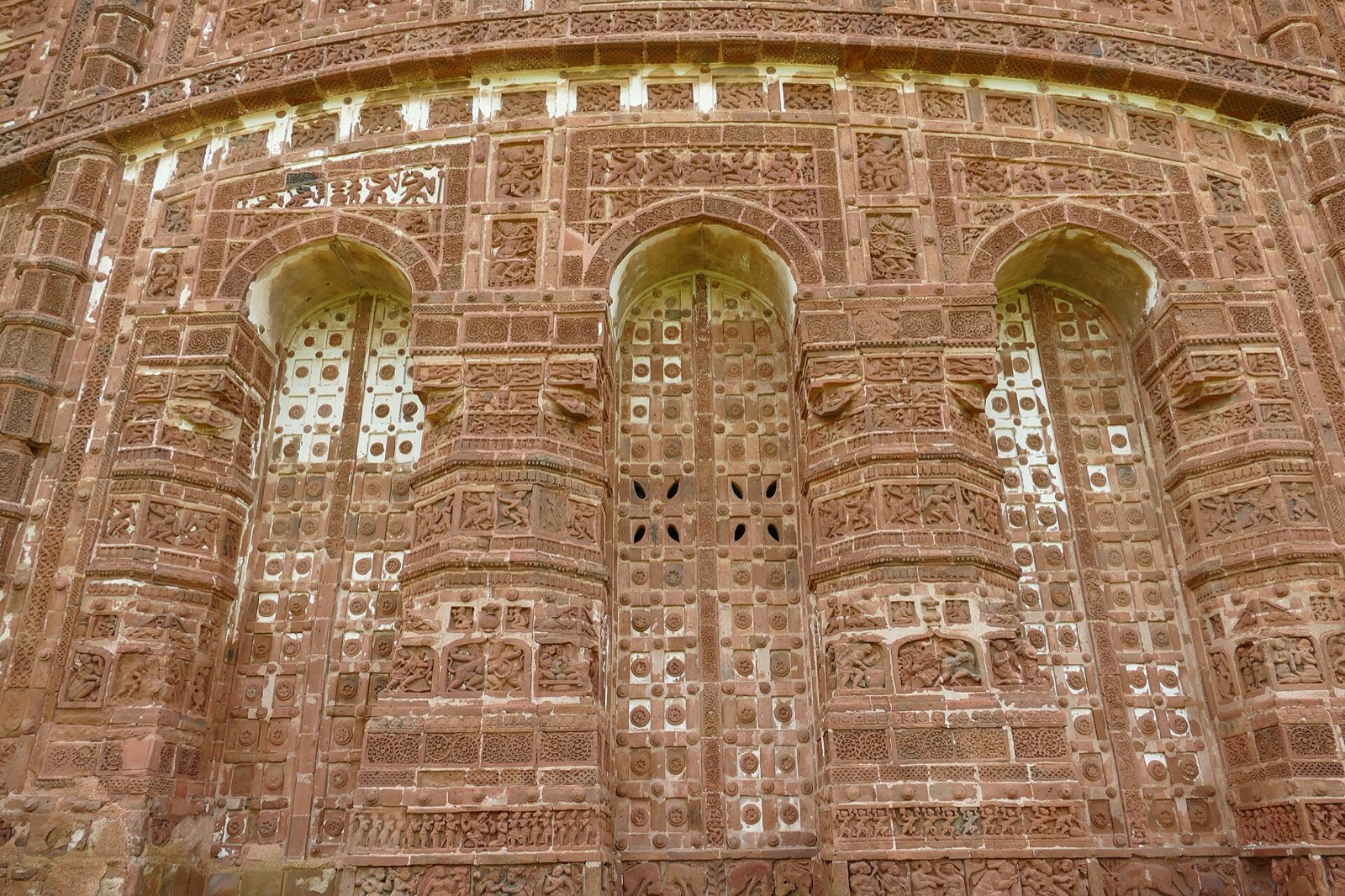
The facades of the Bishnupur temples are covered, from the curved cornice to the ground, in registers of small moulded terracotta plaques, each a scene in low relief. And the scenes tell stories: the great battles of the Ramayana and Mahabharata, the life and loves of Krishna (for these are largely Vaishnava temples, dedicated to Vishnu and his avatars), processions of soldiers and elephants and ships, hunts, dancers, musicians, and vignettes of ordinary Bengali life. A single temple wall might carry hundreds of these panels, so that the building becomes a kind of encyclopedia of myth and daily life in baked clay — a "Bible in terracotta," a way of setting the whole sacred literature before a largely non-literate people in vivid, readable pictures, exactly as the sculpted walls of Khajuraho or the friezes of the Hoysala temples did in stone elsewhere. But here it is done in clay, and the softness and detail the medium allows gives the Bishnupur reliefs a liveliness and intimacy all their own.
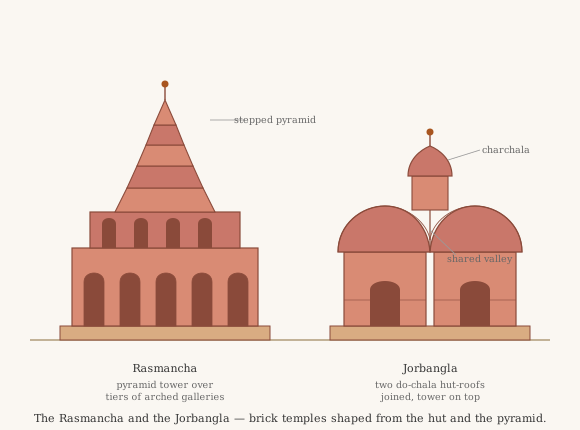
Among the temples, a few are famous: the Rasmancha, an unusual and very early brick structure with a pyramidal superstructure over rows of arches, built to display the Krishna images of the town during a festival; the Jorbangla (Keshta Rai), which joins two curved do-chala huts side by side and crowns them with a tower, its walls among the richest in terracotta; and the pancha-ratna Shyam Rai temple with its five pinnacles. They were built mostly in the seventeenth and early eighteenth centuries by the Malla rajas of Bishnupur, a dynasty that made their small kingdom a great centre of Vaishnava devotion, terracotta art, and — famously — of Indian classical music.
Why Bishnupur matters
Bishnupur earns its place in this series by completing the picture of Indian architecture in a way no stone monument could. It shows, first, that great architecture does not depend on great materials: given only mud and clay, Bengal made temples of real beauty and sophistication, proving that invention matters more than the richness of the stone. It shows, second, the deep and moving process by which a people's own vernacular building — the thatched hut every villager lived in — was lifted into sacred and monumental form, so that the temple of the god took the shape of the home of the poor. And it fills in the map of India's regional traditions with the distinctive voice of the east: where Odisha built soaring stone towers and Kashmir raised colonnaded courts, Bengal curved its brick roofs like huts and told its epics in clay.
Stand before a Bishnupur temple in the low Bengal light, trace the curved roofline that began on a peasant's cottage and ended on an emperor's palace, and read the hundreds of little clay scenes climbing its walls — Rama and Ravana, Krishna and the milkmaids, soldiers and ships and dancers, the whole imagined world of Bengal pressed into baked earth — and you understand the quiet greatness of a land that had no stone, and built wonders out of mud instead.
Part of the Architectural Wonders series. For the curved Bengali roof reborn in Mughal marble, see the Red Fort; for narrative relief in stone, Khajuraho and the Hoysala temples; and for the range of India's regional temple styles, Lingaraja and Martand.
Hero photograph: “Jorbangla Temple, Bishnupur” by Ankur P from Pune, India, via Wikimedia Commons.jpg), licensed under CC BY 2.0.
Export this guide
Related Guides — Deep-dive reading
Vernacular Architecture of Bengal: The Curved Roof That Became the Bungalow
How a mud-bamboo-thatch hut on the Ganga delta gave the world the word and form 'bungalow' — and climbed into Mughal masonry and Bengal's terracotta temples
Vernacular ArchitectureKhajuraho: The Temple Built to Be a Mountain
How the Chandela masons of 10th-century central India made the northern temple rise like a Himalayan peak — and why its sculpture, its engineering and its improbable survival still instruct the modern architect.
Architectural WondersPersepolis: The Palace Where Every Nation Came Bearing Gifts
On a vast stone terrace in southern Iran, the kings of Persia built the grandest ceremonial capital of the ancient world — a forest of impossibly tall columns whose walls, unlike those of any conqueror before them, carved not war and captives but a peaceful procession of twenty-three nations bringing gifts. It is the gentlest image of empire the ancient world produced — until Alexander burned it to the ground. The third article in our chapter on the palaces of worldly power.
Architectural WondersRelated Tools — Try Free
Before & After Studio
Generate AI before-and-after renders to preview how your redesign could look.
DesignAIConcept Generator
Get 3 AI-generated design concepts for any room with style, materials, and cost estimate.
DesignAIMaterial Compare — Side by Side
Compare materials side-by-side: granite vs quartz vs marble, laminate vs acrylic vs PU, and more.
Comparison