
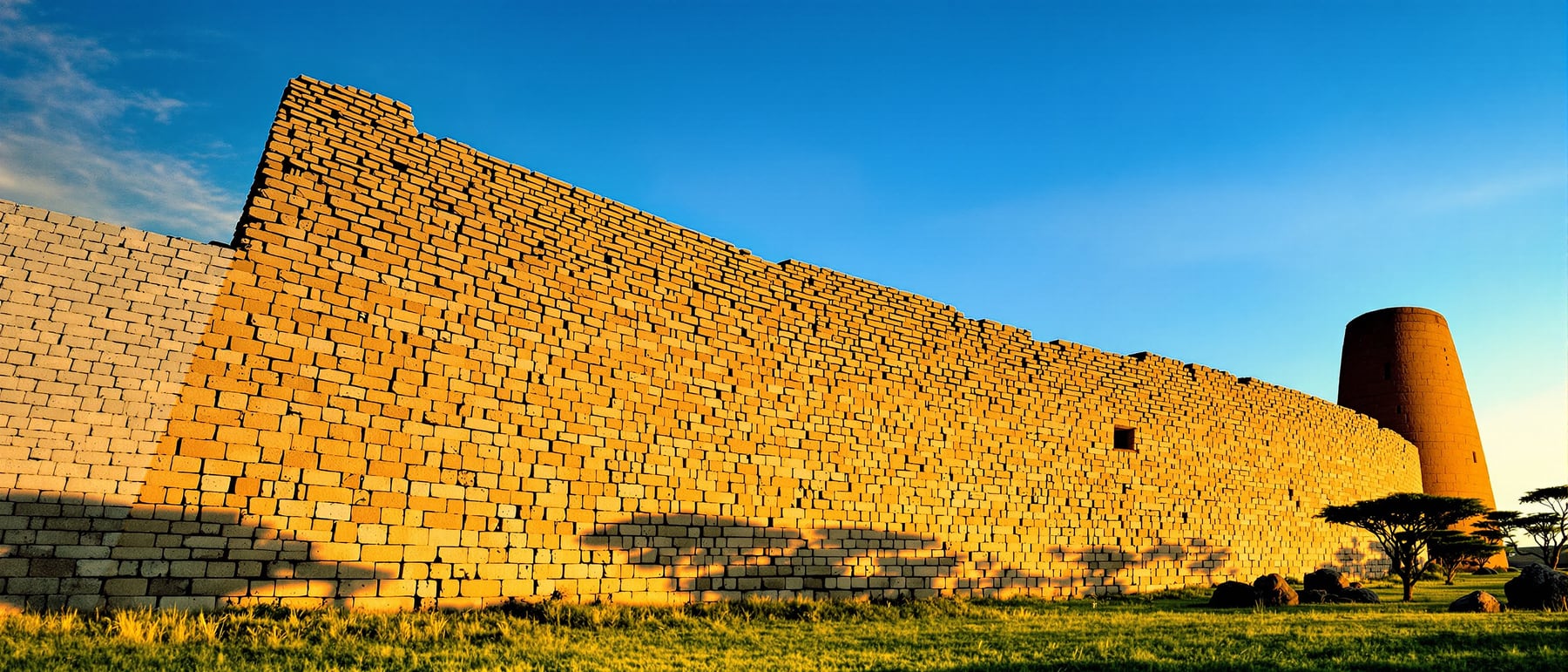
Great Zimbabwe: The Stone City Europe Refused to Believe Africans Built
In the hills of southern Africa stand the largest ancient stone ruins south of the Sahara — a whole city of massive granite walls built without a drop of mortar, the wealthy capital of a gold-trading kingdom. For a century, colonists refused to accept that Africans had raised it, and invented every other builder they could. This is the story of that architecture, and of the lie it outlived. The article that closes our chapter on the palaces and pleasures of worldly power.
We close this chapter — and much of this whole series' long meditation on power, pleasure and memory — on the continent of Africa, at a set of ruins that carries a lesson unlike any other we have met. Every wonder in this chapter has been a seat of worldly power; Great Zimbabwe was one too, the capital of a rich and sophisticated African kingdom. But it teaches us something the others cannot, about a different kind of power: the power to decide whose wonders get believed. For a hundred years, the people who ruled this land insisted that the Africans living beside these walls could not possibly have built them. This is the story of the architecture — and of that lie, which the stones outlived.
This is the seventy-third article in our Architectural Wonders series, and the tenth — and the one that closes — our chapter on the great palaces and pleasures of worldly power.
Great Zimbabwe lies in the hills of south-eastern Zimbabwe, in southern Africa, near the modern town of Masvingo. It was the capital of the medieval Kingdom of Zimbabwe, built by the ancestors of today's Shona people, and it flourished from about 1100 to 1450 CE, home at its height to perhaps eighteen thousand people. It is the largest ancient stone structure in all of sub-Saharan Africa — and it matters so profoundly that the modern nation took its very name from it.
1. The great stone houses
Start with the name, because it holds the whole meaning of the place.
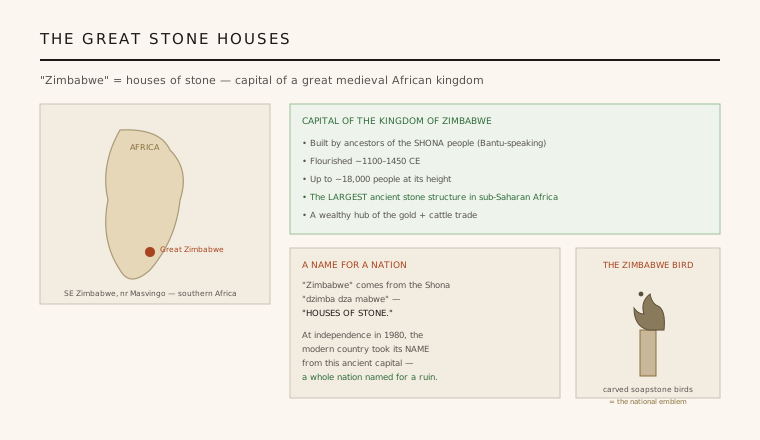
The word "Zimbabwe" comes from the Shona dzimba dza mabwe — "houses of stone." That is exactly what this was: not a temple or a tomb, but a city, the royal and religious capital of a powerful African state, home to kings, priests, craftsmen, cattle-herders and traders. And it was huge — the greatest of hundreds of such stone-walled sites (madzimbabwe) scattered across the region, and by far the largest ancient stone construction anywhere south of the Sahara. (Far to the north, Egypt had raised the pyramids of Giza three thousand years before; Great Zimbabwe is Africa's other great tradition of monumental stone, at the continent's southern end.) Its importance to African identity is hard to overstate: when the country won its independence from white-minority rule in 1980, it chose to name itself Zimbabwe, after these ruins — a whole modern nation taking its name from a medieval African city. And the eight carved soapstone birds unearthed here — the Zimbabwe Birds — became the national emblem, and fly today on the country's flag and coat of arms. Few ruins on Earth are so alive in the identity of a living people.
2. Built without mortar
The architecture itself is a masterclass in one of the oldest and hardest crafts: building in stone with nothing to hold it together but skill.
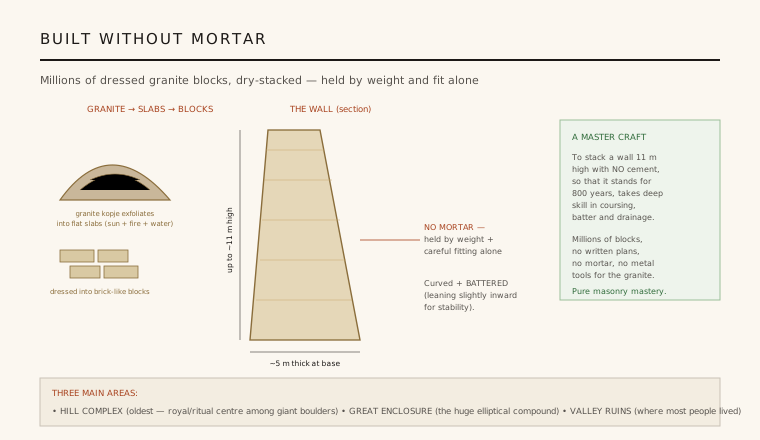
Great Zimbabwe is built of granite — and the builders let the land do the first of the work. The granite hills (kopjes) all around naturally exfoliate, peeling off in flat slabs as the sun heats and the night cools them; the builders helped the process along with fire and water, then dressed the slabs into roughly brick-shaped blocks. These they stacked, course upon course, into walls of astonishing scale — and here is the wonder: entirely without mortar. No cement, no clay, no binding of any kind — the walls are held up by nothing but their own weight, balance, and the precision of their fitting. The greatest of them rise as much as eleven metres high and are five metres thick at the base, gently curved and battered (leaning slightly inward) so they shed their own load safely down into the ground. To raise a mortarless wall that tall, and have it stand for eight hundred years, demands a profound, inherited mastery of coursing, batter and drainage. The city has three main zones: the Hill Complex (the oldest, a royal-ritual centre woven among giant natural boulders on a granite hill); the Great Enclosure (the famous elliptical compound below); and the Valley Ruins (clusters of smaller enclosures, where most people lived in mud-and-thatch houses within the stone). It is African dry-stone building at its absolute summit.
3. The Great Enclosure and the Tower
The single most spectacular structure is the one every visitor comes to see — and it guards a genuine mystery.
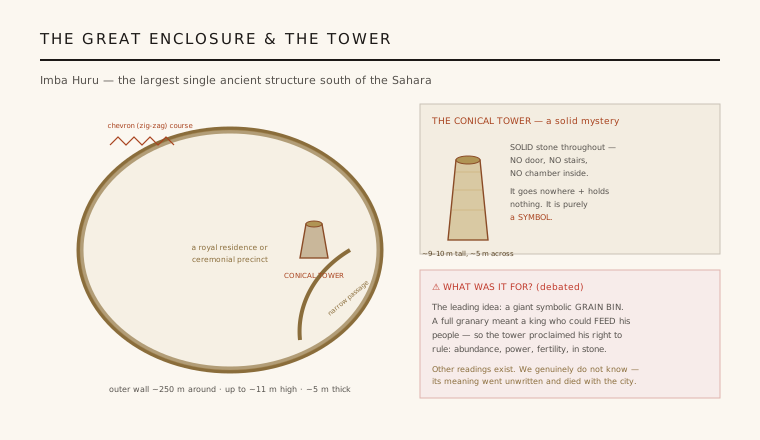
The Great Enclosure — Imba Huru, "the great house" — is a vast oval compound wrapped in a single curving wall some 250 metres around, up to 11 metres high and 5 metres thick: the largest single ancient structure south of the Sahara. Along part of its summit runs a beautiful decorative chevron (zig-zag) course of dark stones, purely for beauty — architecture confident enough to ornament. And deep inside, reached by a wonderfully atmospheric narrow curving passage running between the outer wall and an inner one, stands the enigmatic Conical Tower: a solid, rounded dry-stone tower about 5 metres across and 9 to 10 metres tall. Here is the mystery: it is completely solid. No door, no stairway, no chamber — it holds nothing and leads nowhere. It was never meant to be entered or used; it is pure symbol. The most persuasive reading is that it is a giant stone grain bin — because a full granary meant a ruler who could feed his people, and so the tower may proclaim, in permanent stone, the king's abundance and his right to rule, perhaps with overtones of fertility and power. But we must be honest: its meaning was never written down, and it died with the city. We are reading a sentence in a language we half-lost. The Great Enclosure itself was most likely a royal residence or a ceremonial precinct — the palace, in effect, of this chapter's final king.
4. A city of gold — and the world
To understand how a kingdom grew rich enough to raise these walls, follow the gold.
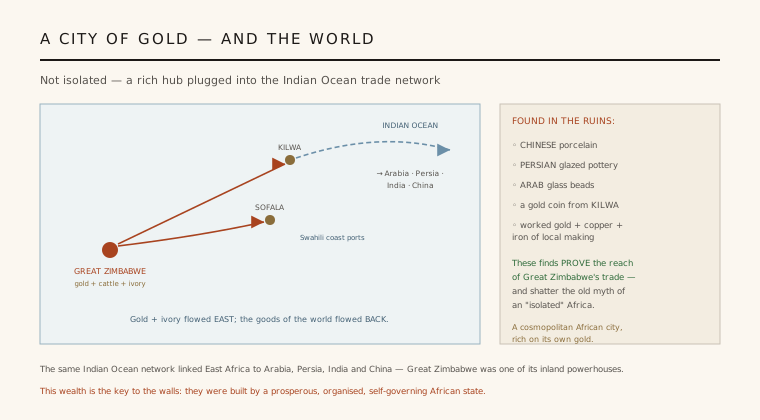
Great Zimbabwe's wealth rested on two pillars: cattle (the region's ancient measure of riches) and gold, mined across the surrounding plateau. And crucially, that gold did not stay home. Traders carried it, along with ivory, eastward to the Swahili coast — to Indian Ocean ports like Sofala and Kilwa — where it entered one of the great trade networks of the medieval world and was exchanged with Arab, Persian, Indian and Chinese merchants. We know this because the ruins have given up their imports: fragments of Chinese porcelain, Persian glazed pottery, Arab glass beads, and a gold coin from Kilwa, alongside the fine local gold, copper and ironwork. This is the fact that shatters an old and poisonous myth — that pre-colonial Africa was isolated and "without history." Great Zimbabwe was nothing of the kind: it was a rich, cosmopolitan, outward-facing hub, an inland powerhouse plugged into a trading system that spanned half the globe, the same Indian Ocean web that touched the mud libraries of Timbuktu across the continent. A prosperous, organised, self-governing African state built these walls — which brings us, at last, to the lie.
5. The lie — and the reclaiming
Here is where Great Zimbabwe becomes not just an architectural wonder but a moral one — and why, of all the buildings in this series, it may be the most important to tell honestly.
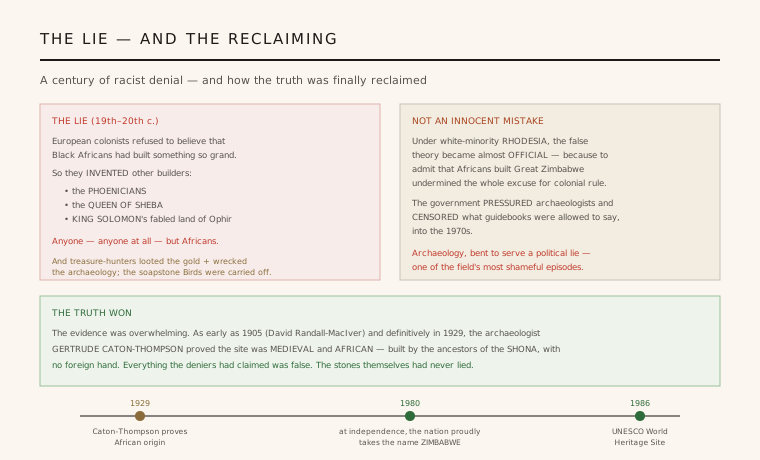
When European colonists reached these ruins in the nineteenth century, they were confronted with something their prejudices could not accommodate: monumental architecture, in the heart of Africa, built by Africans. And rather than revise the prejudice, they revised the history. They insisted the walls must have been raised by anyone but the local people — by ancient Phoenicians, by the Queen of Sheba, by King Solomon, whose biblical gold-land of Ophir they claimed to have found. It would be one thing if this were merely bad early archaeology. It was far worse: under the white-minority government of Rhodesia, the false "foreign builders" theory became almost official doctrine — because to admit that Africans had built Great Zimbabwe was to undercut the entire moral excuse for colonial rule. The state pressured archaeologists, and censored what the official guidebooks were permitted to say, well into the 1970s. It is one of the most shameful episodes in the history of archaeology: a science bent to serve a political lie.
But the stones never lied. The evidence — the local pottery, the datable imports, the unbroken African building tradition — was overwhelming, and honest archaeologists said so plainly: David Randall-MacIver in 1905, and then, definitively, Gertrude Caton-Thompson in 1929, whose careful excavation proved beyond doubt that Great Zimbabwe was medieval and wholly African, built by the ancestors of the Shona, with no foreign hand at all. In the end the truth was not only vindicated but enthroned: when the nation became free in 1980, it claimed these walls as its birthright and took their name; and in 1986 Great Zimbabwe was inscribed as a UNESCO World Heritage Site. (The city itself had been peacefully abandoned around 1450 — for reasons still debated: exhausted soil, dwindling wood and water, shifting trade routes drawing power northward — not destroyed, but quietly outgrown.) And so we end our chapter on the seats of worldly power with the deepest lesson any of them can teach. The Colosseum showed us power as spectacle, Persepolis as harmony, Nineveh as terror. Great Zimbabwe shows us a subtler, uglier power still — the power to erase, to look at another people's masterpiece and refuse to see the people in it. Against that power, architecture has one quiet, patient defence: it endures, and goes on telling the truth about who made it, long after the liars are gone. Every honest building is, in the end, a fact that outlasts the stories told to bury it.
6. What a modern architect can learn from Great Zimbabwe
- Master the material, and you need nothing else. No mortar, no metal tools for the granite, no written plans — and yet walls that have stood for eight centuries. Total command of a single local material can outperform every sophisticated technique. Deep craft is its own technology.
- Let the land do the first work. The builders used granite that split itself into slabs. The wisest design collaborates with the natural behaviour of its site and materials rather than fighting them — reading what the ground already wants to give, and building with the grain of the world.
- Curves and batter are strength. The great walls stand because they lean, taper and curve — geometry doing the work of glue. Structural elegance often lies not in adding reinforcement but in giving a form that holds itself. Shape is the cheapest, oldest engineering.
- Ornament is confidence. The chevron course crowning the Great Enclosure was pure decoration on a working wall — the mark of a culture building not merely to survive but to delight and to mean. A civilisation announces itself in what it adds beyond necessity.
- Buildings carry identity across centuries. A whole modern nation drew its name and its emblem from these ruins. Architecture can become the anchor of a people's memory of themselves — which is exactly why it is fought over, and why building, and preserving, is never a neutral act.
- The truth is in the fabric — defend it. For a century, powerful people lied about who built Great Zimbabwe, and the honest reading of the evidence in the stones eventually defeated them. Whether you build or study buildings, your deepest duty is to what is actually there — and to telling that truth plainly, especially when someone powerful would rather you didn't.
References & further reading
1. UNESCO World Heritage Centre — Great Zimbabwe National Monument (inscribed 1986). https://whc.unesco.org/en/list/364/
2. World History Encyclopedia — Great Zimbabwe. https://www.worldhistory.org/Great_Zimbabwe/
3. Encyclopaedia Britannica — Great Zimbabwe. https://www.britannica.com/place/Great-Zimbabwe
4. Gertrude Caton-Thompson — The Zimbabwe Culture: Ruins and Reactions (the 1931 study that settled the origins question). https://www.worldcat.org/title/zimbabwe-culture-ruins-and-reactions/oclc/2492884
5. Smithsonian Magazine — The Mystery of Great Zimbabwe (on the site and the racist denial of its origins). https://www.smithsonianmag.com/
6. British Museum / Smarthistory — Great Zimbabwe. https://smarthistory.org/great-zimbabwe/
*Last verified 2026-07-05. Figures follow UNESCO, the World History Encyclopedia, Britannica, Smarthistory and standard scholarship (incl. Caton-Thompson), and are given as widely cited approximations that vary by source. Great Zimbabwe, near Masvingo in south-eastern Zimbabwe (southern Africa), is the largest ancient stone structure in sub-Saharan Africa: the capital of the Kingdom of Zimbabwe, built by the Bantu-speaking ancestors of the Shona and flourishing c. 1100–1450 CE (peak population estimated up to ~18,000). "Zimbabwe" derives from Shona dzimba dza mabwe ("houses of stone"); the modern nation took its name from the site at independence (1980), and the carved soapstone "Zimbabwe Birds" are the national emblem. Construction is dry-stone (mortarless) coursed granite (locally exfoliated/dressed blocks); walls reach ~11 m high and ~5 m thick, curved and battered. Three main areas: the Hill Complex (oldest; royal/ritual, among boulders), the Great Enclosure (Imba Huru; an elliptical wall ~250 m in circumference — the largest single ancient structure south of the Sahara — with a chevron-decorated course, an inner passage, and the solid, doorless ~9–10 m Conical Tower, most often interpreted as a symbolic royal grain-bin/authority symbol, though its exact meaning is debated/unknown), and the Valley Ruins (smaller enclosures/commoner housing). Its economy rested on cattle and gold; finds of Chinese porcelain, Persian/Near Eastern ceramics, glass beads and a Kilwa coin attest to trade via the Swahili coast (Sofala, Kilwa) into the Indian Ocean network. CRITICAL HISTORY: 19th–20th-c. European colonists and the white-minority Rhodesian state promoted racist "foreign builder" theories (Phoenicians, Queen of Sheba, Solomon/Ophir) and suppressed/censored contrary archaeology into the 1970s; David Randall-MacIver (1905) and definitively Gertrude Caton-Thompson (1929) established the site's medieval African (proto-Shona) origins. Early treasure-hunting/looting (incl. by the "Ancient Ruins Company" and R. N. Hall's destructive clearances) damaged deposits; several Zimbabwe Birds were removed and later largely repatriated. The city was peacefully abandoned c. 1450 (causes debated: environmental exhaustion, shifting trade/political centres to Mutapa/Khami). UNESCO World Heritage Site 1986. This is the tenth article, and the closing article, of the "palaces and pleasures of worldly power" chapter of the Architectural Wonders series.
Export this guide
Related Guides — Deep-dive reading
Chan Chan: The Vast City of Mud Where Every King Built His Own Palace
On the desert coast of Peru sprawl the ruins of the largest city ever built of mud — a thousand-year-old capital of adobe walls three storeys high, carved with fish and seabirds, that survived only because it almost never rains. It was a city of ten royal palaces, one for each king, driven by a strange rule of inheritance; and today, an earthen city in a warming world, it is racing the rain to survive. The ninth article in our chapter on the palaces and pleasures of worldly power.
Architectural WondersPersepolis: The Palace Where Every Nation Came Bearing Gifts
On a vast stone terrace in southern Iran, the kings of Persia built the grandest ceremonial capital of the ancient world — a forest of impossibly tall columns whose walls, unlike those of any conqueror before them, carved not war and captives but a peaceful procession of twenty-three nations bringing gifts. It is the gentlest image of empire the ancient world produced — until Alexander burned it to the ground. The third article in our chapter on the palaces of worldly power.
Architectural WondersThe Colosseum: The Machine That Fed a City Its Pleasures
Rome's greatest emperors built palaces for themselves; the Flavian emperors did something shrewder — they drained a fallen tyrant's private lake and raised, on the spot, a stupendous arena for fifty thousand ordinary citizens. The largest amphitheatre ever built is a masterpiece of crowd engineering, a hidden stage-machine of lifts and trapdoors, and a place of real, organised killing — all at once. The fourth article in our chapter on the palaces and pleasures of worldly power, and the first on pleasure.
Architectural WondersRelated Tools — Try Free
Cross-Ventilation Analyzer
Estimate airflow and air changes per hour (ACH) from room size, window areas, layout, and local wind — with NBC 2016 Part 8 compliance check.
Ventilation CalculatorSociety Handover & NOC Checklist
Builder-to-RWA handover audit — 9 categories, 65+ checkpoints across legal docs, drawings, utilities, STP/WTP, fire safety, finances, warranties.
RWA HandoverBefore & After Studio
Generate AI before-and-after renders to preview how your redesign could look.
DesignAI