
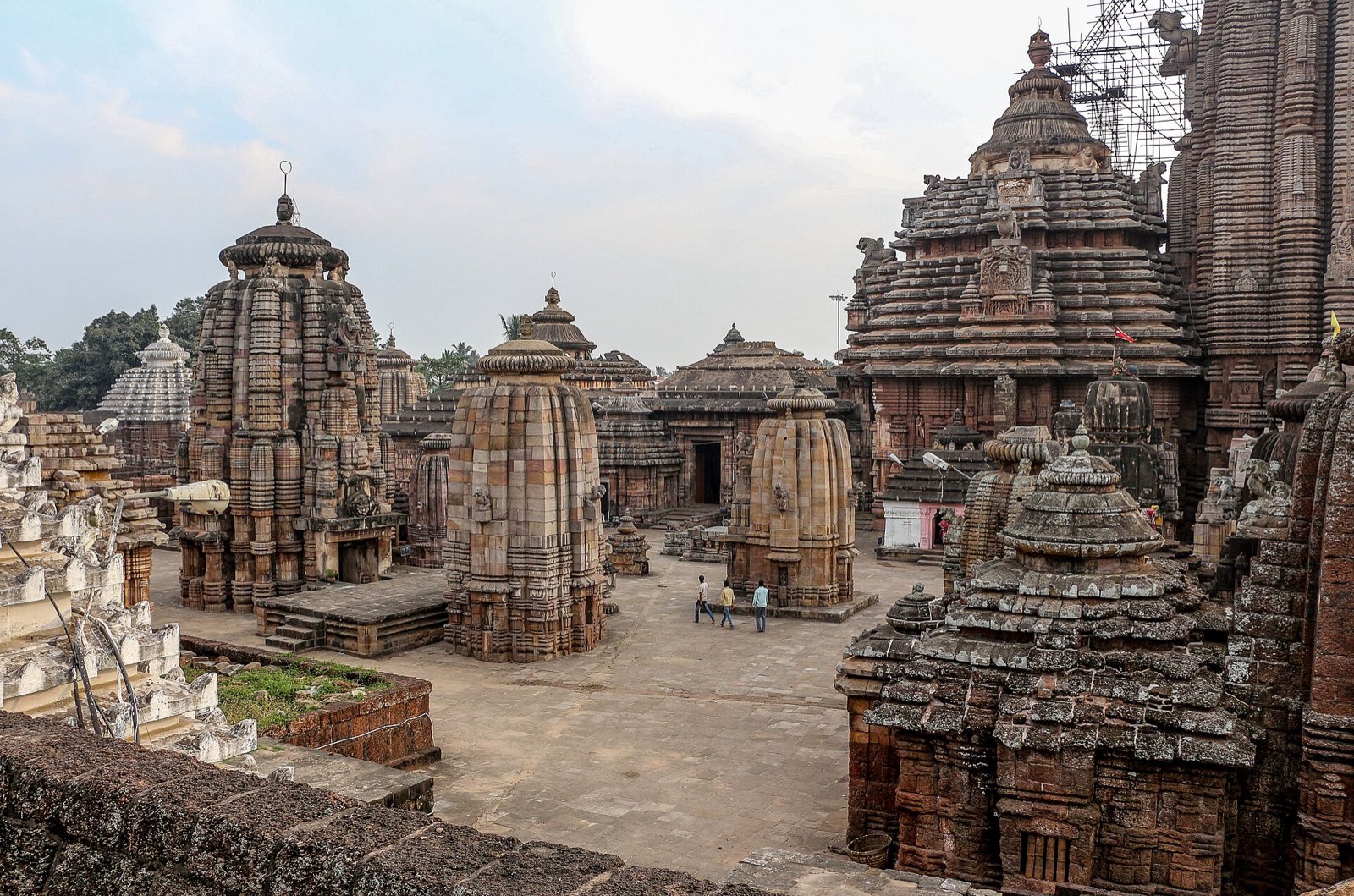
The Lingaraja Temple, Bhubaneswar: The Odishan Temple Perfected
How the temple-builders of Odisha brought their curvilinear tower to its most complete and majestic form — four halls climbing in a straight line to a fifty-five-metre spire — in the greatest of a city of a thousand temples
The eastern state of Odisha produced one of the most distinctive and disciplined regional styles in all of Indian architecture — the Kalinga or Odishan temple — and it produced it in extraordinary concentration around a single city, Bhubaneswar, which once held hundreds of temples and is still sometimes called the "temple city" of India. Of all of them, the greatest, the most complete, and the most majestic is the Lingaraja temple, built around the eleventh century. If you want to understand the Odishan temple not as a ruin or a fragment but as a living, finished, working whole, this is the building to stand before.
It is worth pairing in your mind with a temple already in this series: the Sun Temple at Konark. Konark, built two centuries later, is the Kalinga style at its most ambitious and most doomed — a colossal chariot whose great tower collapsed and now stands ruined. Lingaraja is the same tradition at its most assured and most enduring: still complete, still worshipped, its fifty-five-metre tower rising unbroken over Bhubaneswar as it has for nine hundred years. Between them they show a style at both its reach and its resolution.
Four halls in a line
The Odishan temple has a clear, almost diagrammatic organisation, and Lingaraja displays the full, developed version of it.
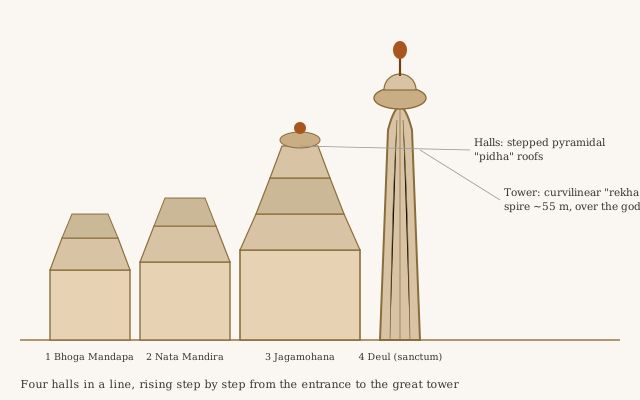
Four structures stand in a single straight line on an east-west axis, and you pass through them in sequence toward the god. First comes the Bhoga Mandapa, the hall of offerings, where food offered to the deity was prepared and distributed. Then the Nata Mandira, the hall of dance, where temple dancers performed before the god. Then the Jagamohana, the great assembly hall where worshippers gathered. And finally the Deul, the sanctuary itself, a small dark chamber holding the deity — here Shiva as Lingaraja, "the king of the linga," worshipped in a form that unites Shiva and Vishnu — over which rises the soaring tower.
The four are not merely a row of rooms; they are a graded ascent. Each is taller than the one before, so that the whole temple climbs step by step from the low entrance hall to the towering spire, drawing you and your eye upward and inward toward the sanctum. And crucially, the halls and the tower carry two different kinds of roof, and telling them apart is the key to reading any Odishan temple.
Two kinds of roof: the pidha and the rekha
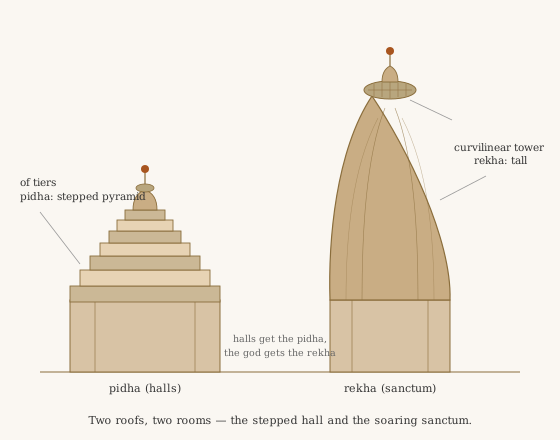
The three front halls are roofed with what is called a pidha roof — a stepped pyramid, built up of horizontal tiers of stone diminishing as they rise, like a squat pyramid made of receding steps. The sanctuary tower is a completely different form, the rekha deul — a tall, curvilinear spire — and it is the signature of the whole style.
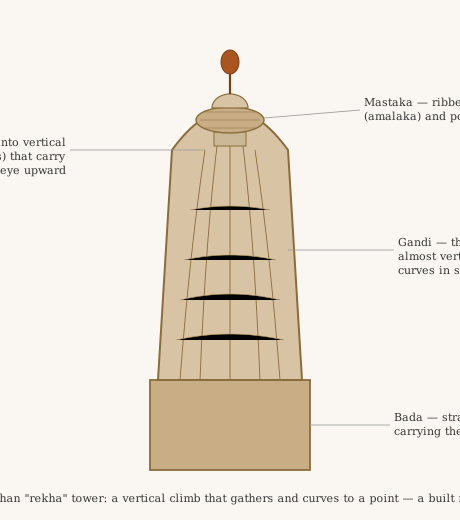
The rekha deul has a distinctive and instantly recognisable profile, quite different from the swelling, mountain-cluster towers of Khajuraho in central India. It has three parts. At the bottom is the bada, the straight vertical wall of the base, which carries much of the figure sculpture. Above it rises the gandi, the tower body, and this is the characteristic Odishan shape: it climbs almost vertically for most of its height, and then curves sharply inward only near the very top, so that the tower reads as a tall, taut, near-cylindrical shaft that suddenly gathers to a point — very different from the continuous outward-then-inward curve of other northern towers. Crowning it is the mastaka, the "head": a great ribbed stone disc called the amalaka (modelled on the amla fruit), and above that a pot-shaped finial, the kalasa. The whole tower's faces are cut into projecting vertical bands — the pagas — that run from base to crown and pull the eye relentlessly upward, emphasising the height.
That vertical emphasis is the emotional heart of the Odishan temple. Where a South Indian gopuram reads as a broad triangle and a Khajuraho tower as a rising mountain range, the Lingaraja deul reads as a single soaring vertical gesture — a straight climb into the sky that gathers itself at the last moment into a crown. It is one of the most powerful vertical forms in Indian architecture.
Carved from top to bottom
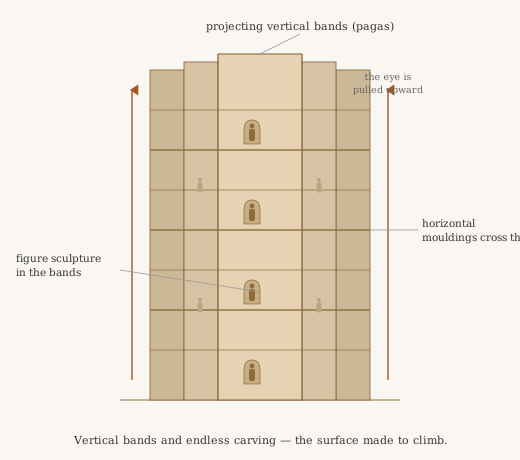
Like all the great temples of its age, Lingaraja is covered in sculpture — the whole exterior, from the base mouldings of the bada to the bands of the tower, is worked with an unbroken skin of carving: guardian figures, amorous couples, dancers, musicians, animals, floral scrollwork and scenes of divine and courtly life. The Odishan carvers, like those of Khajuraho and the western Indian temples, treated the temple wall as a surface to be entirely dissolved into figure and ornament, so that the great mass of the stone is softened everywhere into life. The stone is a warm laterite and sandstone, which has weathered over the centuries to a deep, rich tone that suits the density of the carving.
A living temple in a city of temples
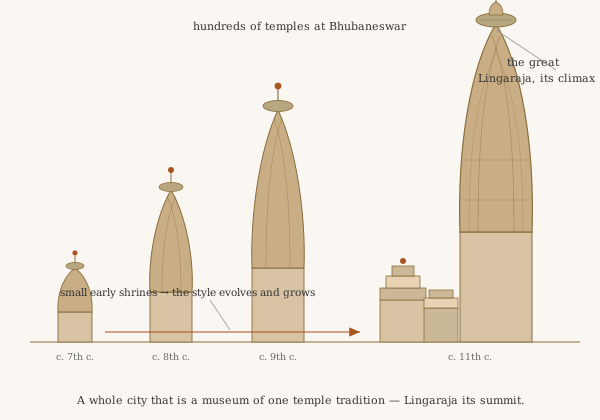
Two things set Lingaraja apart from many of the monuments in this series. The first is that it does not stand alone. Bhubaneswar was, for centuries, a great centre of temple-building, and the styles you see perfected at Lingaraja can be traced through dozens of earlier and smaller temples nearby — the exquisite Mukteshvara, the earlier Parashurameshvara, the great Rajarani — so that the city is effectively an open-air museum of the entire evolution of the Odishan temple, with Lingaraja as its climax. The second is that Lingaraja is a living temple, in continuous worship for nine centuries, its sanctum still active, its rituals still performed — which is also why, as at many major Hindu shrines, the innermost precinct is open only to Hindu worshippers, a working sacred space rather than a monument set apart.
Why Lingaraja matters
In the arc of this series, Lingaraja is the point where the Odishan temple reaches its full, resolved maturity. It is the complete, living answer to the magnificent ruin of Konark: the same regional style, the same curvilinear tower and stepped halls and dense carving, but standing whole and unbroken, doing exactly what it was built to do. Set it beside the other great medieval temples in this series — Khajuraho in the centre, Brihadeeswara in the south, Modhera in the west — and you can feel how sharply distinct India's regional temple traditions really were, each with its own unmistakable silhouette against the sky. The Lingaraja's is the tall, taut, vertical spire of the east, gathering itself in one long upward reach to a crown of stone.
Stand in its walled compound as the great tower climbs over the lower halls and nine centuries of worshippers have climbed toward it, and you see the Odishan temple whole — not a fragment, not a ruin, but the finished thing: a mountain of carved stone, built in a straight line, reaching for the sky.
Part of the Architectural Wonders series. Read its magnificent, ruined Kalinga cousin, the Sun Temple at Konark; and compare the regional temple towers of central India at Khajuraho and the south at Brihadeeswara.
Hero photograph: “Lingaraja Temple, Bhubaneswar” by Bernard Gagnon, via Wikimedia Commons, licensed under CC BY-SA 3.0.
Export this guide
Related Guides — Deep-dive reading
Khajuraho: The Temple Built to Be a Mountain
How the Chandela masons of 10th-century central India made the northern temple rise like a Himalayan peak — and why its sculpture, its engineering and its improbable survival still instruct the modern architect.
Architectural WondersBadami: The Cradle of the South Indian Temple
How 6th-century Chalukya carvers, still working into a red sandstone cliff like the cave-makers before them, designed the porch, hall and sanctum that every later South Indian temple would copy — and shared one cliff between Shiva, Vishnu and the Jain Tirthankaras. The rock-cut laboratory where Dravidian architecture was born.
Architectural WondersMamallapuram: The Workshop Where the South Indian Temple Was Invented
How 7th-century Pallava carvers turned a granite shore into a full-scale sketchbook — five monolithic shrines and a temple by the sea — and worked out, in stone, the grammar of the Dravidian temple.
Architectural WondersRelated Tools — Try Free
Window Orientation Planner
Pick the best window type, glass and shading by wall direction — north, east, south and west.
Window ToolAcoustic Privacy (STC) Visualizer
Indian healthcare acoustic visualizer — compare wall assemblies and noise sources, see received SPL after STC attenuation, and check FGI 2018 / IS 1950 / NABH speech-privacy compliance with live dual-canvas waveform.
Acoustic ToolCircadian Light Meter
Patient-centric circadian lighting visualizer for Indian healthcare design — time-of-day × intensity → CCT, melanopic lux (EML / mEDI), melatonin suppression, and an alertness curve. Calibrated against WELL v2 L03 Circadian Lighting Design, CIE S 026:2018, Brainard 2001, and Lucas et al. 2014.
Circadian Tool