
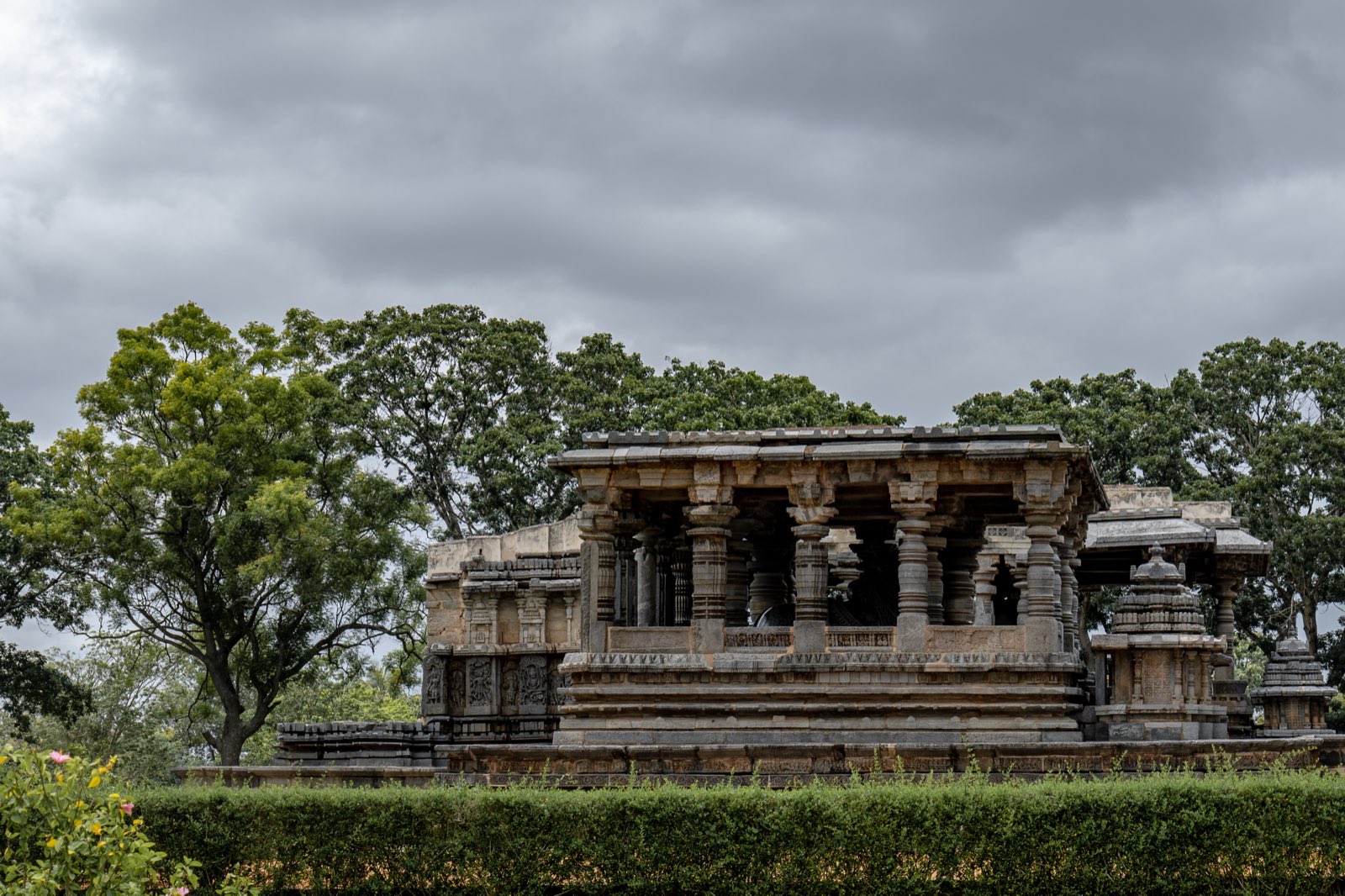
Belur and Halebidu: The Hoysala Temples Carved Like Ivory
How 12th-century Karnataka masons turned soft soapstone into architecture of impossible fineness — star-shaped temples wrapped in continuous friezes and carried on pillars that look turned on a lathe.
Stand close to the wall of the temple at Belur, or its twin at Halebidu, and you will find yourself doubting that you are looking at stone. The surface is worked to the fineness of ivory or cast metal — pillars that seem to have been spun on a lathe, jewellery carved on the figures fine enough to slip a thread through, whole processions of elephants no two of which are alike. These 12th-century temples of the Hoysala dynasty in Karnataka are the most intricately carved buildings in India, and possibly anywhere — and the secret of how they were made is one of the best lessons in all of architecture about the power of a material.
They add a third distinct voice to the temple thread of our Architectural Wonders series. We have seen the granite mass of the southern Dravidian tower at Brihadeeswara, and the soaring sandstone spires of the northern Nagara at Khajuraho. The Hoysala is neither — a compact, hybrid, densely sculpted idiom of its own, and to understand it you have to start not with a shape but with a stone.
1. The star-shaped plan
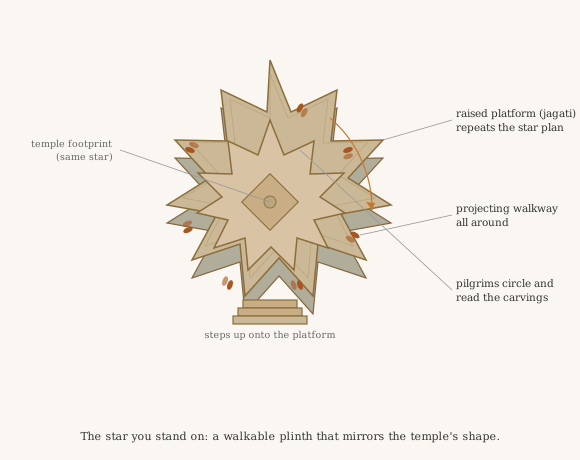
The first thing you notice from above is that a Hoysala temple is not square or rectangular in plan. It is a star.
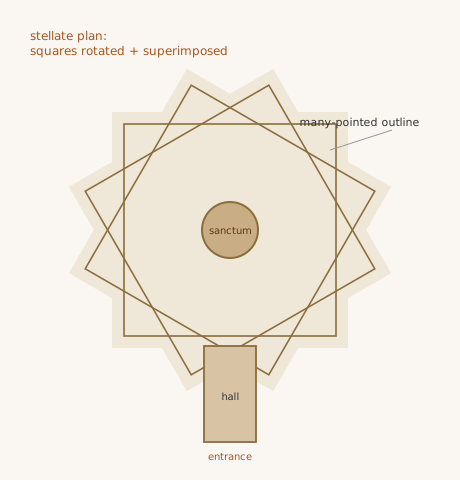
This stellate plan is generated by a simple, beautiful geometric trick: take a square, and rotate copies of it a few degrees at a time about the sanctum's centre; where their overlapping corners project, you get a many-pointed star. The whole temple — sanctum, hall and the raised platform (jagati) you walk around — follows that folded star outline. And the folding is not decoration; it is strategy. A star wall has far more surface than a flat one, and every fold turns a fresh face to the sun, so the building throws itself into an endless play of light and shadow — and, crucially, offers vastly more area to carve. The Hoysalas built compact temples on a modest footprint, then used the star geometry to multiply the surface until there was room for an entire world of sculpture.
2. The material that made the style
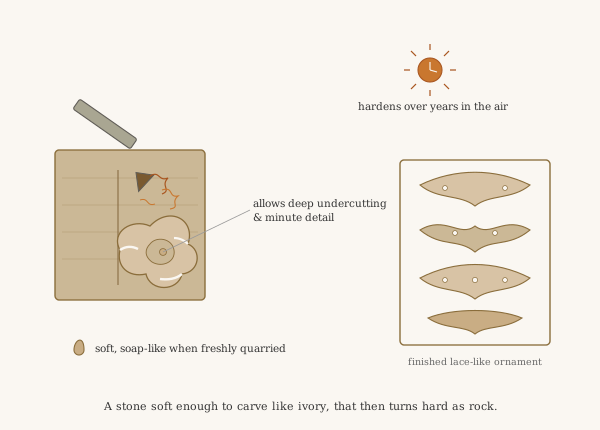
Here is the key that unlocks everything. Hoysala temples are built not of granite or sandstone but of soapstone — a soft chloritic schist that, when freshly quarried, is soft enough to be carved almost like wood, and which slowly hardens as it weathers on exposure to the air.
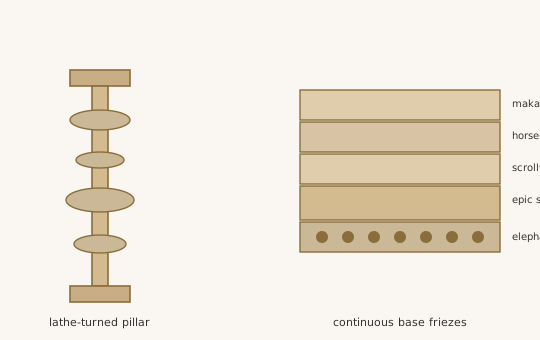
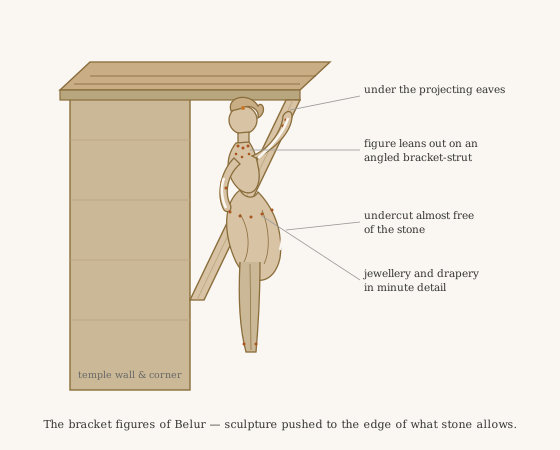
That single property explains the entire Hoysala look. Because the stone was soft, the masons could carve detail no granite would ever permit — the metalwork-fine jewellery, the openwork, the pierced screens. It is why the famous pillars look turned on a lathe: many were quite literally shaped by rotation, producing perfectly circular, bell-and-ring profiles impossible in a hard stone. It is why the bracket figures under the eaves — the celebrated madanika, celestial women — are worked fully in the round, down to the fingernails. The Hoysala style is not an abstract aesthetic choice; it is what happens when superb sculptors are handed a stone that behaves like butter and sets like rock. Material chose the method, and the method became the style.
3. A horizontal encyclopaedia
Where a Nagara temple pulls your eye up the spire, a Hoysala temple pulls it around and around the base. The lower walls are wrapped in a series of continuous horizontal friezes, band stacked on band, each a different subject: a plinth of elephants (strength, and the bearers of the temple), then horsemen, then scrolls of foliage, then rows of geese and mythical makaras, and above them long registers narrating the Ramayana and Mahabharata. You read a Hoysala temple the way you read a scroll — walking its perimeter, following the story around the folds of the star. The density is simply unmatched; at Halebidu, scarcely a hand's breadth of the exterior is left uncarved.
4. Belur, Halebidu, and a temple frozen mid-sentence
Two temples stand at the summit of the style. The Chennakeshava temple at Belur, dedicated to Vishnu, was begun around 1117 by King Vishnuvardhana to mark a great victory, and successive generations kept adding to it for the better part of a century. Its twin, the Hoysaleswara temple at the old capital Halebidu, is a double shrine to Shiva and carries the densest sculptural programme of all — and it was never finished. Work stopped when the Delhi Sultanate's armies sacked the Hoysala capital in the early 1300s, and the temple stands to this day mid-sentence, a masterpiece interrupted. One poignant Hoysala habit deserves note: the master sculptors often signed their work, carving their own names beneath their figures — a rare, proud claim of authorship in medieval art. The finest of these temples were together inscribed by UNESCO as the Sacred Ensembles of the Hoysalas in 2023.
5. What a modern architect can learn from the Hoysalas
- Let the material lead. Almost everything distinctive about the Hoysala temple — the turned pillars, the impossible detail, the fully modelled figures — follows directly from the properties of soapstone. Understand what your material genuinely wants to do, and the style will follow honestly from it.
- Use geometry as an engine. The whole rich, folded star comes from one move: rotating a square about a centre. Simple generative rules can produce enormous formal richness — and give it an underlying order the eye can feel even when it cannot name it.
- Fold the wall. A star plan has far more surface, more light and more shadow than a flat one. Articulating and folding a facade — rather than leaving it flat — is one of the oldest and best ways to give a building depth, texture and life.
- Design for how the building is read. A Hoysala temple is meant to be walked around and read horizontally, band by band; a Nagara temple is meant to be looked up. Decide the path and the direction your architecture wants the body and the eye to travel, and compose for it.
- Let the makers sign. The Hoysala sculptors' habit of signing their work is a reminder that great buildings are made by identifiable people exercising extraordinary craft. Architecture that honours and records its makers tends to be architecture made with more care.
Belur and Halebidu prove the series' point from the direction of pure craft: one clear idea, carried without compromise. Here the idea is not scale or height but surface — the conviction that a soft stone and a patient chisel could make a temple as finely wrought as a piece of jewellery, and at the scale of a building.
References & further reading
1. UNESCO World Heritage Centre — Sacred Ensembles of the Hoysalas (inscribed 2023). https://whc.unesco.org/en/list/1670/
2. Encyclopaedia Britannica — Hoysala dynasty and Hoysala architecture. https://www.britannica.com/topic/Hoysala-dynasty
3. Archaeological Survey of India — Chennakeshava Temple, Belur and Hoysaleswara Temple, Halebidu. https://asi.nic.in/
4. Karnataka Tourism — Belur and Halebidu. https://karnatakatourism.org/
Last verified 2026-07-04. Dates, attributions and the sequence of construction follow standard archaeological and art-historical reference sources and are given as widely accepted approximations; the properties of soapstone, the lathe-turning of pillars, the practice of sculptor signatures, and the interruption of work at Halebidu after the early-14th-century raids follow established scholarship and the historical record.
Export this guide
Related Guides — Deep-dive reading
Khajuraho: The Temple Built to Be a Mountain
How the Chandela masons of 10th-century central India made the northern temple rise like a Himalayan peak — and why its sculpture, its engineering and its improbable survival still instruct the modern architect.
Architectural WondersĠgantija: The Oldest Temple Standing, Built by 'Giants'
How a Neolithic island people on Malta — with no metal and no wheel — raised the oldest free-standing stone temples on Earth a thousand years before Stonehenge or the pyramids, moving fifty-tonne blocks on stone balls into clover-leaf sanctuaries for a faith we can trace but cannot read, then vanished, leaving stones so vast that later islanders swore only giants could have built them.
Architectural WondersGreat Zimbabwe: The Stone City Europe Refused to Believe Africans Built
In the hills of southern Africa stand the largest ancient stone ruins south of the Sahara — a whole city of massive granite walls built without a drop of mortar, the wealthy capital of a gold-trading kingdom. For a century, colonists refused to accept that Africans had raised it, and invented every other builder they could. This is the story of that architecture, and of the lie it outlived. The article that closes our chapter on the palaces and pleasures of worldly power.
Architectural WondersRelated Tools — Try Free
Circadian Light Meter
Patient-centric circadian lighting visualizer for Indian healthcare design — time-of-day × intensity → CCT, melanopic lux (EML / mEDI), melatonin suppression, and an alertness curve. Calibrated against WELL v2 L03 Circadian Lighting Design, CIE S 026:2018, Brainard 2001, and Lucas et al. 2014.
Circadian ToolConcept Generator
Get 3 AI-generated design concepts for any room with style, materials, and cost estimate.
DesignAIDesign Style Finder Quiz
Answer 10 visual questions to discover your Indian interior style profile with materials and colours.
Interactive Quiz