
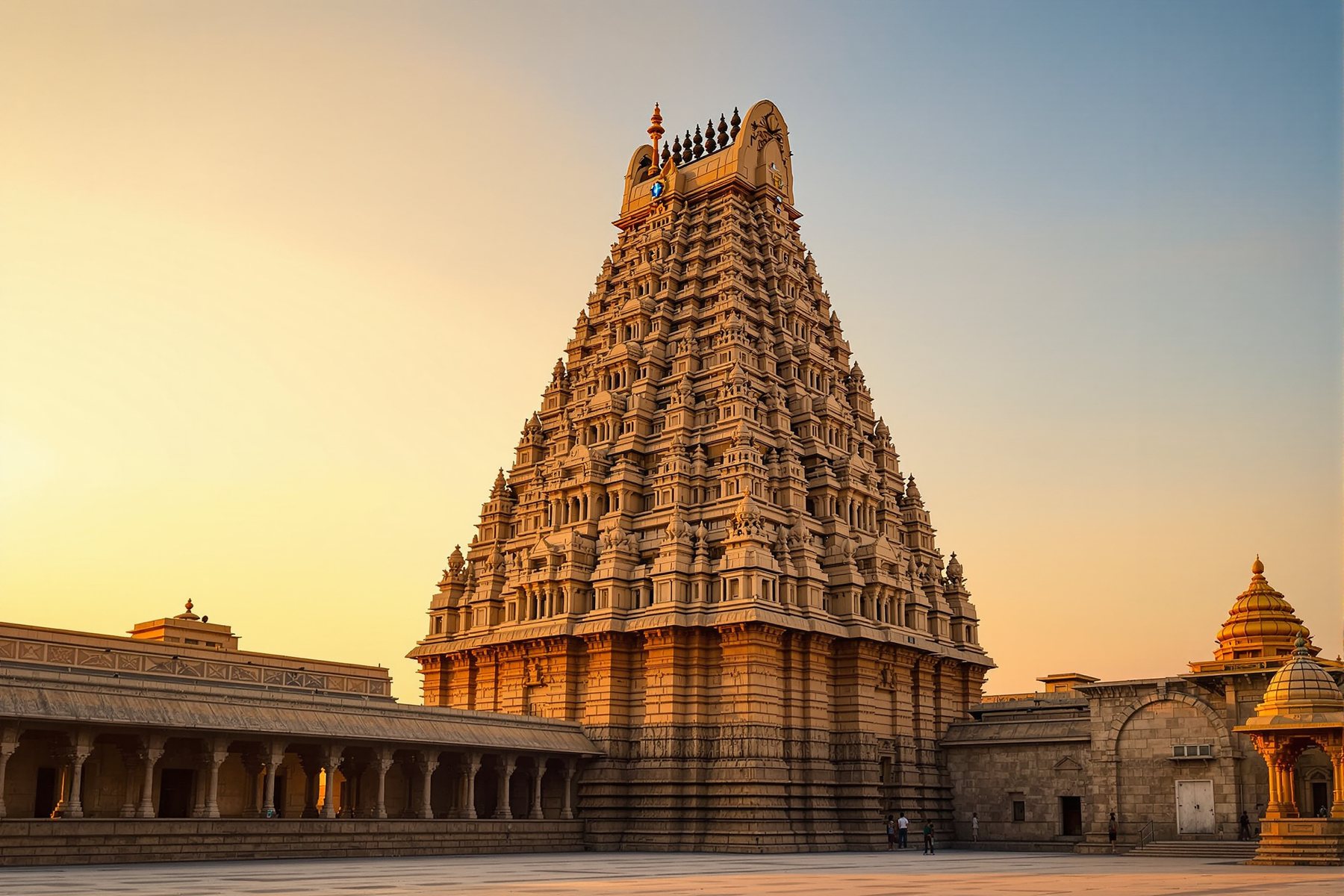
Brihadeeswara: The Chola Tower That Never Fell
How an 11th-century Tamil emperor raised a 216-foot tower of solid granite — with no mortar, no iron and no machine — and why this colossal corbelled mountain has stood for over a thousand years where Konark's fell. The engineering, the 80-tonne capstone, and the lesson.
In the last article in this series we watched a tower fall. The great deul at Konark was meant to be the tallest thing the Kalinga masons had ever raised — and it came down, beaten by its own ambition, its iron and its joints. Now travel south and back two and a half centuries, to the Kaveri delta of Tamil Nadu, and look at a tower that did the opposite. The Brihadeeswara temple at Thanjavur raised a corbelled stone tower even taller than Konark intended — 216 feet of solid granite — and it has stood, unmoved, through a thousand years of monsoons and earthquakes. It has never fallen, and it has never stopped being a temple.
Understanding _why_ is one of the most useful things an architect can learn from a single building.
This is the fourth article in our Architectural Wonders series. It is the direct counterpart to Konark — the same brave idea, the colossal masonry tower, carried out the other way, and answered the other way by time.
1. The mountain Rajaraja built
The temple was built by Rajaraja Chola I, the greatest of the Chola emperors, and completed and consecrated around 1010 CE (construction is usually dated to roughly 1003–1010). The Cholas, at that moment, ruled a maritime empire that reached across South India and out into Southeast Asia, and Rajaraja built his temple as a statement of exactly that power. He named it for the deity Brihadeeswara — "the great lord" — and it is known in Tamil as Peruvudaiyar Kovil, the temple of the great one, and to everyone in Thanjavur simply as the "Big Temple."
It is dedicated to Shiva, and it is the supreme achievement of Dravidian architecture — the South Indian temple tradition of pillared halls, sculpted gateway towers and, above the sanctum, the soaring pyramidal vimana. Where North Indian (Nagara) temples like Konark build a curved, beehive-like tower, the Dravidian vimana is a stepped pyramid of receding storeys — and at Thanjavur it was pushed to a scale never attempted before or, in stone, really since.
2. A tower of 216 feet, in solid granite
The vimana — the tower over the sanctuary — rises about 66 metres (216 feet) in thirteen diminishing tiers. For nearly a thousand years it has been one of the tallest temple towers on the planet, and it is built entirely of granite, one of the hardest and most stubborn building stones on earth.
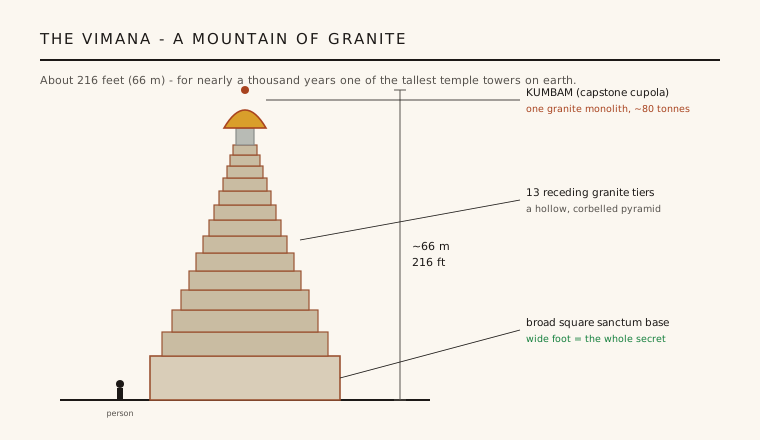
At the very summit sits the single most astonishing component: the kumbam, the domed capstone, carved from one block of granite and weighing — by the usual estimate — around 80 tonnes. Getting a single 80-tonne stone to the top of a 216-foot tower, without a crane in existence, is the problem the whole building is famous for, and we will come to how they probably did it.
But the height and the capstone are not the deepest marvel. The deepest marvel is that the tower is hollow and corbelled — exactly like Konark — and it is still standing.
3. Why it still stands
This is the heart of the matter, and the reason Brihadeeswara belongs beside Konark in this series. Both are corbelled towers: no true arch, no vault: each course of stone over-sails the one below, stepping inward and inward until the courses meet. It is a technique with a hard structural ceiling. Konark hit that ceiling and collapsed. Brihadeeswara, taller, did not. Why?
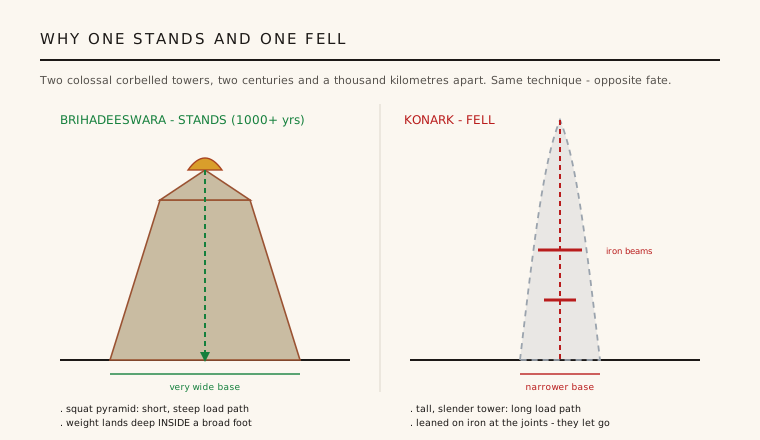
The answer is geometry and the load path. Brihadeeswara is, in essence, a very broad, squat pyramid. Its base is enormous relative to its height, the storeys step in steeply, and the weight of every course is carried down a short, steep path that lands comfortably inside that wide foundation. The structure is held up by its own mass and shape — by being, fundamentally, a stable pile. It does not depend on iron to stay together; the iron-poor Chola tower trusts its geometry instead.
Konark's deul, by contrast, was a tall, slender curvilinear tower: a long load path down to a narrower base, leaning on iron beams to bind its upper mass — and when the iron failed, so did the tower. Same family of technique; opposite proportions; opposite fate.
There is a lesson here so important it is worth saying plainly: the most reliable way to make a tall masonry thing stand is to make it wide at the bottom and let gravity do the work. Brihadeeswara is a thousand-year demonstration that proportion is not an aesthetic afterthought — it is the structure.
4. The capstone and the six-kilometre ramp
So how did they raise an 80-tonne block of granite 216 feet into the air around the year 1010?
By the oldest engineering trick there is: the inclined plane. The tradition — strongly held locally and entirely consistent with the physics — is that the Chola engineers built a gently sloping earthen ramp, said to run some 6.5 kilometres from a village still called Sarapallam ("the hollow in the slope"). Up that vast shallow ramp the capstone was hauled on log rollers by gangs of men and elephants, the long distance trading itself for the great height, until the stone could be eased onto the summit and the ramp dismantled.
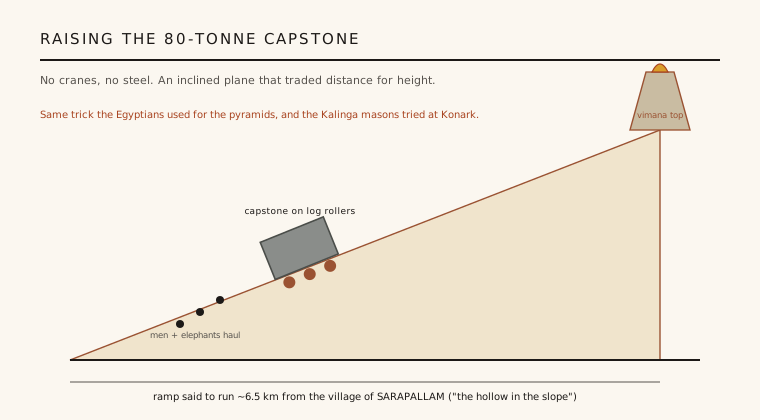
It is the same principle the Egyptians used for the pyramids, and the same one the Kalinga masons reached for at Konark. There is something moving about it: the most sophisticated building in medieval India was raised by the most fundamental machine there is, applied with overwhelming patience and organisation.
5. A whole stone mountain, imported and dry-stacked
Here is a fact that is easy to read past and worth stopping on. Thanjavur sits in the flat alluvial Kaveri delta — fertile rice country with no granite of its own for a long way in any direction. Yet the temple contains well over 130,000 tonnes of granite. Every block of it was quarried in distant hills and carried across the plain — by river, by sledge, by elephant — to a place that had no stone.
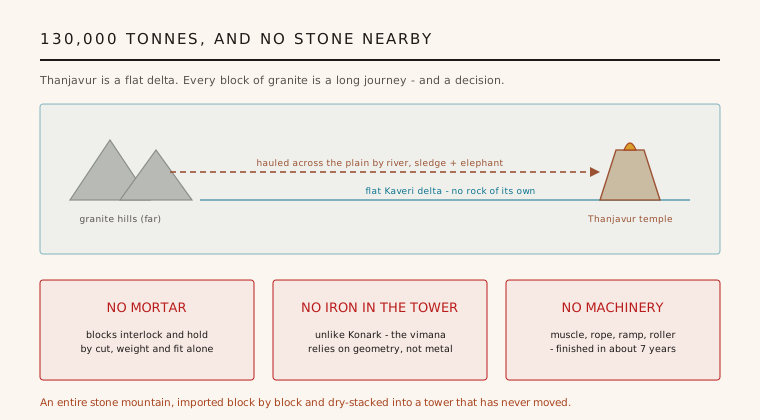
And then it was assembled with breathtaking economy of means: no mortar, the blocks cut so precisely they interlock and hold by weight and fit alone; no iron binding the great tower, which trusts its geometry; and no machinery beyond muscle, rope, ramp and roller. The whole stupendous thing was completed in roughly seven years. It is, in the most literal sense, a mountain that was imported one block at a time and dry-stacked into a tower that has not shifted in a millennium.
6. More than a temple: a record in stone
Brihadeeswara is not only a feat of structure; it is a feat of civilisation, and it tells you so in writing.
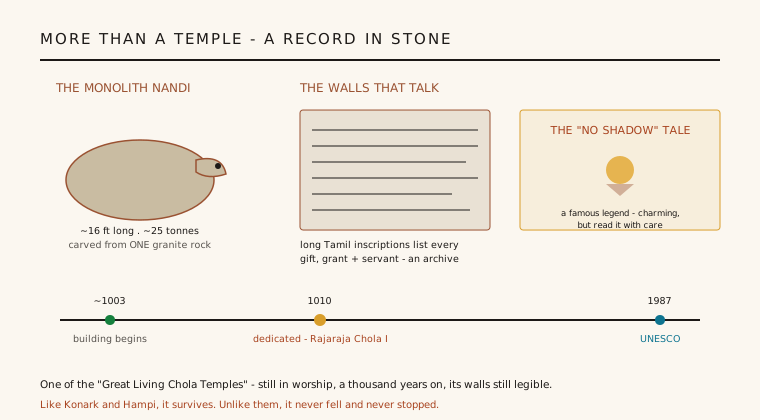
Guarding the approach to the sanctum is one of the largest Nandi (Shiva's bull) figures in India — roughly 16 feet long and carved, like the capstone, from a single block of granite, weighing around 25 tonnes. And the temple's walls are covered in some of the most detailed inscriptions of the medieval world: long records in Tamil of Rajaraja's endowments — the gold, the land, the lamps, the dancers, the musicians, the accountants assigned to the temple — so that the building is simultaneously a place of worship and a meticulous administrative archive of the Chola state. The walls and ceilings also carry Chola-era frescoes, among the finest surviving paintings of their age.
You will also hear the famous claim that the great vimana "casts no shadow at noon." It is a wonderful story and a beloved one — but it is best enjoyed as legend rather than fact: a tall tower always casts _some_ shadow, and the truth (the shadow falls within the temple's own base for much of midday, rather than spilling onto the ground beyond) is impressive enough without embroidery. Part of reading a wonder honestly is loving the myth and still telling the physics.
The temple is one of the three "Great Living Chola Temples" (with Gangaikonda Cholapuram and Airavatesvara), inscribed together as a UNESCO World Heritage Site in 1987 — _living_ because, unlike Konark or Hampi, Brihadeeswara never fell and never stopped: it has held worship continuously for over a thousand years.
7. What a modern architect can learn from Brihadeeswara
- Proportion is structure. The single greatest lesson here is that Brihadeeswara stands because it is _shaped_ to stand — broad foot, steep taper, low resolved weight. Konark fell because it was shaped to be tall. Before you think about material or detail, get the massing right: a stable form forgives a thousand things, and an unstable one forgives nothing. (It is the same instinct our structural safety guides press on every reader.)
- Trust geometry over gadgets. The Chola tower needs no iron and no mortar; it is held up by mass and shape. The most durable solution is usually the one that depends on the fewest things that can fail.
- The simplest machine, applied with organisation, moves mountains. An 80-tonne stone went 216 feet into the air on a ramp. Great works are far more often a triumph of logistics and patience than of secret technology.
- Let the building keep its own records. Brihadeeswara survives partly because it documents itself — its walls tell us who made it, when and why. Architecture that carries its own story is harder to forget and easier to care for.
- Build to live, not just to last. A "living" monument is maintained because it is used. The deepest durability is not only structural; it is the unbroken relationship between a building and the people who still need it.
References & further reading
1. UNESCO World Heritage Centre — Great Living Chola Temples (inscribed 1987). https://whc.unesco.org/en/list/250/
2. Encyclopaedia Britannica — Brihadishvara temple. https://www.britannica.com/place/Brihadishvara-temple
3. Archaeological Survey of India — Brihadisvara Temple, Thanjavur. https://asi.nic.in/
4. World History Encyclopedia — Chola Dynasty and Brihadishvara temple. https://www.worldhistory.org/Chola_Dynasty/
Last verified 2026-06-30. Heights, weights and dates follow standard archaeological and ASI reference sources and are given as widely accepted approximations; the Sarapallam ramp and the "no shadow at noon" claim are presented, respectively, as well-supported tradition and as popular legend qualified by the physics.
Export this guide
Related Guides — Deep-dive reading
Great Zimbabwe: The Stone City Europe Refused to Believe Africans Built
In the hills of southern Africa stand the largest ancient stone ruins south of the Sahara — a whole city of massive granite walls built without a drop of mortar, the wealthy capital of a gold-trading kingdom. For a century, colonists refused to accept that Africans had raised it, and invented every other builder they could. This is the story of that architecture, and of the lie it outlived. The article that closes our chapter on the palaces and pleasures of worldly power.
Architectural WondersĠgantija: The Oldest Temple Standing, Built by 'Giants'
How a Neolithic island people on Malta — with no metal and no wheel — raised the oldest free-standing stone temples on Earth a thousand years before Stonehenge or the pyramids, moving fifty-tonne blocks on stone balls into clover-leaf sanctuaries for a faith we can trace but cannot read, then vanished, leaving stones so vast that later islanders swore only giants could have built them.
Architectural WondersKhajuraho: The Temple Built to Be a Mountain
How the Chandela masons of 10th-century central India made the northern temple rise like a Himalayan peak — and why its sculpture, its engineering and its improbable survival still instruct the modern architect.
Architectural WondersRelated Tools — Try Free
Before & After Studio
Generate AI before-and-after renders to preview how your redesign could look.
DesignAIMaterial Comparison Sheet
India's interior material cheatsheet — plywood, finishes, hardware, countertops, paints, waterproofing.
Reference GuideWindow Orientation Planner
Pick the best window type, glass and shading by wall direction — north, east, south and west.
Window Tool