
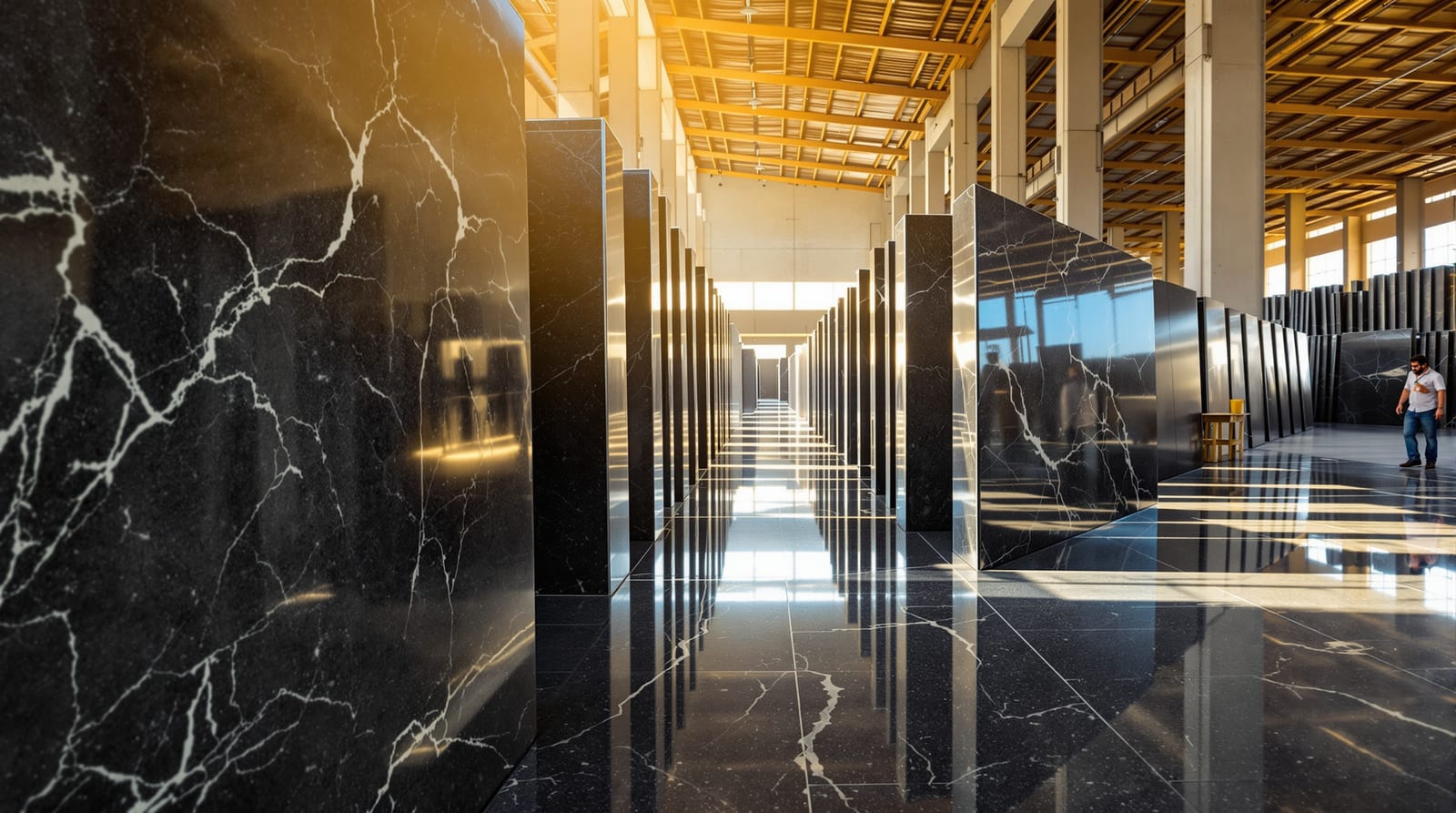
South India Granite Guide: Belts, Varieties & Prices (2026)
Why the south is India's granite capital — a buyer's tour of its quarry belts and famous stones, from Ongole Black Galaxy to Salem Tan Brown, with origin, colour, finish and ₹/sq ft.
If you have ever admired a jet-black kitchen platform flecked with gold, or a brown speckled lobby floor in a Bangalore office, you have almost certainly stood on South Indian granite. The four southern states sit on a vast slab of ancient Archaean and Proterozoic rock — the Deccan and Dharwar cratons — and that geology made the region India's granite capital and one of the world's biggest granite exporters. For a southern buyer this is the single best stone bargain in the country: the same Absolute Black or Black Galaxy that ships to Italy and the United States is quarried an hour or two from your site, so you pay the stone price without the long-haul transport that loads it everywhere else. This guide is a buyer's tour of those belts, the famous varieties, and what they actually cost per square foot.
Why granite is cheapest in the south
Granite is heavy — a polished 18 mm slab weighs roughly 45–50 kg per square metre — so transport is a real fraction of its delivered cost. The further a slab travels from the quarry, the more freight, loading, e-way-bill paperwork and breakage risk it carries. In the south the quarries, the gang-saw and polishing units, and the cut-to-size factories are all close together and close to you, so a Bangalore or Chennai homeowner buys granite the way a Rajkot homeowner buys tiles or a Jaipur homeowner buys marble: near the source, at the keenest price. A common rule of thumb is that the same variety can cost 15–35 percent more delivered to Delhi or Kolkata than to Bangalore or Hyderabad, purely on transport and handling.
There is a second reason. The south's processing industry is built for export — Andhra, Karnataka and Tamil Nadu together account for the lion's share of India's processed-granite exports. That means scale, competition and a deep range of finishes and sizes in the domestic yards, including the second-grade and short slabs that never make the export container but are perfectly good for an Indian home floor at a sharp discount. If you are weighing granite against other floors, the broader granite flooring in India guide covers performance, and granite vs vitrified tiles in India and marble vs granite flooring in India cover the head-to-head choices.
The four granite belts of the south
Each southern state has a signature belt and a signature colour. Knowing which belt your stone comes from helps you judge whether a quote is fair and whether you are buying close to source.
Andhra Pradesh — the black-and-gold belt
Andhra is the headline act. The Ongole belt in Prakasam district is world-famous for Black Galaxy (also sold as Star Galaxy) — a dense black granite studded with tiny golden specks of bronzite that catch the light. It is one of India's most exported stones and the benchmark "premium black" for kitchen platforms and feature floors. The Chimakurthy–Ongole area also yields Galaxy variants and other dark stones. Andhra additionally supplies plain blacks and the famous Kadappa/Cuddapah black limestone (a different, softer stone covered in the Kadappa stone in India guide — do not confuse it with granite).
Tamil Nadu — Salem and Madurai
Tamil Nadu's Salem and Madurai belts (plus Krishnagiri, Dharmapuri and Hosur) are a powerhouse of browns and blacks. Tan Brown — a brown-to-maroon granite with black and grey grains — is closely associated with this belt and is one of the most popular floor and platform stones in India. Salem also produces Absolute Black grade material and various greys, and the region has dense processing and cut-to-size capacity.
Karnataka — greys, blacks and the export yards
Karnataka quarries run across Ilkal, Chamarajanagar, Bangalore Rural, Kanakapura and beyond, producing Steel Grey, blacks, and a range of speckled greys and pinks. Bangalore is the south's biggest granite trading and processing hub, so even varieties quarried elsewhere are often cut, polished and sold here — handy for a Bangalore buyer because the yards carry everything.
Telangana — blacks, greys and tans
Telangana (Karimnagar, Warangal, Khammam and around Hyderabad) supplies blacks, Steel Grey, tan and brown granites and is a strong processing centre serving Hyderabad. The state is also the home of Tandur limestone, a separate grey/yellow flooring stone covered in Tandur stone in Telangana.
The abstract map below shows roughly where these belts sit — it is a schematic, not a survey map.
The famous varieties — origin, colour, price and use
These are the stones a southern dealer will quote you first. Prices are indicative 2026 ₹/sq ft for the polished slab material at a southern yard (not installed), and vary by grade, thickness, slab size and lot — always confirm current rates. Laying labour, adhesive or mortar, edge polishing and GST are extra; the granite flooring cost calculator helps you build the all-in number.
| Variety | Origin (state / belt) | Colour & character | Indicative ₹/sq ft (material) | Best use |
|---|---|---|---|---|
| Black Galaxy | Andhra — Ongole/Chimakurthy | Jet black with fine golden specks | ~120–250+ (export grade higher) | Kitchen platforms, feature floors, cladding |
| Absolute Black | Karnataka / Tamil Nadu (Salem) | Uniform dense black, minimal pattern | ~90–200 | Platforms, premium floors, stairs |
| Tan Brown | Tamil Nadu — Salem; also Telangana | Brown-maroon with black/grey grains | ~70–140 | Living-room floors, lobbies, platforms |
| Steel Grey | Karnataka / Telangana | Medium grey with darker speckle | ~55–100 | General flooring, stairs, commercial |
| Kashmir White | (sold across south; quarried Tamil Nadu/AP belts) | Light grey-white with garnet flecks | ~80–160 | Light floors, bathrooms vanity, cladding |
| Sadarali / P White / Platinum White | Andhra / Tamil Nadu | Pale speckled whites and greys | ~45–90 | Budget light flooring, large areas |
| Coffee Brown / Ruby Red | Karnataka / Andhra belts | Warm brown to red speckle | ~60–120 | Accent floors, platforms |
A few honest notes. "Kashmir White" is a trade name for a pale speckled granite sold across the south and is not from Kashmir; verify the actual slab rather than the romantic name. Black Galaxy commands the highest price because demand and export pull are strongest; the difference between a fine-fleck premium Galaxy and a coarser cheaper lot is visible side by side, so inspect. The cheapest end of the table — the pale whites and greys — is where large budget floors live, and where the south's local-source advantage is biggest.
Grades and export quality
Granite from the south is graded the way export markets demand, and that grading flows into the domestic yard too. You will hear three broad tiers.
| Grade | What it means | Where it goes |
|---|---|---|
| Premium / export (often "1st quality") | Best colour consistency, even grain, no visible cracks or fills, large defect-free slabs | Export containers, premium projects, showrooms |
| Commercial / standard | Minor colour variation, smaller slabs, occasional fills; sound and durable | Most Indian homes — the sweet spot for value |
| Economy / second / short slabs | Larger colour variation, short or odd-size slabs, visible fills | Budget floors, utility areas, cut-to-size offcuts |
For a home floor you rarely need export-premium grade — commercial grade gives you the same stone and durability at a better price, with slightly more natural colour variation that most people never notice once it is laid. The grades that matter to avoid for a main living area are heavily-filled or cracked economy lots. Resin "fills" — where natural pits are filled and polished over — are normal in granite; what you want to avoid is a slab where fills hide structural cracks. Inspect slabs in daylight, which is the core message of how to buy granite in India.
Finishes — what the south's factories offer
The southern processing industry offers every common finish, and the finish changes both the look and the slip behaviour underfoot.
| Finish | How it looks/feels | Where it suits |
|---|---|---|
| Polished (mirror) | Glossy, reflective, deepens colour | Indoor floors, platforms — but slippery when wet |
| Honed (matt) | Smooth but non-reflective, softer look | Bathrooms, around pools, where glare/slip is a concern |
| Flamed (thermal) | Rough, textured, naturally anti-slip | Outdoor paving, steps, ramps, wet areas |
| Leather / antique | Subtle low-sheen texture, hides marks | Designer platforms, feature surfaces |
| Brushed / lapato | Lightly textured semi-matt | Contemporary floors needing some grip |
For a polished granite floor in a wet area, treat slip seriously — a flamed or honed finish, or an anti-skid treatment, is safer. The general principles are in granite floor care in India.
Buying and cut-to-size in the south
The south's biggest practical advantage, beyond price, is cut-to-size capacity. Factories in Bangalore, Hyderabad, Salem and Ongole will cut granite to your exact platform, step, sill or vanity dimensions, polish the edges, and deliver. That cuts on-site labour and waste. A few buying pointers specific to the region:
- Buy at a yard, not just from a builder. Granite yards in Bangalore (granite-trading clusters), Hyderabad, Chennai and the Salem belt let you see and pick the actual slab and lot. Builder rates often carry a margin over yard rates.
- Pick the whole slab, mark it. For platforms and feature floors, select the specific slab in daylight and have it tagged so the polished piece you collect is the one you chose.
- Confirm thickness. Floor tiles run 16–18 mm; full slabs 18–20 mm. An under-gauged "20 mm" that is really 16 mm is a common way to shave a quote — check with a vernier.
- Get an all-in quote. Compare material plus edge polishing plus cutting plus transport plus loading plus laying plus GST, not just the slab rate. GST on granite slabs/tiles is 18 percent (raw blocks 12 percent); ask for a GST invoice and an e-way bill for transport.
- Buy a little spare. Order 5–10 percent extra from the same lot for cuts, wastage and future repairs — colour-matching later is hard.
For where these southern granites sit within the country's wider stone map, see Indian granite types by region in India.
Frequently asked questions
Why is granite so much cheaper in South India?
Because the quarries, processing units and cut-to-size factories are all in the south and close to the buyer. Granite is heavy, so transport is a real part of its delivered cost; a southern buyer skips the long-haul freight, loading and breakage risk that push the same stone's price up in Delhi, Mumbai or Kolkata. The south also has export-scale processing and competition, which keeps yard rates keen and the range deep.
What is Black Galaxy granite and where does it come from?
Black Galaxy (also called Star Galaxy) is a dense jet-black granite flecked with tiny golden specks of bronzite, quarried mainly in the Ongole–Chimakurthy belt of Prakasam district, Andhra Pradesh. It is one of India's most exported granites and a premium choice for kitchen platforms and feature floors. Premium fine-fleck lots cost more than coarse cheaper ones, so inspect before buying.
Is "Kashmir White" granite actually from Kashmir?
No. Kashmir White is a trade name for a pale grey-white speckled granite sold across South India and quarried in southern belts, not in Kashmir. Trade names in granite are about look, not geography, so verify the actual slab and lot rather than relying on the romantic name — the same caution applies to many granite trade names.
Which South Indian granite is best for a kitchen platform?
Black Galaxy and Absolute Black are the classic platform stones — dense, hard, stain-resistant and dramatic, with Tan Brown a popular warmer alternative. All three handle heat, knives and daily kitchen wear far better than marble. Choose a polished finish for the platform, inspect the slab for fills over cracks, and seal it as part of normal care.
Do I need export-grade granite for my home floor?
Usually not. Commercial or standard grade is the value sweet spot for Indian homes — the same stone and durability as export-premium, with slightly more natural colour variation that disappears once laid. Reserve premium export grade for showpiece areas, and avoid only the heavily-filled or cracked economy lots for main living spaces.
Export this guide
Related Guides — Deep-dive reading
Granite Flooring in India: Colours, Finishes, Cost & Buying Guide (2026)
India is one of the world's biggest granite producers — here is the homeowner's guide to popular varieties like Black Galaxy and Tan Brown, polished vs flamed finishes, slab vs tile, ₹/sq ft costs, IS 14223, sealing and where granite beats marble and vitrified.
Flooring & SurfacesKadappa Stone Guide: Andhra's Cheap Black Limestone for Floors, Stairs & Platforms (India)
What Kadappa (Cuddapah) black limestone costs, how it looks natural versus polished, why it is so dense, hard and budget-friendly, and where this South Indian stone works best in homes and commercial floors.
Flooring & SurfacesHow to Buy Granite in India: Slab Inspection, Grades & Price Guide
A buyer's playbook for inspecting granite slabs, spotting dye and resin, judging thickness and finish, and getting an honest all-in rate.
Flooring & SurfacesRelated Tools — Try Free
Flooring Cost Calculator
Estimate the all-in cost of a floor — material, laying, wastage, skirting and GST — by area and material.
Flooring CalculatorGranite Flooring Cost Calculator
Estimate installed granite-floor cost — material, cutting, laying, polishing, sealing, wastage and GST.
Flooring CalculatorCross-Ventilation Analyzer
Estimate airflow and air changes per hour (ACH) from room size, window areas, layout, and local wind — with NBC 2016 Part 8 compliance check.
Ventilation Calculator