
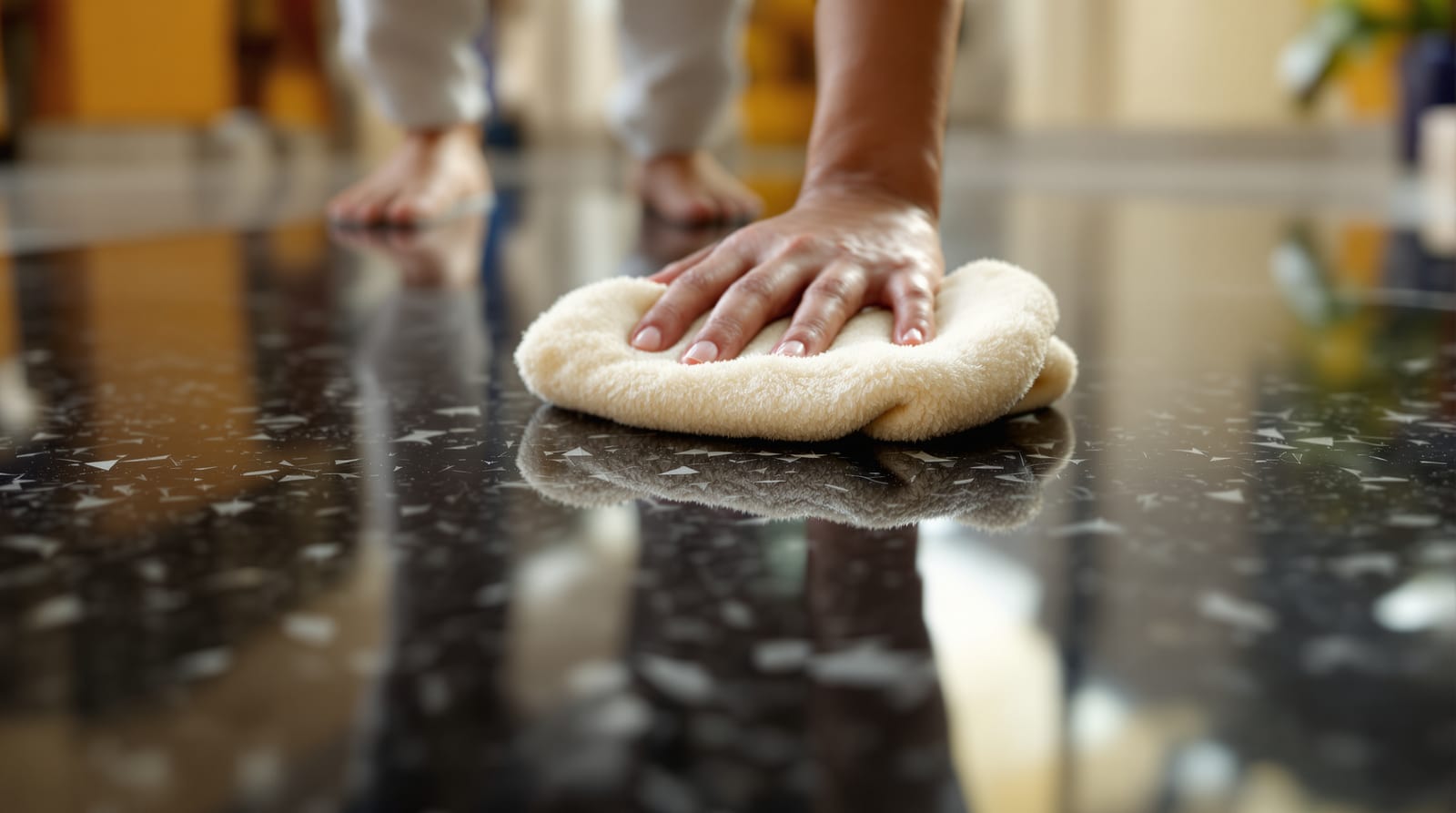
Granite Floor Care in India: Keep a Near-Indestructible Floor Looking New
Why granite is the lowest-maintenance natural stone in Indian homes, the simple pH-neutral routine that keeps it gleaming, and how to seal lighter varieties, lift oil, rust and hard-water marks, and re-polish a dull floor.
Granite is the closest thing to an indestructible floor that an Indian home can buy. It is a hard igneous stone, far denser and more scratch-resistant than marble, it shrugs off a hot kadhai set down straight from the gas, and a polished granite floor can outlive the house it sits in. That toughness is exactly why granite care is the easy chapter of floor maintenance: most of the work is just not doing the wrong things. This guide covers the simple daily routine, the one test that tells you whether your granite needs sealing, and how to deal with the few marks that do get through, oil, rust and hard-water film, plus when a dull old floor is worth re-polishing.
Why granite needs so little care
It helps to know what you are looking after. Granite is a crystalline stone made largely of quartz and feldspar, with a Mohs hardness around 6-7, harder than a kitchen knife. That hardness is why it resists scratching and abrasion that would mark marble, and why a polished granite floor holds its shine for decades. It is also far less porous than marble. Crucially, granite is much more acid-resistant than marble: a splash of lemon, curd, vinegar or chai that would etch and dull a marble floor will usually wipe straight off polished granite with no permanent mark. Polished granite is also heat-resistant, which is why granite remains the default kitchen-platform stone across India.
None of that makes granite zero-maintenance, but it does mean the routine is genuinely simple. The two things that actually dull a granite floor over the years are abrasive grit ground underfoot (which slowly micro-scratches the polish) and hard-water mineral film from mopping with the wrong water and wrong cleaner. Both are easy to prevent.
If you are still choosing or comparing stone, Studio Matrx covers the material itself in granite flooring, and weighs it against the alternatives in marble vs granite flooring and granite vs vitrified tiles.
The daily and weekly routine
The whole routine fits in a paragraph. Sweep or dry dust-mop daily to lift grit before it gets ground in, place a coir or microfibre doormat at every entrance so sand and dust stop at the door, and damp-mop with a pH-neutral cleaner once or twice a week (more in the kitchen). That is it.
The single most important rule is the cleaner. Use a pH-neutral stone cleaner or a few drops of mild dishwashing liquid in warm water, nothing else. Although granite is acid-tolerant, harsh chemistry attacks the sealer (if one is present) and, over years, the polish. Wring the mop until it is just damp, not sopping, mop in sections, and on a high-gloss black or dark granite go over it with a clean dry microfibre cloth to buff off any film and leave it streak-free. Dark polished granite shows every smear and every droplet of hard water, so the dry buff is what keeps it looking like glass.
| Task | How often | What to use |
|---|---|---|
| Dry sweep or dust-mop | Daily | Soft broom or microfibre dust-mop |
| Damp mop | 1-2 times a week (more in kitchen) | pH-neutral cleaner or mild dish soap in warm water |
| Dry buff (dark/gloss granite) | After each mop | Clean dry microfibre cloth |
| Wipe spills | Immediately | Damp cloth, then dry |
| Check sealing (water-drop test) | Every 6-12 months | Plain water (see below) |
| Reseal lighter varieties | Yearly, or when test fails | Penetrating granite sealer |
For deeper, all-material cleaning technique, see the Studio Matrx floor cleaning guide.
Does granite need sealing? The water-drop test
This is the question every granite owner eventually asks, and the honest answer is: it depends on the variety, and you can test it in five minutes. Dark, dense granites, the common Indian Black Galaxy, Black Pearl, Steel Grey and similar, are so tightly crystalline that they barely absorb anything and often never need sealing. Lighter, more open granites, the whites, ivories, creams and some speckled tans, are more porous and benefit from an annual seal, especially in a kitchen or dining area where oil and turmeric are in play.
To find out which camp your floor is in, do the water-drop absorption test. Drop a tablespoon of plain water onto a clean patch of the floor and leave it for about 15-20 minutes, then wipe it away and look.
If the water still beads up or sits as a shiny drop with no change to the stone underneath, your granite is dense or already well sealed, leave it alone. If the spot has darkened where the water sat, the stone is drinking it in and should be sealed. Repeat the test in the kitchen and a bedroom, because the same floor can read differently after years of foot polish.
Sealing lighter granite (and resealing)
Sealing granite is a job most homeowners can do themselves on a free afternoon. Buy a penetrating (impregnating) granite or natural-stone sealer, the kind that soaks in rather than leaving a surface film. Indicative cost is around ₹400-1,200 for a bottle that treats a few hundred square feet, indicative and varying by brand and city; reputable options include MYK Laticrete, Roff and imported impregnators sold at good tile dealers.
The method: clean the floor thoroughly and let it dry completely (any trapped moisture will block the sealer). Work in a well-ventilated room. Wipe or roll the sealer on evenly in a small section, let it dwell for the time on the label (usually 5-15 minutes) so it penetrates, then buff off all the excess with a clean dry cloth before it dries on the surface, leftover sealer dries to an ugly haze. Do the whole floor section by section, apply a second coat if the label recommends, and keep off the floor for the cure time, usually a few hours to overnight. Reseal lighter granites roughly once a year, or whenever the water-drop test starts to fail. Dense dark granites that pass the test need no sealing at all. For the same logic applied across stones and grout, see the Studio Matrx floor resealing guide.
Removing the marks granite does get: oil, rust and hard water
Because granite is so resistant, the few stains that do appear tend to be specific. Here is the issue-to-fix table, then the detail on the trickiest ones.
| Issue | Likely cause | Fix |
|---|---|---|
| Dull, filmy surface | Hard-water film or wrong cleaner residue | Re-mop with pH-neutral cleaner, then dry buff; switch to soft/RO water for final mop |
| Dark oil / grease patch | Cooking oil, ghee soaked into porous granite | Poultice with baking soda paste or acetone, cover, leave 24-48 h, rinse |
| Brown-orange rust spot | Iron object (pan, almirah leg, nails) left wet on stone | Poultice with a stone-safe rust remover; do NOT use acid on polished granite |
| White hard-water ring | Mineral deposits from a leaking pot or plant tray | pH-neutral cleaner and a soft scrub; stubborn film, fine 0000 steel wool gently on dense granite |
| Light scratch / scuff | Dragged furniture, grit underfoot | Buff with stone polishing compound; deep scratches need a professional re-polish |
| Etch / dull spot (rare) | Very strong acid (drain cleaner, Harpic) left to sit | Light re-polish of the spot; prevent by never using acidic cleaners |
| Cloudy white haze after sealing | Sealer left to dry on the surface | Reapply a little sealer to re-soften, then buff off; or use the maker's haze remover |
Oil stains are the most common because Indian kitchens run on oil and ghee, and even granite will slowly absorb oil if a spill sits. The fix is a poultice: a paste that draws the oil back out. Mix baking soda with a little water (or use acetone on a more stubborn patch) to a thick paste, spread it over the stain, cover with cling film taped at the edges, and leave it 24-48 hours to dry and pull the oil up. Scrape it off, rinse, and repeat if a shadow remains. The same poultice approach lifts most deep stains; Studio Matrx has the full method in floor stain removal.
Rust stains, the orange-brown mark left by a wet iron pan or an almirah foot, are the one case where the obvious instinct is wrong. Do not reach for an acidic rust remover or lemon, because while granite tolerates acid better than marble, a strong acid left on polished granite can dull the polish and is risky on any sealer. Use a stone-safe rust remover poultice made for natural stone, follow the label, and test on a hidden patch first.
Hard water is the quiet enemy of dark granite. Across much of India the tap water is hard, and mopping with it leaves a faint mineral film that builds into a dull grey cast on black granite. The cure is preventive: do the final mop or the wipe-down with softened or RO water, dry-buff afterwards, and never let a leaking pot or plant tray sit on the floor. An existing film usually lifts with a fresh pH-neutral mop and a vigorous dry buff.
Re-polishing a dull granite floor
If a granite floor has gone genuinely dull, not filmy but flat, with the mirror shine worn off after a decade of traffic, that is a job for professional re-polishing rather than any home product. Granite re-polishing is done with progressively finer diamond pads on a floor machine, the same crystallisation and diamond process used on stone, finishing to a high gloss. It removes fine scratches and restores the polish without replacing a single slab.
Indicative cost is around ₹12-30 per sq ft, indicative and varying by city, floor condition and finish required (a mirror polish costs more than a satin one). That is meaningfully cheaper than marble re-polishing because granite is harder and needs fewer passes, and it is dramatically cheaper than relaying the floor. For one or two light surface scratches you can try a granite polishing compound and a buffing pad yourself, but anything floor-wide is best left to a stone-polishing crew. To compare what re-polishing different stones costs and decide if it is worth it, see the Studio Matrx floor polishing cost guide, and if you are budgeting a new granite floor rather than maintaining one, the granite flooring cost calculator estimates material plus laying for your area.
What to avoid
A short list of don'ts protects a granite floor better than any product:
- No acidic cleaners as a habit, no vinegar, lemon, Harpic, or "acid" floor cleaners. Granite tolerates the odd splash, but routine acid attacks the sealer and, over time, the shine.
- No abrasive scouring powders, steel scourers or scrubbing pads on polished granite, they micro-scratch the gloss. (Very fine 0000 steel wool, used gently, is an exception only on dense dark granite for stubborn film.)
- No ammonia, bleach or bathroom cleaners as routine floor wash, they are too harsh for the sealer.
- No leaving the floor wet, standing water leaves hard-water rings and, on lighter granite, can darken the stone.
- No dragging furniture, lift it, and fit felt pads under chair and table legs to stop scratches and grit grinding.
- No leaving iron objects wet on the stone, that is what causes rust stains in the first place.
Frequently asked questions
Does a granite floor need to be sealed?
Often not. Dense dark granites like Black Galaxy and Steel Grey absorb almost nothing and usually never need sealing. Lighter, more porous granites, whites, ivories and creams, benefit from an annual seal, especially in kitchens. Run the water-drop test: if water beads, skip sealing; if the spot darkens, seal it.
Can I use a lemon or vinegar to clean granite?
You can without ruining it the way you would marble, since granite is far more acid-resistant, but you should not make it a habit. Repeated acid attacks any sealer and slowly dulls the polish. Use a pH-neutral cleaner or a few drops of mild dish soap in warm water instead.
Why does my black granite floor look dull and streaky after mopping?
Almost always hard-water film and leftover cleaner residue. Mop with a pH-neutral cleaner, do the final pass with softened or RO water, and buff dry with a clean microfibre cloth. Dark gloss granite shows every smear, so the dry buff is essential to the mirror finish.
How do I get an oil or ghee stain out of granite?
Draw it out with a poultice. Make a paste of baking soda and water (or use acetone for stubborn oil), spread it over the stain, cover with cling film for 24-48 hours, then scrape, rinse and repeat if needed. Sealing porous granite first prevents most oil stains.
Is re-polishing granite worth it or should I relay the floor?
Re-polishing is almost always worth it. At an indicative ₹12-30 per sq ft it restores the shine and removes fine scratches for a fraction of the cost and mess of relaying, and granite is hard enough to take many re-polishes over its life. Relay only if slabs are cracked or you want a completely different stone.
Export this guide
Related Guides — Deep-dive reading
Floor Sealing and Resealing Guide India: How to Seal Marble, Granite, Kota, Sandstone, Terrazzo and Cement Grout
Why porous natural stone and cement grout floors need sealing, the simple water-drop test to check if resealing is due, penetrating versus topical sealers, how to clean-dry-coat-buff, how often to reseal, and what you should never seal.
Flooring & SurfacesHow to Clean Bathroom Tiles (India): Shine, Hard-Water Film & Soap Scum
A practical, India-first routine for cleaning bathroom tiles and keeping them glossy — the daily squeegee habit, weekly wash, monthly deep clean, and the safe cleaner for each tile type, including the golden rule that natural stone must never meet acid.
BathroomsMarble Polishing and Care India: Stop Etching and Stains, Daily pH-Neutral Cleaning, Diamond Polishing and Re-Sealing
How to keep marble floors gleaming in Indian homes: why marble etches and stains, pH-neutral daily care, the professional diamond grinding to crystallisation polishing process, how often to re-polish and reseal, and removing etch marks and oil stains.
Flooring & SurfacesRelated Tools — Try Free
Flooring Cost Calculator
Estimate the all-in cost of a floor — material, laying, wastage, skirting and GST — by area and material.
Flooring CalculatorGranite Flooring Cost Calculator
Estimate installed granite-floor cost — material, cutting, laying, polishing, sealing, wastage and GST.
Flooring CalculatorWindow Cleaning Cost Calculator
Estimate professional window cleaning cost per visit and per year by access and frequency.
Window Calculator