
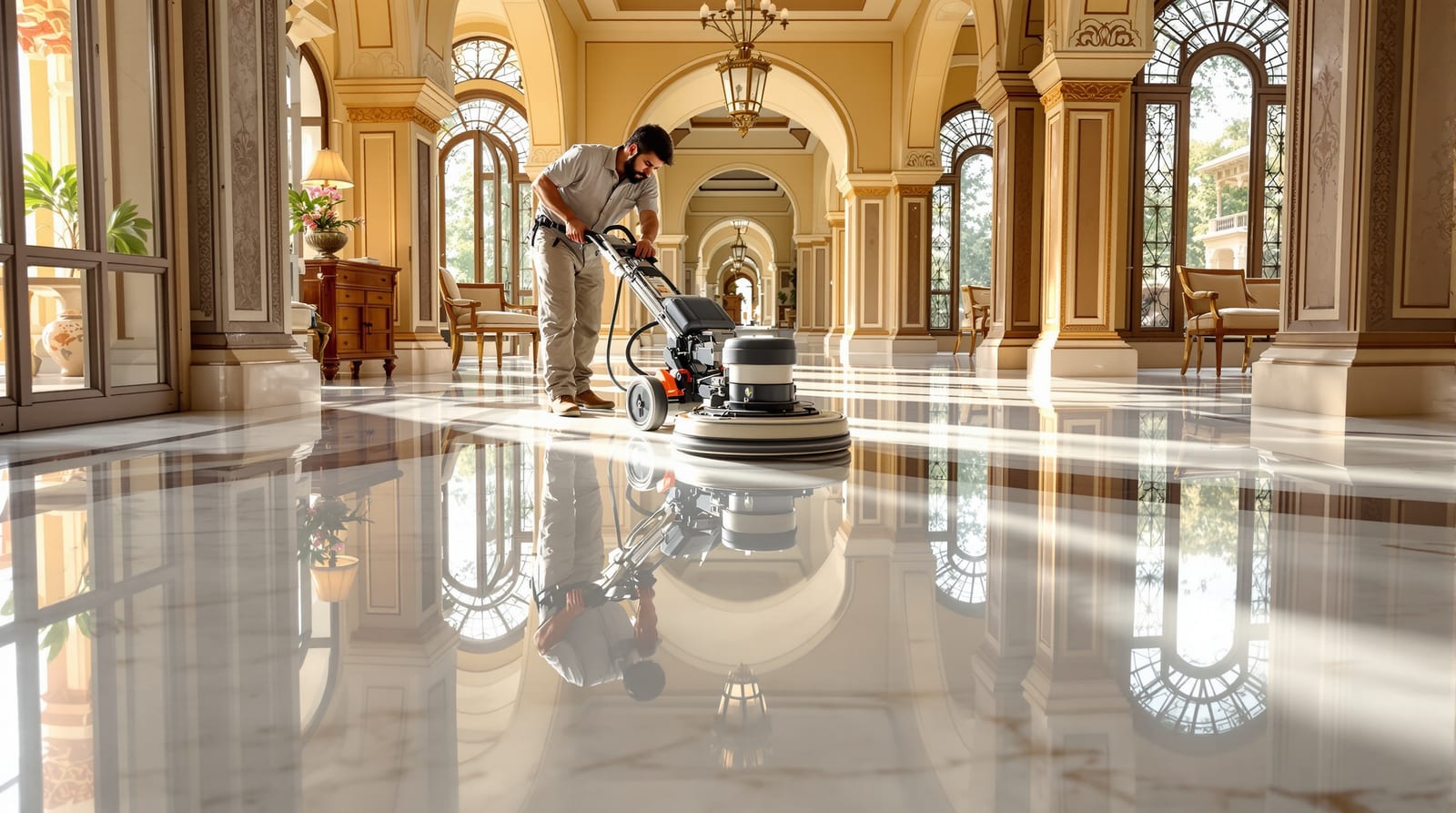
Marble Polishing and Care India: Stop Etching and Stains, Daily pH-Neutral Cleaning, Diamond Polishing and Re-Sealing
How to keep marble floors gleaming in Indian homes: why marble etches and stains, pH-neutral daily care, the professional diamond grinding to crystallisation polishing process, how often to re-polish and reseal, and removing etch marks and oil stains.
A marble floor is one of the few surfaces in an Indian home that can look more beautiful at year ten than year one, but only if it is cared for correctly. Treated like ordinary tile, marble dulls fast: a splash of lemon, a Harpic-soaked mop, a forgotten cup of dal, and the gleam is gone in patches. The good news is that marble is also one of the few floors you can fully renew on site. This guide explains why marble misbehaves, how to clean it daily so it never needs rescuing, the professional polishing process that brings a worn floor back to a mirror, and how to remove the etch marks and oil stains that scare most owners.
Why marble etches and stains in the first place
Marble is calcium carbonate, the same chemistry as chalk and limestone. That single fact explains almost every marble problem in an Indian home. Calcium carbonate reacts with acid. So when anything acidic touches a polished marble surface, it dissolves a microscopically thin layer and leaves a dull, lighter mark called an etch. This is not a stain sitting on top of the floor, it is the polish itself being eaten away, which is why wiping does nothing.
The acids that etch marble are everywhere in an Indian kitchen and bathroom: lemon and lime, vinegar, tamarind, tomato, curd and buttermilk, wine, cola, and the worst offenders of all, acidic cleaners. Harpic, hydrochloric-acid based hard-water removers, descalers and many tile cleaners are strongly acidic and will frost a marble floor in seconds. Even the diluted acid that masons sometimes use to clean cement haze off new tiles will ruin adjacent marble.
Staining is a separate problem from etching. A stain is a substance that soaks into marble's tiny pores and discolours it. Because polished marble is fairly porous, the classic culprits are oil and ghee, which leave dark grey blotches; turmeric, which leaves a stubborn yellow mark; tea, coffee and red wine; and standing water, especially hard water, which leaves pale rings and mineral spotting. Etch marks are lighter and dull, stains are darker and discoloured, and they are fixed in different ways, so learning to tell them apart is the first skill of marble care.
| Damage | What it looks like | Cause | Fix |
|---|---|---|---|
| Etch | Dull, lighter, rough patch where gloss is gone | Acid (lemon, vinegar, Harpic, descaler) dissolving the surface | Re-hone and re-polish, or marble etch-remover paste |
| Oil / ghee stain | Dark grey or brown blotch that soaks in | Cooking oil, ghee, butter penetrating pores | Drawing poultice (baking soda or flour with acetone) |
| Turmeric / food stain | Yellow or coloured patch | Turmeric, curry, wine, tea soaking in | Poultice with appropriate solvent or dilute hydrogen peroxide |
| Water rings | Pale rings or spots | Hard-water minerals, standing water | Light buff, dry promptly, reseal |
| Scratches | Fine grey lines | Grit dragged underfoot, furniture | Buff and re-polish |
Daily and weekly care: pH-neutral, nothing else
The single rule that protects a marble floor is simple: clean it only with a pH-neutral product, and never with anything acidic. A pH-neutral cleaner sits at around 7 on the scale, neither acid nor strong alkali, so it lifts dirt without attacking the calcium carbonate. You can buy dedicated stone or marble cleaners from brands sold in India such as Fila, Lithofin, MYK Laticrete and Stonetech, or simply use a few drops of a mild, neutral dish soap in warm water. What you must never use is vinegar, lemon, Harpic, hard-water acid, descalers, bleach in strength, or generic "all-purpose" tile cleaners that are acidic.
The daily routine is light. Dry dust-mop or soft sweep first, because the real enemy underfoot is grit, fine sand tracked in from outside that acts like sandpaper and slowly scratches the polish. Then damp-mop with the neutral solution using a well-wrung microfibre mop, and dry the floor rather than leaving it to air-dry, which prevents water rings. Wipe spills immediately, especially anything acidic or oily, and blot rather than rub so you do not spread it.
| Do | Don't |
|---|---|
| Use a pH-neutral stone cleaner or mild neutral dish soap | Use vinegar, lemon, Harpic, descaler or acidic tile cleaners |
| Dry dust-mop daily to remove abrasive grit | Drag grit around with a wet mop only |
| Wipe acidic and oily spills immediately | Let dal, oil, curd, wine or chai sit |
| Put doormats at every entrance | Walk in with outdoor grit on shoes |
| Fit felt pads under furniture legs | Drag chairs, sofas and beds across bare marble |
| Use coasters and trays under planters and oil bottles | Leave a leaky planter or a bottle of oil on the floor |
| Damp-mop with a well-wrung microfibre mop | Flood the floor or leave standing water |
Prevention is cheaper than polishing. Doormats at every entrance stop grit at the door, felt pads under all furniture legs stop scratches, trays under oil bottles and coasters under planters stop stains, and prompt wiping stops etches. A floor that is protected this way may need professional polishing only once every several years instead of every couple.
Sealing: an invisible shield, every one to two years
Sealing does not make marble gloss; polishing does that. A sealer (technically an impregnating sealer) soaks into the pores and slows down how fast liquids penetrate, buying you minutes to wipe a spill before it becomes a stain. It is your insurance against oil and turmeric. It does not stop etching, because etching is a surface acid reaction and no penetrating sealer can prevent acid from touching the surface, so sealing and acid-avoidance are both necessary, not either-or.
Apply a quality impregnating stone sealer after every polishing job and then top it up roughly every one to two years, sooner in kitchens and bathrooms where water and oil are constant. The test is easy: drop a little water on the floor and wait a few minutes. If it beads or sits on top, the seal is fine. If it soaks in and darkens the marble, it is time to reseal. The job is simple enough for an owner: clean and fully dry the floor, wipe on the sealer evenly, let it dwell as the label says, then buff off all residue. For the full method across stone and tile, see Studio Matrx on the floor re-sealing guide.
The professional polishing process, step by step
When a marble floor is dull, scratched, etched in many places or has lippage between slabs, surface cleaning will not fix it. It needs mechanical re-polishing, and this is a genuine skill done by specialist crews with heavy planetary grinding machines, not the same labour who laid the tiles. The process is a progression: cut the surface flat and remove damage with coarse diamonds, then refine it through finer and finer grits until the crystal structure of the marble reflects light again, and finally lock in a hard gloss.
Honing is the middle stage of this progression: working through medium grits to produce a smooth, even, matte-to-satin surface. If you want a matte marble look, you stop at honing. If you want the classic mirror, you continue to high grits and then crystallise or buff. Crystallisation is a chemical-mechanical polish where a mild fluorosilicate compound and steel wool or a polishing pad under a weighted machine react with the calcium surface to form a harder, glassier, more wear-resistant skin. It is the standard high-shine finish in Indian marble polishing and is what gives showroom floors their wet-looking depth.
| Step | What happens | Tooling | Notes |
|---|---|---|---|
| 1. Inspect and protect | Assess wear, lippage, stains; mask skirting and remove furniture | Survey, masking tape | Treat oil stains with a poultice before grinding |
| 2. Coarse grinding | Cut the surface flat, remove lippage, scratches and deep etches | Metal-bonded diamonds, roughly 30-50 grit | Wet process, creates slurry; only if floor is uneven or badly worn |
| 3. Intermediate grinding | Remove the coarse scratch pattern | Diamonds around 100-200 grit | Each pass must erase the previous grit's marks |
| 4. Honing | Refine to a smooth, even satin surface | Resin diamonds, roughly 400-800 grit | Stop here for a matte finish |
| 5. Fine polishing | Bring up reflectivity through high grits | Resin diamonds, roughly 1500-3000 grit | The shine starts to appear |
| 6. Crystallisation / buffing | Form a hard glossy skin, lock in the mirror finish | Crystalliser compound plus steel wool or pad, weighted buffer | The standard Indian high-gloss finish |
| 7. Clean and seal | Clear slurry and dust, dry, apply impregnating sealer | Wet vac, neutral clean, sealer | Protects the new surface from stains |
The reason the grit sequence matters is that each pass exists only to remove the scratch pattern of the pass before it. Skip a grit and the previous coarse scratches show through the final gloss as a faint haze. A good crew never jumps grits. The diagram below shows that progression, from a damaged, dull surface on the left to a flat, refined, mirror surface on the right.
What it costs and how often to re-polish
Professional marble polishing in India is priced per square foot and depends mostly on how much grinding the floor needs. A floor that only needs honing and crystallisation costs less than one that needs heavy coarse grinding to remove lippage and deep damage. Indicative 2026 rates, which vary by city and vendor and attract 18% GST, run roughly ₹15-45 per sq ft for full marble grinding and polishing, with simple buffing-and-crystallisation refreshes at the lower end and full multi-stage diamond grinding of a damaged floor at the higher end. By comparison granite polishing runs about ₹12-30 per sq ft and Kota or mosaic grinding about ₹15-35. For a full breakdown across stones and finishes, see Studio Matrx on floor polishing cost in India, and estimate your own job with the floor polishing cost calculator.
| Service | Indicative rate (plus 18% GST) | When you need it |
|---|---|---|
| Buffing and crystallisation refresh | ₹15-25 per sq ft | Floor is dull but flat, no deep damage |
| Honing plus polishing | ₹25-35 per sq ft | Light scratches and scattered etch marks |
| Full diamond grinding to polish | ₹35-45 per sq ft | Lippage, deep etches, heavily worn floor |
| Re-sealing (often bundled with polishing) | Small add-on or DIY | Every 1-2 years between polishes |
How often to re-polish depends on traffic and care, not the calendar alone. A well-protected marble floor in a low-traffic home may go five to ten years between full polishes, needing only a buffing refresh in between. A busy entrance, living room or a poorly cared-for floor may dull within two to three years. The honest signal to re-polish is when the floor looks tired despite correct cleaning: an overall loss of reflection, visible scratch haze, or widespread etching that no cleaning brings back. Between full polishes, a single crystallisation buffing pass can revive the shine for a fraction of the cost.
Removing etch marks and oil stains yourself
You can fix many marks at home before calling a polishing crew. Light etch marks, the dull spots from a lemon or a drop of acid, can sometimes be buffed out with a marble polishing powder or etch-remover paste sold for the purpose: dampen the spot, work the powder in with a damp cloth or a low-speed buffer, and the dull patch can re-gloss to match the surrounding floor. Deep or widespread etching needs professional re-honing.
Stains come out with a poultice, which is the most useful technique a marble owner can learn. A poultice is a paste of an absorbent powder and the right liquid that you spread over the stain to draw it back out of the stone as it dries. For an oil or ghee stain, mix baking soda or plain white flour with a little acetone or a degreasing solvent into a peanut-butter-thick paste. Spread it about a centimetre thick over the stain, cover with cling film taped at the edges, and leave it 24 to 48 hours to dry fully. As it dries it pulls the oil up into the powder. Scrape it off with a plastic (never metal) edge, rinse with plain water, and repeat if a shadow remains. For an organic stain such as tea, coffee, wine or turmeric, make the poultice with dilute hydrogen peroxide instead of acetone. Always test any chemical on a hidden corner first.
For stubborn or large stains, and for matching the finish afterwards, treat it as a repair job rather than a daily chore, and see Studio Matrx on floor stain removal for the full method across surfaces.
How marble care fits your wider flooring choice
If you are still deciding on marble, or weighing Indian versus imported stone, the maintenance reality in this guide should inform that choice: marble rewards care and punishes neglect more than vitrified tile does. For the buying-side picture, see Studio Matrx on marble flooring in India, the specifics of Italian marble flooring, and the more forgiving, harder-wearing Indian marble flooring options such as Makrana and Rajnagar that many homes choose precisely because they polish well and live long. The care routine here applies to all of them, because they share the same calcium-carbonate chemistry. To budget the stone itself before you weigh polishing upkeep, the Studio Matrx marble flooring cost calculator gives a quick estimate.
Frequently asked questions
Can I use vinegar or lemon to clean my marble floor?
No. Vinegar and lemon are acids, and acid dissolves the polished surface of marble, leaving permanent dull etch marks. Use only a pH-neutral stone cleaner or a few drops of mild neutral dish soap in water. The same warning applies to Harpic, descalers and acidic tile or hard-water cleaners, which can frost a marble floor in seconds.
What is the difference between an etch mark and a stain?
An etch is a dull, lighter, slightly rough spot where acid has eaten away the gloss, so it is surface damage and wiping does nothing. A stain is a darker discolouration where a substance like oil or turmeric has soaked into the pores. Etches are re-polished out; stains are drawn out with a poultice. Sealing helps prevent stains but not etching.
How often should I re-polish my marble floor?
It depends on traffic and care, not just time. A well-protected, low-traffic floor may go five to ten years between full polishes, needing only a buffing refresh in between, while a busy or neglected floor can dull in two to three years. Re-polish when the floor looks tired despite correct cleaning, with overall loss of shine, scratch haze or widespread etching.
How much does marble polishing cost in India?
Indicatively around ₹15-45 per sq ft in 2026, plus 18% GST, varying by city and how much grinding is needed. A simple crystallisation buffing refresh is at the lower end, while full multi-stage diamond grinding of a damaged or uneven floor is at the higher end. Use the Studio Matrx floor polishing cost calculator to estimate your specific job.
How do I remove an oil stain from marble?
Use a poultice. Mix baking soda or plain flour with a little acetone into a thick paste, spread it about a centimetre thick over the stain, cover with cling film, and leave 24 to 48 hours to dry. As it dries it draws the oil up into the powder. Scrape off with a plastic edge, rinse and repeat if needed. Test on a hidden spot first.
Export this guide
Related Guides — Deep-dive reading
Floor Sealing and Resealing Guide India: How to Seal Marble, Granite, Kota, Sandstone, Terrazzo and Cement Grout
Why porous natural stone and cement grout floors need sealing, the simple water-drop test to check if resealing is due, penetrating versus topical sealers, how to clean-dry-coat-buff, how often to reseal, and what you should never seal.
Flooring & SurfacesHow to Clean Bathroom Tiles (India): Shine, Hard-Water Film & Soap Scum
A practical, India-first routine for cleaning bathroom tiles and keeping them glossy — the daily squeegee habit, weekly wash, monthly deep clean, and the safe cleaner for each tile type, including the golden rule that natural stone must never meet acid.
BathroomsVitrified Tile Maintenance: How to Care for Vitrified & PGVT Floors in India
Vitrified and PGVT tiles are India's most common, near maintenance-free floor; the real weak point is the cement grout, not the tile, so this guide shows the simple routine, post-construction haze and stain removal, and how to keep the gloss.
Flooring & SurfacesRelated Tools — Try Free
Flooring Cost Calculator
Estimate the all-in cost of a floor — material, laying, wastage, skirting and GST — by area and material.
Flooring CalculatorMarble Flooring Cost Calculator
Estimate installed marble-floor cost — material, laying, grinding and polishing, sealing, wastage and GST.
Flooring CalculatorFloor Polishing Cost Calculator
Estimate marble, granite, mosaic, Kota or wood floor polishing cost by area, condition and gloss.
Flooring Calculator