
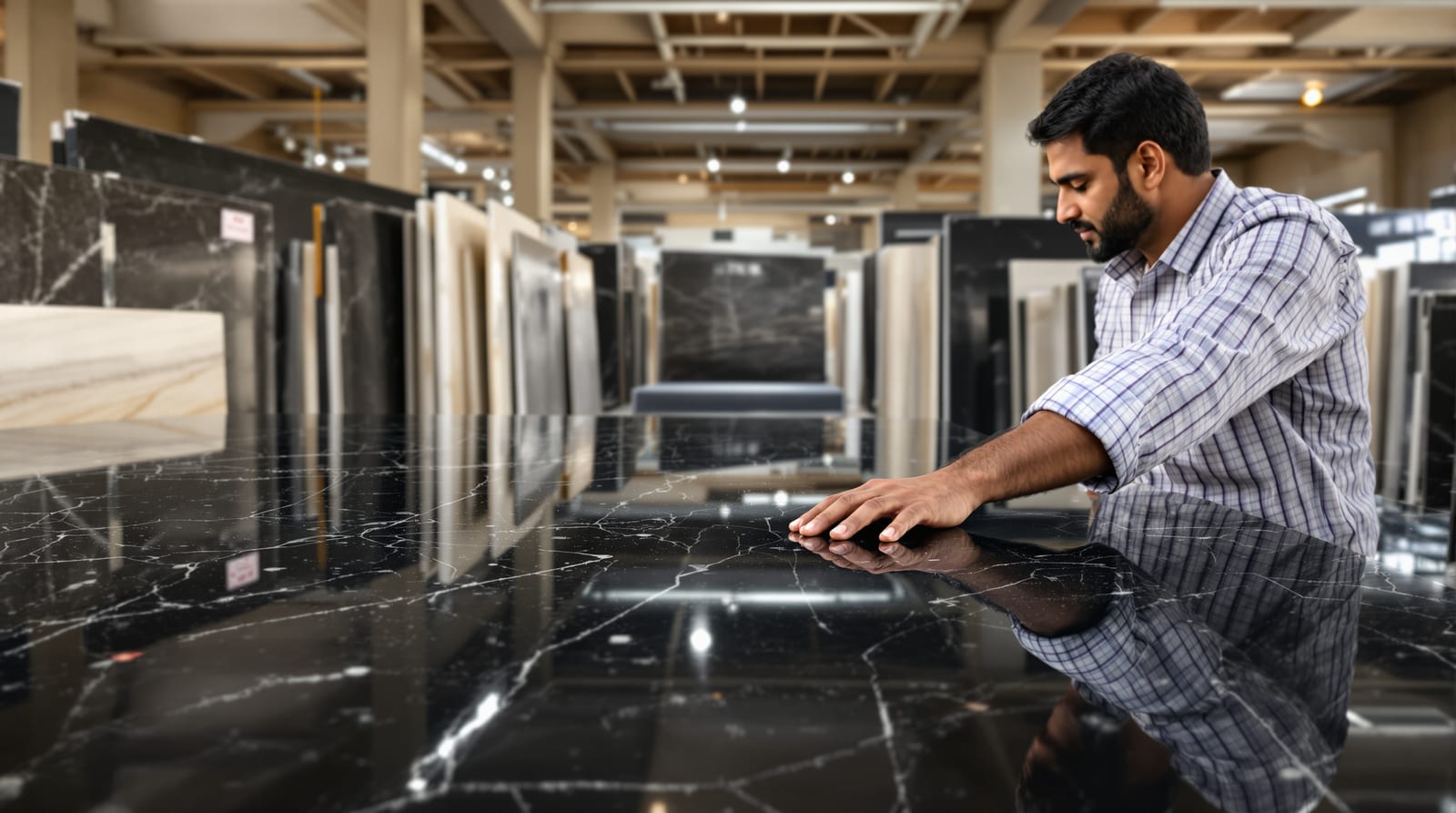
How to Buy Granite in India: Slab Inspection, Grades & Price Guide
A buyer's playbook for inspecting granite slabs, spotting dye and resin, judging thickness and finish, and getting an honest all-in rate.
Granite is the workhorse of Indian floors and counters: hard, heat-proof, almost maintenance-free, and quarried in our own backyard. But the slab market is opaque. The same Black Galaxy can be a stunning natural slab or a cheap lot brushed with colour-enhancing dye, riddled with resin-filled pits, and sawn 12 mm thin. Buying granite well is less about the variety on the dealer's board and more about how you inspect the actual slabs and read the all-in rate. This guide walks you through the slab inspection, the dye and resin tests, thickness, grades and origin, finishes, and the real ₹/sq ft maths so you pay for stone, not for marketing.
Start with where granite comes from
South India is the granite heartland, which matters for both price and authenticity. Karnataka, Andhra Pradesh, Telangana and Tamil Nadu hold most of the country's quarries and processing units, so granite is cheapest closest to source — in Bangalore, Hyderabad and Chennai you buy almost at quarry-gate, while Mumbai, Delhi-NCR and Kolkata add real transport cost per square foot. If you are far from the south, factor freight and loading into every quote.
A few origin facts worth knowing as a buyer. Ongole (Andhra) is the home of genuine Black Galaxy and Galaxy granites — the speckle you pay a premium for. Absolute Black (jet black, no grain) comes largely from Karnataka and Andhra. Tan Brown, Steel Grey, Kashmir White and the river-pattern whites are South Indian staples that are also heavily exported, which is why the best-finished slabs often go abroad and the home market sees a wider quality spread. When a dealer quotes a famous name, ask which quarry and ask to see the block or gangsaw slab it was cut from, not just a polished offcut.
For deeper regional detail see the Studio Matrx guides on South India granite and Indian granite types by region.
How to inspect a granite slab
Never buy granite off a small sample tile or a photo. Insist on seeing the full slabs you will actually receive, stood up against a wall in daylight (not under yellow shop lights, which hide flaws and exaggerate colour). Walk the whole slab, both faces, and run the checks below.
The most useful single tool is your phone torch and a wet cloth. Wetting the slab previews how it will look sealed and reveals patches and fills; the torch raking across the surface at a low angle throws up scratches, pits and uneven polish you cannot see straight-on.
| Check | What to look for | Reject / negotiate if |
|---|---|---|
| Colour and grain | Uniform shade and speckle across the slab and between matching slabs | Blotchy patches, sudden colour change, slabs from different lots that won't match |
| Cracks and fissures | None. Run a coin or key edge across suspect lines | Any line you can feel; hairline cracks run further once laid |
| Ring / tap test | Stand slab on edge, tap several spots — clear ringing tone | Dull, flat thud = internal crack or heavy resin |
| Resin and fills | Tilt to the light; resin sits glossy and slightly different in tone | Many filled pits, especially in cheap black and galaxy lots |
| Dye / colour enhancement | See the dye test below | Colour rubs off, or cut/back edge is paler than the face |
| Thickness | Measure the edge with a tape or vernier | Below 16 mm for flooring; uneven thickness across the slab |
| Surface flatness | Sight along the polished face; lay a straight edge | Waviness, dull zones, swirl marks from poor polishing |
| Pinholes and pits | Natural in some varieties; should be minimal and unfilled-honest | Pits crudely filled and over-polished to hide |
| Edges and corners | Square, un-chipped, enough size for your cut plan | Chipped or undersized slabs that force extra joints |
Buy 5–10% more area than you need from the same lot, in one go. Granite is natural — a second order weeks later rarely matches, and you will see the line across a floor.
The dye and resin tests
Cheap or tired black and galaxy granites are sometimes coated with a colour-enhancing dye or a black "shoe-polish" type treatment to fake depth. It fades and patches within a year or two. Two field tests catch it:
The acetone / rub test: dab a little nail-polish remover (acetone) or even a drop of thinner on an inconspicuous corner and wipe with a white cloth. Natural granite leaves the cloth clean; a dyed slab transfers black or colour onto the cloth. Also simply look at the sawn back and the cut edge — the colour should match the face. If the face is rich black but the edge is grey, it is dyed.
For resin, the tap test above is your main tool, plus the light tilt: a slab that has been resin-flooded to hide pits and micro-cracks reads dull on tap and shows a faint plasticky sheen in patches when you tilt it to the light. A little factory resin on a few natural pits is normal and fine; a slab held together by resin is not.
Here is the inspection sequence as a quick flow:
Thickness, gangsaw vs cutter, and grades
Thickness is where money is quietly saved by sellers. For granite flooring, insist on 16–18 mm finished thickness; for kitchen counters and heavy-use slabs, 18–20 mm. Thin 10–12 mm "economy" granite cracks under point loads and is hard to lay flat. Measure it yourself — quoted thickness and delivered thickness often differ.
How a slab is sawn tells you its grade. Gangsaw slabs are cut from large blocks on a multi-blade gangsaw machine into big, uniform-thickness, large-format slabs (often 9 ft+ long) — these are the premium, even, fewer-joint slabs you want for floors and counters. Cutter slabs (or "cutter pieces") are cut on smaller single-blade cutters into shorter, often slightly uneven pieces — cheaper, fine for small areas, sills, treads and stairs, but they mean more joints and more variation across a floor. For a living room or large hall, pay for gangsaw; for a small utility area, cutter is sensible economy.
Grades in the trade run roughly from premium quarry-select lots down to commercial and "second" lots with more pits, fills and colour variation. There is no single legal grade stamp, so the words mean different things to different dealers — let your own slab inspection, not the grade label, decide.
| Slab type | Typical size | Thickness | Joints / waste | Best for |
|---|---|---|---|---|
| Gangsaw slab | Large (8–10 ft+) | Even, 16–20 mm | Fewest joints | Floors, halls, kitchen counters |
| Cutter slab | Shorter pieces | Can vary slightly | More joints | Small rooms, steps, sills, ledges |
| Cut-to-size | Made to your sizes | As specified | Pre-finished, low waste | Counters, vanities, exact layouts |
Finishes — pick for the room
The same granite behaves very differently depending on finish. Match it to the room and to slip safety. Polished is glassy and shows water and scratches more; honed and leather hide marks and grip better underfoot; flamed is for outdoors and wet zones.
| Finish | Look and feel | Slip / grip | Best use |
|---|---|---|---|
| Polished | Glossy, mirror-like, deepest colour | Slippery when wet | Indoor floors, counters, dry areas |
| Honed | Matte, smooth, softer colour | Better grip than polished | Bathrooms, high-traffic floors |
| Leather (leathered) | Soft sheen, subtly textured | Good grip, hides smudges | Counters, modern floors, hides marks |
| Flamed | Rough, faded, heat-textured | High grip, anti-slip | Outdoor, steps, pool, wet areas |
For wet and outdoor zones, also see the Studio Matrx notes on granite floor care and the broader natural stone standards (IS 14223 for polished building/granite stone, IS 1124 for water absorption). For step-by-step slab quality checking across stone and tile, the flooring quality inspection guide complements this one.
What it costs — rate, GST and the extras
Granite flooring in India runs broadly ₹50–₹250+/sq ft for the material, depending on variety: common greys and browns at the lower end, Absolute Black and genuine Black Galaxy at the top, with exotic and imported granites going higher. Laying labour adds metro rates of ₹35–60/sq ft (Mumbai, Delhi-NCR, Bangalore) and ₹20–40/sq ft in tier-2 cities, plus cement/adhesive, polishing, skirting and grouting. These are indicative and vary by city and vendor.
Get the rate slab-area-correct. Granite is sold by the square foot of slab, and offcuts and wastage are real — budget 8–12% extra. Cut-to-size and edge work (for counters, steps, nosings, drip grooves, and bevelled or bullnose edges) are charged separately per running foot; ask for these in writing.
GST is a common confusion. Granite blocks attract 12% GST; granite slabs and tiles attract 18%. Works-contract and labour are 18%. Always take a proper GST invoice — it is your proof of genuineness, your warranty trail, and (for businesses) your input credit. For interstate transport the seller must raise an e-way bill; transport and loading/unloading are real per-sq-ft costs you should see itemised, not hidden in a round number.
Compare quotes on an all-in basis — material + adhesive + laying + skirting + grouting + polishing + edge work + transport + loading + GST — never on the headline slab rate alone. The cheapest slab rate frequently carries the highest hidden extras. To model your own numbers, use the Studio Matrx granite flooring cost calculator.
Who lays it, and your buying checklist
Granite is heavy and unforgiving, so use an experienced stone mason, not a general tile-layer, especially for large gangsaw slabs and counters. Confirm who handles cutting on site, who is liable for breakage during handling, and that the layer beds slabs fully (no hollows that crack later) and seals the stone after laying.
Before you pay, lock these down: see and approve the exact slabs from one lot; confirm thickness and gangsaw/cutter type in writing; run the dye and resin checks; get a written quote with variety, quarry/origin, area + wastage, finish, edge work, all extras and GST; agree delivery, breakage and any surface warranty; and never pay full advance — hold a final payment until the slabs arrive and match.
For related buying decisions, compare with the Studio Matrx guide how to buy marble is a useful sibling if you are torn between stones, and granite flooring covers the material in depth.
Frequently asked questions
How can I tell if granite has been dyed or colour-enhanced?
Look at the sawn back and cut edge — they should match the face. If the face is rich black but the edge is grey, it is dyed. Confirm with the acetone test: wipe a corner with nail-polish remover on a white cloth; natural granite leaves the cloth clean, dyed granite transfers colour. Dye fades and patches within a year or two, so reject it for floors.
What thickness of granite should I buy for flooring?
Insist on 16–18 mm for floors and 18–20 mm for kitchen counters and heavy-use slabs. Thin 10–12 mm economy granite cracks under point loads and is hard to lay flat. Measure the edge yourself with a tape or vernier — delivered thickness often differs from what was quoted.
What is the difference between gangsaw and cutter granite?
Gangsaw slabs are cut from large blocks into big, uniform, large-format slabs — premium, even, with the fewest joints, ideal for floors and counters. Cutter slabs are shorter pieces cut on smaller machines — cheaper, slightly more variable, fine for small rooms, steps and sills but meaning more joints across a floor.
What is the GST rate on granite in India?
Granite blocks attract 12% GST, while granite slabs and tiles attract 18%. Labour and works-contract are 18%. Always take a GST invoice for genuineness, warranty and (for businesses) input credit, and ensure an e-way bill is raised for interstate transport.
Why is granite cheaper in South India?
Most of India's granite quarries and processing units are in Karnataka, Andhra Pradesh, Telangana and Tamil Nadu, so buyers in Bangalore, Hyderabad and Chennai buy close to quarry-gate. In Mumbai, Delhi-NCR and Kolkata, freight and loading add a real per-square-foot cost, so always factor transport into far-city quotes.
Export this guide
Related Guides — Deep-dive reading
South India Granite Guide: Belts, Varieties & Prices (2026)
Why the south is India's granite capital — a buyer's tour of its quarry belts and famous stones, from Ongole Black Galaxy to Salem Tan Brown, with origin, colour, finish and ₹/sq ft.
Flooring & SurfacesHow to Buy Marble in India Without Getting Cheated (2026 Buyer's Guide)
Inspect full slabs in daylight, spot resin fills and the 'Italian marble' relabelling scam, read grades and thickness, and price a job all-in — from Makrana and Kishangarh to your floor.
Flooring & SurfacesFlooring Buying Mistakes in India: 12 Costly Purchase Errors and How to Avoid Them (2026)
From ordering the exact area with no spare and losing the dye-lot, to mixing calibre, buying seconds for living rooms, skipping the ISI mark, paying full advance and ignoring transport and loading charges, here are the purchase mistakes that quietly inflate a floor's true cost.
Flooring & SurfacesRelated Tools — Try Free
Granite Flooring Cost Calculator
Estimate installed granite-floor cost — material, cutting, laying, polishing, sealing, wastage and GST.
Flooring CalculatorFlooring Cost Calculator
Estimate the all-in cost of a floor — material, laying, wastage, skirting and GST — by area and material.
Flooring CalculatorInterior Contract Clause Checklist
16 sections and 98 checkboxes covering scope, BOQ, milestones, penalties, warranty, and disputes.
Contract Checklist