
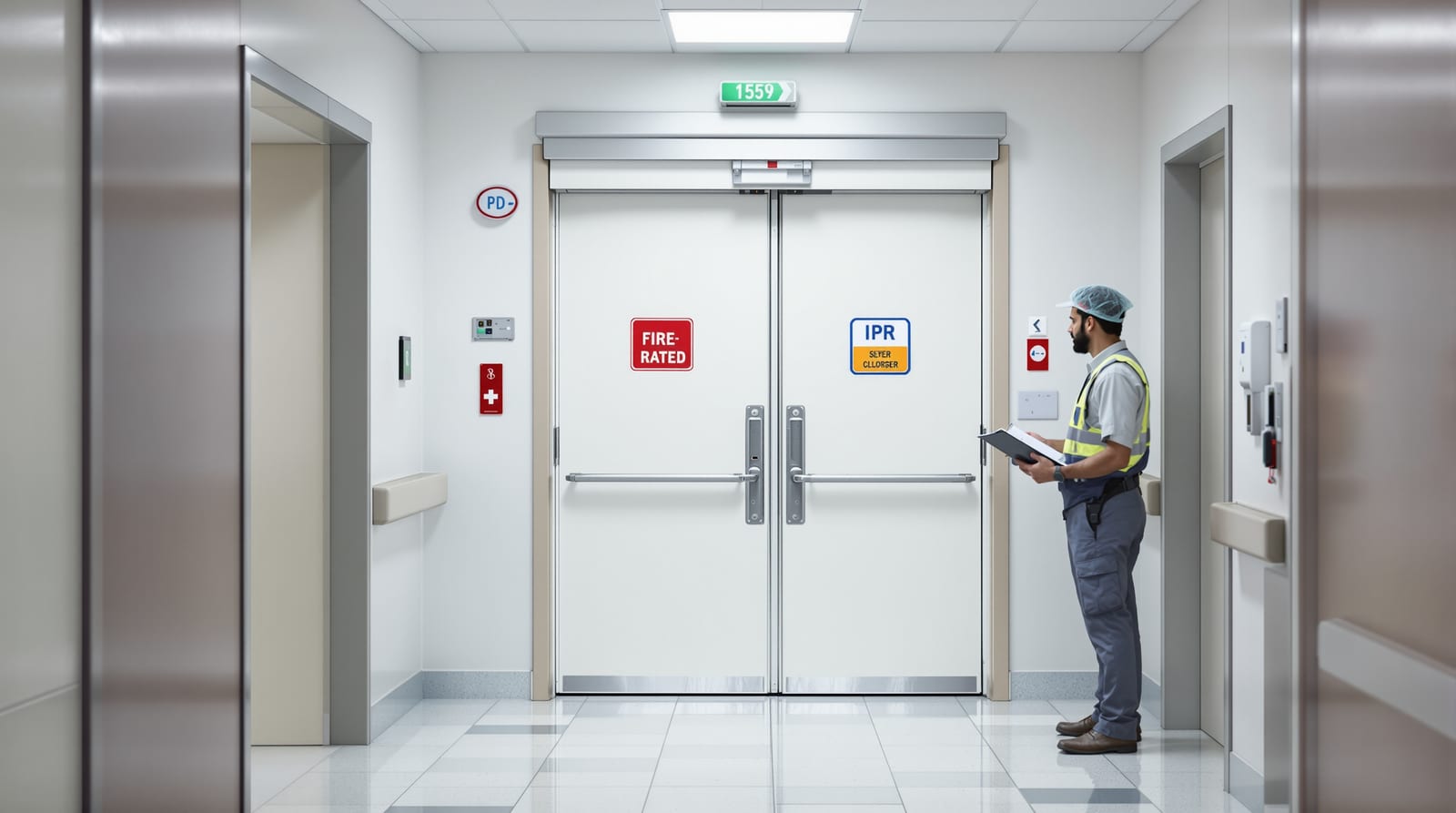
Door Fire Rating Schedule in India: FD30/FD60 Compliance 2026
How to schedule fire-rated doors across a project, record FD30/FD60 ratings, match certified sets and prove compliance at procurement and fitting.
A door fire rating schedule is the single project document that says, door by door, which leaves must resist fire and for how long. On any Indian building of consequence — a stairwell, a basement, a hotel corridor, a hospital, a high-rise lobby — fire-rated doors are not a product choice the carpenter makes on site; they are a compliance decision flowing from the fire strategy and the National Building Code. This guide is about the scheduling and compliance craft: how to identify which doors need FD30 or FD60, how to record those ratings on the door schedule so nobody loses them, how to match certified door-sets at procurement, and how to verify that what got fitted is actually what was specified. It complements — but does not repeat — the product-level fire door ratings guide, which explains what an FD rating is. Here the question is project-wide: which doors, what rating, proven how.
What a fire rating is, in schedule terms
A fire rating is a tested resistance time, expressed in minutes — in India usually written FD30, FD60, FD90 or FD120, meaning the door-set held back fire (integrity, and where rated, insulation) for that many minutes in a furnace test. NBC 2016 Part 4 (Fire and Life Safety) sets where rated doors are required and the minimum periods; IS 3614 governs fire-check and metal-clad doors and their testing. The crucial discipline for the scheduler is this: a rating belongs to a complete, tested door-set — the leaf, the frame, the intumescent and smoke seals and the ironmongery — not to a bare leaf. So a fire-rating column on a schedule is only meaningful when it is tied to a certified set and a test certificate reference. A leaf that "says FD60" with mismatched hinges or an oversize lock cut-out is, legally and physically, not an FD60 door.
Where ratings come from
Never invent a rating. It is read off the project fire strategy / fire-safety drawings, prepared by the architect or fire consultant under NBC 2016 and the local fire NOC requirements. Typically: doors onto and within protected escape stairs, lobby/lift-lobby doors, basement and service-shaft doors, and compartment-wall openings carry ratings; risk rooms (electrical, generator, transformer, kitchen) often demand higher periods. As a rule of thumb you will see FD30 (30 min) on many internal protecting doors and FD60 (60 min) on stair, lobby, basement and higher-risk separations — but the strategy, not this guide, is the authority. The scheduler's job is to transcribe the strategy faithfully onto every affected door reference.
Building the fire-rating column into the door schedule
A general door schedule already lists every door by reference number with location, size, leaf type, material, handing and ironmongery set (see the door schedule guide and door numbering and tagging). The fire-rating schedule is not a separate spreadsheet — it is a column (or a focused extract) within that master schedule, so the rating lives next to the door it governs and travels with it to procurement and site.
| Field | What it records | Why it matters for compliance |
|---|---|---|
| Door ref / tag | Unique number keyed to the drawing | Ties strategy → schedule → the physical leaf on site |
| Location | Stair, lobby, basement, risk room | Justifies the rating against NBC 2016 |
| Fire rating | FD30 / FD60 / FD90 / NR (not rated) | The core compliance value |
| Self-closing | Closer / spring hinge required | Rated doors must close fully unaided |
| Seals | Intumescent + smoke (cold smoke) | Part of the tested set; not optional |
| Vision panel | Rated glazing + bead, or none | Glazing must be tested to the same period |
| Certified set ref | Maker, test report / certificate no. | Proves the leaf matches a tested assembly |
| Signage | "Fire door — keep shut" / "keep locked" | NBC life-safety marking |
A worked fire-door schedule extract
| Ref | Location | Size (mm) | Rating | Self-close | Seals | Certificate ref | Signage |
|---|---|---|---|---|---|---|---|
| FD-01 | Stair lobby, GF | 1000 x 2100 | FD60 | Closer | Intumescent + smoke | TC/IS3614/… | Keep shut |
| FD-02 | Basement entry | 1200 x 2100 | FD60 | Closer | Intumescent + smoke | TC/IS3614/… | Keep shut |
| FD-03 | Electrical room | 900 x 2100 | FD60 | Closer | Intumescent + smoke | TC/IS3614/… | Keep locked |
| FD-04 | Corridor cross-door | 900 x 2100 | FD30 | Closer | Intumescent + smoke | TC/IS3614/… | Keep shut |
| FD-05 | Hotel guest-room | 900 x 2100 | FD30 | Closer/spring | Intumescent + smoke | TC/IS3614/… | Keep shut |
Keep "NR" (not rated) explicit on non-fire doors too — a blank in the rating column is dangerous, because nobody can tell whether it means "not required" or "not yet decided". On a large project, sort or filter the master schedule on the rating column so the fire doors stand out as a discrete population that procurement, the fitting crew and the inspector can each work through systematically. Many practices also colour-code rated references on the door layout drawing so the carpenter setting out can see at a glance that a particular opening is life-safety critical and must not be improvised.
Procurement: matching the rating to a certified set
The rating column is a buying instruction. When you raise the purchase, you are not ordering "an FD60 door" — you are ordering a certified door-set whose test report (to IS 3614 or an equivalent recognised standard) covers the exact configuration you scheduled: leaf construction, frame, seals, vision panel and ironmongery. Demand the certificate and the maker's installation/field-of-application data before delivery, and file the certificate reference against the door ref in the schedule. The commonest, most expensive failure on Indian sites is procuring a rated leaf but pairing it with an uncertified frame, non-fire-rated hinges or the wrong closer — which invalidates the rating even though the leaf is genuine.
Procurement checklist
| Step | Check | Evidence to file |
|---|---|---|
| Specify | Rating + set config matches schedule | Approved schedule + fire strategy |
| Certify | Test report to IS 3614 / NBC | Certificate no. against door ref |
| Match set | Frame, seals, hinges, closer all tested | Maker's set datasheet |
| Glazing | Vision panel rated to same period | Glazing test data |
| Tag | Plug/label keyed to schedule ref | Photo of plug + delivery note |
| Store | Flat, dry, off floor, acclimatised | See delivery and storage |
Verifying compliance at fitting
Scheduling ends at the door frame. Install-time compliance — gaps of 3–4mm around the leaf, threshold gap controlled or sealed, continuous intumescent and smoke seals, rated hinges (three minimum, four on heavy/FD60+ leaves), self-closing, no oversize cut-outs breaching the core, and the "Fire door — keep shut" signage — is covered in depth by the fire door installation compliance guide, and ongoing checks by fire door maintenance and inspection. The scheduler's role at this stage is the audit trail: tick each scheduled fire door against its certificate, record gap measurements and seal continuity, photograph the fitted set and signage, and sign it off. That signed, photographed schedule is what satisfies the fire NOC inspection and the door handover pack. Treat fire doors as life-safety items — never let a fire-rated door be substituted, value-engineered down or fitted by unsupervised mixed-skill labour without a final rated-door inspection.
Common scheduling failures to design out
- Blank rating cells — ambiguity between "not required" and "not decided". Always state NR.
- Leaf-only certificates — the rating must cover the whole set.
- Silent downgrades — FD60 quietly bought as FD30 to save cost; cross-check every ref against the strategy.
- Lost glazing rating — a vision panel added on site to a door whose glazing was never tested.
- No as-built record — substitutions made during construction not fed back into the schedule.
Use the fire door compliance checker to validate gaps, seals, self-closing and signage against the scheduled rating before sign-off, and feed approved entries into your master ironmongery schedule. For the whole project picture, return to the complete door guide.
Frequently asked questions
Is the fire-rating schedule different from the door schedule?
Not really — it is the fire-rating column (and a focused extract) within the master door schedule. Keeping the rating beside its door reference, rather than in a separate file, stops ratings from being lost between design, procurement and site, and lets one document follow each door from the fire strategy through to handover.
Who decides whether a door is FD30 or FD60?
The project fire strategy or fire consultant does, under NBC 2016 Part 4 and the local fire NOC. The scheduler transcribes those decisions — never assigns ratings independently. As a rule of thumb FD60 appears on stair, lobby, basement and high-risk separations and FD30 on many internal protecting doors, but the strategy is always the authority.
Does the rating apply to the leaf or the whole door-set?
The whole tested set — leaf, frame, intumescent and smoke seals, hinges, closer and any glazing. A rated leaf in an uncertified frame, or with non-fire-rated hinges or an oversize lock cut-out, is not a compliant rated door. Always procure and certify the complete set, referenced to an IS 3614 (or recognised equivalent) test report.
What proof of compliance does an inspector expect?
The approved schedule with the fire-rating column, the certificate reference for each fire door, recorded gap and seal checks, and photographs of the fitted set and signage — ideally signed off. This audit trail supports the fire NOC and the handover pack, and shows that what was fitted matches what the strategy required.
Can a fire door be value-engineered to a lower rating to save cost?
Only if the fire strategy is formally revised and re-approved — never silently on site. Quietly substituting FD30 for a scheduled FD60 is a life-safety breach. Cross-check every door reference against the strategy at procurement and at fitting, and record any approved change as an as-built revision in the schedule.
Export this guide
Related Guides — Deep-dive reading
Fire-Door Installation Compliance: India 2026 Fitting Guide
Getting a fire door right at fitting — certified set, gaps under 3mm, continuous seals, fire-rated hinges, self-closing and signage to NBC 2016 and IS 3614.
Home Doors & EntrancesFire Rated Doors in India: IS 3614 Ratings, Cost & Where They're Required (2026)
What a fire-check door is, how the 30/60/90/120-minute ratings work to IS 3614, where the NBC makes them mandatory, and why the whole assembly must be certified.
Home Doors & EntrancesDoor Schedule Guide: Reading & Preparing One (India 2026)
What a door schedule is, every column explained, and how this single table controls door procurement, fitting and snagging across an Indian project.
Home Doors & EntrancesRelated Tools — Try Free
Fire Door Rating Checker
See the likely fire-door rating (30/60/90/120 min) and components a location needs per IS 3614 / NBC — guidance, confirm with your architect.
Compliance ToolLift Safety Audit Checklist
Interactive checklist that scores your home lift on safety devices, compliance and upkeep.
ChecklistAccess-Control Schedule Generator
Build the time schedules that decide when each access group can enter — an editable list for your integrator.
Time Schedules