
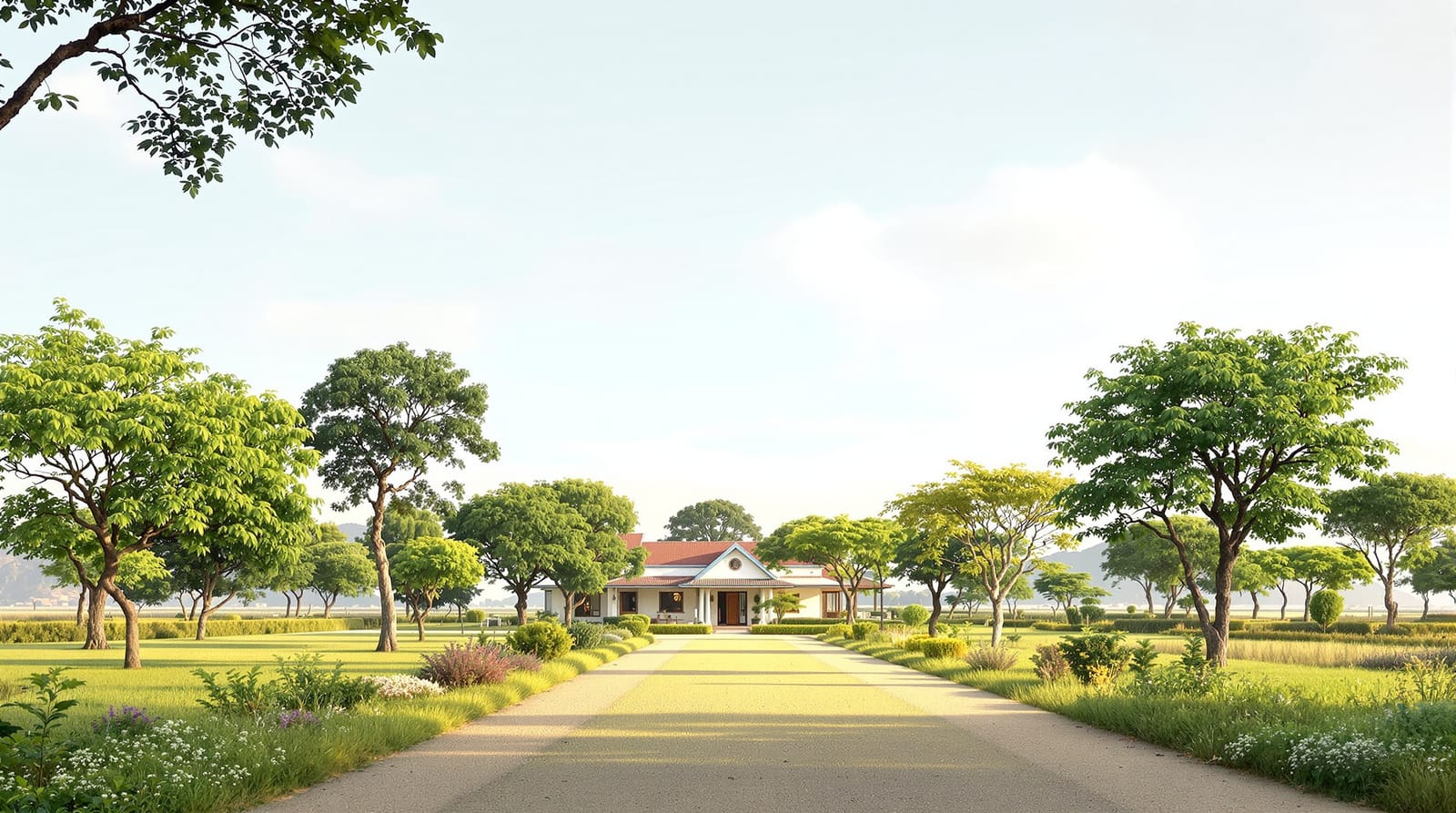
Landscape Design for Farmhouses & Weekend Homes
The large rural plot — approach avenue, productive orchard and kitchen garden, natural zones, water on site, and a low-maintenance landscape that thrives between weekend visits
A farmhouse landscape is not a city garden made bigger — it is a piece of working land that must look after itself between your visits, settle gracefully into its rural surroundings, and reward you with shade, fruit and quiet rather than a manicured lawn that demands daily attention you cannot give.
Most Indian "farmhouses" are not farms at all — they are weekend and second homes on one to five acres of peri-urban land at the edge of Bengaluru, Hyderabad, Pune, the NCR green belt, or along the coastal and hill roads out of every metro. You arrive Friday night, you leave Sunday evening, and for the other five days nobody is there but a caretaker and the crows. That single fact — occupancy in bursts, neglect in between — should govern every planting and irrigation decision you make. Design for the Tuesday you are not there, not the Saturday you are.
How a farmhouse landscape differs from a city garden
The instinct, when people buy land, is to recreate the suburban garden they already know — clipped hedges, a green carpet of lawn, beds of seasonal annuals — only larger. This is the single most expensive mistake on a farmhouse plot, because everything that is fiddly in a 40 by 60 site becomes unmanageable across two acres.
A farmhouse landscape differs on five honest counts:
- Scale. You cannot intensively garden two acres. Most of the land should be planted once and left to grow — trees, native grasses, orchards — with only a small "kept" zone near the house.
- Informality. Straight edges and topiary read as anxious on rural land. Curves, drifts, meadow, and irregular tree groves belong here. The land sets the geometry, not a drawing board.
- Productivity. A city garden is ornamental; a farmhouse can and should feed you — fruit, vegetables, herbs, fodder, firewood. Productivity is also low-maintenance: a mango tree asks nothing of you after year three.
- Native and natural planting. With no mali on daily duty, the plants that survive are the ones that belong to your climate zone and rainfall. Exotics that need pampering will die in your absence.
- Working with the land. Existing trees, the slope, the soil, the water table, the wind — on a large rural plot these are loud and worth obeying. Read the land before you draw a single bed. This is the heart of Landscape Planning Before Building Design and Residential Site Planning.
This is the deepest line of difference from Villa Landscape Design: a villa is a suburban plot, lived in every day, intensively gardened, with a gardener who waters each evening. A farmhouse is rural, episodically occupied, mostly planted-and-left, and judged by how well it survives your absence — not by how immaculate it looks the one weekend you are there.
The grounds: zoning a farmhouse plot
A large plot wants to be read as a sequence of zones, each with a different intensity of care, arranged so the high-maintenance bits are small and close to the house and the low-maintenance bits cover the bulk of the land. The principle is the same as Landscape Zoning for Family Activities, scaled up to acres.
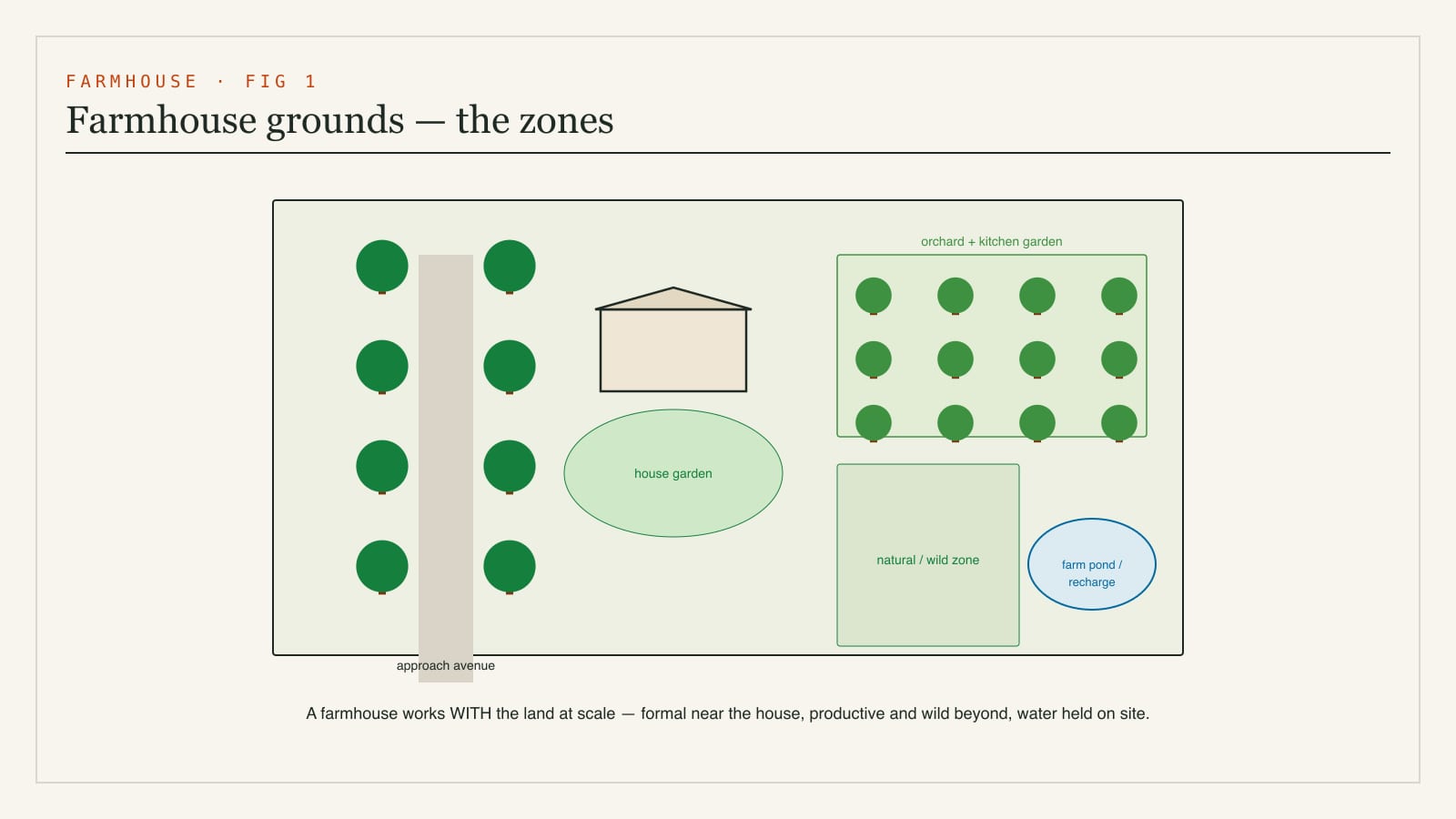
| Zone | Where | Character | Care intensity |
|---|---|---|---|
| Approach avenue | Gate to porch | Tree-lined drive, shade, arrival drama | Low — trees only |
| House garden | Wrapping the building | Informal lawn or paving, shade trees, seating | High — the only intensive zone |
| Productive zone | Mid-plot, sunny | Orchard rows + kitchen garden | Low–medium, seasonal |
| Natural / wild zone | Far edges | Native grass, scrub, existing trees | Near-zero |
| Water | Low point of land | Farm pond, recharge pit, borewell | Low |
| Utility / service | Behind, screened | Caretaker quarters, compost, parking, tools | Functional |
The approach avenue
The drive from gate to house is the farmhouse's signature gesture. Line it with a single avenue species — Polyalthia longifolia (Ashoka) for a tall green screen, Pongamia pinnata (karanj) for dense shade and a hardy nothing-can-kill-it constitution, Tabebuia for spring colour, or in larger plots the slow grandeur of a Tamarind or Mahua row. Plant on both sides at 6–8 m spacing; in five years you have a shaded tunnel that announces arrival and cools the approach. Avenue trees are the lowest-maintenance high-impact planting you will ever do — they want nothing after establishment.
The house garden
This is the one zone you garden properly: shade trees over a sit-out, an informal lawn or, better, a paved-and-gravel terrace, climbers on a pergola, fragrant planting (Jasminum, Plumeria, Murraya) near the veranda. Keep it deliberately small — a manageable apron around the building — so that what little intensive care exists is concentrated where you actually sit. Privacy and boundary planting here matters too; see Landscape Privacy Design.
The productive zone
The orchard and kitchen garden — covered below and in depth in Edible Landscapes — should occupy the sunny middle of the plot, laid out in rows you can mow or strim between.
The natural / wild zone
The plot's far reaches should be left to native grasses, existing trees, and a little managed scrub. This is not laziness — a wild edge supports birds, pollinators and soil, breaks wind, and needs cutting once or twice a year, no more. Resist the urge to "tidy" it.
Circulation
Loop a simple compacted-earth or gravel track through the zones so a vehicle can reach the orchard, the pond and the service yard without churning lawn. Hard daily paths near the house, soft tracks beyond — the logic of Outdoor Circulation Design.
The weekend-home challenge
This is the section that should change how you plan, because it is the reality almost nobody designs for: a landscape that must thrive when you visit only weekly or monthly. A garden built to be watered and fussed every evening will be brown and half-dead by the third weekend you skip. The answer is not more help — it is a landscape engineered to need almost no help.
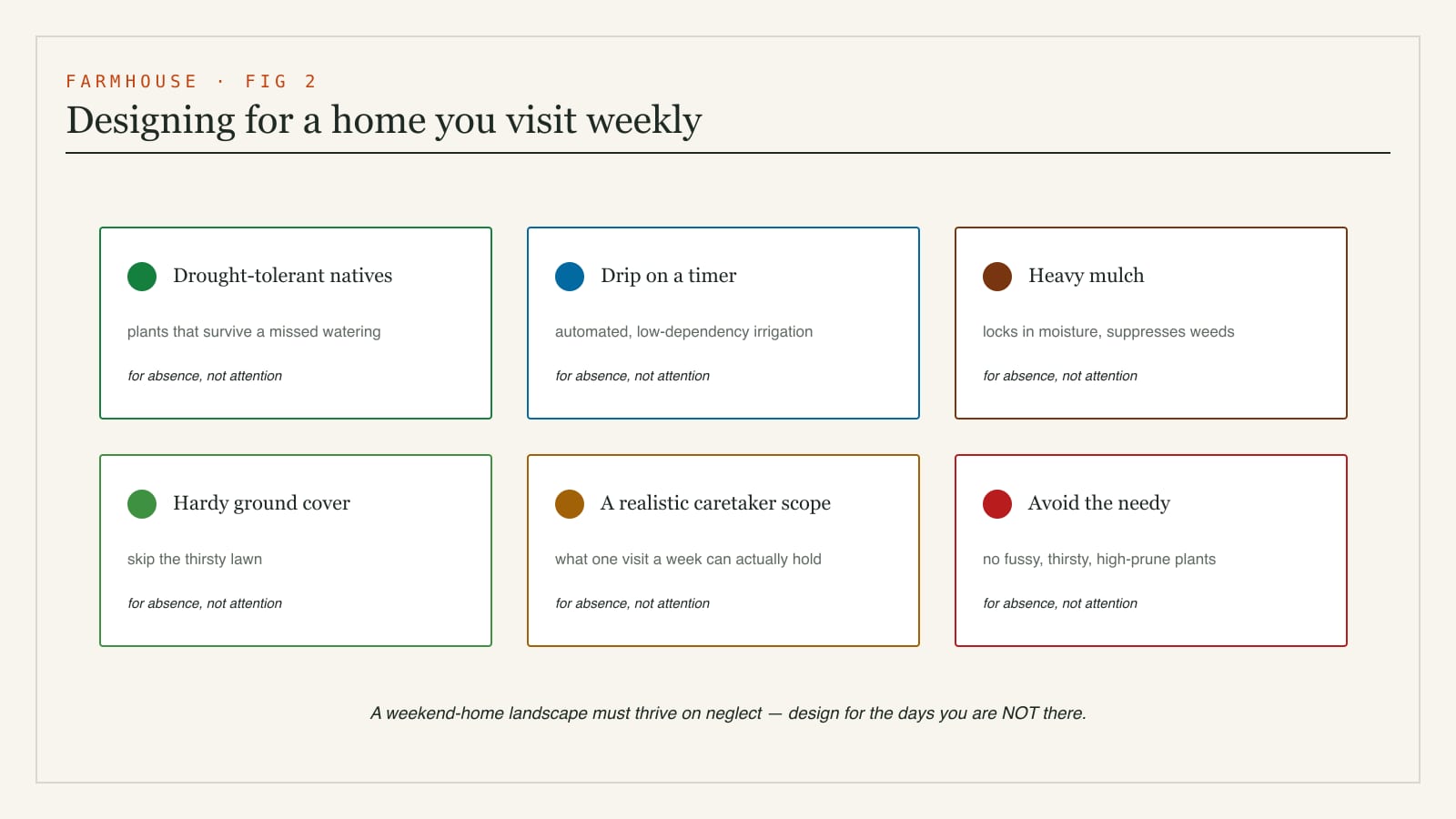
Plant for absence
Choose species that survive on local rainfall once established and shrug off a missed watering. Native and naturalised drought-tolerant planting is the foundation, in tune with Climate-Responsive Landscape Design:
- Trees: Pongamia, Neem (Azadirachta indica), Tamarind, Gulmohar, Cassia fistula, Albizia — all thrive on neglect once rooted.
- Shrubs: Bougainvillea, Tecoma, Hamelia, Ixora, Nerium (oleander), Lantana (sterile cultivars), Duranta — tough, flowering, indifferent to skipped watering.
- Ground cover instead of lawn: Wedelia, Cuphea, or simply native grasses and gravel. A lawn is the single highest-maintenance, highest-water element you can choose — avoid it or keep it tiny.
- Hardy "lawn" if you must: Bermuda (Cynodon, "doob") survives drought and bounces back from brown; never plant thirsty carpet grasses like Mexican or Korean lawn on a weekend plot.
Automate the water
Install drip irrigation on a battery or solar timer, zoned by plant type, fed from your overhead tank or directly from the borewell with a pressure-compensated emitter line. A timer that runs at dawn three times a week keeps trees and beds alive with zero human presence and a fraction of the water of sprinklers. Add a simple rain sensor so it skips the monsoon. This is the difference between coming back to a green plot and coming back to a graveyard.
Mulch heavily
Mulch is the lazy gardener's superpower. A 75–100 mm layer of dry leaves, sugarcane trash, coir pith or wood chips over every bed and tree base cuts evaporation by more than half, suppresses weeds (your caretaker's biggest unbudgeted task), and feeds the soil as it rots. On a weekend plot, mulch is not optional — it is what lets the drip system and the rain do the watering for you.
Be realistic about the caretaker
Most farmhouses run on one local caretaker — often the same person who guards the gate. Be honest about scope:
| A caretaker can reliably do | Do NOT design a landscape that needs them to |
|---|---|
| Open valves / check the timer | Hand-water beds daily |
| Strim grass once a fortnight | Prune topiary, deadhead annuals |
| Watch for theft and fire | Diagnose plant disease, re-pot, transplant |
| Pick and store fruit | Maintain a fussy English-style flower border |
| Spot-fix a burst drip line | Manage a high-input vegetable plot in your absence |
Design to the left column. Every task you imagine in the right column is a task that will not happen, and a plant that will die.
What NOT to plant if you are away
- Thirsty exotic lawns (Mexican/Korean grass) — brown and dead within weeks unmonitored.
- Seasonal annuals (petunia, salvia, marigold beds) — need deadheading and constant water; plant them only in pots near the house for a weekend you are present.
- Fussy roses and dahlias — pest-prone, demanding, pointless when nobody is watching.
- Invasive quick screens like Subabul (Leucaena) or unmanaged bamboo running varieties — they will eat the plot.
- Water features that need a running pump — they go green and stagnant; a still recharge pond is better than a dead fountain.
Security and boundary planting
A weekend home is empty most of the week, so the boundary does real work. A living thorn-and-dense hedge — Bougainvillea (thorny and impenetrable when mature), Caesalpinia (kanta), Carissa carandas (karonda, edible too), Agave along the line — is cheaper than a wall over a long perimeter, hard to climb, and supports birds. Keep planting low and open right at the gate and near the house for natural surveillance, dense and thorny at the far perimeter. A solid wall everywhere is costly and, ironically, gives a burglar cover; a thorn hedge with sightlines is often safer.
Shade avenues and orchard species for India
Trees are the farmhouse's best investment: planted once, they pay shade, fruit, fodder and beauty for decades with almost no input. Choose by climate zone and by what you will actually use — fruit you eat, shade you sit under. See also Best Trees for Indian Homes.
| Species | Use | Notes for a weekend plot |
|---|---|---|
| Mango (Mangifera indica) | Fruit + shade | The anchor orchard tree; grafted varieties fruit in 4–5 yrs; very hardy |
| Chickoo / Sapota (Manilkara zapota) | Fruit | Evergreen, drought-tolerant, low fuss, fruits much of the year |
| Guava (Psidium guajava) | Fruit | Fast, forgiving, fruits in 2–3 yrs, thrives on neglect |
| Citrus (lemon, sweet lime, orange) | Fruit | Needs decent drainage; lemon is the toughest |
| Coconut (Cocos nucifera) | Fruit + avenue | Coastal/warm-humid only; iconic, low-care once tall |
| Jamun (Syzygium cumini) | Fruit + shade | Large, hardy, monsoon fruit, excellent shade tree |
| Drumstick / Moringa | Pods + leaves | Grows from a cutting, edible everything, near-indestructible |
| Amla, Pomegranate, Custard apple | Fruit | All drought-hardy and well suited to dry-zone farmhouses |
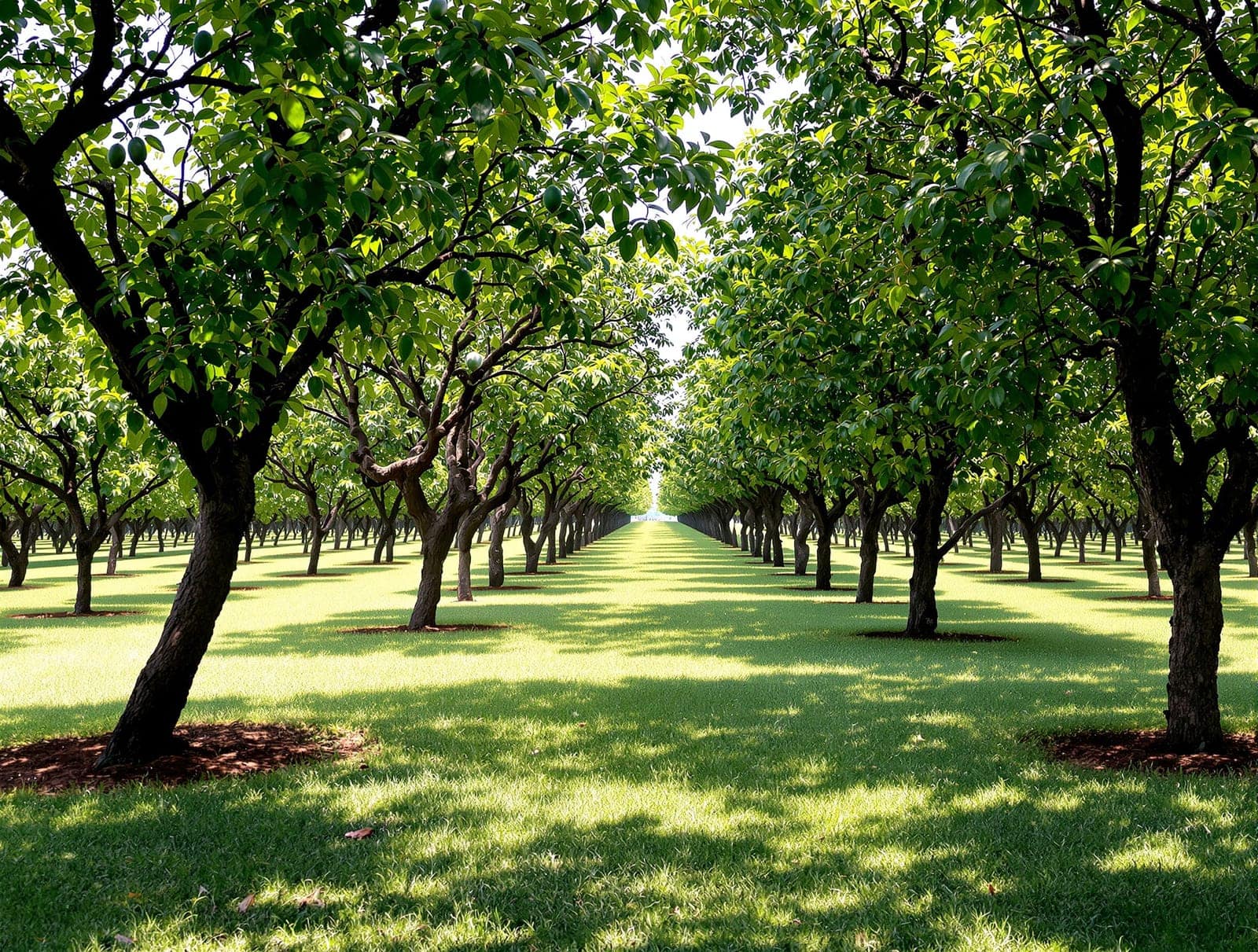
Lay the orchard in rows on a grid — typically 8–10 m apart for mango and jamun, closer for guava and citrus — so you can drive or strim between them, run a single drip line down each row, and harvest easily. An orchard avenue, where the rows themselves become shaded walks, is one of the most beautiful and useful things you can build on rural land.
A working kitchen garden — a few raised beds near the house for greens, gourds, chillies, brinjal and herbs on drip — gives the weekend cook something to pick, while the deeper productive principles (guilds, perennial vegetables, fruit-and-veg integration) are covered fully in Edible Landscapes.
Water on a large plot
On acres of land with an erratic municipal supply (or none), water is the whole game, and a large rural plot is the ideal canvas for catching and storing it.
- Borewell is usually the primary source — but a borewell on a weekend plot that runs a thirsty lawn will fail you and your neighbours. Size your planting to your water, not the other way round.
- Recharge first. Direct your roof and hardstanding runoff into recharge pits and trenches so the monsoon refills the aquifer your borewell draws from. A large plot can recharge enormous volumes.
- Farm pond. A simple lined or puddled depression at the low point of the land stores monsoon runoff for the dry months, supports wildlife, cools the microclimate, and looks beautiful — far better than a pump-dependent fountain on an empty plot.
- Swales and contour bunds. On any slope, shallow contour swales slow and sink rainwater into the orchard rows instead of letting it run off and gully.
The full design of these elements — sizing pits, routing runoff, integrating storage with planting — is the subject of Rainwater Harvesting Through Landscape Design, and on a farmhouse it is not a green nicety but the difference between a self-sustaining landscape and an expensive water bill.
A realistic cost frame (₹, indicative)
| Element | Indicative cost |
|---|---|
| Avenue / orchard saplings (grafted fruit) | ₹150–600 each; bulk natives ₹40–150 |
| Drip system with timer (per acre, zoned) | ₹40,000–1,20,000 |
| Recharge pits + trenches | ₹25,000–80,000 depending on volume |
| Farm pond (excavation + lining) | ₹1–4 lakh by size and method |
| Living thorn boundary hedge (per running metre) | ₹150–400 vs ₹1,500–3,000+ for a wall |
| Annual maintenance (caretaker + inputs) | ₹60,000–1,50,000/yr — far below an intensive villa garden |
Costs vary widely by region, water depth and labour rates; treat these as planning anchors, not quotes.
A relaxed maintenance philosophy
The farmhouse asks you to let go. A city gardener fights nature into submission; a farmhouse gardener works with it and accepts a little wildness as the point, not a failure. Let the grass go golden in summer and green in the monsoon. Let the orchard floor grow rough. Let leaves lie as mulch. Cut the wild zones once or twice a year, not weekly. Concentrate your effort on the small kept apron near the house where you sit, and trust the rest of the land to look after itself.
Get this right and the reward is precisely what you bought the land for: you drive up the shaded avenue on a Friday evening, the trees have grown a foot since last month, the drip has kept everything alive, the pond is full, there is fruit on the mango, and the landscape greets you without ever having needed you. That is a farmhouse landscape doing its job.
References & further reading
- National Building Code of India 2016, Part 10 (Landscape Development, Signs and Outdoor Display Structures), Bureau of Indian Standards.
- Indian Society of Landscape Architects (ISOLA) — publications and practice guidance on Indian landscape design.
- ICAR–Indian Institute of Horticultural Research (IIHR), Bengaluru — package of practices for fruit crops (mango, guava, sapota, citrus) and kitchen-garden guidance.
- Central Ground Water Board (CGWB), Ministry of Jal Shakti — Manual on Artificial Recharge of Ground Water and rainwater harvesting guidelines.
- Bole, P. V. & Vaghani, Y. — "Field Guide to the Common Trees of India" (Oxford University Press) for native and avenue species selection.
- Randhawa, M. S. — "Flowering Trees" and allied works on Indian ornamental and avenue trees.
Export this guide
Related Guides — Deep-dive reading
The Best Trees for Indian Homes
A research-grade guide to choosing and placing trees around an Indian home — the real cooling and clean-air numbers, the right species for shade, flowers, fragrance and fruit, and the placement science that keeps roots out of your walls and drains.
LandscapeSecurity for Holiday Homes in India (2026): Protecting a Second Home That Sits Empty — Make It Look Lived-In, Put Someone Local In Charge, and Watch It From Afar
A hill-station cottage, a Goa flat, a farmhouse or the family house back home — visited a few times a year and empty the rest, often far from where you live. This is how to secure a home you are not living in: look occupied, keep a trusted local presence, monitor it remotely, harden the empty house against break-ins and burst pipes alike, and check your insurance for long vacancy.
SecurityUnderstanding Site Planning for Residential Projects
A homeowner's landscape guide to reading your plot's sun, wind, water, soil and trees before zoning and building the grounds.
LandscapeRelated Tools — Try Free
Rainwater Tank Sizer
How big should your rainwater tank be? Computes annual harvest, recommended tank capacity in litres, water-bill savings, and payback — for 10 Indian cities.
RWH CalculatorLandscape Cost Calculator
Estimate a garden's cost — hardscape, softscape, lawn, irrigation, lighting and annual upkeep — by area, tier and city.
Budget CalculatorMonsoon-Readiness Checklist
Pre-rain home audit across 9 categories — terrace, drains, waterproofing, electrical, HVAC, pest, vehicles, documents.
Seasonal Audit