
Outdoor Circulation Design — Moving Through the Garden
Desire lines, the route hierarchy, the arrival sequence and accessible, well-flowing paths that make a home's outdoor space work
A garden is not a collection of pretty zones — it is a journey, and the routes you walk through it are the skeleton that holds everything together; design the circulation first and the planting, paving and seating will find their natural places around it. Most Indian home gardens fail not because the plants are wrong or the budget too small, but because nobody decided, on paper, where people would actually walk. The result is a beautiful bed flattened by a shortcut, a "feature" path that leads nowhere, and a front door reached by a route that feels accidental rather than welcoming. This guide is about flow — the network of movement through your outdoor space, the hierarchy of routes, the choreography of arrival, and the quiet logic that makes some gardens feel effortless to move through and others feel like an obstacle course.
A note on scope before we begin: this guide is about the network — where movement goes, how routes rank, and how the journey feels. It is deliberately not about how to build a path (the sub-base, the joints, the choice between Kota stone and exposed-aggregate concrete). For that craft, read our sibling guide, The Architecture of Pathways. Here, we stay in the air above the garden, drawing the lines of movement.
Why circulation is the skeleton of a garden
Think of how a building works. The walls and rooms get the attention, but it is the corridors, stairs and doorways — the circulation — that determine whether a home feels generous or cramped, logical or confusing. A garden is identical. Before you place a single frangipani or decide where the swing seat goes, you should be able to answer one question: how will people move through this space, and why?
Circulation is the first decision because it is the hardest to change later. You can move a pot, replant a bed, repaint a wall. You cannot easily re-route the path everyone has worn into the grass, nor undo the awkward dog-leg that makes carrying groceries from the gate to the kitchen a daily irritation. Movement is structural. This is exactly why the broader sequencing argument — that you plan the land before you finalise the building — matters so much; we make that case in Landscape Planning Before Building Design and in Residential Site Planning.
Get the skeleton right and the rest of the garden hangs off it comfortably. Get it wrong and no amount of expensive planting will rescue the experience.
Reading desire lines: let people tell you where they want to walk
The single most useful concept in circulation design is the desire line — the path people actually take, regardless of where you put the paving. You have seen them everywhere in India: the diagonal scar across a society lawn cutting the corner between two blocks, the bald strip beside a winding "ornamental" path where everyone simply walks straight.
Desire lines are not vandalism. They are honest data. They reveal the shortest, most sensible route between two points people genuinely use, and fighting them is almost always a losing battle. The professional move is to observe before you pave.
- If you are landscaping an existing home, watch for a week. Where is the grass thinning? Where do the children cut across? Where does the maid carry the laundry?
- For a new build, trace the obvious origin-destination pairs on paper: gate to front door, kitchen to service yard, living room to the rear lawn, parking to the entrance.
- Where a desire line is unavoidable and direct, honour it with the primary path. Where you genuinely want to slow people down — say, to draw them past a water feature — you must give them a positive reason, not just a longer route.
A reliable rule: people will tolerate a route that is up to roughly 20–25% longer than the straight line if the longer route is more pleasant, shaded or interesting. Beyond that, they cut the corner and your bed dies.
The route hierarchy: primary, secondary, tertiary
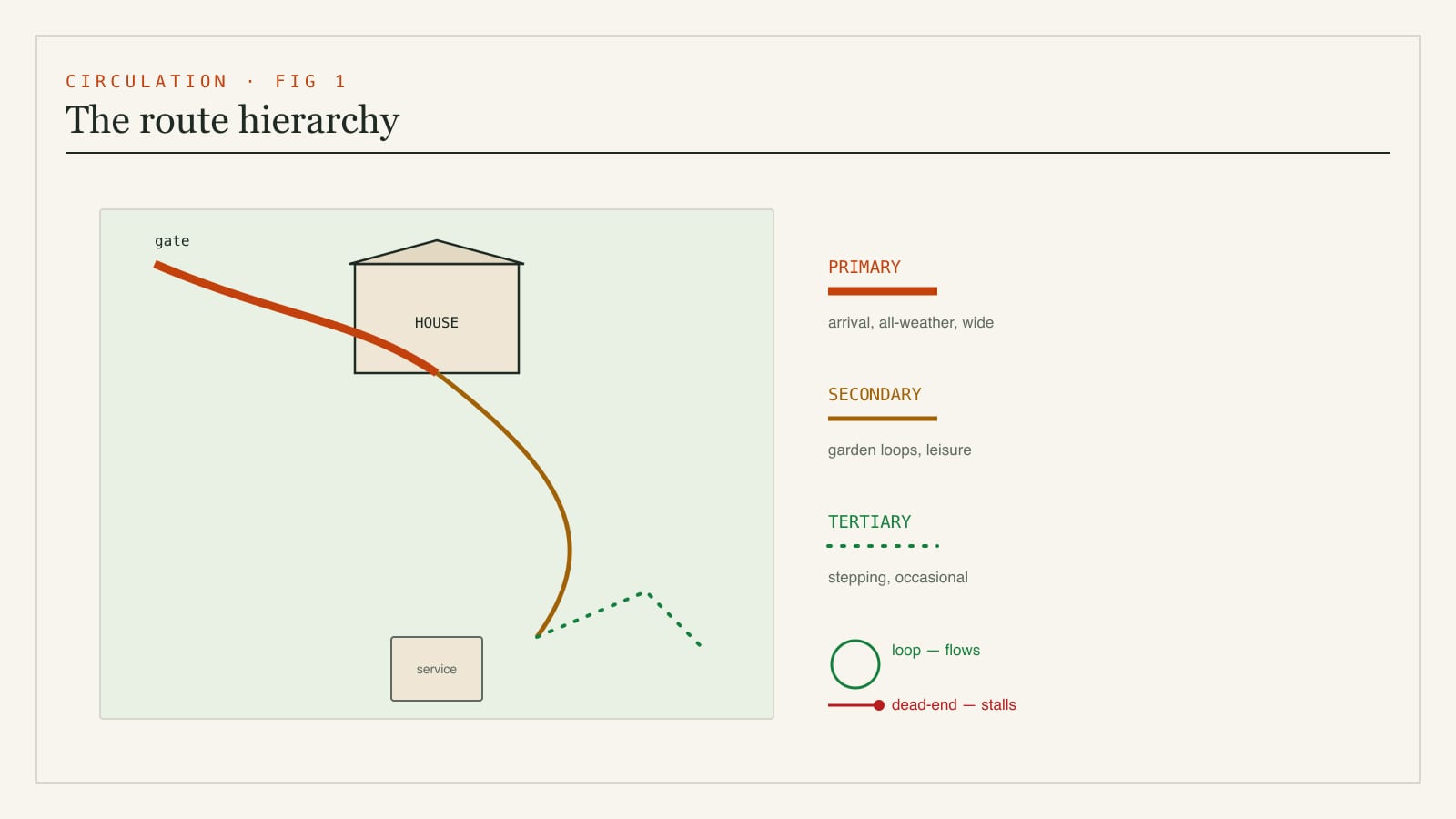
Not all routes are equal, and treating them as equal is a classic mistake. A well-organised garden has a clear hierarchy of movement, just as a city has highways, roads and lanes. This hierarchy should be legible underfoot — wider and more solid for important routes, narrower and more delicate for minor ones.
| Tier | Role | Typical use | Width (clear) | Feel |
|---|---|---|---|---|
| Primary | Arrival & main spine | Gate to front door; parking to entry | 1.2–1.5 m (two people abreast) | Generous, all-weather, well-lit |
| Secondary | Garden circuits | Around the lawn, to the seating, to the rear | 0.9–1.0 m (one person, comfortable) | Inviting, can curve, partly shaded |
| Tertiary | Stepping & access | Through a bed, to a tap, between plants | 0.45–0.6 m (single file / stepping stones) | Informal, discontinuous, optional |
The hierarchy does practical work. The primary route signals this way to the door without a sign — its width and surface tell a first-time visitor where to go. Secondary routes invite exploration without competing with the spine. Tertiary routes (stepping stones through a planted bed, a maintenance strip behind the screen of palms) keep gardeners off the lawn and out of the beds.
A few India-specific notes on width:
- A primary path must be wide enough for two people to walk side by side, because in Indian homes arrival is social — guests are received and walked in, not left to find their own way.
- Allow for the monsoon. A 1.5 m primary path with a slight crossfall sheds water and stays usable; a narrow path becomes a puddle channel.
- If a route must carry a two-wheeler or be used by a delivery cart, size it accordingly (1.5 m and firm).
The arrival sequence: choreographing the journey from street to door
This is where good circulation becomes memorable. The journey from the public street to your private front door is not a transition to be minimised — it is a sequence to be choreographed. Done well, it manages the shift from public to private, builds a small sense of anticipation, and makes the home feel cared-for before a guest has even rung the bell.
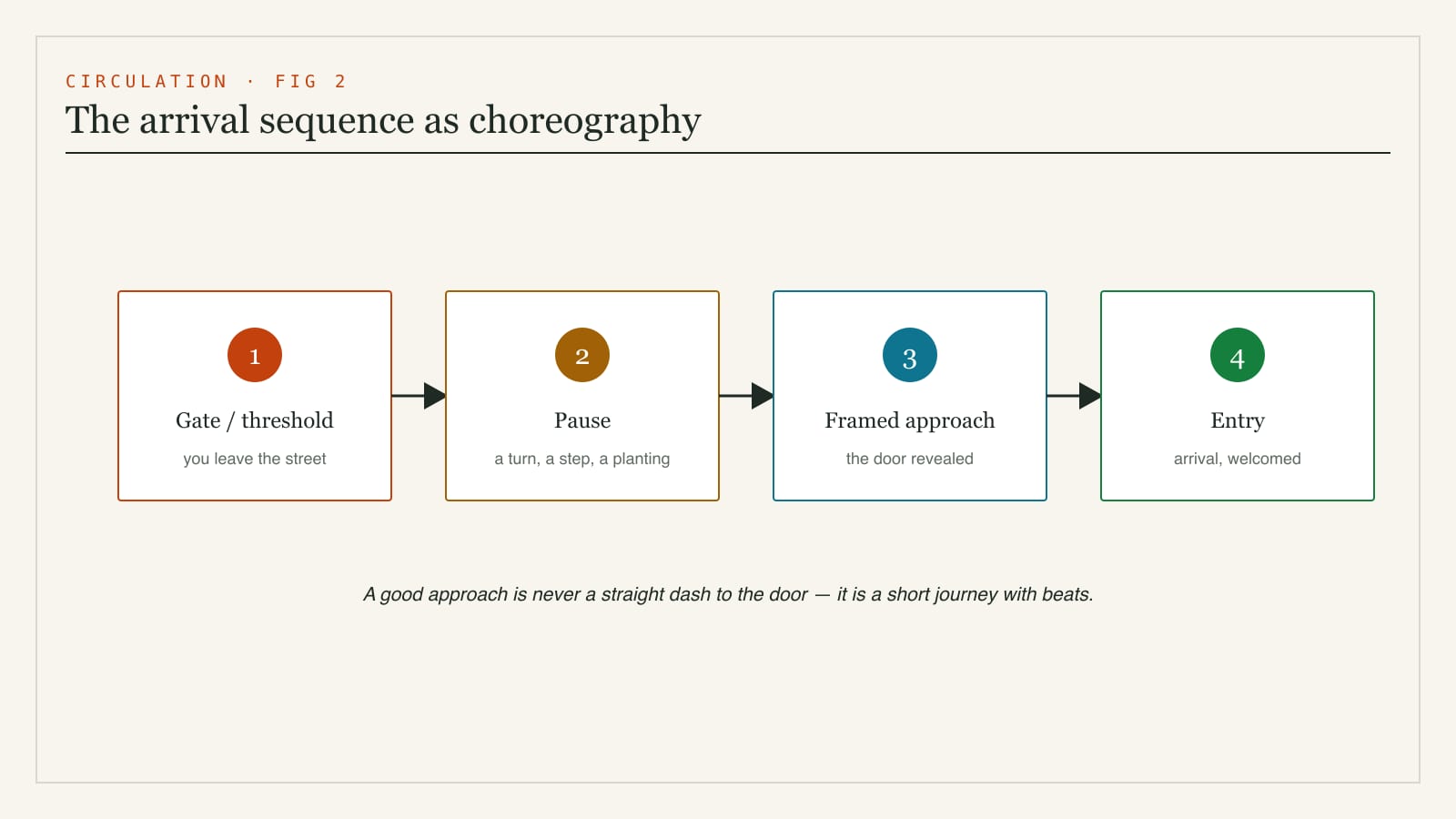
The classic arrival sequence has four beats:
1. The threshold (gate). The first compression — a moment of "leaving the street". A gate, a change in paving, or a planted gateway marks the boundary. In Vastu-conscious homes the main entry is often placed in the north or east of the plot; whatever the orientation, the gate should announce the start of the journey, not just be a hole in the wall.
2. The pause / transition. A small forecourt, a turn, a step, or a tree to walk under — a beat where the visitor reorients from "street pace" to "home pace". This is also where you can screen the front door from direct street view for privacy and comfort.
3. The framed approach. The route now points clearly at the entrance, ideally with the door framed by planting, a pergola, or a narrowing of the path. This is the moment of arrival proper. A specimen tree, a fragrant shrub (parijat, raat ki rani for an evening scent), or symmetrical pots can do the framing.
4. The entry. A generous, sheltered landing at the door itself — room to stand under cover during a downpour, to set down a bag, for two people to wait together.
You can compress this sequence into ten steps on a small plot or stretch it across a long villa drive, but the structure holds. A direct, straight shot from gate to door can feel grand and formal (think of a symmetrical bungalow); a gently deflected route that reveals the door obliquely feels softer and more private. Neither is wrong — but choose deliberately. The emotional dimension of this journey is explored further in Biophilic Landscape Design and Outdoor Wellness Spaces.
Separating social from service flow
One of the surest signs of an amateur layout is that the family's morning walk to the car crosses the path the dhobi takes to the drying yard, which crosses the route the cook takes to the bins. Good circulation separates social movement from service movement so the two rarely collide.
Social circulation includes arrival, the route to the sit-out, the path to the rear garden, the way to the entertaining lawn. Service circulation includes access to the kitchen yard, the dustbin point, the water tank and pump, the gardener's store, the dhobi's drying line, the meter and the genset.
| Social circulation | Service circulation | |
|---|---|---|
| Users | Family, guests | Staff, deliveries, maintenance |
| Priority | Comfort, beauty, welcome | Directness, durability, discretion |
| Surface | Refined, generous | Hard-wearing, easy to clean |
| Visibility | Featured, lit | Screened from view |
| Typical India link | Gate → forecourt → front door → sit-out → lawn | Side gate → service yard → kitchen → utility → bins |
The practical fix on most Indian plots is a side service spine — a utilitarian path running along one setback (often the south or west side, where you would not want a prized garden anyway, given the harsh sun) connecting the kitchen, utility, tanks and bins, with its own modest gate where possible. The garden's social circulation then stays uninterrupted and pretty. On apartment plots and gated layouts this is often dictated by the RWA's service-access rules, so check the approved plan before assuming you can route a path along a boundary. For how these zones get allocated across the plot in the first place, see Villa Landscape Design.
Loops versus dead-ends: why loops feel better
Here is a subtle truth that most people feel but cannot name: a garden you can loop through feels far larger and more pleasant than one you must back-track out of.
A dead-end forces a decision and a reversal. You walk to the end of the path, reach the back corner, and then have to turn around and retrace your steps — passing everything you have already seen, the experience deflating on the way back. A loop, by contrast, keeps you moving forward. It offers a circuit, a sense of journey with a return, and it makes even a small plot feel like it has more to discover. The eye is always drawn onward to what is around the next curve.
Wherever the plot allows, aim to connect your secondary routes into at least one loop — front to side to rear and back, or a circuit around the central lawn. Practical benefits follow:
- Perceived size. A circuit makes a 1,200 sq ft garden feel twice as big as a single out-and-back spur.
- Better evening walks. Many Indian families do a post-dinner stroll; a loop makes this possible without leaving the compound.
- Maintenance access. A loop lets the gardener reach every bed without trampling through others.
- Crowd flow. During a function or pooja, guests circulate rather than bottleneck.
Dead-ends are not banned — a quiet spur to a single bench in a shaded corner is a lovely thing, precisely because it is a destination, not a thoroughfare. The rule is: make dead-ends intentional and rewarding, and make the everyday routes loop.
Accessibility: gradients, widths, and safe movement at night
Circulation must work for everyone who uses it — including grandparents, a parent carrying a sleeping toddler, someone on crutches after surgery, and eventually your own older self. Indian households are frequently multi-generational, so accessible outdoor circulation is not a niche concern; it is normal planning.
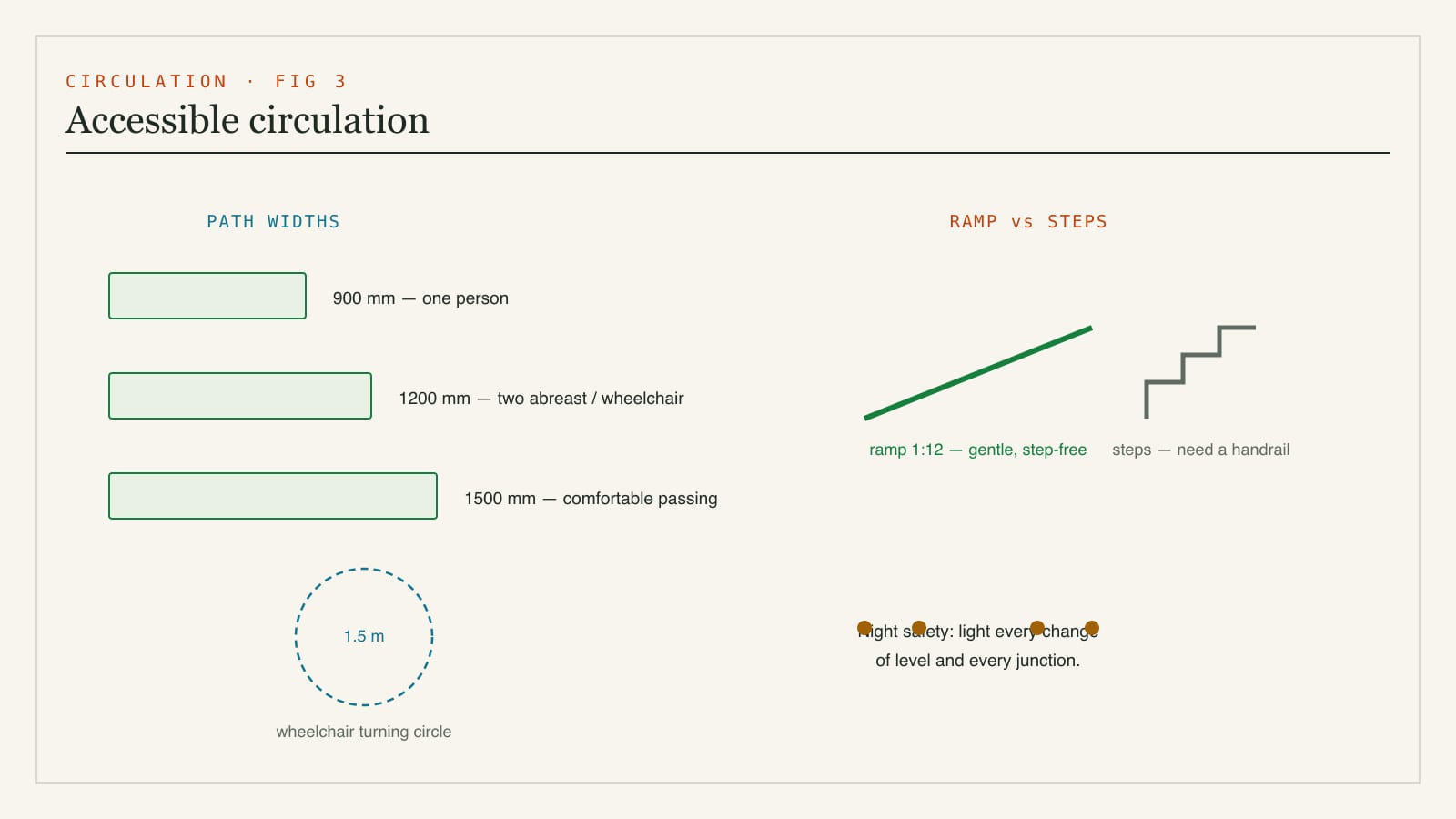
Gradients. Wherever there is a level change, ask whether a ramp can replace or accompany steps.
| Element | Comfortable target | Notes |
|---|---|---|
| Wheelchair ramp | 1:12 max (gentler is better, 1:15–1:20) | Provide a level landing every 9 m of ramp |
| Walkable slope (no ramp needed) | up to ~1:20 | Feels almost flat; ideal for elderly |
| Steps | 150 mm rise, 300 mm tread | Keep risers equal; never a single lonely step (trip hazard) |
| Clear width for wheelchair | 0.9 m minimum, 1.2 m comfortable | 1.5 m allows turning / two-way passing |
Widths and surfaces. A primary route should be at least 1.2 m clear so a wheelchair or a person with a walking frame is not squeezed. Keep surfaces firm, slip-resistant (important during the monsoon and around any water feature), and free of loose gravel on routes the elderly use daily. Avoid sudden material changes that read as a step when they are not.
Handrails and edges. On ramps and steps used by older family members, a continuous handrail at ~900 mm is a small cost and a large kindness. A defined path edge (a kerb or planting strip) helps the visually impaired track the route by foot or cane.
Night safety. Most Indian outdoor injuries happen after dark. Light the route, not the garden as a whole: low bollards or step lights wash the surface so people see where to place their feet, with no glare in the eyes. Pay special attention to level changes, the gate, and the door landing. Photoluminescent or contrast-edged step nosings are cheap insurance. Pair lighting with a sensible planting palette so foliage never overgrows and narrows the walking width — the practicalities of climate and plant growth are covered in Climate-Responsive Landscape Design.
A final accessibility point unique to Indian sites: drainage. A path that floods in the monsoon is inaccessible to everyone. Coordinate your circulation with surface water flow so routes shed water and never sit in it — a topic we treat in depth in Sustainable Water Management in the Landscape.
Common circulation mistakes
After the principles, here are the traps to avoid — most of them visible in half the gardens on any Indian street.
- Paving the pretty line instead of the desire line. The curvy path looks good on the drawing and gets ignored in life. Honour the direct route; save the curves for genuinely optional garden walks.
- No hierarchy. Every path the same width and material, so nothing tells the visitor which way to the door.
- A path too narrow for two. The primary arrival route at 0.6 m forces guests into single file — ungracious, and impossible with an umbrella in the rain.
- Service crossing social. The bin route cutting across the entertaining lawn; the drying line visible from the sit-out.
- All dead-ends. A garden of spurs you must reverse out of, when one loop would transform the experience.
- The forgotten landing. A front door with no sheltered standing room, leaving guests exposed during a downpour.
- Ignoring the monsoon. Beautiful flush gravel that becomes a swamp; level paths that pond; unlit steps invisible at night.
- Designing only for today. No thought for the grandparent's stick, the future ramp, the pram. Build in the gentle gradient now; retrofitting is expensive and ugly.
- Steps where a slope would do. A single step at a threshold is the most common trip hazard in the home — design it out where you can.
Fix these, and your garden will do something subtle and valuable: it will guide people effortlessly, make arrival feel like welcome, and make a small plot feel like a journey. That is what circulation design buys you — and it costs mostly thought, not money.
References & further reading
- Tom Turner, Garden History: Philosophy and Design and his writing on routes and the "promenade" through landscape — useful on arrival sequence and the experience of movement.
- Ian H. Thompson, Landscape Architecture: A Very Short Introduction (Oxford University Press) — accessible grounding in how circulation and spatial sequence shape designed landscapes.
- Indian Society of Landscape Architects (ISOLA) — resources and practice guidance on residential landscape planning in the Indian context.
- Harmonised Guidelines and Standards for Universal Accessibility in India (CPWD / Ministry of Housing and Urban Affairs) — authoritative Indian standards for ramp gradients, path widths and accessible routes.
- Royal Horticultural Society (RHS) — practical guidance on garden paths, layout and planting for movement and access.
- Indian Institute of Horticultural Research (IIHR, ICAR), Bengaluru — regional horticulture guidance to coordinate planting with circulation in Indian climates.
Export this guide
Related Guides — Deep-dive reading
Designing Adaptable & Universal-Design Homes
Accessibility, Aging-in-Place, and the Multi-Stage Family — Code, Anthropometrics, and Plan-Stage Discipline for Indian Residential Architects
Room PlanningWhy Corridor Width Matters
The most overlooked dimension in your home — how passage width decides comfort, flow and wasted space
Design EducationOrientation, Light & Views: Designing With Your Space, Not Against It
How reading your plot's sun, breeze and views — and placing each room on the right face — gives an Indian home that is cooler, brighter and quietly right, instead of one that fights its site forever.
Design PrinciplesRelated Tools — Try Free
Cross-Ventilation Analyzer
Estimate airflow and air changes per hour (ACH) from room size, window areas, layout, and local wind — with NBC 2016 Part 8 compliance check.
Ventilation CalculatorCircadian Light Meter
Patient-centric circadian lighting visualizer for Indian healthcare design — time-of-day × intensity → CCT, melanopic lux (EML / mEDI), melatonin suppression, and an alertness curve. Calibrated against WELL v2 L03 Circadian Lighting Design, CIE S 026:2018, Brainard 2001, and Lucas et al. 2014.
Circadian ToolGarden Planning Toolkit
Get a tailored garden plan — planting layers, Indian species, features and a checklist — from your climate, space, sun and goals.
Planner