
Landscape Planning Before Building Design — Why It Comes First
Read the land before you draw — the cost of the afterthought trap, what to assess before you buy or build, and how to sequence landscape with architecture in India
The cheapest landscape decisions you will ever make are the ones you make before a single line of the building is drawn — because by the time the foundation is poured, the land has already decided most of your garden for you. Treating the outdoors as something you "do later", once the house is built and the budget is bleeding, is the single most expensive habit in Indian home-building. It quietly costs you grown trees, summer shade, monsoon drainage, morning light and lakhs in retrofitting — all for the want of a few weeks of thinking at the right moment.
This guide is about sequence and timing, not site analysis in the abstract. If you want the deeper how-to of reading a plot — measuring slopes, mapping micro-climates, zoning the garden — that lives in our companion guide on Residential Site Planning. Here, the question is narrower and more urgent: in what order should things happen, and what must you decide about the land before the architecture is locked?
The afterthought trap
Walk onto almost any newly finished Indian home and you can read the order of decisions in the result. The house was sited for the road and the gate, the rooms were planned for the brochure, and the garden became whatever flat, sun-blasted, badly drained margin was left over. The landscape was an afterthought — and afterthoughts are expensive.
Here is what the afterthought actually costs, in real terms:
| What gets ignored early | What it costs to fix later |
|---|---|
| Existing mature trees not surveyed | A 30-year neem or mango felled for a compound wall; ₹0 to keep, decades and lakhs to replace with equivalent shade |
| Natural ground slope and water flow | Monsoon water pooling against the plinth; retrofitted French drains, sump pumps and waterproofing — ₹1.5–6 lakh |
| Sun path across seasons | West rooms unbearable in May; bolt-on pergolas, reflective film, extra AC tonnage and running cost forever |
| Cut-and-fill done without a plan | Topsoil buried under rubble, then truckloads of new garden soil bought back at ₹8,000–15,000 per load |
| Service trenches dug after planting | Sewer, water and cable lines slicing through a finished lawn; replant and re-turf at full cost |
| Views and privacy unconsidered | A bedroom window staring into the neighbour's kitchen; corrective screening, blinds, regret |
None of these are landscaping problems. They are sequencing problems. Every one of them is cheap or free to solve on paper and brutal to solve in concrete. The afterthought trap is not that people forget the garden — it is that they remember it after the land has already been re-shaped by decisions that never consulted it.
Read the land before you draw
Before an architect draws a single wall, six things on the land should already be understood. These are not "nice to know" — they are the inputs that should shape where the house sits and how it opens up. Get them on the table early and the building and the garden grow from the same logic instead of fighting each other.
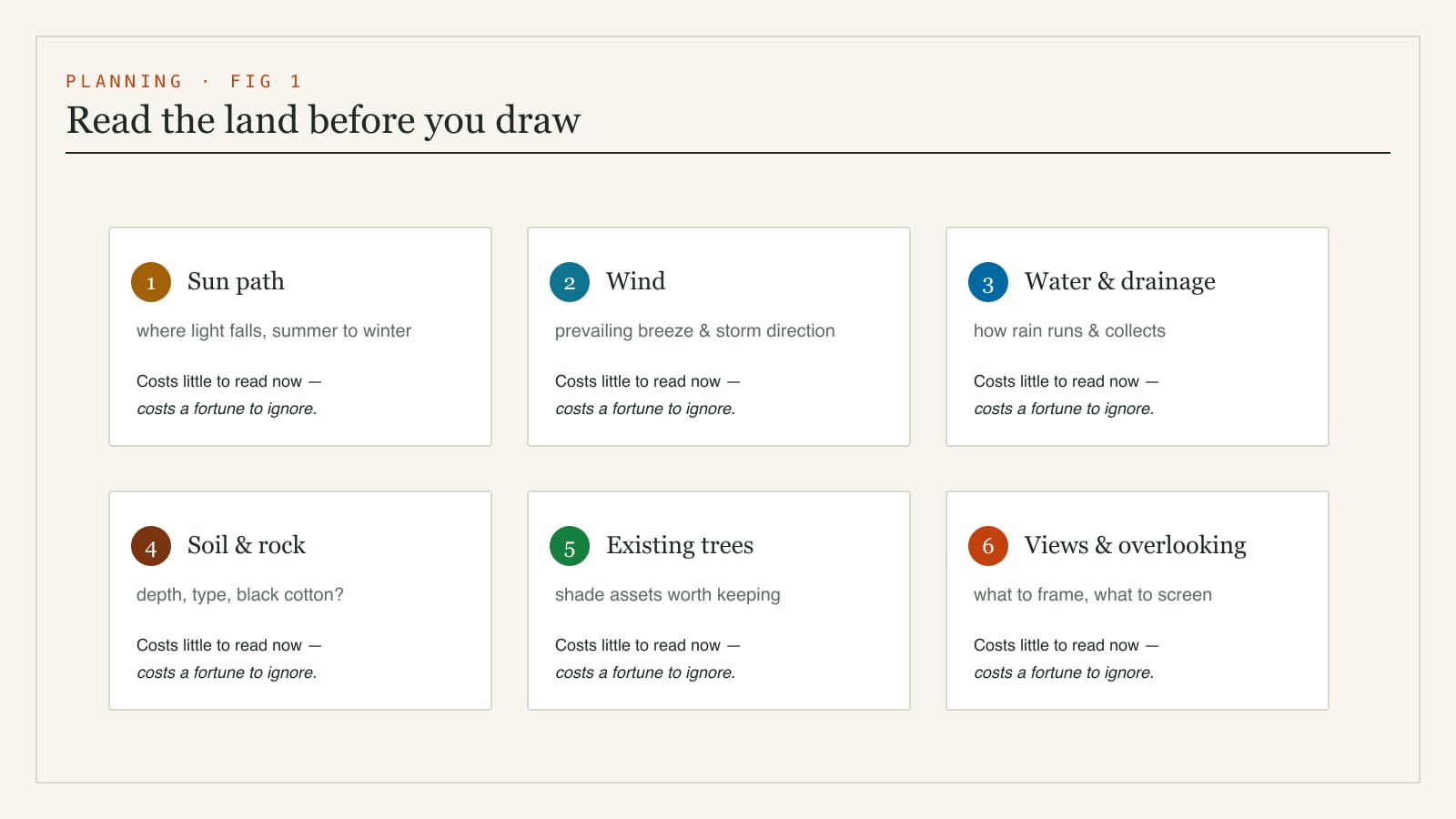
1. Sun path across the seasons. Where does the hard afternoon western sun fall in May, and where does the gentle morning light land in December? In most of India the western and south-western faces need protection while the eastern face wants to be opened up. This single fact should influence which way living spaces face and where shade trees go — long before elevations are finalised.
2. Prevailing wind. The pre-monsoon and monsoon wind direction tells you where to invite breeze through the house and where to plant a windbreak. In coastal and hot-dry zones this is the difference between natural cooling and a sealed box that runs on compressors.
3. Water flow and drainage. Stand on the plot in heavy rain if you possibly can. Where does water arrive, where does it sit, where does it want to leave? The natural low point should become a rain garden or a soak pit, not the spot you happen to build the plinth over. See Sustainable Water Management in the Landscape for how to design with this rather than against it.
4. Soil and rock. Black cotton soil, lateritic murram, sandy coastal soil and shallow rock each change both foundation cost and what will grow. A soil test before design tells the structural engineer and the gardener something each badly needs to know.
5. Existing trees. Mature trees are the one asset on a plot that money genuinely cannot buy back quickly. A grown tree gives shade, lowers ambient temperature several degrees, and anchors the whole composition. Survey and tag every worthwhile tree before siting the building — our guide on the Best Trees for Indian Homes explains which are worth fighting to keep.
6. Views and overlooking. What do you want to see, and who can see you? The good view should pull a window towards it; the overlooking neighbour should be screened. This is decided by where rooms and openings go — an architectural decision that only works if the landscape logic was in the room when it was made.
Plot-reading before you even buy
The earliest and highest-leverage moment of all is before purchase. Two adjacent plots at the same price can carry wildly different building and landscaping costs once the land is read honestly. A walk-through with a checklist can save you from buying a problem.
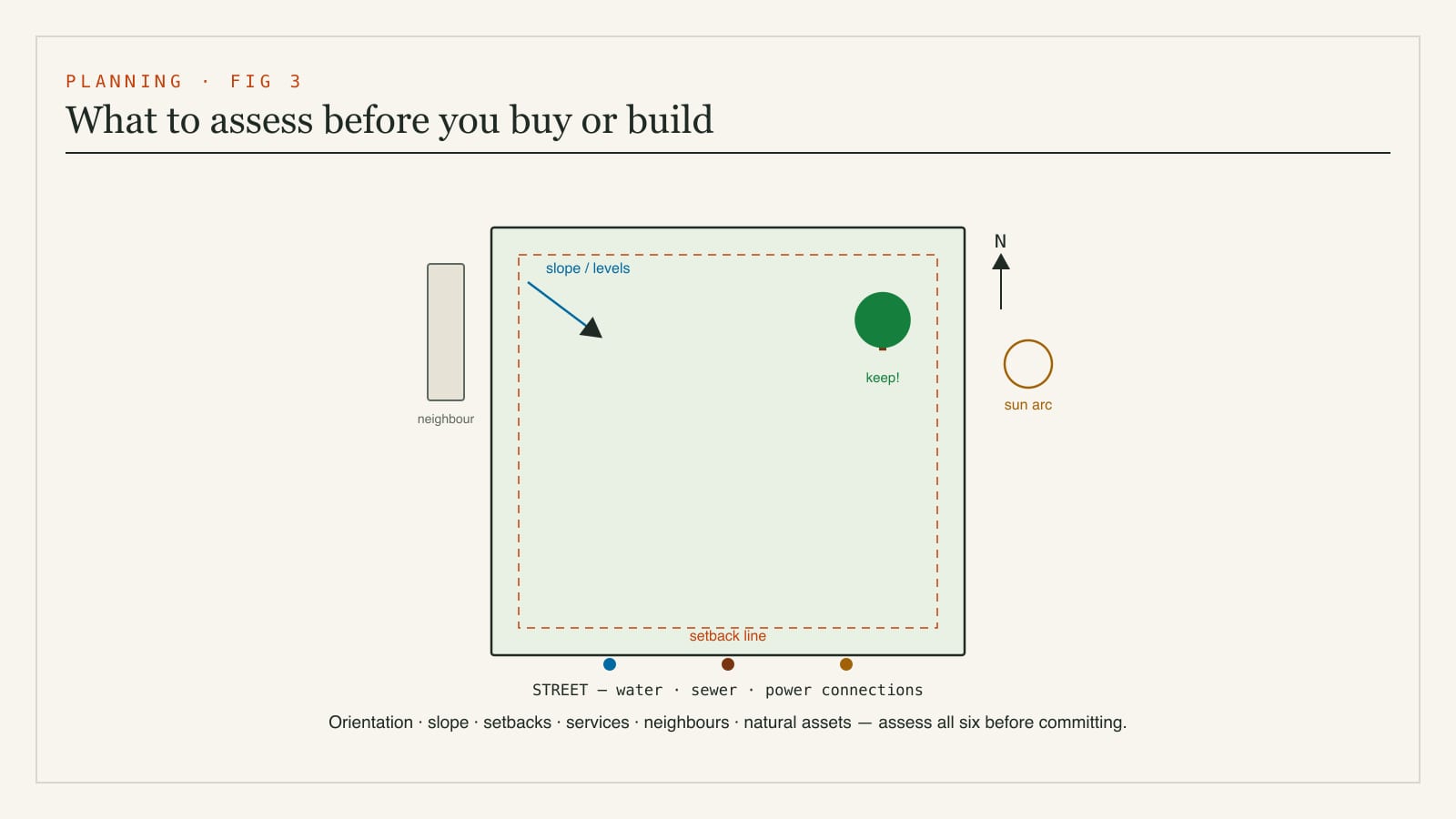
Before you sign, assess:
- Orientation. Which way does the plot face, and where will the buildable area sit relative to the punishing west? An east- or north-facing open side is a quiet, permanent gift.
- Slope and levels. Gentle slope is workable and even useful; a steep cross-fall or a plot lower than the road means costly retaining walls and a permanent battle with water.
- Setbacks and buildable footprint. Local byelaws fix how close you can build to each boundary. The setback strips are exactly where your landscape will live — narrow setbacks mean a narrow garden, no matter how big the plot looks on paper.
- Service connections. Where do water, sewer, electricity and storm drains enter? Trenches for these will cross the garden; knowing their routes early lets planting be planned around them.
- Neighbouring buildings. Tall structures to the south or south-east can steal your winter sun and your breeze. A blank neighbour wall can become a green backdrop — or a heat-radiating problem.
- Natural assets to keep. Mature trees, a natural pond, good topsoil, a rock outcrop with character. Note them now; they are reasons to choose this plot and constraints to design around.
The right sequence: land first, then form
The fix for the afterthought trap is not to spend more — it is to decide in the right order. The land should inform siting, siting should inform built form, and built form and landscape should be detailed together. When this sequence holds, the garden is not the leftover; it is a partner that was in the conversation from the start.
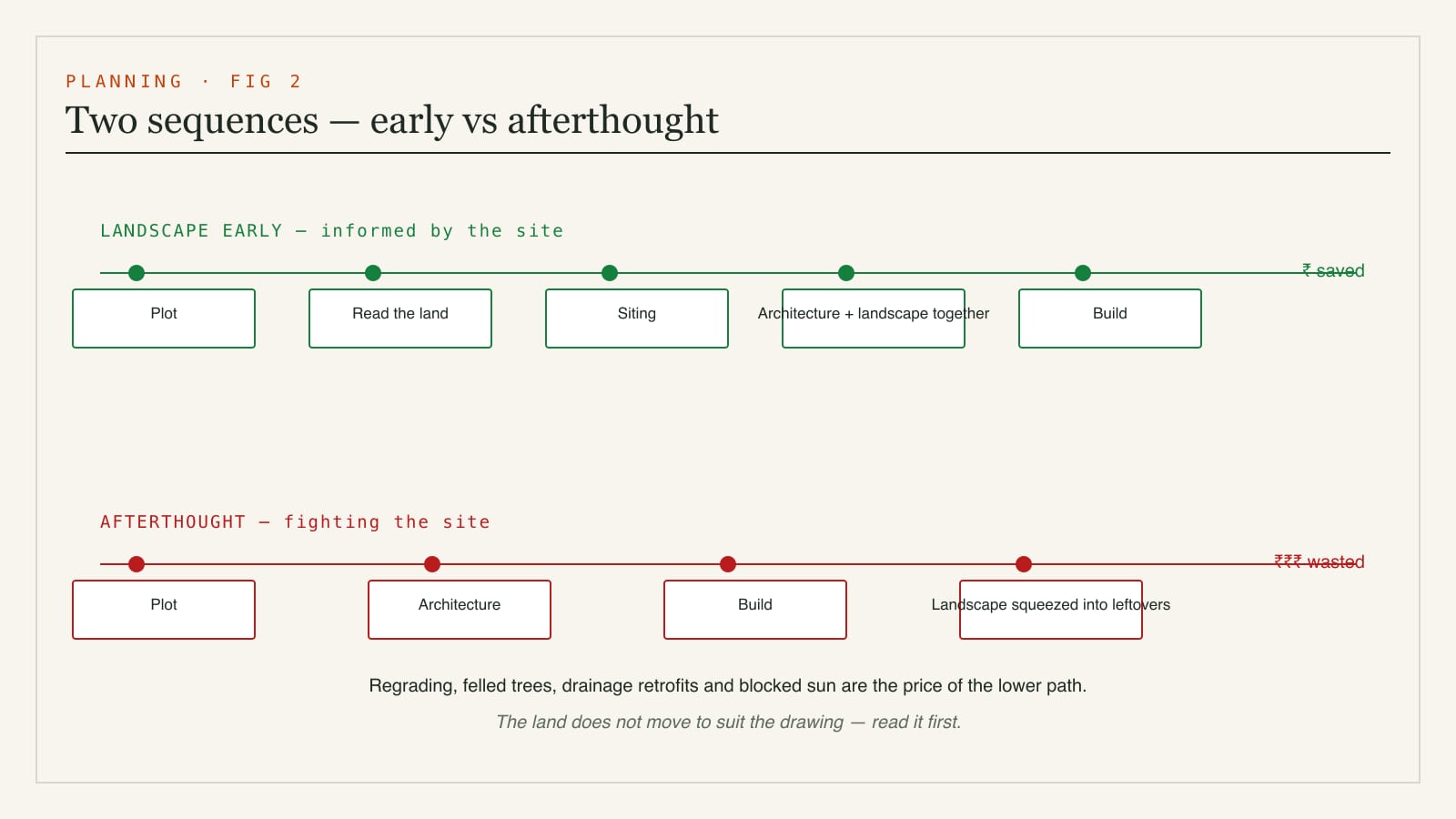
| Phase | Afterthought sequence (costly) | Landscape-first sequence (smart) |
|---|---|---|
| Plot selection | Buy on price and road access alone | Read orientation, slope, trees, drainage; buy the easier plot |
| Site analysis | Skipped or done after design | Sun, wind, water, soil, trees, views mapped first |
| Siting the building | Maximise footprint, ignore land | Place house to protect from west sun, save trees, follow drainage |
| Built form & openings | Designed to elevation only | Windows pull views and breeze; west face shaded; courtyards planned |
| Landscape design | Whatever is left over, after handover | Detailed alongside architecture; soil and trees protected |
| Construction | Trees felled, topsoil buried, levels lost | Trees fenced and protected, topsoil stockpiled, levels staged |
The two professionals who make or break this are the architect and the landscape designer, and the cheapest way to coordinate them is to get them talking early — ideally at the concept stage, not at handover. The landscape designer's site reading should feed the architect's siting decisions; the architect's plinth levels, drainage outlets and service routes should be shared so the garden is designed to fit, not retrofitted to cope. On smaller projects where there is no separate landscape consultant, the architect should still wear that hat consciously rather than leaving it for "later". The principles of designing the spaces between buildings are explored in our companion guide on Outdoor Circulation Design, and Climate-Responsive Landscape Design shows how this early coordination plays out across India's climate zones.
Decisions to lock before foundations
Some decisions become irreversible the moment earthwork begins. These are the ones to settle on paper, with both architect and landscape input, before the excavator arrives:
- Finished plinth and ground levels. Where the building sits relative to the road and the garden sets the entire water story. Lock it before cut-and-fill.
- Which trees stay. Mark them on the drawing, fence them physically before machinery comes, and protect the root zone. A tree promised "we'll keep it" without a barricade rarely survives the build.
- Topsoil strategy. The top 150–300 mm of soil is your most fertile asset. Strip it, stockpile it separately, and reuse it — do not let it be buried under excavation spoil.
- Drainage and stormwater outlets. Decide where roof and surface water will go, and where a soak pit or rain-harvesting recharge sits, before the plinth is cast.
- Service routing. Plan the trenches for water, sewer, electrical and any future garden lighting or irrigation so they do not later cut through finished planting.
- Hard-paving footprint. Decide how much of the open ground will be paved versus soft and permeable. Over-paving is a default that bakes the plot and sheds water; it is far easier to resist on a drawing.
- Boundary treatment. A solid compound wall, a planted edge, or a hybrid — this affects breeze, privacy, cost and the feel of the Villa Landscape Design long before the wall is built.
What early landscape planning saves
Done in the right order, early landscape thinking is not an added cost — it is a net saving, and it pays back in four currencies.
| Currency | What you save by planning early |
|---|---|
| Money | No retrofitted drainage, no re-bought topsoil, no corrective shading; smaller AC load and lower running cost for decades |
| Trees | Mature shade trees survive the build instead of being replaced by saplings that take 15–20 years to catch up |
| Comfort | West sun shaded, breeze invited in, courtyards and verandahs that actually work in Indian summers |
| Water | Monsoon water managed at source, groundwater recharged, no annual battle with a flooding plinth |
There is a wellbeing dividend too. A home whose outdoor spaces were planned from the start tends to have usable verandahs, shaded sit-outs and a garden that connects to the rooms rather than sitting marooned beyond them — the foundation of the kind of restorative spaces covered in Outdoor Wellness Spaces and the human-nature connection at the heart of Biophilic Landscape Design.
Quick pre-design checklist
Run through this before you let any building design be finalised:
- [ ] Visited the plot at different times of day, and ideally in the rain
- [ ] Sun path noted — where the hard western sun falls in summer
- [ ] Prevailing wind direction identified
- [ ] Water flow and natural low point observed
- [ ] Soil type known (test done if foundation or planting is uncertain)
- [ ] Every worthwhile existing tree surveyed and tagged
- [ ] Good views and overlooking problems mapped
- [ ] Setbacks confirmed against local byelaws
- [ ] Service connection points and routes located
- [ ] Plinth and ground levels decided with drainage in mind
- [ ] Architect and landscape input coordinated before earthwork
- [ ] Topsoil and tree-protection plan agreed before the excavator arrives
If most of these boxes are ticked before the building design is locked, you have already avoided the great majority of expensive afterthought corrections. The land will have shaped the home — which is the right way round.
References & further reading
- Catherine Dee, Form and Fabric in Landscape Architecture — on reading and structuring outdoor space.
- Ian L. McHarg, Design with Nature — the foundational text on letting land and natural systems guide siting and design.
- Indian Society of Landscape Architects (ISOLA) — professional resources and guidance on landscape practice in the Indian context.
- ICAR–Indian Institute of Horticultural Research (IIHR), Bengaluru — horticulture and soil guidance relevant to Indian gardens.
- National Building Code of India (NBC), Bureau of Indian Standards — setbacks, drainage and site-development provisions.
- Energy and Resources Institute (TERI) / GRIHA — guidance on site planning, orientation and water management for sustainable Indian homes.
Pre-design landscape checklist
Export this guide
Related Guides — Deep-dive reading
Understanding Sun Path Analysis for Your Home
How the sun actually moves over an Indian site through the day and the year — and why that single fact quietly decides where your kitchen, bedroom and living room should sit.
Site PlanningUnderstanding Site Planning for Residential Projects
A homeowner's landscape guide to reading your plot's sun, wind, water, soil and trees before zoning and building the grounds.
LandscapeOrientation, Light & Views: Designing With Your Space, Not Against It
How reading your plot's sun, breeze and views — and placing each room on the right face — gives an Indian home that is cooler, brighter and quietly right, instead of one that fights its site forever.
Design PrinciplesRelated Tools — Try Free
Cross-Ventilation Analyzer
Estimate airflow and air changes per hour (ACH) from room size, window areas, layout, and local wind — with NBC 2016 Part 8 compliance check.
Ventilation CalculatorRainwater Tank Sizer
How big should your rainwater tank be? Computes annual harvest, recommended tank capacity in litres, water-bill savings, and payback — for 10 Indian cities.
RWH CalculatorWindow Orientation Planner
Pick the best window type, glass and shading by wall direction — north, east, south and west.
Window Tool