
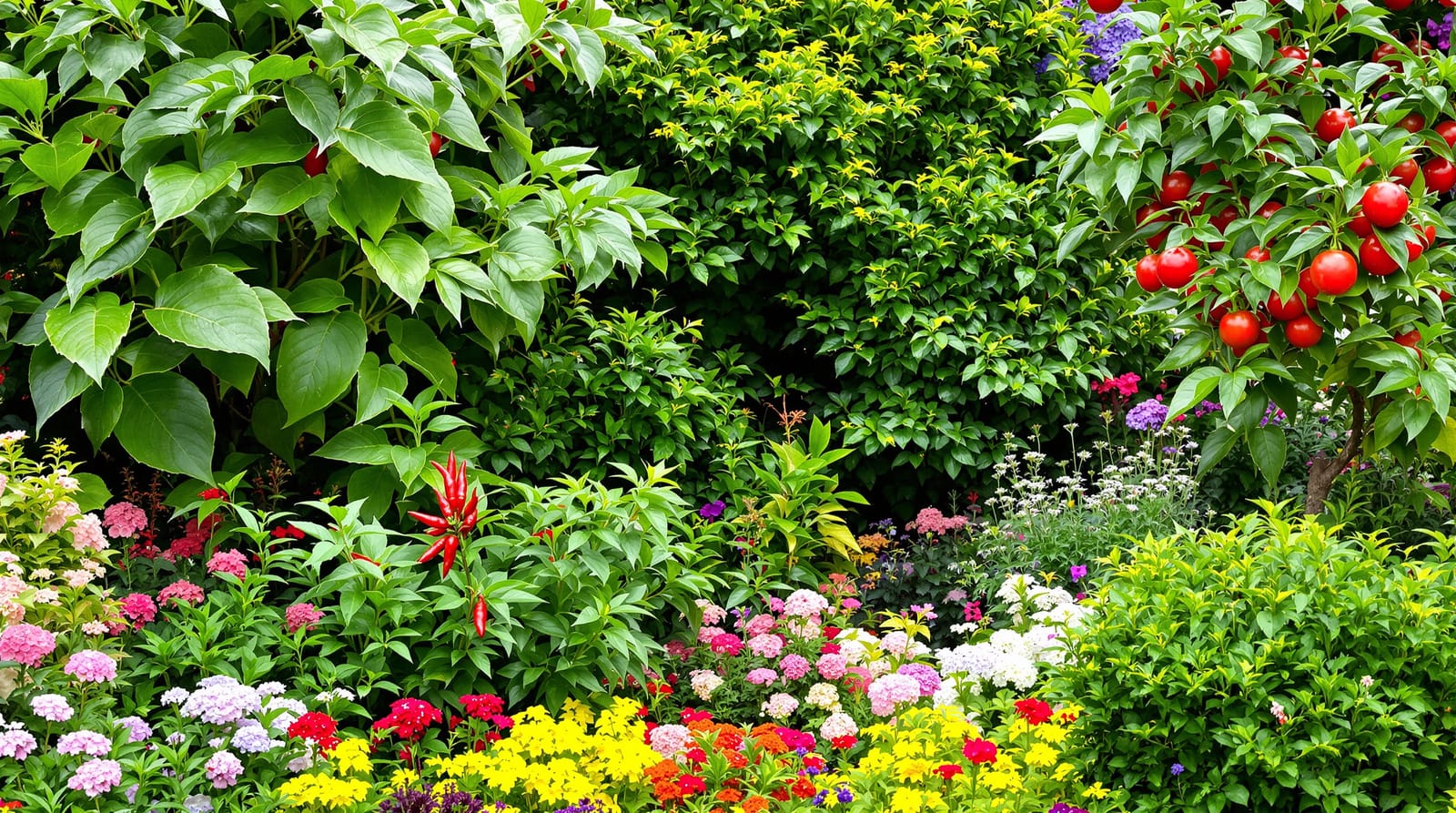
Edible Landscapes for Indian Homes — Beautiful and Productive
Weaving food plants into the ornamental garden — borders, hedges, containers, vertical screens and specimen fruit trees that look gorgeous and feed the family
The most beautiful Indian gardens of the future will not choose between flowers and food — they will grow both in the same border, where a pomegranate flames against a clipped curry-leaf hedge and a row of purple brinjal earns its place as a sculptural plant, not merely a vegetable. Edible landscaping is not the kitchen garden hidden behind the garage; it is the deliberate design decision to weave plants that feed you into the part of the garden you actually look at — and to do it so well that no one can tell where the ornamental ends and the edible begins.
This guide is about looks. It is about composition, colour, texture and structure — about making food plants pull their weight as design elements in a gorgeous garden. It is deliberately not a yield-and-cultivation manual: for sowing seasons, soil prep, spacing, watering schedules and harvest technique, head to our sibling guide Productive Gardens Explained. Here we stay in our lane: how to make the garden feed the family without ever looking like an allotment.
The false split between beautiful gardens and food gardens
Somewhere in the last century, Indian home gardening quietly divided itself in two. The front garden became the showpiece — lawn, hibiscus, bougainvillea, a frangipani, neatly edged beds. Food, meanwhile, was exiled to a sunny back corner: a few chilli plants in old paint buckets, a curry-leaf tree by the kitchen door, tomatoes sprawling over a wire. One half was for guests; the other was strictly utilitarian, and frankly looked it.
That split is a habit, not a law of design. It survives because we assume edibles are inherently scruffy and ornamentals inherently tidy — but spend ten minutes really looking at vegetables and the assumption collapses. Okra produces a flower indistinguishable from an ornamental hibiscus, because it is one (both are mallows). Amaranth throws up plumes of magenta and gold that a florist would charge for. A well-grown chilli plant studded with red, purple and yellow fruit is more colourful than most flowering shrubs in October. The plants were always beautiful; we simply filed them under "useful" and stopped seeing them.
Reuniting the two halves is partly aesthetic and partly practical. A border that mixes edibles and ornamentals is more resilient — pest problems do not sweep through a monoculture — and it makes every square metre work twice. On a tight urban plot, where the brief in our Residential Site Planning guide already has the garden fighting for space against parking, setbacks and a drying yard, a bed that is simultaneously gorgeous and productive is not a luxury. It is good planning.
The edible-ornamental palette: Indian edibles that are genuinely beautiful
Not every vegetable belongs in the front border. Some — cauliflower, most gourds on the ground, leggy tomatoes — are honestly best kept backstage. But a surprisingly long list of Indian edibles can hold their own against any ornamental on looks alone. These are the plants to design with.
| Edible plant | What it brings visually | Best design role |
|---|---|---|
| Pomegranate (anar) | Scarlet flowers, glossy leaves, jewel-like fruit, good autumn colour | Specimen shrub or small tree; flowering hedge |
| Curry leaf (kadi patta) | Dense, fine, dark-green foliage; clips well | Low evergreen hedge; structural shrub |
| Chillies (mirchi) | Red, purple, orange, yellow fruit held upright | Front-of-border colour; container star |
| Brinjal / aubergine | Purple-veined leaves, violet flowers, glossy fruit | Mid-border sculptural accent |
| Okra (bhindi) | Pale hibiscus-like flowers with maroon throat | Tall flowering vertical in a border |
| Amaranth (rajgira / chaulai) | Magenta, crimson and gold plumes and foliage | Bold colour block; cut-flower effect |
| Tulsi & basil | Aromatic, mounding, purple or green; spires of bloom | Edging; herb cluster; container |
| Lemongrass | Fountain of arching blue-green blades | Ornamental-grass substitute; soft edge |
| Papaya | Architectural palm-like silhouette | Vertical accent; tropical structure |
| Banana / plantain | Huge paddle leaves, dramatic flower | Lush screen; tropical focal point |
| Passionfruit & other edible vines | Intricate flowers, fast cover | Vertical screen; arbour |
| Edible flowers (nasturtium, marigold, roselle, butterfly pea) | Pure colour that you can also eat | Border fillers; container spillers |
The trick is to read each plant for its form first and its crop second. Lemongrass is, to the eye, simply an ornamental grass that happens to flavour your tea. Tulsi, already sacred and central to many Indian homes for cultural and Vastu reasons, doubles as a fragrant evergreen edging plant. Papaya and banana give you the bold, large-leaved tropical structure that designers normally reach for cannas and ornamental gingers to provide — except these also fruit.
Five ways to integrate edibles into an ornamental garden
There is no single "edible garden" layout. Integration happens at five different scales, and a good garden usually uses several at once.
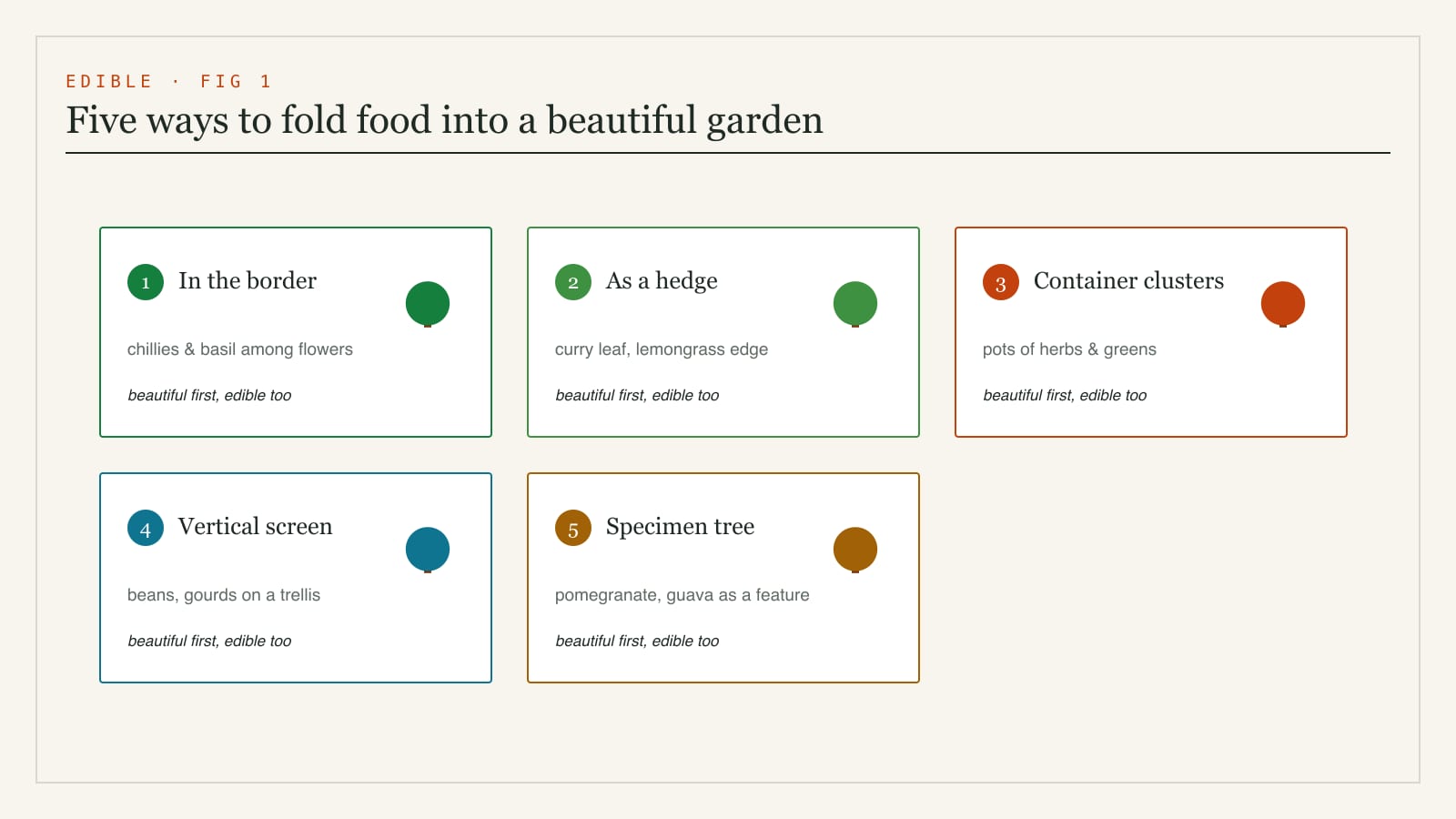
| Strategy | How it works | Best Indian edibles for it | Visual effect |
|---|---|---|---|
| In the flower border | Slot edibles between ornamentals as if they were perennials | Chillies, brinjal, amaranth, okra, basil, kale | Seamless; food disappears into the planting |
| As a hedge | Clip or train edibles into a defined line | Curry leaf, pomegranate, rosemary, hibiscus-sabdariffa | Structure and edges; reads as formal |
| In container clusters | Group pots of varying heights near a sit-out or door | Chillies, herbs, cherry tomatoes, dwarf citrus | Movable, lush, decorative |
| As a vertical screen | Train climbers on a trellis, arbour or wire | Passionfruit, edible gourd vines, beans, spinach vine (Malabar) | Green privacy; living wall |
| As a specimen | Let one fruit plant be a sculptural focal point | Pomegranate, papaya, banana, guava, fig, custard apple | A garden "moment"; instant maturity |
In the border is the most invisible and the most satisfying. The rule is simple: choose edibles with strong foliage or flower, and intersperse them so no single crop forms a recognisable "vegetable row". A drift of purple-leaved basil between salvias, a clump of red amaranth behind marigolds, three chilli plants threaded through a low planting — the eye reads colour and texture, not cabbages.
As a hedge, edibles give you structure for free. Curry leaf makes an excellent clipped low hedge, evergreen and aromatic, and you harvest it every time you cook. Pomegranate can be grown as a loose flowering hedge along a boundary — far more interesting than the ubiquitous duranta or clipped ficus. For a society or RWA boundary where a green wall is mandated, an edible hedge satisfies the rule and feeds the building.
Container clusters are the workhorse of Indian gardens, where so much living happens on hard paving, terraces and balconies. Grouped pots at different heights — a tall papaya in a large pot, a mid-height chilli, a froth of herbs spilling at the base — create a deliberate composition rather than a scatter of buckets. Choose pots in a consistent material (terracotta, or a single glazed colour) and the cluster instantly looks designed.
A vertical edible screen earns its keep twice: it gives privacy and shade — vital against the hard western afternoon sun discussed in our Climate-Responsive Landscape Design guide — while producing fruit. A passionfruit vine on a steel-cable trellis is one of the most beautiful screens you can grow, and Malabar spinach (poi / basella) gives a glossy, fast, edible curtain in the monsoon.
As a specimen, a single fruit tree becomes the garden's anchor. A mature pomegranate, a multi-stemmed guava, a sculptural papaya, a fig against a warm wall — these read as designed focal points, not crops. This is also where edible landscaping overlaps with broader tree strategy; our guide on the Best Trees for Indian Homes covers siting, shade and root behaviour that apply equally to fruit specimens.
Designing in layers: the edible garden as a planted section
The most resilient and the most lush-looking edible gardens borrow their structure from the forest: they stack plants in layers, so the eye reads depth and fullness while every level produces something. This is the principle behind food-forest and biophilic planting, and it is the secret to a small Indian garden looking abundant rather than sparse.
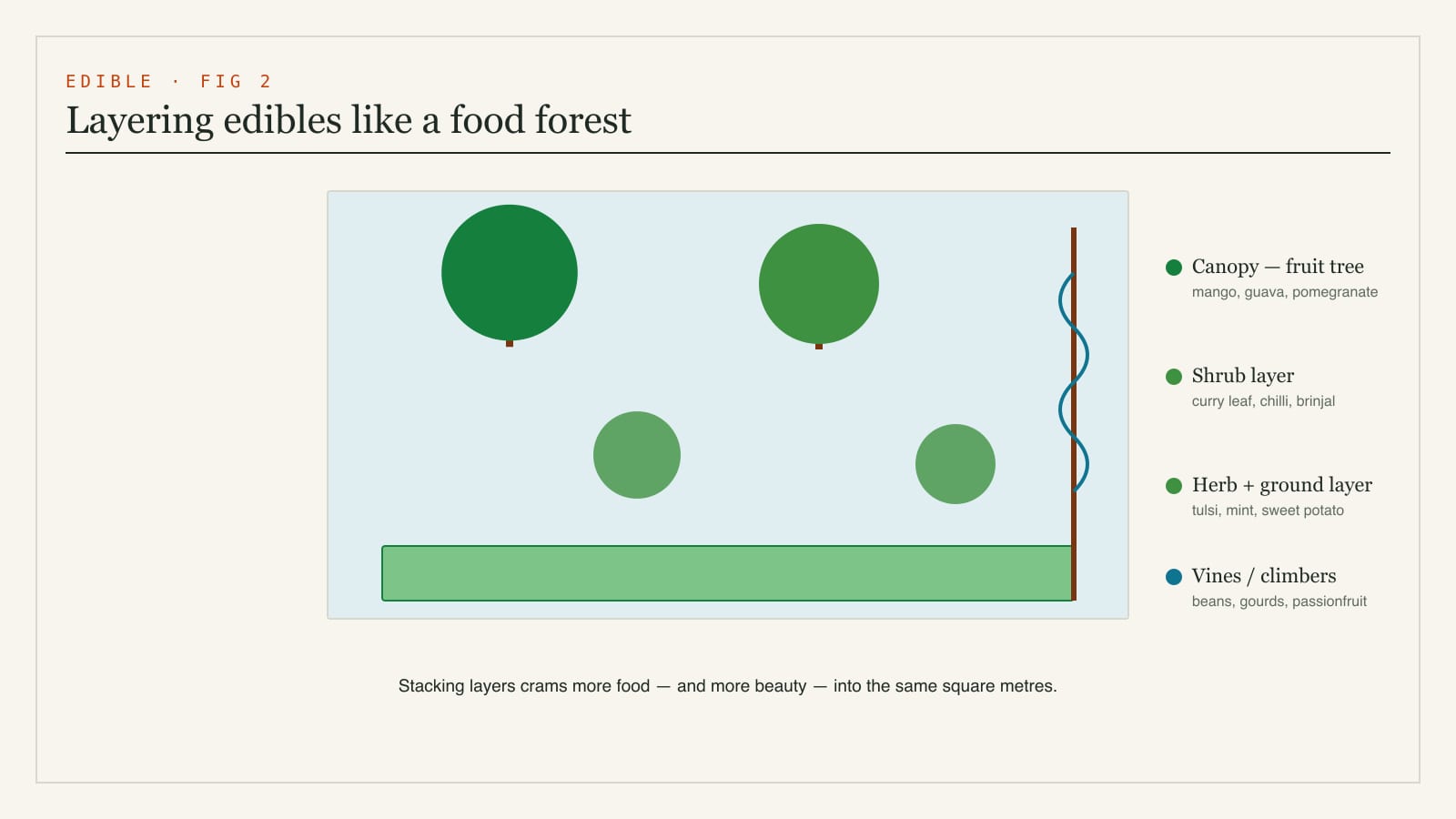
- Canopy — a fruit tree (mango on a large plot, guava or custard apple on a small one) giving height and dappled shade.
- Shrub layer — pomegranate, curry leaf, chilli, brinjal filling the mid-height.
- Herb layer — tulsi, mint, coriander, ajwain at knee height, soft and aromatic.
- Ground cover — sweet potato, pumpkin trailing, or a carpet of nasturtium spilling colour.
- Vines — passionfruit and edible gourds climbing through the canopy edge or over a screen.
Layering does double duty. Visually, it removes the bare-soil look that makes vegetable beds feel raw, because something is growing at every height. Ecologically, this density is exactly what the Biophilic Landscape Design approach calls for — habitat, pollinators, a garden that hums. The layered edible garden is biophilia you can eat.
Designing for year-round looks
The hardest design problem with edibles is honesty about time: a vegetable is at its best for a few weeks, then it is harvested, and then there is a gap. An ornamental shrub simply sits there looking like a shrub for years. To keep an edible landscape looking good in every season, you design a backbone of permanent edibles and treat the seasonal crops as changing colour, the way a planted border uses bulbs and annuals.
- Evergreen backbone: curry leaf, lemongrass, tulsi, and fruit trees stay attractive year-round and hold the composition together.
- Seasonal colour: chillies, amaranth, brinjal and herbs come and go; plan for two or three of these "slots" that you replant, so there is always something cropping.
- Stagger the planting: rather than sowing a whole bed at once and having it all finish together, plant in waves so the bed never goes entirely bare.
Indian seasons help here. The monsoon and the cool post-monsoon months are generous, while the harsh peak of summer is when most leafy edibles struggle — which is precisely when the evergreen backbone and the fruit trees carry the garden's looks. Pairing this with the soil-moisture and mulching practices in Sustainable Water Management in the Landscape keeps even the seasonal layer looking lush through the dry months.
Colour, texture and structure with edibles
Once you stop thinking "crop" and start thinking "plant material", edibles become a rich design palette in their own right.
Colour. Edibles are not only green. Red and purple amaranth, the deep aubergine of brinjal foliage and fruit, the traffic-light range of chillies, the bright funnels of nasturtium and the electric blue of butterfly-pea flowers give you a full painter's box. Use them the way you would ornamental colour — repeat a colour through a border to tie it together, or set a hot block of amaranth against cool green for contrast.
Texture. This is where edibles genuinely outshine many ornamentals. The fine, fern-like delicacy of carrot and coriander foliage; the bold, glossy paddles of banana and the deeply lobed leaves of papaya and pumpkin; the architectural fountain of lemongrass — set fine against bold, matte against glossy, and the planting gains the depth that good design depends on.
Structure. Strong shapes anchor a garden. Papaya and banana give vertical, sculptural form; a standard-trained pomegranate or a clipped curry-leaf ball brings ornamental geometry; an arbour heavy with passionfruit creates an architectural event. These structural edibles are what stop the garden reading as a vegetable patch and let it read as a designed landscape — the same compositional logic that drives high-end planting in our Villa Landscape Design guide.
Small-space and balcony edible design
Most Indian homes do not have a sprawling plot; they have a balcony, a terrace, a narrow side-return, a few square metres of paving. Edible landscaping arguably matters more here, because every plant is on show and there is no back corner to hide the ugly ones.
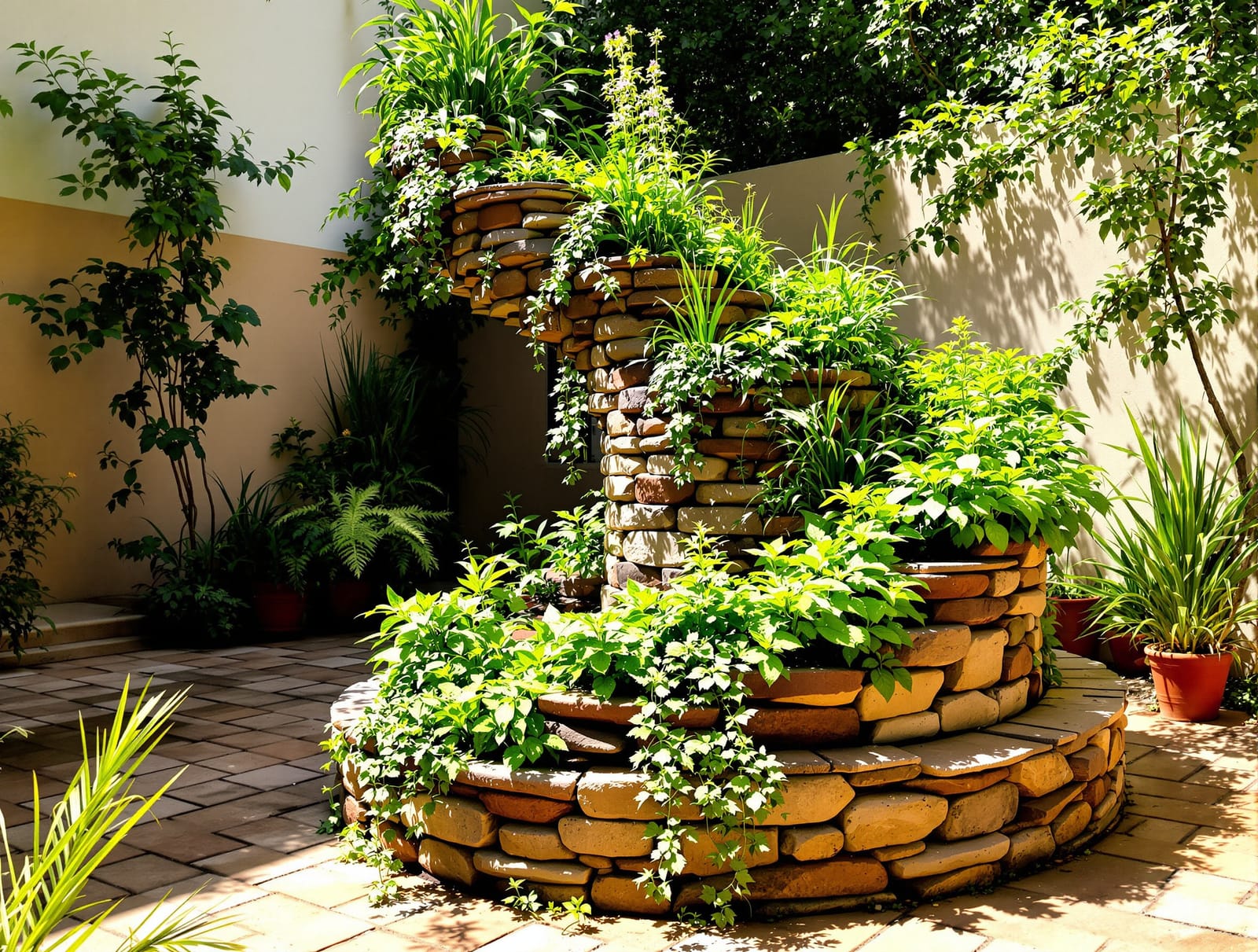
The herb spiral is the small-space showpiece: a low, coiled raised bed that packs many herbs into a tight footprint, with the dry, sunny top for rosemary and the moist base for mint and coriander. It is sculptural, it reads as a deliberate garden feature, and it puts the most-used kitchen herbs at arm's reach. On a balcony, the same logic scales down to a tiered stand of pots.
A few rules keep small edible spaces looking designed, not cluttered:
- Limit the pot palette. One material and two or three sizes. Mismatched buckets are what make balconies look like a nursery overflow.
- Go vertical. Wall-mounted pockets, a railing trough of cherry tomatoes, a trellis of beans or passionfruit — use the air, not just the floor.
- Choose compact, good-looking varieties — ornamental chillies, dwarf citrus, leafy greens, herbs — over sprawlers.
- Respect the rules. Many societies restrict railing-mounted planters and anything that drips onto the flat below; check your RWA bylaws and use drip trays. A balcony edible garden that floods the neighbour is a short-lived one.
For the wider question of using these green corners for rest and not just production, our Outdoor Wellness Spaces guide pairs naturally with a balcony herb garden — the scent of crushed tulsi and lemongrass is half the point.
Maintenance honesty: edibles change as you harvest
Here is the truth no glossy garden photo admits: an edible landscape looks different through the harvest, and you have to design for that. The day you cut the amaranth or pull the spent chilli plants, the border has a gap. A purely ornamental border never does this to you.
So design with the gap in mind. Keep the permanent, evergreen edibles as the visible structure so that harvesting a seasonal crop only opens a small, plannable hole — not a collapse. Plant in succession so a finished plant is immediately replaced. Accept that edible landscaping asks for slightly more attention than a shrub border: deadheading, replanting, staking, harvesting on time so fruit does not rot on the plant and spoil the look. Mulch generously to keep the soil covered and the bed reading as "planted" even between crops.
Done with that honesty, the trade is overwhelmingly worth it. You get a garden that is genuinely beautiful for guests and genuinely useful for the kitchen — colour, scent, structure and dinner from the same square metre of soil. That is not a compromise between a flower garden and a food garden. It is a better garden than either.
References & further reading
- Indian Society of Landscape Architects (ISOLA) — professional resources on Indian planting design and residential landscapes.
- ICAR – Indian Institute of Horticultural Research (IIHR), Bengaluru — research and varietal information on Indian fruit, vegetable and herb crops.
- Rosalind Creasy, Edible Landscaping (Sierra Club Books) — the foundational text on integrating food plants into ornamental gardens.
- Robert Kourik, Designing and Maintaining Your Edible Landscape Naturally — practical design-led edible landscaping.
- Ian H. Thompson, Landscape Architecture: A Very Short Introduction (Oxford University Press) — principles of composition, structure and planting design.
- Royal Horticultural Society (RHS) — guidance on ornamental kitchen gardens, herb spirals and growing edibles decoratively.
Export this guide
Related Guides — Deep-dive reading
Small Garden Design for Urban Homes
Make a tight city garden feel bigger — the space-expanding tricks, vertical greening, multi-function layouts and the right plants for small ground gardens
LandscapeDesigning for Views and Privacy
The site-level craft of capturing the good view while screening the neighbour's window three metres away — tuned for dense Indian plots.
Site PlanningThe Best Trees for Indian Homes
A research-grade guide to choosing and placing trees around an Indian home — the real cooling and clean-air numbers, the right species for shade, flowers, fragrance and fruit, and the placement science that keeps roots out of your walls and drains.
LandscapeRelated Tools — Try Free
Rainwater Tank Sizer
How big should your rainwater tank be? Computes annual harvest, recommended tank capacity in litres, water-bill savings, and payback — for 10 Indian cities.
RWH CalculatorCross-Ventilation Analyzer
Estimate airflow and air changes per hour (ACH) from room size, window areas, layout, and local wind — with NBC 2016 Part 8 compliance check.
Ventilation CalculatorGarden Planning Toolkit
Get a tailored garden plan — planting layers, Indian species, features and a checklist — from your climate, space, sun and goals.
Planner